In March 1947, Herbert Graf, director of the NBC Opera, expressed his skepticism of direct broadcasts from the stage: “Telecasts from opera houses, seem, for technical reasons, to belong to the future, and even if this should become technically possible, it is doubtful whether such television broadcasting of opera will be satisfactory on the screen.”Footnote 1 Jump forward seventy-odd years and it appears as though the telecasts of the future have finally arrived. Although frequently compared to film or radio, the Live in HD broadcasts of the Metropolitan Opera are also a clear successor to early experiments in televising opera, particularly with their capitalization of the intimacy of the camera and the immediacy of the event.Footnote 2 But this form of broadcasted opera was hardly preordained; the presentation of opera on television—and its relationship to live performance—was in flux throughout the 1940s and 1950s.
Like previous attempts to make opera part of American life, the central question facing early television producers was whether to change the performance of opera to accommodate an American audience or to educate viewers to accept the style of opera performance found in the opera house.Footnote 3 This question was further complicated by the early aesthetics of the small screen. Part of the problem is that characteristics supposedly inherent to television seemed to be diametrically opposed to opera, particularly in its grander iterations: television's quick pacing did not suit the reflective time of arias, the camera close-up distorted singers’ large gestures and captured the facial contortions of singing much too accurately, and even the mode of watching live television at home could run contrary to the sense of event at the opera house.Footnote 4 In short, although early television may have held great promise in bringing opera into the homes of American viewers, its very traits were often thought to have doomed television opera from the start.Footnote 5
This article takes a different approach. Instead of focusing on the supposed incompatibility of early television and opera, I explore how broadcasters sought to initiate new audience members into the experience of opera by personalizing the perspectives that they were meant to take with them into the opera house. In particular, I examine how the pedagogical aims of opera broadcasting relied upon televisual values, namely the intimacy and immediacy, of the small screen. And yet, the very exploitation of these traits could lend itself to re-inscribing opera as a grand art form. Examining the pedagogical undercurrents of early broadcasts, then, reveals the persistent American fascination with the grandness of opera, even as broadcasters sought to remake it through the lens of the camera.
The locus of my study is NBC: not only did it support a long-running opera series, the NBC Opera Company (1949–64), but it also hosted a number of projects designed to educate audiences about opera, both on and off screen. First, I examine how the emergence of opera on television was shaped by competing visions in the late 1940s and early 1950s of how to best exploit television's potential. I then compare the pedagogical principles underpinning two projects: Leonard Bernstein's “What Makes Opera Grand?” on Omnibus (Reference Bernstein and Robbie1958) and the visits of the NBC Opera Company to Saint Mary's College (South Bend, Indiana) in 1956 and 1957. Finally, I suggest a few ways that these strategies have continued in the Metropolitan's Live in HD series. Ultimately, I argue that, even though early broadcasts of opera on television may not have ensured a future for the art form on the small screen, they helped to set the terms for the revival of opera on screen today.
Early Experiments
From its earliest days, opera on television has been connected to grand opera performance.Footnote 6 Whether broadcasting operas straight from the stage or rejecting the opulence of the opera house for the studio, opera on television was judged by how closely it hewed or diverged from the stereotypically lavish opera production at a major opera house, usually as represented by the Metropolitan Opera. As opera on television developed throughout the 1940s and early 1950s, two distinct positions emerged: those in favor of a “made-for-television” studio approach and those who preferred direct telecasts from the stage. Onto these camps were projected a number of ongoing debates about opera performance, particularly pertaining to language, with the former pushing for opera in English and the latter promoting opera in the original language and performance style, with studio productions incorporating more naturalistic gestures and typecasting and the telecasts preserving the grander style of acting from the opera house. Regardless of their position, proponents argued that their form of opera was best suited to television: small-scale opera performance was said to fit the intimate screen in the viewer's living room, whereas telecasts capitalized upon the liveness of early television in transporting images and sounds from the opera house in real time.Footnote 7
Leading the “made for television” brigade was Graf, a Viennese stage director who pioneered studio production at NBC in the mid-1940s. He argued that television could make opera more akin to popular dramatic art forms: “There is little doubt that today opera is on its way to becoming real, is narrowing the gap which has existed between operatic production on one hand and that of the legitimate stage and the movies on the other.”Footnote 8 To offer a more “realistic” production style, Graf advocated for typecasting (supplemented by microphones), built sets rather than painted backdrops, and the use of film snippets for crowd scenes.Footnote 9 And yet, despite or even because of this focus on visual realism, Graf frequently manipulated the music: he used prerecorded tracks to which singers lip-synched and relegated the orchestra to playing soft background music in the manner of Hollywood films.Footnote 10 He also replaced recitative with spoken dialogue and made cuts to the score to improve the dramatic pacing. Although Graf only produced a few broadcasts for NBC—abridged performances of Pagliacci, La bohème, Carmen, and The Barber of Seville—his studio approach set the standard for later presentations by opera groups, including the short-lived CBS Opera Television Theatre (1949–50) and the NBC Opera Theatre.Footnote 11
Not all critics, however, were equally enamored with the promise of studio production, particularly its treatment of music, with Irving Kolodin of the Saturday Review suggesting that “televised opera can best be realized musically as a by-product of Met performance.”Footnote 12 Initial attempts at relaying performances from the opera house, however, met with a number of challenges: in 1948, the ABC network televised Verdi's Otello from the Metropolitan Opera, but its broadcast was hampered by poor lighting, distant camera shots, and musically inexperienced camera operators.Footnote 13 Still, the prospect of opera live from the opera house captivated the imagination of critics, who marveled at how television might actually improve upon the experience of being there.Footnote 14 For instance, Jack Gould of the New York Times suggested that the Otello broadcast was most successful when “[it] broke away from the usual theatre conventions [and] caught the intimate details of facial expression and gesture with more faithfulness than could the human eye in the Metropolitan auditorium itself.”Footnote 15 Even though Gould acknowledged that some singers may need to refine their acting methods for the camera close-ups, he suggested that it was in “the exploitation of this quality of intimacy,” particularly its ability to “sharpen the emotional reaction,” that opera could be most successful on television.Footnote 16
Although ABC mounted two more relays from the Metropolitan Opera, a new focus on closed-circuit broadcasting and the costs of the broadcasts eventually led to their abandonment.Footnote 17 Still, grand opera continued to be of interest to broadcasters.Footnote 18 The greatest step forward came when the Metropolitan Opera teamed up with Theatre Network Television in the 1950s to offer two broadcasts direct from the stage to the movie theatre: it transmitted a performance of Carmen to twenty-seven cities in 1952 and an “opening night” potpourri of opera scenes to thirty-two locations in 1954.Footnote 19 Now on the big screen, these broadcasts were still described as “televised” performances and relied extensively on the vocabulary of film, particularly its fondness for close-ups, to showcase the “grandness” of opera.Footnote 20 As the New York Times put it, “it was as though each spectator had a front-row seat. There was the intimacy that one gets with television in the home and the size and clarity that one gets in the films.”Footnote 21
With these closed-circuit broadcasts, it seemed as though grand opera had finally hit upon a winning formula, one that would do justice to the large-scale art form but allowed for the intimacy and immediacy offered by television. However, although the 1954 broadcast raked in $62,000 in profits, it still struggled with many technical difficulties, leading to the cancellation of a proposed broadcast of The Tales of Hoffman and the end of the venture.Footnote 22 By the mid-1950s, telecasts from the stage had mostly disappeared from American airwaves and the full-length opera that remained was generally made in the studio.
Grand opera, however, continued to loom large over television: whether promoting or rebelling against it, opera presentations on the small screen reinforced the Metropolitan Opera's status as the nation's premiere opera house—and the de facto standard for opera performance. In what follows, I discuss how two contemporaneous NBC programs wrestled with the grandness of the art form in promoting opera. These initiatives embody the two “competing” camps of opera on television, with one seeking to defend the aesthetics of grand opera as presented at the Metropolitan and the other using the aesthetics of the studio to remake opera performance on stage. Although these efforts differed in their techniques, they both sought to capture and enhance the experience of opera using the vocabulary of television.
Television Makes Opera Grand
Grand opera performance took center stage in NBC's 1958 broadcast of “What Makes Opera Grand?” This show was featured on Omnibus, a series underwritten by the Ford Foundation that was dedicated to experimentation in the performing arts.Footnote 23 Omnibus had previously offered two condensed studio versions of Die Fledermaus and La bohème performed by Metropolitan Opera singers, but the 1958 program was different in that it was broadcast directly from the Metropolitan Opera house, emptied of its patrons. Starring Leonard Bernstein, “What Makes Opera Grand?” built upon the conductor's previous appearances on television: he had been twice featured on Omnibus and he regularly hosted the CBS Young People's Concerts with the New York Philharmonic.Footnote 24
Like other pedagogical programs on Omnibus, “What Makes Opera Grand?” does not stage a whole work but rather spends most of its time explaining the art form. Adopting an inclusive tone, the program declares that it wishes to convert new audience members, those “people who may still think of opera as a formidable figure of fun, as the mother-in-law of the arts.”Footnote 25 To help make the art form more accessible, Bernstein claims that the grandness of opera was not to be found in the trappings surrounding it—“that opulence, those furs and diamonds” most associated with it—but rather in the ways that the music “magnifies and crystallizes human emotions.”Footnote 26 To this end, Bernstein proposes to put the art form under a microscope, dissecting specific arias and scenes performed by the Metropolitan Opera singers and orchestra to show how music elevates drama to new heights.
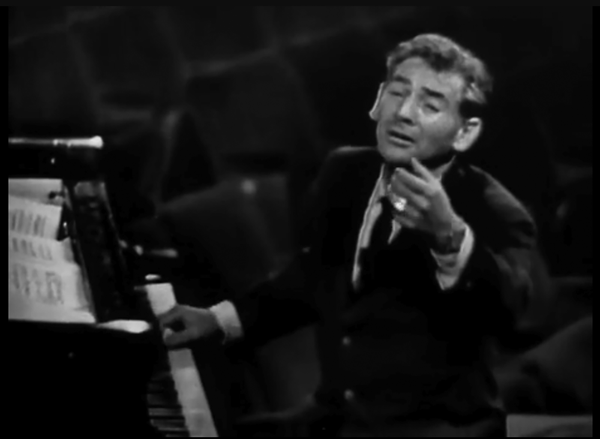
Similar to other programs that put the conductor front and center, much of the appeal of “What Makes Opera Grand?” relies upon the creation of a personalized relationship between the viewer and Bernstein.Footnote 27 With his casual and self-assured manner, Bernstein addresses the viewer directly, explains operatic characters in contemporary terms—he describes the main characters from La bohème as “Greenwich Village types”—and even acts out operatic scenes at the piano. These shared intimacies between viewer and conductor are further underscored by the camerawork, which frequently concentrates on Bernstein and brackets the Metropolitan Opera orchestra and cast off-screen. In Figure 1, Bernstein demonstrates how Mimì's music in La bohème, with its many rests and falling intervals, indicates that she is sick. The camera closes in on Bernstein as he sings through Mimì's line and mimics her gasping and shortness of breath at the piano. In this way, the “secrets” of the music of opera are disclosed, not in a grand manner on stage but through direct explanations from Bernstein to the viewer.
Leonard Bernstein acting out Mimì's musical line at the opening of act 3 of Puccini's La bohème, Omnibus: What Makes Opera Grand? (March 23, Reference Bernstein and Robbie1958).

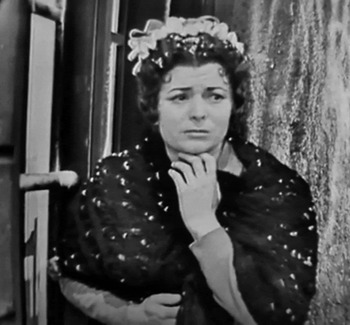
Key to Bernstein's definition of opera's grandness is music's emotional directness, the way in which song can reveal the all-consuming nature of human passions. He argues that music operates through “sheer immediacy of impact,” as it doesn't “have to pass through the censor of the brain before it reaches the heart,” but is a “direct hit.”Footnote 28 This explanation borrows the terms of television—especially its prized immediacy, which distinguished it from film in the 1950s—to underscore audience members’ supposedly unhampered understanding of music. Of course, these kinds of immediacy are slightly different: the immediacy of early television was predicated on its liveness, the fact that viewers were watching the performance in real time, whereas the immediacy of which Bernstein speaks has to do with an emotional appeal, the belief that music can affect the viewer more directly than words. But in “What Makes Opera Grand?” the distinction between these kinds of immediacy is blurred: although Bernstein argues that the music in opera is not dependent on cerebral understanding, the broadcast relies heavily on visual techniques designed to appeal to the viewers’ emotions in real time. For example, in staging act 3 in La bohème when Mimì overhears Rodolfo's confession to Marcello that she is dying, the camera zooms in on Mimì's face (Figure 2). Her reaction to this news is documented in great detail, with her face crumpling as she learns of her fate. According to the logic of early television, the close-up of her face offers access to her emotions and thoughts, allowing the screen to bypass lengthy monologues,Footnote 29 but it also provides a visual manifestation of the immediacy of impact that Bernstein claims is conveyed by the music.
Mimì (Marcella Pobbe) reacting to news of her illness in act 3 of Puccini's La bohème in Omnibus: What Makes Opera Grand? (March 23, 1958).

Such visual representations were particularly important in “What Makes Opera Grand?,” as the opera excerpts were performed in a foreign language. In defending the original language as part of the “grandness” of opera, Bernstein dismissed the necessity of understanding the text, suggesting that “the highest state that opera can reach [is] where the music is so communicative that the merest general knowledge of the dramatic action is enough to give you the key to a rich enjoyment of the work.”Footnote 30 But this argument is weakened by the program's decision to preface each sung excerpt with a spoken version acted out in English by a separate cast.Footnote 31 By contrasting the spoken version with the sung one, Bernstein aimed to showcase the ways in which music makes a scene grand, but this technique can also act as a crutch, undercutting the supposed transparency of musical communication.
A similar argument could be made about the use of close-ups: even as they may help to create the sense of directness that Bernstein claims is at the heart of opera, they are necessarily compensatory, as if to make up for the tinny sound of the music through the television's speakers or the new viewers’ lack of musical background. As noted in the reviews of earlier telecasts from the opera house, these televisual effects inadvertently acknowledge the ways in which television can actually improve the experience of watching grand opera, namely by sharpening the emotional response.Footnote 32 But if operatic music was as direct and accessible as Bernstein claimed, then it would seem as though viewers would not need this additional visual cue—or even Bernstein's explanations. This pedagogical trick conceals a contradictory impulse: it makes music's effects more visible at the same time that it encourages new audience members to enter the opera house where no such televisual cues would be on offer.
Ultimately, then, Bernstein may promote a purely musical understanding of grand opera, but the program achieves this “grandness” by transforming opera into televisual terms. At the end of “What Makes Opera Grand?,” Bernstein argues that the purpose of grand opera is not to become more like the world that Americans already inhabit but rather to allow viewers entry into a world apart: “And so a new world is created for us. Any great work of art is great because it creates a special world of its own.”Footnote 33 In describing grand opera performance as a “special world of its own,” Bernstein is content to keep the main pillars of opera performance—grand gestures and foreign language—in place. But, in order to convince audience members to enter into this world and accept opera in all of its grandeur, the program seeks to make the art form more relatable through the intimacy and immediacy of the screen. If the answer to “What Makes Opera Grand?” is the way in which music elevated the emotions of drama, this effect is to be made perceptible through television itself.
Promoting Opera Off Screen
Whereas the Omnibus program promoted opera on the small screen, another network initiative, the NBC Opera Company, sought to educate audiences about opera off screen. This touring company was an offshoot of the NBC Opera Theatre, a series of studio-made opera productions on television. Defined in opposition to the Metropolitan Opera, this company pushed for a more intimate form of English-language opera performance that producer Samuel Chotzinoff and artistic director Peter Herman Adler believed would attract a large American following if transferred to the stage.Footnote 34 This belief was put to the test when the company embarked on a nine-week, fifty-city tour across the country. I have written about this project and tour elsewhere; for the purposes of this essay, I would like to focus on the pedagogical function and reception of the performances at Saint Mary’s College, a small Catholic women’s school run by nuns in South Bend, Indiana.Footnote 35
From the outset, the NBC Opera Company's reception was molded by local preconceptions of what opera was—and specifically how grand it ought to be. Despite the company's origins in the studio, its appearance in South Bend was frequently described as “grand opera” in the local press.Footnote 36 (The press's emphasis on the grandness of the event of opera can be contrasted with reporters’ accounts of the stage performances, which were generally lauded for their intimacy.)Footnote 37 This characterization was a reflection of the cultural aspirations of the town and the promise that reporters saw for spreading live opera performance beyond the big cities.Footnote 38 Brimming with excitement, members of the press and of the college commended the network for bringing opera to South Bend and speculated that opera could become for Saint Mary's what football was for the nearby University of Notre Dame.Footnote 39 The “grand” occasion also received attention from the political class: city and state dignitaries attended the opening night and, when the company returned in 1957, President Dwight Eisenhower and Vice President Richard Nixon sent their congratulations by telegram.Footnote 40 Although Chotzinoff claimed that the NBC Opera wished to “take the ‘grand’ out of ‘grand opera,’” opera's grandeur—defined here by its elite status and spectacle—was more of a lure than a deterrent for South Bend.Footnote 41
At the same time, the town's response to the premiere seemed to be modeled on what they had seen on screen, with one Saint Mary's press release boasting that “Hollywood could take lessons from South Bend for festive openings. As television and newsreel cameras whirred, press photographers vied for ‘good angles’; all of which was abetted by several search lights playing about the autumn sky.”Footnote 42 Much like earlier telecasts from the Metropolitan Opera, the grandeur of opera was emphasized at every turn. The community gave the company a key to the city, greeted the opera singers with a band, and formed a “parade of stars” that one press release compared to the annual showing at La Scala in Milan.Footnote 43 Thus, despite the NBC Opera Company's own calls to break away from a “grand” conception of opera, the premiere took on all of the external trappings that Bernstein tried to distance opera from in his Omnibus program.
Beyond the pomp of opening night, the NBC Opera Company sought to educate a new audience to accept its style of live opera performance. Working together with Saint Mary's College, the NBC Opera Company opened up its dress rehearsals of The Marriage of Figaro to 5,200 high school and college students within fifty miles of South Bend.Footnote 44 Although the NBC Opera Company general manager Chandler Cowles cautioned students not to expect a perfect showing, it seemed like they delighted in the errors, as they underscored the immediacy of the performance.Footnote 45 Indeed, as 1950s television producer Jan Bussell noted, it is this very sense of immediacy that made early television so effective: “the consciousness that it is all happening now this minute, that one is witnessing actual creation—that might even go wrong—adds tremendously to the feeling that one is a part of it, that it is something personal between oneself and the artist.”Footnote 46 Now seen in “real life,” the NBC Opera Company's rehearsals offered a “heightened” form of immediacy. As the South Bend citizens committee reported, “the idea of seeing mistakes made and remedied by these operatic artists seemed to add to the charm and excitement of each performance” for the student audiences.Footnote 47
Such statements revealed the extent to which a live performance was no longer sufficient in itself to create immediacy. Like earlier intermission features in telecasts from the Metropolitan, students’ and teachers’ participation was now cultivated through “behind the scenes” activities: they were permitted to slip into chorus rehearsals, examine costumes, and handle production materials in the props room. In 1957, students were even invited to participate in the making of opera when the network returned to establish an opera festival at Saint Mary's College. Centered on the NBC Opera Company's performances of La traviata and Madama Butterfly, this week-long festival offered workshops and lectures for students from seventy-eight Midwestern colleges and high schools. Featuring apprenticeships in performance, stagecraft, and costuming, the festival enabled students to put on opera scenes under the tutelage of NBC's own staff. All of this contributed to the excitement surrounding the performances, with one student commenting that “even the slightest knowledge of ‘behind the scenes’ contributes immeasurably to the enjoyment of a work of art.”Footnote 48
Students also had the opportunity to meet cast members. Each singer was accompanied by a student “guardian angel,” production crew chatted with students offstage, and the costume designer led a meeting of the sewing class. As the company prepared to leave, the student newspaper reported that it was with “a real sense of loss”: “We had grown attached to them during their short stay.”Footnote 49
The question remains, however, as to how successful these pedagogical strategies were in appealing to and retaining a new audience for the art form. Although the NBC Opera Company's visits to Saint Mary's did attract a sizeable audience—counting the students, it was easily in the tens of thousands—NBC kept few records on the makeup of this audience and, apart from the open rehearsals for the students, it is impossible to know how much of the overall audience was new to opera.Footnote 50 Knock-on effects are similarly difficult to pin down. Following the NBC Opera Company's appearances, South Bend became an epicenter for regional opera beyond Chicago, as the Saint Mary's board had hoped: in the 1960s, the school hosted tours by the New York City Opera and appearances by noted soloists, such as Marian Anderson.Footnote 51 But this turn of events may have had more to do with the college's new auditorium—one of the few in the area—as well as the revival of interest in opera through nearby Lyric Opera of Chicago, than with the after-effects of the NBC Opera Company's visit on audience receptivity to opera.Footnote 52 This problem is not unique to NBC but endemic in studying the effects of television on audience outcomes: although scholars have credited new media with the emergence of a revitalized appetite for opera, as evidenced by the widespread growth in new opera troupes in the 1960s, it is impossible to ascertain how much of this was motivated specifically by television.Footnote 53 Rather, these early efforts show us how broadcasters thought that they could educate a new audience to accept the art form by offering new ways to connect with opera. As such, they are valuable insofar as they show what was thought to be appealing—and lacking—in grand opera for a twentieth-century viewership.
Up Close and Personal at the Metropolitan Opera
In 1953, Graf had prophesied that television was to be opera's “saving angel”: “In all three forms—video transmission from the opera house, studio telecasts, and television films—television can become one of the most important factors in the organization of new American ways of operatic sponsorship.”Footnote 54 With the Metropolitan Opera facing financial challenges, proponents like Graf believed that television might bring the same influx of cash as radio had done in the 1930s.Footnote 55 The bright future predicted by Graf, however, did not come to pass. Faced with financial restructuring in the late 1950s, NBC folded its touring company and scaled back on the number of its television productions. Failed attempts to obtain advertising sponsorship, along with the death of producer Samuel Chotzinoff, led to the cancellation of the series in 1964.Footnote 56 Meanwhile, Omnibus disappeared from the airwaves in the early 1960s, thus further limiting the platforms for pedagogical introductions to opera on the small screen. This retrenchment was not limited to opera but extended across the performing arts, as the 1960s saw commercial broadcasters turn to popular, pre-recorded fare from Hollywood.
Recently, Metropolitan Opera General Manager Peter Gelb has taken a page out of Graf's playbook, suggesting that broadcasting can simultaneously save and improve upon the performance of grand opera.Footnote 57 Given the failure of opera to secure a foothold on television, one might ask why the Metropolitan Opera's Live in HD series would continue television's earlier strategies. One key difference here is the model of sponsorship: whereas NBC and Omnibus assumed an unsustainable “philanthropic” model of offering opera at the network's or the Ford Foundation's expense, the Metropolitan Opera Live in HD series has actually made money for the opera house, providing 12 percent of total revenues in 2015.Footnote 58 With falling ticket purchases, particularly in subscription packages, these broadcasting revenues have been of increasing importance, even as some critics have alleged that these gains have come at the expense of opera house ticket sales.Footnote 59
Beyond these financial considerations, I would argue that early televisual strategies became embedded in the language of broadcasting as it moved from the studio to the telecast from the stage. In the 1960s and 1970s, the same directors and conductors who had worked at NBC, notably Kirk Browning and Peter Herman Adler, came to define the style of broadcasting, as seen in the NET (National Educational Television) Opera studio productions and the Live from Lincoln Center telecasts from the stage.Footnote 60 Indeed, it seems as though early television's emphasis on intimacy and immediacy came to be how producers approximated opera-lovers’ heartfelt responses to the art form—the way in which opera seemed to speak to them in a direct and personal way—for a new viewership. As Browning explained, “you have to make the audience care, which involves a committed camera … [that] must represent music in visual terms.”Footnote 61 Remaking grand opera so that it is “up close and personal,” then, became synonymous with broadcasting it, whether on television or to the cinema screen.
Now in high definition, the legacy of this approach can be seen in the Metropolitan Opera's Live in HD broadcasts. Like the Omnibus broadcasts, the grandness of the emotions is often showcased in close-ups on the singers’ faces—particularly when they are not singing but reacting to one another—as if to compensate for the ways in which the movie house microphones flatten and render all voices the same size and scope.Footnote 62 In order to augment the participatory element, the broadcasts also incorporate roving camerawork and behind-the-scenes snippets, such as a tracking shot of the conductor walking from the green room to the podium. The Metropolitan Opera has even undertaken “off-screen” initiatives to personalize the grand opera house experience: much like the NBC Opera Company's visits to Saint Mary's College, they have opened up working rehearsals to New York schools and offered students in schools further afield the chance to meet artists in “video chats.” These strategies seem designed to satisfy audiences’ competing desires, offering the intimacy of personal connection while maintaining the “grandeur” of the opera event broadcast from the stage.
At the same time, all of this scaffolding can lead back to the privileging of the opera house as the site of the “real opera.” As James Steichen has noted, the Live in HD series is not just selling the broadcasts, but it is actually in the business of staging the Metropolitan Opera itself. Footnote 63 This was apparent during the intermission of a recent Live in HD broadcast of Gounod's Roméo et Juliette when the hostess, Ailyn Pérez declared, “As exciting as it is to watch on the movie screen, it is even more exciting live” and invited the moviegoers to come to the opera house.Footnote 64 The caveat, of course, is that the experience offered by these broadcasts is markedly different: with the close-ups, behind-the-scenes shots, and intermission features, viewing the broadcasts is hardly akin to the experience of watching a performance in the opera house—nor should it be.Footnote 65 Rather, it seems as though the Metropolitan Opera's Live in HD series may have been too successful. Critics such as Alex Ross have warned that remaking grand opera for the camera may lead to its failure on stage, while journalists have worried about the lack of subscribers to the Metropolitan Opera house. Recent reports have even suggested that the Metropolitan Opera may be cannibalizing its own audience, as well as those of regional opera companies.Footnote 66
Ironically, then, although early television's emphasis on intimacy and immediacy has been thought to be a barrier to screening opera on television, it now seems like these same qualities may threaten the viability of the stage performance itself. And yet, even as the broadcasts have reached millions of people, it remains to be seen whether they are able to create a new audience for the live performance of the art form.Footnote 67 Only time will tell what the future holds for the audience for live opera performance. But, at least for the time being, the Live in HD broadcasts bear witness to the enduring and particular combination of grandeur and intimacy that opera on television pioneered.