Introduction
Today most European consumers feel concerned by the welfare of the animals supplying the food products they buy, especially meat (European Commission, 2005 and 2007). Fear reactions are particularly marked at the end of the animals’ life when they are transferred for slaughter. During this process, they are separated from their penmates, loaded into trucks, transported and unloaded, mixed with other animals, led through corridors and exposed to noise and the smell of blood, etc. before being stunned and killed. Special attention has been paid to slaughter conditions by the European Commission (SCAHAW; European Commission, 2002), the Council of Europe Committee of Ministers (1991) (Recommendation No. R(91) seven of the Committee of Ministers to members States on the slaughter of animals) and the Office International des Epizooties (Bayvel, 2004), in order to improve animal welfare. Stress reactions before slaughter can also impair the acidification of carcasses and result in poor meat quality (Warriss, Reference Warriss1990). It is thus important to improve the welfare of animals at the end of their lives not only to meet societal concerns, but also to ensure best meat quality.
Practices involving human presence, such as loading animals into trucks, can generate stress in cattle (Gregory and Grandin, Reference Gregory and Grandin1998). Cattle’s reactions to handling depend on their level of fear of humans (Hemsworth, Reference Hemsworth2003). In general, animal reactivity to humans is greatly influenced by farmers’ behaviour towards them, as shown in pigs (Hemsworth et al., Reference Hemsworth, Barnett and Hansen1986; Hemsworth and Barnett, Reference Hemsworth and Barnett1991), heifers (Breuer et al., Reference Breuer, Hemsworth and Coleman2003) and calves (Lensink et al., Reference Lensink, Boivin, Pradel, Le Neindre and Veissier2000b). In livestock, rough contacts increase the readiness of animals to display fear responses to humans, whereas gentle contacts reduce them. In several production contexts, the farmer’s behaviour towards animals is correlated with attitudes towards them and towards farming work in general (cows: Hemsworth et al., Reference Hemsworth, Coleman, Barnett and Borg2000; Waiblinger et al., Reference Waiblinger, Menke and Coleman2002; pigs: Hemsworth et al., Reference Hemsworth, Barnett, Coleman and Hansen1989; calves: Lensink et al., Reference Lensink, Boissy and Veissier2000a). Farmers with positive attitudes towards animals are more inclined to have gentle rather than rough contact with animals (Lensink et al., Reference Lensink, Boissy and Veissier2000a).
In Europe, although some bulls are finished on the farm where they were born (i.e. in a breeding-finishing unit), most are transferred after weaning from their original breeding farm to a unit specialized in finishing. Thus they experience handling and transport at this stage. Prior experience of handling may further reduce the reactivity of animals towards humans (Boissy and Bouissou, Reference Boissy and Bouissou1988). In addition, bulls are often mixed at the beginning of finishing, and this can also increase their responses to external events (Mounier et al., Reference Mounier, Veissier, Andanson, Delval and Boissy2006c).
We hypothesized that (1) in beef production, farmers’ positive attitudes and behaviour, low responses of animals to handling and low carcass pH were linked and (2) a high carcass pH might also result from prior finishing conditions such as social mixing and lack of handling. We conducted a survey on several commercial farms (breeding-finishing units and specialized units) to test our hypotheses, while controlling for conditions of transfer of animals to slaughter. The present study was run on the same set of farms and animals as a previous study that compared attitudes between specialized finishers and breeder-finishers and analysed the link between these attitudes and production results (Mounier et al., Reference Mounier, Colson, Roux, Dubroeucq, Boissy, Ingrand and Veissier2006a).
Material and methods
Subjects
A survey was conducted on 20 farms, run by one farmer each and affiliated to the same beef producers’ organization (Coopérative Inter-départementale Aube Loiret Yonne Nièvre (CIALYN)) and based in the centre of France. In all, 10 of the farms were breeding-finishing units and 10 were units specialized in finishing. In all, 32 groups of Charolais bulls (442 bulls in all) were followed; 10 groups were in breeding-finishing units and were composed solely of bulls born on that unit that had never been mixed with other animals (breeding-finishing unit, unmixed bulls). Eleven groups were in breeding-finishing units but comprised both bulls born on the farm and bulls from other breeding units; they were thus mixed at the beginning of finishing (breeding-finishing unit, mixed bulls). Another eleven groups were composed of bulls that had been transported from breeding units to the beef producers’ organization, where they were mixed with other bulls before being transported to a finishing unit (specialized finishing unit, mixed bulls). Group sizes ranged from 8 to 24 bulls and were 14, 13 and 18, respectively, on average for unmixed bulls finished in breeding-finishing units, mixed bulls finished in breeding-finishing units and mixed bulls finished in specialized finishing units. The finishing period began after weaning, which occurred at 9 months of age on average, and lasted for 9 months. Transfer from the breeding to the finishing unit took place between weaning and the start of finishing.
During finishing, all the bulls were loose-housed in semi-open barns with straw bedding and equipped with troughs with no feeding barriers. Space allowance ranged from 3.3 to 9 m2 per bull. The bulls were fed a complete ration of sugar beet pulp and concentrates ad libitum.
The bulls were transported to the slaughterhouse when they weighed 731 ± 42 kg. For each group, at least five bulls were transported together. The transport lasted between 30 min and 2 h, with no stops in other farms before reaching the slaughterhouse. The space allowance in the truck was about 2 m2 per bull. At their arrival at the slaughterhouse, the bulls were led to individual stalls through a corridor equipped with a restrainer to prevent mounting. They were given water and were housed in these stalls for a maximum of 2 h before being slaughtered. The bulls were never mixed with stranger bulls, either in the truck or at slaughter.
Measurements
Each farm was visited during the last 6 weeks of the finishing period to assess the farmers’ attitudes towards bulls and record their behaviour with their animals. Responses of the bulls to handling were recorded when the bulls were loaded into the truck. Carcass pH was measured at slaughter. The measurements are detailed below.
Farmers’ attitudes towards bulls and working with bulls
The 20 farmers were invited to fill in a questionnaire that aimed at assessing
(1) their beliefs about success factors in finishing (12 questions);
(2) their job satisfaction (7 questions);
(3) their beliefs about the sensitivity of bulls (14 questions); and
(4) their attitudes towards contacts with bulls (5 questions).
The questions were identical to those used by Mounier et al. (Reference Mounier, Colson, Roux, Dubroeucq, Boissy, Ingrand and Veissier2006a). Briefly, the questions were formed as follows:
(1) ‘In your opinion, what is the importance of x for the success of finishing?’ where x included factors such as ‘bull genetics’, ‘housing’, ‘farmers’ contacts with the bulls’, or actions such as ‘observing the bulls’ or ‘speaking to the bulls’;
(2) ‘How much do you enjoy x?’ where x included actions such as ‘feeding bulls’ or ‘administering healthcare to bulls’;
(3) ‘Do you agree with x?’ where x included statements such as ‘bulls are savage’ or ‘bulls are difficult animals’; and
(4) ‘How often do you do x?’ where x included actions such as ‘speak to the bulls’ or ‘touch the bulls’.
Answers were given on a psychometric line, 10-cm long with no indentation, with left and right ends corresponding to extreme positions (e.g. ‘fully disagree’ v. ‘fully agree’).
Farmers’ behaviour with bulls
To assess farmers’ behaviour toward their bulls, each farmer was asked to enter a pen holding bulls and to try to approach a bull designated by the observer to a distance closer than 1 m. At this stage, the reason given to the farmer for conducting the test was that we wanted to assess whether the presence of a person disturbed the bulls. The following farmers’ activities were recorded: entering the pen with or without an object (stick, electric prod), speaking softly or shouting, trying to touch the bulls or not and hitting a bull. Farmers often tried to approach and touch not only one but several bulls. The number of bulls that the farmer voluntarily approached and touched and the duration of the test were also recorded. Debriefing about the purposes of the study was conducted after study completion.
Observations during the loading of bulls into the truck for transport to the slaughterhouse
Bulls were loaded into the truck by the truck driver. During the loading the following variables were recorded: frequency of human interventions, pushing bulls with an object (stick, electric prod), bulls falling, bulls turning back and failed attempts to load the bulls. The time necessary to load the bulls, the distance from the pen to the truck, the presence of a corridor or ramp for leading animals to the truck, the number of bulls loaded and whether some bulls were left in the finishing pen after loading the target bulls were also recorded. Owing to the difficulties met working in commercial conditions, observations were completed for only 21 of the original 32 groups of bulls (nine groups finished on breeding-finishing units and never mixed, six groups composed of both bulls born on the farm and bulls that had been transferred and mixed before finishing, and six groups finished on a finishing unit, and thus all transferred after weaning, and mixed at the beginning of finishing).
Carcass pH
For each group of bulls, the carcass pH was taken on the bulls transferred to slaughter together and observed at loading (see above). If more than five bulls were transferred to slaughter, five carcasses were chosen at random for pH measurement. The pH was measured in the longissimus dorsi, using an ISFET silicon probe and a portable pH meter (IQ 200®; IQ Scientific Instruments Inc., Carlsbad, CA, USA), at 18 and 24 h post slaughter. Owing to technical problems, the pH was obtained for only 92 out of the 105 carcasses selected.
Statistical analyses
Statistical analyses were performed using the SAS statistical package (v. 8.1; SAS Institute Inc., Cary, NC, USA).
Preliminary calculations
For each of the four attitude categories or observations (farmers’ behaviour and reactions of bulls during loading), we ran a principal component analysis (PCA). Synthetic variables were constructed from PCA components that had an eigenvalue higher than 1. To interpret these components, we took into account variables with a factor loading (eigenvector) greater than 0.3.
• Attitude categories: Six synthetic variables were obtained from PCAs run on a larger sample of farms (24 farms, Mounier et al., Reference Mounier, Colson, Roux, Dubroeucq, Boissy, Ingrand and Veissier2006a). Briefly, four PCAs were run, one on each attitude category. They lead to six synthetic variables corresponding to ‘importance of behaviour for the success of finishing’, ‘job satisfaction’, ‘beliefs in bulls being sensitive to humans’, ‘beliefs in bulls being difficult animals’, ‘positive attitude towards gentle contacts with bulls’ (e.g. touching the bulls) and ‘positive attitude towards rough contacts with bulls’ (e.g. striking the bulls) (see Mounier et al., (Reference Mounier, Colson, Roux, Dubroeucq, Boissy, Ingrand and Veissier2006a) for detailed explanations).
• Farmers’ behaviour with bulls: The PCA on the behaviour of the farmer gave one component with an eigenvalue of 2.1 accounting for 43% of the variability in the seven original variables. This component was loaded by: ‘speaking softly’ (eigenvector = 0.50), ‘number of touched bulls’ (eigenvector = 0.50) and ‘number of approached bulls’ (0.49), and is thus labelled ‘gentle behaviour with bulls’. The higher the value on this component, the more gentle the farmer’s behaviour was with the bulls during the test.
• Observations during loading of the bulls in the truck for transport to the slaughterhouse: The frequencies of all events recorded during loading and the time necessary to load the bulls into the truck were divided by the number of bulls loaded. The PCA run on these data gave one component with an eigenvalue of 2.2 and accounting for 44% of the initial variability. This component was loaded by: ‘frequency of intervention with an object’ (0.60), ‘frequency of bulls’ turning’ (0.47), ‘attempts to load the bulls’ (0.45) and ‘time necessary to load a bull’ (0.44), and is thus labelled ‘loading score’. A high ‘loading score’ indicates that the loading of the bulls was difficult.
Analyses of links between components
For farmers’ behaviour with bulls and the observations during loading, the group was used as the statistical unit. For carcass pH, each bull was considered as a statistical unit, as it was taken as having specific past experience (e.g. transfer from a breeding to a finishing unit), and individual data were available. Each farm is described in the models by the farmers’ attitudes.
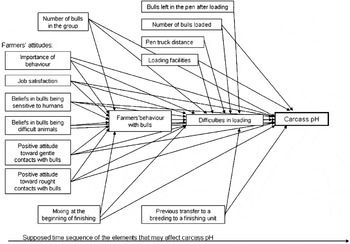
An initial model was constructed according to our hypotheses (see Introduction); this model is summarized in Figure 1. Path analyses were used to test associations between factors. Path analysis is a multiple regression technique that enables an assumed time sequence of events to be taken into account. The explanatory variables are introduced into the model according to this time sequence, and remain in the model to explain variables occurring further in that time sequence. The links between each variable and variables that correspond to processes occurring earlier in time (regressors) are thus analysed.
Model of hypotheses for the path analysis. The explanatory variables were introduced into the model according to a supposed time sequence, and remained in the model to explain the further variables entered in. Two explanatory variables (‘distance between the pen and the truck’ and ‘bulls left in the pen after loading of the target bulls’) were introduced only once to explain the reactions to loading, and did not stay in the model thereafter because of their specific effect on loading. ‘Mixing at the beginning of fattening’ and ‘transfer from a breeding to a finishing unit’ were assimilated to binary variables with two possible values (0/1). The conditions of transfer to slaughter per se (e.g. duration of journey) were not included in the model because they were standardized for the purpose of the present survey.

The explanatory variables to analyse farmers’ behaviour with bulls were the six synthetic variables derived from the PCA on farmers’ attitudes, the number of bulls in the group and social condition of finishing (mixed v. unmixed at the beginning of finishing). The additional explanatory variables to explain the loading score were the farmers’ behaviour with bulls, the number of bulls left in the pen after loading, the distance between the pen and the truck, the loading facilities, the number of bulls loaded and whether bulls already experienced a transfer by truck from the breeding to the finishing unit. Two explanatory variables (‘distance between the pen and the truck’ and ‘number of bulls left in the pen after loading’) were introduced only once to explain the reactions to loading, and did not stay in the model thereafter because of their specific effect on loading. Loading score was added as explanatory variable to analyse the carcass pH.
To run such analyses, ‘mixing at the beginning of finishing’ and ‘whether or not there was prior transfer from breeding to finishing unit’ were assigned to binary variables with two possible values (1/0). The stepwise procedure was chosen: the regressors were progressively introduced, the best predictor entering the regression equation first. Variables associated with a P value smaller than or equal to 0.20 were included in the model. They were excluded if their P value exceeded 0.10 after later variables had been introduced. Results are expressed in terms of proportion of variability explained (R 2), regression coefficient (β), its standard error (s.e.(β)), the ratio of variance (F) and probability (P). Statistical significance was set at P < 0.05 and tendency at P < 0.1.
Results
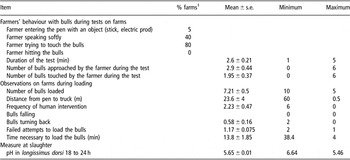
Mean values, s.e. and minimum and maximum values for quantitative measurements and % of farms for qualitative measurements are presented in Table 1. Descriptive statistics on attitudes are not reported in the present paper but in Mounier et al. (Reference Mounier, Colson, Roux, Dubroeucq, Boissy, Ingrand and Veissier2006a).
Descriptive statistics on data collected on farms and carcass pH. For qualitative data, proportion of farms out of the 20 observed is shown, and for quantitative data, mean ± s.e., minimum and maximum are shown

% observations meeting the criterion.
Farmer behaviour with bulls
The multiple regression analysis of farmers’ behaviour showed that it tended to be more gentle when the farmers had positive attitudes towards gentle contacts with bulls (R 2 = 14.6%; β = 0.47, s.e.(β) = 0.25; F = 3.58; P = 0.07).
Loading score
The multiple regression analysis of the behaviour of bulls showed that the difficulties met in loading the bulls into the truck tended to increase with the number of bulls loaded (R 2 = 16.3%; β = 0.14, s.e.(β) = 0.07; F = 3.50; P = 0.078) and with farmers displaying more gentle behaviour with their bulls (R 2 = 15.4%; β = 0.41, s.e.(β) = 0.21; F = 3.83; P = 0.067).
Carcass pH
Three carcasses were discarded from commercialization because of an end pH higher than 6. They were all of bulls that had been mixed either in a specialized unit (one bull) or in a breeding-finishing unit (two bulls). The multiple regression analysis of carcass pH showed that pH in the longissimus dorsi was higher for bulls that had not been transferred from a breeding to a finishing unit after weaning (R 2 = 24.1%; β = −0.053, s.e.(β) = 0.015; F = 5.72; P = 0.028). The pH tended to be higher when the loading was more difficult (R 2 = 12.1%; β = 0.017, s.e.(β) = 0.0065; F = 3.22; P = 0.09), when no corridor or ramp to lead the bulls to the truck was available on the farm (R 2 = 11.88%; β = −0.021, s.e.(β) = 0.009; F = 3.66; P = 0.074) and when the farmer did not display gentle behaviour towards bulls (R 2 = 9.09%; β = −0.013, s.e.(β) = 0.007; F = 3.18; P = 0.09).
Discussion
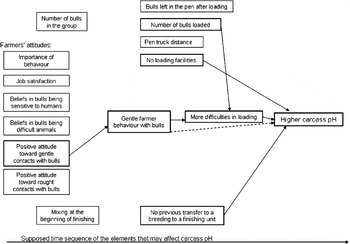
As we hypothesized, our study suggests that in beef bull production, farmers’ attitudes and behaviour, responses of animals to handling and carcass pH are linked. It also showed that carcass pH depended on finishing conditions. The results are summarized in Figure 2.
Summary of significant results of the path analysis to explain the pH of bull carcasses by prior elements (farmers’ attitudes and behaviour, conditions for finishing, loading for transport to slaughterhouse).

First, we observed that the behaviour of beef producers tended to be gentler when they had positive attitudes towards gentle contacts with the bulls. This result is consistent with the theory of Fishbein (Reference Fishbein1980) that human behaviour is accurately predicted by behavioural attitudes. This is also consistent with previous reports where farmer behaviour correlates with farmer attitudes in pig production (Hemsworth et al., Reference Hemsworth, Barnett, Coleman and Hansen1989; Coleman et al., Reference Coleman, Hemsworth and Hay1998), veal calf production (Lensink et al., Reference Lensink, Boivin, Pradel, Le Neindre and Veissier2000b) and dairy production (Waiblinger et al., Reference Waiblinger, Menke and Coleman2002). Nevertheless, our results do not suggest a close link between farmers’ attitudes and behaviour in beef bull production. In the production contexts cited above (pigs, veal calves and dairy cows), close human interactions with individual animals are frequent. For instance, dairy cows are milked twice a day, and in the study by Lensink et al. (Reference Lensink, Boissy and Veissier2000a) veal calves were individually fed by the farmer. In contrast, close contacts are rare in beef bull production: mechanical feeding reduces contact time (Rushen et al., Reference Rushen, Taylor and De Passillé1999) and group housing reduces human–animal interactions (Raussi, Reference Raussi2003). In addition, because fully grown bulls are dangerous animals, due to their size, horns and their tendency to express behaviour such as mounting, farmers generally avoid entering their pens. Waiblinger et al. (Reference Waiblinger, Menke and Coleman2002) found that correlations between farmers’ attitudes and behaviour with dairy cows were closer when the farmer personally collected the cows for milking than when contact with cows was limited. Our present results support a weak link between attitudes and behaviour with animals when the general management practice does not require close regular contacts with animals.
In the previous study done on the same farms (Mounier et al., Reference Mounier, Colson, Roux, Dubroeucq, Boissy, Ingrand and Veissier2006a), we found no difference between breeder-finishers and specialized finishers in their attitude towards gentle contacts with bulls. In accordance with this previous finding on attitudes, we found no difference in behaviour between the two categories of farmers when we asked them to approach and gently touch a bull in the present study. By contrast, in this previous study, specialized finishers tended to be more in favour of rough contacts with bulls than breeder-finishers. The behavioural test we performed did not show any difference in rough contacts, probably because no such contacts were required. Nevertheless, the behaviour of breeder-finishers and specialized finishers could have been different if the test had required handling.
Second, we observed that the difficulty in loading the bulls into the truck taking them to the slaughterhouse tended to be associated with farmers’ behaviour towards the animals. Surprisingly, the bulls from the farmers who were more ready to approach them when asked to enter a finishing pen (speaking softly, touching the animals) proved more difficult to load into the truck. This conflicts with previous observations made with calves by Lensink et al. (Reference Lensink, Raussi, Boivin, Pyykkonen and Veissier2001b), who found that less effort was needed to load calves that had received gentle contacts than calves that had received minimal contacts from their farmer. However, our results are in full agreement with those we obtained in another survey where 61 journeys of bulls from farm to slaughter were followed under non-standardized conditions (Mounier et al., Reference Mounier, Dubroeucq, Andanson and Veissier2006b). Finishing bulls are heavier and more dangerous than calves. Usually, with such large animals, handlers take advantage of the animal’s flight zone to direct them to a specific area (Broom, Reference Broom2003). During the loading of bulls into a truck, it is common practice to capitalize on the tendency of animals to avoid people when driving them to the truck, rather than interacting physically with them, as with calves. It seems that if bulls are too familiar with people and not at all afraid of them, then it may not be easy to load them into a truck. Thus in large animals such as beef bulls, overly positive behaviour with the animals during finishing may result in more difficulty in handling them. Alternatively, one could use means to handle bulls not based on their potential fear of humans. For instance, Grandin (2007) recommends driving bulls thanks to a long stick with plastics flags or ribbons attached to its end. In that case, bulls avoid this device instead of avoiding humans and it would not be necessary to limit previous positive contacts.
Difficulties in loading also increased with the number of bulls loaded. This increase was found even after dividing the loading score by the number of bulls loaded, suggesting that each bull was more difficult to handle when it was handled with its penmates. The presence of penmates can lower arousal in stressful situations (Boissy and Le Neindre, Reference Boissy and Le Neindre1990). This may result in animals being less inclined to avoid people and thus more difficult to drive into the truck.
Third, as expected by our hypothesis, we found that carcass pH may depend on previous finishing conditions. During transfer to the slaughter plant, animals can be exposed to various stressors such as fasting, changes in the familiar environment, handling (e.g. during loading and unloading) and novelty, causing physical exhaustion or psychological stress (Kent and Ewbank, Reference Kent and Ewbank1983; Grandin, Reference Grandin1997). Stress experienced before slaughter lowers the glycogen content of their muscles, which in turn limits the normal decrease in carcass pH (Hemsworth et al., Reference Hemsworth, Barnett, Hofmeyr, Coleman, Dowling and Boyce2002). The ability of animals to cope with stressors, and so the consequences on the carcass pH, may thus depend in part on their prior experience.
We found that 24% of the variability in carcass pH could be explained by prior transfer of bulls from a breeding to a finishing unit after weaning. Bulls that had not been transferred after weaning had stayed in the same farm from calving to the transfer to slaughter and had never been loaded into a truck, transported or unloaded from a truck. Hence they were probably less used to being handled and had never experienced transport, which was thus completely novel for them at the end of finishing. They may have been more stressed by transfer to slaughter, which may explain the lower carcass pH for these bulls. On the contrary, there seems to be some habituation to transport among bulls transferred after weaning, even when the two experiences of transport were several months apart. However, this hypothesis needs confirmation by further studies where stress just after transfer to slaughter is more accurately measured, especially by physiological measurements.
We found no link between mixing before finishing and carcass pH measured on the longissimus dorsi. This lack of effect of mixing on pH in the longissimus dorsi had been previously observed in commercial conditions (Mounier et al., Reference Mounier, Dubroeucq, Andanson and Veissier2006b) but conflicts with results obtained in a controlled experiment (Mounier et al., Reference Mounier, Veissier, Andanson, Delval and Boissy2006c). In this last study, the transport to slaughter was of short duration and the animals were handled with the least possible stress. The social buffering effect between unmixed bulls seems to be masked when the animals are in very stressful conditions and so does not influence carcass pH in commercial conditions.
The carcass pH tended to be higher when the farmer had not displayed gentle behaviour with the bulls during the approach test. Published reports demonstrate that gentle behaviour leads to less fear response in animals to the farmer (Hemsworth et al., Reference Hemsworth, Price and Borgwardt1996) and results in a lower meat pH, owing to lower negative response to handling during transfer to the slaughterhouse (Lensink et al., Reference Lensink, Fernandez, Cozzi, Florand and Veissier2001a). Our results suggest the same trend; the bulls were probably more afraid of handling when the farmer did not behave gently with them. However, the link between farmers’ behaviour and carcass pH seems to remain weak compared with that observed in pigs and calves. This may be explained by the low frequency of close contacts between farmers and animals in beef production as already suggested by Mounier et al. (Reference Mounier, Dubroeucq, Andanson and Veissier2006b).
The carcass pH also tended to be higher when loading of the bulls into the truck was more difficult and when no loading facilities were present on the farm. This result is consistent with those we obtained in the survey described above (Mounier et al., Reference Mounier, Colson, Roux, Dubroeucq, Boissy, Ingrand and Veissier2006a), where we found that loading into the truck was more difficult on farms not equipped with a corridor or a loading ramp. Bulls that were loaded using sticks or bulls that fell were clearly more stressed. Difficult conditions of loading are thus likely to lead to emotional stress and physical exhaustion and thus to a depletion of muscle glycogen content, which limits the extent of muscle/meat acidification.
Our results support our first hypothesis that farmers’ attitudes and behaviour, animal response to handling, and carcass pH are linked. First of all, our results suggested that the more positive the farmer’s attitude towards gentle contact with the bulls, the more gentle was the actual behaviour with them. Secondly, the bulls seemed more difficult to load into the truck when the farmer displayed gentle behaviour with them. Lastly, carcass pH tended to be higher when the farmer did not display gentle behaviour with the bulls.
Our findings also support our second hypothesis that carcass pH may depend on prior finishing conditions. The pH in the longissimus dorsi was higher for bulls that had not been transferred from a breeding to a finishing unit at weaning.
Our results showed weak links between farmers’ attitudes and behaviour, responses of animals to handling, and carcass pH. They need further confirmation on a larger sample of farms. Nevertheless, these links justify certain recommendations. To improve the welfare of bulls during transfer to slaughter and to ensure favourable carcass pH, farmers’ behaviour towards bulls must not generate unnecessary stress. One way to obtain this condition may be to encourage farmers to behave positively with their bulls each time close contacts are needed. This may limit the use of the flight distance of bulls towards people during handling. In that case, alternative handling methods should be recommended, such as the use of alternative driving aids.
Acknowledgements
The authors thank the farmers who took part in the study, the CIALYN technicians for their co-operation and B. Grosjean (CIALYN) for his personal involvement.