This article argues that income inequality influences perceptions of the legitimacy of income differences. This influence occurs in a counter-intuitive direction: individuals who perceive larger income differences in their society come to think of greater income differences as legitimate. The phenomenon occurs at least in part because perceptions of legitimacy are formed through a process of motivated social cognition: human beings are motivated to think of their social system as fair and, therefore, tend to attribute legitimacy to inequality. The finding that public opinion adjusts to increasing inequality can provide an empirical basis for future studies to assume that the public reacts to inequality with adapted expectations, not increased demands for redistribution. This alternative approach can open the door for new research on the factors that enable resistance to inequality (supplementing existing research on factors that prevent such resistance from occurring).
Income inequality in advanced industrial countries has been growing since the 1970s,Footnote 1 and income inequality in the United States is now at a historic high.Footnote 2 Even though income inequality has increased, popular concern with inequality (for example, agreement with the statement that inequality is too high) has not grown.Footnote 3 In comparative perspective, public opinion in more unequal countries is not systematically more concerned about income differences and does not exhibit stronger demands for redistribution.Footnote 4 This is despite the fact that recent increases in income inequality have been heavily top-skewed,Footnote 5 making it in the economic self-interest of a majority of the population in these societies to oppose increased inequality.
This absence of popular opposition to increasing income inequality poses a theoretical puzzle, given that it violates the predictions made by models of public opinion that rely on economic self-interest as the key determinant of demand for redistribution.Footnote 6 Why does increasing income inequality not systematically result in increased concern with inequality and increased demands for redistribution? I argue that this happens in part because public opinion adjusts to existing levels of income inequality. This ‘adjustment hypothesis’ suggests that when income inequality increases, people adjust their perceptions of what constitutes legitimate levels of income inequality upward. As a result, the public can become aware of increased inequality without exhibiting increased opposition to it.
The adjustment hypothesis provides a model of public opinion that departs, empirically and theoretically, from the traditional economic self-interest assumption. Because of this, the adjustment hypothesis can provide an alternative research framework, one that starts from the assumption of popular acquiescence in the face of increasing inequality. On the one hand, it is commonly observed that high levels of inequality do not lead to high levels of demand for redistribution.Footnote 7 On the other hand, the working assumption that inequality should lead to demands for redistribution remains a popular theoretical tool, including in studies that ultimately do not find support for it. This article does not advocate replacing the economic self-interest assumption, whose many virtues include simplicity, elegance, internal consistency and usefulness. Rather, this article argues in favor of adding an alternative assumption to our toolbox. Assuming acquiescence in the face of inequality will open up research designs that are not available to us if we rely exclusively on the economic self-interest assumption.
In studies that start with the economic self-interest assumption, demands for redistribution are considered the obvious and expected consequence of economic differences. It follows that, even when such demands occur, their existence is not thought of as a phenomenon in need of (additional) scientific explanation. As a consequence, we know very little about the conditions that actively enable or lead to demands for redistribution. The conditions that prevent demands from redistribution from occurring are well studied, as the economic self-interest model logically highlights their presence. Ex ante, however, it is not clear that the conditions that enable demands for redistribution to occur are in their entirety constituted by the absence of obstacles. In order to find out what these enabling conditions are, we need to do more research into when and how public opposition to inequality actually emerges.
This article does not study these enabling factors directly; rather, it seeks to provide a theoretically and empirically sound foundation from which such research can emerge. This foundation consists of evidence that the public reacts to economic inequality with legitimation of inequality. Building on this foundation, it should be empirically defensible for future scholars to assume acquiescence as the default public reaction to inequality, deviations from which then become objects worthy of scientific study and curiosity. Such models will be well placed for asking under what conditions popular opposition to economic inequality occurs.
OUTLINE
Following a brief summary of the current state of knowledge on attitudes toward inequality, I present four experiments that explore the impact of income inequality on perceptions of legitimacy in income differences. A laboratory experiment shows that taking part in a competition with unequal prizes causes individuals to subsequently recommend more unequal prizes themselves. A survey experiment with American subjects shows that receiving information regarding the high levels of income inequality in the United States causes individuals to revise upward their perceptions of how large income differences are legitimate (without changing their attitudes on whether inequality is too high). The survey experiment is replicated in Sweden, illustrating that the phenomenon is not confined to the American cultural and political environment. Finally, a further survey experiment with American subjects demonstrates that a psychological motivation to legitimate one’s social system (the system justification motivation) is at least partly responsible for producing the adjustment phenomenon. Together, the experiments illustrate that increasing inequality can affect perceptions of legitimacy in income differences, instead of causing increased demands for redistribution.
INEQUALITY AND DEMAND FOR REDISTRIBUTION
It is frequently observed that, contra the predictions of the traditional economic self-interest model of redistribution,Footnote 8 economic inequality does not lead to demands for redistribution.Footnote 9 Even so, the economic self-interest model is hugely influential and useful, partly because it correctly predicts that the poor are more likely to support redistribution than the rich,Footnote 10 and partly because it provides a compelling framework for studying why and how deviations from its predictions occur. The large and fruitful literature on obstacles that prevent demands for redistribution from forming has highlighted factors like racial or ethnic heterogeneity,Footnote 11 features of the electoral system,Footnote 12 and beliefs in upward mobility.Footnote 13 Each of these factors can in turn be affected by whether the population is aware of levels and/or changes in economic inequality.Footnote 14 Even so, we have not arrived at a satisfactory understanding of support for redistribution and keep returning to the same puzzle: why does inequality not lead to more popular dissatisfaction?
If the picture feels incomplete, this may be because we are missing one part of the whole: the factors that enable demands for redistribution to emerge (these factors are not necessarily the same as ‘absence of obstacles’). Such factors may include the organizational power of unions, the activities of grassroots movements, rhetorical frames that resonate with personal experiences, or other variables. The predominant public opinion literature has paid relatively little attention to enabling factors because there has been no intellectual imperative to do so: in the prevailing model, demands for redistribution are considered the obvious reaction to economic inequality, and therefore their emergence – when it does occur – does not warrant further study.
In order to directly study the factors that enable demands for redistribution, we need a theoretical model in which pro-redistribution attitudes are the phenomena in need of explanation. This article provides empirical and theoretical foundations for such a model, by providing evidence that the default reaction to economic inequality is not popular demand for redistribution but rather adjustment to inequality and legitimation of it.
THE LEGITIMACY OF ECONOMIC INEQUALITY
The legitimacy of economic inequality varies across situations and domains.Footnote 15 In general, the more legitimate economic differences are perceived to be, the less likely it is that individuals will call for redistribution or otherwise express intent to reduce those differences.Footnote 16 In this article, I test whether the legitimacy of income differences is affected by existing income differences. More specifically, I ask whether perceptions of what constitutes legitimate income differences are influenced by perceptions of existing income differences.Footnote 17 If existing income differences systematically inform ideas of what constitutes legitimate inequality, then individuals in more unequal situations will think of higher inequality as legitimate and acceptable. As a consequence, they will be no more likely than their counterparts in more equal situations to experience economic differences as illegitimate, or to call for redistribution. I will refer to this expectation as the adjustment hypothesis.
Survey evidence has, for some time, shown patterns consistent with the possibility that inequality affects perceptions of legitimacy. Studies that directly focus on the legitimacy of income differencesFootnote 18 consistently find that perceptions of inequality are the strongest predictor of legitimate income differences.Footnote 19 Individuals who believe that income inequality in their society is high also tend to think that higher income inequality is legitimate. This pattern holds in developed and developing countries,Footnote 20 and in market economies and state socialist economies.Footnote 21
The strong correlation between perceived income inequality and legitimate income inequality has led several observers to suggest that perceptions of inequality may systematically affect perceptions of legitimacy.Footnote 22 While this evidence is consistent with the adjustment hypothesis, until now we have not had direct evidence that the relationship is causal and in this direction. In particular, there has been no direct empirical reason to reject the alternative explanation that people see the world the way they would like it to be (motivated reasoning), and that this causes the observed correlation. Omitted variable bias is another concern – perhaps individuals who prefer more inequality differ from individuals who prefer less inequality in some systematic way that also leads them to perceive more inequality. Possibly because of the lack of firm causal evidence, the adjustment hypothesis has not been incorporated in any serious or visible way into the literature on the determinants of redistributive opinions. In particular, it has not become part of model specifications or assumptions. The experiments presented in this article seek to put the adjustment hypothesis on firmer ground by establishing whether inequality can influence perceptions of what fair income differences look like.
THEORETICAL REASONS TO EXPECT ADJUSTMENT TO INEQUALITY
Theoretically, there are good reasons to suspect that an adjustment process occurs, and that it is caused by specific psychological phenomena, in particular status quo bias (including anchoring) and the system justification motivation.
First, and relatively straightforwardly, we can expect individuals to adjust their expectations about legitimate inequality because of rational updating and anchoring. Facts about the world convey useful information that may cause individuals to (rationally) update their opinion about what an ideal world would look like. Less rationally, the human tendency to anchor numeric estimates on recently or frequently seen numbers can have a similar outcome.Footnote 23 To illustrate these mechanisms, let us say that a person receives credible information that the salaries of chief executive officers (CEOs) are higher than this person previously thought. This information may carry information about the hard work or productivity of the CEO, and may therefore result in this person (potentially rationally) revising their opinion upward on how much CEOs in general ought to make. If anchoring occurs, then recent exposure to information about the CEO’s salary may subtly influence this person’s subsequent numeric estimates of how much a CEO ideally should earn. In everyday situations, both of these mechanisms probably contribute to the adjustment process, causing individuals who are exposed to inequality to think of higher inequality as legitimate.
In addition, the adjustment hypothesis can also be derived from system justification theory, which directly aims to explain when and how social outcomes are perceived as legitimate.Footnote 24 This theory proposes that human beings are inherently motivated to think of their social systems as fair and legitimate, and to maintain this belief even when faced with information that may indicate the opposite. This subconscious motivation is known as the system justification motivation. The belief that one’s social system is unfair or illegitimate causes psychological discomfort, and human beings are motivated to avoid this discomfort by interpreting information about their social system in a way that legitimizes and ‘makes sense of’ social outcomes (including unequal outcomes). This process is easier if a culturally acceptable reason for rationalizing an inequality is readily available to us. The system justification motivation has broad applicability in social cognition and has, among other things, been shown to affect adherence to social stereotypes,Footnote 25 perceptions of discrimination,Footnote 26 perceptions of whether women belong in politics,Footnote 27 and policy attitudes toward affirmative action.Footnote 28
System justification theory specifically predicts that attitudes toward income inequality are affected by the system justification motivation.Footnote 29 When we receive information about income inequality, we are biased in favor of interpreting it without challenging our own pre-existing beliefs regarding the fairness of our social system. With respect to income inequality in particular, such legitimacy-maintaining interpretations are readily available because the concept of ‘justly earned’ income is culturally accessible, and judgements of fairness in income differences are inherently ambiguous. To illustrate, let’s return to the person who receives credible information that CEO salaries are higher than they previously thought. Two alternative interpretations of the information are immediately available to this individual: they can conclude that the salary is too high and, therefore, reflects an injustice, or they can conclude that the salary is probably an accurate reflection of the hard work of the CEO and therefore no injustice has occurred. If both explanations are ex ante plausible and additional information is not provided, the system justification motivation tilts the playing field in favor of the second conclusion: that no injustice has occurred. By adopting this interpretation, we avoid the psychological discomfort associated with concluding that our social system is more unjust than we previously thought. Note that the prediction is not that all individuals always accept all inequalities (which patently is not the case). Rather, the prediction is that when several alternative interpretations of facts are available to us, we are biased in favor of interpretations that do not cause us psychological distress (interpretations that do not point to unfairness or illegitimacy in our social system). Thus, exposure to information about large income differences is, in the aggregate, likely to produce a re-evaluation of what fairness in income differences looks like (how much the CEO ought to earn).
The adjustment hypothesis is therefore supported by several psychological phenomena, all of which plausibly contribute to the adjustment process. The main objective of this article is to establish that the adjustment hypothesis holds, rather than to definitively establish which of the mechanisms is most frequent or influential – and the contribution of the article does not hinge on definitively adjudicating between different possible mechanisms. That being said, I present compelling evidence that system justification strongly contributes to attitudes about inequality and, as I review below, this has important implications for the development of future hypotheses regarding resistance to inequality.
Hypotheses
The first and main hypothesis of this article is the adjustment hypothesis: that income inequality affects perceptions of legitimacy in income differences. The four experiments presented below all test this hypothesis. The fourth experiment also directly tests the hypothesis that the system justification motivation is a cause of the adjustment effect.
LABORATORY EXPERIMENT: MANIPULATING EXPERIENCES OF INEQUALITY
The first experiment serves as a test of principle, showing that experiences of different levels of inequality influence subsequent attitudes toward inequality. In this laboratory experiment, participants took part in a competition where the inequality of prizes was randomly assigned. Since I am interested in the impact of inequality under conditions of plausible legitimacy, the experiment was designed as a competition in which the rewards were ‘earned.’ To look at the impact of inequality (and not the impact of economic self-interest) on distribution preferences, all participants were by design disadvantaged by inequality. I hypothesize that individuals who are randomly assigned to experience higher inequality will subsequently think of higher inequality as appropriate.
Method
Participants were recruited for a study about experiences of competitive situations. The participants were told that they would take part in a competition against a second participant (who was in fact a confederate of the researcher). The participants first filled in a background survey that included only the Big Five personality measures, the Global Belief in a Just World scale,Footnote 30 the Social Dominance Orientation scale,Footnote 31 and demographic variables including ideology and partisanship. The participants then ‘competed’ in a four-minute anagram solving competition. The anagram competition included the randomly assigned treatment condition: a monetary prize. In the ‘more unequal’ condition, the winner was awarded $9 and the loser was awarded $1. In the ‘less unequal’ condition, the winner was awarded $6 and the loser was awarded $4. To reduce the role that economic self-interest could play in bolstering the participants’ support for inequality, the confederate always ‘won’ the competition, and the participant always ‘lost.’ In other words, the participants never personally benefitted from the inequality of competition prizes. The researcher verbally pointed out the existence of a money prize in the competition; however, the exact dollar amount was only specified on the written instructions received by the participant prior to the anagram task. Both the researcher and the confederate were blind to the experimental condition until after the experiment was completed.
The words in the anagram task were neutral with respect to inequality (e.g. ‘rat’, ‘elbow’, ‘ocean’). The anagram task was designed to be challenging, and most participants reported that they experienced the task to be ‘somewhat’ to ‘very’ difficult. The participants scored between 0 and 32 points on the anagram task (roughly equivalent to solving zero to twelve anagrams), and the confederate always ‘scored’ 2 points more than the participant.Footnote 32 When the scores were announced, the participants were reminded that they would get the second-place prize while the confederate would get the winner’s prize. They then filled in the final questionnaire of the experiment, which was ostensibly about their experience of the competition. This final questionnaire included a question on the fairness of the payment that the participant had received, and a question on how the participant herself would distribute the $10, were she to design the game. The participants were then asked whether they recalled what their monetary payment was going to be (manipulation check), asked for any suspicions regarding the purpose of the experiment, debriefed, and paid.
Participants
Sixty-five participants were recruited using the Psychology Department Study Pool of a large university in northeastern United States in February–May 2012. They completed the study for a cash payment of $5 (fifty-five participants) or course credit (ten participants) plus the cash payment earned during the experiment. Twelve participants were excluded from the analysis due to one or a combination of: guessing the purpose of the experiment, guessing that the confederate was not a true participant, and/or treatment failure (not remembering the payments of the winner and loser). Including these participants does not change the results of the experiment. The remaining fifty-three participants were a combination of college students and community members. Ages ranged from 15 to 56 years (mean 30, median 24). Twenty-five were female and twenty-eight male; 55 per cent of participants were White, 17 per cent were African American, 11 per cent were Hispanic, and 13 per cent were Asian. Twenty-six participants were in the ‘more unequal’ condition ($1–$9) and twenty-eight in the ‘less unequal’ condition ($4–$6). A balance table is provided in the Supplementary Information.
Results
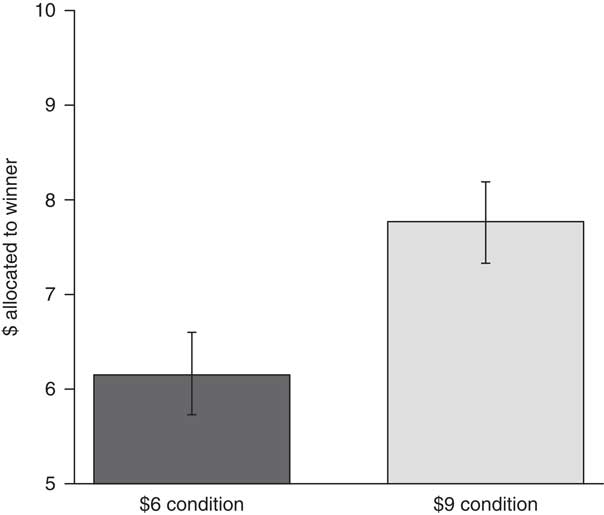
The main dependent variable was the amount of money the participant would award to the winner of the competition, were the participant to design the game. The amount of money awarded to the winner is used as a direct measure of how unequal the participant would make the payments, as the participants were constrained to divide exactly $10 between the winner and loser. The results are shown in Figure 1: participants in the ‘less unequal’ condition would, on average, give the winner $6.15, while participants in the ‘more unequal’ condition would, on average, give the winner $7.77. The difference is significant at p<0.001. Individuals in the ‘more unequal’ condition also reported with a significantly (p=0.02) higher probability that their payment was not fair, and the average dollar amount they would allocate to the winner is below the $9 they experienced.
Laboratory experiment results Note: The bars represent the amount of money (out of $10) that the participants recommended as a fair allocation to the winner of an anagram competition, showing mean allocations with 95 percent confidence intervals. The fifty-three participants were randomly assigned to competitions where the winner got $9 or $6 (out of $10) respectively; the difference in subsequent recommendations is statistically significant at p<0.001.

The simultaneous occurrence in the unequal condition of perceptions of unfairness and preferences for reducing inequality illustrates the close relationship between fairness and the legitimacy of inequality, as established in the literature. However, despite this difference in perceived fairness across conditions, individuals in the ‘more unequal’ condition still recommend a substantively and significantly more unequal allocation of money than individuals in the ‘less unequal’ condition. In other words, even when people perceive a situation as unfair and attempt to correct for this, they do not endorse a distribution that is as equal as the one endorsed by people who start out in a more equal status quo. Therefore, this experiment shows a partial adjustment to high inequality and demonstrates that experiences of inequality can have an impact on preferences for inequality.
SURVEY EXPERIMENTS: ATTITUDES TOWARD INCOME INEQUALITY
The laboratory experiment showed that it is possible for experiences of inequality to affect perceptions of how much inequality is legitimate. The two survey experiments below show that this adjustment of expectations also occurs in the context of public opinion. In these experiments, participants are asked to think about real-life income inequality in the United States and Sweden, respectively. The hypothesis in both experiments is that individuals who are informed that their society is more unequal than they previously believed will come to think of higher income inequality as legitimate.
Measuring Attitudes toward Legitimate Income Differences
The outcome variable in the following survey experiments is attitudes toward income inequality, specifically the respondents’ opinion on how large the income differences between different occupations ‘ought’ to be. Inequality at the societal level is a relatively abstract concept, and it can be difficult to formulate questions on income inequality that are straightforward and easy to understand for all respondents. With this in mind, I chose to use a set of questions on occupational earnings that has previously been used in the International Social Survey Project’s (ISSP) Inequality Module and in the General Social Survey in the United States. The respondents are asked how much money they believe that a list of occupations earns in a year, after which they are asked how much they believe that these occupations ought to earn in a year. This provides estimates of the respondents’ perceived level of income inequality and their recommended level of income inequality. The recommended level of income inequality is in this article interpreted as a legitimate income difference in the eyes of the respondent.
The occupational groups used in this survey are: unskilled factory worker, skilled factory worker, owner of a small shop, a doctor in general practice, a member of the Federal Cabinet and a CEO of a large national corporation. To develop a uniform measure of perceived and recommended inequality, I use a previously formalized justice index,Footnote 33 which has been used to analyze this question as it has been asked in the ISSP.Footnote 34 In this index, perceptions of and recommendations for inequality are captured as log(income of high prestige occupations/ income of low prestige occupations). Since I am focusing purely on perceptions of overall income inequality, without hypotheses regarding the relative prestige of occupations, I use the highest earning and lowest earning occupations, as defined by the respondent.Footnote 35 For each respondent, then, the index of perceived and recommended income differences becomes log(highest specified income / lowest specified income). This yields two indices for each person: a perceived income gap index, and a recommended income gap index. This log index is used for computing the statistical significance of the findings in the tables below; for ease of interpretation, the non-logged ratio of high to low incomes is provided in all figures. The intuitive interpretation of this non-logged ratio is simply, ‘Compared to people in the lowest-paid occupation, how many times more should people in the highest-paid occupation get paid?’
In data from the ISSP, almost all respondents underestimate the true extent of income inequality in the United States.Footnote 36 This finding is replicated in my survey sample: 93 percent of respondents guessed that income differences between occupational groups are smaller than they truly are. Because of this, no deception is required to create a treatment that tells individuals that income inequality is higher than they think it is. The treatment is simply a presentation of factually correct income data.
EXPERIMENT 2: IMPACT OF INFORMATION REGARDING INEQUALITY IN THE UNITED STATES
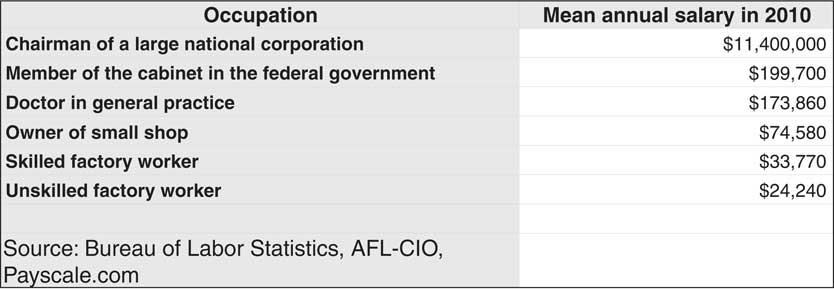
In August 2012, 407 US participants were recruited on Mechanical Turk to answer an ‘Opinion survey’.Footnote 37 The mean age of participants was thirty years, 36 percent were female, 55 percent had a college degree or higher, 77 percent were Caucasian, and 20 per self-identified as Republican. A balance table is provided in the Supplementary Information. One half of my sample (203 participants) was the control group: they answered only some basic demographic questions including their occupation, the scale on belief in a just world,Footnote 38 and an attention prompt (which was not used to exclude participants from analysis), followed by the questions on perceived and ideal income inequality. The remaining half of the sample (204 participants) additionally received information regarding current income inequality in the United States (see Figure 2 for an image of the information treatment). This information was inserted immediately after the participants gave their guesses for existing income inequality, and immediately before they gave their responses for how large income inequality ought to be. All respondents then also indicated their annual income, race, partisanship, and answered one question on interpersonal trust and six political attitude questions, including a question on whether income differences in America are too large.Footnote 39
Information treatment from Experiment 2 Note: The participants were first asked to give their estimates of how much a member of each of the shown occupations earns in a year. After they had given their answers, the treatment group was shown this table with the accompanying prompt.

Results and Discussion
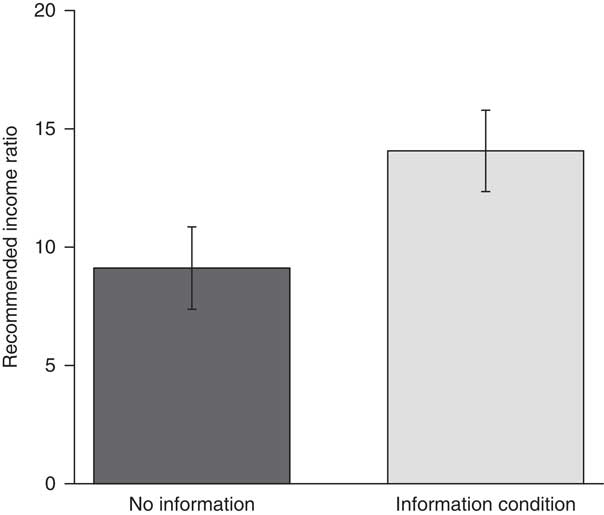
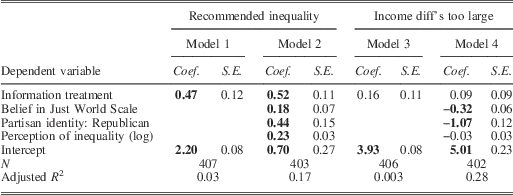
The results of the survey experiment are summarized in Table 1 and Figure 3. Figure 3 depicts predicted values from Model 1 in Table 1; the predicted values shown in Figure 3 are non-logged ratios of recommended income inequality (highest recommended income/lowest recommended income). After receiving the information treatment, the recommended level of income inequality rises from 9 to 14.3 – a 50 percent increase from control group preferences (p<0.001). The information that income inequality is higher than previously thought thus caused an upward adjustment in recommendations for how much income inequality there should be.
Results of survey experiment with American sample. Note: The figure shows recommended ratios of income inequality between the highest and lowest paid occupations (see Figure 2 for list of occupations), by information treatment condition. The values are predicted values with 95 percent confidence intervals, based on Model 1 in Table 1, and are presented as non-logged for ease of interpretation.

Results of Survey Experiment with American Sample

Note: The information treatment presents participants with information on actual income inequality in the United States, informing the participant that inequality is higher than they previously thought (see Figure 2). Recommended inequality is measured as log(highest suggested income/lowest suggested income). Agreement with the statement ‘Income differences in America are too high’ is measured on a 1–5 scale where 5 indicates stronger agreement. Coefficients that are statistically significant at the 95 percent confidence level are shown in bold.
In Model 2 (see Table 1), the experimental effect is compared to the relationship between relevant covariates and recommended levels of inequality. As can be seen in Model 2, Republican partisans recommend higher inequality than other participants, as do participants with higher levels of belief in a just world (a measure that is correlated with the system justification motivation).Footnote 40 Both effects are in the expected direction. The effect of the information treatment is larger than the estimated relationship between Republican identification and recommended inequality.Footnote 41 Individuals who entered the experiment thinking that income inequality in the United States is relatively high also recommend higher inequality, thus exhibiting the same relationship that has been repeatedly found in ISSP data.Footnote 42 The fact that the information treatment, which increases perceptions of income inequality, causes an upward adjustment of recommended inequality shows that the previously established correlation between inequality perceptions and preferences has a causal element in the direction from perceptions to preferences.Footnote 43
Showing an upward adjustment in respondents’ opinions regarding legitimate income inequality supports the adjustment hypothesis, but stops short of showing that the respondents’ demands for redistribution have not increased. Indeed, it is possible that the upward adjustment of inequality recommendations is accompanied by increased dissatisfaction with inequality, especially if the adjustment process is driven mainly by a non-evaluative mechanism like anchoring. The argument made in this article is that the adjustment process, by virtue of ‘moving the goalposts’ on what is considered legitimate inequality, leads participants not to exhibit increased dissatisfaction with inequality or increase their demands for redistribution. Therefore, in order to test for increased dissatisfaction with inequality, the respondents were asked a number of policy attitude questions at the end of the survey. The degree of agreement with the statement ‘Differences of income in America are too large’ is modeled as a dependent variable in Models 3 and 4 in Table 1. As the analysis shows, there are no significant differences by treatment condition. Essentially identical null results are found with the related propositions, ‘It is the responsibility of the government to reduce the differences in income between people with high incomes and people with low incomes’ and ‘Large differences in income are necessary for America’s prosperity’.
In sum, while the information treatment caused respondents to revise their recommended levels of income inequality upward, it did not have any discernible impact on their attitudes about whether differences of income in America are too large. This is the pattern of results we would expect if adjustment to higher inequality is at least in part due to a motivated mechanism such as the system justification motivation (which is not mutually exclusive with other mechanisms), and if the adjustment in recommended inequality occurs, therefore, partly in order to avoid the conclusion that differences in income in America are too large (or to avoid agreeing with this statement more strongly than before). All of this does not preclude the existence of egalitarian demands in general. Such demands manifestly exist in democratic populations as well as in this experimental sample. The general argument is instead that the existence of egalitarian demands is not a straightforward consequence of the mere existence (and awareness of) disparities.
One alternative explanation for the results of the survey experiment may be that the adjustment phenomenon, rather than stemming from universal psychological mechanisms, is particular to the American ethos (broadly understood as a widespread belief in the American dream, i.e. that individuals who work hard can make it and, by corollary, that individuals who have made it deserve their fortune).Footnote 44 The following experiment puts this alternative explanation to the test: replicating the survey experiment in Sweden shows that the phenomenon is not uniquely American, and that it occurs in a country with a strong tradition of egalitarianism and social democracy.
EXPERIMENT 3: IMPACT OF INFORMATION REGARDING INEQUALITY IN SWEDEN
Experiment 3 replicates Experiment 2 in Sweden. Beyond the usual value of a direct replication, the change of political environment to Sweden also serves as a mechanism check. If the results of Experiment 2 were due to a uniquely American ethos, we would not expect to find the same result in Sweden, a country with an extensive welfare state, higher taxation, and lower income inequality than the United States.Footnote 45 Swedish citizens are more in favor of government redistribution than are Americans,Footnote 46 and recommend lower income inequalities in the type of income questions that are used in this experiment.Footnote 47 Finally, Swedes are more likely than Americans to believe that luck determines a person’s income,Footnote 48 a belief that should dampen the impact of the information treatment (since it weakens the claim to legitimacy of income differences). In other words, if American exceptionalism in attitudes toward luck vs. desert in determining an individual’s income is wholly responsible for the information effect found in Experiment 2, the results should not be replicable in Sweden. On the other hand, if the adjustment phenomenon is due to general psychological mechanisms, then the different political environment may attenuate but will not entirely remove the impact of the information treatment on recommended levels of inequality.
Methods and Participants
The experimental set-up is a direct replication of Experiment 2, albeit with a modified information treatment that gave participants correct information on income inequality in Sweden (see Supplementary Information for an image of the information treatment). Income inequality in Sweden is lower than in the United States, but just like in the American sample, a vast majority of respondents (244 out of 250) underestimated the extent of income inequality in their country. It follows that the information treatment in this experiment serves the same function as in Experiment 2: it informs participants that inequality is higher than they previously believed.
In July–August 2013, 250 participants were recruited in Sweden. The participants were recruited from a combination of a psychology study pool at a Swedish university (ninety participants; the study pool does not include undergraduates majoring in psychology) and the online study pool ‘Studentkaninen’ (160 participants).Footnote 49 All participants took the survey online and received a lottery ticket (approx. value US$5) for their participation. The participants ranged in age from 19 to 59 years (mean age 26, median age 24), and 60 percent were female; 47 percent had a university education; 41 percent of the participants reported voting for a left-wing party in the last general elections; 27 percent reported voting for a right-wing party. The participants all lived in urban areas; the vast majority lived in the greater Stockholm area (including Uppsala). A balance table is provided in the Supplementary Information. During the experiment, participants only answered demographic questions, filled in the Global Belief in Just World scale, and answered the questions on perceived and recommended income inequalities, followed by indicating their income, how they voted in the last parliamentary elections, and answering four political opinion questions.Footnote 50
Results
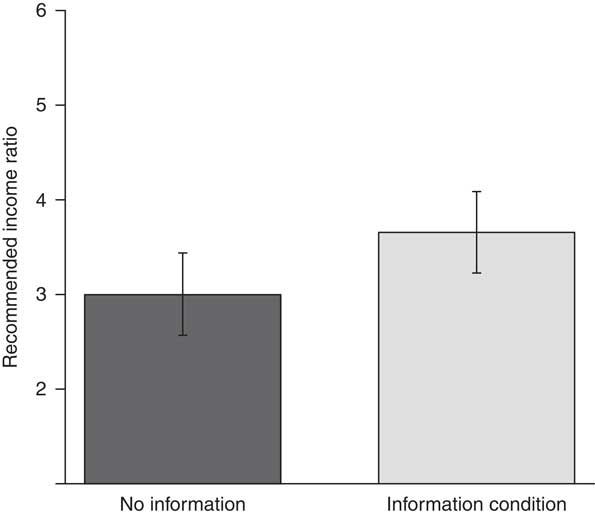
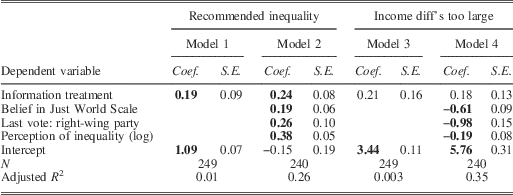
The replication was successful, and the results of the experiment are presented in Figure 4 and Table 2. Receiving information regarding actual income inequality in Sweden moves the participants’ mean recommended income ratio from 3.0 to 3.6 – a 20 percent increase that is statistically significant at the 95 percent confidence level.Footnote 51 The effect size is comparable to the relationship between recommended inequality and having voted for a right-wing party in the last parliamentary elections (Model 2, Table 2). The increase in recommended inequality occurs even though the Swedish participants overall recommend much lower income inequality and are more concerned about the level of income inequality in their country than the American participants in Experiment 2. Further replicating the findings of Experiment 2, the information treatment has no impact on the Swedish participants’ level of concern about income inequality, as shown in Models 3 and 4 in Table 2.
Results of survey experiment with Swedish sample Note: The figure shows recommended ratios of income inequality between the highest and lowest paid occupations (see Figure 2 for list of occupations) by information treatment condition. The values are predicted values based on Model 1 in Table 2, with 95 percent confidence intervals, and are presented as non-logged for ease of interpretation. The effect of the information treatment is statistically significant at p<0.05.

Results of Survey Experiment with Swedish Sample

Note: The information treatment presents participants with information on actual income inequality in Sweden, informing the participant that inequality is higher than they previously thought (see the Supplementary Information for visual image of the treatment). Recommended inequality is measured as log(highest suggested income/lowest suggested income). Agreement with the statement ‘Income differences in Sweden are too large’ is measured on a 1–5 scale where 5 indicates stronger agreement. Coefficients that are statistically significant at the 95 percent confidence level are shown in bold.
Discussion
The successful replication, first and foremost, increases confidence that the findings of Experiment 2 were not obtained by chance or were not in some other way a feature of the peculiarities of the sample obtained through Mechanical Turk. Further, this replication shows that the mechanism by which perceptions of the legitimacy of income inequality change is not solely the function of an American ethos. The point estimate of the treatment effect is substantially smaller in the Swedish sample; it is plausible that the smaller factual inequality to which participants were exposed may account for the smaller adjustment (the CEOs of the largest Swedish companies make 48 times the salary of an average unskilled factory worker; in the American experimental information treatment, this ratio was 470). However, it is also possible that a different political and ideological background reduces the impact of this information (for example, Swedes may be less likely to attribute high incomes to individual merit). This interpretation is supported by the fact that Swedish participants scored lower on the Belief in Just World scale than American participants, indicating that they are less likely to attribute individual outcomes to fair societal processes. On a scale from 1 to 6, where higher numbers indicate a stronger belief in a just world, the mean Swedish score was 2.82 while the mean American score was 3.24. In other words, there are several plausible reasons for the smaller information effect in the Swedish sample, and this experiment cannot distinguish between these explanations. The experiment does show that the process by which individuals adjust their perceptions of legitimate inequality upward in response to information about inequality is present in each of two socio-political environments, even though the cultural emphases on individualism, equality, and redistribution of incomes are markedly different in these two countries.
EXPERIMENT 4: THE ROLE OF THE SYSTEM JUSTIFICATION MOTIVATION
The three experiments presented so far have demonstrated that when perceptions of inequality change, recommended levels of inequality adjust in the same direction. These experiments have not differentiated between plausible mechanisms that cause the adjustment process to occur, such as rational updating, anchoring, and system justification. The fourth experiment will address the question of mechanisms directly, by testing whether the system justification motivation is one of the mechanisms at work.
The adjustment hypothesis is primarily concerned with the existence of adjustment, and it is highly likely that all three potential mechanisms contribute to it. In particular, it would be surprising if anchoring were not a relevant mechanism, given the ubiquity of evidence that anchoring on available numbers is a common occurrence. Without denying the potential involvement of other mechanisms, this experiment asks whether system justification in particular is a cause of the adjustment phenomenon. System justification is singled out for further inquiry for two reasons. First, system justification is less well known among political scientists than anchoring or rational updating of priors (and, therefore, additional evidence may be required to demonstrate its relevance). Second, system justification theory predicts that features of the political and social environment (such as the presence of outside threats) can increase or decrease the strength of the system justification motivation. These predictions open up potential follow-up questions about the conditions under which we should most expect the adjustment phenomenon to occur.Footnote 52 Experiment 4, therefore, directly tests whether the system justification motivation influences adaptation to income inequality, by experimentally manipulating the strength of the system justification motivation. The hypothesis will be that, given exposure to the information treatment, experimentally increasing the system justification motivation will further increase adjustment, resulting in even higher recommended levels of inequality (beyond the already demonstrated information treatment effect).
Manipulating the System Justification Motivation
The strength of the system justification motivation varies across individuals, and it also has situational determinants.Footnote 53 The social psychology literature on system justification has identified a set of social determinants of this motivation.Footnote 54 One unified approach to these determinants is the theory of compensatory control, which posits that support for external systems can be explained, in part, as compensation for fluctuating levels of perceived personal control.Footnote 55 When an individual’s perceived control over their personal valued outcomes decreases, they become more motivated to attribute control, predictability, and fairness to their social system. This framework is consistent with previously identified determinants of the system justification motivation, including system threat, system dependence, system inescapability, and low personal control.Footnote 56
The situational determinants of the system justification motivation can be experimentally manipulated.Footnote 57 The experimental manipulations are designed to increase the system justification motivation temporarily, and in this experiment I use a previously established and tested treatment that has been used in studies of attitudes toward the disproportionate wealth of parliamentarians, government funding regulations, and gender inequality.Footnote 58 The treatment is a paragraph of text that manipulates perceptions of the inescapability of the social system (with a reverse-worded control paragraph). The full text of the treatment and control paragraphs is included in the Supplementary Information. The paragraph tells participants that in the future it will become harder to escape their social system (by emigrating from the United States). This information makes participants feel more dependent on their social system, and the resulting psychological discomfort increases their motivation to believe that the social system (in this case, the United States) is generally fair. The participants do not need to be actively considering emigration for the treatment to be effective; the sense of increased dependence on the social system occurs subconsciously. The paragraph does have to be particular to the respondents’ own country; reading about reduced emigration opportunities from a foreign country (or otherwise inapplicable social systems) does not produce these results.Footnote 59 Note that, importantly for this experiment, the paragraph does not mention economic inequality. Therefore, it should not impact preferences for income differences other than through the system justification motivation. I hypothesize that, in the presence of information on income inequality, participants with an experimentally increased system justification motivation will recommend higher income inequality than will participants who read the control paragraph.
Methods
This experiment is an exact replication of Experiment 2, with the added condition of reading a system justification treatment or control paragraph, where the treatment paragraph (described above) is designed to temporarily increase the participant’s system justification motivation. In addition, the information treatment was updated to reflect the most up to date information on income inequality in the United States (see the Supplementary Information). The experimental design thus has a 2 (inequality information) ×2 (system justification manipulation) set-up. Below, the terms ‘control’ and ‘treatment’ condition refer to the type of paragraph read by the participant (and not whether the participant saw the information treatment), unless otherwise specified.
Participants
In July 2013, 616 participants were recruited on Amazon’s Mechanical Turk.Footnote 60 The mean age of the respondents was 30 years, with a median of 27 and a range from 19 to 74 years; 37 percent were female, 54 percent had a college degree, and 61 percent identified as Democrats (including independents who lean Democrat), while 20 percent identified as Republicans (including independents who lean Republican); 71 percent self-identified as Caucasian, 13 percent as Asian and 7 percent as African American. A balance table is provided in the Supplementary Information.
Results
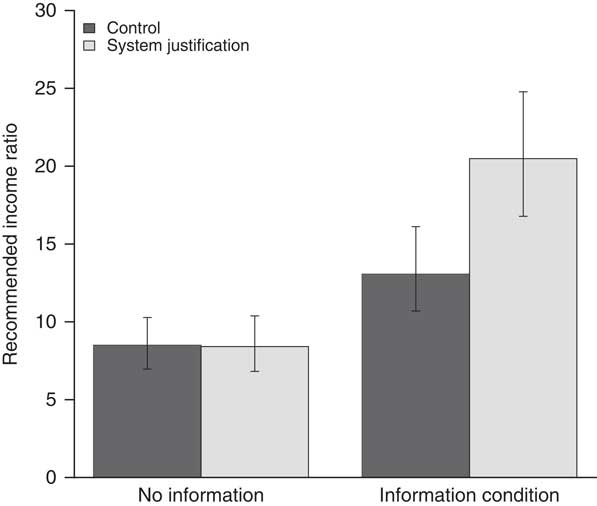
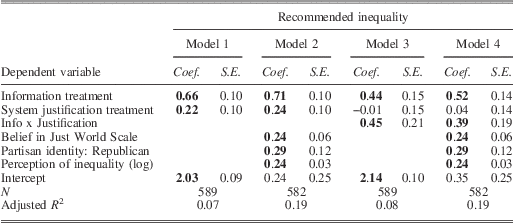
The results are presented in Table 3 and Figure 5. Across the whole sample, individuals who read the system justification-inducing paragraph endorsed higher income inequality; this is shown in Models 1 and 2 in Table 3. Adding an interaction effect reveals that the impact of the system justification treatment occurs entirely among people who were exposed to information regarding income inequality; this relationship is illustrated in Figure 4. Because the treatment paragraph makes no mention of income inequality, the only theoretical explanation for these results is the following sequence: (a) the paragraph successfully increased participants’ motivation to justify their social system, (b) the presentation of income inequality data then presented a salient feature of the participants’ society, and (c) the participants proceeded to interpret this income inequality as more legitimate than they would have done in the control condition.Footnote 61 Therefore, at least part of the phenomenon by which individuals adjust their expectations for legitimate income differences in the face of increasing inequality occurs because of the system justification motivation.
Results of survey experiment with an experimental manipulation of the system justification motive Note: The figure shows recommended ratios of income inequality between the highest and lowest paid occupations (see Figure 2 for list of occupations) by information and system justification treatments. Showing predicted values based on Model 3 in Table 3, with 95 percent confidence intervals.

Results of Survey Experiment with System Justification Manipulation
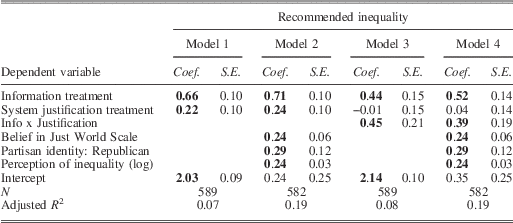
Note: The information treatment presents participants with information on actual income inequality in the United States (see Supplemental Information for a visual image of the treatment). The system justification treatment increases the system justification motivation. Recommended inequality is measured as log(highest suggested income/lowest suggested income). Coefficients that are statistically significant at the 95 percent confidence level are shown in bold.
In addition to providing evidence in favor of the system justification mechanism, the results of this experiment have potential implications for studying the relationship between national political events and the formation of public opinion. The topics that are discussed in typical system justification manipulations are not limited to possibilities for migration but also include, for example, the degree to which individual outcomes depend on the political system or the presence of outside threats to the polity. These topics are not directly about inequality, but they are profoundly political and may readily be discussed on the front pages of national newspapers – alongside reports about historically high levels of CEO pay. In light of these findings, it is interesting to consider whether the presence or absence of outside threats to the nation can modify reactions to domestic developments such as increasing income inequality; this and other questions on the role of system justification in public opinion formation may provide interesting future research questions.
CONCLUSION
The four experiments presented in this article provide empirical support for the adjustment hypothesis: that income inequality affects which income differences are considered legitimate. These results give direct empirical support to previously tentative interpretations of survey data, reducing concerns about reverse causality and omitted variable bias. In light of these experiments, it is reasonable to interpret the strong real-world relationship between perceptions of inequality and recommendations for inequality as causal, with perceptions influencing recommendations. The findings have potential implications for the study of attitudes toward economic inequality and redistribution more broadly.
First, these findings serve as a qualifier to any assumption that a more informed public would be more likely to oppose increased income inequality. Osberg and Smeeding observe that Americans, when compared to other nationalities, were (at least in the early 2000s) particularly likely to underestimate the true extent of income inequality in their country.Footnote 62 Given the results in this article, fixing this knowledge gap would not necessarily raise Americans’ concern with inequality; on the contrary, it may have the counter-intuitive effect of making Americans think of higher income differences as legitimate.Footnote 63 At the same time, it is important to bear in mind that the data presented to participants in these experiments were neutral in terms of partisanship, and that more politically charged ways of presenting these data may well have a different impact on opinion – this potential variation is certainly important enough to be explored in future research. If all neutral information regarding the currently high levels of income inequality causes the public to support higher wage gaps as fair, the findings ought to give pause to any left-wing organizations that seek to change minds regarding the acceptability of inequality mainly by informing the public.
More broadly, this article provides empirical and theoretical reasons to expect public reactions to inequality to consist of adjusted perceptions of legitimacy, as opposed to demands for redistribution. As such, the adjustment hypothesis can provide the basis for new models of public opinion, where acquiescence to inequality is the expected outcome and demands for redistribution are a phenomenon to be explained. This novel set-up cannot be achieved using the more traditional economic self-interest assumption.
It is clear that opposition to economic inequality exists in the real world (as well as in the experiments in this article). Almost none of my respondents, for example, fully endorsed all of the real-world income inequality of which we informed them. On the one hand, the participants in the survey experiments adjusted their expectations for what fairness looks like without changing their minds about whether income inequality is too high, and therefore exhibited straightforward adjustment to the status quo. On the other hand, the participants in the laboratory experiment had a more mixed reaction to inequality: they became more likely to think the inequality was unfair and yet also adjusted their expectations for what constitutes fair inequality. Would an even higher sense of unfairness reduce the adjustment effect? If so, what explains the emergence of a sense of unfairness and/or support for redistribution, given that simply the presence of inequality does not suffice? These are key questions for future research.
The adjustment phenomenon does not explain all attitudes toward economic inequality (just like the economic self-interest assumption explains some but not all attitudes toward economic inequality). In fact, much of the potential usefulness of the adjustment hypothesis stems from the fact that there is opposition to economic inequality, and that this opposition needs to be explained – hopefully with novel questions and interesting research findings. It is my hope that this article has provided enough empirical evidence in favor of the adjustment hypothesis to make it easier to ask questions such as: ‘What causes demand for redistribution?’