Archaeologists have argued for decades about the urban status of Classic period Maya settlements. For some, the low populations and densities of these sites disqualify them as “urban” settlements (Sanders and Webster Reference Sanders and Webster1988), whereas others focus on their political and religious roles as (urban) organizing nodes for a larger landscape (Smith Reference Smith1989). Even if one accepts the characterization of these settlements as “urban,” there is little agreement concerning their similarity to or difference from cities in other urban traditions of the past and present.
Roland Fletcher (Reference Fletcher and Smith2012) includes the Classic Maya in his category of low-density, agrarian-based urbanism; other examples include Angkor and other early urban systems of Africa and Asia. He claims that these low-density urban centers had distinctive social, political, and agricultural systems—very different from cities in other urban traditions—making them fragile and prone to collapse. For Fletcher (Reference Fletcher1995), the low densities of these cities created patterns of social interaction and communication quite different from those in most urban systems known from both ancient and modern times.
In this article we use the analytical framework known as settlement scaling theory (SST) to quantitatively evaluate the similarities and differences between southern Mesoamerican settlement systems and other urban systems known from history and contemporary scholarship. SST, as an integrated approach to the study of settlements across eras, cultures, and geography, developed over the last decade initially by researchers investigating contemporary urban systems. It builds on extant traditions in urban economics, economic geography, and urban sociology, but is grounded in an alternative perspective that views settlements as social networks embedded in built environments (Bettencourt Reference Bettencourt2013, Reference Bettencourt2014; Lobo et al. Reference Lobo, Bettencourt, Strumsky and West2013, Reference Lobo, Bettencourt, Ortman and Smith2020). The many and varied social interactions that occur when individuals meet and mix—which fundamentally involve the sharing and exchange of information—are the drivers of the quantitative patterns identified and explained by SST. We refer to these interactions, ranging from interplays mediated by ritual to chance encounters in a plaza, as “social mixing.” Here, we examine data from five full-coverage surveys from the Maya Lowlands and the Pacific coast of Chiapas, Mexico, to determine how several aggregate properties of settlements (total area, epicenter area, civic architecture volume) relate to their populations as estimated by domestic dwelling counts.
We focus on two key expectations of SST. The first builds from the long-observed property of contemporary urban systems in which larger cities have higher densities than smaller ones (Bettencourt Reference Bettencourt2013). SST makes a specific quantitative prediction concerning the average rate at which cities densify as their populations increase, and this prediction has been borne out in numerous systems of a variety of scales, cultures, and time periods (Lobo et al. Reference Lobo, Bettencourt, Ortman and Smith2020). A recent study by Chase and Chase (Reference Chase and Chase2016), however, suggests that this densification process did not characterize Classic Maya cities. Specifically, they find that for nine large excavated Maya cities, larger cities had lower densities than smaller ones; Drennan (Reference Drennan, Wilk and Ashmore1988) made a similar observation. We expand on this work here using larger and more systematic regional datasets. We confirm that, indeed, residential density generally does decrease even as the number of residences in southern Mesoamerican sites increases, because the area over which the houses are spread grows more rapidly than the number of houses. This result, which is not consistent with SST, implies that in southern Mesoamerica the social units encapsulated within archaeological site boundaries did not mix socially across the site area on a daily basis, as is typical of villages, towns, and cities in many settings. Nevertheless, we do find evidence for an alternative, lower-frequency form of social mixing in these societies, which we explain later.
The second prediction involves the effect of population size on socioeconomic rates. In many urban systems, larger cities are more productive and innovative per capita but also exhibit more crime and disease per capita than smaller cities. This characteristic of cities today has led to their description as social reactors, or places of energized crowding (Smith Reference Smith and Gyucha2019), that generate outputs proportionally greater than their population alone might suggest (Bettencourt Reference Bettencourt2013). We examine this possibility here using civic architecture volumes and find that the expected relation between civic construction rates and the contributing population becomes apparent when civic architecture volumes are compared against their relevant administered populations. Based on these results, we argue that people of southern Mesoamerica and other low-density urban systems did take advantage of the social reactor process, but they did so in a distinctive way that is not reflected in contemporary systems: they mixed socially with a less-than-daily rhythm.
The discussion is organized as follows. The next section presents SST and the specific predictions we investigate. The data are discussed in the third section, and the results are presented in the fourth section. The final section discusses the results and draws implications for understanding Maya and other southeastern Mesoamerican settlements, as well as urban systems in general.
The Social Reactor Process
SST builds from first principles, which is to say, basic statements about human behavior that apply to any culture or society. For these claims to be empirically valid, they must be rather modest in content while remaining useful for the construction of a theory and derivation of hypotheses. Anthropologists who focus on variation in human societies and cultures tend to be skeptical of such statements. Our view is that, at the most fundamental level, every society consists of human beings whose psychological and behavioral predispositions have been shaped through evolution. This ultimately means they have been shaped by the net effects of behavior for reproduction in the physical world. Anthropology shows us that there is much room for social and cultural variation within the constraints imposed by the physical world and the behavioral predispositions that have arisen in dialogue with that world. SST does not discount this variation. It merely seeks to capture the effects of these dispositions for human social behavior. In the process, it seeks to account for some of the variation in human behavior, thus bringing the remaining variation and its sources into greater focus.
The first principles and assumptions of SST, and the basic models derived from the theory, have been discussed in several publications (Bettencourt Reference Bettencourt2013, Reference Bettencourt2014; Lobo et al. Reference Lobo, Bettencourt, Ortman and Smith2020; Ortman and Coffey Reference Ortman and Coffey2017; Ortman et al. Reference Ortman, Cabaniss, Sturm and Bettencourt2014, Reference Ortman, Cabaniss, Sturm and Bettencourt2015). Here, we provide a brief overview of the models in this framework, focusing on the relationship between population and area. The emphasis here is on the mathematical relationships themselves. A more extensive discussion in Supplemental Text 1 provides lengthier justifications for the assumptions, notes the links between SST and existing research traditions, and provides responses to concerns raised by archaeologists in previous studies. It is recommended that readers who are unfamiliar with the approach read the Supplemental Text 1 first and then return to this section (also see Supplemental Table S1 for a list of mathematical symbols used in the following discussion).
The most fundamental assumption of SST is that settlements are areas where people have arranged themselves in physical space in a way that balances the costs of movement with the benefits that accrue from the resulting social interactions. In the simplest case, the average energetic cost to the individual engaged in a social mixing process is given by the distance across the area encompassed by the group:

where ɛ is the is the energetic cost of movement, L is the transverse dimension of the area, A is the circumscribing area within which most movement and interaction take place, and the one-half power relates the area to its transverse dimension. The energetic benefit of the resulting interactions experienced by that individual is then given by

where y is the average per capita result, ${\hat g}$ denotes the average “productivity” of an interaction (across all types that can occur), a0 is the interaction distance, l refers to the average path length traveled by an individual per unit time, and ${N \over A} \;$
 is the average population density of the area.
By setting c = y (i.e., balancing the benefits of social interactions with the costs of engaging in such interactions; see Supplemental Text 1), we can derive the following expression for the circumscribing area required for a population to engage in a social mixing process:

where $G = {\hat g}a_0l$ represents the net “social attraction” of an individual's movements and interaction. The area required for social mixing grows proportionately to the population raised to the α = 2/3 power: the required area thus grows more slowly than the population, becoming progressively denser. This is called the amorphous settlement model. Note also that the quantity (G/ɛ)2/3 = a varies in accordance with the productivity of interactions, G, and transportation (movement) costs, ɛ, but is independent of population.
This very simple model can be adjusted in several ways. For example, as the population (and density of the required area) grows, social interaction must become increasingly structured in space by setting aside specific areas for movement and mixing: roads, paths, plazas, and other public spaces. The space needed for this “access network,” d, can be added in accordance with the current population density (meaning that movement-related infrastructure is added as the population increases), so that the space embedded in such a network per capita is

and the total area of the network area (An) thus becomes

Substituting aN 2/3 for A in Equation (5), based on the relationship derived previously, leads to the following expression for the interaction area (which is different from, and smaller than, the circumscribing area):

As a population that mixes regularly across an area grows, interactions become increasingly structured by the interaction space. As a result, the area taken up by this group grows proportionately to the population raised to the 5/6 power; this alternative is referred to as the structured or networked settlement model. In both the “amorphous” and “networked” cases there is a clear economy of scale, in that larger groups arrange themselves more densely, but the densification rate declines slightly, from 2/3 to 5/6, as space becomes increasingly structured.
Finally, the socioeconomic output (Y) generated by a spatially embedded mixing population is viewed as being proportional to the total number of social interactions that occur among its inhabitants per unit time (see Supplemental Text 1). Given the assumption that human networks support as much mixing as is possible given spatial constraints, we can write as an expression for aggregate output,

where G once again represents the net social attraction of an individual's movements and interactions. The number of interactions per unit time is assumed to be undirected and as large as possible, given the frictional effects of distance and the average benefit of an interaction, and thus ≈ N 2 over the area within which interactions occur.
We can then compute the expected scaling of outputs relative to population by substituting the expression for A n in equation (6) into equation (7). This leads to

which in turn implies an average per capita output of

Equation (9) states that, as a spatially localized mixing population grows, its average per capita socioeconomic outputs grow proportionately to population raised to the 1/6 power, and its total aggregate outputs grow proportionately to population raised to the 7/6 power. In other words, there are increasing returns to scale, such that larger groups are more productive on a collective and per capita basis.
It is important to emphasize that all these mathematical formalisms concern the average effect of population for other properties of settlements in a system. These relationships are relative to transport costs and a variety of institutions and technologies that affect the productivity of interactions, all of which are system specific. As a result, the only thing these models predict is the average effect of scale, given all these other factors, for the settlements in a particular system. In addition, there are numerous social, cultural, ecological, and cosmological factors that archaeologists are well aware of that are not included in these models but that obviously do affect the properties of individual settlements. SST proposes that the effects of these factors can be seen in the deviations of individual settlements from the average expectation value defined by the models (see Supplemental Text 1). So, for example, one could not use equation (3) to exactly predict the actual past population of Tikal based on its circumscribing area. All equation (3) provides is a point estimate for this population, given a circumscribing area, in the context of other settlements in the Tikal region (see Supplemental Text 1).
In these formulations we de-emphasized the terms “settlement” and “city” when describing the area over which social mixing occurs. This is because at the most fundamental level SST concerns a process of social mixing, and the relevant space involved does not necessarily need to correspond to the boundary of a settlement, city, or, indeed, an archaeological site. In many past societies, mixing populations were actually localized within settlements, making it convenient to measure both the interacting population and the corresponding interaction area using the settlement as the relevant unit (Cesaretti et al. Reference Cesaretti, Bettencourt, Lobo, Ortman and Smith2016; Hanson and Ortman Reference Hanson and Ortman2017; Ortman and Coffey Reference Ortman and Coffey2017; Ortman et al. Reference Ortman, Cabaniss, Sturm and Bettencourt2014, Reference Ortman, Cabaniss, Sturm and Bettencourt2015, Reference Ortman, Davis, José Lobo, Smith, Bettencourt and Trumbo2016). In such cases, the social reactor process described earlier is revealed by measuring the aggregate properties of settlements across a system. But there are other possibilities.
In modern cities, for example, the populations that reveal the social reactor process are defined on the basis of daily commuter flows, not the actual distribution of residences on the landscape (Arcaute et al. Reference Arcaute, Hatna, Ferguson, Youn, Johansson and Batty2015; Bettencourt Reference Bettencourt2013; Bettencourt and Lobo Reference Bettencourt and Lobo2016). Disjunctions between a population and its relevant area of social mixing can also arise when residences are interspersed with farmland. In such cases, the social mixing area may be much smaller than the settled area, perhaps being centered on civic buildings and plazas. One would still expect there to be a relationship between the social mixing space and the population, but the social mixing space would be much smaller than the total area of the dispersed settlement. In addition, the total area taken up by the settlement will reflect land in production, as well as residential and interaction space.
It is also important to note that interacting populations and their associated mixing spaces can vary across systems, especially when the frequency of social mixing occurs less than daily. As an example, late prehispanic pueblos in the U.S. Southwest were built with enough plaza space to hold a portion of the entire social network of the community, not just the residents of the pueblo, in public dances that occurred periodically and asynchronously across villages (Ortman and Coffey Reference Ortman, Coffey and Ortman2019). A single individual participated in several different mixing populations in several different spaces over the course of a year, with the frequency of such participation being far less than daily. Previous work in the prehispanic Basin of Mexico has similarly found evidence that individuals contributed corvée labor in different locations, and obviously at different times, based on their position within a nested political hierarchy and their associated administrative centers (Ortman et al. Reference Ortman, Cabaniss, Sturm and Bettencourt2015). So, over time, a single individual would have participated in mixing populations in the public areas of his or her home community, district capital, regional capital, and other locations. We believe these considerations are important for making sense of low-density urbanism, especially in situations where residence groups outside of urban cores were interspersed with farmland (Barthel and Isendahl Reference Barthel and Isendahl2013), where polity- or settlement-level administrative hierarchies were important (Ashmore Reference Ashmore1981; Chase Reference Chase2016; Marcus Reference Marcus, Sabloff and Henderson1993), and where the temporal rhythms of social mixing likely varied across different scales in the hierarchy (Chase and Chase Reference Chase and Chase2017). In such situations, relationships between the populations and areas of sites and/or settlements may be quite different from the relationships between mixing populations, mixing spaces, and socioeconomic outputs in systems where settlements reflect actual mixing areas.
Southern Mesoamerican Settlement Data
To match the settlement scaling framework with archaeological data, several criteria must be met. First, individual settlements must belong to the same socioeconomic system (but not necessarily the same polity), meaning that they share attributes of settlement form, economy, technology, and society. Second, there must be a method to estimate population size that is not derived directly from site area. In the lowland regions of Mesoamerica, the typical means of estimating population involves counting residences, which are generally visible as stone foundations or earthen platforms on the modern ground surface (Culbert and Rice Reference Culbert and Rice1990; Rice Reference Rice and Storey2006). Third, the collection of sites to be analyzed needs to encompass the range of size variation among settlements in a region and needs to be large enough for reasonable statistical evaluation of relationships between population and other quantities. All the data analyzed here conform to these requirements. Each of the five surveys we consider documented settlements across a settlement hierarchy, defined site boundaries in similar ways, and used domestic residences as the basis for estimating population. Four of the surveys (Palenque, Rosario Valley, Belize Valley, and Uxbenká/Ix Kuku'il) also include information on settlement hierarchies and civic-ceremonial precincts that allow additional types of analysis.
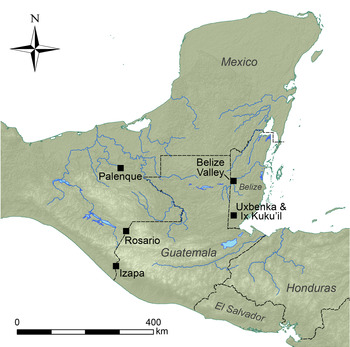
In this section we present the fieldwork projects that provided the data analyzed in this article. A discussion of each project, with citations and information on how field results were converted into data for analyses, is included in Supplemental Text 2. The locations of the five projects are shown in Figure 1.
Locator map showing the locations of the five survey projects analyzed in this article. (Color online)

Palenque
Our first dataset is the published results from the Proyecto Regional Palenque, carried out by Liendo Stuardo (Reference Liendo Stuardo2011). This full-coverage survey identified 413 sites within an area of 450 km2. The sites included here date to the Balunté period, AD 750–850, which was the demographic peak in this area.
Rosario Valley
This dataset was compiled by Olivier de Montmollin (Reference de Montmollin1989, Reference de Montmollin1995) for the Grijalva River Upper Tributaries, several hundred kilometers south of Palenque, in what can be called the southwest periphery of the Maya area. Advantages of this area include the fact that Maya occupation was essentially limited to the Terminal Classic period and that surface architectural visibility is excellent because the semi-arid local climate. As a result, it is reasonable to view the results as a synchronic snapshot of the settlement system.
Belize Valley
The upper Belize Valley encompasses an area of approximately 125 km2, extending 25 km eastward and downriver from the Maya centers of Cahal Pech to Blackman Eddy. From 1988 to 2017, the Belize Valley Archaeological Reconnaissance (BVAR) Project extended Gordon Willey's initial study area through a block survey program designed for total coverage of the region (Hoggarth et al. Reference Hoggarth, Awe, Jobbová and Sims2010; Walden et al. Reference Walden, Ebert, Hoggarth, Montgomery and Awe2019). An airborne lidar survey for the BVAR study area was conducted in 2013 as part of the West-Central Belize lidar Survey to supplement the pedestrian survey (Chase et al. Reference Chase, Chase, Awe, Weishampel, Iannone, Moyes, Yaeger, Brown, Shrestha, Carter and Diaz2014).
Uxbenká and Ix Kuku'il
Uxbenká and Ix Kuku'il are two neighboring polities located on the calcareous sandstone foothills of the southern Maya Mountains in Belize. The Uxbenká Archaeological Project (UAP) conducted a decade of pedestrian settlement survey and excavations including ground-truthing sites detected with aerial lidar data and high-resolution satellite imagery (Prufer et al. Reference Prufer, Thompson and Kennett2015). Combined survey and excavations produced a comprehensive diachronic settlement history of both polities. Both have origins earlier than the Early Classic and their maximum populations occurred during the Late Classic (Prufer et al. Reference Prufer, Thompson, Meredith, Culleton, Jordan, Ebert, Winterhalder and Kennett2017; Thompson et al. Reference Thompson, Meredith and Prufer2018).
Izapa
The site of Izapa is famous for its large mounds and elaborate sculpture, but nothing was known of the regional structure of the polity until Rosenswig initiated the Izapa Regional Settlement Project (IRSP) in 2011. Two 60 km2 survey zones were documented with lidar, and more than 1,000 mounds were surface-collected and the periods of their occupation determined on a phase-by-phase basis (Rosenswig et al. Reference Rosenswig, López-Torrijos, Antonelli and Mendelsohn2013, Reference Rosenswig, López-Torrijos and Antonelli2015). Then, a larger area was mapped, bringing the total to just under 600 km2 and 40 political centers documented forming a three-tiered settlement hierarchy (Rosenswig and López-Torrijos Reference Rosenswig and López-Torrijos2018).
Results
We examine relationships between population size and other aggregate measures (settlement area, epicenter area, civic architecture volume) using a general form of equations (3) and (6):

where Y denotes the dependent variable, X refers to the independent variable (a population), the power β captures the scaling relationship between area and population, and eξ are fluctuations of each settlement from the expected scaling relationship due to the combination of sampling error, measurement error, and other social, cultural, and technological factors that are not included in the model. The constant a captures how system-wide socioeconomic development modulates the effect of population size for other properties. The choice of a power-law functional form can be justified independently of the derivations in the previous section: the form assumes that the effect on the dependent variable of increasing population size is not additive but multiplicative, which is to say that the increase in Y is driven by the interaction of many factors observationally summarized by the increase in population size (Coffey Reference Coffey1979).
Taking the natural logarithm of equation (10) we obtain the estimation equation:

where i indexes individual settlements or associated mixing populations and areas, and the scaling exponent β is the slope of the linear regression of lnYi on lnXi. The distributional properties of ξ are an approximate Gaussian random variable with zero mean, reflected in the residuals to this linear fit line. Depending on whether the estimated value of β is smaller than, equal to, or greater than 1, the relationship between an area and a population can be characterized as sublinear, linear, or superlinear, respectively.
To examine patterns across surveys we include results for each survey region, but we also provide pooled analyses to maximize sample sizes. There are differences in the baseline areas and civic architecture construction rates across survey areas. These differences represent interesting avenues for further investigation, but they also preclude us from pooling the data from multiple surveys in estimating the scaling exponent β. We control for these effects by centering the data from each region before analysis. Centering involves subtracting the mean value of a variable across cases in a survey from each case value, after log-transformation. This has the effect of rescaling the data so that their mean coordinate of each group is at the origin. This allows one to control for variation in the intercepts of scaling relations across surveys to better estimate the slope of the overall scaling relationship.
Population and Site Area
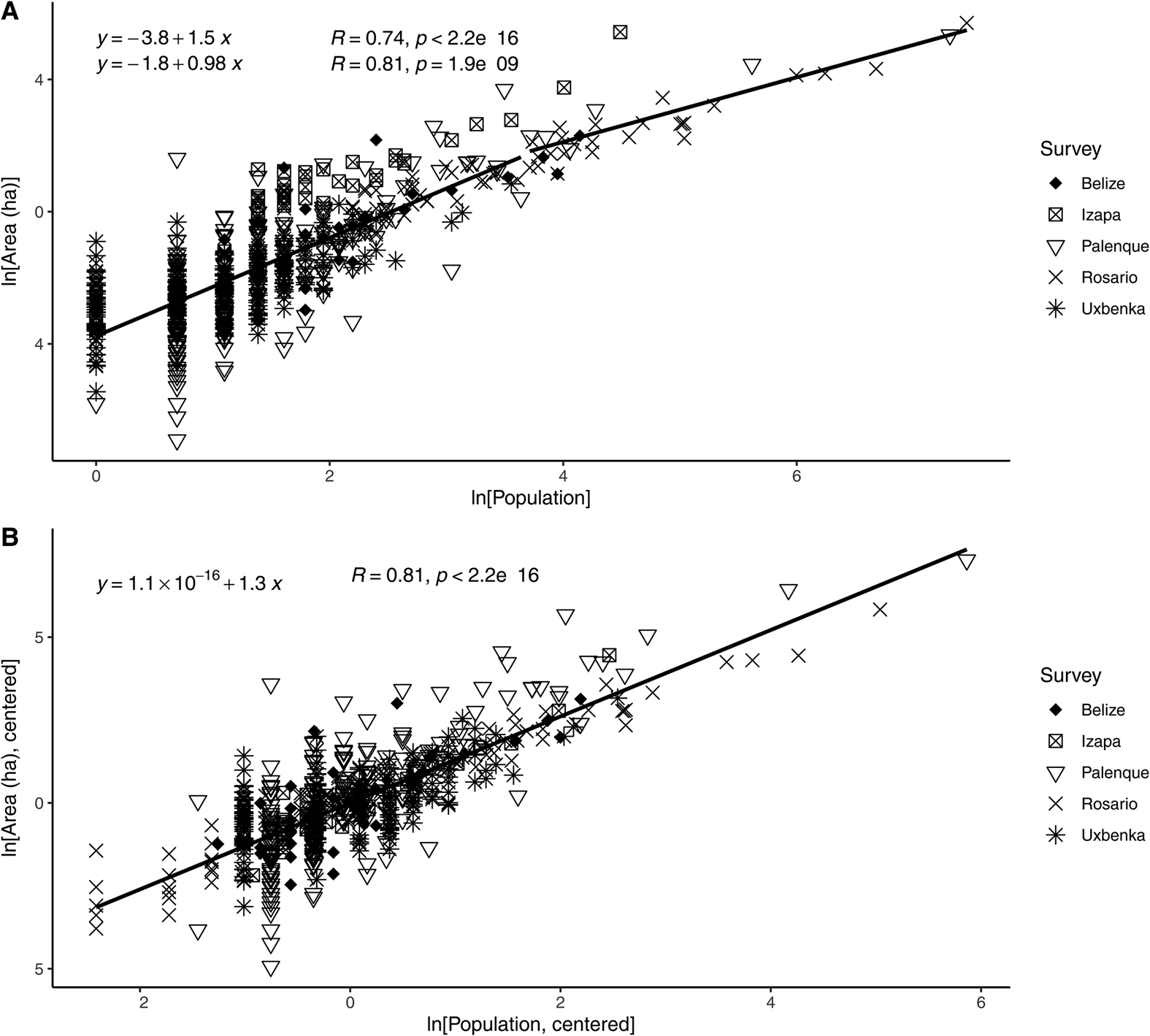
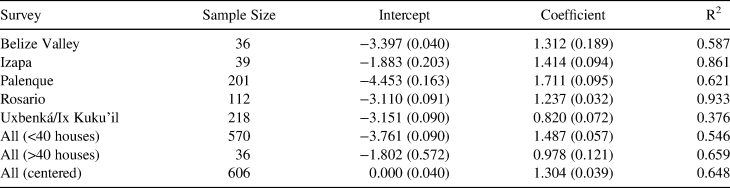
The overall relationship between the domestic structure count and the site area across the five survey datasets is not scale-invariant (Figure 2). Instead, there is a shift in the slope of the relationship, with a steep initial slope that gradually flattens out as site population increases. The transition point in this relationship appears to coincide with a settlement size of about 40 houses. Figure 2A presents regression lines that were fitted separately for two subpopulations—one with fewer than 40 domestic structures per settlement and the other one with 40 or more structures (see Table 1). The estimation results show that the area encompassed by these settlements initially exhibits a superlinear relationship such that the area grows faster than population, but it eventually transitions to a roughly linear relationship such that the site area grows proportionately to population (in the largest settlements).
Relationship between population (domestic structure count) and area in six settlement pattern surveys from southern Mesoamerica. (A) All data included, with a breakpoint at 40 houses; (B) after centering the data for each survey, with no breakpoint. Note that there appears to be a transition from superlinearity to linearity when the raw data are considered, but after controlling for the baseline area in each region all data are well summarized by a single fit line.

Relationships between Settlement Area and Population (House Count).

Notes: In all cases the independent variable is the house count. All regressions are ordinary least-squares fits following natural log transformation. All results are significant (p < 0.0001) and standard errors are in parentheses. Note that the only case of sublinear scaling (Ix Kuku'il) has a low r-squared value. Thus, results show that households in southeast Mesoamerica did not arrange themselves to balance costs and benefits of daily social mixing.
However, as alluded to earlier, it appears that differences in the baseline area per person across surveys (perhaps because of differences in local agricultural productivity), in combination with differences in the size distributions of settlements across surveys, are responsible for this feature of the data. This is made clear by centering the data by survey and then replotting the results, shown in Figure 2B. After centering, the domestic structure versus area relationship is much more consistent and is well described by a fit line with a slope substantially greater than one. Table 1 presents regression results for each survey dataset, almost all of which suggest a superlinear relationship between house count and area. The only sublinear relationship observed in these data is for Uxbenká/Ix Kuku'il, the survey dataset for which the relationship has the lowest r-squared value (Table 1). Taken together, these results confirm that the scaling of population size (as proxied by domestic structures) and settlement area for southern Mesoamerican sites exhibits a markedly different pattern than is typical of both past and present urban systems, where 2/3 ≤ β ≤ 5/6. This in turn implies that southern Mesoamerican archaeological sites do not represent areas within which households arranged themselves to facilitate daily social mixing. Instead, social mixing may have occurred less frequently, within central areas, by groups that are not necessarily coterminous with site boundaries. This result is in keeping with previous studies (Lobo et al. Reference Lobo, Bettencourt, Ortman and Smith2020; Ortman et al. Reference Ortman, Smith, Lobo and Bettencourt2020).
Although this result indicates that households in southern Mesoamerica did not mix across site areas on a regular basis, it does not rule out the possibility that individuals moved in a more directed way, gathering and mixing in epicenter areas on a less frequent basis. To test this possibility, we first use information on the position of each site in the settlement hierarchy to associate specific centers with their administered populations. These administrative relationships were likely hierarchical and nested in at least three levels, with the span of control of local centers being limited to the settlement itself, of district capitals to the residents of all sites in that district, and of polity capitals to all residents of the polity. These relationships among settlements, as defined by the surveyors in the Palenque and Rosario surveys and applied to the Belize Valley and Uxbenká/Ix Kuku'il surveys here, were used to estimate the populations that gathered periodically in specific sites. These are referred to as “mixing” or “contributing” populations in Table 2 and Supplemental Data Appendix 2. These mixing populations can then be compared to the epicenters and civic architectural volumes of the associated centers.
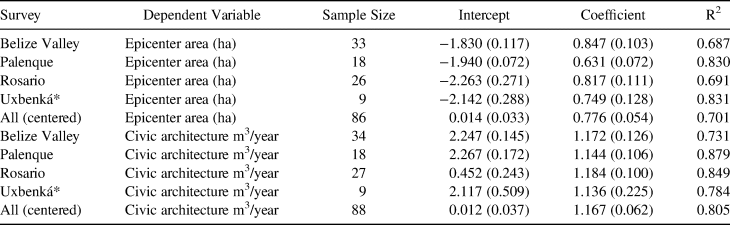
Relationships between Interacting of Mixing Populations and Epicenter Properties.

Notes: In all cases the independent variable is the contributing population. All regressions are ordinary least-squares fits following natural log transformation. All results are significant (p < 0.0001) unless otherwise noted, and standard errors are in parentheses. Note that the relationships for epicenter/plaza area are all strongly sublinear, and the relationships for civic architecture construction rates are all superlinear. In combination with Table 1, these results suggest that polities in southeast Mesoamerica took advantage of social mixing with a temporal rhythm that was much slower than daily.
*p < 0.0001.
Although the definitions of epicenter and civic architecture are relatively standardized in Maya archaeology (Houston Reference Houston1998), the measurements of epicenter areas are not identical between the surveys included in this analysis. In the Rosario case, de Montmollin traced the outlines of areas within settlements that contained concentrations of epicenter architecture and calculated the areas within these outlines to estimate the area of the epicenter of each local, district, or regional center. In the Palenque case, in contrast, Liendo Stuardo (Reference Liendo Stuardo2011:Table 4.4) used Turner and colleagues’ (Reference Turner, Turner, Adams and Ashmore1981) method to determine the epicenter ranking of tier 1–3 settlements; as a step in this process one calculates a measure of the epicenter area within these settlements (Code AB2, which is the square of the product of the linear dimension of all plazas and the linear dimension of all temples). Finally, in the Belize Valley and Uxbenká/Ix Kuku'il surveys, epicenter areas were calculated from polygons representing the extent of landscape modifications and constructed plazas derived from GPS mapping and lidar data. Despite this variation, all are measures of the epicenter area within settlements that can be compared to the size of the populations that likely gathered there periodically for civic-ceremonial events and activities.
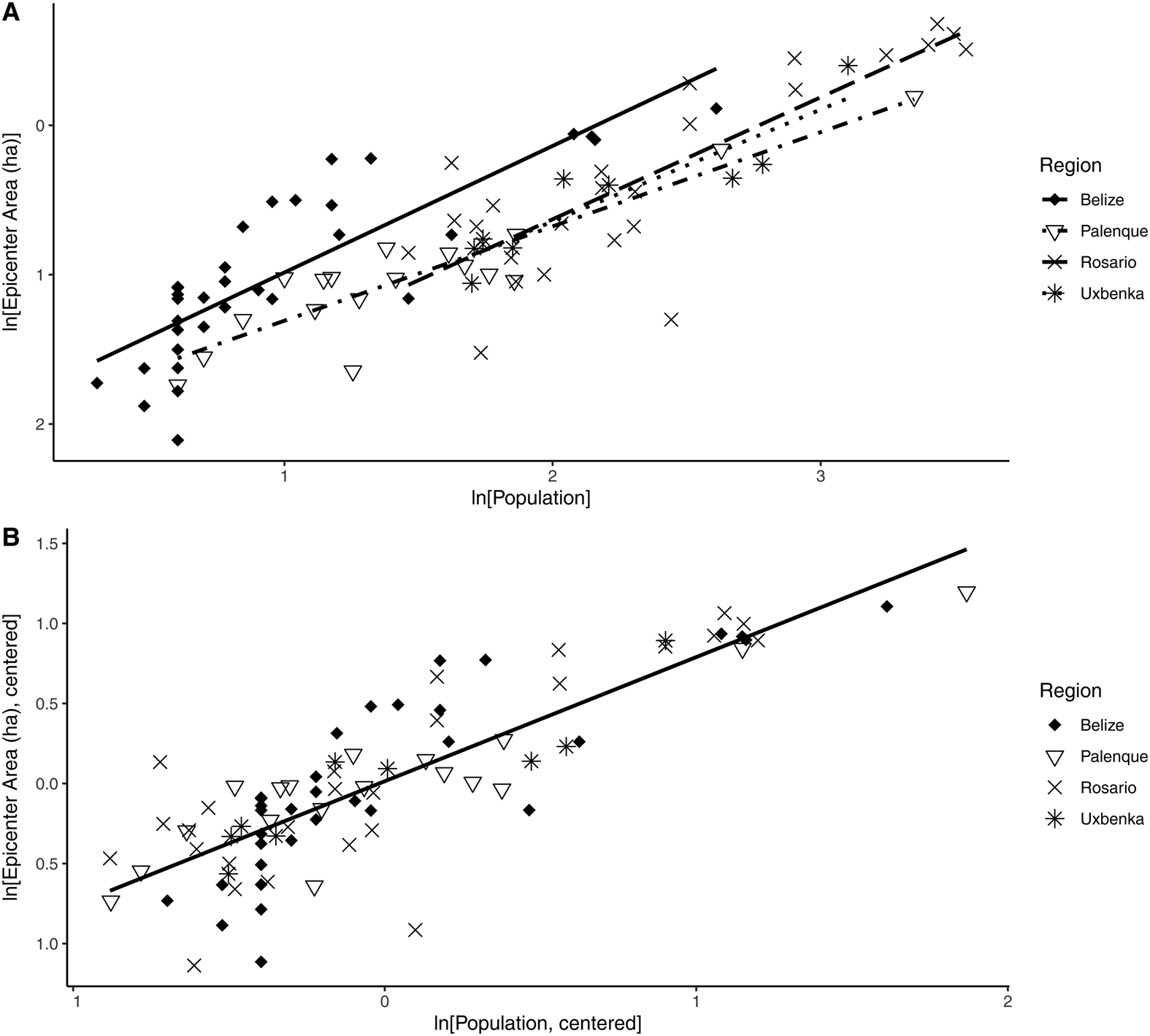
With these details in mind, Figure 3 illustrates the relationship between mixing populations and epicenter areas for the centers in four of the five surveys, and Table 2 presents the estimation results. In this case, all relationships are clearly sublinear, with an exponent approaching 2/3 in the Palenque case and 5/6 in the other three cases. (The lower exponent for Palenque may be due to the exclusion of streets and paths from the AB2 calculation versus their inclusion in the epicenter area calculation for the other three surveys.) This relationship conforms to the prediction of SST regarding the average relationship between a mixing or interacting population and the mixing area, but in this case the relevant mixing area is not the area over which people lived, but the area within which they gathered. Presumably in this case, this mixing social network came into being relatively infrequently, such that the energetic benefits of social mixing were not the dominant factor in determining the spatial distribution of residences. Also notice that the implied patterns of movement involved residents commuting to different locations, for gatherings of different scales, over some calendrically based period. This is quite different from the pattern of daily commuting in contemporary cities.
Relationship between contributing population and civic/epicenter area (ha) in four survey regions, taking the political/settlement hierarchy into account. (A) Raw data; (B) centered data. Note that after controlling for the baseline investment in civic area across regions the data are well summarized by a single fit line.

Population and Civic Architecture
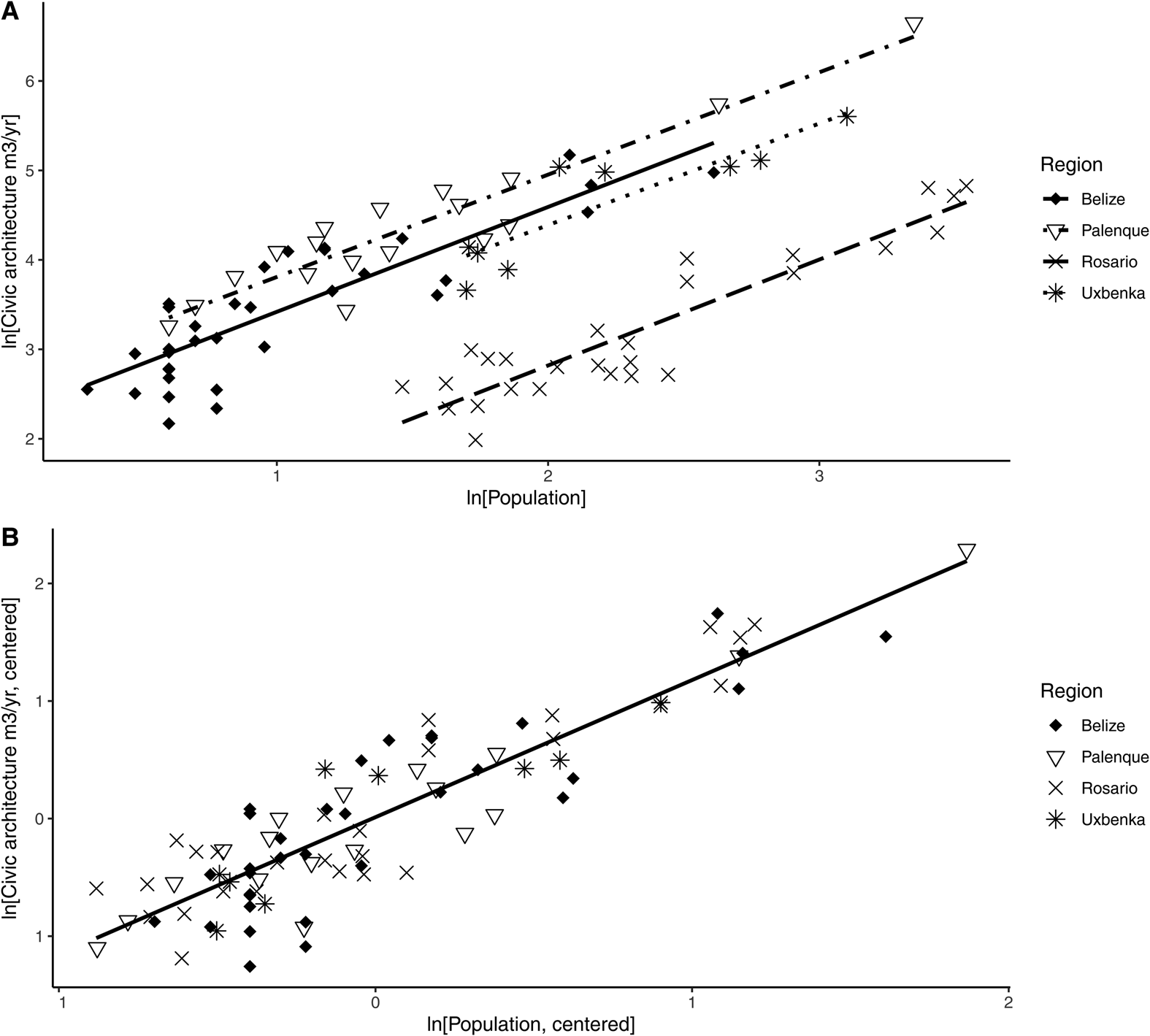
Additional evidence for the periodic social mixing of groups defined by the settlement hierarchy is also apparent in the relationship between mixing populations and civic architecture construction rates (Table 2; Figure 4). Once again, the measures of civic architecture volumes are not identical across cases. In the Palenque survey, Liendo multiplied the epicenter area mentioned earlier by a third dimensional measure derived from both the summed heights of civic buildings and aspects of the quality of construction (Code X; Turner et al. Reference Turner, Turner, Adams and Ashmore1981). In the Rosario survey, de Montmollin estimated the total volume of all civic-ceremonial architecture within each epicenter based on dimensions recorded in the field. And in the Belize Valley and Uxbenká/Ix Kuku'il surveys, civic architecture volumes were computed directly from a DEM derived from lidar survey. Thus, one might expect the measure for the Palenque survey to be somewhat larger than, but still proportional to, the volume measures from the other surveys. One might also expect the volume estimates to be more precise for the Belize Valley and Uxbenká/Ix Kuku'il surveys compared to the Rosario survey.
Relationship between contributing population and civic architecture construction rates (m3/years in period) in four survey regions, taking the political/settlement hierarchy into account. A) Raw data; (B) centered data. Note that after controlling for the baseline investment in civic area across regions the data are well summarized by a single fit line.

It is also important to note that all the sites in the Palenque and Rosario surveys date from a single archaeological phase, but the Belize Valley and Uxbenká/Ix Kuku'il sites date to one or more phases. To control for this variation to some extent, we divided the civic architecture volumes at centers in the Belize Valley and Uxbenká survey by the number of phases of occupation at that center to estimate the amount of construction during the Late Classic (AD 600–900) period to which the other settlement data pertain. As a result, the amount of civic architecture at a center can be viewed as an average construction rate over one phase of occupation. This is obviously not ideal, because civic architecture construction rates likely varied over time; yet, improving on this approach would require extensive excavations within public buildings to determine construction volumes during each archaeological phase. With these details in mind, Table 2 shows that the slope of the fit line for all four surveys is very close to 7/6, the value predicted by SST for the relationship between a mixing population and a socioeconomic rate. These results suggest that southern Mesoamerican populations did in fact mix socially within epicenters, at least for the purpose of construction. This result, combined with the fact that the overall relationship between population and site area is not consistent with daily social mixing, coincides with other research in suggesting that southern Mesoamerican populations gathered and mixed in civic-ceremonial centers on only a periodic or episodic basis (Inomata Reference Inomata2006; Ossa et al. Reference Ossa, Smith and Lobo2017). It also suggests that site boundaries by themselves do not capture these mixing populations. This phenomenon—where expected scaling relationships are apparent with respect to administered populations but not with respect to archaeological site populations—may explain the atypical results of previous scaling analyses. For example, Ossa and coauthors (Reference Ossa, Smith and Lobo2017) found that epicenter areas do not scale with site populations as predicted by SST, but they were only able to examine individual settlement populations, not contributing populations (because such data were not available for their samples).
Discussion: Low-Density Urbanism in Southern Mesoamerica
The results presented in this article illustrate ways in which Classic period Maya and Izapan settlement systems were both similar to and different from other systems. Before discussing our results, we should address two background issues: the urban status of these settlements and the reasons why their population density was so low. Although much ink has been spilled arguing about whether Maya settlements were cities or not (Hutson Reference Hutson2016; Sanders and Webster Reference Sanders and Webster1988; Willey Reference Willey1982), our results suggest this may not be a particularly important question. There are many definitions of urbanism, and these low-density settlements conform to some definitions but not others (Smith Reference Smith2020). SST focuses on spatially embedded human networks and argues that the social reactor process is the fundamental generative force driving change and growth (Glaeser Reference Glaeser2011; Lobo et al. Reference Lobo, Bettencourt, Ortman and Smith2020; Smith Reference Smith and Gyucha2019; Storper and Venables Reference Storper and Venables2004). Our results indicate that southern Mesoamerican archaeological sites do not represent containers for social mixing, but that Maya and Izapan people still took advantage of the social reactor process in a distinctive way by congregating periodically in central places for ceremonialism, exchange, and corvée labor projects.
A central finding of settlement scaling research is that the effects of social network sizes for other properties of those networks are consistent across a wide range of societies, from contemporary urban systems to past urban systems—such as the Basin of Mexico, the Roman Empire, or medieval Europe (Cesaretti et al. Reference Cesaretti, Bettencourt, Lobo, Ortman and Smith2016; Hanson et al. Reference Hanson and Ortman2017, Reference Hanson, Ortman, Bettencourt and Mazur2019; Ortman et al. Reference Ortman, Cabaniss, Sturm and Bettencourt2014, Reference Ortman, Cabaniss, Sturm and Bettencourt2015)—and even non-urban settlement systems of small-scale societies (Ortman and Coffey Reference Ortman and Coffey2017; Ortman and Davis Reference Ortman, Davis and Ortman2019). In this context, southern Mesoamerican centers clearly facilitated the same social reactor process that characterizes a wide range of societies. The results of this process are most evident in contemporary cities, but the process itself is common to societies of all scales, regardless of how one labels them. From the perspective of SST, then, determining whether southern Mesoamerican centers were cities is secondary to understanding exactly how they facilitated the social processes that characterize human networks of all scales.
Although our research was not designed to answer the question of why the densities of southern Mesoamerican cities were so low, our results do shed some light on this issue. We would first mention that recent lidar surveys have confirmed the generally low-population densities of Maya centers. For example, based on lidar survey of 2,144 km2 across 10 survey blocks that included such major centers as Tikal, Uaxactun, Xultun, and Naachtun, Canuto and colleagues (Reference Canuto, Estrada-Belli, Garrison, Houston, Acuña, Kováč, Marken, Nondédéo, Auld-Thomas, Castanet, Chatelain, Chiriboga, Drápela, Lieskovský, Tokovinine, Velasquez, Fernández-Díaz and Shrestha2018) defined urban cores as regions containing more than 300 structures per square kilometer. Based on their population index this works out to a minimal population density of 10–20 persons per hectare. These urban cores are denser than surrounding urban (5–10 persons/ha), periurban (2–5 persons/ha), and rural (<2 persons/ha) areas, but they are still strikingly low. Hanson and Ortman (Reference Hanson and Ortman2017) documented population densities for ancient Roman cities ranging from 50–500 persons/ha. Even if the cores of Maya centers had elevated residential densities and concentrations of civic architecture, they still had comparatively low densities and were surrounded by much larger areas of even lower-density settlement (Rice Reference Rice and Storey2006; Webster Reference Webster2018). Our findings (see Figure 2B) suggest that the larger the center, the larger the surrounding sprawl, and the lower the average residential density—a pattern that is likely to be even more marked when one considers the areas over which mixing populations of district and polity capitals were drawn.
Barthel and Isendahl (Reference Barthel and Isendahl2013) have discussed four possible explanations for the relatively low density of Maya cities. The first is that incomplete recognition of subsurface evidence (Johnston Reference Johnston2004) may result in erroneous low-density estimates. We doubt, however, that such biases would lead to the consistent patterns reported in this article. The second is that weak sociopolitical control was unable to offset centrifugal tendencies in occupation patterns (Inomata Reference Inomata2006). This notion is based on the assumption that, left to their own devices, agriculturalists prefer dispersion over agglomeration. This suggestion is weakened by the finding that settlement aggregation has often occurred in the absence of centralized control (Bandy and Fox Reference Bandy and Fox2010; Birch Reference Birch2013; Gyucha Reference Gyucha2019) and that the same scaling patterns are apparent in such societies (Ortman and Coffey Reference Ortman and Coffey2017; Ortman and Davis Reference Ortman, Davis and Ortman2019). Clearly agglomeration can happen with or without centralized control.
The third possibility is that southern Mesoamerican settlement patterning was an adaptive response to the tropics’ high ecological diversity and low individual species density (Scarborough and Burnside Reference Scarborough and Burnside2010). Even if tropical environments have this character, the idea that intensive agriculture was not possible in such an environment is contradicted by the extensive landesque capital documented in recent lidar surveys (Canuto et al. Reference Canuto, Estrada-Belli, Garrison, Houston, Acuña, Kováč, Marken, Nondédéo, Auld-Thomas, Castanet, Chatelain, Chiriboga, Drápela, Lieskovský, Tokovinine, Velasquez, Fernández-Díaz and Shrestha2018). Finally, Barthel and Isendahl's (Reference Barthel and Isendahl2013:327) favored explanation is that substantial agricultural production took place within the areas that archaeologists define as settlements (Isendahl Reference Isendahl2002). Although this is undoubtedly true, it does not explain why this was the preferred arrangement. We suggest that such an explanation will require consideration of regional demography, soils, labor productivity, land tenure systems, and economic organization (Dunning and Beach Reference Dunning, Beach, Peter Martini and Chesworth2010; Prufer et al. Reference Prufer, Thompson, Meredith, Culleton, Jordan, Ebert, Winterhalder and Kennett2017). What we add to the conversation here is evidence that Maya and Izapan populations nevertheless did take advantage of the social reactor process by congregating periodically in local communities, district capitals, and polity capitals.
Our results also have a bearing on the concept of low-density urbanism developed by Roland Fletcher (Reference Fletcher and Smith2012). In Fletcher's (Reference Fletcher1995) initial model, settlements grow in both population and density until they reach a size limit based on their communications and transport technology. Settlements can only cross certain size thresholds and continue to grow if they develop or borrow techniques and institutions to handle the scalar stress caused by population size and density. As part of this investigation, Fletcher observed that settlements in some ancient societies had very low densities yet grew to cover a large area. He hypothesized that these low-density cities had found an alternative pathway to growth (Fletcher Reference Fletcher1995:93). Fletcher subsequently developed the concept of “low-density agrarian-based urbanism” through a comparative analysis of settlements of the Maya, Angkor, Bagan, and Anuradhapura (Fletcher Reference Fletcher and Smith2012). In Fletcher's model, low densities, distinctive growth trajectories, and a suite of distinctive social, political, and agricultural systems made ancient low-density urban systems fragile and prone to collapse.
For the Maya, some have argued there may be occasional outliers to the low-density urban model based on actual settlement densities, such as Chunchucmil (Hutson Reference Hutson2016). Nevertheless, for Fletcher (Reference Fletcher1995), the low density of these cities overall reflects patterns of social interaction and communication that are quite different from those in most urban systems of the past and present. Although we acknowledge these differences, our results suggest that large-scale, low-density systems still took advantage of energized crowding, albeit at a slower temporal rhythm than is characteristic of urban systems today. It would be useful to follow up our study with scaling analyses of the internal structure of some of the large mapped Maya cities.
Most past and present settlement systems show an empirical pattern of increasing density with settlement size. In those cases where quantitative analysis is possible, the specific rates of densification are consistent with the SST model of settlements as containers for social mixing (Lobo et al. Reference Lobo, Bettencourt, Ortman and Smith2020). Chase and Chase (Reference Chase and Chase2016) published preliminary data suggesting that this model is not appropriate for Classic Maya settlements, and we have reinforced and expanded on this finding through the analyses described in this article. Our results make clear that the large sites defined by archaeologists in southern Mesoamerica should not be thought of as areas that contained populations that mixed socially across that area on a regular basis. Instead, southern Mesoamerican populations seem to have congregated periodically in nested centers for political, ceremonial, construction, and economic activities.
Archaeologists have long known that Classic lowland Maya people did aggregate periodically for at least ceremonial activities, and perhaps economic activities as well (Inomata Reference Inomata2006; Ossa et al. Reference Ossa, Smith and Lobo2017; Rice Reference Rice2009). The built environments of the epicenters where these activities took place provide evidence that their outcomes exhibit the same scalar effects noted for other forms of settlement. However, because these activities took place at a lower frequency than daily, their outcomes were comparatively less than those emanating from daily social mixing in other societies. In addition, the fact that the Izapa data predate the Late Classic Maya by a millennium and that they derive from a non-Maya region strongly suggests that the distinctive settlement pattern identified in this article was part of a deep tradition in southern Mesoamerica, perhaps related to minimizing the costs of particular forms of intensive farming. The Izapa case also shows that distinctive Maya cultural characteristics or institutions cannot account for this pattern (see the Supplemental Text 1 for an initial attempt to account for the de-densification pattern observed in this study).
In this article we have shown that, although settlement densities were low, and the relevant social units do not correspond to the boundaries of individual sites, southern Mesoamerican populations nevertheless did generate economies of scale and increasing returns to scale through periodic gathering and social interaction in political centers. This means that, on a very basic level, these populations interacted with one another as in other urban traditions, and those interactions had discernible outcomes in the quantitative properties of civic architecture and infrastructure. In this sense, these urban systems operated the way other urban systems operate: they were not radically different. Our results show the importance of face-to-face social interactions within the built environment—energized crowding (Smith Reference Smith and Gyucha2019)—as a generative force in ancient Mesoamerican societies. At the same time, periodic energized crowding was not associated with a settlement densification process. Indeed, from a functional and energetic perspective, it is not all that clear what the settlements apparent to archaeologists working in the region represent. We do not doubt their reality; several different research teams defined the settlements examined in this study, and they show consistent scaling patterns. Still, in the repertoire of settlement systems investigated through scaling analysis thus far, southern Mesoamerican societies present a distinctive pattern. Whether it can be generalized to other low-density urban systems is an open question.
Acknowledgments
This collaboration began when the Social Reactors Working Group (Smith, Ortman, Lobo, and Bettencourt) invited a group of Mayanists to a workshop at the Santa Fe Institute in 2018. We then invited the other authors to collaborate on a combined analysis of multiple datasets, headed by Ortman. Portions of this research were supported by a grant from the James S. McDonnell Foundation (#220020438, to Ortman). Our initial work was aided by funding from the Arizona State University-Santa Fe Institute Center for Biosocial Complexity. Rosenswig acknowledges support from the National Science Foundation (grants BCS-0947787 and BCS-1418988). Ebert, Prufer, and Thompson thank the Belize Institute of Archaeology and the National Institute for Culture and History (NICH) for permits to support field research. Ebert thanks BVAR Project codirectors Jaime Awe and Julie Hoggarth for access to data. The West-Central Belize Lidar Survey provided lidar data, and financial support was provided by the National Science Foundation (grant DGE-1255832, Ebert) for the BVAR Project survey. Research at Uxbenká and Ix Kuku'il was supported by grants from the Alphawood Foundation (Prufer), National Science Foundation (BCS–DDIG-1649080, Prufer and Thompson; BCS-0620445, Prufer; HSD-0827305, Prufer), Explorer's Club of New York (Thompson), and the UNM Roger's Research Award (Thompson).
Data Availability Statement
Tables containing the data analyzed in this paper are posted with the Supplemental Materials.
Supplemental Materials
To view supplemental material for this article, please visit https://doi.org/10.1017/laq.2020.80.
Supplemental Text 1. A Model for Agglomeration Effects (Introduction to Settlement Scaling Theory).
Supplemental Table S1. List of Mathematical Symbols.
Supplemental Text 2. Descriptions of Survey Projects.
Supplemental Data Appendix 1. Site data from five settlement pattern surveys in southern Mesoamerica.
Supplemental Data Appendix 2. Mixing populations, epicenter areas, and civic architecture volumes for political units in four regional surveys.