Implications
The identified significant quantitative trait loci conferring susceptibility to enterotoxigenic Escherichia coli (ETEC) F41 provides a starting point for characterising the gene(s) encoding the intestinal F41 receptors in pigs. The pig industry would benefit by selecting ETEC F41-resistant animals for breeding.
Introduction
Diarrhoea caused by enterotoxigenic Escherichia coli (ETEC) is one of the most common and widespread diseases in neonatal and postweaned pigs (Baker et al., Reference Baker, Billey and Francis1997), resulting in substantial economical losses in the pig industry. ETEC strains with different fimbriae have been isolated from pigs with diarrhoea, including F4 (Jones and Rutter, Reference Jones and Rutter1972), F18 (Bertschinger et al., Reference Bertschinger, Bachmann, Mettler, Pospischil, Schraner, Stamm, Sydler and Wild1990), 987P (Nagy et al., Reference Nagy, Moon and Isaacson1977), K99 (Moon et al., Reference Moon, Nagy, Isaacson and Orskov1977) and F41 (Morris et al., Reference Morris, Thorns, Wells, Scott and Sojka1983). These bacteria adhere to brush borders of the intestinal epithelial cells through their surface fimbriae. After colonisation, the bacteria produce enterotoxins, which act locally on enterocytes and lead to hypersecretion of water and electrolytes into intestinal lumen, causing diarrhoea (Moon et al., Reference Moon, Hoffman, Cornick, Booher and Bosworth1999). Adherence to specific receptors is a necessary requirement for disease progression, hence, it is of great interest to investigate and clarify the mechanism of interaction between fimbriae and their corresponding intestinal receptors.
Virulence of bacteria with fimbriae F41 to pigs has been shown in several studies (Duchet-Suchaux et al., Reference Duchet-Suchaux, Bertin and Menanteau1991; Chen et al., Reference Chen, Gao, Jiao and Liu2004). Death rates of conventionally raised Chinese Meishan and European Large White pigs were high after being intragastrically challenged with ETEC strains bearing F41 fimbriae (Duchet-Suchaux et al., Reference Duchet-Suchaux, Bertin and Menanteau1991). A considerable percentage (9.7%) of fimbrial antigens of F41 was also detected in a survey of 215 E. coli isolates from pigs with postweaning diarrhoea from eight provinces in eastern China (Chen et al., Reference Chen, Gao, Jiao and Liu2004).
Inheritance of gene encoding receptor for F4ab/ac has been characterised and clearly demonstrated to follow a Mendelian dominance model (Gibbons et al., Reference Gibbons, Sellwood, Burrows and Hunter1977). Moreover, several candidate genes (Joller et al., Reference Joller, Jørgensen, Bertschinger, Bürgi, Stannarius, Mortensen, Cirera, Archibald, Genini, Edfors-lilja, Andersson, Fredholm and Vögeli2006; Peng et al., Reference Peng, Ren, Yan, Huang, Tang, Wang, Zhang and Huang2007; Zhang et al., Reference Zhang, Ren, Yan, Huang, Ji, Peng, Zhang and Huang2008) for the F4ab/ac and F18 receptors (Meijerink et al., Reference Meijerink, Neuenschwander, Fries, Dinter, Bertschinger, Stranzinger and Vogeli2000) have been proposed. However, the genetic basis of susceptibility to ETEC F41 remains poorly understood. The aim of this study was to determine ETEC F41 adhesion phenotypes in a three-generation White Duroc × Chinese Erhualian intercross population, detect the loci for the F41 receptors and reveal the prevalence of susceptibility to ETEC F41 in the two founder breeds: Chinese Erhualian and White Duroc.
Material and methods
Animals
Experimental pigs used in this study were from a three-generation White Duroc × Erhualian resource population and the purebred White Duroc and Erhualian breeds. In the resource population, 2 White Duroc founder boars were mated to 17 Erhualian founder sows, and 9 F1 boars and 57 F1 sows were then selected avoiding full-sib mating to produce a total of 1912 F2 animals in six batches. The Erhualian founder sows were selected from three pig-breeding farms, representing a high reproductive performance (litter size ⩾18) and a broad sample of lineages in China, in 1998. The White Duroc founder boars were kindly provided by Genus PIC China Company in 2000. All F2 animals were raised under a standard and consistent indoor condition at the experimental farm of Jiangxi Agricultural University (China). All piglets were weaned at 46 days of age and the male were castrated at 90 days. The management of the resource population was described in detail by Yang et al. (Reference Yang, Ren, Li, Mao, Guo, Zou, Ren, Ma and Huang2008). In this study, 835 F2 animals at 240 days of age were recorded for their F41 adhesion phenotypes and used for the quantitative trait loci (QTL) analysis. Moreover, 14 purebred White Duroc piglets from four unrelated sire families and 14 Chinese Erhualian piglets from five unrelated sire families at ages of 6 to 8 weeks were collected and slaughtered for adhesion phenotype recording.
Bacteria and phenotype measurement
ETEC strains C83707 (O101:K30:F41) were obtained from China Institute of Veterinary Drug Control. The bacteria were verified for their ability to produce F41 fimbriae by a routine agglutination assay. Bacteria were firstly cultured in broth culture medium, and enriched on an inclined BBL (Jingkehongda, Beijing, China) medium containing 1.9% agar for 18 h at 37°C. A microscopic enterocyte adhesion test was used to record adhesion phenotypes of the F41 ETEC strain in the experimental pigs as described in Zhang et al. (Reference Zhang, Ren, Yan, Huang, Ji, Peng, Zhang and Huang2008). Briefly, a 2-cm segment of the jejunum was collected from each animal within 30 min post mortem and then epithelia brush borders were isolated. Suspensions with bacteria-brush border admixture were examined by a phase contrast microscopy (Leica, Wetzlar, Germany). For each specimen, 20 distinct brush border vesicles were examined and the total number of bacteria that adhered to brush borders in each specimen were recorded, which were used as phenotypic data for the subsequent QTL mapping analysis. According to the criteria proposed by Baker et al. (Reference Baker, Billey and Francis1997), a pig was classified as an adhesive animal if at least 2 out of 20 brush borders adhere to more than two bacteria (Figure S1a). Pigs with all brush borders bound by less than two bacteria were judged as non-adhesive animals (Figure S1b). Otherwise they were considered as weakly adhesive (Figure S1c).
Markers and linkage map
Genomic DNA was extracted from ear or spleen tissues of experimental pigs according to a standard phenol/chloroform method. The quality and concentration of DNA samples were checked by using a DU®640 nucleic acid and protein analyzer (Beckman Coulter Inc., Fullerton, CA, USA). All animals in the White Duroc × Erhualian resource population were genotyped for a total of 183 informative microsatellite markers covering the whole pig genome. Amplification was performed for each locus as described in Guo et al. (Reference Guo, Mao, Ren, Yan, Duan, Yang, Ren, Zhang, Yang, Ouyang, Brenig, Haley and Huang2009). Genotype data were recorded in an ABI PRISM® 3130XL Genetic Analyzer (Applied Biosystems, Foster City, CA, USA) with GeneMapper version 3.7, and visually inspected by two persons to assess the accuracy of genotype assignment. The comprehensive linkage map was constructed with CRIMAP version 2.4 (Green et al., Reference Green, Falls and Crooks1990). The number of markers on each chromosome varied from 5 on pig chromosome (SSC) 18, to 24 on SSC13 with a total length of 2344.7 cM and an average interval of 13.40 cM (Guo et al., Reference Guo, Mao, Ren, Yan, Duan, Yang, Ren, Zhang, Yang, Ouyang, Brenig, Haley and Huang2009).
Statistics
Descriptive statistics and t-test of adhesion phenotypes of animals in the resource population were estimated with the univariate and t-test procedure of SAS 9.0 (SAS Institute Inc., Cary, NC, USA). Both F2 and half-sib (Knott et al., Reference Knott, Elsen and Haley1996) QTL analyses were performed with QTL Express (Seaton et al., Reference Seaton, Haley, Knott, Kearsey and Visscher2002) at http://qtl.cap.ed.ac.uk/ based on a least-squares method (Haley et al., Reference Haley, Knott and Elsen1994), with assumptions of either fixed or segregation of QTL genotypes in each found breed in the resource population. Briefly, probabilities of the three QTL genotypes were calculated based on flanking informative markers. Coefficients for additive and dominance effect were obtained as follows:

Here Prob(QQ) and Prob(qq) denote probability of QTL alleles that are homozygous for Duroc sires and Erhualian dams, and Prob(Qq) for the probability of heterozygotes. Coefa and Coefd were included in the following model to estimate additive and dominant effects at each 1 cM by the least-squares method. The PROC GLM procedure of SAS 9.0 was used to determine the fixed effects and covariates in the following QTL model.

where yi is the total number of adhesive bacteria in each specimen, and batch, sex and family were considered as fixed effect. F-values were calculated by comparing the model with QTL to the model without QTL. Genome-wide significant thresholds were determined by 10 000 permutation testing (Churchill and Doerge, Reference Churchill and Doerge1994), in which phenotypes were shuffled and genome scans were performed with 10000 sets of permutated data. Confidence intervals (95%) for each QTL were estimated by a bootstrap method (Visscher et al., Reference Visscher, Thompson and Haley1996) with 2000 iterations. The fraction of phenotype variance explained by a given QTL was computed by the following formula:

where MSfull, MSreduce 1and MSreduce were the residual mean square (MS) of the models with all QTL detected, with all QTL except the one under analysis and without all QTL detected, respectively.
Results and discussion
Phenotype distribution
The adhesion phenotypes of the two purebred piglets tested are shown in Table 1. A majority of Chinese Erhualian pig (11/14) were resistant (non-adhesive) to this bacterium. In comparison, a lower proportion of White Duroc (8/14) pigs showed resistance (non-adhesive) to ETEC F41. This suggested that animals of the two breeds are still at risk of suffering diarrhoea caused by ETEC F41, and White Duroc pigs are more vulnerable to the bacterium. There are two possible reasons accounting for high proportion of F41 adhesive animals in White Duroc and Erhualian pigs: (1) although the adhesive phenotype is unfavourably associated with morbidity and mortality during the early life, it may have a beneficial effect on performance traits during the fattening period, making them preferentially selected as breeding animals. The prevalence of adhesive animals could be consequently attributable to balanced natural and artificial selection in the two breeds. This hypothesis has also been proposed for the prevalence of ETEC F4ab/ac adhesive pigs (Yan et al., Reference Yan, Ren, Huang, Zhang, Ouyang, Zeng, Zou, Yang, Yang and Huang2009). (2) ETEC F41 is not the main pathogen for morbidity or mortality in piglets, so adhesive animals could have not undergone selection pressure. We noticed that no significant QTL was evidenced for other performance traits in the chromosome region on SSC4 associated with susceptibility to ETEC F41 (data not shown). This observation seems to support the second hypothesis. However, considering that only 14 animals in each Erhualian and White Duroc were analysed and may not be well representative for the two breeds, further studies are needed to confirm the assumptions.
Adherence patterns of ETEC F41 in White Duroc and Erhualian pigsFootnote a

ETEC F41 = enterotoxigenic Escherichia coli F41.
a +, adhesive; −, non-adhesive; ±, weakly adhesive; the means and their standard deviation of adhesive phenotypes are given in parentheses. No bacterium was bound to brush borders of non-adhesive purebred animals.
b Means and standard deviation of the number of adhered bacteria.
The adherence patterns of F2 animals in the resource population are compiled in Table 2. An almost equal proportion (43.23% v. 47.31%) of F2 animals was adhesive or non-adhesive to ETEC F41, and 9.46% of individuals showed the weakly adhesive phenotype. Considerable segregation of F41 adhesion phenotypes in the current F2 population makes it feasible to perform the QTL analysis for the loci determining susceptibility to F41.
Adherence patterns of ETEC F41 in the White Duroc × Erhualian resource population

ETEC F41 = enterotoxigenic Escherichia coli F41.
aTotal number of F2 animals.
bShapiro–Wilk statistic for test of normality.
QTL detection
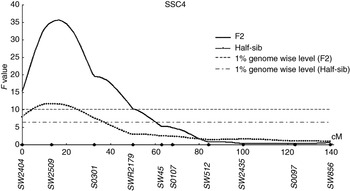
To our knowledge, no genome scan has been performed for the F41 adhesion QTL in pigs. In this study, we employed both F2 and half-sib models to detect QTL in case of fixation or segregation of QTL genotypes within each founder line. In the F2 analysis, one genome-wide significant and two suggestive (5% chromosome-wide) QTL for susceptibility to F41 were identified on SSC4, SSC5 and SSC15, respectively (Table 3). The most significant QTL was found in a region between SW2509 and S0301 on SSC4 (Figure 1) with a 95% confidence interval of 13 cM. This QTL explained up to 7.9% of the phenotypic variance with the favourable allele decreasing the number of adhesive bacteria from the Erhualian breed. However, the favourable allele of the QTL on SSC5 was inherited from the White Duroc breed, which is opposite to allele effect of the QTL on SSC4. This observation indicated that genes conferring susceptibility to F41 are segregating in both White Duroc and Erhualian founder animals, which was consistent with the adhesion results in purebred White Duroc and Erhualian piglets in the current study. Another suggestive QTL at 54 cM on SSC15 showed a much larger dominant effect than additive effect (17.2 ± 5.04 v. 1.60 ± 3.18), appearing to be overdominant. However, suggestive QTL should be interpreted with caution for potential false positive results. In the half-sib analysis, only one QTL at 1% genome-wide significance level was detected at 12 cM on SSC4, with a confidential interval almost perfectly overlapping with that of the QTL on this chromosome detected by the F2 analysis (Figure 1).
Details of QTL for susceptibility to ETEC F41 detected in the White Duroc × Erhualian intercross resource population

QTL = quantitative trait loci; ETEC F41 = enterotoxigenic Escherichia coli F41; SSC = pig chromosome number.
aSignificance level: *5% chromosome-wide significance level; **1% genome-wide significance level.
b95% confidence interval.
cAdditive effects and their standard error.
dDominance effects and their standard error.
ePercentage of the phenotypic variance explained by the QTL.
Statistic F-value curve indicating the significant quantitative trait loci for susceptibility to F41 on SSC4 using both F2 and half-sib analyses. Horizontal axis represents length of the linkage map and vertical axis represents F values. Threshold of 1% genome-wide level is indicated by dashed line. Markers genotyped on this chromosome are indicated by diamond symbols on horizontal axis.

ETEC F41 fimbriae can bind to periodate-sensitive oligosaccharides of glycoproteins in the colostrum (Lindahl, Reference Lindahl1989). Acidic monosaccharides, particularly sialic acid, were effective inhibitors of haemagglutination of F41 adhesin (Brooks et al., Reference Brooks, Cavanagh, Jayroe, Janzen, Snoek and Trust1989). In the significant QTL region associated with susceptibility to F41 on SSC4, we found a interesting candidate gene, ST3 beta-galactoside alpha-2,3-sialyltransferase 1 (ST3GAL1). This gene encodes a type II membrane protein that catalyses the transfer of sialic acid from cytidine 5′-monophosphate-sialic acid to galactose-containing substrates (Harduin-Lepers et al., Reference Harduin-Lepers, Mollicone, Delannoy and Oriol2005), and is expressed in the small intestinal epithelium in mice (Takashima et al., Reference Takashima, Tachida, Nakagawa, Hamamoto and Tsuji1999). The association of ST3GAL1 with susceptibility to F41 in pigs requires further investigation.
Susceptibility to E. coli K88ab/ac has been firmly established as a dominant monogenetic trait (Python et al., Reference Python, Jorg, Neuenschwander, Asai-Coakwell, Hagger, Burgi, Bertschinger, Stranzinger and Vogeli2005). In this study, F41 adhesion phenotypes were recorded only for F2 animals. It is hence difficult to directly deduce the model of inheritance for adherence of ETEC F41. We used the total number of F41 bacteria adhering to each animal rather than binary treatment as phenotype variable in the QTL model. This method allows us to detect a significant region on SSC4 showing remarkably additive rather than dominant (28.00 ± 3.26 v. 3.91 ± 5.01) effects on susceptibility to F41. These results implied that susceptibility to F41 could be a multifactorial trait in pigs.
In summary, we used F2 and half-sib models to detect QTL for susceptibility to ETEC F41 in the White Duroc × Erhualian resource population. The two analyses consistently detected a 1% genome-wide significant QTL on SSC4. Moreover, we showed the prevalence of susceptibility to ETEC F41 in the two founder breeds (White Duroc and Erhualian). To our knowledge, this study is the first to report the QTL for susceptibility to F41 in pigs. Further work will be directed toward fine mapping of the significant QTL on SSC4, with the ultimate goal to identify tightly linked markers or causal genes underlying susceptibility to F41 in the pig.
Acknowledgements
This study was financially supported by National 863 Program of China (2006AA1Z194) and the Jiangxi Provincial Key Research Project.