I. INTRODUCTION
Controlling the cast structure is one of the most fundamental requirements of the foundry industry. The grain size is an important quality characteristic of a sound cast. Grain refinement has attracted much attention for many years in both industrial and academic fields since fine, equiaxed grain structures can impart to the castings uniform and improved mechanical properties throughout the material, improved ability to achieve uniformly anodized surface, and super plasticity. Reference Ohno and Motege1–Reference StJohn, Qian, Easton and Cao3 Furthermore, a sound grain-refining practice avoids hot tearing, allows a marked increase in casting speed, and improves the homogeneity of the cast structure by refining the distribution of secondary phases and microporosity. Reference Jones and Pearson4 The use of grain-refining master alloys in casting of ingots, billets, and strips has thus become a standard practice in Al foundries worldwide. Reference Yu, Liu, Wang and Bian5 The grain refinement of aluminum alloys by melt inoculation is generally achieved by introducing grain refiners into the melt; the vast majority of grain-refining applications use Al–Ti–B alloys which typically consist of soluble Al3Ti and insoluble TiB2 particles in an aluminum matrix with extremely small amounts of Ti and B in solution. Reference Wang, Fu, Chen, Xu, Zhu, Cao and Li6 Owing to the importance of grain refinement to a broad range of aluminum alloys, a large amount of research has been carried out to determine the mechanisms by which grain refinement occurs. Reference Quested7,Reference Mohanty and Gruzleski8 There are many models on the mechanism of grain refinement by Al–5Ti–1B, in which the duplex nucleation theory is accepted by most investigations. The essence of duplex nucleation theory is that the TiB2 particles with a thin Al3Ti layer serve as the nuclei in the crystallization. Reference Mohanty and Gruzleski8
Many investigations find that holding time is a critical parameter during the refinement of Al–5Ti–B in aluminum. Reference Gerloff, Heyroth, Reif, Schmidt and Wang9–Reference Wang, Guo, Chen and Liao11 If the holding time is too short, the finest grain size may not be achieved. On the other hand, if the holding time is too long, the effectiveness of the grain refiner will be lowered. This lower effectiveness at excessive holding time is known as fading effect. Many investigators Reference Wang, Guo, Chen and Liao11,Reference Limmaneevichitr and Eidhed12 ascribe the fading mechanism to agglomeration and sedimentation of TiB2 with a higher density compared to that of molten Al.
Due to its effectiveness in grain refinement, easy operation, elimination of macrosegregation, and homogeneous temperature distribution, the electromagnetic stirring process during solidification is receiving more and more attention. A number of studies have already been reported concerning the impact of rotating magnetic fields (RMFs) in solidifying metals. Reference Vives13–Reference Szajnar and Wròbel17 However, effects of RMF on the fading effect during refinement of pure Al by inoculation have been rarely examined. Compared with natural convection, the flow pattern of forced-melt flow generated by RMF is different and the flow intensity is stronger and more adjustable. Hence, it is worth studying the effect of forced-melt flow generated by RMF on the fading effect of Al–5Ti–1B during the refinement of commercial pure Al.
In the present study, effects of RMF on the grain refinement potency of Al–5Ti–1B during the solidification of commercial pure Al are investigated. Furthermore, the mechanism of improved fading resistance of Al–5Ti–1B caused by RMF is also discussed.
II. EXPERIMENTAL PROCEDURES
Commercial pure Al (99.7%, all compositions quoted in this work are in wt% unless otherwise stated) was used as the experimental material. The selected refiner was Al–5Ti–1B, whose composition is as follows: Ti, 5.2%; B, 0.98%; Fe, 0.18%; and Al, balance. Commercial pure Al was melted in an electrical resistance furnace and the melting temperature was kept at about 720 ± 5 °C. After melting and temperature stabilization, 0.2% Al–5Ti–1B was added to Al. Al–5Ti–1B was dried in an oven at 300 °C and then wrapped in aluminum foil before addition to ensure that it dissolved properly and evenly throughout the melt. The melt was stirred thoroughly for homogenization using a graphite rod for 30 s after inoculation, and then poured at regular intervals (0, 5, 10, 20, 30, and 60 min) into a graphite crucible (40 mm in inner diameter and 100 mm in height) that was preheated to 720 °C. The sample designated as 0 min refers to that part of the Al melt which was cast before the addition of the grain refiner.
To investigate effects of RMF on the refinement efficiency of Al–5Ti–1B in pure Al, a series of experiments was designed. RMF with magnetic flux densities of 6, 12, and 18 mT was applied to the inoculated Al after pouring at regular intervals (0, 5, 10, 20, 30, and 60 min) until the temperature decreased to 662 ± 1 °C. The temperature was controlled by a K-type thermocouple connected to a temperature recording device, and the thermocouple was immersed in the melt at 15 mm depth and clung to the mold wall.
Specimens collected in this study were all cut across transversal sections at a height of 20 mm from the bottom of castings for macrostructural characterization to avoid experimental error. Then the specimens were ground and polished using standard metallographic procedures for macrostructure and microstructure examinations. The etched reagent for macrostructure was a mixed acid of 75 mL HCl, 25 mL HNO3, and 5 mL HF. The solidification microstructure of the samples was observed with an optical microscope, and the grain size measurements were carried out by the mean linear interception method using an image analyzer.
III. RESULTS
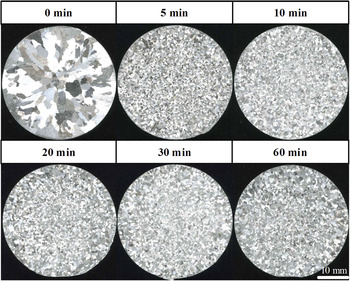
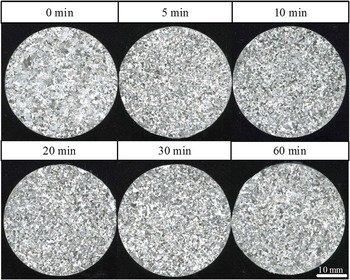
Figure 1 shows the macrostructures of specimens with different holding times after adding Al–5Ti–1B to Al. The comparison of these photographs demonstrates that complete conversion of coarse columnar to fine equiaxed grain structure occurs within 5 min after inoculation with Al–5Ti–1B. In the case of solidification without Al–5Ti–1B, the coarse columnar grains start to grow vertically from the wall of the mold in the opposite direction of the heat flow. After adding Al–5Ti–1B to the melt, the equiaxed grains can be achieved because of the introduced heterogeneous nucleation sites. However, with the increase in holding time, the refinement potency of Al–5Ti–1B decreases. It can be seen that the solidification structure with the holding time of 60 min is much coarser than that of 5 min.
Macrostructures of commercial pure Al by inoculation with different holding times.

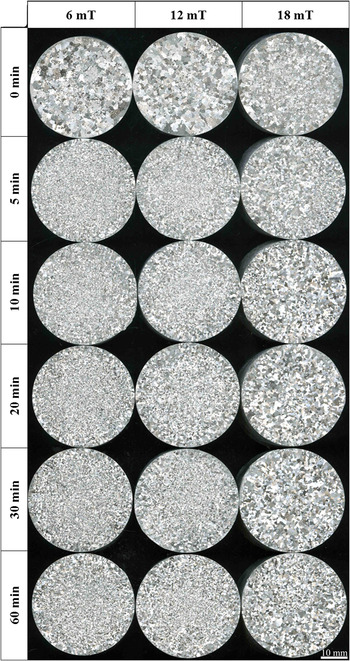
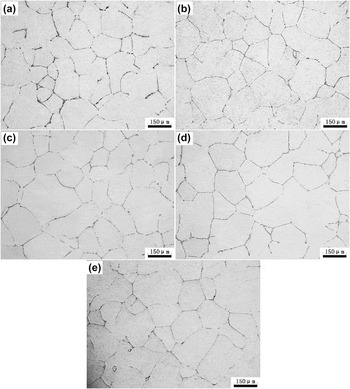
The consequences of RMF with increasing magnetic flux density on the refinement of commercial pure Al by Al–5Ti–1B are shown in Fig. 2, and the microstructures treated by inoculation and RMF with magnetic flux density of 6 mT are presented in Fig. 3. When applying RMF to Al melt without Al–5Ti–1B until the temperature decreases to 662 °C, big columnar grains change into coarse equiaxed grains, and the grains become finer with the increase in magnetic flux density. When RMF is applied to the inoculated Al, the refinement performance of Al–5Ti–1B is almost invariant with the prolongation of holding time. It is interesting to note that the solidification structure of the uninoculated Al becomes finer, while that of the inoculated Al becomes coarser with the increasing magnetic flux density.
Macrostructures of inoculated Al with RMF until the temperature decreased to 662 °C.

Microstructures of commercial pure Al treated by RMF with magnetic flux density of 6 mT and inoculation with the holding time of (a) 5 min, (b) 10 min, (c) 20 min, (d) 30 min, and (e) 60 min.

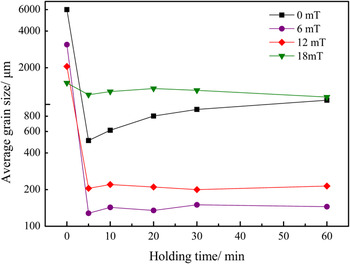
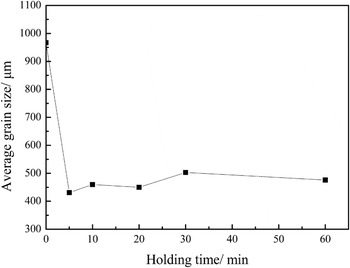
Figure 4 depicts the average grain sizes of commercial pure Al treated by inoculation and RMF with different intensities. It is clear that further reduction in grain size is achieved after adding Al–5Ti–1B to Al. With the increase in holding time, there is an obvious loss of refinement potency in Al by Al–5Ti–1B. The average grain size with the holding time of 60 min is 1083 μm which is about twice that achieved with 5 min. Applying RMF to the inoculated Al, the average grain size can be further reduced with magnetic flux densities of 6 and 12 mT and shows a small fluctuation with the prolongation of holding time. However, when the magnetic flux density of RMF increases to 18 mT, the mean grain size is coarser than that obtained using single inoculation.
Average grain sizes of commercial pure Al treated by inoculation and RMF with different magnetic flux densities.

IV. DISCUSSION
A. Effect of RMF on grain refinement of inoculated Al
When an alternating current is imposed, the coil generates RMF in the melt. This field, in turn, creates an induced vortex current in the melt in the opposite phase to the imposed alternating current. As a result, the melt is subjected to an electromagnetic body force caused by the interaction of the vortex current and the magnetic field, which can be expressed as follows: Reference Vives18
 $$F = J \times B = ({1 \mathord{\left/ {\vphantom {1 \mu }} \right. \kern-\nulldelimiterspace} \mu })(\nabla \times B) \times B\quad ,$$
where J is the induced vortex current; B and μ represent the magnetic flux density and magnetic permeability, respectively; and ∇ is the Hamilton operator.
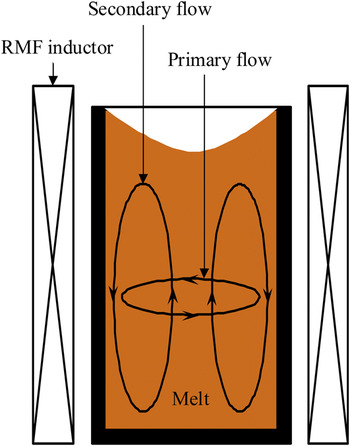
The electromagnetic body force generates a forced convection in the melt. In the steady state, the primary flow driven by RMF is a rotation of the fluid around the cylinder axis. The electromagnetic body force is not uniform along the axial direction and reaches a maximum at the horizontal midplane of the cylinder, where the velocity declines to zero at the wall across the developing Bödewadt boundary layers. Reference Davidson and Pothérat19 The consequence is an imbalance of the centrifugal forces, driving a radial inward flow along the solidification front. For reasons of continuity, a secondary circulation appears in the longitudinal plane, which has the form of two toroidal vortices. The two types of flow patterns in the liquid cylindrical volume generated by RMF are illustrated in Fig. 5.
Flow pattern of forced-melt flow generated by RMF.

The forced convection provides an efficient mixing to the temperature field which reduces the temperature gradient in the melt. When applying RMF to the molten Al without Al–5Ti–1B until the temperature decreases to 662 °C close to the liquidus temperature, the Al is inclined to simultaneous solidification because of the decreasing temperature gradient caused by the forced convection. Therefore, the solidification structure of the uninoculated Al transforms from dendrites into coarse equiaxed grains with the application of RMF nearby the liquidus temperature as shown in Fig. 2 (0 min).
With the prolongation of holding time, TiB2 particles agglomerate into clusters and settle down, leading to a larger particle density of TiB2 at the bottom of the crucible. However, when applying a RMF with a small magnetic flux density to the inoculated Al, the clusters reach the top under the action of the secondary flow, break up, and distribute uniformly. In addition, the temperature gradient is reduced by electromagnetic stirring. Therefore, when applying RMF with magnetic flux density of 6 mT to the inoculated Al until the temperature decreases to 662 °C, homogeneous distribution of TiB2 particles and low temperature gradient make a big contribution in increasing the effective nuclei, which leads to an increasing fading resistance of Al–5Ti–1B in grain refinement as shown in Fig. 3.
Investigations Reference Vives13,Reference Steinbach and Ratke16,Reference Fragoso and Santos20 show that the solidification structure can be refined when applying RMF to the melt during the entire solidification process. In this study, a fine solidification structure has been achieved when a RMF of 6 mT was applied to the inoculated Al until the temperature decreased to 662 °C. Can a much finer solidification structure be achieved if RMF was applied until solidification? To clarify this question, another group of experiments was designed. RMF with magnetic flux density of 6 mT was applied until solidification after pouring at regular intervals (0, 5, 10, 20, 30, and 60 min). Figure 6 shows macrographs of pure Al and Fig. 7 shows the corresponding average grain sizes of different samples. Compared to Fig. 1 (0 min) and Fig. 2 (6 mT, 0 min), Fig. 6 (0 min) clearly demonstrates that the solidification structure is significantly refined when RMF is used until solidification. The grain size can be further reduced under the combined effect of RMF and inoculation. Meanwhile, the grain size presents a small fluctuation as shown in Fig. 7. However, the grain size with RMF until solidification is much larger than that with the application of RMF to the inoculated Al until the temperature decreased to 662 °C.
Macrostructures of commercial pure Al treated by RMF with magnetic flux density of 6 mT until solidification.

Average grain sizes of commercial pure Al treated by RMF with magnetic flux density of 6 mT until solidification.

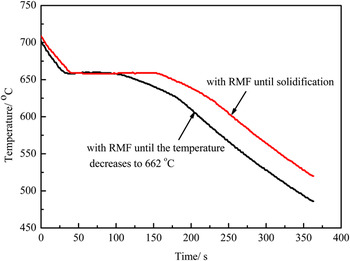
To investigate why the solidification structure became coarse when applying RMF to the inoculated Al until solidification, the thermal analysis method was adopted. Cooling curves of the inoculated Al under RMF were measured by K-type thermocouples and recorded using a temperature recording device. The same RMF parameters and pouring temperature were used for these experiments. The thermocouple was immersed in the inoculated Al at a height of 20 mm from the bottom of the crucible. The measured cooling curves are shown in Fig. 8. It can be seen that the initial time of solidification is almost the same. However, the platform of the cooling curve treated by RMF until solidification is longer than that treated by RMF until the temperature decreased to 662 °C. In other words, the solidification time is prolonged when RMF is applied until solidification. According to the operating principle of the magnetic field, not only the magnetic field but also an induction current is produced when alternating current passes through the induction coil. Thus, Joule heat is obtained due to the induction current and it is time dependent on the system. It can be neglected during the time of applying RMF nearby the liquidus temperature since the combined action of forced convection and inoculation is dominant. However, the forced convection is weak at the stage of solidification, and electromagnetic energy is mainly converted into thermal energy. Hence, Joule heat cannot be ignored during the entire stage of solidification where the combined action of Joule heat and inoculation is dominant. The thermal analysis result indicates clearly that Joule heat is obvious when applying RMF to the inoculated Al until solidification, leading to an increase in the solidification time and giving the grains enough time to grow. Therefore, the solidification structure of the inoculated Al with RMF until solidification is much coarser (see Fig. 6) than that with RMF until the temperature decreased to 662 °C (see Fig. 2, 6 mT).
Cooling curves of inoculated Al under RMF.

B. Intensity of RMF on the refinement potency of Al–5Ti–1B in pure Al
As expressed in Eq. (1), an electromagnetic body force is produced in Al when RMF is applied. Under the influence of RMF, there is a centrifugal force field in the melt. TiB2 particles in the melt will perform a radial motion outward in addition to a rotary motion under the action of the centrifugal force, due to the difference between the densities of TiB2 and Al (4.459 and 2.37 g/cm3, respectively). The radial velocity v P according to Stokes formula Reference Szekdy21 :
 $${v_{\rm{P}}} = {{2r{R^2}{\omega ^2}\left( {{\rho _1} - {\rho _2}} \right)} \over {9\nu }}\quad ,$$
where r is the radius of the particle; R is the distance of the particle from the axis; ρ1 and ρ2 are the densities of TiB2 particle and Al melt, respectively; and ν is the viscosity of the Al melt. It can be seen that v P is directly proportional to R 2 and ω2, and the TiB2 particle exhibits a tendency to move to the peripheral part, rather than the center of the sample. Therefore, the TiB2 particles will move with different velocities because of the uneven electromagnetic force. Under RMF with magnetic flux density of 18 mT, according to the gradient collision model proposed by Saffman and Turner, Reference Saffman and Turner22 the collision probability of the TiB2 particles will be highly increased when the particles move with different velocities in the melt. Furthermore, some TiB2 particles will move along radial directions in the melt because of the centrifugal force field caused by the RMF, which will also increase the collision probability of the TiB2 particles. As a result, the TiB2 particles will collide with each other and agglomerate into clusters in the melt due to the effect of intense convection caused by the RMF. Hence, the application of RMF with magnetic flux density of 18 mT can aggravate the agglomeration of TiB2 particles, which leads to a loss of the refinement potency of Al–5Ti–1B as shown in Fig. 2 (18 mT). In other words, the effect of inoculation can be greatly weakened by highly forced convection caused by RMF with magnetic flux density of 18 mT.
V. CONCLUSIONS
The effect of RMF on the refinement potency of pure Al by Al–5Ti–1B has been investigated. Several conclusions can be derived from this study:
-
(1) By adding Al–5Ti–1B to pure Al, the grain size can be reduced. However, with the prolongation of holding time, there will be an obvious loss of potency on the refinement of Al–5Ti–1B.
-
(2) When applying RMF with magnetic flux density of 6 mT to the inoculated Al until the temperature decreased to 662 °C, the fading effect of Al–5Ti–1B can be eliminated to a great extent. Simultaneously, a finer solidified structure can be achieved, which is attributed to the homogeneous distribution of TiB2 particles and low temperature gradient caused by forced convection.
-
(3) The effect of inoculation can be greatly weakened by RMF with magnetic flux density of 18 mT, because intensely forced convection caused by the RMF can aggravate the agglomeration of TiB2 particles.
-
(4) The finest solidification structure can be achieved by inoculation and RMF with magnetic flux density of 6 mT until the temperature decreased to 662 °C.
ACKNOWLEDGMENTS
The authors gratefully acknowledge the support of the Natural Science Foundation of China (Grant Nos. 51134013, 51271042, and 50874022), the China Postdoctoral Science Foundation (Grant No. 2013M530913), and the Fundamental Research Funds for the Central Universities of China.