Introduction
During recent decades in the most developed countries, older workers have been leaving their full-time jobs in ever increasing numbers and at earlier ages (Boersch-Supan Reference Boersch-Supan2000; Wise Reference Wise1997). This tendency toward early retirement has been spurred by changing national pension structures and by pension programmes that encourage early exit (Conde-Ruiz and Galasso Reference Conde-Ruiz and Galasso2003; D'Amours, Lesemann and Crespo Reference D'Amours, Lesemann and Crespo2001). It is timely to ask, therefore, whether the growing trend toward early retirement is good for older people. A key component of a good old age is longevity, and particularly disability-free survival. Urban legends have claimed that early retirement promotes longer life (Padfield Reference Padfield1996), but empirical studies have found little support for this assertion (Morris, Cook and Shaper Reference Morris, Cook and Shaper1994; Tsai et al. Reference Tsai, Wendt, Donnelly, de Jong and Ahmed2005). The association between early retirement and mortality requires greater scrutiny. A major challenge in the study of ‘early retirement’ is its diversity: the phrase describes different and even conflicting states. Early exit from the workforce can on the one hand reflect poor health (Green Reference Green2006), or on the other a privileged occupational status (Mein et al. Reference Mein, Martikainen, Stansfeld, Brunner, Fuhrer and Marmot2000). As a result, it is difficult to disentangle the effect of the timing of exit from the labour force on survival in later-life (Quaade et al. Reference Quaade, Engholm, Johansen and Moller2002).
The study reported in this article offers new evidence regarding the effect of early retirement on mortality, or the lack thereof. It addresses the association between early retirement and seven-year all-cause mortality in a sample of 2,374 older Jewish Israelis. The inquiry was made possible by linking data from a comprehensive national household survey in Israel in 1997 of people aged 60 or more years with 2004 data from the Israeli Death Registry. The analysis is innovative in that it takes into account both the age of retirement and the reason for retirement. As such, it seeks to provide greater clarity in understanding the association of early exit from the workforce and subsequent survival.
Early retirement and mortality
Early retirement may be defined as exit from the workforce earlier than a specified normative age. The actual timing of early retirement varies across countries and professions, but most countries are currently experiencing accelerating falls in labour-force participation rates among older workers (Boersch-Supan Reference Boersch-Supan2000; Siegrist Reference Siegrist2005, Wise Reference Wise1997). Early retirement is made possible, and indeed encouraged, by pension programmes and structures. A study of elderly labour-force participation and retirement decisions in The Netherlands found, for example, that institutional structures of benefit and pension programmes were prime determinants of the timing of retirement (Heyma Reference Heyma2004). Correspondingly, an analysis of early exit from the workforce in Canada underscored the role of firms' policies and practices along with the contribution of public policies concerning retirement (D'Amours et al. Reference D'Amours, Lesemann and Crespo2001). A review by Friedberg and Webb (Reference Friedberg and Webb2005) showed that defined-benefit retirement plans with age-related incentives contributed to the lowering of the retirement age in the United States. In contrast, Americans with defined-contribution plans that lacked age-related incentives were found to retire some two years later. Thus the policy context of early retirement, as well as its programmatic mechanisms, have been instrumental in promoting earlier exits from the labour force.
A leading reason for the decision to retire early is poor health (Mein et al. Reference Mein, Martikainen, Stansfeld, Brunner, Fuhrer and Marmot2000; Waldron Reference Waldron2001), though one study using early United States Health and Retirement Study data reported no health differences between Social Security benefits claimants and non-claimants aged 62 years (Burkhauser, Couch and Phillips Reference Burkhauser, Couch and Phillips1996). Many early exits from the workforce result from occupational-related injuries (Pransky, Benjamin and Savageau Reference Pransky, Benjamin and Savageau2005) or illnesses (Brenner and Ahern Reference Brenner and Ahern2000), from chronic conditions related to unhealthy behaviours such as smoking (Husemoen et al. Reference Husemoen, Osler, Godtfredsen and Prescott2004), or for other associated reasons. Poor mental health has also been recognised as a precursor of early exit (Butterworth et al. Reference Butterworth, Gill, Rodgers, Anstey, Villamil and Meļzer2006; Buxton, Singleton and Melzer Reference Buxton, Singleton and Melzer2005; Karpansalo et al. Reference Karpansalo, Kauhanen, Lakka, Manninen, Kaplan and Salonen2005). Job-related factors are additional precipitants of early retirement. For instance, a preference for premature exit is predicted by excessive job demands (Elovainio et al. Reference Elovainio, Forma, Kivimaki, Sinervo, Sutinen and Laine2005), especially among women (Soidre Reference Soidre2005), and by lack of satisfaction with one's job (Mein et al. Reference Mein, Martikainen, Stansfeld, Brunner, Fuhrer and Marmot2000; Reitzes, Mutran and Fernandez Reference Reitzes, Mutran and Fernandez1998). Involuntary early retirements also stem from plant closures, company down-sizing and other corporate changes (Isaksson and Johansson Reference Isaksson and Johansson2000; Szinovacz and Davey Reference Szinovacz and Davey2005).
The relationship between socio-economic status and early retirement is complex. A study in Scotland noted, for example, that many lower income workers do not prepare for their retirement for various reasons including family responsibilities, personal histories, cultural factors and general orientation to life (Anderson et al. Reference Anderson, Li, Bechhofer, McCrone and Stewart2000). On the other hand, a Swedish study found that low socio-economic status was a risk factor for being granted a disability pension even after controlling for work conditions and health conditions (Mansson et al. Reference Mansson, Rastam, Eriksson and Israelsson1998). Then again, low income may also generate the need to continue working despite the worker's preference. The Whitehall II study of British civil servants found that material problems tended to keep people working (Mein et al. Reference Mein, Martikainen, Stansfeld, Brunner, Fuhrer and Marmot2000), and similarly data from the United States ‘Asset and Health Dynamics Among the Oldest Old’ (AHEAD) study suggest that people lacking sufficient health benefits for retirement work longer, to retain access to employer-provided health insurance or to pay for high out-of-pocket medical expenses (Green Reference Green2006). Thus, low income may or may not lead to early retirement.
Gender is also linked to retirement decisions (Szinovacz and DeViney Reference Szinovacz and De Viney2000). Analysis of data from the ‘German Socio-Economic Panel’ found, for example, that having children delayed a woman's exit from the labour force, particularly among those who gave birth to their first child relatively late, and among those who were employed during the earlier child-rearing years (Hank Reference Hank2004). Using American data, Pienta (Reference Pienta1999) also found that women who delayed child-bearing were more likely to remain in the labour force during their later years. An analysis of data from the US ‘National Survey of Families and Households’ found, moreover, that the effect of family obligations on retirement decisions varied by gender, race and marital status (Szinovacz, DeViney and Davey Reference Szinovacz, DeViney and Davey2001).
The focus of this paper is the association between early retirement and mortality. A number of studies have addressed this topic and produced variable findings. One early study of the American rubber-tyre industry, for example, compared workers who left work prematurely (age 62–64 years) with those who retired on time (age 65 years). The study found that among the early retirees, pre-retirement health was the major predictor of survival. Among the ‘normal’ age retirees, on the other hand, occupational status not health predicted survival (Haynes, McMichael and Tyroler Reference Haynes, McMichael and Tyroler1978). A British study examined the correlates of survival over five-and-a-half years among men aged 40–59 years who had been continuously employed for at least five years. After adjustment for socio-economic variables, health-related behaviour and health indicators, the non-employed showed higher mortality. The investigators noted, moreover, that those who retired early for reasons other than poor health (and who appeared to be comparatively fortunate), had a significantly increased risk of mortality when compared with those who remained continuously employed (Morris, Cook and Shaper Reference Morris, Cook and Shaper1994). Similarly, an American study found that men who retired early died sooner than men who retired at age 65 or more years (Waldron Reference Waldron2001). In this latter study, it was assumed (but not verified) that poorer health had contributed to both early retirement and to earlier deaths.
In contrast, a Danish study found that early retirement prolonged survival for men (Munch and Svarer Reference Munch and Svarer2005). Another Danish study compared mortality among persons who left employment early through disability benefits (granted mainly for health reasons), and among those who left through other early retirement benefits (Quaade et al. Reference Quaade, Engholm, Johansen and Moller2002). The results showed that mortality among the early-retirement benefit recipients was lower than among the recipients of disability benefits, but greater than among employed persons. Moreover, the relative risk of death among the early-retirement benefit recipients increased with time since retirement. The investigators suggest that an adverse effect of retirement on health may have been responsible for the increased mortality among the early-retirement benefit recipients.
Alongside such studies that suggest either a greater or a lesser risk of mortality as a result of early retirement, a recent study of American workers in the petrochemical industry found no such association (Tsai et al. Reference Tsai, Wendt, Donnelly, de Jong and Ahmed2005). The study compared employees who retired at ages 55, 60 and 65 years. It found that mortality among those who retired at 55 years was higher than among those who continued working. Moreover, after adjustment for gender, year of entry to the study, and socio-economic status, the mortality of those who retired at 60 years was similar to that of those who retired at 65 years. The investigators concluded that retiring early was not associated with longer survival than among those who retired at the prescribed age, although the data did not allow the researchers to examine whether those who retired early were in poorer health. Mortality rates are influenced by several factors, some of which also influence early retirement decisions, including age (Ahmad and Bath Reference Ahmad and Bath2005; Bath Reference Bath2003), gender (Shye et al. Reference Shye, Mullooly, Freeborn and Pope1995; Walter-Ginzburg et al. Reference Walter-Ginzburg, Shmotkin, Blumstein and Shorek2005), socio-economic status (Manor et al. Reference Manor, Eisenbach, Peritz and Friedlander1999) and health status (Walker et al. Reference Walker, Maxwell, Hogan and Ebly2004). Disability and common diseases are known to increase mortality risk in later-life, especially cancer, diabetes, heart attack, stroke and dementia (Aguero-Torres et al. Reference Aguero-Torres, Fratiglioni, Guo, Viianen and Winblad1999; Feil, Marmon and Unutzer Reference Feil, Marmon and Unutzer2003; Schupf et al. Reference Schupf, Costa, Luchsinger, Tang, Lee and Mayeux2005).
As noted earlier, the present analysis focuses upon older Jews in Israel. Previous analysis of older Israelis from all backgrounds found associations between several of the variables noted above and seven-year all-cause mortality (Litwin and Shiovitz-Ezra Reference Litwin and Shiovitz-Ezra2006b). For example, the older-old were much more likely to have died than those aged 60–69 years, and men were more likely than women to have died. In addition, persons who had been diagnosed with major illness were found to have had higher mortality. Another Israeli study addressed the association of continued employment and survival among community-dwelling 70-year-olds in Jerusalem. Subjects who had been employed at baseline (including as volunteers) were compared to persons who had not been employed at the time. Seven years later, after controlling for socio-economic status and health, those who had been working at age 70 years had better survival rates (Hammerman-Rozenberg et al. Reference Hammerman-Rozenberg, Maaravi, Cohen and Stessman2005). Thus, work status, as well as background and health characteristics, need to be taken into account in the study of mortality.
In sum, clarification of the association between early retirement and mortality is a complex undertaking, because early retirements result from quite different reasons. Inquiry into this area must equally take into account the age of exit from the workforce and the reasons for choosing to retire early. In addition, such analyses must control for the effects of other variables that may be related to early retirement, to mortality, or to both.
Data and methods
The data for the analysis were from a national household survey of older adults (Litwin and Shiovitz-Ezra Reference Litwin and Shiovitz-Ezra2006a) conducted by the Israeli Central Bureau of Statistics (CBS) in 1997. The present analysis focuses upon the 2,397 respondents aged 60 or more years who reported that they had been employed in Israel prior to baseline (1997) or were still employed at baseline. All but 23 respondents (about one per cent) in the sample had specified the reason for exiting the workforce, or were still working at baseline. The study sample thus comprised 2,374 respondents, consisting of 1,443 men and 931 women, who had ever worked during their lives. The employment history data were linked to mortality records for 2004 from the Israeli Death Registry.
The variables and measures
The outcome variable was seven-year mortality risk (from 1997 to 2004), which was calculated from the recorded deaths. At the end of the monitored period, 613 sample members had died (25.8%). The main independent variable, early retirement, was measured both in terms of the timing of the event (age at retirement), and the motivation for exit from the labour force (reason for retirement). The timing or age of departure from work was calculated by subtracting the year of birth from the year that was indicated by the respondent as the date of cessation of his or her employment. The resultant ages were then collapsed into categories. Those who had left work before 50-years-of-age were classified as having ‘left work young’. Women who left work at ages 50–59 years, and men who left at ages 50–64 years, were classified as taking ‘early retirement’ (at the time of the baseline survey, eligibility for retirement pensions began at 60 years for women and 65 years for men). Correspondingly, women who retired when aged 60 or more years and men who retired when aged 65 or more years were considered to have retired ‘on time’. Respondents who were still working were labelled ‘not retired.’ Finally, about nine per cent of respondents failed to date their exit from work, and were assigned to a category labelled ‘missing data’. This particular category did not have any inherent meaning, but was used as a control.
As for retirement motivation, the respondents who indicated that they were no longer employed were asked the principal reason for their decision to cease work. Eight reasons or motivations that appeared in the questionnaire were collapsed into four main groups: (1) poor personal health, (2) leaving work for family reasons, such as marriage, caring for small children or for a sick spouse, (3) involuntary departure caused by unsatisfactory job conditions, plant closure, dismissal or other reasons, and (4) having reached the retirement age. The respondents who were still working constituted a fifth category.
The baseline background and health control variables addressed in the analysis included gender, age, income, education, and diagnosed illness. Gender was a dichotomy (men=1, women=0). Income had three categories: low – up to $10,000 per year (in New Israeli Shekels); medium – up to $20,000; and high – over $20,000 per year. Education similarly had three levels: low – 0–4 years of schooling or education; medium – 5–12 years; and high – more than 12 years. Finally, the health variable was a dichotomy based on diagnosed illness. Those who had ever been diagnosed with cancer, heart attack, stroke, diabetes or Alzheimer's disease were given the value ‘1’, while the respondents free of these conditions were allocated ‘0’.
Analytical method and test statistics
The analysis proceeded in several stages that begun with a univariate analysis of the two measures of early retirement – the timing of retirement and the motivation for leaving work – and examination of their association by means of cross-tabulation. Chi-squared tests of significance were used to test the association. The second stage was analysis of the unadjusted association of each of the two early retirement variables with mortality risk using Cox proportional hazards models. The third stage was a bivariate examination of the relationship between gender and both retirement timing and motivation using chi-squared tests. The fourth and final stage was a hierarchical multivariate examination of the associations between early retirement and mortality risk, again using Cox proportional hazards models, and adjusting for gender and other background characteristics including health. In the first model, mortality risk was regressed only on the two early-retirement measures. In the second model, gender was introduced, and in the third, age, income, education and diagnosed illness were added.
Results
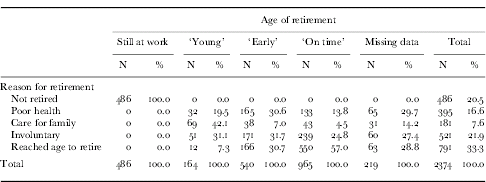
Four-in-ten of the respondents had retired ‘on time’ (40.6%), one-fifth were still working at baseline, more than one-fifth (22.7%) ‘retired early’, and about seven per cent left work at a young age. As noted earlier, about nine per cent did not indicate the age at which they left the workforce. As for retirement motivation, one-third of the respondents said that they had reached the age of retirement (Table 1). More than one-fifth reported that their exit from work had been involuntary, one-sixth noted that poor health was the primary reason for retirement, and fewer than eight per cent left work for family reasons. The relative frequencies of these reasons differed by the age at which respondents retired (Table 1). Only 57 per cent of those who retired ‘on time’ cited having reached the age of retirement as the primary reason for leaving work, and one-quarter of this group stated that their exit was involuntary. Most of the remaining respondents in this category cited poor health (13.8%) as their motivation for retirement and only a few noted the need to care for a family member.
Age retired and reason for retirement among older Israeli Jews, 1997
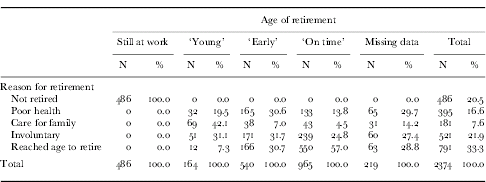
Note: Chi-squared=2879.8, 16 degrees of freedom, p<0.001.
Those who reported having left employment early, on the other hand, divided almost equally (about 31% each) between three motivation categories: poor health, involuntary exit and having reached the age of retirement. Many in the last group were probably either in occupations with officially recognised or normative early-retirement age options, or those who felt subjectively that it was time to retire even though they had not reached the normative age. A greater percentage (7%) of those retiring early cited having to care for a family member as their primary reason for leaving work than of those who retired on time. Nevertheless, the motivation was still the least common among the early retirees. This was not the case among those who left work ‘young’. The main reported motivation for having left work in this group was family reasons (42.1%). Almost another one-third cited their exit as involuntary and about one-fifth noted poor health. A few claimed that they had reached the age to retire, even though they had left work before 50 years-of-age. Among the respondents who did not indicate their age of retirement, the reasons for having left work divided fairly equally across the four main motivations, with the exception of family reasons which only few reported.
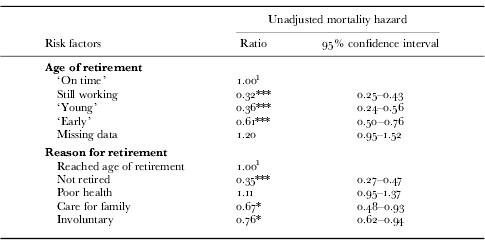
Table 2 presents the unadjusted risk ratios of mortality by age of retirement and by reasons for retirement. Normative retirement age and reason for leaving the workforce served as the respective reference categories. The figures show that, when compared to ‘on-time’ retirees, those retiring ‘early’ had a slightly lower risk of mortality, and those who left work ‘young’ or were still working had a much lower risk of mortality. Those in the missing data group, on the other hand, showed no association with mortality risk, reflecting the arbitrary character of this control category. Viewing the unadjusted reasons for retirement, it appears that those who left work involuntarily and those who left for family reasons had a somewhat lower risk of mortality than those who left because they had reached the age to retire. The still-working group had a much lower risk of mortality, as previously. Interestingly, those who cited poor health as their main motivation for retirement did not have a greater risk of mortality than the respondents who left work because it was the time to retire.
Age of retirement, reason for retirement and mortality over seven years, older Israeli Jews 1997–2004
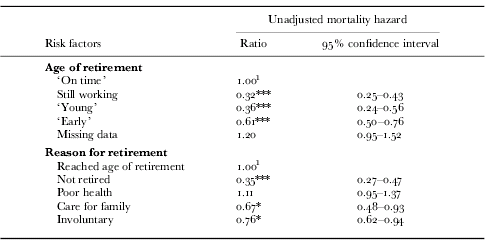
Notes: HR Unadjusted hazard ratios. 1. Reference category.
Significance levels: * p<0.05
*** p<0.001.
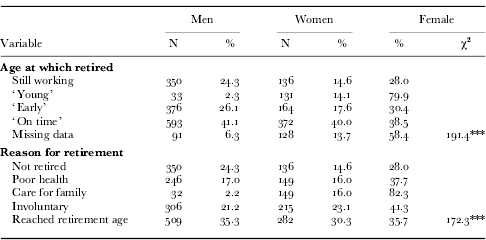
Table 3 presents the cross-tabulations of the variables ‘age at which retired’ and ‘reasons for retirement’ by gender. As may be seen, women constituted the overwhelming majority of respondents who had left work when ‘young’. More women also failed to indicate their age of exit from the workforce. In comparison, men constituted the majority of those reporting ‘early’ retirement and still being in work. The proportion of men and women retiring on time was about equal. As for reasons for retirement, women constituted the overwhelming majority of respondents who had left work for family reasons. On the other hand, the proportion of men and women in the other motivation categories was about equal (except for those still working which has already been reported). The sex differences in both the ‘age at which retired’ variable and the ‘reason for retirement’ measure were significant. Accordingly, multivariate assessment of mortality risk required adjustment for gender.
Age retired, reason for retirement and gender among older Israeli Jews, 1997
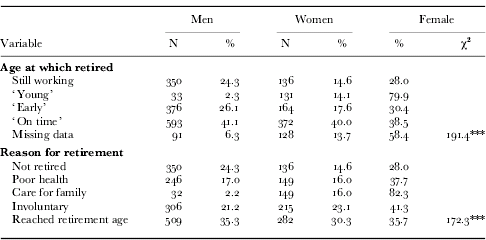
Significance level: *** p<0.001.
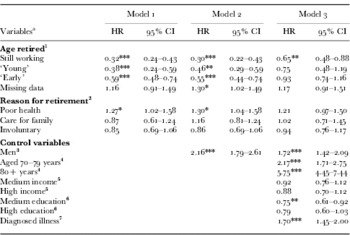
Table 4 shows the results of the multivariate analysis. Model 1 presents the risk ratios by the age of retirement categories adjusted for the reasons for retirement. As previously, normative age of retirement and reason for leaving the workforce served as the reference categories (in addition, the ‘not retired’ were treated as identical to the ‘still working’). As the model shows, ‘early retirement’ retained its somewhat lesser risk of mortality when adjusted for retirement motivation. Similarly, the categories having ‘left work young’ and ‘still working’ retained their even lesser risk of mortality. However, among the respective motivations for retirement, neither family reasons nor involuntary exit retained their previous unadjusted association. On the other hand, poor health as the primary reason for retirement emerged as a significant factor, and was associated with a slightly greater mortality risk.
Hierarchical multivariate analysis of retirement characteristics and mortality

Notes: HR: Adjusted hazard ratios. CI: confidence interval. Reference categories: 1. Retired ‘on time’ (women 60 years, men 65 years). 2. Reached age of retirement. 3. Women. 4. Aged 60–69 years. 5. Low income. 6. Low education. 7. No diagnosed illness.
Significance levels: * p<0.05
** p<0.01
*** p<0.001.
Model 2 added gender to the analysis. As may be seen, men were twice as likely to have died as women. Even after adjusting for gender, however, the relative risks of mortality that emerged in the previous model remained, with only minor changes of magnitude. That is, those still working and those who had retired young or early, had lesser risk of having died seven years later. People who left work for health reasons, on the other hand, had a greater risk. These differentials changed significantly when the remaining control variables were entered into the analysis. As may be seen in Model 3, when adjusted for gender, age, income, education and illness, only those who were ‘still working’ could be differentiated from the ‘on-time’ retirees. That is, persons still employed at baseline were 1.5 times less likely to have died seven years later. Moreover, none of the reasons for retirement remained significant predictors of mortality. The control for diagnosed illness outweighed the effect of poor health as the main motivation for leaving the labour force. A subsequent analysis (not shown here) added a term for the interaction between early retirement and poor health as the motivation for retirement. The results of that regression were identical to Model 3 and the interaction term was not statistically significant. In the final model, mortality was predicted primarily by age, gender and diagnosed illness at baseline. Survival was predicted by having been employed at baseline, and to a lesser degree, by having a medium level of education (as opposed to low education). The data in this analysis did not support an association between early retirement and mortality. Stated differently, ‘early retirement’ was not found to be related to subsequent longevity.
Discussion
Limitations of the study
While this examination of the reasons for retirement has elaborated our understanding of the causes of early exits from employment, there are potential shortcomings in this line of inquiry. Details of the reasons for retirement were from retrospective self-reports with unknown reliability and may have an element of ex post rationalisation (Bazzoli Reference Bazzoli1985). Similarly, self-reported health assessments may not be sufficiently robust. The current study found some discrepancies between the age of retirement and the reported reasons, particularly among those who made ‘early’ exits. Some of the incongruities may have arisen from the special arrangements for particular occupations or employers' policies that foster early normative retirement ages. This may have lead respondents to state that they left ‘on time’. Similarly, respondents who left work at the normative societal retirement age may nonetheless have seen their exit as involuntary, or motivated by declining health. Future research on the issue needs to develop more robust and distinctive measures of motivation. Another potential limitation of the current inquiry may arise because the attributes, attitudes and behaviour of the studied birth cohort, people aged 60 or more years in 1997, may not be shared by later cohorts.
The study's contribution
Given the recent spread of early retirement, this study has examined whether it leads to longer life and, specifically, whether survival is influenced by the timing of and reasons for retirement. The results suggest that early retirement was indeed associated with a lower risk of mortality. In both the unadjusted hazard regressions and those adjusted by gender and reason for retirement, ‘early’ retirees had significantly lower seven-year all-cause mortality than those who had retired ‘on time’. It was also found that those who cited poor health as the main motivation for leaving work had a higher rate of mortality than those who said that they left work because they had reached the age to retire. By separating health reasons for retirement from its timing, a positive association between early retirement and survival was established.
The final analytic model, however, did not support this association. When age, income, education and diagnosed illness were introduced into the hazards regression, the mortality risk among ‘early’ retirees did not prove to be distinguishable from that of respondents who had retired ‘on time’. Older age, male gender, and having been diagnosed with one or more of five major illnesses were all associated with higher mortality. Medium level education and still being employed at baseline, on the other hand, were associated with lower mortality. The timing of retirement, that is, early versus normative exit from the workforce, was not found to be related to survival.
The findings therefore support the conclusions from the study by Tsai and others (Reference Tsai, Wendt, Donnelly, de Jong and Ahmed2005) who found no association between early retirement and mortality among a sample of American workers. Indeed the findings are stronger evidence, because Tsai and colleagues' analysis did not address the retirees' health status. As the findings showed, the effect of the objective indicator, ‘diagnosed illness’, outweighed the effect of perceived or subjective health. The findings therefore corroborate the results of earlier studies that have shown a link between ‘early’ exit from the workforce and mortality, presumably because of poor health. Separation of the measurement of the timing of retirement from its motivation has more clearly specified the unique effect of early retirement on survival. The findings suggest that there is no such effect. The current analysis has also underscored the association between continued employment and survival in later life. The respondents who were still working at baseline showed significantly lower mortality over seven years even after controlling for gender, education and health status. It cannot be determined from the available data whether continued employment was the factor responsible for longer survival. It could have been a selection effect, with those who continued working enabled to do so by relatively good health. Further inquiry is warranted regarding this phenomenon.
Finally, a word is required about the environment in which early retirement takes place, particularly the policy context. Those concerned about the actuarial robustness of social security schemes have warned about the possible ill effects of early retirement on long-term insurance coverage. The scenario of people retiring at ever younger years and enjoying, as a result, longer years of life has produced actuarial alarm. This concern has encouraged calls to delay retirement so as to prevent the depletion of social security reserves. The fear is that the longer-living early retirees will make social insurance insolvent. This study has shown, however, that people who prematurely exit the labour force do not live significantly longer than others. The apprehension that early retirees will necessarily extend their claims on the social insurance mechanism over longer periods of time may not be fully warranted. In conclusion, the findings do not support the proposition that early retirement increases survival. In terms of longevity, those who left work early were indistinguishable from those who had retired on time.
Acknowledgements
The study on which this paper is based was made possible by financial support provided by the Israeli Ministry of Science and Technology to the Israel Gerontological Data Center at the Hebrew University in Jerusalem. I also thank Mr Aviad Lipkin, whose inquiry about the association between early retirement and survival lead to the development and the execution of this analysis.