INTRODUCTION
Water deficit is a major abiotic constraint that affects CO2 assimilation rates (A), diminishing both growth and production. Therefore, it is advisable to explore new cultivars, giving preference to those that tolerate water deficit best. Drought tolerance in crops has been evaluated through the analysis of various physiological characteristics: root traits, leaf area, gas-exchange parameters, water relations, carbon isotope discrimination and chlorophyll fluorescence (Baker and Rosenquist, Reference Baker and Rosenquist2004; Blum, Reference Blum, Jones, Flowers and Jones1989). So far, certain molecular and physiological mechanisms have been identified that suggest that plants’ response to drought will depend on the severity of stress, as well as other local environmental conditions (Cattivelli et al., Reference Cattivelli, Rizza, Badeck, Mazzucotelli, Mastrangelo, Francia, Mare, Tondelli and Stanca2008; Chaves et al., Reference Chaves, Pereira, Maroco, Rodrigues, Ricardo, Osorio, Carvalho, Faria and Pinheiro2002).
In a specific case of cacao, growth and production are regulated by the amount and distribution of rainfall (Almeida and Valle, Reference Almeida and Valle2007). Cacao crops are traditionally grown in areas with an annual rainfall exceeding 1500 mm, even though drought periods may occur, with durations that vary between regions and change from year to year. Variability in the length of dry period can affect productivity and quality of cacao beans (Moser et al., Reference Moser, Leuschner, Hertel, Hölscher, Köhler, Leitner, Michalzik, Prihastanti, Tjitrosemito and Schwendenmann2010). Studies related with the response of cacao cultivars to variations in the water supply have been conducted both in greenhouse and field conditions (Almeida et al., Reference Almeida, Brito, Aguilar and De Valle2002; Balasimha et al., Reference Balasimha, Daniel and Prakash1991; Rada et al., Reference Rada, Jaimez, Garcia-Nuñez, Azocar and Ramírez2005). The latter have the advantage of better representing natural microclimatic changes; including small diurnal variations in the water supply, unlike the relatively constant environment provided by the greenhouse. Information concerning the effect of drought on cacao crops in field conditions is notably scarce, and the current trend appears to characterise the metabolic response of plants to a combination of inter-related abiotic stresses (Mittler, Reference Mittler2006).
Under customary shade conditions of cacao farming, water deficit is a relatively slow process. High radiation, temperature and leaf–air vapour pressure differences (VPD), which usually occur during periods of water deficit, have a negative impact on assimilation in cacao plants. Typically, as soil-water deficit increases, more negative water potentials enhance limitations to water transport and, consequently, produce injury to plants. Plant death is potentially higher during the first two years of cultivation because of limited root development in the soil surface. Photochemical protection mechanisms and osmotic adjustment differences between cultivars (Almeida et al., Reference Almeida, Brito, Aguilar and De Valle2002) are likely related to the rates of survival and growth. Although the relationship between osmotic adjustment and higher yield has been established for commercial crops and shrubs (Babita et al., Reference Babita, Maheswari, Rao Arun, Shanker and Gangadhar Rao2010; Blum et al., Reference Blum, Jingxian and Nguyen1999), information regarding this relationship is controversial in the case of cacao; therefore, it remains unclear whether osmotic adjustment could be a water-deficit tolerance strategy in the case of cacao (Carr and Lookwood, Reference Carr and Lockwood2011).
Latin American countries (Colombia, Venezuela and Ecuador) are currently expanding cacao cultivation, particularly the Criollo-type because of its high quality; thus, it is necessary to improve its tolerance to water deficit in order to offer a wider range of cultivars that can be grown in regions with extended drought periods. An important advantage of growing cacao in drier environments is that it helps to minimise costs of pest- and disease-control chemicals, which are usually used in high dosage in humid environments (Almeida and Valle, Reference Almeida and Valle2007). In this aspect, information on Criollo cacao is very scarce, and studies under field conditions are limited.
To assess whether drought tolerance mechanisms, such as osmotic adjustment and photoprotection mechanisms, help improve growth and survival of Criollo cacao despite reduction in A and stomatal conductance (gs) rates, seasonal changes in gas exchange, chlorophyll fluorescence, water relations and growth were measured in juvenile plants of four Criollo cultivars planted under the shade provided by timber trees in the southern region of Maracaibo lake basin, in Venezuela.
MATERIALS AND METHODS
Timber species were planted between January and March 2007 to establish an agroforestry system with the Criollo cacao cultivars traditionally used by local producers in western Venezuela. The timber tree species planted were Cedrela odorata L. (Meliaceae), Cordia thaisiana Agostini (Boraginaceae), Swietenia macrophylla King (Meliaceae) and Tabebuia rosea (Bertol.) A. D.C. (Bignoniaceae), in addition to Erythrina fusca. All species were planted with a regular spacing of 6 m. Average heights of timber species at the time of the Criollo cacao cultivars plantation were 5.7 m for C. thaisiana, 4.3 m for C. odorata, 2.6 m for T. rosea and 2.4 m for S. macrophylla. Two-month-old seedlings were obtained from nursery facilities of Corpozulia and Experimental Tachira University, Venezuela. All cultivars were planted under these timber trees when the latter reached heights that provided adequate shade, which consisted of 30–40% reduction in full sunlight. The Criollo cultivars assayed in this system were Porcelana, Guasare, Porcelana and Criollo Merideño. Cultivars were planted on 10 December 2008 in rows alternating with timber trees at a distance of 3 × 3 m. Plantation design consisted of a randomised block with three replications, distributed in 2 ha. Each block had 16 plots (combination of four cacao cultivars and four timber tree species). Soils in the plantation at depths of 0–0.5 m alternate between sandy and loamy sands; with pH 5.2–6.3, N contents of 0.03–0.1% and P and K values ranging between 0–8 mg/kg and 25–118 mg/kg, respectively. Cacao seedlings were fertilised with 40 g per plant of 15-15-15 commercial NPK fertiliser and after nine months with 50 g per plant of 15-15-15-3 Ca-3S. Two preventive acaricide treatments were applied for the first four months.
During the assay, two dry periods, in which there was no rain and lasted for at least 28 days, occurred after seven and 13 months of planting of cacao seedlings. All ecophysiological measurements were carried out in mature leaves of 6th and 7th nodes. With the exception of pressure–volume curves (P–V), ecophysiological variables were measured during both dry and wet seasons of 2009 and 2010, and only in the plots planted under the shade of C. thaisiana and C. odorata, in order to maintain similar environmental conditions. Dry season measurements were carried out on 3 and 4 July 2009, then on 21 and 22 January 2010; wet season measurements were carried out on 14 and 15 October 2009 and 17 and 18 May 2010.
Water relations
Leaf water potentials (Ψ) were measured in both dry and wet seasons with the Scholander pressure chamber (Model SKPM 1400, Skye, Powys, UK) during early morning hours (Ψem) (0700–0745 hours) and noon (Ψn) (1300–1400 hours). Measurements were performed in four to five leaves of different individuals, located in different plots. Water potential parameters were determined from P–V curves, during both dry and wet seasons of 2010 in four individuals per cultivar according to the Tyree and Jarvis (Reference Tyree, Jarvis, Lange, Nobel, Osmond and Ziegler1982) method. Leaf samples were cut between 1600 and 1700 hours and immediately placed in a container with distilled water, recut under water and transported to the laboratory, where they were covered with black plastic bags and left to rehydrate at room temperature (16–18°C) during 15 hours, giving them sufficient time to reach full saturation. After measuring initial fresh weight and water potentials, the samples were allowed to transpire freely at room temperature. Fresh weight and water potential determinations were repeated several times until several points of the linear portion of the P–V curve were obtained. Dry weight samples were obtained by drying the leaves at 60°C. Average values of osmotic potential at full turgor (Ψ100π), osmotic potential at turgor loss point (Ψ0π) and volumetric elastic modulus (ε) were obtained from relative water content (RWC) versus 1/Ψ relations using the program for P–V curves (Microsoft Excel 2000, University of California Berkeley; Schulte and Hinckley, Reference Schulte and Hinckley1985).
Gas exchange
Leaf gas exchange variables (A, transpiration (E) and gs) and photosynthetic photon flux density (PPFD) were measured during both dry and wet seasons in five individuals per cultivar. All measurements were performed between 1000 hours and 1100 hours with a portable infrared gas analyser (LCA-4, The Analytical Development Co. Ltd., Hoddesdon, UK). Water-use efficiency (WUE = A/E) was also estimated for both seasons. For all measurements, PPFD measured with a sensor in the leaf chamber of LCA-4 varied between 500 μmol m−2s−1 and 710 μmol m−2s−1. In cacao, the saturating photosynthetic photon flux (PPF) is relatively low, ranging from about 400 μmol m−2s−1 to 750 μmol m−2 s−1 (Almeida and Valle, Reference Almeida and Valle2007). Temperature and CO2 of air fluctuated between 27°C and 28.5°C and 370 μmol mol−1 and 400 μmol mol−1, respectively.
Chlorophyll a fluorescence
Chlorophyll a fluorescence and light response curves were measured on dark-adapted leaves during at least one hour with a portable fluorometer PAM model 2100 (Heinz Walz, Germany). These curves were carried out between 0800 hours and 1100 hours, in three curves per cultivar, per season during 2009 and 2010. Parameters of chlorophyll fluorescence calculated were as follows: Maximum quantum efficiency of the photosystem II (Fv/Fm) was calculated as Fv/Fm = (Fm – F0)/Fm, where Fm is the maximal fluorescence signal, and F0 is the minimal fluorescence signal. The relative quantum yield of photosystem II (ΦPSII) at steady state was calculated as ΦPSII = (F′m − Fs)/F′m, where Fs and F′m are fluorescences at steady state and maximum fluorescence in the light, respectively. The photochemical quenching (qP) and non-photochemical quenching (qN) were calculated as follows: qP = (F′m − Fs)/(F′m − F′o), and qN = Fv − (Fv′/Fv). Electron-transport rate (J) of PSII was estimated as J = ΦPSII × PPF × 0.84 × f, where f = 0.5 is the fraction of electrons transported by PSII divided by the total transport (photosystems I and II), assuming that both photosystems are equally involved in linear electron transport.
Growth and N, P and K foliar concentration determination
Basal diameters (bd) of 15 plants (five plants per block) per cultivar were measured at 390 days after transplant. Samples of mature leaves (five to seven from the apex) from each cultivar were harvested from 15 plants per block and dried at 70°C for determining N, P and K. For N, we employed the modified Kjeldahl method. Determination of P was performed by the colorimetric method using dinitrophenol (DNP). Determination of K was performed by atomic absorption spectrophotometry on a Perkin Elmer 603. Results are expressed as percentages of dry matter. For each nutrient, three measurements were carried out that correspond to samples of each block.
Statistical analysis
The results are presented as average values ± standard error. Analysis of variance was performed (p < 0.05), and the Duncan test was used to analyse differences between means. Sigmaplot was used to fit curves.
RESULTS
Water relations
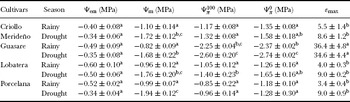
No significant differences were found in Ψem values between cultivars and seasons. At noon, Ψn value of all cultivars was significantly lower (p < 0.05) during the dry season. Guasare cultivar presented the lowest Ψ0π and Ψ100π values, being 40% lower than the rest of the cultivars for both seasons. Porcelana and Criollo Merideño cultivars did not show an osmotic adjustment, contrary to Lobatera and Guasare, which presented an osmotic adjustment close to 0.35 MPa during the dry season, with a marked decrease in Ψ0π values in the latter (Table 1). ε values were similar in all cultivars during the dry and wet seasons with exception of Guasare, since the latter presented higher ε (p < 0.05; Table 1).
Early morning water potential (Ψem), minimum water potential (Ψm), osmotic potential at full turgor (Ψ100π), osmotic potential at turgor loss (Ψ0π) and modulus of elasticity (ε) measured for four Criollo cacao cultivars during rainy and drought periods. Values for Ψem and Ψm are means from a total of eight measurements ± standard error. Values for Ψem and Ψm are from two consecutive years (2009 and 2010) characterised by rainy and dry seasons. Values of Ψ100π, Ψ0π and εmax correspond to observations from 2010.

a.,b,cMean differences within column according to the Duncan test (p < 0.05).
Gas exchange
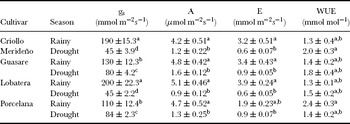
Average A and gs values for all cultivars during the rainy season were 4.7μmol m−2s−1 and 158 mmol m−2s−1, respectively. All cultivars exhibited 60% decrease in gs with drought (Table 2), resulting in 73% decrease in A and E values (A < 1.6 μmol m−2s−1 and E < 0.9 mmol m−2s−1). With the exception of Porcelana, other cultivars showed slight increase in WUE during drought (Table 2).
Mean of stomatal conductance (gs), CO2 assimilation rate (A), transpiration (E) and instantaneous water use efficiency (WUE) of four Criollo cacao cultivars during two consecutive years (2009 and 2010) characterised by rainy and dry seasons Values are mean of five plants ± standard error.

a.,b.,c.,dMean differences within column according to the Duncan test (p < 0.05).
Chlorophyll a fluorescence
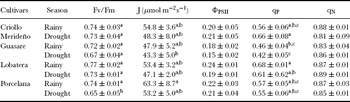
Maximum quantum yield of PSII (Fv/Fm) decreased for all cultivars during the dry season, period in which Porcelana cultivars were most affected, suggesting photoinhibition (Table 3). None of the cultivars showed an increase in qN during the water-deficit period. qP values did not vary significantly between seasons in the cultivars with the exception of Guasare, in which qP decreased during the dry season. J and ФPSII were similar for all cultivars in both seasons (Table 3).
Maximum quantum efficiency of photosystem II (Fv/Fm) and responses of electron transport index (J), quantum yield of photosystem II (ФPSII), photochemical quenching (qP) and non-photochemical quenching (qN) of chlorophyll a to a photon flux of 400–700 μmol m−2s−1 in Criollo cacao cultivars during two consecutive years (2009 and 2010). Each year is characterised by rainy and dry seasons. Values are means of six replicates ± standard error.

a.,b.,cMean differences within column according to the Duncan test (p < 0.05).
Survival rates, growth and leaf nutrients
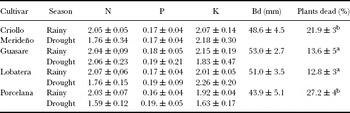
Guasare and Lobatera cultivars had low mortality rates, which did not exceed 14%, whereas in Criollo Merideño and Porcelana, dead plants were 21.9% and 27.2%, respectively. Basal diameters were similar for all cultivars. Leaf N concentrations ranged between 1.59% and 2.06% for drought, while during raining period, 2.05% concentration was obtained between cultivars. With the exception of Guasare, other cultivars showed lower N concentrations. K concentrations varied between 1.92% and 2.15%, and 1.63% and 2.26% during the rainy and dry periods, respectively (Table 4). All cultivars showed similar P concentrations for both periods. There was a linear trend between osmotic adjustment and survival percentage (Sp) (Sp = 74.15 + 36.5 × osmotic adjustment, r2 = 0.93) among cultivars.
Mean of concentration (%) of N, P and K for two consecutive periods of rainy and drought seasons (2009 and 2010), basal diameter (bd) at 390 days after transplant of four Criollo cacao cultivars and percentage of plants dead. Values are means of six samples ± standard error for nutrients concentration. Bd values are means of 15 plants ± standard error.

a.,bMean differences within column according to the Duncan test (p < 0.05).
DISCUSSION
The cacao cultivars showed differences regarding water-deficit tolerance during the first two years of establishment. Although all cultivars showed significant stomatal closure during drought, higher turgor maintenance offers the possibility to further respond to severe water deficit.
The accumulation of solutes in the early years of establishment appears to be a tolerance mechanism that reduces mortality rates during the establishment phase. It is precisely in this stage that plants are more sensitive to drought, since the root system has not yet reached its maximum growth; thus periods of more than 40 days without rain can signify a threat to survival. Such dry and unpredictable days are common in these areas because of the occurrence of events such as ‘El Niño’ or climate changes in the inter-tropical belt associated with weather conditions in the Atlantic and Pacific oceans. Cultivars that show rigid cell walls can maintain a steeper water potential gradient between leaves and soils, ensuring water uptake from drying soils. Higher ε and low Ψ100π values involve better mechanism for maintaining the integrity of cell. Likewise, if cell walls yield to turgor pressure generated by the osmotic adjustment, the adjustment benefits would be lost (Mitchell et al., Reference Mitchell, Veneklass, Lambers and Burgess2008). Osmotic adjustment has been also reported by Rada et al. (Reference Rada, Jaimez, Garcia-Nuñez, Azocar and Ramírez2005) for four-year-old Guasare plants in another region of Venezuela, and Almeida et al. (Reference Almeida, Brito, Aguilar and De Valle2002) reported for Forastero cultivars, suggesting that osmotic adjustment improves water balance of leaves during drought in cacao cultivars. It appears that osmotic adjustment prevails during the entire life cycle of cacao plants, and it is independent of environmental conditions. In other crops that require shade, such as coffee, osmotic adjustment is very low, suggesting that it is not a water-deficit tolerance strategy (Da Matta, Reference Da Matta2004). According to Premachandra and Joly (Reference Premachandra and Joly1992), the osmotic contribution of inorganic ions in cacao is two to four times that of amino acids and sugars where K provides 65% of osmolarity of inorganic ions. The high K concentrations found in leaves in three of the four cultivars studied suggest that its intake plays an important role in osmotic adjustment. Similar K concentrations were reported in high-yielding cacao clones cultivated under a shade of 50% incident light in tropical conditions (Rehem et al., Reference Rehem, Almeida, Mielke, Gomes and Vallee2010).
Balasimha et al. (Reference Balasimha, Daniel and Prakash1991) reported higher Ψ values during midday hours in cultivars tolerant to water deficit. In the case of the cultivars studied, three cultivars had lower Ψm values during the dry period, regardless of percentage of seedling mortality and osmotic adjustment.
During drought, all the cultivars showed significant stomatal closure, which indicates the sensitivity of this crop to water deficit, supporting results reported in recent reviews (Almeida and Valle, Reference Almeida and Valle2007; Carr and Lockwood, Reference Carr and Lockwood2011). This closure leads to lower A and E values, yet a higher WUE during the dry season compared with the rainy periods. The Porcelana cultivar was the only cultivar that did not increase WUE with drought, also the lowest Fv/Fm, revealing its high sensitivity to water deficit. The lower Fv/Fm obtained in all cultivars during both seasons can be the result of a deficient P leaf concentration (Conroy et al., Reference Conroy, Smillie, Kuppers, Bevege and Barlow1986), suggesting the necessity of applying higher P dosage than those currently used.
Water deficit did not change qN values among cultivars, indicating similar strategies for light acclimation of non-radiative energy dissipation, probably because of the fact that cacao cultivars developed under relatively low light conditions (<500 μmol m−2s−1), coinciding with results reported by Praxedes et al. (Reference Praxedes, DaMatta, Loureiro, Ferrấo and Cordeiro2006), which demonstrated that heat dissipation mechanisms did not increase under water-deficit conditions in coffee cultivars. During the dry periods, J value does not decrease as opposed to the results obtained during rainy periods, which shows that although reductions in A exist, an increase in mitochondrial activity as a sink for electrons from photochemical activity may occur and can constitute an important energy dissipation mechanism (Lawlor and Tezara, Reference Lawlor and Tezara2009). Although there is evidence of increases or decreases in respiration during water-deficit periods, the changes that occur are minor, compared with significant decreases in the photosynthetic carbon gain (Atkin and Macherel, Reference Atkin and Macherel2009).
It would appear that in cacao, water stress tolerance increases survival rates in juvenile plants. Preliminary data obtained from this trial for the first fruit harvest showed that Guasare and Lobatera cultivars yielded the highest fruit production (0.35 fruits/plant) as opposed to Porcelana with the lowest production (0.06 fruits/plant) and Criollo Merideño with an intermediate production (0.22 fruits/plants). These results suggest that the benefits of greater osmotic adjustment may be reflected in a higher initial production of fruit. Further research is likely to corroborate the relationship between osmotic adjustment and production during the first five years.
In summary, one of the consequences of drought during establishment of cacao crops is an elevated mortality of plants, which differs among cultivars. Survival rates are associated with osmotic adjustment, which determines turgor maintenance, essential for physiological processes. Stomatal closure produces a decrease in gas exchange rates during drought. At low radiation conditions, prevailing mechanisms of heat dissipation and electron transport do not change. Electron sink mechanisms such as photorespiration and mitochondrial respiration are also likely to increase.
Acknowledgements
This research has been financed by the PIC project CDCHTA-ULA-SAD-FO-04-09-01 and the project LOCTI ‘Combinando cacao con árboles maderables’ financed by the Papelex company. We wish to thank the staff of Finca La Judibana, Universidad de Los Andes,Venezuela, Corpozulia Station, Zulia state, Venezuela and Universidad Experimental del Tachira, Venezuela for logistical support. We are grateful to Dra. Francisca Ely for many constructive comments and editing of the manuscript.