Introduction
The mountains of southern Oman are influenced by the southwest monsoon which creates a tropical fog-oasis in an arid environment. The area is an outstanding example of an island-like refugium: a seasonal cloud-forest in an otherwise arid environment (Kürschner, Reference Kürschner, Ghazanfar and Fisher1998; Hildebrandt, Reference Hildebrandt2005). The mountain chain in southern Oman and adjacent Yemen has a unique climate which is reflected in a high plant species diversity with high levels of endemism.
These local climatic and geographic factors allow for the survival of subtropical elements in an otherwise unfavourable arid environment. Isolation in space, time and climate has led to the independent development of many taxa, resulting in a high number of endemics (Miller & Nyberg, Reference Miller and Nyberg1991; White & Léonard, Reference White and Léonard1991; Patzelt, Reference Patzelt2008). The mountains of southern Arabia have recently been added to the list of worldwide biodiversity hotspots as part of the ‘Horn of Africa’ hotspot (Mittermeier et al., Reference Mittermeier, Gil, Hofman, Pilgrim, Brooks and Goetsch Mittermeier2005).
Plate tectonics and climate, recent and historic, are the driving forces behind diversity and floristic composition of the Themeda quadrivalvis (L.) Kuntze tall-grass savannah in southern Arabia. The relatively late separation of Arabia from Africa and Asia, during the Oligocene, some 10–15 million years bp, allowed for the migration of plants between tropical Africa, southern Arabia and the Indo-Malayan region (Raven & Axelrod, Reference Raven and Axelrod1974; Mandaville, Reference Mandaville1984; Delany, Reference Delany1989; White & Léonard, Reference White and Léonard1991; Kürschner, Reference Kürschner, Ghazanfar and Fisher1998). During the Miocene, when today’s separate landmasses were still connected, Arabia supported palaeotropical vegetation with swamps and open savannah grassland (Hamilton et al., Reference Hamilton, Whybrow and McClure1978; Whybrow & McClure, Reference Whybrow and McClure1981; Mandaville, Reference Mandaville1984). During the late Tertiary this vegetation was progressively replaced by more drought-adapted vegetation. Mesic elements of the palaeo-African and palaeo-Indo-Malayan stock could only survive in climatically favourable refugia (Lioubimtseva, Reference Lioubimtseva1995; Kürschner, Reference Kürschner, Ghazanfar and Fisher1998). These refugia in southern Arabia developed during the late Tertiary and early Quaternary through a strong enhancement of the monsoon (Mandaville, Reference Mandaville1984; Jolly et al., Reference Jolly, Prentice, Bonnefille, Ballouche, Bengo and Brenac1998).
Although the unique vegetation of the ‘Dhofar Fog Oasis’ (Miller, Reference Miller, Davis and Heywood1994) has been acknowledged by many authors (e.g. Mandaville, Reference Mandaville1977; Radcliffe-Smith, Reference Radcliffe-Smith1980; Miller & Morris, Reference Miller and Morris1988; Miller, Reference Miller, Davis and Heywood1994), plant community aspects have only recently been investigated (Kürschner et al., Reference Kürschner, Hein, Kilian and Hubaishan2004). These recent results highlight the significance of this mountain chain where endemic palaeo-African relict plant forest communities, dominated by the endemic Anogeissus dhofarica A.J.Scott, are found. In Oman Themeda savannahs replace Anogeissus forest on plateaus at medium altitudes. They are the tallest grasslands in the country and are restricted to the refugium provided by the southern mountains.
The aims of this study are (i) to identify habitat characteristics, structure, diversity of life forms, biogeographical relationships and the phytosociological classification of the Themeda quadrivalvis tall-grass savannah in southern Oman, (ii) to relate species composition to the tall-grass savannah of Yemen and East Africa, and (iii) to correlate biogeographical relationships to Tertiary and Quaternary events.
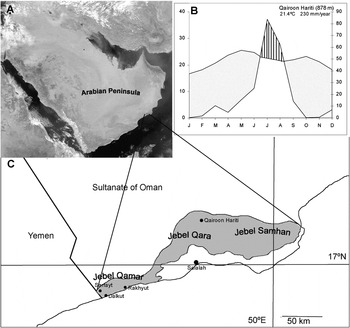
The study area is located in the fog-affected mountains of southern Oman (Fig. 1). This mountain chain extends some 320 km from the southeastern part of the Al Mahra, Yemen, to southwestern Dhofar, the southern region of the Sultanate of Oman. In Dhofar the mountain chain is built up of three ranges: Jebel Qamar, Jebel Qara and Jebel Samhan. The present study was carried out on Jebel Qamar, situated in the centre of the monsoon-affected area. Jebel Qamar reaches an altitude of 1350 m and forms a steep escarpment to the south, with smaller plateaus between 500 and 800 m. The rock is formed by Cretaceous and Tertiary limestone material, overlaid in many areas with Quaternary scree (Guba & Glennie, Reference Guba, Glennie, Ghazanfar and Fisher1998). From mid-June to mid-September the area comes under the influence of the southwest monsoon (locally called ‘khareef’). During these three months dense fogs build up against the seaward-facing mountains, reaching only a few kilometres inland (Stanley-Price et al., Reference Stanley-Price, Al-Harthy, Whitcombe and Whitehead1988). The low cloudbank cannot rise because of a temperature inversion created by the flow of warm dry air from the inland desert north of the mountain chain. This combination of topography and temperature inversion thus creates a stable fog bank clinging to the sea-exposed slopes. Measurements indicate that fog precipitation during the monsoon amounts to 13 litres/m2 per day at 0.9 m above the ground and 34–35 litres/m2 at 4.2 m (Stanley-Price et al., Reference Stanley-Price, Al-Harthy, Whitcombe and Whitehead1988), amounting to two-thirds of the annual precipitation (Hildebrandt, Reference Hildebrandt2005). Unfortunately no long-term climatic data of the study area are available. Climatic data at Qairoon Hariti, situated in the drier part of the mountains, are used for comparison (Fig. 1B).
Location of the mountain chain of southern Oman (A & C) and climatic conditions (B). In B, the left-hand axis is temperature (°C) and the right-hand axis is rainfall (mm).

Materials and Methods
The description of the Themeda grassland of Oman is based on the traditional Braun-Blanquet cover-abundance scale (Braun-Blanquet, Reference Braun-Blanquet1964), using the modified scales of Barkman et al. (Reference Barkman, Doing and Segal1964) representing the following values: r = solitary, cover < 5%; + = few, less than 1% cover; 1 = few and 1–5% cover; 2m = numerous and cover < 5%; 2a = 6–12% cover; 2b = 13–25% cover; 3 = 25–50% cover; 4 = 51–75% cover; 5 = 76–100% cover. Cover-abundance values are relatively broad subjective classes, and were determined by estimating cover of every single species within the area of the stand. A standard 5-point scale was used to indicate the degree of clumping or gregariousness (sociability) of an individual plant species, obtained as a visual impression, represented by the following values: ‘1’ indicates a shoot growing singly, ‘2’ indicates plants growing in small groups of a few individuals or in small tussocks, ‘3’ indicates small patches, cushions or large tussocks, ‘4’ refers to growing in extensive patches, carpets or broken mats, and ‘5’ indicates plants growing in large mats or pure populations.
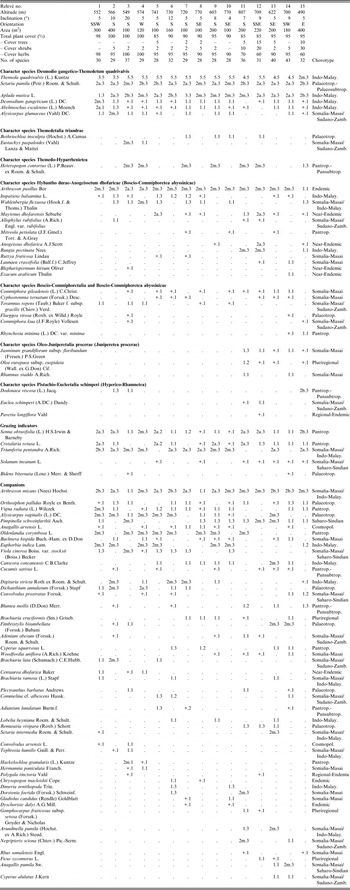
The areas of relevés were selected with respect to floristic homogeneity and representation of typical stands. In each relevé and stratum a plant list was established and cover-abundances and sociability were estimated. Fieldwork was carried out in September and November 2003 and September/October 2004 and 2005. The size of the sampling stands varied but was usually 100–200 m2. The vegetation was sampled in 15 relevés (Table 1). For each relevé a habitat description was recorded which included geographic coordinates, altitude, slope inclination, aspect, height of different strata, plant cover, topographic position and soil characteristics. The study area is located between 16°41′N, 53°06′E and 16°49′N, 53°40′E.
The Desmodio gangetico-Themedetum quadrivalvis, a newly described grassland community from southern Arabia. See Materials and Methods for an explanation of the figures

Additional species:
A 2: Senra incana Cav. +.1; Tripogon leptophyllus (A.Rich.) Cufod. 1.3. A 8: Gramineae indet +.1. A 22: Abelmoschus manihot (L.) Medik. 1.1. A 24: Orobanche dhofarensis M.J.Y.Foley 1.3. A 25: Andrachne aspera Spreng. 1.2; Carissa spinarum L. +.1; Corchorus trilocularis L. +.1; Cordia crenata Delile subsp. crenata +.1. A 51: Heliotropium longiflorum (Hochst. ex A.DC.) Jaub. & Spach +.1; Nicandra physalodes Gaertn. +.1. A 52: Schizachyrium brevifolium (Sw.) Nees ex Büse 1.1. A 54: Eclipta prostrata (L.) L. r.1; Eragrostis viscosa (Retz.) Trin. 2m.3; Cyperus longus L. +.1; Ficus vasta Forssk. +.1; Indigofera tinctoria L. +.1. A 55: Achyranthes aspera L. +.1; Ceropegia bulbosa Roxb. +.1; Aloe praetermissa McCoy & Lavranos +.1; Scrophularia arguta Aiton 2m.3. A 73: Cleistachne sorghoides Benth. +.1; Digitaria ciliaris (Retz.) Koeler 1.1; Vernonia cinerea (L.) Lees 1.1. A 74: Enicostemma axillare (Lam.) A.Raynal 1.1; Sida ovata Forssk. +.1.
After fieldwork the next stage in this method involved the tabulation of data from similar stands and the synthesis of vegetation units. The final table (Table 1) displays vegetation units which are defined by the presence of particular characteristic species. Finally, the vegetation units under investigation are positioned in the hierarchical floristic system of Braun-Blanquet which requires consideration of the sociological rank and ecological amplitude of each species.
The classification of plant communities at higher syntaxonomic levels in southern Arabia remains difficult as higher levels are not yet known. Therefore, further investigation is needed into which synsystematic rank each species belongs to and how to segregate the higher syntaxa. The syntaxonomic classifications follow the International Code of Phytosociological Nomenclature (Weber et al., Reference Weber, Moravec and Theurillat2000).
Family concepts follow APG II (Angiosperm Phylogeny Group, 2003). The taxonomy and nomenclature of the taxa recorded follows Thulin (Reference Thulin1993, Reference Thulin1995, Reference Thulin1999, Reference Thulin2006), Miller & Cope (Reference Miller and Cope1996), Cope (Reference Cope, Knees and Miller2007) and Ghazanfar (Reference Ghazanfar2003, Reference Ghazanfar2007). Otherwise the most recent taxonomic publications were consulted. Distribution data and chorotypes were mainly compiled from Cope (Reference Cope1985), Miller & Morris (Reference Miller and Morris1988), Thulin (Reference Thulin1993, Reference Thulin1995, Reference Thulin1999, Reference Thulin2006), Miller & Cope (Reference Miller and Cope1996), Ghazanfar (Reference Ghazanfar2003, Reference Ghazanfar2007) and Pickering & Patzelt (Reference Pickering and Patzelt2008).
For the purposes of this study, an ‘endemic species’ is defined as a species that occurs in only one country and a ‘near-endemic’ or ‘limited range species’ is defined as ‘a species which occurs in limited numbers in no more than three countries in Arabia’. For the physiognomic classification, the vegetation structure classification as described in Scholte (Reference Scholte2000) has been followed.
Voucher specimens are deposited in the National Herbarium of Oman (ON), and in the Herbarium of Sultan Qaboos University (SQUH). Some duplicates were donated to the Royal Botanic Gardens, Kew (K) and to the Royal Botanic Garden Edinburgh (E).
Within each relevé, 10 soil samples were taken from the surface (0–10 cm depth). The samples were air-dried, mixed and any large stones removed. The soil was then crushed and passed through a 2-mm sieve to remove gravel and debris. The particles not passing the 2-mm sieve were weighed separately for determination of the content of the coarse fragments. The fraction smaller than 2 mm was used for the soil analysis. Soil texture was determined according to Benzler et al. (Reference Benzler, Finnern, Müller, Röschmann, Will and Wittmann1982). Soil-water extracts (1:5) were prepared for measurement of pH. To test carbonate content, hydrochloric acid was added to 5 g of sieved soil (air-dried soil fraction < 2 mm) on a watch glass. The carbonate content was measured on the basis of the intensity and time of effervescence (Benzler et al., Reference Benzler, Finnern, Müller, Röschmann, Will and Wittmann1982).
Results
Soil, vegetation structure and species composition of the Arabian Themeda grassland
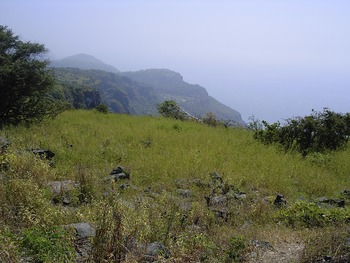
The Themeda grassland (Fig. 2) forms a belt on the gentle seaward slopes with a width of about 3–5 km and is restricted to a narrow altitudinal range of 500–800 m. The grassland is found almost exclusively on south-facing slopes with an inclination of 4–20°. The soil texture is silty clay with a pH between 6.4 and 6.7; carbonate content is low. The soil type is a vertisol. During the dry season the soil becomes extraordinarily hard and is divided into rough polygons and prisms; wide cracks develop to a depth of 50 cm or more. The cracks close during the monsoon when the clay minerals swell. Skeletal rock comprises up to 10% of the surface of the relevés.
Typical aspect of the Themeda quadrivalvis grassland in southern Oman.

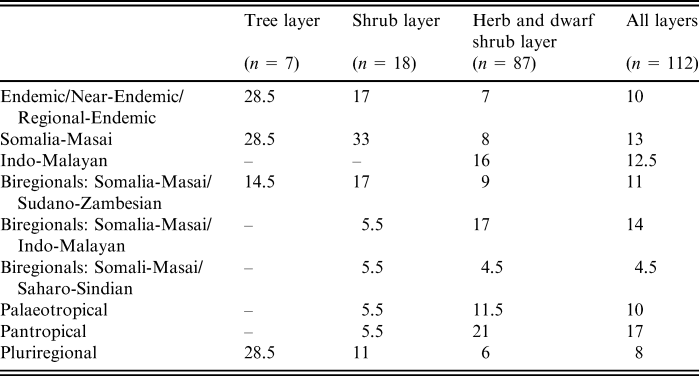
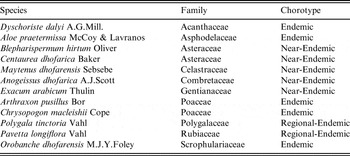
The Themeda grassland is rich in species (112 taxa, mean species number/relevé = 32; Table 1). Twelve species (11%) found in the grassland are endemic, near-endemic or regionally endemic (Table 3). Both structurally and floristically, the grassland community is characterised by the dominance of the annual grass Themeda quadrivalvis, which can reach 2.5 m in height and often occupies more than 70% of the total cover.
In Arabia Themeda quadrivalvis is restricted to southern Oman and southeastern Yemen, whereas Themeda triandra Forssk. is found along the western mountain chain in Yemen and also in Soqotra (Cope, Reference Cope, Knees and Miller2007). Themeda quadrivalvis was also recorded from Soqotra in the 19th century but has not been seen since (Miller & Morris, Reference Miller and Morris2004). Globally the annual Themeda quadrivalvis has a much more restricted distribution, whereas the perennial T. triandra is distributed throughout the tropical and subtropical Old World and, in many places, is regarded as a problematic species.
In Oman Themeda quadrivalvis and other grasses are associated with groups of trees and shrubs mainly composed of the endemics Anogeissus dhofarica and Maytenus dhofarensis Sebsebe, and the evergreen Olea europaea subsp. cuspidata (Wall. ex G.Don) Cif. The herb and shrub layer is characterised by three distinct strata. The upper stratum is dominated by the tall annual Themeda quadrivalvis. Shorter grasses (e.g. Apluda mutica L., Setaria pumila (Poir.) Roem. & Schult.) form an intermediate stratum up to 80 cm tall. The lowest stratum consists mainly of small annual grasses and therophytes up to 15 cm tall. Therophytes clearly dominate the grassland (50%), but shrubby chamaephytes (19%), hemicryptophytes (11%) and phanerophytes (16%) are common as well. Geophytes play a minor role (3%). Rocks provide a more sheltered habitat and thus enable some perennials to grow, such as the stem succulent Dorstenia foetida (Forssk.) Schweinf.
The yearly cycle of plant activity is strongly correlated with the monsoon precipitation and corresponding changes in available moisture. As soon as the first fog arrives at the end of June, the annual species germinate and deciduous perennials sprout their first leaves. Most of the annuals set seed at the end of the humid season in October/November. The grassland is used for grazing of livestock, mainly after the monsoon fogs have lifted. Grazing indicators are common and conspicuous non-palatable palaeotropical and pantropical weeds can reach high cover values. The chorotype analysis indicates a community with strong affinities to xerotropical and subtropical grasslands of Yemen and East Africa as well as subtropical Southeast Asia (Table 2).
Percentage of different chorotypes in the Themeda quadrivalvis grassland in different strata, reflecting the phytogeographical affinities

The phytosociological analysis of the community has led to the description of a new plant community, the Desmodio gangetico-Themedetum quadrivalvis (see Table 1). Characteristic species are the grasses Themeda quadrivalvis, Setaria pumila and Apluda mutica, and the herbs Desmodium gangeticum (L.) DC., Abelmoschus esculentus (L.) Moench and Alysicarpus glumaceus (Vahl) DC. The Desmodio-Themedetum is relatively uniformly developed but towards the escarpment rim trees and shrubs become more dominant, indicated by species of the sclerophyllous evergreen Anogeissus dhofarica woodlands (relevés nos. 11–15 in Table 1).
Discussion
Environmental determinants
A total of 112 taxa were found in the Themeda grassland on Jebel Qamar. As the country’s total flora comprises c.1200 species (Miller & Cope, Reference Miller and Cope1996), 9.5% of the total flora is represented in the grassland, a high percentage.
The geographically closest tall-grass savannah dominated by Themeda sp. is located in Yemen, including Soqotra, and Ethiopia (Pichi-Sermolli, Reference Pichi-Sermolli1957; White, Reference White1983; Friis, Reference Friis1992; Miller & Morris, Reference Miller and Morris2004; Suttie et al., Reference Suttie, Reynolds and Batello2005; World Wildlife Fund, 2010). A comparison with phytosociological studies from East African data extracted from Lebrun (Reference Lebrun1947), Knapp (Reference Knapp1973), Schmidt (Reference Schmidt1975a, Reference Schmidt1975b) and White (Reference White1983) reveals a number of linking species: Eustachys paspaloides (Vahl) Lanza & Mattei, Heteropogon contortus (L.) P.Beauv. ex Roem. & Schult. and Bothriochloa insculpta (Hochst.) A.Camus.
Grassland dominated by Themeda quadrivalvis is also found on the outer escarpment mountains of southeastern Yemen (A. G. Miller, pers. comm.). In Yemen, Heteropogon contortus, Bothriochloa insculpta and Eustachys paspaloides are found in similar grassland vegetation (A. G. Miller, pers. comm.). Further studies are required to investigate the Themeda grasslands on the monsoon-affected mountains of Soqotra and on the escarpment mountains of Yemen to elucidate their relationship with the Themeda grassland of southern monsoon-affected Oman.
Compared with the Themeda triandra savannah in East Africa, however, species diversity in southern Arabia is far lower. For example, Schmidt (Reference Schmidt1975b) reported at least 260 taxa from Tanzania. Studies of the Themeda grasslands of Ethiopia (Suttie et al., Reference Suttie, Reynolds and Batello2005) reveal that species diversity seems to be higher than in the Themeda quadrivalvis grassland of Oman. The Themeda grassland of Oman is impoverished in species compared with the African Themeda savannah.
Low shrub and tree cover in savannah vegetation on vertisol has been explained by wetness of the soil and resulting low levels of oxygen during the monsoon with correspondingly extreme shrinkage and hardness in the dry season (Schmidt, Reference Schmidt1975b). Therefore, the dominant life forms are therophytes, which can withstand these severe environmental conditions (Huntley, Reference Huntley, Huntley and Walker1982; Menault, Reference Menault and Bourlière1983). Higher cover and abundance of trees and shrubs on steeper slopes towards the escarpment rim can be explained by better drainage conditions.
The use of the Anogeissus forest for browsing and the clearing of forest to provide pastures have a long history in Dhofar. The grassland of Oman has supported pastoral communities for thousands of years without excessive overgrazing except in the last three decades (Miller & Morris, Reference Miller and Morris1988). In recent years, high densities of grazers, principally cattle and camels, and changes towards the communities becoming more sedentary have had a severe effect, leading to high cover values of unpalatable herbs, such as Crotalaria retusa L. and Nicandra physalodes (L.) Gaertn.
Phytogeographical affinities of the Themeda quadrivalvis grassland
Phytogeographically the vegetation of the monsoon-affected mountains in Dhofar marks the easternmost extent of the Somalia-Masai regional centre of endemism (Léonard, Reference Léonard1988; White & Léonard, Reference White and Léonard1991; Ghazanfar, Reference Ghazanfar1992; Kürschner, Reference Kürschner, Ghazanfar and Fisher1998). The close floristic relationships between East Africa and southern Arabia are evident from the 24% of species which belong to the Somalia-Masai and Sudano-Zambesian chorotype (Table 2). These palaeotropical African floristic elements reach their easternmost limit in Dhofar, whereas the Indo-Malayan species are at their westernmost limit in southern Arabia.
Clayton & Cope (Reference Clayton and Cope1980) indicated that the grasses in southern Arabia have strong links to Asia. This is well supported by the present study. Only a few Saharo-Sindian geoelements are found in the Themeda grassland, although the mountain chain is bordered to the north by a desert dominated by Saharo-Sindian species. The absence of these taxa is due to the humid site conditions during the monsoon season which restricts Saharo-Sindian elements. The palaeotropical species clearly reflect the former land connection of Arabia with Africa and Asia. The pantropical and pluriregional species are mainly weedy and ruderal species, indicating recent human influence.
The occurrence of endemic and near-endemic species in the Themeda grasslands underlines the importance of the monsoon-influenced mountains of southern Arabia as a refuge area, representing a regional centre of endemism (Table 3). The ‘Dhofar Fog Oasis’ is a centre of species richness (Miller & Nyberg, Reference Miller and Nyberg1991; Miller, Reference Miller, Davis and Heywood1994) and these centres usually coincide with centres of endemism (Crisp et al., Reference Crisp, Laffan, Linder and Monro2001). Recent work highlights the concentration of range-restricted and rare and threatened species in southern Oman where a total of 145 range-restricted species, representing 12.1% of the total flora, are found (Patzelt, Reference Patzelt2008). Endemic and near-endemic species occur quite frequently in the grassland and are relatively widespread. These species are, per definition, rare, and therefore potentially threatened on a global level (Myers et al., Reference Myers, Mittermeier, Rappenhöner and Strätz2000). The Themeda grassland is thus an important habitat for the survival of species with restricted distribution and requires greater conservation effort.
Range-restricted species in the Themeda quadrivalvis grassland

Phytosociological classification reveals the position within the East African Themedo-Hyparrhenietea
Classification at the community level has so far not been performed on Arabian grasslands (Deil & Al Gifri, Reference Deil, Al Gifri, Ghazanfar and Fisher1998) and only on small portions of the African savannah (e.g. in East Africa by Lebrun, Reference Lebrun1947; Troupin, Reference Troupin1966; Leippert, Reference Leippert1968; Quezel, Reference Quezel1969; Schmidt, Reference Schmidt1975b) and South Africa (reviewed in Cowling et al., Reference Cowling, Richardson and Pierce1997). No detailed analysis at community level from the grasslands on the Indian subcontinent has so far been undertaken (Misra, Reference Misra and Bourlière1983).
On the basis of close floristic relationships, the Themeda grasslands in Oman are interpreted as the easternmost outliers of the African Themeda tall-grass savannah. Stand number 3 represents the typus stand of the Desmodio gangetico-Themedetum quadrivalvis ass. nov.
Knapp (Reference Knapp1965) combined all East and South African tall-grass savannah types into the class Themedo-Hyparrhenietea Knapp Reference Knapp1965. The analysis of the herbaceous layer of the Themeda quadrivalvis grasslands from Dhofar reveals its position in this class (Knapp, Reference Knapp1965, Reference Knapp1968), with Heteropogon contortus as a characteristic species of the class and Bothriochloa insculpta and Eustachys paspaloides as characteristic species of the order Themedetalia triandrae sensu Lebrun Reference Lebrun1947. Classification within an alliance still remains unclear and the relationship of the grasslands dominated by Themeda quadrivalvis to the grasslands dominated by T. triandra requires further study.
Besides taxa of the tall-grass savannah, species of other phytosociological classes are important for the characterisation of the Dhofar grassland. Further species that always occur are characteristic of the Hybantho durae-Anogeissetum dhofaricae Kürschner et al. Reference Kürschner, Hein, Kilian and Hubaishan2004, a drought-deciduous forest community of the Boscio-Commiphoretea abyssinicae (= Acacia–Commiphora drought-deciduous woodland – Zohary, Reference Zohary1973). In East Africa these are often replaced by evergreen shrub communities of the Pistachio-Eucleetalia schimperi (Gillett, 1941; Hemming, Reference Hemming1966). Montane African-Arabian forest communities of the Oleo-Juniperetalia procerae (Pichi-Sermolli, Reference Pichi-Sermolli1957; Knapp, Reference Knapp1965, Reference Knapp1968, Reference Knapp1973; White, Reference White1983; König, Reference König1987) are restricted to forested patches within the grassland.
In Dhofar, the Themeda grassland is in direct contact with two different forest communities of the Boscio-Commiphoretea abyssinicae. On the south-facing sea-exposed side the gentle slopes covered in grassland are suddenly replaced by Anogeissus forest on steep, almost perpendicular, escarpments. On the north-facing slopes, beyond the monsoon precipitation, the grassland is replaced quite abruptly by drought-deciduous Acacia–Commiphora woodland. Many of the grassland species occur as marginal intruders on edaphically shallow sites in the Anogeissus forest but are absent from the dry woodland.
Thus, most grassland species are ‘borrowed’ from adjacent forests with similar moisture conditions and were able to invade open habitats created after clearing of the forests. This is in agreement with the suggested origin of most African savannah grass species (White, Reference White and Werger1978). It is therefore suggested that the Themeda grassland in Oman results from anthropogenic activities. A similar explanation is suggested for the grassland in open areas in Anogeissus forest in southeastern Yemen (Hauf), situated within the same geographic region (Kürschner et al., Reference Kürschner, Hein, Kilian and Hubaishan2004). An anthropogenic origin has also been suggested for grassland-fragments in Yemen with Heteropogon contortus, Bothriochloa insculpta and Themeda triandra (Deil & Müller-Hohenstein, Reference Deil and Müller-Hohenstein1985).
As all the mountains of southern Arabia are affected by the southwest and northeast monsoons, it is highly likely that the newly described association will also be found within Anogeissus forest on Ras Fartak west of Hauf in Yemen and may also extend into Soqotra (A. G. Miller, pers. comm.).
Conservation status
Within the grasslands there are 12 taxa, representing 11% of the total within the grasslands, which require a high conservation priority (Patzelt, Reference Patzelt2008) in order to maintain the current high plant diversity. Overgrazing has already led to a degeneration of the plant community and an invasion of many unpalatable weeds which now dominate in severely overgrazed areas. In many areas in Dhofar the grasslands are so heavily grazed that the grasses no longer reach reproductive maturity.
Although overgrazing is the major direct threat to this plant community it is clear that without the involvement and cooperation of local people there can be little hope for future conservation efforts. The inclusion of local people offers the best prospect for the control of grazing pressure and for exploration of new practices and new uses of rangelands. It is therefore essential that efforts be made to promote a policy of sustainable development and conservation of the environment to ensure a good standard of living for local people while conserving the native flora.
Principal Results
1 Isolation in space, time and climate has led to a unique and endemic plant community, the Desmodio gangetico-Themedetum quadrivalvis ass. nov., which is found exclusively in the monsoon-affected mountains of Dhofar and probably also in adjacent Yemen.
2 This annual grassland is interpreted as the easternmost outlier of the East African tall-grass savannah in the class Themedo-Hyparrhenietea Knapp Reference Knapp1965.
3 Taxa of xeric-African, mesic-African and mesic-tropical Asian origin indicate the importance of southern Arabia as a migration link during the Tertiary.
4 The seasonal fog-oasis conditions in an otherwise arid environment offer a refuge area for palaeotropical mesic elements.
5 The tall-grass savannah in Oman is an important habitat for endemic and near-endemic species and thus deserves further investigation and greater conservation effort.
Acknowledgements
I am very grateful to Anthony G. Miller and Sabina G. Knees (Royal Botanic Garden Edinburgh, UK) for valuable and stimulating discussions on the grassland vegetation of Dhofar and Yemen and for helpful comments on the manuscript. I would like to thank the National Herbarium, Ministry of National Heritage and Culture, Oman, for allowing me to work on its plant voucher collection. I am also grateful to Laila Al Harthi, Oman Botanic Garden (Oman), who helped to analyse the soil samples, and to Mansoor Amerjeed, Directorate General of Municipalities and Water Resources, Salalah (Oman), who provided meteorological data.
I am also very grateful to David Middleton (Royal Botanic Garden Edinburgh) for very helpful comments on the manuscript.