Introduction
During the 1940s and 1950s, the Argentinian naturalist Carlos Rusconi discovered key Cambrian outcrops in the southern Precordillera of Mendoza, western Argentina, and described large numbers of invertebrates including trilobites, hyoliths, mollusks, brachiopods, and sponges (Rusconi, Reference Rusconi1946, Reference Rusconi1954a, Reference Rusconi1955, Reference Rusconi1956 and references therein; Cerdeño, Reference Cerdeño2005). These pioneering investigations, together with additional contributions of Leanza (Reference Leanza1947), V. Poulsen (Reference Poulsen1958), and C. Poulsen (Reference Poulsen1960), gave great impetus to the understanding of the paleontology of Mendoza, which was subsequently refined by up-to-date systematic revisions of Rusconi's collections at the Museo J.C. Moyano (e.g., Palmer, Reference Palmer1965; Robison, Reference Robison1988; Tortello and Bordonaro, Reference Tortello and Bordonaro1997; Bordonaro, Reference Bordonaro2014; Tortello, Reference Tortello2018, Reference Tortello2020) and the study of additional trilobite faunas (e.g., Bordonaro and Liñán, Reference Bordonaro and Liñán1994; Shergold et al., Reference Shergold, Bordonaro and Liñán1995; Bordonaro, Reference Bordonaro2003, Reference Bordonaro2014; Bordonaro and Fojo, Reference Bordonaro and Fojo2011; among others). Most of these fossils come from early Miaolingian to late Furongian limestone allochthonous blocks (olistoliths) occurring within Middle and Upper Ordovician shales (Bordonaro et al., Reference Bordonaro, Beresi and Keller1993; Keller, Reference Keller1999).
Another important source of information on the Cambrian of the southern Precordillera was assembled by Ángel V. Borrello and his associates (Universidad Nacional de La Plata, Argentina), who sampled numerous trilobites from several Rusconi fossil-collecting localities. These specimens were collected in the early 1960s and deposited in the Museo de La Plata. Borrello (Reference Borrello1965, Reference Borrello and Holland1971) began personally to study the samples and drew attention to the biostratigraphic implications of the faunas, but his research was interrupted by his sudden unexpected death in 1971. More recently, Tortello (Reference Tortello2009, Reference Tortello2011, Reference Tortello2014a, Reference Tortellob, Reference Tortello2017) and Tortello and Cingolani (Reference Tortello and Cingolani2016) revised late Miaolingian and Furongian trilobites from the Borrello collections, while a review of the early Miaolingian material (Wuliuan, Glossopleura walcotti and Ehmaniella zones) was still pending.
The Glossopleura walcotti Zone is richly fossiliferous and known from different regions of North America, as well as from the Precordillera of San Juan and the Southern Precordillera of Mendoza. In Mendoza, the early reports of Glossopleura Poulsen, Reference Poulsen1927, Athabaskia Raymond, Reference Raymond1928 (=Mendospidella Rusconi, Reference Rusconi1952), Kootenia Walcott, Reference Walcott1888, Zacanthoides Walcott, Reference Walcott1888, Oryctocephalus Walcott, Reference Walcott1886, and Alokistocare Lorenz, Reference Lorenz1906 (see Leanza, Reference Leanza1947; Rusconi, Reference Rusconi1952, Reference Rusconi1954b, Reference Rusconi1955; Poulsen, Reference Poulsen1958; Pernas, Reference Pernas1963) allowed pertinent correlations with USA and Sonora (Borrello, Reference Borrello1965, Reference Borrello and Holland1971). More recently, Bordonaro (Reference Bordonaro2014) revised in detail material of Athabaskia and identified the Laurentian species A. anax (Walcott, Reference Walcott1916).
Aiming to further improve the knowledge of the Glossopleura walcotti Zone from Mendoza, assemblages of this age from the Borrello collections at the Museo de La Plata are fully described herein. The samples come from key fossiliferous sites of the San Isidro area and encompass dolichometopids, dorypygids, oryctocephalids, zacanthoidids, and kochaspids of high biostratigraphic and paleogeographic value. To facilitate comparisons with Rusconi's taxa, selected type specimens from the Rusconi collections at the Museo J.C. Moyano are also considered in this study.
Geologic setting
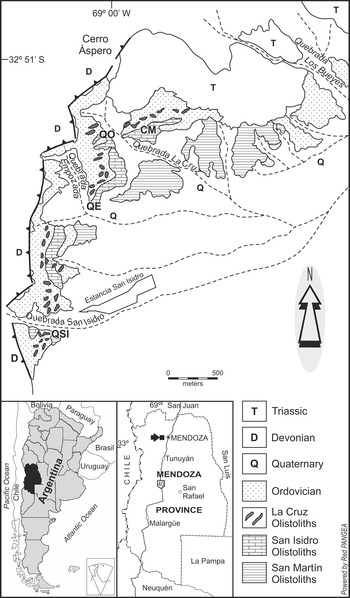
The Cambrian of the southern Precordillera in Mendoza Province consists predominantly of open-marine limestone olistoliths of different sizes, from centimeters to hundreds of meters in thickness, occurring chaotically within the Middle and Upper Ordovician shales of the Estancia San Isidro and Empozada formations (Bordonaro et al., Reference Bordonaro, Beresi and Keller1993; Keller, Reference Keller1999; Bordonaro, Reference Bordonaro2003; Heredia and Beresi, Reference Heredia and Beresi2004). The most notable fossil-collecting area is San Isidro, which comprises a number of hills and creeks ~15 km west of Mendoza City (Rusconi, Reference Rusconi1952, fig. 1; Fig. 1). There, the San Isidro, San Martin, and La Cruz olistoliths yield trilobites of early Miaolingian to late Furongian age (Bordonaro, Reference Bordonaro2003, fig. 2).
Map of the San Isidro area, Mendoza Province, Argentina (after Bordonaro et al., Reference Bordonaro, Beresi and Keller1993, and Tortello, Reference Tortello2014a), showing the fossil localities of the San Isidro Olistoliths reported in the text. (CM) Cerro Martillo; (QO) Quebrada Oblicua; (QE) Quebrada Empozada; (QSI) Quebrada San Isidro.

The trilobites described herein come from the San Isidro Olistoliths, which consist of medium- to large-sized blocks composed of mudstones and marlstones intercalated with fossiliferous limestones (wackestones and packstones) (Keller et al., Reference Keller, Bordonaro and Beresi1993; Bordonaro, Reference Bordonaro2003, Reference Bordonaro2014). According to both Borrello (Reference Borrello1965, p. 41) and information available in the archives of the División Geología of the Museo de La Plata, the trilobites were collected at Cerro Martillo (CM); Quebrada Oblicua—on the right side of Quebrada La Cruz-(QO); Quebrada Empozada (QE); and Quebrada San Isidro (QSI) (Rusconi, Reference Rusconi1945, Reference Rusconi1952, fig. 1; Fig. 1), although the exact locations of the fossiliferous levels are unknown.
Biostratigraphy
The Glossopleura walcotti Zone.—This North American polymerid zone is well represented in North Greenland, eastern and western Canada, northern Idaho, Montana, Wyoming, the Great Basin, Arizona, Sonora, and the Appalachians (e.g., Holland, Reference Holland1971 and multiple references therein; Robison, Reference Robison1976; Palmer and Halley, Reference Palmer and Halley1979; Babcock, Reference Babcock1994; McCollum and Sundberg, Reference McCollum and Sundberg2007; Southworth et al., Reference Southworth, Brezinski, Orndorff, Repetski and Denenny2008; Foster, Reference Foster2011; Rowland, Reference Rowland2011; Sundberg, Reference Sundberg2011a, Reference Sundberg2018, Reference Sundberg2020; Taylor et al., Reference Taylor, Repetski, Loch and Leslie2012; Cuen-Romero et al., Reference Cuen-Romero, Valdez-Olguín, Buitrón-Sánchez, Monreal, Enríquez-Ocaña, Aguirre-Hinojosa, Ochoa-Granillo and Palafox-Reyes2018; Peel, Reference Peel2021, among many others). Glossopleura is an especially important member of the assemblage, constituting a valuable guide genus in restricted facies and open-shelf deposits at the platform margin. If other trilobite genera are associated with it, the most common are Athabaskia and the long-ranging Kootenia, Zacanthoides, and Amecephalus Walcott, Reference Walcott1924 (e.g., Rasetti, Reference Rasetti1951; Lochman in Cooper et al., Reference Cooper, Arellano, Johnson, Okulitch, Stoyanow and Lochman1952; Palmer, Reference Palmer1954; Lochman and Wilson, Reference Lochman and Wilson1958; Robison, Reference Robison1976). Largely used as a traditional genus-based zone (Glossopleura Zone, Howell et al., Reference Howell, Bridge, Deiss, Edwards, Lochman, Raasch, Resser, Duncan, Mason and Denson1944; Rasetti, Reference Rasetti1951; Glossopleura-Kootenia Zone, Lochman in Cooper et al., Reference Cooper, Arellano, Johnson, Okulitch, Stoyanow and Lochman1952), this unit was redefined in more detail by McCollum and Sundberg (Reference McCollum and Sundberg2007) on the basis of species or species associations (Sundberg, Reference Sundberg2011a, Reference Sundberg2018).
In addition to North America, the Glossopleura walcotti Zone is known from the Precordillera of Argentina. In the Eastern Precordillera of San Juan, it occurs in the carbonate platform La Laja Formation (Poulsen, Reference Poulsen1958; Borrello, Reference Borrello and Holland1971 and references therein; Bordonaro and Pratt, Reference Bordonaro and Pratt2008; Foglia and Vaccari, Reference Foglia and Vaccari2010; Pratt and Bordonaro, Reference Pratt and Bordonaro2014; Bordonaro, Reference Bordonaro2016), where G. walcotti Poulsen, Reference Poulsen1927, is the most diagnostic species (Foglia and Vaccari, Reference Foglia and Vaccari2010). This biozone also was recognized in allochthonous blocks from both the Western Precordillera of San Juan (Ojos de Agua and Los Ratones olistoliths; Bordonaro and Banchig, Reference Bordonaro and Banchig1990, Reference Bordonaro and Banchig1995, Reference Bordonaro and Banchig1996) and the southern Precordillera of Mendoza.
Implications of the fauna from Mendoza
As stated by Borrello (Reference Borrello1965, Reference Borrello and Holland1971), the pioneering studies of Leanza (Reference Leanza1947), Rusconi (Reference Rusconi1952, Reference Rusconi1954b), Poulsen (Reference Poulsen1958), and Pernas (Reference Pernas1963) provided essential information on the early middle Cambrian trilobites from Mendoza. The Glossopleura-Kootenia association, together with Athabaskia (=Mendospidella), Zacanthoides, Oryctocephalus, and fragmentary remains of kochaspids, led to the identification of the “Glossopleura Zone” in the San Isidro area, and this evidence has been cited frequently in the literature (e.g., Bordonaro, Reference Bordonaro, Gutiérrez Marco, Saavedra and Rábano1992, Reference Bordonaro2003; Bordonaro et al., Reference Bordonaro, Beresi and Keller1993; Bordonaro and Banchig, Reference Bordonaro and Banchig1996; Keller, Reference Keller1999).
Rusconi (Reference Rusconi1952, p. 77) and Bordonaro (Reference Bordonaro2014) noted that Athabaskia anax (Walcott, Reference Walcott1916) (=Mendospidella quebradensis Rusconi, Reference Rusconi1952) is a common species in San Isidro; a fact that is also evident in the present study. As shown below, Athabaskia anax is the most abundant taxon in the Borrello collections, and is associated with Glossopleura leona Lochman in Cooper et al., Reference Cooper, Arellano, Johnson, Okulitch, Stoyanow and Lochman1952, Kootenia aff. K. incerta (Rusconi, Reference Rusconi1945), Kootenia crassa Fritz, Reference Fritz1968, Oryctocephalites reynoldsi (Reed, Reference Reed1899), Zacanthoides sp., Spencia? sp., Amecephalus normale? (Resser, 1938) (Resser, Reference Resser1938a), Amecephalus laticaudum? (Resser, 1939) (Resser, Reference Resser1939a), and Amecephalus sp. (Appendix). No agnostoids were found in the samples examined.
Both Glossopleura leona and Kootenia crassa, which are reported from the Argentine Precordillera for the first time, indicate a close affinity with the Glossopleura walcotti Zone of the Arrojos Formation at Cerro Los Difuntos and Cerros La Proveedora, Caborca, Sonora (Lochman in Cooper et al., Reference Cooper, Arellano, Johnson, Okulitch, Stoyanow and Lochman1952; Stewart et al., Reference Stewart, McMenamin and Morales-Ramírez1984; Cuen-Romero et al., Reference Cuen-Romero, Valdez-Olguín, Buitrón-Sánchez, Monreal, Enríquez-Ocaña, Aguirre-Hinojosa, Ochoa-Granillo and Palafox-Reyes2018). Kootenia crassa also is known from coeval levels of east-central Nevada (Pioche Shale) (Fritz, Reference Fritz1968) and the Bear River Range, southeastern Idaho (Fritz in Oriel and Armstrong, Reference Oriel and Armstrong1971).
Oryctocephalites reynoldsi is another valuable index in the fauna studied. As revised by Sundberg (Reference Sundberg2020), this species has been described from the Glossopleura walcotti and Ehmaniella zones of the Stephen Formation, Canadian Rocky Mountains (Rasetti, Reference Rasetti1951; Whittington, Reference Whittington1995), from the Ptychagnostus praecurrens Zone (a partial equivalent of the G. walcotti Zone) of the lower Lakeview Limestone of Pend Oreille Lake, Idaho (Resser, Reference Resser1938a; Sundberg, Reference Sundberg2020), as well as from the G. walcotti Zone of the Spence Shale of southeastern Idaho and Wellsville Mountains, northern Utah (Resser, Reference Resser1939a; Campbell, Reference Campbell1974; Robison et al., Reference Robison, Babcock and Gunther2015; Kimmig et al., Reference Kimmig, Strotz, Kimmig, Egenhoff and Lieberman2019).
As pointed out by Bordonaro (Reference Bordonaro2014), Athabaskia anax was originally described from the G. walcotti Zone of the Spence Shale of Wellsville Mountain (Walcott, Reference Walcott1916; Resser, Reference Resser1939a). Similarly, fragmentary materials described herein in open nomenclature are indistinguishable from faunas from the Spence Shale of the Bear River Range (“locality 55c” of Resser, Reference Resser1939a) (Zacanthoides sp., Spencia? sp., Amecephalus normale?, A. laticaudum?) and Wellsville Mountains (Amecephalus normale?, A. laticaudum?); from the Ptychagnostus praecurrens Zone of the lower Lakeview Limestone of Pend Oreille Lake, Idaho (Amecephalus normale?); and from the Albertella and G. walcotti zones of the Pioche Shale, Nevada (Amecephalus laticaudum?).
The Argentine Precordillera is part of a terrane that possibly rifted from the Ouachita embayment of the southern margin of Laurentia during Cambrian time and collided with the western margin of Gondwana in the Late Ordovician (Ramos et al., Reference Ramos, Jordan, Allmendinger, Mpodozis, Kay, Cortés and Palma1986; Astini et al., Reference Astini, Benedetto and Vaccari1995; Keller, Reference Keller1999; Thomas and Astini, Reference Thomas and Astini2003). The trilobite assemblage revised here is representative of the North American Glossopleura walcotti Zone, and closely allied to faunas from the Great Basin (Spence Shale), Sonora, and, to a lesser extent, from northwestern Idaho.
Materials and methods
Materials and preservation
The collection studied consists of disarticulated specimens that are mostly preserved as internal molds or partly exfoliated sclerites. Before photography, the material was coated with magnesium oxide smoke from burning magnesium ribbon.
Repositories and institutional abbreviations
The material studied is housed in the Museo de La Plata (MLP), Argentina. In addition, selected type specimens from the Rusconi collections at the Museo de Ciencias Naturales y Antropológicas “Juan Cornelio Moyano” (MCNAM), Mendoza, Argentina, are reillustrated in Figure 2.
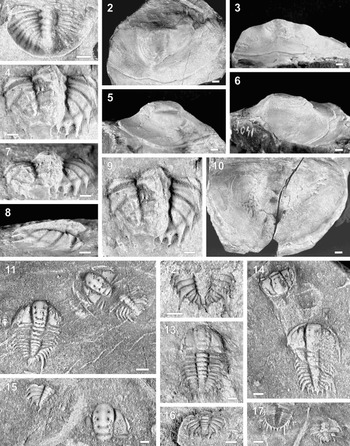
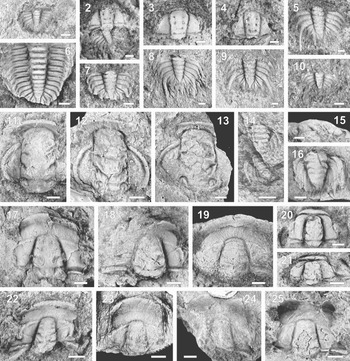
Type specimens of selected species from the Wuliuan of the San Isidro area described by Rusconi (Reference Rusconi1945, Reference Rusconi1952). (1) Athabaskia anax (Walcott, Reference Walcott1916): pygidium, MCNAM 14817, Chilonorria lasherensis Rusconi, Reference Rusconi1952, paratype, 40 m southeast of Cerro Martillo. (2, 3, 5, 6) Glossopleura leona? Lochman in Cooper et al., Reference Cooper, Arellano, Johnson, Okulitch, Stoyanow and Lochman1952: fragmentary pygidium in dorsal, posterior, lateral, and oblique views, MCNAM 14095, Ogygopsis? martillensis Rusconi, Reference Rusconi1952, paratype (illustrated previously by Rusconi, Reference Rusconi1952, pl. 4, fig. 3), Cerro Martillo. (4, 7–9) Kootenia incerta (Rusconi, Reference Rusconi1945): pygidium in postero-dorsal, posterior, lateral, and dorsal views, MCNAM 2160, Olenoides? incertus Rusconi, Reference Rusconi1945 holotype (illustrated previously by Rusconi, Reference Rusconi1945, text-fig. 2; Castellaro, Reference Castellaro1963, p. 20), 500 m west of Estancia San Isidro. (10) Glossopleura leona? Lochman in Cooper et al., Reference Cooper, Arellano, Johnson, Okulitch, Stoyanow and Lochman1952: pygidium (external mold), MCNAM 13769, Ogygopsis? martillensis Rusconi, Reference Rusconi1952 holotype (illustrated previously by Rusconi, Reference Rusconi1952, pl. 1, fig. 6), Cerro Martillo. (11–17) Oryctocephalites reynoldsi (Reed, Reference Reed1899): (11) two exoskeletons, MCNAM 14580, Viñakainella spinulosa Rusconi, Reference Rusconi1952, paratype (illustrated previously by Rusconi, Reference Rusconi1952, pl. 3, fig. 21), 40 m southeast of Cerro Martillo; (12) pygidium, MCNAM 13941, Oryctocephalus (Viñakainella) asperoensis Rusconi, Reference Rusconi1952, holotype (illustrated previously by Rusconi, Reference Rusconi1952, pl. 1, fig. 14), 1 km north of Cerro Martillo; (13) exoskeleton, MCNAM 14577, Viñakainella spinulosa Rusconi, Reference Rusconi1952, holotype (illustrated previously by Rusconi, Reference Rusconi1952, pl. 3, fig. 20), 40 m southeast of Cerro Martillo; (14) cephalon (upper) and exoskeleton (lower), MCNAM 14461, Oryctocephalus (Viñakainella) asperoensis Rusconi, Reference Rusconi1952, paratype (illustrated previously by Rusconi, Reference Rusconi1952, pl. 3, fig. 11; Bordonaro and Banchig, Reference Bordonaro and Banchig1995, pl. 2, fig. 5), Cerro Martillo; (15) pygidium (left) and cranidium (right), MCNAM 14500, Viñakainella pentacantha Rusconi, Reference Rusconi1952 holotype (illustrated previously by Rusconi, Reference Rusconi1952, pl. 3, fig. 16), 50 m southeast of Cerro Martillo; (16) pygidium, MCNAM 14501, Viñakainella pentacantha Rusconi, Reference Rusconi1952, paratype (illustrated previously by Rusconi, Reference Rusconi1952, pl. 3, fig. 17), 50 m southeast of Cerro Martillo; (17) two pygidia, MCNAM 13942, Oryctocephalus (Viñakainella) asperoensis Rusconi, Reference Rusconi1952 paratype (illustrated previously by Rusconi, Reference Rusconi1952, pl. 3, fig. 9), Cerro Martillo. Scale bars for (1–10) = 2 mm. Scale bars for (11–17) = 1 mm.

Systematic paleontology
Terminology
The morphological terms used below have been mostly defined by Whittington and Kelly (Reference Whittington, Kelly and Kaesler1997). Abbreviations: sag = sagittally; exs = exsagittally; long = longitudinally; tr = transversally.
Order Corynexochida Kobayashi, Reference Kobayashi1935
Family Dolichometopidae Walcott, Reference Walcott1916
Genus Athabaskia Raymond, Reference Raymond1928
Type species
Athabaskia ostheimeri Raymond, Reference Raymond1928, from the middle Cambrian of Alberta, Canada, by original designation.
Remarks
Although Resser (Reference Resser1935) regarded Athabaskia Raymond, Reference Raymond1928, as a junior synonym of Clavaspidella Poulsen, Reference Poulsen1927, from the middle Cambrian of Greenland, the former is distinguished by having a proportionately wider (tr.), parallel-sided posterior half of glabella, narrower fixigenae (tr.), and a less-distinct indentation on the rear pygidial margin, and by lacking well-defined eye ridges and pygidial border furrow (Lochman in Cooper et al., Reference Cooper, Arellano, Johnson, Okulitch, Stoyanow and Lochman1952, p. 128; see also Kobayashi, Reference Kobayashi1942; Rasetti, Reference Rasetti1951; Poulsen, Reference Poulsen1964; Peel, Reference Peel2021). Lochman in Cooper et al. (Reference Cooper, Arellano, Johnson, Okulitch, Stoyanow and Lochman1952), Palmer (Reference Palmer1954), and Poulsen in Moore (Reference Moore1959) provided emended diagnoses of Athabaskia, which have been largely accepted by subsequent authors (Robison and Babcock, Reference Robison and Babcock2011; Bordonaro, Reference Bordonaro2014; Sundberg, Reference Sundberg2020).
Athabaskia anax (Walcott, Reference Walcott1916)
Figures 2.1,3,4
- Reference Walcott1916
Bathyuriscus anax Walcott, p. 335, pl. 48, figs. 1, 1a, ?1d (only).
- Reference Resser1939a
Clavaspidella anax (Walcott); Resser, p. 13, pl. 5, figs. 5, 6.
- Reference Rusconi1952
Chilonorria lasherensis Rusconi, p. 109 (only paratype MCNM 14817).
- Reference Bordonaro2014
Athabaskia anax (Walcott); Bordonaro, p. 565, figs. 2.1–2.7, 3.1–3.8, 4.1–4.3 (see for further synonymy).
- Reference D'Angelo, Bordonaro, Raviolo, Bruno and Camí2021
Athabaskia anax (Walcott); D'Angelo et al., fig. 2A–D.
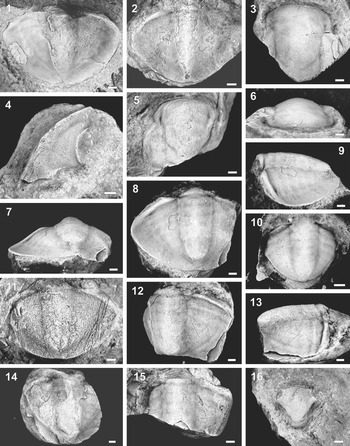
Athabaskia anax (Walcott, Reference Walcott1916) from the Glossopleura walcotti Zone of the San Isidro area, Precordillera of Mendoza: (1–3) cranidium and pygidium in dorsal, lateral, and anterior views, MLP 36402, CM; (4) small cranidium, MLP 36408, CM; (5) cranidium, MLP 36419, CM; (6) cranidium, MLP 24360a, CM; (7, 8) cranidium in lateral and dorsal views, MLP 36422, CM; (9) librigena, MLP 36412, CM; (10) cranidium, MLP 36423, QE; (11) cranidium, MLP 24350d, QO; (12) librigena, MLP 36415, CM; (13) librigena, MLP 24360e, CM; (14) librigena, MLP 36406, CM; (15) cranidium, MLP 36428, QO; (16–18) hypostome in ventral, lateral, and anterior views, MLP 36424, QE; (19) hypostome, MLP 36404a, CM; (20) hypostome, MLP 24360b, CM. Scale bars = 2 mm.

Lectotype
Complete specimen (U.S. National Museum 62637) from 7.2 km north of Brigham City, Wellsville Mountain, Box Elder County, Utah (Walcott, Reference Walcott1916, pl. 48, fig. 1; Resser, Reference Resser1939a, pl. 5, fig. 6).
Diagnosis
A species of Athabaskia having short genal spines; pygidial axis subparallel sided to slightly tapered backwards, containing four rings and an extended terminal piece, length ~75–85% of pygidium; pleural fields and pygidial border of moderate proportions, showing five apparent pleural and interpleural furrows of equal length that almost reach the pygidial margin; rear pygidial margin broadly rounded or slightly indented; well-preserved pygidia show a pair of delicate fossulae on the fifth pleural furrow, close to the posterolateral corners of the axis.
Occurrence
Wellsville Mountain, Box Elder County, Utah; Spence Shale, Wuliuan, Glossopleura walcotti Zone (Walcott, Reference Walcott1916; Resser, Reference Resser1939a). Cerro Martillo, Quebrada Oblicua, Quebrada Empozada, and Quebrada San Isidro, San Isidro area, Mendoza; San Isidro Olistoliths, Glossopleura walcotti Zone (Bordonaro and Banchig, Reference Bordonaro and Banchig1995; Bordonaro, Reference Bordonaro2014).
Remarks
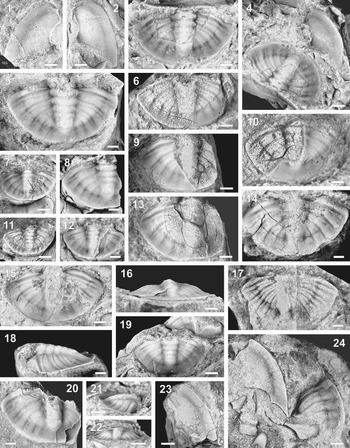
Bordonaro (Reference Bordonaro2014) described in detail numerous specimens of Athabaskia from the San Isidro area and regarded both Clavaspidella digesta Leanza, Reference Leanza1947, and several of Rusconi's (Reference Rusconi1952) species (Mendospidella asperoensis Rusconi, Reference Rusconi1952; Mendospidella quebradensis Rusconi, Reference Rusconi1952; Clavaspidella asperoensis Rusconi, Reference Rusconi1952) as junior synonyms of Athabaskia anax (Walcott, Reference Walcott1916) from the Spence Shale of Wellsville Mountain in northern Utah. As noted by Bordonaro (Reference Bordonaro2014), pygidia from Argentina exhibit high levels of variability, which are partly due to chemical changes produced during fossilization (D'Angelo et al., Reference D'Angelo, Bordonaro, Raviolo, Bruno and Camí2021). Variations in the degree of expression of pleural and interpleural furrows of A. anax are also well documented herein (e.g., compare Fig. 4.5, 4.14, and 4.17). Besides, pygidium length/width ratios (excluding articulating half ring) are somewhat variable, ranging from 0.46–0.56.
Athabaskia anax (Walcott, Reference Walcott1916) from the Glossopleura walcotti Zone of the San Isidro area, Precordillera of Mendoza: (1) librigena, MLP 36403, CM; (2) librigena, MLP 36417, CM; (3) pygidium, MLP 36418b, CM; (4) pygidium and librigena, 36418a, b, CM; (5) pygidium, MLP 36425, QO; (6) pygidium, MLP 36413, CM; (7) pygidium, MLP 36410b, CM; (8) pygidium, MLP 36418c, CM; (9) pygidium, MLP 36407, CM; (10) pygidium, MLP 36414, CM; (11) pygidium, MLP 36426, QO; (12) pygidium, MLP 36410a, CM; (13) pygidium, MLP 36409, CM; (14) pygidium, MLP 24360d, CM; (15) pygidium, MLP 36404b, CM; (16) pygidium in posterior view, MLP 36421, CM; (17) pygidium, MLP 36427, QO; (18) pygidium in lateral view, MLP 36416, CM; (19) pygidium, MLP 36418d, CM; (20) pygidium, MLP 36420, CM; (21, 22) pygidium in lateral and posterior views, MLP 36411, CM; (23) librigena, MLP 36405, CM; (24) librigena and fragmentary pygidium, MLP 36412a,b, CM. Scale bars = 2 mm.

Chilonorria lasherensis Rusconi, Reference Rusconi1952, was based on pygidia from different localities at the surroundings of Cerro Martillo, Mendoza, and comprises a partially preserved holotype (Rusconi, Reference Rusconi1952, pl. 2, fig. 3) and several paratypes, among which there is one (MCNAM 14817) that is reassignable to A. anax (cf., Bordonaro, Reference Bordonaro2014). The latter (Fig. 2.1) is a semielliptical sclerite of Athabaskia type showing a slightly tapered axis, five pairs of distinct pleural and interpleural furrows that almost reach the pygidial margin, a concave border, and a weak axial indentation, so its affinity with A. anax is evident. Athabaskia bithus (Walcott, Reference Walcott1916), from the Spence Shale of Wellsville Mountain, Utah, and Bear River Range, Idaho (Walcott, Reference Walcott1916, pl. 47, fig. 4 [only]; Resser, Reference Resser1939a, pl. 5, fig. 12; Campbell, Reference Campbell1974) (=Clavaspidella excavata Resser, Reference Resser1939b, pl. 9, figs. 1–6; Campbell, Reference Campbell1974), also shares a pygidial outline, relative development of pleural furrows, and proportions of the pygidial axis with A. anax, but according to assemblages described by Campbell (Reference Campbell1974), A. bithus bears much stouter genal spines.
Athabaskia anax and A. gladei Robison and Babcock, Reference Robison and Babcock2011, from the Glossopleura Zone in the Spence Shale at Wellsville Mountain (Robison and Babcock, Reference Robison and Babcock2011, fig. 4.1, 4.2), share small genal spines and a weakly indented pygidial rear margin. Nevertheless, A. gladei, as well as the closely allied species Athabaskia bela (Walcott, Reference Walcott1916) from the Gordon and Damnation formations of Montana (Walcott, Reference Walcott1916, pl. 50, figs. 2, 2a–d; Deiss, Reference Deiss1939, pl. 16, figs. 11, 18, 19; Schwimmer, Reference Schwimmer1973) and the Arrojos Formation of Sonora (Lochman in Cooper et al., Reference Cooper, Arellano, Johnson, Okulitch, Stoyanow and Lochman1952, pl. 29, figs. 1–10), are easily distinguished from A. anax by having a shorter (sag.) pygidial axis, a much wider (long.; tr.) pygidial border, and pleural and interpleural furrows of markedly different depth and length. Athabaskia howelli (Walcott, Reference Walcott1886), from the Chisholm Formation of Pioche, Nevada (Walcott, Reference Walcott1886, pl. 30, fig. 2, 2a; Pack, Reference Pack1906, pl. 2, fig. 2, 2a; Walcott, Reference Walcott1916, pl. 47, figs. 1, 1a, b; Palmer, Reference Palmer1954, pl. 13, fig. 8; Foster and Gaines, Reference Foster and Gaines2016, fig. 5.6) is another species that is characterized by a relatively short pygidial axis and a broad pygidial border.
Athabaskia wasatchensis (Resser, Reference Resser1939b), from the Spence Shale of Wellsville Mountain (Resser, Reference Resser1939b, pl. 8, figs. 15–20; Campbell, Reference Campbell1974; Liddell et al., Reference Liddell, Wright and Brett1997, fig. 3B), differs from A. anax because the former has wider (tr.) and concave librigenae that extend into larger genal spines, and a pygidium showing weaker interpleural furrows, and a longer (sag.) postaxial area.
Athabaskia minor (Resser, 1938) (Resser, Reference Resser1938a), from Pend Oreille Lake, Idaho and Cerro Los Arrojos, Sonora (Resser, Reference Resser1938a, pl. 1, figs. 45, 46, 48, 49; Lochman in Cooper et al., Reference Cooper, Arellano, Johnson, Okulitch, Stoyanow and Lochman1952, pl. 31, figs. 1–3; Sundberg, Reference Sundberg2020, fig. 11.1–11.23), has a proportionately long pigaxis and a narrow pygidial border, like those of A. anax, but its pygidial pleural furrows are much broader (exs.) and its genal spines seem to be bent outward from curvature of lateral margin of librigenae (compare with Sundberg, Reference Sundberg2020, fig. 11.5).
A single pygidium from the Albertella Zone of the Cathedral Formation of Alberta (Rasetti, Reference Rasetti1951, pl. 22, fig. 12) was considered as closely related to Athabaskia anax by Rasetti (Reference Rasetti1951) and Bordonaro (Reference Bordonaro2014); however, this specimen shows a slightly raised marginal border, so its affinity with Athabaskia is doubtful (cf., Palmer and Halley, Reference Palmer and Halley1979).
Genus Glossopleura Poulsen, Reference Poulsen1927
Type species
Dolichometopus boccar Walcott, Reference Walcott1916, from the middle Cambrian of British Columbia, Utah, Nevada, and Arizona, by original designation.
Remarks
Resser (Reference Resser1935), Palmer (Reference Palmer1954), Poulsen in Moore (Reference Moore1959), Palmer and Halley (Reference Palmer and Halley1979), and Babcock (Reference Babcock1994) discussed in detail the diagnosis of Glossopleura. As stated by Palmer (Reference Palmer1954), this genus combines relatively shallow dorsal furrows, a poorly developed frontal area, long (exs.) palpebral lobes, and a large semicircular to subovate nonspinose pygidium with a broad, flat, or concave border.
Large numbers of Glossopleura species are known in the literature, several of which are in need of revision. Specific differences are usually more apparent in pygidia than in cranidia (Rasetti, Reference Rasetti1951; Oldroyd, Reference Oldroyd1973). Babcock (Reference Babcock1994) and Sundberg (Reference Sundberg2005) pointed out that various features (e.g., development of glabellar furrows, outline and convexity of the pygidium, depth of pygidial furrows, length of pygdial axis, width of pygidial border) can vary within relatively wide limits in a species. As shown by specimens of G. walcotti Poulsen, Reference Poulsen1927 (e.g., Babcock, Reference Babcock1994, fig. 3.3, 3.4., 3.6; Sundberg, Reference Sundberg2018, fig. 13.2–13.5; Peel, Reference Peel2021, figs. 9E, F, 10K), these variations are related in part to ontogeny.
Glossopleura leona Lochman in Cooper et al., Reference Cooper, Arellano, Johnson, Okulitch, Stoyanow and Lochman1952
Figures 5, ?2.2, ?2.3, ?2.5, ?2.6, ?2.10
- Reference Cooper, Arellano, Johnson, Okulitch, Stoyanow and Lochman1952
Glossopleura leona Lochman in Cooper et al., p. 135, pl. 25, figs. 1–21.
- ?Reference Rusconi1952
Ogygopsis? martillensis Rusconi, p. 81, pl. 1, fig. 6, pl. 4, fig. 3.
Glossopleura leona Lochman in Cooper et al., Reference Cooper, Arellano, Johnson, Okulitch, Stoyanow and Lochman1952, from the Glossopleura walcotti Zone of the San Isidro area, Precordillera of Mendoza: (1) pygidium, MLP 36438, QO; (2) pygidium, MLP 36439, QO; (3, 6) fragmentary cranidium in dorsal and frontal views, MLP 36441, QO; (4) librigena, MLP 36430, CM; (5) fragmentary cranidium, MLP 36434, CM; (7–9) pygidium in posterior, dorsal, and lateral views, MLP 36431, CM; (10) pygidium, latex cast, MLP 36432, CM; (11) pygidium, MLP 36437, QO; (12, 13) pygidium in dorsal and lateral views, MLP 36435, QO; (14) pygidium, MLP 36436, QO; (15) fragmentary pygidium, MLP 36429, CM; (16) hypostome, MLP 36433, CM. Scale bars = 2 mm.

Holotype
Cranidium (U.S. National Museum 115830) from 10 km west of Caborca, Cerros La Proveedora, Sonora, Northwest Mexico (Lochman in Cooper et al., Reference Cooper, Arellano, Johnson, Okulitch, Stoyanow and Lochman1952, pl. 25, fig. 18).
Diagnosis
A species of Glossopleura with a minute frontal area; anterior part of glabella slightly expanded laterally, showing a pit-like depression on the axial furrow at level of S4 and close to the anterior end of the palpebral lobe; librigena with well-delineated border and medium-length genal spine; pygidial axis long (sag.), scarcely tapered backward, composed of six or seven smooth rings and terminal piece, which are delimited by faint, transverse transaxial furrows, occupying ~85–90% of total pygidial length (excluding articulating half ring); the first three pygidial axial rings combined (excluding articulating half ring) are slightly shorter (sag.) than the rest of the axis; pleural furrows faint or almost imperceptible, generally not extended into marginal border; pygidial border and doublure apparent, narrowed backward; rear margin slightly indented.
Occurrence
Cerro Los Difuntos and Cerros La Proveedora, west of Caborca, Sonora; Arrojos Formation, Wuliuan, Glossopleura walcotti Zone (Lochman in Cooper et al., Reference Cooper, Arellano, Johnson, Okulitch, Stoyanow and Lochman1952). Cerro Martillo, Quebrada Oblicua, and Quebrada San Isidro, San Isidro area, Mendoza; San Isidro Olistoliths, Glossopleura walcotti Zone.
Remarks
The specimens studied are characterized by a very short frontal area, a slightly expanded frontal glabellar lobe, a delicate pit on the axial furrows at level of glabellar furrow S4, a very long, slightly tapered backward pygidial axis, weak pleural furrows, and a fairly indented rear margin; features that are typical of Glossopleura leona Lochman in Cooper et al., Reference Cooper, Arellano, Johnson, Okulitch, Stoyanow and Lochman1952, from the Arrojos Formation of Sonora, Mexico (Lochman in Cooper et al., Reference Cooper, Arellano, Johnson, Okulitch, Stoyanow and Lochman1952, pl. 25, figs. 1–21). Lochman in Cooper et al. (Reference Cooper, Arellano, Johnson, Okulitch, Stoyanow and Lochman1952) provided a full description of this species based on holaspides of different sizes. Pygidia described herein compare most closely with the largest specimens from Sonora, which exhibit moderate-sized (Lochman in Cooper et al., Reference Cooper, Arellano, Johnson, Okulitch, Stoyanow and Lochman1952, pl. 25, figs. 3, 4) to large-sized (Lochman in Cooper et al., 1952, pl. 25, fig. 21) borders.
Rusconi (Reference Rusconi1952, p. 81, pl. 1, fig. 6, pl. 4, fig. 3) erected Ogygopsis? martillensis Rusconi, Reference Rusconi1952, on the basis of two imperfectly preserved Glossopleura pygidia from Cerro Martillo (Fig. 2.2, 2.3, 2.5, 2.6, 2.10) that invite comparison with the material described here. However, although the holotype of O.? martillensis (Rusconi, Reference Rusconi1952, pl. 1, fig. 6; Fig. 2.10) seems to accord in most of the essential features (general outline, axial length and shape, relative development of marginal border) with G. leona, its poor state of preservation prevents a conclusive specific assessment.
Glossopleura leona strongly resembles G. walcotti Poulsen, Reference Poulsen1927, from the G. walcotti Zone of Greenland (C. Poulsen, Reference Poulsen1927, pl. 16, figs. 20–32, 39, pl. 17, fig. 10; V. Poulsen, Reference Poulsen1964, pl. 1, figs. 2–4; Babcock, Reference Babcock1994, fig. 12.1–12.6; Peel, Reference Peel2021, figs. 9A–F, H, 10K–M), the southern Great Basin (California, Nevada) (Palmer and Halley, Reference Palmer and Halley1979, pl. 16, figs. 6–8, 11–19; Eddy and McCollum, Reference Eddy and McCollum1998; McCollum and Sundberg, Reference McCollum and Sundberg2007; Sundberg, Reference Sundberg2011a, Reference Sundberg2018, fig. 13.1–13.7), and the Precordillera of San Juan, western Argentina (Foglia and Vaccari, Reference Foglia and Vaccari2010, fig. 4.10–4.23). However, late holaspides of G. walcotti are distinguished by their proportionately shorter (sag.) pygidial axis.
Glossopleura templensis Rasetti, Reference Rasetti1951, from the Stephen Formation of British Columbia (Rasetti, Reference Rasetti1951, pl. 24, figs. 14–17), shares a long, slightly tapered backward pygidial axis with G. leona, but the former differs by having a more developed (sag.) frontal area, a less-expanded (tr.) glabellar frontal lobe and less-distinct glabellar furrows, and lacking a median inbend on the posterior margin of the pygidium. Additionally, Glossopleura curticei Resser, Reference Resser1938b, from the Wuliuan of Georgia (Resser, Reference Resser1938b, pl. 7, figs. 9–12), exhibits more posteriorly located palpebral lobes.
The type species, Glossopleura boccar (Walcott, Reference Walcott1916), from the G. walcotti Zone of British Columbia, Nevada, Utah, and Arizona (Sundberg, Reference Sundberg2005, fig. 6.10–6.14 and references therein; Foster, Reference Foster2011, fig. 4.1–4.3; Foster and Gaines, Reference Foster and Gaines2016, fig. 5.D), differs from G. leona because G. boccar possesses a pygidium with a semicircular outline, a shorter pygidial axis, and a more-developed (long.) postaxial region. Similarly, G. tuta Resser, Reference Resser1945, from the Muav Limestone of Arizona and the Bonanza King Formation of Nevada (Resser, Reference Resser1945, pl. 26, figs. 5, 6; Palmer and Halley, Reference Palmer and Halley1979, pl. 16, figs. 21–24; Sundberg, Reference Sundberg2011b, p. 187–189), is differentiated by its proportionately shorter pygidial axis, which additionally lacks indications of segmentation. Large holaspides of Glossopleura belesis (Walcott, Reference Walcott1916), from the Gordon Shale of Montana (Walcott, Reference Walcott1916, pl. 50, figs. 1, 1a–i; Schwimmer, Reference Schwimmer1973), are distinguished mainly by showing a wide (sag.) frontal area and a smaller pygidial axis. Glossopleura campbelli Robison and Babcock, Reference Robison and Babcock2011, from the Spence Shale of Wellsville Mountain, Utah (Robison and Babcock, Reference Robison and Babcock2011, fig. 5.1–5.2), is clearly differentiated from G. leona by having a wider (tr.) axis, narrower marginal borders, shorter genal spines, and unusually large pleural fields.
Glossopleura similaris Resser, 1939 (Resser, Reference Resser1939a), and G. utahensis Resser, Reference Resser1935, from the Glossopleura Zone of the Great Basin, are at first glance very similar to G. leona by sharing a long, conical pygidial axis. Unfortunately, the former are known by very fragmentary material, which precludes suitable comparisons. The holotype pygidium of G. similaris (Resser, Reference Resser1939a, pl. 5, fig. 11) seems to differ from G. leona mainly by having pleural furrows extended into the marginal border, whereas the paratype of G. utahensis (Resser, Reference Resser1939a, pl. 5, fig. 16) is distinguished by its distinct axial nodes. Glossopleura bassleri Resser, 1938 (Resser, Reference Resser1938b), from the Elbrook Formation of the Central Appalachians (Bassler, Reference Bassler1919, pl. 26, figs. 1–9; Resser, Reference Resser1938b, pl. 7, figs. 1, 2), also compares closely with G. leona, but its scope and affinities are obscured by distortion.
Family Dorypygidae Kobayashi, Reference Kobayashi1935
Genus Kootenia Walcott, Reference Walcott1889
Type species
Bathyuriscus (Kootenia) dawsoni Walcott, Reference Walcott1889, from the middle Cambrian of British Columbia, Utah, Nevada, and Alabama, by original designation.
Remarks
The generic diagnosis of Palmer (Reference Palmer1968) is followed herein, with minor emendation by Palmer and Gatehouse (Reference Palmer and Gatehouse1972), Sundberg (Reference Sundberg1994), and Robison and Babcock (Reference Robison and Babcock2011). Kootenia is characterized mainly by having a long (sag.), relatively broad (tr.), unfurrowed glabella, moderately developed palpebral lobes situated opposite middle third of glabella, a long (sag.) pygidial axis composed of 4–6 segments, pleural fields showing deep pleural furrows and barely apparent or absent interpleural furrows, and a spinose pygidial margin.
Kootenia is one of the most diverse genera of the trilobites (Geyer, Reference Geyer1994). More than one hundred species have been named worldwide, although many of them have been almost entirely defined on pygidial features, and in numerous cases their variability ranges remain unknown. Several authors (e.g., Lochman in Cooper et al., Reference Cooper, Arellano, Johnson, Okulitch, Stoyanow and Lochman1952; Sundberg, Reference Sundberg1994, Reference Sundberg2020; Eddy and McCollum, Reference Eddy and McCollum1998; Robison and Babcock, Reference Robison and Babcock2011) have pointed out the need of a comprehensive revision of the genus—a study that is beyond the scope of this paper.
Kootenia aff. K. incerta (Rusconi, Reference Rusconi1945)
Figures 6, 7
Description
Glabella long (sag.), straight-sided, subquadrangular in outline, longer than wide, slightly elevated above genal region, delimited by distinct axial furrows; frontal area lacking preglabellar field; ocular ridges weak; palpebral lobes imperfectly preserved, terminating at just anterior of mid-length (sag.) of glabella; occipital furrow deepest at sides and shallow on midline, slightly curved backward medially; occipital ring with a stout axial spine directed backward.
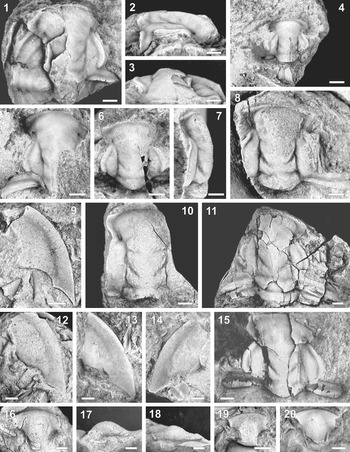
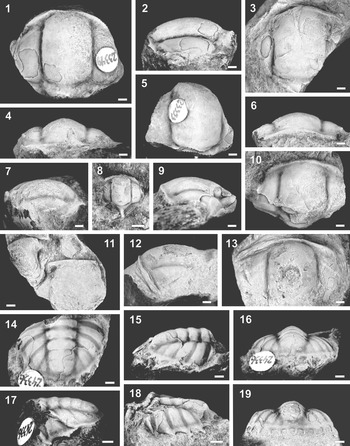
Kootenia aff. K. incerta (Rusconi, Reference Rusconi1945) from the Glossopleura walcotti Zone of the San Isidro area, Precordillera of Mendoza: (1, 2) cranidium in dorsal and lateral views, MLP 23349, QSI; (3) cranidium, MLP 23353b, QSI; (4, 7) cranidium in anterior and lateral views, MLP 36446, QO; (5) cranidium, MLP 23353c, QSI; (6, 9, 10) cranidium in anterior, lateral, and dorsal views, MLP 36449, QSI; (8) small cranidium, MLP 36450, QSI; (11) fragmentary cranidium and hypostome, MLP 36445, CM; (12, 13) cranidium in lateral and dorsal views, MLP 36448, QSI; (14–16) pygidium in dorsal, lateral, and posterior views, MLP 24336d, QSI; (17) pygidium in lateral view, MLP 24336i, QSI; (18) pygidium in lateral view, MLP 24336j, QSI; (19) pygidium in posterior view, MLP 24336a, QSI. Scale bars = 2 mm.

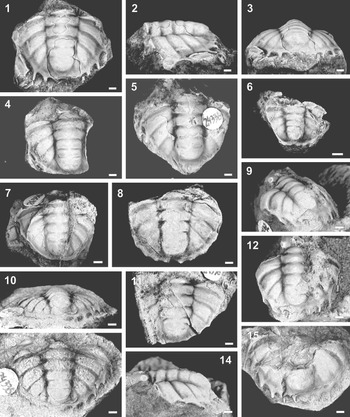
Kootenia aff. K. incerta (Rusconi, Reference Rusconi1945) from the Glossopleura walcotti Zone of the San Isidro area, Precordillera of Mendoza: (1–3) pygidium in dorsal, lateral, and posterior views, MLP 36444, CM; (4) pygidium, MLP 24336h, QSI; (5) pygidium, MLP 24336f, QSI; (6) fragmentary pygidium, MLP 36447, QSI; (7) fragmentary pygidium, MLP 24336i, QSI; (8) pygidium, MLP 36443, CM; (9, 12, 14) pygidium in oblique, dorsal, and lateral views, MLP 24336m, QSI; (10, 13) pygidium in posterior and dorsal views, MLP 24336b, QSI; (11) pygidium, MLP 24336c, QSI; (15) pygidium, MLP 24334g, QSI. Scale bars = 2 mm.

Length of pygidium about three quarters of its maximum transverse width, including spines; axis long (sag.), prominent, subparallel-sided to slightly tapered backward, extended almost to rear pygidial margin, composed of four rings and a broadly rounded terminal piece, lacking axial nodes; pleural areas with four well-defined pleural furrows, and indistinct interpleural furrows; border furrow faint; border very narrow, poorly convex, bearing six pairs of marginal spines, swollen near base of each spine; spines thin and long, equidistant, directed straight backward and downward.
Occurrence
Cerro Martillo, Quebrada Oblicua and Quebrada San Isidro, San Isidro area, Mendoza; San Isidro Olistoliths, Wuliuan, Glossopleura walcotti Zone.
Remarks
The specimens described above are close to Kootenia incerta (Rusconi, Reference Rusconi1945), a species described on imperfectly preserved material from the San Isidro Olistolith of Quebrada San Isidro (Rusconi, Reference Rusconi1945, text-fig. 2; Rusconi, Reference Rusconi1946, text-fig. 3a–c; Leanza, Reference Leanza1947, pl. 1, figs. 3, 4, 6, 10, 15, 16; Castellaro, Reference Castellaro1963, p. 20). However, the former slightly differ from the holotype pygidium of K. incerta, which is illustrated photographically for the first time herein (Fig. 2.4, 2.7–2.9), by having narrower, less-convex pygidial borders (e.g., compare Figs. 6.19 and 2.7).
Among the numerous species of Kootenia known in the literature, Kootenia aff. K. incerta compares most closely with those that combine a subquadrangular glabella, four pygidial axial rings lacking medial nodes, and six pairs of delicate, down-turned marginal spines. Kootenia schenki Resser, Reference Resser1945, from the Muav Formation of the Grand Canyon area (Resser, Reference Resser1945, pl. 20, figs. 11–17), seems to be very similar to the material described herein, but unfortunately its holotype pygidium (Resser, Reference Resser1945, pl. 20, fig. 17; Norr et al., Reference Norr, Santucci and Tweet2016, fig. 6D) is poorly preserved and illustrated. Kootenia aldrichensis Butts, Reference Butts1926, known only from a single pygidium from the Wuliuan of Alabama, southern Appalachians (Resser, Reference Resser1938b, pl. 7, fig. 23), is hardly differentiated from K. aff. K. incerta by having shorter marginal spines and faint indications of axial nodes.
Kootenia erromena Deiss, Reference Deiss1939, from the Glossopleura-Kootenia fauna of the Damnation Formation, Montana (Deiss, Reference Deiss1939, pl. 17, figs. 14–17), is distinguished by showing a proportionately shorter (sag.), tapering rather than tubular-shaped pygidial axis. Kootenia cf. K. erromena, from the Mexicella mexicana Zone of the Telt Bugt Formation, northwestern Greenland (Peel, Reference Peel2021, fig. 7A–G, J–M), further differs from K. aff. K. incerta by having a pygidium with a slightly wider (tr) axis, a fainter fourth axial ring furrow, and a somewhat wider border.
The type species, K. dawsoni Walcott, Reference Walcott1889, from the Wuliuan of British Columbia, the Great Basin and the southern Appalachians (Rasetti, Reference Rasetti1951, pl. 27, figs. 4–7; Sundberg, Reference Sundberg1994, fig. 14.1–14.8 and references therein), is clearly distinguished from K. aff. K. incerta by bearing a slightly expanding glabella, axial nodes on the pygidium, and somewhat broader based, not down-turned marginal spines.
Kootenia crassa Fritz, Reference Fritz1968
Figure 8
- Reference Cooper, Arellano, Johnson, Okulitch, Stoyanow and Lochman1952
Kootenia exilaxata Deiss; Lochman in Cooper et al., p. 125, pl. 26, figs. 1–20.
- Reference Fritz1968
Kootenia crassa Fritz, p. 198, pl. 42, figs. 23–27.
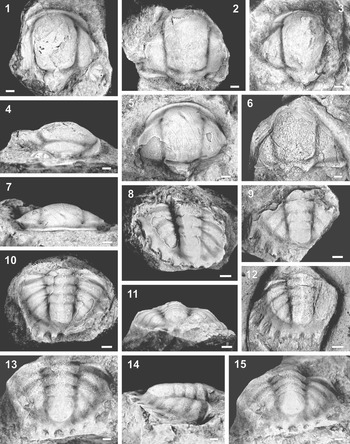
Kootenia crassa Fritz, Reference Fritz1968, from the Glossopleura walcotti Zone of the San Isidro area, Precordillera of Mendoza: (1, 4) cranidium in dorsal and lateral views, MLP 36452, CM; (2) cranidium, MLP 36455, QE; (3) cranidium, MLP 36451, CM; (5, 7) cranidium in dorsal and anterior views, MLP 36459, QO; (6) cranidium, MLP 23353a, QSI; (8) pygidium, MLP 36456, QO; (9) pygidium, MLP 36453, QO; (10, 11) pygidium in dorsal and posterior views, MLP 36457, QO; (12) pygidium, MLP 36458, QO; (13–15) pygidium in dorsal, lateral and posterior-dorsal views, MLP 36454, QE. Scale bars = 2 mm.

Holotype
Pygidium (U.S. National Museum 153639) from the east flank of the Northern Egan Range, 20 miles north of Ely, White Pine County, Nevada (Fritz, Reference Fritz1968, pl. 42, figs. 26, 27).
Occurrence
Campbell Range section, Northern Egan Range, Nevada; Pioche Shale, Wuliuan, upper Albertella Zone and Glossopleura Zone (Fritz, Reference Fritz1968). Cerro Los Arrojos and Cerros La Proveedora, west of Caborca, Sonora; Arrojos Formation, Glossopleura walcotti Zone (Lochman in Cooper et al., Reference Cooper, Arellano, Johnson, Okulitch, Stoyanow and Lochman1952). Copenhagen Canyon, Bear River Range, southeastern Idaho; ?Glossopleura walcotti Zone (Fritz in Oriel and Armstrong, Reference Oriel and Armstrong1971, p. 43). Cerro Martillo, Quebrada Oblicua, Quebrada Empozada, and Quebrada San Isidro, San Isidro area, Mendoza; San Isidro Olistoliths, Glossopleura walcotti Zone.
Remarks
Based on material from the Pioche Shale of Nevada, Fritz (Reference Fritz1968, pl. 42, figs. 23–27) described K. crassa in detail, pointing out the presence of a somewhat convex, anteriorly expanded glabella with a broadly curved anterior margin; a flat and rather broad (exsag.) anterior cranidial border; an axially enlarged occipital ring with a short spine; a subcylindrical pygidial axis consisting of three rings, a faintly defined fourth, and terminal piece, lacking axial nodes; three distinct pleural furrows and indications of two sets of faint interpleural furrows; and a shallow pygidial border bearing six pairs of wide, flattened marginal spines. Fritz (Reference Fritz1968) also regarded specimens from the Arrojos Formation in Sonora (Mexico), assigned by Lochman in Cooper et al. (Reference Cooper, Arellano, Johnson, Okulitch, Stoyanow and Lochman1952, pl. 26, figs. 1–20) to K. exilaxata Deiss, Reference Deiss1939, as conspecific with K. crassa. This species also was reported from the Bear River Range, southern Idaho, by Fritz in Oriel and Armstrong (Reference Oriel and Armstrong1971, p. 43).
The material studied herein exhibits the diagnostic features of K. crassa. The pygidia from Mendoza, as well as those from Mexico, slightly differ from the holotype (Fritz, Reference Fritz1968, pl. 42, figs. 26–27) by showing less-triangular pleural fields; a difference that may lack specific significance.
The pygidium of Kootenia libertyensis Resser, 1939 (Resser, Reference Resser1939b), from the Wuliuan of the Bear River Range, Idaho (Resser, Reference Resser1939b, pl. 9, figs. 7–9), bears strong similarities with that of K. crassa by preserving a wide marginal furrow and six pairs of long and slender marginal spines. Unfortunately, the corresponding cranidium of K. libertyensis is doubtful (Resser, Reference Resser1939b, p. 48), precluding a full comparison. Kootenia acicularis Resser, 1939 (Resser, Reference Resser1939b), from the Glossopleura walcotti and Ehmaniella zones of Idaho, Utah, and Nevada (Resser, Reference Resser1939b, pl. 10, figs. 24–26; Sundberg, Reference Sundberg1994, fig. 16.1–16.3) (?=K. elongata Rasetti, Reference Rasetti1948, from conglomerate boulders of Quebec), is differentiated from K. crassa because the former shows an elongate glabella and thinner marginal spines on the pygidium.
The types of Kootenia exilaxata Deiss, Reference Deiss1939, from the Damnation Formation of Montana (Deiss, Reference Deiss1939, pl. 17, figs. 23–26; Schwimmer, Reference Schwimmer1973), differ from K. crassa by having a quadrangular glabella and less-stout, uniformly sized pygidial marginal spines, which show higher rate of taper and are round in cross-section rather than flat (cf., Fritz, Reference Fritz1968). Kootenia quadriceps (Hall and Whitfield, Reference Hall and Whitfield1877), from the Ehmaniella Zone of Utah and Nevada (e.g., Palmer, Reference Palmer1954, pl. 14, figs. 1–3; Sundberg, Reference Sundberg1994, pl. 19, figs. 1–7), is distinguished mainly by its cranidium with parallel axial furrows, arcuate front margin, and elongate glabella.
Kootenia mckeei Resser, Reference Resser1945, from the Wuliuan of the Grand Canyon area (Resser, Reference Resser1945, pl. 20, figs. 5–8; Norr et al., Reference Norr, Santucci and Tweet2016, p. 198), shares a slightly expanded glabella and six pairs of pygidial spines with K. crassa, but the pygidium of the former differs in having distinct interpleural furrows and rear spines that are minute. Kootenia nodosa Babcock, Reference Babcock1994, from the Glossopleura Zone of North Greenland (Babcock, Reference Babcock1994, fig. 13.1–13.8), is distinguished from K. crassa mainly by showing distinctive pygidial axial nodes and shorter marginal spines.
Kootenia spencei Resser, 1939 (Resser, Reference Resser1939a), from the Spence Shale of southern Idaho and northern Utah (Resser, Reference Resser1939a, pl. 3, figs. 4–7; Campbell, Reference Campbell1974; Lyon, Reference Lyon2011), is differentiated from K. crassa in possessing an additional pygidial axial ring, as well as seven rather than six sets of marginal spines. Kootenia convoluta Resser, 1939 (Resser, Reference Resser1939b), sensu Fritz, Reference Fritz1968, from southern Idaho and east-central Nevada (Resser, Reference Resser1939b, pl. 10, figs. 1–3, 7–21; Fritz, Reference Fritz1968, pl. 41, figs. 17–24), differs by its subparallel-sided glabella and fewer pygidial spines.
Family Oryctocephalidae Beecher, Reference Beecher1897
Subfamily Lancastriinae Kobayashi, Reference Kobayashi1935
Genus Oryctocephalites Resser, Reference Resser1939
Type species
Oryctocephalites typicalis Resser, Reference Resser1939 (Resser, Reference Resser1939b), from the middle Cambrian of Idaho, by original designation.
Remarks
Sundberg (Reference Sundberg2014) provided a comprehensive phylogenetic analysis of Oryctocephalidae and revised the diagnosis of the widespread genus Oryctocephalites Resser, 1939 (Resser, Reference Resser1939b) (=Viñakainella Rusconi, Reference Rusconi1952). As stated by Sundberg (Reference Sundberg2014), several species of Oryctocephalites, together with Metabalangia Qian and Yuan in Zhang et al., Reference Zhang, Lu, Zhu, Qian, Lin, Zhou, Zhang and Yuan1980, and Tonkinella Mansuy, Reference Mansuy1916, characterize a clade within the Subfamily Lancastriinae Kobayashi, Reference Kobayashi1935.
Oryctocephalites reynoldsi (Reed, Reference Reed1899)
Figures 2.11–2.17, 9.1–9.10
- Reference Reed1899
Oryctocephalus reynoldsi Reed, p. 359, text-fig. (line drawing).
- Reference Rusconi1952
Oryctocephalus (Viñakainella) asperoensis Rusconi, p. 97, pl. 1, fig. 14, pl. 3, figs. 9–14, 18.
- Reference Rusconi1952
Viñakainella pentacantha Rusconi, p. 100, pl. 3, figs. 16, 17.
- Reference Rusconi1952
Viñakainella spinulosa Rusconi, p. 100, pl. 3, figs. 19–21.
- Reference Poulsen1958
Oryctocephalus asperoensis Rusconi; Poulsen, p. 6 (see for further synonymy).
- Reference Castellaro1963
Oryctocephalus asperoensis; Castellaro, p. 21.
- Reference Rusconi1967
Viñakainella asperoensis; Rusconi, text-fig. 78.
- Reference Rusconi1967
Viñakainella spinulosa; Rusconi, text-fig. 79.
- Reference Bordonaro and Banchig1995
Oryctocephalus burgessensis Resser; Bordonaro and Banchig, pl. 2, fig. 5.
- Reference Kimmig, Strotz, Kimmig, Egenhoff and Lieberman2019
Oryctocephalus walcotti Resser; Kimmig et al., fig. 5.k.
- Reference Sundberg2020
Oryctocephalites reynoldsi (Reed); Sundberg, p. 19, figs. 18.1–18.22, 19.1–19.14 (see for further synonymy).
(1–10) Oryctocephalites reynoldsi (Reed, Reference Reed1899): (1) small pygidium, MLP 36461b, CM; (2) cranidium and pygidium, MLP 36465b, QO; (3) cranidium, MLP 36465a, QO; (4) cranidium, MLP 36464, QO; (5) pygidium, MLP 24369a, QO; (6) thoracopygon (lacking anteriormost thoracic segment), MLP 24364a, QO; (7) pygidium, MLP 36460, CM; (8) pygidium, MLP 36463, QO; (9) pygidium, MLP 24364b, QO; (10) pygidium, MLP 36462b, CM. (11–16) Zacanthoides sp.: (11, 15) cranidium in dorsal and lateral views, MLP 36466, CM; (12) cranidium, latex cast, MLP 36468, QO; (13) cranidium, latex cast, MLP 36469, QO; (14) two pygidia, MLP 36470, QO; (16) pygidium, MLP 36467, QO. (17–19) Amecephalus normale? (Resser, 1938) (Resser, Reference Resser1938a): (17) cranidium, MLP 36472, QE; (18) cranidium, MLP 36471, QO; (19) cranidium, MLP 36473, QO. (20, 21) Spencia? sp.: (20) cranidium, MLP 36478, QSI; (21) distorted cranidium, MLP 36477, CM. (22) Amecephalus sp.: cranidium, MLP 36475, QO. (23–25) Amecephalus laticaudum? (Resser, 1939) (Resser, Reference Resser1939a): (23) cranidium, MLP 24237a, QSI; (24) cranidium, MLP 24351f, QO; (25) cranidium, MLP 36474, CM. Glossopleura Zone of the San Isidro area, Precordillera of Mendoza. Scale bars for (1–10) = 1 mm. Scale bars for (11–25) = 2 mm.

Holotype
Shield A1425 (Sedgwick Museum) from Mt. Stephen, British Columbia, Canada (Reed, Reference Reed1899, p. 359).
Occurrence
Pend Oreille Lake, Idaho; Lakeview Limestone, Wuliuan, Ptychagnostus praecurrens Zone (Resser, Reference Resser1938a; Sundberg, Reference Sundberg2020). Southern Idaho and Wellsville Mountains, Utah; Spence Shale, Glossopleura walcotti Zone (Resser, Reference Resser1939a; Campbell, Reference Campbell1974; Robison et al., Reference Robison, Babcock and Gunther2015; Kimmig et al., Reference Kimmig, Strotz, Kimmig, Egenhoff and Lieberman2019). Mt. Stephen and Mt. Field, Canadian Rocky Mountains; Stephen Formation, Glossopleura walcotti and Ehmaniella zones (Rasetti, Reference Rasetti1951; Whittington, Reference Whittington1995). Cerro Martillo and Quebrada Oblicua, San Isidro area, Mendoza; San Isidro Olistoliths, Glossopleura walcotti Zone (Rusconi, Reference Rusconi1952; Poulsen, Reference Poulsen1958; Sundberg, Reference Sundberg2014).
Remarks
Although these oryctocephalid specimens are imperfectly preserved, they clearly show an anteriorly expanding glabella, lateral glabellar furrows represented by subcircular pits at S1–S3 that are not extended to the axial furrows, S1 pits connected by a transglabellar furrow, an occipital ring lacking longitudinal furrows projecting from S0 depression to the posterior margin, and six cylindrical spines on the pygidium; features that are present in Oryctocephalites Resser, 1939 (Resser, Reference Resser1939b) (see diagnosis in Sundberg and McCollum, Reference Sundberg and McCollum1997, p. 1079; Sundberg, Reference Sundberg2014, p. 579). In addition, the presence of a relatively flat anterior cranidial border, weak ocular ridges, five pygidial axial rings, pygidial marginal spines including three uniform anterior pairs, a fourth represented by a relatively long macrospine, and two short posterior pairs, as well as interpleural furrows that are better defined in the posterior segments, indicate affinity with O. reynoldsi (Reed, Reference Reed1899), as revised by Sundberg (Reference Sundberg2020).
Rusconi (Reference Rusconi1952) erected three oryctocephalid species—Oryctocephalus (Viñakainella) asperoensis; Viñakainella pentacantha; Viñakainella spinulosa—from Cerro Martillo, the types of which are reillustrated in Figure 2.11–2.17. As suggested by Sundberg (Reference Sundberg2014, p. 579), their morphologies accord with that of Oryctocephalites reynoldsi, so the Rusconi (Reference Rusconi1952) species are regarded herein as junior synonyms.
Family Zacanthoididae Swinnerton, Reference Swinnerton1915
Genus Zacanthoides Walcott, Reference Walcott1888
Type species
Embolimus spinosus Rominger, Reference Rominger1887, from the middle Cambrian of Mount Stephen, British Columbia, by original designation.
Remarks
The diagnostic characters of Zacanthoides were discussed in detail by Palmer (Reference Palmer1954) and Sundberg (Reference Sundberg1994), who pointed out the presence of an elongate subparallel-sided glabella, apparent anterior border and preglabellar field, anteriorly divergent facial sutures, long (exs.), narrow, strongly curved palpebral lobes, broad thorax and pygidial axes, and three or more pairs of posteriorly directed spines on the margin of the pygidium (Palmer and Halley, Reference Palmer and Halley1979; Young and Ludvigsen, Reference Young and Ludvigsen1989).
Zacanthoides sp.
Figure 9.11–9.16
Occurrence
Cerro Martillo and Quebrada Oblicua, San Isidro area, Mendoza; Wuliuan, San Isidro Olistoliths, Glossopleura walcotti Zone.
Remarks
The Borrello collection includes a few poorly preserved cranidia and pygidia that are assignable to Zacanthoides Walcott, Reference Walcott1888. The cranidia exhibit a parallel-sided glabella, a proportionately short (sag.) frontal area with a slightly rounded anterior border, and moderately divergent anterior facial sutures, whereas the pygidia show a tapered axis with four to five axial rings plus a terminal piece, and five or six pairs of marginal spines.
These specimens appear to be indistinguishable from material from the Spence Shale of the Bear River Range (“locality 55c”), southern Idaho, to which Resser (Reference Resser1939a) assigned different names (see especially Zacanthoides abbreviatus Resser, 1939 (Resser, Reference Resser1939a, pl. 2, figs. 7 -9); as well as Z. adjunctus Resser, 1939 (Resser, Reference Resser1939a); Z. gradatus Resser, 1939 (Resser, Reference Resser1939a); Z. idahoensis Walcott, Reference Walcott1908; Z. serratus Resser, 1939 (Resser, Reference Resser1939a); Z. holopygus Resser, 1939 (Resser, Reference Resser1939a)) and compares closely with Z. ferula Leanza, Reference Leanza1947, from the San Isidro Olistolith of Quebrada San Isidro (Leanza, Reference Leanza1947, pl. 1, figs. 1, 2, 8, 9, 11, 14). However, the sclerites studied herein are provisionally left in open nomenclature pending recovery of more and better-preserved specimens.
Order Pychopariida Swinnerton, Reference Swinnerton1915
Suborder Ptychopariina Richter, Reference Richter, Dittler, Joos, Korschelt, Linek, Oltmanns and Schaum1932
Family uncertain
Genus Spencia Resser, Reference Resser1939
Type species
Spencia typicalis Resser, 1939 (Resser, Reference Resser1939a), from the middle Cambrian of southern Idaho.
Spencia? sp.
Figure 9.20, 9.21
Occurrence
Cerro Martillo, Quebrada Empozada and Quebrada San Isidro, San Isidro area, Mendoza; Wuliuan, San Isidro Olistoliths, Glossopleura walcotti Zone.
Remarks
Three somewhat distorted adult cranidia from the San Isidro area are characterized by their small size and moderate convexity, a barely convex glabella that is slightly tapered and extends to the anterior border furrow, weak but visible lateral glabellar furrows, a convex and medially swollen anterior border that narrows (exs.) laterally, an extremely reduced (sag.) preglabellar field, convergent anterior facial sutures, faint ocular ridges, and palpebral lobes situated opposite middle third of glabella; features that are characteristic of Spencia Resser, 1939 (Resser, Reference Resser1939a) (Rasetti, Reference Rasetti1963, p. 591) (=Stauroholcus Resser, 1939 (Resser, Reference Resser1939a)); Rasetti, Reference Rasetti1951, p. 240–241). Cranidia of the closely related genus Spencella Rasetti, Reference Rasetti1963, are hardly differentiated from the type species of Spencia, Spencia typicalis Resser, 1939 (Resser, Reference Resser1939a), by having a glabella that is elevated well above fixigenae, and a smooth rather than a granulate test.
The material examined seems to be indistinguishable from Spencia typicalis Resser, 1939 (Resser, Reference Resser1939a) (=S. plena Resser, 1939 (Resser, Reference Resser1939a)), from the Spence Shale of the Bear River Range, southern Idaho (Resser, Reference Resser1939a, pl. 6, figs. 19–25; Rasetti, Reference Rasetti1963, p. 591). However, given that the specimens from Mendoza consist only of cranidia, they are cautiously left in open nomenclature.
Both Spencia typicalis and Spencia? sp. differ from S. quadrata Fritz, Reference Fritz1968, from the upper Albertella Zone of the Pioche Shale, Nevada (Fritz, Reference Fritz1968, pl. 40, figs. 27–29), mainly because the latter exhibits a more pointed glabella, less-convex fixigenae, and more anteriorly located palpebral lobes (Fritz, Reference Fritz1968).
Genus Amecephalus Walcott, Reference Walcott1924
Type species
Ptychoparia piochensis Walcott, Reference Walcott1886, from the middle Cambrian of Nevada.
Remarks
Sundberg and McCollum (Reference Sundberg and McCollum2000), Robison and Babcock (Reference Robison and Babcock2011), and Sundberg (Reference Sundberg2020) discussed in detail the diagnosis of Amecephalus Walcott, Reference Walcott1924, which is followed herein. Although several cranidia from the Borrello collections are compatible with material of Amecephalus from northern Idaho and the Great Basin, their specific affiliation cannot be assessed with complete certainty because none of the specimens is associated with pygidia.
Amecephalus normale? (Resser, Reference Resser1938)
Figure 9.17–9.19
Occurrence
Quebrada Oblicua and Quebrada Empozada, San Isidro area, Mendoza; Wuliuan, San Isidro Olistoliths, Glossopleura walcotti Zone.
Remarks
The cranidia examined show a broadly and evenly rounded anterior margin, a moderately long (sag.) frontal area, noticeable preglabellar caeca, a tapered glabella showing apparent lateral furrows, nearly parallel anterior facial sutures, and relatively long (exs.) palpebral lobes. Their distinct glabellar furrows indicate further affinity with Amecephalus rather than the closely related genus Achlysopsis Fritz, Reference Fritz1968 (Sundberg, Reference Sundberg2018). These cranidia are identical to those of Amecephalus normale (Resser, 1938) (Resser, Reference Resser1938a) from the Lakeview Limestone of northern Idaho and the Spence Shale of southern Idaho and northern Utah (Resser, Reference Resser1938a, pl. 1, figs. 41, 42, 44; Sundberg, Reference Sundberg2020, figs. 24–25 and references therein).
Amecephalus laticaudum? (Resser, Reference Resser1939)
Figure 9.23–9.25
Occurrence
Cerro Martillo, Quebrada Oblicua and Quebrada San Isidro, San Isidro area, Mendoza; Wuliuan, San Isidro Olistoliths, Glossopleura walcotti Zone.
Remarks
These Amecephalus cranidia are characterized by having a low convexity, a wide (sag.) slightly concave anterior border and a transverse, slightly indented preglabellar furrow, as well as by lacking bacculae. They are consistent with Amecephalus laticaudum (Resser, 1939) (Resser, Reference Resser1939a), from the Wuliuan of the Pioche Shale (Nevada), Chisholm Formation, and Spence Shale (Utah and southern Idaho) (Resser, Reference Resser1939a, pl. 4, figs. 15–19; Fritz, Reference Fritz1968, pl. 40, figs. 17–23; Sundberg, Reference Sundberg2005, fig. 6.6), but the scarce material from Mendoza precludes further comparison.
Amecephalus sp.
Figure 9.22
Occurrence
Quebrada Oblicua, San Isidro area, Mendoza; Wuliuan, San Isidro Olistoliths, Glossopleura walcotti Zone.
Remarks
A single cranidium showing a tapered, proportionately narrow (tr.) glabella and long (exs.) palpebral lobes strongly compares with the lectotype of the type species, Amecephalus piochensis (Walcott, Reference Walcott1886) from the Chisholm Shale of Nevada (Foster, Reference Foster2011, fig. 10.1; Sundberg, Reference Sundberg2020, fig. 22.6, 22.7), differing only by having a slightly shorter (sag.) preglabellar field. Amecephalus jamisoni Robison and Babcock, Reference Robison and Babcock2011, from the Spence Shale of Wellsville Mountain, Utah (Robison and Babcock, Reference Robison and Babcock2011, fig. 15.1–15.4), further differs by possessing shorter (exs.) palpebral lobes and a prominent medial spine on the occipital ring.
Acknowledgments
C. Cingolani (División Geología, Museo de La Plata) is thanked for his encouragement and for making the material available for study. G. Campos, E. Aranguez, M. Parral, F. Rojo (Museo de Ciencias Naturales y Antropológicas “Juan Cornelio Moyano”, Mendoza), and A. Riccardi (División Paleozoología Invertebrados, Museo de La Plata) provided access to the collections housed in their respective institutions. E. Clarkson, S. Morrison, and the library staff of the Museo de La Plata helped in the search of bibliographic information. The manuscript was greatly improved by the constructive reviews of F. Sundberg and B. Pratt. Thanks are extended to N. Hughes, B. Hunda, and J. Kastigar for their editorial work. This research was supported by the Consejo Nacional de Investigaciones Científicas y Técnicas and the Universidad Nacional de La Plata, Argentina.
Appendix––Locality and faunal register
Cerro Martillo (CM).––Athabaskia anax, Glossopleura leona, Kootenia aff. K. incerta, Kootenia crassa, Oryctocephalites reynoldsi, Zacanthoides sp., Amecephalus laticaudum?, Spencia? sp.
Quebrada Oblicua (QO).––Athabaskia anax, Glossopleura leona, Kootenia aff. K. incerta, Kootenia crassa, Oryctocephalites reynoldsi, Zacanthoides sp., Amecephalus normale?, Amecephalus laticaudum?, Amecephalus sp.
Quebrada Empozada (QE).––Athabaskia anax, Kootenia crassa, Amecephalus normale?, Spencia? sp.
Quebrada San Isidro (QSI).––Athabaskia anax, Glossopleura leona, Kootenia aff. K. incerta, Kootenia crassa, Amecephalus laticaudum?, Spencia? sp.