Introduction
Swallowing dysfunction (dysphagia) following total laryngectomy is common; researchers recently found that 42 per cent of patients required a modified diet three years post-operatively.Reference Ward, Bishop, Frisby and Stevens1 Dysphagia may be due to a combination of factors. Some of these may be anticipated, due to the planned surgical derangement, and some may be unexpected, as a result of commonly occurring surgical complications.
At the time of total laryngectomy surgery, there is permanent separation of the trachea and oesophagus. Following removal of the larynx, the pharynx requires reconstruction. The pharyngeal defect is usually closed primarily with mucosa that is raised from the thyroid ala, the pyriform sinus and the post-cricoid region. ENT and head and neck surgeons generally agree that a minimum of 3 cm of mucosa is required, in order to allow for a transverse closure that enables the patient to have good post-operative swallowing.Reference Freeman, Hamaker, Blom, Singer and Hamaker2, Reference Hamaker, Cheesman, Blom, Singer and Hamaker3
There are several different surgical methods used to close the pharynx. The most common appear to be a ‘T’ or ‘Y’ closure of the mucosa and muscle.Reference Hamaker, Cheesman, Blom, Singer and Hamaker3 The inferior margin of the reconstructed pharynx is then anastomosed to the upper oesophagus. This area, which incorporates the inferior constrictor muscles, the altered crico-pharyngeus and the upper circular fibres of the oesophagus, is known as the pharyngo-oesophageal segment.Reference Edels and Edels4
Hamaker and Cheesman stated that reconstruction of the pharynx and management of the pharyngeal constrictor muscles following a total laryngectomy are important for optimal post-operative speech and swallowing functionReference Ward, Bishop, Frisby and Stevens3. Cheesman (1998) described the elements of pharyngeal closure for optimal pharyngeal function following laryngectomy, as promoted by Charing Cross Hospital, UK, ENT surgeons. First, Cheesman advocated a transverse closure (or Y - shape if the resection is larger) of the mucosa, with interrupted inverting sutures as the ‘best’ way of surgically closing the pharynx. Next, he undertakes a muscle closure, performed by closing the thyropharyngeus muscles anteriorly and suturing the suprahyoid muscles superiorly.Reference Ward, Bishop, Frisby and Stevens3 In addition to this reconstruction of the pharynx described by Cheesman, a pharyngeal constrictor myotomy was recommended by both Cheesman and Hamaker (1998),Reference Ward, Bishop, Frisby and Stevens3 who stated that the myotomy needed to be down to the submucosal vessels; extending from the base of tongue to the oesophageal inlet, for optimal post-operative speech and swallowing function.Reference Ward, Bishop, Frisby and Stevens3
Following a total laryngectomy, anticipated changes to swallowing include significantly reduced amplitude and duration of pharyngeal wall contractions (i.e. peristalsis, required to propel the food bolus through to the oesophagus on swallowing).Reference Dantas, Aguiar-Ricz, Gielow, Filho and Mamede5 Reduced sensation in the reconstructed pharynx is also expected, due to sectioning of the superior and recurrent laryngeal nerves.
Absent or reduced sensation, poor opening of the pharyngo-oesophageal segment and reduced pharyngeal motility will probably result in residual material remaining in the reconstructed pharynx after swallowing.
Swallowing difficulties may also result from surgical complications, such as partial breakdown of the inferior anastomosis, creating an anterior pseudo-diverticulum, which in turn can impair the complete pharyngeal clearance of a bolus after swallowing.Reference Dantas, Aguiar-Ricz, Gielow, Filho and Mamede5 A stenosis or constriction at the level of the reconstructed pharyngo-oesophageal segment may occur, resulting in significant impairment of the hypopharynx, with food and/or fluid residue remaining at this site after swallowing.
Adjuvant treatments (including radiotherapy and chemotherapy) are also known to have a negative effect on swallowing.Reference Cook, Castell and Richter6 In addition to the anatomical and physiological changes which follow treatment for laryngeal cancer, co-morbid changes are frequently present in the laryngectomy population, who are generally older.
AgeingReference Lindgren and Janzon7 and depressionReference Boyd, Brodsky, Day, Lee and Martin-Harris8 are known to negatively impact on swallowing. Following total laryngectomy, swallowing disorders may therefore be multi-factorial in aetiology, with some factors being outside the surgeon's control.
It seems evident that a careful pharyngeal reconstruction is necessary in order to optimise swallowing outcomes following total laryngectomy.Reference Hamaker, Cheesman, Blom, Singer and Hamaker3 Despite the potential for swallowing to be affected by the surgical approach, a thorough literature review did not identify any studies correlating surgical technique with swallowing outcome following total laryngectomy.
Informal discussion with ENT and head and neck surgeons at unit case conferences in New South Wales, Australia, revealed that their own reconstruction of the pharynx, following removal of the larynx, was dependent on several factors, including; the tumour itself (i.e. size and location); their own surgical experience, and from whom they received their early training.
Some of the features of pharyngeal closure which may vary during laryngectomy surgery include: the direction of closure (either vertical or transverse, including T and Y closures); the level of closure (mucosal closure only, or mucosa and muscle closure); suture techniques (interrupted or continuous); and the length of the myotomy performed (if any). Full, three-layered closure with a posterior myotomy and pharyngeal neurectomy is practised by some ENT and head and neck surgeons,Reference Cole and Miller9 whereas others advocate vertical mucosal closure alone, which (they report) results in improved swallowing outcomes (R Gallagher, personal communication).
To date, no one standard procedure has been taught or recommended. In order to thoroughly investigate this clinical problem, there first needs to be documented evidence of the practice of differing techniques of total laryngectomy surgery. If substantive differences exist, it would then be possible to examine whether these different techniques resulted in better or worse swallowing outcomes following total laryngectomy surgery.
Materials and methods
There are many ways in which such data might be obtained. In this study, a questionnaire design was chosen because the investigators wanted to target as many ENT and head and neck surgeons as possible, in an efficient manner, across all the states of Australia. This method was also chosen as it was a useful way to gather data using a standardised measurement tool, and also allowed respondents to answer the questions at their own convenience. It is acknowledged that one weakness of questionnaire studies is the potential for a low yield. Nevertheless, this research design was adopted, as it enabled ENT and head and neck surgeons in both major tertiary city hospitals and rural areas to participate in the study. The questionnaire was anonymous, to encourage candid responses, and respondents were informed that they would be assessed against their peers.
The aim of this study was to investigate and document differences in the method of surgical closure following total laryngectomy surgery, as practised by Australian ENT and head and neck surgeons. If there is heterogeneity in the surgical reconstruction methods used, this should be considered when evaluating swallowing outcomes following laryngectomy.
We developed the questionnaire to document the most pertinent features of pharyngeal reconstruction used by Australian ENT and head and neck surgeons following total laryngectomy. The questions were dichotomous, except where indicated. However, respondents were requested to provide further information if they responded ‘yes’ to any question. They were also given the opportunity to provide further comment if they desired. The questionnaire is shown as Appendix 1.
On behalf of the researchers, the secretary of the NSW branch of the Australian Medical Association sent the questionnaire to all ENT and head and neck surgeons who were members of the Australian and New Zealand Head and Neck Society. Respondents were asked to complete and return the questionnaire via e-mail or fax.
Results
The questionnaire was completed and returned by 28 of the 56 participants (50 per cent). The best return rate that researchers can anticipate from a questionnaire is approximately 30–60 per cent,Reference Portney, Watkins, Portney and Watkins10 so this was a good response. Respondents reported using differing surgical techniques when performing a total laryngectomy, as follows.
Levels of pharyngeal closure
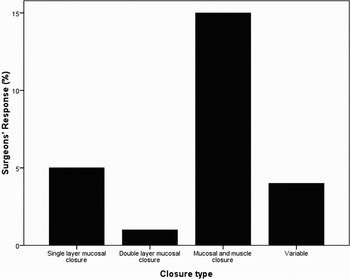
Although the majority of respondents used a mucosal and muscle closure (57.7 per cent), 19.2 per cent advocated a mucosa only closure. Several respondents wrote that they believed swallowing was improved by a mucosa only closure. A number of respondents (15.4 per cent) indicated that their closure type varied depending on the features of the tumour. They recommended different surgical techniques for each individual patient (see Figure 1).
Reported levels of pharyngeal closure.

Features of closure
When asked about the features of closure which they felt were important following total laryngectomy, the majority of respondents (29 per cent) stated that they used a vertical closure to close the pharyngeal defect.
There were differences in the reported suture techniques, with 32 per cent of respondents stating that inverted mucosal sutures should be used. Although continuous sutures were used by 21.4 per cent of respondents, 10.7 per cent stated that interrupted sutures were preferable for closing the pharynx. Two respondents specifically stated that non-tension closure was an important aspect of their technique, and a further two commented that, where possible, a staple gun should be used to close the pharynx (although no reasons were given for this statement).
Two respondents made reference to the importance of preserving the hyoid bone if possible. One respondent suggested that preservation of the hyoid bone was possible after removal of glottic and subglottic tumours, and that this may stabilise the muscles in the floor of mouth, thereby leading to improved swallowing.
Other aspects of surgical closure
Most respondents conducted a myotomy (91.7 per cent), with 58 per cent commenting that it should be a ‘long myotomy’. Only 34.9 per cent of respondents reattached the suprahyoid muscles as part of their pharyngeal reconstruction.
Testing of pharyngeal integrity and commencing oral intake
Intra-operative testing of pharyngeal integrity, by flushing water through the reconstructed pharynx, was undertaken by 20.8 per cent of respondents. Those who tested pharyngeal integrity intra-operatively also used a mucosa only closure of the pharynx.
Post-operative care of the total laryngectomy patient appeared to differ across respondents. There was variation in the time for patients to restart oral intake, with a range of seven to 14 days reported. Most patients reportedly resumed oral intake on their seventh post-operative day.
Discussion
This study represents the first published report of Australian ENT and head and neck surgeons' variations in total laryngectomy technique. Data were collected via an anonymous postal questionnaire, with a good response rate achieved (50 per cent). There were marked differences in respondents' reported techniques for pharyngeal reconstruction. Most respondents reported undertaking a myotomy at the time of surgery (this was the most consistent questionnaire response). However, differences were reported regarding the length and position of this myotomy. The majority of respondents stated that it was important to conduct a long myotomy; one stated that ‘…the whole length of the constrictor muscle should be included’, and another that the myotomy ‘…should be approximately 5–8 cm in length’. Respondents commented that this was required to ensure that the best speech and swallowing outcomes were achieved. There is evidence in the literature to support a long myotomy, from the base of the tongue to the oesophageal inlet, in order to achieve the best tracheoesophageal puncture voice and to decrease the likelihood of spasm.Reference Hamaker, Cheesman, Blom, Singer and Hamaker3 However, the best myotomy length and position, for optimal post-operative swallowing function, has not been investigated.
The surgeons' responses indicated a move away from the traditional T or Y closures of both mucosa and muscle, with approximately one-third of respondents commenting that they always tried to achieve vertical closure first if possible. Only one-third of respondents reported reattaching the suprahyoid muscles, despite this being previously described in the literature as a key aspect of pharyngeal closure.Reference Hamaker, Cheesman, Blom, Singer and Hamaker3 One respondent stated that the hyoid bone should be preserved where possible, in order to improve tongue and floor of mouth stability. This may be plausible but it has not been systematically tested, and the impact of this technique on swallowing function is unknown. There also appears to be a number of surgeons who now close the pharynx with a mucosa only closure, or a mucosal with interrupted muscle closure. Again, it was commented that this type of closure may result in better swallowing outcomes, although this has not been objectively studied. The respondents who favoured a mucosa only closure also tended to test pharyngeal integrity intra-operatively by flushing water through the reconstructed area with a syringe. Freeman and Hamaker stated that using muscle reinforces the pharyngeal closure and decreases the chance of breakdown.Reference Freeman, Hamaker, Blom, Singer and Hamaker2 Therefore, when mucosa alone is used, it may be important to test intra-operatively that there is no leak, to ensure that a fistula does not occur.
• Following total laryngectomy, recent research shows that swallowing may be more problematic than previously thought
• The aetiology of swallowing difficulties is likely to be multi-factorial, and may involve: anatomical and physiological derangement following surgery; surgical complications; side effects of adjuvant treatments (including radiotherapy and chemotherapy); and other co-morbid factors (such as ageing)
• To date, no published research has correlated the type of surgical closure performed, following total laryngectomy, with the swallowing outcomes
• This study adds to the current literature by clearly documenting the widespread differences in total laryngectomy technique practised by Australian surgeons
Although the results of this questionnaire highlighted the fact that surgical techniques vary, there is currently no high quality evidence about which pharyngeal reconstruction technique(s) result in the best swallowing outcomes. As swallowing difficulties have been shown to be a significant determinant of laryngectomy patients' quality of life,Reference Ward, Bishop, Frisby and Stevens1 factors negatively affecting a patient's ability to eat and swallow need to be identified and, where possible, addressed. Further research is required to assess whether differences in surgical techniques employed during total laryngectomy have an effect on the development of dysphagia post-operatively.
We acknowledge some shortcomings of this study, including the lack of opportunity to contact the respondents (as the survey was anonymous) in order to clarify any ambiguous responses, and the fact that we could not ensure equal representation across all Australian states. Furthermore, due to the nature of the survey, it was also not possible to ensure that responses were necessarily received from those surgeons who conducted the majority of total laryngectomies in Australia.
Conclusion
After total laryngectomy, swallowing may be affected by the surgical approach used. To date, there has not been a standard procedure recommended for pharyngeal reconstruction following total laryngectomy. A systematic audit of the differing surgical technique(s) used, followed by correlation with post-operative swallowing function, could ascertain ‘best practice’ in laryngectomy surgery. Such data would be simple to document, and the results would be powerful if the information was collected from multi-centres and then shared.
Acknowledgements
This paper was part of a wider research study generously funded through the Laryngectomee Association of NSW, as part of Julia Maclean's PhD studies at La Trobe University, Melbourne. The authors would like to thank Mr Ian Cole, Head and Neck Surgeon, Sydney, for his comments on an early draft of the manuscript.
Appendix 1
Questionnaire
(1) After a straightforward total laryngectomy (i.e. without any component of pharyngectomy or oesophagectomy), how do you close the pharyngeal defect?
(a) Single layer mucosal closure
(b) Double layer mucosal closure
(c) Mucosal and muscle closure
(d) Other (please describe)
(2) Do you re-attach any of the suprahyoid muscles to the anastomosis?
(3) Do you perform a pharyngeal constrictor myotomy?
(4) Do you test the integrity of your pharyngeal closure intra-operatively?
(5) Are there other aspects of your surgical closure that you believe are important (such as direction of closure, suture technique, etc)? Please describe.
(6) All progressing well, on which post-operative day would the patient usually commence oral intake?
(7) Do you perform any radiological assessment prior to commencing oral intake?