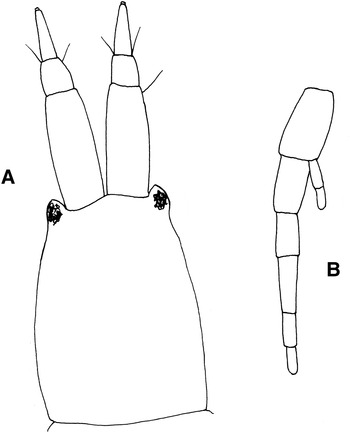
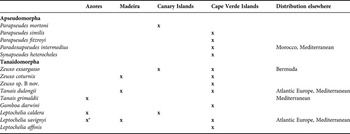
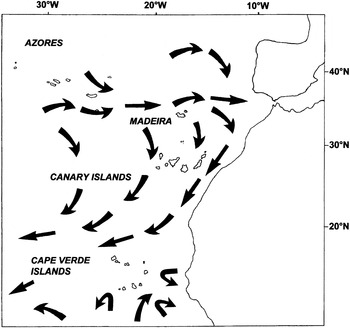
INTRODUCTION
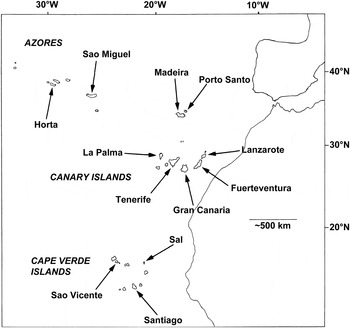
The Macaronesian islands incorporate four inhabited archipelagos in the north-east Atlantic, from the Azores in the north and at the Mid-Atlantic Ridge, through Madeira and the Canary Islands to the Cape Verde Islands in the south (Figure 1), as well as the small uninhabited archipelago of the Salvagen Islands to the south of Madeira. The name comes from the Greek makárōn nêsoi ‘islands of the fortunate’, a term used by Ancient Greek geographers for islands to the west of the Strait of Gibraltar. All the islands are of volcanic origin, mainly with rocky shorelines descending steeply into the sublittoral, and scarce, relatively-unstable sedimentary shores (e.g. Morton et al., Reference Morton, Britton and Martins1998). The present-day littoral zones have only been at their present altitude (relative to sea-level) since the rise in sea-level following the end of the last glaciation, about 10,000 years ago. The islands are separated from the European and African continents by waters of depth exceeding 2000 m.
Diagrammatic map of Macaronesia, showing islands named in the text. Scale bar is ~500 km, depending on the latitude.

The benthic fauna of the sedimentary shores of these islands is generally impoverished owing to the instability of these habitats (Morton, Reference Morton1990; Bamber & Robbins, Reference Bamber and Robbins2009); the peracarid fauna of rocky shores is associated with algal turf habitats, and while it can be numerous it also tends to be of low diversity. Both habitats share the recent history of glaciation-induced sea-level fall and rise, and are thus relatively new: sedimentary shores were absent during the glacial period owing to the steep shores of these volcanic formations. The associated fauna must of necessity comprise comparatively-recent colonists, or those ascending from deeper waters. While recruitment by taxa with planktonic or pelagic dispersive phases might be assumed to be relatively feasible, even for these archipelagos which are situated hundreds of kilometres from adjacent littoral habitats, peracarid crustaceans brood their young, and, in the case of the tanaidaceans, have no actively dispersive phase in their life-cycle. The provenance of such taxa in Macaronesia is thus of interest.
There is only a sporadic prior history of tanaidacean recording from Macaronesia. In historical sequence, the earliest published descriptions of tanaidaceans from the region are those of Krøyer (Reference Krøyer1842), who described what is now known to be one species of Leptochelia, L. savignyi, from Madeira (see Bamber, Reference Bamber2010).
Willemoes-Suhm (Reference von Willemoes-Suhm1875) recorded one new species of Apseudes, A. caeca, currently considered incertae sedis, from ‘Challenger’ material off the Azores but from deep water (1800 m). Hansen (Reference Hansen1895) described two new species from material taken in plankton samples from São Vincent, Cape Verde, viz. Apseudes intermedius and Leptochelia affinis, the latter subsequently and unfortunately synonymized by Lang (Reference Lang1973) and Sieg (Reference Sieg, Gruner and Holthuis1983) with the Brazilian species Leptochelia dubia (Krøyer, Reference Krøyer1842).
Dollfus (Reference Dollfus1897) reported on the tanaidacean material collected around the Azores during the cruise of the ‘Hirondelle’ in 1887 and 1888, recording Leptochelia savignyi from Horta, and Tanais dulongii (Audouin, 1826) (as Tanais cavolinii Milne-Edwards, 1828) from Baie de Fayal, and described as new T. grimaldii from Horta. His T. dulongii is now believed to be T. grimaldii (see Bamber & Costa, Reference Bamber and Costa2009). He also described as new ‘Paratanais atlanticus’, but this taxon is incertae sedis, and certainly not attributable to Paratanais (see Bamber & Costa, Reference Bamber and Costa2009). His other material was from deep water.
Vanhöffen (Reference Vanhöffen1914) collected tanaidaceans from the Cape Verde Islands, where the German South Polar Expedition stopped on its way out to the Antarctic; he listed, or described as new, five taxa from the island of St Vincent, and some of his material survives in the Museum für Naturkunde Berlin (MNB).
Most recently, Bamber & Costa (Reference Bamber and Costa2009) analysed material from São Miguel, Azores, including their new sublittoral species Paratanais martinsi, as well as one species from the Canary Islands. They were the first to approach the question of the origin of the tanaidacean fauna of the Macaronesian islands, concluding that a difficulty in the interpretation of the provenance of the Azorean taxa was the lack of knowledge about the equivalent fauna of adjacent island (or continental) systems.
As a result, the present study of the other archipelagos of Macaronesia was instigated, including analysis of samples collected from a number of the Canary Islands between 2006 and 2009 and kindly made available for study by Professor Brian Morton. In addition, specific sampling visits were undertaken to Madeira and to the Cape Verde Islands.
All taxa discovered in these surveys, together with all of those recorded previously from the littoral habitats of Macaronesia, are discussed below.
MATERIALS AND METHODS
Samples were collected from low-littoral algal turfs and sabellariid tube-worm reefs, as well as some SCUBA-collection from pools in the Azores (see Bamber & Costa, Reference Bamber and Costa2009). Samples were either sorted alive after rinsing with freshwater or fixed whole in alcohol. All samples were sieved across a 0.5 mm mesh.
Sampling sites in the Azores in 2006 are as described in Bamber & Costa (Reference Bamber and Costa2009), while those in Madeira and on Porto Santo in 2009 are described in Bamber (Reference Bamber2010).
Sampling sites in the Canary Islands included five of the Islands, as follows: amongst low-littoral red algae, Fuerteventura, 28°25.85′N 13°51.87′W, 5 July 2006; from a rocky intertidal platform covered in algal turf, Playa de Fanabe, Costa Adeje, Tenerife, 28°04.70′N 16°44.22′W, 27 June 2007; low-shore mixed algal turf, Puerto del Carmen, Lanzarote, 28°56.03′N 13°37.00′W, 22 May 2008; amongst littoral algae, Maspalomas, Gran Canaria, 27°44.61′N 15°36.62′W, 19 January 2009; amongst littoral algae, Charco Azul, La Palma, 28°40′N 17°52′W, 2 May 2009; amongst littoral coralline algae, San Andrés, La Palma, 28°36′N 17°45′W, 2 May 2009.
Sampling sites in the Cape Verde Islands were amongst coralline algae in low-shore rock pools, Praiamar, Praia, Santiago, 14°54.54′N 23°30.81′W, 9 June 2009; amongst low shore algae, and amongst an Idanthyrsus luciae (Rochebrune, 1882) (Annelida: Polychaeta: Sabellariidae) tube-reef, low water slack tide (LWST), both on Quail Island (Santa Maria), Praia, Santiago, 14°54.16′N 23°30.46′W, 10 June 2009; amongst low-shore algae on rocks, Santa Maria, Sal, 16°35.83′N 22°54.47′W, 12 June 2009.
Material from Vanhöffen's (1914) collection was kindly made available by Dr Charles Coleman of the MNB, and is all discussed below. Other type and voucher material is lodged at the Natural History Museum, London (BMNH).
Morphological terminology is as in Bamber & Costa (Reference Bamber and Costa2009). Total length is measured axially from the tip of the rostrum to the posterior edge of the pleotelson; measurements were made dorsally on the body and antennules, and laterally on the pereopods and antennae.
RESULTS
SYSTEMATICS
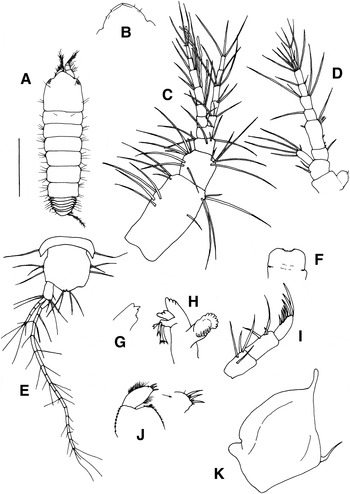
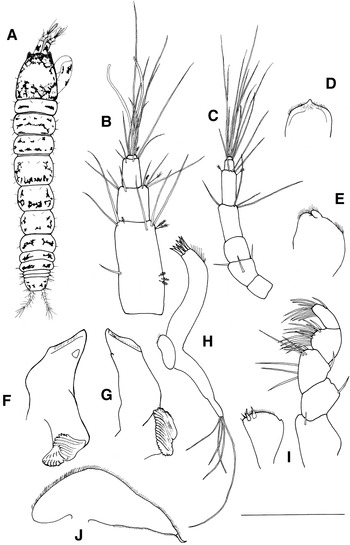
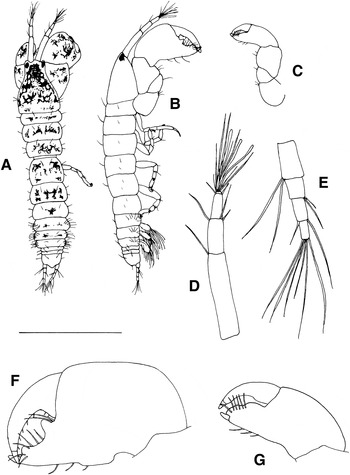
Parapseudes mortoni sp. nov., female: (A) holotype, dorsal; (B) rostrum; (C) antennule; (D) antenna; (E) pleotelson and left uropod; (F) labrum; (G) incisor of right mandible; (H) left mandible; (I) mandibular palp; (J) labium, with detail of palp spines; (K) epignath. Scale bars = A, 1 mm; B & E, 0.4 mm; C, D & F–K, 0.2 mm.

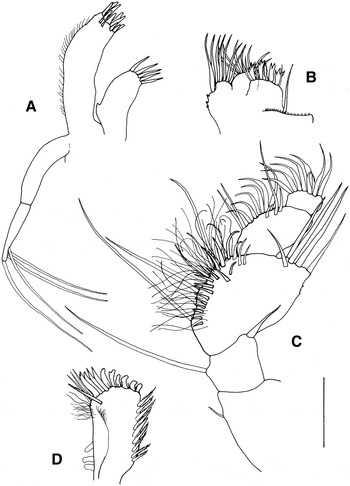
Parapseudes mortoni sp. nov.: (A) maxillule; (B) maxilla; (C) maxilliped; (D) maxilliped endite. Scale bar = 0.1 mm.

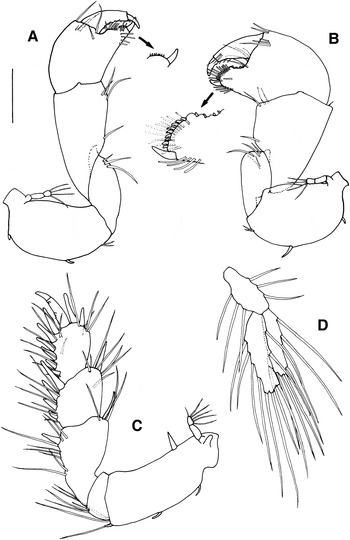
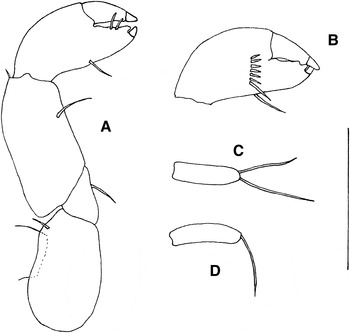
Parapseudes mortoni sp. nov.: (A) right cheliped of female; (B) right cheliped of male; (C) pereopod 1; (D) pleopod (plumose nature of setae not shown). Scale bars = A–C, 0.2 mm; D, 0.1 mm.

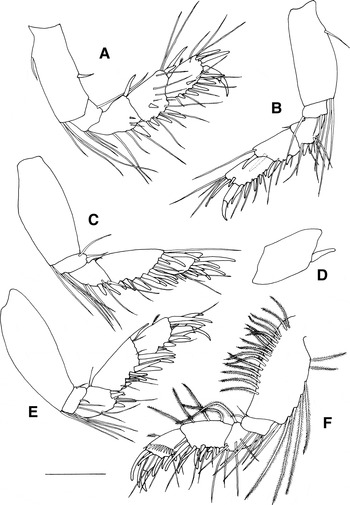
Parapseudes mortoni sp. nov.: (A) pereopod 2; (B) pereopod 3; (C) pereopod 4; (D) propodus and claw of pereopod 4; (E) pereopod 5; (F) pereopod 6. Scale bar = 0.2 mm.

TYPE MATERIAL
Canary Islands: holotype: brooding ♀, (BMNH. 2011.1774), low-shore mixed algal turf, Puerto del Carmen, Lanzarote, 28°56.03′N 13°37.00′W, 22 May 2008, coll. B. Morton (B.M.). 1♂, allotype (BMNH. 2011.1775), same data as holotype.
Paratypes: 2♀♀, (BMNH. 2011.1776-1777), 1 brooding ♀, 1♀ with oostegites (paratypes, dissected, not retained), same data as holotype.
DESCRIPTION OF FEMALE
Body (Figure 2A) compact, holotype 2.48 mm long, four times as long as wide, narrower posteriorly. Cephalothorax pentangular, as long as wide including rostrum, anterior margin produced into convex, rounded rostrum (Figure 2B) with smooth anterior margin bearing four minute setae; lateral margins of carapace smoothly curved, single dorsolateral seta behind each eye, paired lateral setae centrally on branchial chambers. Eyes present on rounded eyelobes, with few ocelli unpigmented in alcohol-preserved material. Anterior three pereonites with lateral margins uniformly convex, margins on pereonites 4 to 6 with slight central concavity; pereonite 1 with single simple dorsolateral and lateral setae on each side; pereonites 2 to 4 dorsally naked but with three anterolateral and one posterolateral setae; pereonites 5 and 6 dorsally naked but with three anterolateral and two posterolateral setae; pereonites 1 to 4 and 6 subequal in length, about one-third as long as cephalothorax; pereonite 5 longest, about half as long as cephalothorax (all pereonites respectively 2.9, 2.8, 2.7, 2.8, 1.8 and 2.0 times as wide as long). Pleon 1.3 times as long as pereonite 5, of five free subequal pleonites, the first four only bearing pleopods, and pentangular pleotelson; pleonites more than 7.5 times as wide as long, laterally expanded by spiniform apophysis and bearing one simple seta longer than half pleonite width, pleonite 1 with dorsolateral row of three setae on each side. Pleotelson (Figure 2E) laterally rounded, just more than half as long as whole pleon, as wide as long, bearing three lateral and two distal setae on each side.
Antennule (Figure 2C) peduncle proximal article compact, 1.9 times as long as wide, with inner distal and outer mesial and distal tufts of long simple setae, mostly longer than article width; second article one-third as long as article 1, with inner distal and outer mesial and distal tufts of long simple setae, mostly longer than article width; third article 0.4 times as long as second, with one shorter and two or three longer inner and outer simple distal setae; fourth article almost as long as third, with outer distal seta. Main flagellum of six segments, segments 2, 3 and 4 bearing one, two and one aesthetascs respectively; accessory flagellum of five segments, all but fourth with distal setae.
Antenna (Figure 2D) proximal peduncle article with inner rounded apophysis bearing single seta; peduncle article 2 three-quarters as long as article 1, inner margin naked, outer margin with two simple setae and distal squama with five simple marginal setae; peduncle article 3 shorter than wide, half as long as article 2, with one inner seta; article 4 three times as long as article 3, outer margin with single distal spinule, inner margin with proximal spinules, short and long distal setae and one penicillate seta; article 5 slightly longer than article 3, with single long outer simple seta. Flagellum of five segments, segment 3 with distinct distal crown of six setae, other setae as figured.
Labrum (Figure 2F) simple, distally concave with sparse fine setules. Left mandible (Figure 2H) bearing strong, crenulated pars incisiva, lacinia mobilis robust with three rounded denticulations, setiferous lobe with two trifurcate and two bifurcate setae, pars molaris robust, distally rugose, margin with row of rounded teeth; mandibular palp (Figure 2I) of three articles, proximal article twice as long as wide with four inner setae, article 2 just longer than article 1 with two longer and one shorter setae in distal half; article 3 just shorter than article 1 with seven progressively longer setae in distal half; right mandible as left but without lacinia mobilis, pars incisiva with irregular sharp denticulation (Figure 2G). Maxillule (Figure 3A) inner endite with five distal setae and outer apophysis; outer endite with ten distal spines and two subdistal setae, outer margin finely setose; palp of two articles with four distal setae. Maxilla (Figure 3B) with denticulation on outer margin; outer lobe of moveable endite with two arcuate, tapering subdistal setae and five distal setae; inner lobe of moveable endite with seven simple setae; outer lobe of inner endite with two outer simple setae, three stout trifurcate spines, interspersed with simples, bifurcate and bilaterally denticulate spines; inner lobe of fixed endite with rostral row of 17 setae guarding one longer seta. Labium (Figure 2J) with denticulate outer margin, palp with fine lateral setules and three simple distal spines interspersed with three shorter denticles. Maxilliped (Figure 3C) basis with one short inner seta; palp article 1 with single distal seta on outer margin and long simple inner seta longer than article 2; palp article 2 with rows of four mainly elongate marginal setae and 13 shorter submarginal spines on inner margin surrounding field of fine, elongate marginal setules, four distal mesial curved spines, outer margin slightly denticulate and with five distal setae; palp article 3 longer than wide, with two straight and six curved simple setae along inner margin, and three submarginal setae in distal half; palp article 4 with eight curved, tapering distal setae; endite (Figure 3D) with simple, dagger-like inner caudodistal seta and stout spines along distal margin; three coupling hooks. Epignath (Figure 2K) large, subrectangular, with slender inner apophysis and simple distal seta.
Cheliped (Figure 4A) basis stout, 1.6 times as long as wide, dorsally naked, ventrally with one proximal and one medial spine and paired subdistal setae; exopodite present, 3-articled, distal article with four plumose setae. Merus lozenge-shaped, with three ventrodistal simple setae. Carpus 1.7 times as long as wide, ventrally with one proximal and three distal setae. Chela palm (propodus) longer than wide, with inner comb of three setae, fixed finger with four rounded ventral setae, cutting edge with fine distal spinules and row of eight rounded setae but no apophyses, distal claw slender, curved; dactylus with row of fine stout setae along cutting edge, distal claw slender, curved.
Pereopod 1 (Figure 4C) basis twice as long as wide, dorsally with one substantial proximal spine but no setae, proximally with linguiform, proximally-directed apophysis, ventrally with proximal, mid-ventral and distal curved spines, ventrodistally with three longer setae; exopodite present, 3-articled, distal article with six plumose setae. Ischium with tuft of three longer and one shorter ventrodistal setae. Merus half as long as basis, expanded distally, with entire row of ventral simple setae and one stout ventrodistal spine, dorsodistally with three setae and slender spine half as long as carpus. Carpus shorter than merus, with four ventral spines becoming longer distally and intervening simple setae, dorsodistally with seven setae and robust spine. Propodus 0.9 times as long as carpus, with six ventral spines becoming longer distally and alternating with simple setae, simple dorsal setae in proximal half and two dorsodistal spines. Dactylus 0.6 times as long as propodus, with two ventral denticulations; unguis half length of dactylus.
Pereopod 2 (Figure 5A) somewhat similar to pereopod 1, basis 2.5 times as long as wide with dorsal spine distal of mid-length, shorter ventroproximal seta and ventrodistal tuft of three setae, the longest exceeding distal margin of merus. Ischium with three ventrodistal setae, the longest exceeding distal margin of merus, and dorsal seta reaching mid-length of carpus. Merus as long as carpus, with curved, slender dorsodistal spine, row of ventral simple setae and stout ventrodistal spine. Carpus with three ventral spines interspersed with setae, submarginal spine and inner mesial row of setae, two long dorsodistal simple setae, and one shorter and one longer dorsodistal spines. Propodus articulating anaxially on merus, just longer than merus, with five ventral spines, two longer and one shorter dorsodistal spines with interspersed setae, and mid-dorsal penicillate seta. Dactylus curved, with fine ventrodistal seta and slender unguis, together 0.9 times as long as propodus. Pereopod 3 (Figure 5B) similar to pereopod 2, but basis without dorsal spine, merus with two ventral spines but no dorsal spine, carpus with two ventral spines, propodus without dorsal penicillate seta.
Pereopod 4 (Figure 5C) similar to pereopod 3 but basis slightly stouter, 2.1 times as long as wide, without ventroproximal seta; ischium with two dorsal setae; carpus with extensive array of distal setae, dorsodistal spines as long as propodus; propodus with extensive array of distal setae; dactylus and unguis fused, short, half length of propodus (Figure 5D), without distal seta. Pereopod 5 (Figure 5E) similar to pereopod 4, carpus with paired ventral spines but fewer distal spines; propodus with fewer distal spines; dactylus plus unguis as on pereopod 3, together as long as propodus.
Pereopod 6 (Figure 5F) basis with plumose setae along all but distal fifth of dorsal margin, ventral margin with four longer ventral plumose setae in the distal half and two shorter proximal plumose setae, two ventrodistal simple setae; ischium with two dorsal and five distal simple setae; merus with one dorsal plumose seta and fan of five simple ventral setae; carpus with four dorsal plumose setae, eight, mainly paired, ventral spines interspersed with few setae, and two distal spines; propodus with ventrodistal submarginal row of 12 spinules, two ventral and five distal spines with interspersed setae, dactylus plus unguis as long as propodus.
Pleopods (Figure 4D) in four pairs all alike. Basis elongate, with three dorsal and three ventral plumose setae. Endopod shorter than exopod without proximal articulation; both rami slender, with 8 to 9 marginal plumose setae.
Uropod (Figure 2E) biramous, basis with long inner and outer distal setae; exopod twice as long as basis, of four segments; endopod of 16 segments, 3.5 times as long as pleotelson.
DESCRIPTION OF MALE
Penial tubercle inconspicuous. Main flagellum of antennule with aesthetascs on each of segments 1 to 4; flagellum of antenna with two aesthetascs on each of segments 1 to 3, one on segment 4.
Cheliped (Figure 4B) conspicuously more robust than that of female; basis 1.6 times as long as wide, dorsally naked, ventrally with single proximal and medial spine and two fine distal setae; exopodite present, 3-articled, distal article with four plumose setae. Merus rectangular with ventrodistal shoulder bearing three setae and one subdistal seta. Carpus 1.3 times as long as wide, with three ventrodistal setae and single fine dorsodistal seta. Chela palm (propodus) shorter than wide, setae as in female; fixed finger distally squared, cutting edge with small apophysis, preceded by four rounded teeth and distally with nine longer teeth; dactylus as that of female.
ETYMOLOGY
Named after Professor Brian Morton in gratitude for his collecting all the Canary Islands material (including this type-series) and for field assistance in Cape Verde and Madeira.
REMARKS
Lang (Reference Lang1965) synonymized all Parapseudes material worldwide into P. latifrons (Grube, 1864), with a putative distribution from the Yugoslavian Adriatic (type locality), the Mediterranean, the Atlantic Ocean, the Caribbean, Pacific Central and South America through Hawaii to Japan. His decision was based on observing variation in the number of uropod segments, the number of ventral spines on the distal articles of pereopod 1, and the number of segments in the antennule flagella, all characters on which earlier species had been distinguished. From our present knowledge about sibling species in the Tanaidacea, such a synonymy is no longer tenable. Both Guţu (Reference Guţu1998a), in his preliminary reassessment of the genus, and Larsen & Shimomura (Reference Larsen and Shimomura2008) in their sensible discussion of Parapseudes, point out that the many described species require detailed re-examination in order to determine their validity, and indeed to understand the world-wide diversity of this genus. Guţu (Reference Guţu1998a) gave a revised diagnosis for the genus, but failed to include therein a significant characterizing feature, viz. the presence of only four pairs of pleopods.
Guţu (Reference Guţu1998a, b, 2001) distinguished four species in the genus based, inter alia, on the number of dorsal proximal spines on the basis of pereopod 1. To extend this concept, P. latifrons sensu Sars (Reference Sars1882) (from the Mediterranean), P. algicola (Shiino, Reference Shiino1952) (Japan) and P. francispori (Bãcescu, 1980) (Mediterranean) have one proximal spine, P. latifrons sensu Guţu (Reference Guţu1998b) (Tanzania) and P. latifrons sensu Lang (Reference Lang1965) (Japan) (both non Rhoëa latifrons Grube, 1864), and P. similis Vanhöffen, Reference Vanhöffen1914 (Cape Verde, see below) have two proximal spines, and P. inermis (Silva Brum, Reference da Silva Brum1974) (Brazil) and P. trispinosus Guţu, 1998(a) (Indonesia) have three; none of these have a subdistal spine. Parapseudes pedispinis (Boone, Reference Boone1923) (California) has one proximal spine and one subdistal spine on the pereopod 1 basis. P. similis Vanhöffen Reference Vanhöffen1914 (Cape Verde), P. neglectus Miller, Reference Miller1940 (Hawaii) and P. spongicola Brown, Reference Brown1958 (South Africa) apparently have no such spines, although the original (and only) descriptions of these species are variously somewhat wanting. Parapseudes arenamans Larsen & Shimomura, Reference Larsen and Shimomura2008 (Japan) definitely has no such spines. The spination of the pereopod 1 basis in P. goodei Richardson, Reference Richardson1905 (Bermuda) is not known (although Heard et al. (Reference Heard, Hansknecht and Larsen2004) report what may be this species from Florida, in which case it has two proximal spines only), and P. hirsutus Stebbing, Reference Stebbing1910 (Chagos) is not a Parapseudes. Larsen & Shimomura (Reference Larsen and Shimomura2008) suggested that the appearance of such spines may be an artefact based on setae embedded in mucus: this is clearly not the case for the present material, or for many of the species listed above.
Parapseudes mortoni sp. nov. has one very large proximal spine on the basis with no subdistal spine dorsally on the basis of pereopod 1. This basis spination only resembles that of P. latifrons, P. francispori and P. algicola. All three of these species have a more slender cheliped carpus, and are without the ventroproximal cheliped basis spine. In addition, P. latifrons and P. algicola have more segments in the antennular and antennal flagella, and in the uropod rami, and shorter setae on the pereopods; both species have a more substantial mid-ventral cheliped basis spine, particularly in the male, while the carpus of the male cheliped in P. algicola has a substantial ventral expansion. The description and figures of P. francispori are poor, but that species has only ′4 or 5′ ventral propodal spines on pereopod 1 (see also Guţu, Reference Guţu2001, figure 1A), and ′7 or 8′ marginal squama setae on the antenna. Neither this species nor P. latifrons have the very long ventrodistal setae on the basis and ischium of the pereopods shown by P. mortoni sp. nov.
From species where the spination of the pereopod 1 basis is unknown, P. mortoni differs in the ventral spination of the merus, carpus and propodus of pereopod 1, in the number of segments in the antennule flagella (notwithstanding the variation inferred by Lang, Reference Lang1965), in the proportions of the pereonites, and in the plumose setation of pereopod 6, inter alia.
Both Larsen & Shimomura (Reference Larsen and Shimomura2008) and Guţu (Reference Guţu1998a, Reference Guţub) found in their species and in P. francispori (see Guţu, Reference Guţu2001) that the dactylus of pereopod 4 was reduced to a small tubercle-like structure with the unguis reduced to a seta, and both speculated that this might be the norm in the genus. The present species shows a normal (although reduced in size) dactylus on pereopod 4 (Figure 5D), albeit without an unguis. A normal dactylus and unguis were also shown by Sars (Reference Sars1886) for what must be taken as P. latifrons sensu stricto, and by Shiino (Reference Shiino1952) in P. algicola, while that of P. latifrons agg. from Esperance (Bamber, Reference Bamber, Wells, Walker and Kendrick2005) has a reduced but not tubercle-like dactylus and unguis.
PREVIOUS RECORDS
Cape Verde Islands: 15 specimens, amongst littoral Lithothamnium, Mindello harbour, Porto Grande, St Vincent, September 1901 (Vanhöffen, Reference Vanhöffen1914: types).
REMARKS
This species has not been recorded since the original description, and the types could not be found. Characterizing features identified by Vanhöffen (Reference Vanhöffen1914) were first pereopod having six ventral spines on the propodus, four on the carpus and two on the merus, with the same articles having two, one and one dorsodistal spines respectively. The pereopod 1 basis was not shown to have any dorsoproximal spines, but midventrally there are two long setae rather than a spine. The cheliped fixed finger has three ventral setae. No figure or description is given for the dactylus of pereopod 4. From these features alone it is distinct from the two new Macaronesian species of Parapseudes decribed herein.
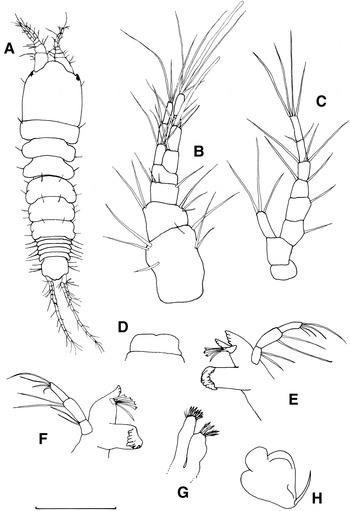
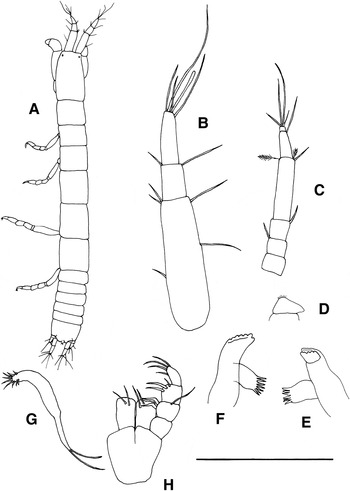
Parapseudes fitzroyi sp. nov., female: (A) holotype, dorsal; (B) antennule; (C) antenna; (D) labrum; (E) left mandible; (F) right mandible; (G) maxillule endites; (H) epignath. Scale bars = A, 0.4 mm; B H, 0.1 mm.

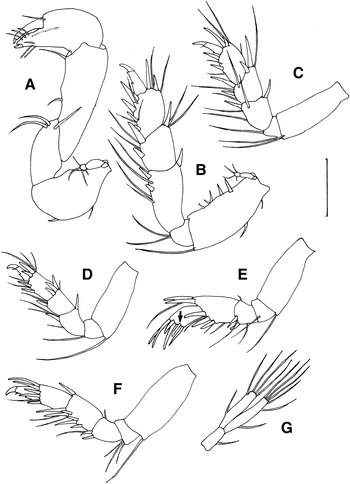
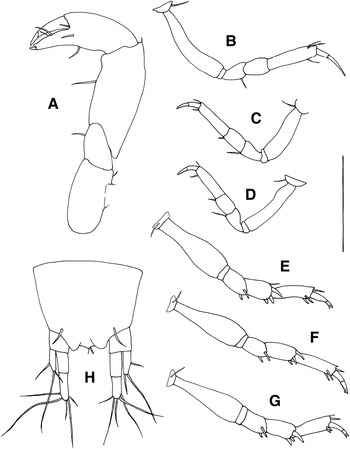
Parapseudes fitzroyi sp. nov., female: (A) cheliped; (B–F) pereopods 1 to 5; G, pleopod (plumose nature of setae not shown). Scale bar = 0.1 mm.

TYPE MATERIAL
Cape Verde Islands: holotype: ♀ (BMNH. 2011.1778), amongst low shore algae, Quail Island (Santa Maria), Praia, Santiago, 14°54.16′N 23°30.46′W, 10 June 2009, coll. R.B.
DESCRIPTION OF FEMALE
Body (Figure 6A) compact, holotype 1.1 mm long, four times as long as wide, narrower posteriorly. Cephalothorax subrectangular, as long as wide including rostrum, anterior margin produced into convex, rounded rostrum with smooth anterior margin; lateral margins of carapace relatively straight, single dorsolateral seta behind each eye. Eyes present on rounded eyelobes, with few ocelli, black in alcohol-preserved material. Anterior three pereonites with lateral margins uniformly convex, margins on pereonites 4 to 6 with slight central indentation; pereonite 1 with single simple anterolateral setae on each side; pereonites 2 and 3 with three single midlateral setae; pereonites 4 to 6 with paired dorsal and two midlateral setae; pereonites subequal in length, mostly about one-third as long as cephalothorax, pereonite 5 longest, 0.4 times as long as cephalothorax (all pereonites respectively 3.5, 3.0, 2.6, 2.3, 2.0 and 2.4 times as wide as long). Pleon twice as long as pereonite 4, of five free subequal pleonites, the first four only bearing pleopods, and septangular pleotelson; pleonites more than eight times as wide as long, laterally expanded by slight apophysis and bearing one simple seta about three times as long as pleonite width, pleonite 1 without dorsolateral setae. Pleotelson just more than half as long as whole pleon, as wide as long, bearing three lateral setae on each side.
Antennule (Figure 6B) peduncle proximal article compact, 1.5 times as long as wide, with inner and outer tufts of long simple setae in distal half, mostly longer than article width; second article 0.4 times as long as article 1, with inner and outer distal tufts of two or three simple setae; third article 0.7 times as long as second, with one outer and three inner simple distal setae; fourth article shorter than third, naked. Main flagellum of four segments, segments 2 and 4 each bearing one aesthetasc; accessory flagellum of three segments, all with distal setae.
Antenna (Figure 6C) proximal peduncle article short, naked, without apophysis; peduncle article 2 1.8 times as long as article 1, naked, with distal squama bearing three simple distal setae; peduncle article 3 just shorter than article 2, with one inner seta; article 4 just longer than and otherwise identical to article 3; article 5 three-quarters as long as article 4, with single inner and outer simple distal setae. Flagellum of three segments, each distally setose as figured.
Labrum (Figure 6D) simple, distally concave, naked. Left mandible (Figure 6E) bearing strong, crenulated pars incisiva, lacinia mobilis slender with three rounded denticulations, setiferous lobe with two trifurcate, one bifurcate and one simple setae; pars molaris robust, distally rugose, margin with row of rounded teeth; mandibular palp of three articles, proximal article twice as long as wide with two inner setae in distal half, article 2 nearly twice as long as article 1 with two inner setae in distal half; article 3 just shorter than article 2 with four progressively longer setae distally. Right mandible (Figure 6F) as left but without lacinia mobilis, setiferous lobe with three trifurcate, one bifurcate and one simple setae. Maxillule (Figure 6G) inner endite with four distal setae, outer endite with eight distal spines and fine outer-distal setae. Palp, maxilla, labium and maxilliped not sufficiently retrieved in dissection. Epignath (Figure 6H) large, ovoid, with rounded inner lobe and simple distal seta.
Cheliped (Figure 7A) basis stout, 1.6 times as long as wide, dorsally naked, ventrally with one proximal seta and one medial spine but no subdistal setae; exopodite present, 3-articled, distal article with four plumose setae. Merus almost as long as basis ventrally, with three ventrodistal simple setae each as long as or longer than merus width. Carpus slender, 2.9 times as long as wide, ventrally with one proximal and one longer distal setae. Chela palm (propodus) 1.5 times as long as wide, with inner ‘comb’ of one seta, one seta adjacent to dactylus attachment, fixed finger with two ventral and one submarginal setae, cutting edge with row of three setae but no apophyses, distally extending past attachment of claw; dactylus naked.
Pereopod 1 (Figure 7B) basis 2.2 times as long as wide, dorsally with two substantial spines in proximal half, one mid-dorsal spine and two smaller spines distal of that; ventrally with proximal and mid-ventral curved spines, ventrodistally with one seta two-thirds as long as basis; exopodite present, 3-articled, distal article with four plumose (?) setae. Ischium with two long ventrodistal setae. Merus 0.7 times as long as basis, slightly wider distally, ventrally with four simple setae and two stout spines in distal half, one dorsodistal stout spine. Carpus 0.7 times as long as merus, ventrally with two simple setae and two stout spines in distal half, dorsodistally with two simple setae and one spine. Propodus as long as carpus, with four ventral spines becoming longer distally and alternating with simple setae, dorsodistally with two simple setae and two spines. Dactylus 0.6 times as long as propodus, with two ventral denticulations; unguis half length of dactylus.
Pereopod 2 (Figure 7C) basis 2.7 times as long as wide with two ventrodistal setae 0.9 times as long as basis. Ischium with one ventrodistal seta exceeding distal margin of merus. Merus as long as carpus, with curved, slender dorsodistal spine, two ventral and one outer-distal simple setae and one ventrodistal spine. Carpus with two ventral spines interspersed with setae, one outer-distal simple seta, one long dorsodistal simple setae, and one shorter and one longer dorsodistal spines. Propodus 1.3 times as long as carpus, with two ventral spines interspersed with setae, two long dorsodistal simple setae, and one shorter and one longer dorsodistal spines. Dactylus with fine ventrodistal seta and mid-ventral denticulation, unguis slender, both together 0.9 times as long as propodus. Pereopod 3 (Figure 7D) similar to pereopod 2, but basis with one ventrodistal spine, carpus with one ventral and three dorsodistal spines, propodus with three dorsodistal setae.
Pereopod 4 (Figure 7E) broadly similar to pereopod 3, but merus with paired ventrodistal spines, simple dorsodistal seta; carpus with two dorsodistal, one inner-distal and two ventrodistal spines; propodus with array of five distal spines; dactylus (arrowed on Figure 7E) and unguis fused, short, half length of propodus, without distal seta. Pereopod 5 (Figure 7F) similar to pereopod 4, but ischium with three ventrodistal setae, carpus with ventral rows of four and two marginal and submarginal spines respectively, one dorsodistal spine; propodus with five distal spines and one simple distal seta; dactylus plus unguis as on pereopod 3, together as long as propodus.
Pereopod 6 (not figured) both severely damaged, bases with plumose setae, but distal articles missing.
Pleopods (Figure 7G) in four pairs all alike. Basis elongate, with one inner but no outer plumose setae. Endopod shorter than exopod with one inner and four distal plumose setae; exopod with two outer and four distal plumose setae.
Uropod (Figure 6A) biramous, basis with two inner and three outer distal setae; exopod twice as long as basis, of four segments; endopod of ten segments, three times as long as pleotelson.
Male unknown.
ETYMOLOGY
Named after Vice-admiral Robert FitzRoy who, as captain of the HMS ‘Beagle’, made first landfall at Praia, Santiago, and established his first monitoring station on ‘Quail Island’, now known as Santa Maria, the type-locality of the present species.
REMARKS
Unfortunately both sixth pereopods of the holotype and only specimen of Parapseudes fitzroyi sp. nov. were almost entirely missing, and some of the mouthparts were not adequately recovered during dissection, partly owing to the comparatively small size and slight calcification of the specimen. Nevertheless, those features important in the classification of the species in this genus were all present.
The present species is unique in the genus in the abundance of dorsal spines (five) on the basis of pereopod 1; previously, the largest number recorded was three in both P. inermis and P. trispinosus (see Remarks under P. mortoni above). As in P. mortoni, pereopod 4 of P. fitzroyi has a reduced dactylus without an unguis, and all the pereopods have proportionately long setae, particularly the bases and ischia.
Parapseudes fitzroyi is one of the smallest species of the genus known, and, apart from the dorsal margin of pereopod 1, the presence of relatively low numbers of setae and spines on the various appendages is attributed to that small size; a similar reduction in setation/spination has been found in various recently-described unrelated taxa which are small for their genera, e.g. Triparatanais meios and Zeuxo andaminimus (see Bamber & Chatterjee, Reference Bamber and Chatterjee2010), and Typhlotanais angstromensis Błażewicz-Paszkowycz & Bamber, 2009 (see Bamber et al., Reference Bamber, Bird, Błażewicz-Paszkowycz and Galil2009).
MATERIAL EXAMINED
Cape Verde Islands: 1♀, coralline algae in low-shore rock pools, Praiamar, Praia, Santiago, 14°54.54′N 23°30.81′W, 9 June 2009; 1 brooding ♀ (damaged) (BMNH.2011.1779), amongst low shore algae, Quail Island (Santa Maria), Praia, Santiago, 14°54.16′N 23°30.46′W, 10 June 2009; both coll. R.B.
PREVIOUS RECORDS
Cape Verde Islands: 2♀♀ (types), plankton sample, St Vincent, 1893? (Hansen, Reference Hansen1895); 9 specimens (including 2 brooding ♀♀), amongst littoral Lithothamnium, Mindello harbour, Porto Grande, St Vincent, September 1901 (Vanhöffen, Reference Vanhöffen1914).
REMARKS
Cape Verde is the type locality of this species, and this is the third time it has been recorded there. While Hansen's (1895) original types were from a plankton haul, Vanhöffen (Reference Vanhöffen1914) collected his material amongst littoral algae, the habitat in which the present specimens were found.
Subsequently, Monod (Reference Monod1925) recorded further material of ‘Apseudes sp.’ from the Atlantic coasts of Morocco; Larwood (Reference Larwood1940) attributed some apseudid material from Alexandria, Egypt to A. intermedius, and he sent some of this material to Monod who confirmed it as being the same as his own Moroccan taxon; Băcescu (Reference Băcescu1961, Reference Băcescu1980) attributed specimens collected off Israel and Monaco (respectively) to A. intermedius, and Riggio (Reference Riggio1996) recorded it from Sicily. The distribution of this species is thus from the Azores to Morocco and sparsely throughout the Mediterranean, predominantly littoral but down to 30 m depth.
Guţu (Reference Guţu2006) moved this species to his new genus Muramura (and subsequently, by inference, to Muramurina Guţu, Reference Guţu2007a [q.v.], Muramura being preoccupied), despite distinctions in the morphology of the rostrum and the pleotelson from his type species (M. splendida Guţu, Reference Guţu2006). However, as that genus was predominantly distinguished from Apseudes on the basis of its having simultaneous hermaphrodite species, yet that is a characteristic of Apseudes talpa (Montagu, 1808), the type-species of Apseudes (see Larsen et al., Reference Larsen, Bertocci and Froufe2011) it is not considered to be valid. Subsequently, Guţu (Reference Guţu2007b, Reference Guţu2008) moved this species again, into Gollumudes Bamber, 2000 and then Paradoxapseudes Guţu, 1991.
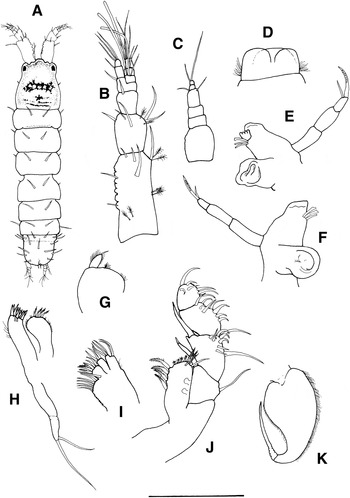
Synapseudes heterocheles, female: (A) dorsal; (B) antennule; (C) antenna; (D) labrum; (E) left mandible; (F) right mandible; (G) labium; (H) maxillule; (I) maxilla; (J) maxilliped; (K) epignath. Scale bars = A, 0.6 mm; B & C, 0.15 mm; D–K, 0.1 mm.

Synapseudes heterocheles, female: (A) cheliped; (B–G) pereopods 1–6 respectively; (H) uropod. Scale bar = 0.1 mm.

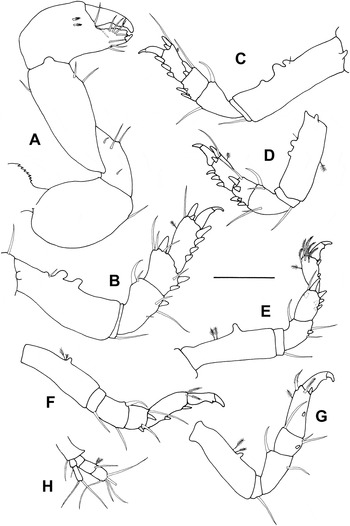
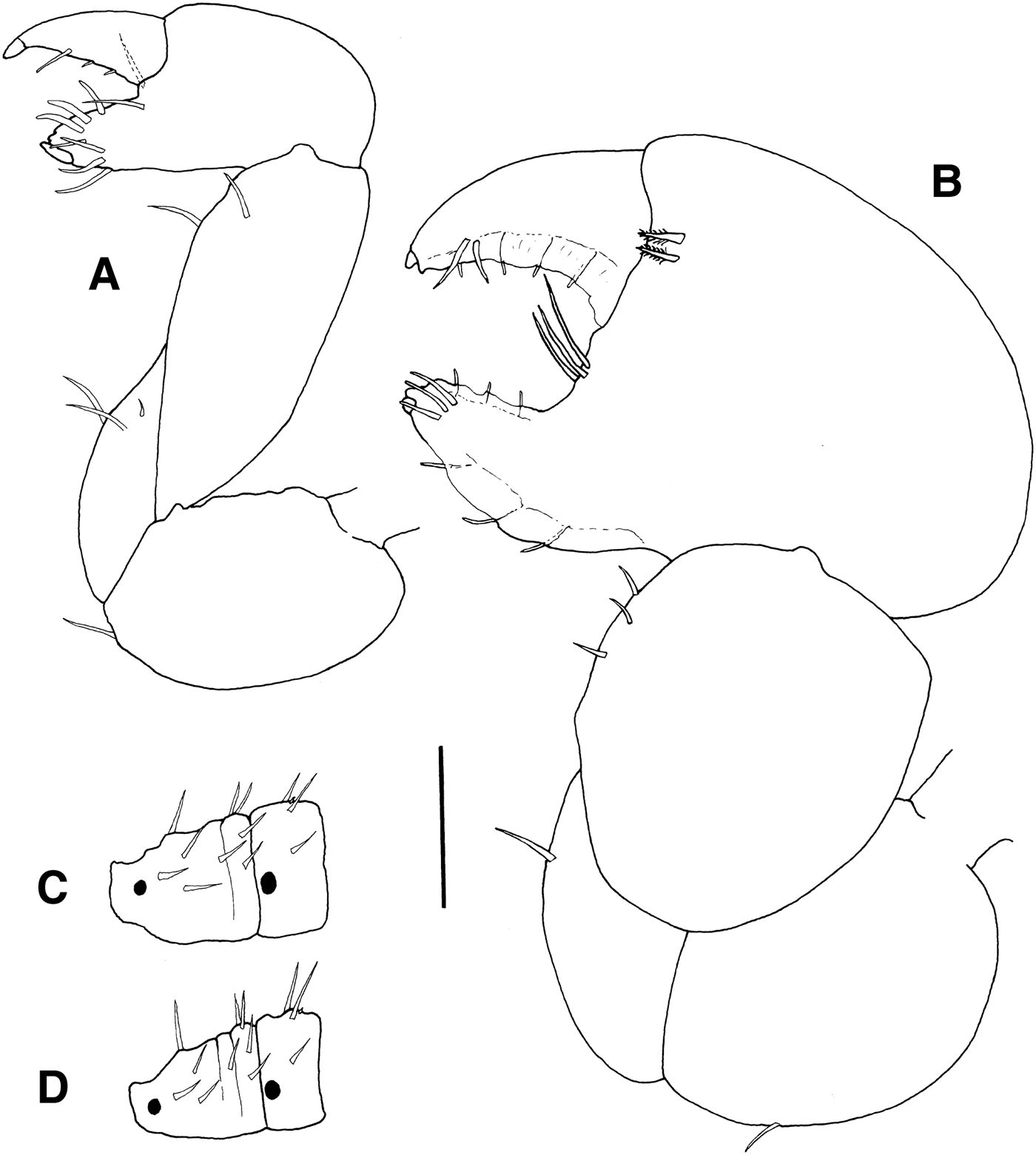
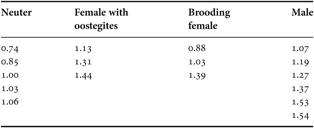
Synapseudes heterocheles: (A) male smaller cheliped (left); (B) male larger cheliped (right); (C & D) lateral views of pereonite 6 and pleotelson of C, 1.03 mm brooding female and D, 1.37 mm male. Scale bars = A & B, 0.1 mm; C & D, 0.25 mm.
MATERIAL EXAMINED
Cape Verde Islands: 1 brooding ♀, 1 ♀ with oostegites, 2♂♂, 1 neuter (BMNH.2011.1780-1784), coralline algae in low-shore rock pools, Praiamar, Praia, Santiago, 14°54.54′N 23°30.81′W, 9 June 2009; 1 brooding ♀, (BMNH. 2011.1785), 2♂♂, 4♀♀ (2 brooding), 4 neuters (BMNH. 2011.1786-1795), 1 brooding ♀ (dissected), amongst low shore algae, and 2♂♂, 1♀ (BMNH.2011.1796-1798), 1 brooding♀, amongst Idanthyrsus luciae tube-reef, LWST, both Quail Island (Santa Maria), Praia, Santiago, 14°54.16′N 23°30.46′W, 10 June 2009; 1 juvenile, probably this species, low-shore algae on rocks, Santa Maria, Sal, 16°35.83′N 22°54.47′W, 12 June 2009; all coll. R.B.
OTHER MATERIAL EXAMINED
Cape Verde Islands: holotype: 1 ♂ (MNB 17 760), amongst littoral Lithothamnium, Mindello Harbour, Porto Grande, St Vincent, September 1901 (Vanhöffen, Reference Vanhöffen1914).
DESCRIPTION OF FEMALE
Body (Figure 8A) compact, neotype 1.3 mm long, 4.4 times as long as wide, slightly narrower posteriorly. Cephalothorax subrectangular, 1.13 times as long as wide including rostrum, anterior margin with conspicuous flattened rostrum. Eyes present on robust eyelobes; paired lateral setae on branchial chambers; brown pigmentation on carapace, paler towards anterior. Six free pereonites, all with lateral margins uniformly convex, each with two mid-dorsal strong setae, pereonites 1 to 5 with single anterolateral seta on each side, pereonite 6 with longer midlateral seta on each side; pereonite 1 about one-third as long as cephalothorax; pereonites 2 to 4 subequal (pereonite 4 longest), 1.3 times as long as pereonite 1; pereonite 5 as long as pereonite 1; pereonite 6 shortest, 0.8 times as long as pereonite 1 (all pereonites respectively 2.7, 2.0, 2.0, 1.7, 2.3 and 2.9 times as wide as long). Pleon 1.7 times as long as pereonite 1 and as long as wide, of one distinct pleonite without pleopods and pleotelson (Figure 10C); pleonite 0.2 times as long as whole pleon, with six strong setae around dorsum. Pleotelson distally rounded, bearing nine strong dorsal and lateral setae as figured, central seta on slight boss; distal margin with two shorter simple setae.
Antennule (Figure 8B). Peduncle proximal article compact, 2.33 times as long as wide, inner margin with 7 or 8 rounded crenulations and two simple setae, outer margin with distal curved spine and paired penicillate setae and penicillate seta at mid-length, dorsally with proximal penicillate setae and distal group of three curved spines; second article 0.45 times as long as article 1, distally with three curved spines, two setae and two penicillate setae, but without short inner and outer distal tooth-like spines; third article 0.6 times as long as second, with distal spine; fourth article one-third as long as third article, with inner distal seta. Main flagellum of 3 segments, each bearing two setae and single aesthetasc; accessory flagellum of 2 segments, proximal segment with one distal seta, distal segment with three distal setae.
Antenna (Figure 8C). Proximal peduncle article rounded with smooth margins, just longer than wide; articles 2 and 3 compact, naked, subequal, wider than long and 0.3 times as long as article 1; article 4 half as long as article 1, 1.5 times as long as wide, with two distal setae; article 5 very short, naked; article 6 (flagellum) as long as article 5, with two distal setae.
Labrum (Figure 8D) flattened, proximally setose. Left mandible (Figure 8E) smooth pars incisiva, lacinia mobilis robust with four rounded denticulations, setiferous lobe with three setae, pars molaris robust, blunt; mandibular palp of three articles, articles 1 and 2 naked, article 3 shorter and with two denticulate distal setae. Right mandible (Figure 8F) as left but without lacinia mobilis. Labium (Figure 8G) with smooth outer margin, setose distal margin, palp marginally setose and with one fine distal spine. Maxillule (Figure 8H) inner endite rounded, expanded distally, with four finely setulate distal setae and finely setulose margins; outer endite with ten distal spines and two subdistal setae, outer margin finely setose; palp of two articles, with two distal setae. Maxilla (Figure 8I) with fine denticulation on inner margin; outer lobe of moveable endite with two simple subdistal setae and three simple distal setae; inner lobe of moveable endite with three simple setae; outer lobe of inner endite distally with four outer simple setae and two setulose setae, one subdistal simple seta; inner lobe of fixed endite with rostral row of 6 setae. Maxilliped (Figure 8J) basis naked; palp article 1 with stout distal spine on outer margin and long simple inner seta longer than article; palp article 2 longer than wide, with stout distal spine on outer margin, inner margin with two longer marginal setae and seven shorter, mostly-recurved submarginal setae in distal half; palp article 3 longer than wide, with eight mostly-recurved setae along inner margin; palp article 4 with three inner, three subdistal recurved and one longer distal setae. Endite with six finely-setulose distal setae, one simple subdistal inner seta, simple inner caudodistal seta, and two coupling hooks. Epignath (Figure 8K) rounded, tapering to long distal spine, with setulose margins.
Cheliped (Figure 9A) basis 1.4 times as long as wide, dorsally naked, ventrally with simple subdistal setae; exopodite absent. Merus subrectangular, with two longer and one shorter ventrodistal simple setae, one shorter inner proximal seta. Carpus 2.3 times as long as wide, ventral margin with two simple subdistal setae, dorsal margin with single subdistal seta. Propodus (palm of chela) just longer than wide, with comb-row of two short setulose setae; chela fingers shorter than palm, ventral margin of fixed finger with three setae; one inner and one outer setae near articulation of fixed finger; cutting edge slightly crenulated with row of four setae, distal claw stout; dactylus naked, distal claw stout.
Pereopod 1 (Figure 9B) with single seta on coxa. Basis stout, 2.9 times as long as wide, dorsal margin with one smaller and two larger rounded apophyses, single fine seta adjacent to shorter apophysis, proximally with blunt apophysis overlapping coxa; exopodite absent. Ischium with one simple ventrodistal seta. Merus just less than half as long as basis, expanded distally, with two shorter and one longer ventral simple setae, stout, rounded ventrodistal spine, dorsodistally with one simple seta and curved spine. Carpus 0.7 times as long as merus, with two stout, rounded ventral spines and adjacent simple seta, dorsodistally with three simple setae and stout, rounded spine. Propodus 1.3 times as long as merus, with four stout, rounded ventral spines, one mid-dorsal penicillate seta, one dorsodistal seta and one longer and one shorter stout, rounded dorsodistal spines. Dactylus stout, smooth, curved, 0.7 times as long as propodus; unguis short.
Pereopod 2 (Figure 9C) similar to but smaller than pereopod 1. Basis 3.5 times as long as wide, proximal apophysis more elongate, dorsally with three rounded apophyses, distal apophysis shortest. Merus 1.6 times as long as carpus, with single ventral seta but no ventrodistal spine. Carpus with single dorsodistal seta. Propodus with only three ventral stout, rounded spines. Pereopod 3 (Figure 9D) smaller than but similar to pereopod 2, but basis with only two dorsal apophyses and one ventral penicillate seta, carpus with two additional inner stout, rounded spines, propodus with three dorsodistal spines.
Pereopod 4 (Figure 9E) similar to pereopod 3 but basis with no proximal apophysis, only one dorsal apophysis, and two dorsal penicillate setae proximal of apophysis; merus with stout, rounded ventrodistal spine; propodus with two small stout, rounded ventral spines, and dorsodistal tuft of six finely denticulate setae. Pereopod 5 (Figure 9F) similar to pereopod 4, but merus longer than carpus, and without ventrodistal spine; carpus with only two distal stout, rounded spines; propodus more slender, with two plumose dorsodistal setae. Pereopod 6 (Figure 9G) as pereopod 5 but carpus with only one stout, rounded ventral spine.
Pleopods absent.
Uropod (Figure 9H) biramous, basis with slight inner distal apophysis, one outer distal seta; exopod as long as proximal two segments of endopod, of two segments, proximal segment half as long as distal segment and with one distal seta, distal segment with two distal setae; endopod of three segments, first segment shortest, second segment distally with one penicillate and one simple setae, distal segment with five distal setae.
One complete brooding-female bears 10 eggs. One other undamaged brooding female in BMNH.2011.1786-1795 bears 4 eggs.
DESCRIPTION OF MALE
Generally similar to but slightly larger than female. Antennule as that of female, with one aesthetasc on each segment of main flagellum. Sexual dimorphism in heteromorphic chelipeds.
Smaller cheliped (Figure 10A) similar to that of female, but dactylus with one longer and two shorter fine spinules along cutting edge. Larger cheliped (Figure 10B) more robust, basis rounded, 1.2 times as long as wide, with single subdistal ventral seta; merus ventrally rounded, subtriangular, with single ventral seta; carpus rounded, 1.2 times as long as wide, with three ventral marginal setae in distal half; chela massive, palm projecting proximally behind carpus, three setae in axis of fingers; fixed finger half as long as palm, expanded into narrow flanges ventrally and along cutting edge, each flange incorporating three short setae, distally with three setae and minute distal claw; dactylus stout, cutting edge expanded into narrow flange incorporating four short setae, distally with two setae and minute distal claw.
Of six males, three have a larger right cheliped and three a larger left cheliped. The holotype has a larger left cheliped.
One male showed a suggestion of a second pleon suture, posterior to anterior pair of pleotelson setae as shown on Figure 8A ( Figure 10D).
Neuter: as female but generally smaller (and without oostegites).
Body lengths
REMARKS
Vanhöffen (Reference Vanhöffen1914) described this species (as Pagurapseudes heterocheles) from a single ‘1.2 mm long’ male collected on St Vincent, and showed only a lateral figure of the whole animal. Through the courtesy of the Museum für Naturkunde Berlin, I have re-examined Vanhöffen's specimen, herein designated the holotype. Although Vanhöffen's figure indicates three rounded apophyses on the inner margin of the antennular peduncle, this may be taken as a stylized representation, as his description refers to this margin as ‘serrated’, and examination of his specimen shows the antennule to agree with Figure 8B herein. His figure (but not his description) also indicate carpal apophyses on the larger (in his case left) cheliped, but no such apophyses are present on the holotype nor in the present material. Vanhöffen also describes the dorsal apophyses on the bases of the pereopods (as ‘short but powerful’), though he did not see them on the posterior pereopods, on which they are now known to be reduced in number to one. He was uncertain about the number of pleonites (‘abdominal segments’) but noted they were reduced: the holotype has one distinct pleonite. Finally, he missed the proximal segment of the uropod exopod, referring to it as one-segmented.
The species is unusual for the genus in being without short inner and outer distal tooth-like spines on the second article of the antennular peduncle, most species of this genus having these spines (e.g. Menzies, Reference Menzies1949: figure 41d; Guţu, Reference Guţu2006: figure 443; Blazewicz-Paszkowycz et al., Reference Blazewicz-Paszkowycz, Heard and Bamber2011: figure 2A). The apparent ontogenetic variation in number of defined pleonites (see Figure 10C, D) suggests that other species need reinvestigation in the event that this trend is more prevalent in the genus.
Despite the small size of the analysed material, the presence of females with oostegites significantly larger than some brooding females, together with the wide size range of males all larger than neuters, suggests iteroparity.
The species has not been recorded since Vanhöffen (Reference Vanhöffen1914), but from the present material would be expected to be common around the Cape Verde Islands, and its rediscovery is most valuable.
MATERIAL EXAMINED
Canary Islands: 3♂♂, 4♀♀ with oostegites, 1 brooding ♀ (BMNH.2007.757-763), rocky intertidal platform covered in algal turf, Playa de Fanabe, Costa Adeje, Tenerife, 28°04.70′N 16°44.22′W, 27 June 2007 (see Bamber & Costa, Reference Bamber and Costa2009). 11♀♀ (2 brooding, 5 with oostegites), 1♂, 8 juveniles, 7 mancae, amongst littoral algae, Charco Azul, La Palma, 28°40′N 17°52′W, 2 May 2009. 1♀ with oostegites, littoral coralline algae, San Andrés, La Palma, 28°36′N 17°45′W, 2 May 2009. 2♂♂, littoral algae, Maspalomas, Gran Canaria, 27°44.61′N 15°36.62′W, 19 January 2009. 22♀♀ (8 brooding, 5 with oostegites), 9♂♂, 35 juveniles, 5 mancae (BMNH.2011.1799-1808), amongst low-shore mixed algal turf, Puerto del Carmen, Lanzarote, 28°56.03′N 13°37.00′W, 22 May 2008. 3 juveniles, low-littoral red algae, Fuerteventura, 28°25.85′N 13°51.87′W, 5 July 2006. All coll. B.M.
Cape Verde: 1 brooding ♀, coralline algae in low-shore rock pools, Praiamar, Praia, Santiago, 14°54.54′N 23°30.81′W, 9 June 2009; coll. R.B.
REMARKS
Prior to these records from Macaronesia, Zeuxo (Parazeuxo) exsargasso was only known from the type collection from floating Sargassum natans (L.) Gaillon, 1828, 32 km south-east of Bermuda. Bamber & Costa (Reference Bamber and Costa2009) suggested its presence in the Canary Islands was likely to be the result of transport in floating Sargassum by drift from the Americas via the Gulf Stream and the Azores and Canary Currents (see Timmermann, Reference Timmermann1932, for a discussion on faunistic transport in Sargassum). Its presence in Cape Verde is unlikely to be from a similar origin (see below).
Zeuxo coturnix sp. nov., female: (A) holotype, dorsal; (B) antennule; (C) antenna; (D) labrum; (E) labium; (F) left mandible; (G) right mandible; (H) maxillule and maxilla; (I) maxilliped; (J) epignath. Scale bars = A, 1 mm; B–J, 0.2 mm.

Zeuxo coturnix sp. nov., female: (A) cheliped; (B–G) pereopods 1–6 respectively; (H) first pleopod; (I) uropod. Scale bar = 0.2 mm.

TYPE MATERIAL
Cape Verde: holotype: brooding ♀, (BMNH. 2011.1809), coralline algae in low-shore rock pools, Praiamar, Praia, Santiago, 14°54.54′N 23°30.81′W, 9 June 2009; coll. R.B.
Paratypes: 2 brooding ♀♀ (1 dissected), 2 neuters, (BMNH. 2011.1810-1812), same data as holotype; 3♀♀, (BMNH. 2011.1813-1815), amongst low shore algae, and 6♀♀, (BMNH.2011.1816-1821), amongst Idanthyrsus luciae tube-reef, LWST, both Quail Island (Santa Maria), Praia, Santiago, 14°54.16′N 23°30.46′W, 10 June 2009; all coll. R.B.
OTHER MATERIAL EXAMINED
Madeira: 1♂, 39♀♀ (6 brooding, 8 with oostegites), 12 juveniles, in low-littoral algal-bedded sand on sandstone outcrops, Campo de Baixo, Porto Santo, 33°03′N 16°21′W, 19 October 2009, coll. R.B./B.M.; 11♀♀ (2 brooding, 8 with oostegites), 1 juvenile, LWST Corallina-turf on jetty-pier-bases, Vila Baleira, Porto Santo, 33°04′N 16°20′W, 20 October 2009, coll. R.B./B.M.
DESCRIPTION OF FEMALE
Typical Zeuxo, body (Figure 11A) 5.7 times as long as wide, dorsally with black mottling on cephalon except its central area, on all pereonites, pleonites 1 to 3 and pleotelson as figured; length of holotype 2.3 mm. Cephalothorax subrectangular, tapering towards anterior, 1.1 times as wide as long, with slight rounded frons but no rostrum, eyes present, pigmented. Cephalothorax shorter than pereonites 1–3 together. Six free pereonites, rounded laterally, with one (pereonite 1) or three (pereonites 2 to 6) small lateral setae on each side, one small dorsal seta on all pereonites either side of midline towards anterior of pereonite; pereonite 1 shortest, one-third as long as cephalothorax, pereonites 2 and 3 subequal, 1.5 times as long as pereonite 1, pereonites 4 longest, 1.5 times as long as pereonite 2, pereonites 5 and 6 progressively shorter, 1.3 and 1.2 times as long as pereonite 2 respectively (all pereonites respectively 3.0, 1.9, 2.0, 1.3, 1.4 and 1.4 times as wide as long). Pleon of five free pleonites with lateral seta on each side, without transverse latero-dorsal rows of setae, pleonites 1 to 3 bearing pleopods; pleonite 1 largest, 0.8 times as long as pereonite 2 and 2.3 times as wide as long; pleonites 2 and 3 subequal, half as long as pereonite 2 and 3.6 times as wide as long; pleonites 4 and 5 shorter and narrower, 0.2 times as long as pereonite 2 and 7.8 times as wide as long, without pleopods. Pleotelson semicircular, 1.7 times as wide as long, with paired anterolateral and four laterodistal setae on each side.
Antennule (Figure 11B) of four articles; proximal article with dorsal pigmentation (see Figure 11A), twice as long as wide, outer margin with proximal and distal tufts of penicillate setae and distal group of three simple setae, inner margin with mesial simple seta, distal pair of simple setae and one distal penicillate seta; second article 0.4 times as long as first with outer and inner distal tufts of three simple setae and two outer distal penicillate setae; third article 0.8 times as long as second with five distal simple setae; distal article very small, with six simple and one penicillate distal setae and two aesthetascs.
Antenna (Figure 11C) of seven articles, first article naked; second article 1.2 times as long as first article, wider distally, with single mesial, dorsodistal and ventrodistal setae; third article as long as second, naked; fourth article 1.3 times as long as second article, with one dorsodistal and three ventrodistal setae; fifth article longest, just longer than fourth, distally with three simple and two penicillate setae; sixth article 0.3 times as long as fifth, with two distal setae; seventh article very small with eleven distal setae.
Labrum (Figure 11D) extended centrally, rounded, setose. Left mandible (Figure 11F) with angular pars incisiva, small but distinct triangular lacinia mobilis; right mandible (Figure 11G) with lacinia mobilis reduced to mere tubercle; pars molaris of each mandible robust, rugose. Labium (Figure 11E) all lobes finely setose distally, outer lobe with rounded labial palp. Maxillule (Figure 11H) with eight distal spines, finely setose outer-distal margin, palp with five distal setae; maxilla simple, kidney-shaped, with some marginal setules. Maxilliped (Figure 11I) typical of genus, basis with single seta not reaching half length of palp article 1; proximal palp article with outer seta; second palp article with outer seta three inner and five inner-distal simple setae; third article with nine inner marginal and three inner submarginal setae; fourth article with eight inner to distal and one outer subdistal simple setae; maxilliped endites with setulose distal margin and two stout coarsely-plumose setae. Epignath (Figure 11J) subovoid, elongate with distal spine and finely setose margins.
Cheliped (Figure 12A) comparatively stout, basis 1.4 times as long as wide with single ventrodistal and dorsal-subdistal seta; merus ventrally with two ventral and one inner setae; carpus as long as basis, 1.5 times as long as wide, with three midventral setae, dorsally with three subdistal setae and seta in proximal half; propodus with five ventral setae and three setae near articulation of dactylus; fixed finger with six inner and two outer setae along cutting-edge, cutting edge with tooth-like apophysis towards distal end; dactylus with row of seven fine setae along cutting edge.
Pereopod 1 (Figure 12B) longer than others; coxa with three setae but no significant apophysis; ischio-basis slender, six times as long as wide with one dorsoproximal seta; merus 0.3 times as long as ischio-basis with one dorsodistal seta; carpus 1.3 times as long as merus, naked; propodus 1.6 times as long as carpus, with two ventral subdistal setae, mid-dorsal seta and dorsodistal seta longer than dactylus; dactylus 0.75 times as long as claw, both together 0.8 times as long as propodus, dactylus with fine distal seta. Pereopod 2 (Figure 12C) stouter than pereopod 1, ischio-basis 3.1 times as long as wide with two ventrodistal setae; merus 0.4 times as long as ischio-basis with dorsodistal seta, ventrodistally with two setae and short tooth-like spine; carpus compact, 0.7 times as long as merus, with two dorsal and one ventral setae, crown of distal tooth-like spines, longer and with subdistal seta dorsally; propodus 1.4 times as long as carpus with one dorsodistal and two ventral subdistal setae; dactylus plus longer 0.6 times as long as propodus. Pereopod 3 (Figure 12D) similar to pereopod 2 but ischio-basis with dorsoproximal penicillate setae, merus with rugose ventral margin.
Pereopod 4 (Figure 12E) ischio-basis 2.5 times as long as wide, with two dorsal penicillate setae in proximal half and four ventrodistal setae; merus 0.4 times as long as ischio-basis, ventrodistally with simple seta and paired short spines; carpus 0.75 times as long as merus, with crown of five short tooth-like spines, longer and with subdistal seta dorsally; propodus 1.5 times as long as carpus with two simple and one penicillate dorsodistal setae; dactylus and unguis fused into a claw, curved, with lateral comb of five spinules, and 0.5 times as long as propodus. Pereopod 5 (Figure 12F) similar to pereopod 4, but ischio-basis without penicillate setae, merus and carpus subequal in length, carpus with fewer distal spines, propodus with mid-ventral seta. Pereopod 6 (Figure 12G) similar to pereopod 5, but propodus with distal row of ten leaf-like spines.
Pleopod (Figure 12H) basis with one plumose seta on inner margin, outer margins on pleopods 1, 2 and 3 with 6, 5 and 4 plumose setae respectively; exopod with 29 plumose setae along outer edge; endopod with one inner and 15 outer plumose setae, distally with shorter, stout, articulate seta.
Uropod (Figure 12I) uniramous, of five segments plus basis, basis with two inner and three outer distal setae, ramus segments 1.6 to 2.6 times as long as wide, subequal in length.
Male unknown.
ETYMOLOGY
With reference to Quail Island (now Santa Maria), Coturnix being the generic name for the phasianid bird, the common quail.
REMARKS
There are four described species of Zeuxo (Parazeuxo) with a 6-segmented uropod in the adult, viz. Z. (P.) belli Edgar, Reference Edgar2008 from Queensland, Australia, Z. (P.) cloacarattus Bamber, Reference Bamber2006 from New Caledonia, Z. (P.) russi Edgar, Reference Edgar2008 from Queensland, Australia and Z. (P.) seurati (Nobili, Reference Nobili1906) from Hawaii, all of which share reduced lacinia mobili on the mandibles as shown by the present species. Of these, only Z. (P.) russi shares five ventral setae on the cheliped fixed finger and five setae on the maxillule palp with Z. (P.) coturnix sp. nov. However, the female of that species is far less slender, being about 4.6 times as long as wide with pereonite 2 three times as wide as long, has three or four aesthetascs on the antennule (as opposed to only two in the present species), fewer inner setae on the maxilliped palp, fewer leaf-like spines in the distal propodal comb of pereopod 6, and a distinct pigmentation pattern, dark pigment being largely limited to a dark mask behind the eyes and dark dorsal posterior stripes on each pereonite.
Edgar (Reference Edgar2008) was perhaps the first to point out the value of distinguishing species of Zeuxo by their adult pigmentation patterns. Z. (P.) coturnix was easily distinguished from sympatric Z. (P.) exsargasso on the basis of its pigmentation: all specimens had an unpigmented area over the centre of the carapace and mid-lateral dorsal bars of pigment on pereonite 1, while carapace pigmentation in Z. (P.) exsargasso covered most of the dorsum (including the central area) in the Cape Verde specimen, and pereonite 1 was unpigmented in both Cape Verde and Canary Islands populations.
Zeuxo sp. B nov., male: (A) dorsal; (B) lateral; (C) left cheliped; (D) antennule; (E) uropod; (F) right chela; (G) left chela. Scale bars = A–C, 1 mm; D, F & G, 0.4 mm; E, 0.2 mm.

MATERIAL EXAMINED
Cape Verde: 1♂ (BMNH. 2011.1822), amongst Idanthyrsus luciae tube-reef, LWST, Quail Island (Santa Maria), Praia, Santiago, 14°54.16′N 23°30.46′W, 10 June 2009; coll. R.B.
DESCRIPTION
Body (Figure 13A, B) length 2 mm, 5.4 times as long as wide, dorsally with black mottling on cephalothorax, all pereonites and anterior three pleonites. Cephalothorax pear-shaped, tapering with concave lateral margins towards anterior, 1.3 times as long as maximum width, with slight rounded frons but no rostrum, eyes present, pigmented; single lateral setae anterior to branchial chamber, paired lateral setae posterior to branchial chamber. Cephalothorax longer than pereonites 1–3 together. All pereonites rounded laterally, with one (pereonites 1 and 2) or two (pereonites 3 to 6) small lateral setae on each side, paired dorsal setae on each pereonite towards anterior margin. Pereonites 1 to 3 together just longer than wide, pereonite 1 shortest, 0.2 times as long as cephalothorax; pereonites 2, 3 and 6 subequal in length, 1.5 times as long as pereonite 1; pereonite 4 longest, 2.5 times as long as pereonite 1, pereonite 5 almost twice as long as pereonite 1 (all pereonites respectively 3.8, 2.4, 2.1, 1.3, 1.8 and 2.3 times as wide as long). Pleon of five free pleonites plus pleotelson; pleonites 1 to 3 only with pleopods, and with lateral tufts of setae; pleonite 1 as long as pereonite 6, pleonites 2 and 3 as long as pereonite 1; pleonites 4 and 5 equal in length, with single lateral seta on each side and paired dorsolateral setae. Pleotelson subpentangular, 1.4 times as wide as long, with single lateral and dorsal setae on each side and paired distal setae.
Antennule (Figure 13D) of four articles; proximal article 2.3 times as long as second article, 4.3 times as long as wide, with dorsodistal seta; second article with single dorsodistal and paired ventrodistal setae; third article 0.7 times as long as second, with two distal setae; distal article very small, with eight distal setae and three aesthetascs.
Right cheliped (Figure 13B, F) robust, basis as long as wide with ventrodistal setae; merus ventrally with single subdistal seta; carpus 1.3 times as long as wide, with paired midventral setae; propodus larger than carpus, with three ventral setae, fixed finger with larger proximal and smaller distal tooth-like apophyses on cutting edge, six adjacent setae; dactylus with row of fine spinules along cutting edge. Left cheliped (Figure 13C, G) more slender than right cheliped, more typical of a female tanaid cheliped, propodus 0.6 times as large as that of right cheliped, fixed finger without apophyses on cutting edge.
Pleopod present on first three pleonites only.
Uropod (Figure 13E) uniramous, of three segments plus basis, penultimate segment longest.
REMARKS
With only one (male) specimen, this taxon was not dissected. It was initially assumed to be the male of Zeuxo coturnix (see above), with which it was collected, but it only has four articles in the uropod, compared with six in that species.
This is the first member of the family to be recorded with dimorphic chelipeds (‘heterochely’), although that would not be expected to be the case in the female. That this specimen is aberrant (possibly a regenerating left cheliped) or teratological cannot be discounted, and its full description and appellation should await the discovery of the female.
MATERIAL EXAMINED
Madeira: 1♂, 5♀♀ (2 brooding, 2 with oostegites), 6 juveniles, Prainha, Caniçal, Madeira, 32°44′N 16°44′W, east side of bay, LWST, algal turf on low shore rocks, 16 October 2009; 1 juvenile, LWST Corallina-turf on jetty-pier-bases, Vila Baleira, Porto Santo, 33°04′N 16°20′W, 20 October 2009, coll. R.B./B.M.
Cape Verde Islands: 2♀♀, amongst low shore algae, Quail Island (Santa Maria), Praia, Santiago, 14°54.16′N 23°30.46′W, 10 June 2009, coll. R.B.
REMARKS
Despite confused records of this species in the past (see Sieg, Reference Sieg1980; Bamber & Costa, Reference Bamber and Costa2009), Tanais dulongii certainly occurs around the Atlantic coasts of northern Europe and throughout the Mediterranean. Littoral algal turf habitats are favoured by this species throughout this distribution.
MATERIAL EXAMINED
Azores: numerous specimens from littoral algal habitats around São Miguel, 1996 to 2006, all coll. A.C. Costa & João Brum (see Bamber & Costa, Reference Bamber and Costa2009). Previous records: type-material collected at Faial, Horta, at 5 to 6 m depth (Dollfus, Reference Dollfus1897, including specimens identified as Tanais cavolinii Milne-Edwards, 1828, see Bamber & Costa, Reference Bamber and Costa2009).
REMARKS
Bamber & Costa (Reference Bamber and Costa2009) discussed the distribution of Tanais grimaldii, attributing all records of the genus from the Azores (the type locality) to this species. Sieg (Reference Sieg1980) points out that records of Tanais cavolinii sensu Sars, Reference Sars1882 from the Mediterranean are in fact also of this species, and Sars' later illustration (Sars, Reference Sars1886: pl. 9, figure 3) shows clearly the four-segmented uropod which distinguishes it from T. dulongii with its three-segmented uropod.
DIAGNOSIS
Small nototanaid, body glabrous, slender, about ten times as long as wide, pereonites 1 to 3 about as long as wide, pereonites 4 to 6 longer than wide. Eyelobes fused to carapace, eyes present. Antennule not longer than carapace. Labrum setulose. Incisor of right mandible with crenulate distal margin and bilobed inner-distal corner; mandibular molar stout with spine-like distal ‘teeth’; maxillule endite bent almost at right-angles; maxilliped basis without seta, endites with two setae but no distal tubercles. Cheliped with single ventral seta on each of merus, carpus and propodus, fixed finger of chela shorter than palm, chela less slender in male and with more elaborate comb-row. Bases and ischia of pereopods naked; coxae of all pereopods with seta, without apophysis; pereopods 4 to 6 without prickly tubercles, with distal spines on merus, carpus and propodus; unguis bifurcate, not fused to dactylus. Pleopods absent in female, reduced in male. Exopod of uropod shorter than endopod.
ETYMOLOGY
Named after Gamboa Beach, Praia, off which the island of Santa Maria lies (feminine).
TYPE SPECIES
Gamboa darwini sp. nov. by monotypy.
REMARKS
Błażewicz-Paszkowycz (Reference Błażewicz-Paszkowycz2007) discussed the distinctions between the Nototanaidae and the Typhlotanaidae Sieg, 1984; using her criteria, the structure of the incisor of the right mandible (distally bifid and with a crenulated upper margin), the lack of distal tubercles on the maxilliped endite, and the almost right-angled flexure of the maxillule endite, as well as the presence of eyes and the spination of the posterior pereopods (without prickly tubercles), is typical of the Nototanaidae rather than the Typhlotanaidae.
Nototanaids mostly have the dactyli and ungues on the posterior pereopods fused, although they are distinct in Nototanaoides Sieg & Heard, 1985. None of the nototanaids have bifurcate posterior ungues. Conversely, in the Typhlotanaidae, bifurcate ungues on the posterior pereopods are present in Typhlotanais Sars, Reference Sars1882sensu stricto and in Pulcherella Błażewicz-Paszkowycz, Reference Błażewicz-Paszkowycz2007. The absence (female) or reduction (male) of pleopods are attributed to an interstitial mode of life.
With little sexual dimorphism, Gamboa gen. nov. does not appear to be closely related to any other nototanaid genus.
Gamboa darwini gen. et sp. nov., female: (A) holotype, dorsal; (B) antennule; (C) antenna; (D) labrum; (E) left mandible; (F) right mandible; (G) maxillule; H, maxilliped. Scale bars = A, 0.4 mm; B–H, 0.1 mm.

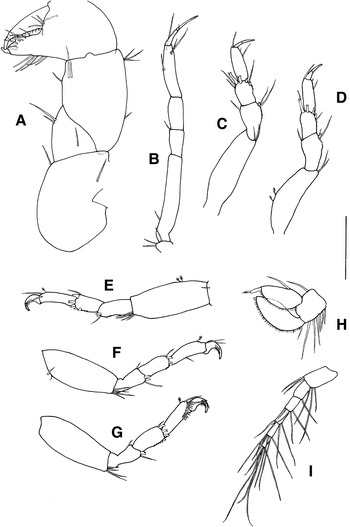
Gamboa darwini gen. et sp. nov., female: (A) right cheliped; (B–G) pereopods 1–6 respectively; (H) pleotelson and uropods. Scale bar = 0.1 mm.

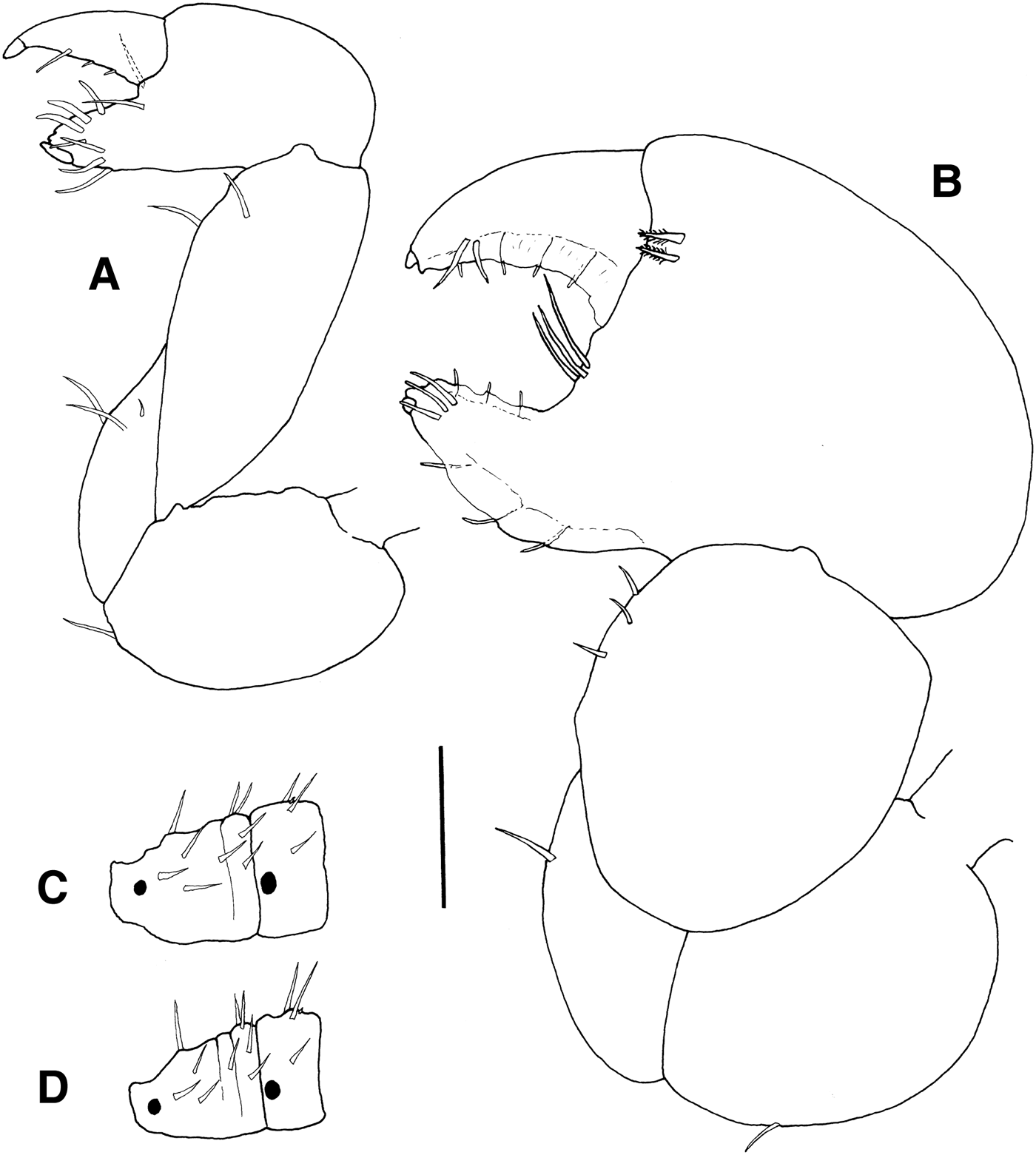
Gamboa darwini gen. et sp. nov., male: (A) right cheliped; (B) left chela; (C) second pleopod; (D) fourth pleopod. Scale bars = A & B, 0.1 mm; C & D, 0.05 mm.

TYPE MATERIAL
Cape Verde Islands: holotype: 1♀ (BMHN.2011.1823), amongst littoral Idanthyrsus luciae tube-reef, LWST, Quail Island (Santa Maria), Praia, Santiago, 14°54.16′N 23°30.46′W, 10 June 2009, coll. R.B.
Paratypes: 1♂ (BMHN. 2011.1824), dissected allotype, 1♀ (BMHN. 2011.1825), and 1♀ (BMHN. 2011.1826), dissected paratype, same data as holotype.
DESCRIPTION OF FEMALE
Body (Figure 14A) slender, holotype 0.9 mm long, 11 times as long as wide. Cephalothorax subrectangular, slender, 1.7 times as long as wide, about as long as pereonites 1 and 2 together, naked; eyelobes absent, small eyes present as a few dark subcutaneous ocelli. Pereonites 1 to 3 subequal in length, half as long as cephalothorax; pereonites 4 to 6 subequal, 0.7 times as long as cephalothorax, (all pereonites respectively 1.2, 1.2, 1.0, 0.8, 0.8 and 0.9 times as wide as long). Pleon with five free subequal naked pleonites without pleopods; each pleonite 2.8 times as wide as long and one-third as long as pereonite 6. Pleotelson (Figure 15H) subpentangular, twice as long as pleonite 5 and 1.2 times as wide as long, with one posterior seta over attachment of each uropod and paired mid-posterior setae.
Antennule (Figure 14B) of three articles, proximal article 3.2 times as long as wide, 1.4 times as long as distal two articles together, with one longer outer and one shorter inner setae at mid-length, one longer outer and two shorter inner setae distally; second article 1.5 times as long as wide, 0.3 times as long as first article, with one longer outer and one shorter inner distal setae; third article tapering slightly, 1.6 times as long as second article, with one aesthetasc and four simple distal setae.
Antenna (Figure 14C) of six articles, articles 1 to 3 compact, subequal; first article naked, second article with ventrodistal seta, third article with dorsodistal seta; fourth article longest, four times as long as wide, straight, with one simple dorsodistal sera and single dorsal and ventral penicillate distal setae; fifth article 0.4 times as long as fourth with one distal seta; sixth article minute with four distal setae.
Labrum (Figure 14D) rounded, hood-shaped, distally setulose. Left mandible (Figure 14E) with simple pars incisiva and wide, crenulate lacinia mobilis, right mandible (Figure 14F) without lacinia mobilis. Pars incisiva crenulated, distally bilobed; pars molaris of both mandibles stout with few (6?) spine-like teeth around distal margin. Labium not recovered. Maxillule (Figure 14G) with nine distal spines, palp with two distal setae. Maxilla not recovered. Maxilliped palp (Figure 14H) first article naked, second article with one slender distal and two geniculate inner setae; third article with three inner setae in distal half of article; fourth article with one inner and three distal setae; basis naked; endites with two subdistal setae and slightly undulating distal margin. Epignath not recovered.
Cheliped (Figure 15A) with rounded basis 1.8 times as long as wide, with dorsodistal seta, posterior margin of basis overlapping pereonite 1 ventrally; merus subtriangular with single ventral seta; carpus elongate, twice as long as wide, with one midventral seta, one fine dorsodistal seta; propodus slender, 1.7 times as long as wide, with one seta at attachment of dactylus and one mid-distal spine (comb-row); fixed finger 0.7 times as long as palm, with one ventral seta, two setae on cutting edge, cutting edge with distal apophysis; dactylus naked.
Pereopod 1 (Figure 15B) coxa without apophysis, with seta; basis arcuate, slender, nearly six times as long as wide, naked; ischium compact, naked; merus one-quarter as long as basis, with one simple ventral sub-distal seta; carpus 1.2 times as long as merus, naked; propodus just over twice as long as carpus, with two dorsal subdistal setae, one ventral subdistal seta; dactylus naked, slender unguis twice as long as dactylus, both together 0.7 times as long as propodus. Pereopod 2 (Figure 15C) similar to but shorter than pereopod 1, basis 3.5 times as long as wide; merus 0.4 times as long as basis, with single ventrodistal seta; carpus as long as merus, with slender ventrodistal spine; propodus 1.9 times as long as carpus, with one dorsal and one ventral distal setae; dactylus and unguis subequal in length, both together 0.6 times as long as propodus. Pereopod 3 (Figure 15D), similar to pereopod 2.
Pereopod 4 (Figure 15E) coxa with seta; basis stouter than those of anterior pereopods, clavate, 2.9 times as long as wide, naked; ischium naked; merus one-third as long as basis, with two slender ventrodistal spines; carpus as long as merus, with two inner and one outer distal curved spines, one dorsodistal seta, without prickly tubercles (sensu Błażewicz-Paszkowycz, Reference Błażewicz-Paszkowycz2007); propodus 1.7 times as long as carpus, with strong dorsodistal seta, and two ventrodistal slender spines; dactylus stout, unguis short and bifurcate, both together 0.6 times as long as propodus. Pereopod 5 (Figure 15F) as pereopod 4, but carpus without dorsodistal seta. Pereopod 6 (Figure 15G) as pereopod 5, but propodus with additional fine dorsodistal seta.
Pleopods absent.
Uropod (Figure 15H) biramous, basis naked; exopod one segment, just shorter than proximal endopod segment, with one mid-outer seta and one shorter and one longer distal setae; endopod of two subequal segments, proximal segment naked, distal segment with five distal setae.
DESCRIPTION OF MALE
Closely similar to female, but cheliped dimorphic: chela (Figure 16A, B) more robust than that of female, propodus 1.4 times as long as wide, comb row of seven spines, seta at attachment of dactylus not evident; chela fingers stouter than those of female, fixed finger half as long as palm.
Reduced pleopods (Figure 16C, D) present on each pleonite, of one article, with two distal setae on pleopods 1 to 3 (Figure 16C) and one distal seta on pleopods 4 and 5 (Figure 16D).
ETYMOLOGY
Named after Charles Darwin, whose first stop on his passage on the HMS ‘Beagle’ was at Praia, where he visited Quail Island, and there noted the ‘raised beach’ in the cliff which lies directly above the type locality of this species.
REMARKS
The distinctions of this taxon from other nototanaids are summarized above under the remarks for the genus. It is not clear as yet whether such characters as the two-segmented uropod endopod, the nine distal spines on the maxillular endite or the unguis on pereopod 1 being twice as long as the dactylus are specific characters or generic characters.
MATERIAL EXAMINED
Azores: 1 ♀ with oostegites, holotype (NHM.2007.424), 1♂, allotype (NHM.2007.425), 15♀♀, paratypes, amongst algae within the flooded crater of the Ilhéu de Vila Franca, São Miguel, 37°42.30′N 25°26.52′W, 24 July 2006, coll. A. Salvador, R. Robbins & R.B. Numerous specimens from littoral algal habitats around São Miguel, Azores, 1996 to 2006, all coll. A.C. Costa & João Brum (see Bamber & Costa, Reference Bamber and Costa2009).
Canary Islands: 2♀♀, Charc Azul, La Palma, 28°40′N 17°52′W, 2 May 2009, amongst littoral algae, coll. B. Morton.
REMARKS
Leptochelia caldera was discovered only recently in the Azores, where it was the only species of this genus found in the extensive sampling in São Miguel over the last 15 years. The record from La Palma, incidentally the nearest Canary Island to the Azores, is at present the only record of the genus from the Canary Islands.
MATERIAL EXAMINED
Madeira: 1♀, Caniço de Baixo, Madeira, 32°38.78′N 16°49.55′W, west side of Bay, algal mats on low shore rocks with barnacles and Anurida, 17 October 2009, coll. R.B./B.M. 1♀, in low-littoral algal-bedded sand on sandstone outcrops, Campo de Baixo, Porto Santo, 33°03′N 16°21′W, 19 October 2009, coll. R.B./B.M. (see Bamber, Reference Bamber2010).
Cape Verde Islands: 1♂, 1♀ (BMNH.2011.1827-1828), amongst low shore algae, and 1♀, amongst littoral Idanthyrsus luciae tube-reef, LWST, both Quail Island (Santa Maria), Praia, Santiago, 14°54.16′N 23°30.46′W, 10 June 2009; 1♀ with brood pouch, coralline algae in low-shore rock pools, Praiamar, Praia, Santiago, 14°54.54′N 23°30.81′W, 9 June 2009; all coll. R.B.
PREVIOUS RECORDS
Madeira: type locality, no details (Krøyer, Reference Krøyer1842, including as ‘Tanais’ edwardsii). Azores: Faial, Horta at 5 to 6 m depth (Dollfus, Reference Dollfus1897).
REMARKS
This species is discussed comprehensively by Bamber (Reference Bamber2010). These recent records place the species in three of the four inhabited Macaronesian archipelagos, although it has not been recorded in the Azores since the 19th Century despite much collecting (see Bamber & Costa, Reference Bamber and Costa2009). Elsewhere it is prevalent along the Atlantic coasts of Europe from the British Isles south to Portugal, and probably in the Mediterranean off Italy.
MATERIAL EXAMINED
Cape Verde Islands: 1 damaged ♀, within MNB 17 760; one of the specimens of Vanhöffen (Reference Vanhöffen1914), see below.
PREVIOUS RECORDS
Cape Verde Islands: 1 brooding ♀, plankton sample, St Vincent, 1893? (Hansen, Reference Hansen1895); 7 specimens, amongst littoral Lithothamnium, Mindello harbour, Porto Grande, St Vincent, September 1901 (Vanhöffen, Reference Vanhöffen1914).
REMARKS
This species was only scantily described by Hansen (Reference Hansen1895); his single specimen was, however, a brooding female with a four-segmented uropod endopod, which negates its being Leptochelia savignyi, the only Leptochelia species collected in Cape Verde in our recent sampling: adult L. savignyi have six segments in the uropod endopod. Equally, the only other species of Leptochelia recorded recently from Macaronesia, L. caldera, also has a six-segmented uropod endopod in the adult, and an antennule of proportions unlike those figured by Hansen (Reference Hansen1895: pl. VI, figure 2). While damage to the uropod is a possibility, Vanhöffen (Reference Vanhöffen1914) also noted all of his specimens to have a four-segmented uropod endopod (describing few other characters). One of Vanhöffen's specimens, a headless female, was available for examination within MNB 17 760, but was not in a sufficient condition to shed any light on this taxon.
Until fresh material is collected from Cape Verde of a Leptochelia matching the few characters known for Hansen's species, L. affinis must remain incertae sedis; however, it is not L. savignyi.
Heterotanais groenlandica sensu Vanhöffen, Reference Vanhöffen1914, female: (A) cephalothorax and antennules, dorsal; (B) left uropod, showing proportions of segments.

MATERIAL EXAMINED
Cape Verde Islands: 1♀, within MNB 17 760; one of the specimens of Vanhöffen (Reference Vanhöffen1914), see below.
PREVIOUS RECORDS
Cape Verde Islands: 3 specimens, amongst littoral Lithothamnium, Mindello harbour, Porto Grande, St Vincent, September 1901 (Vanhöffen, Reference Vanhöffen1914 as Heterotanais groenlandica Hansen).
REMARKS
The description of this taxon by Vanhöffen (Reference Vanhöffen1914) is scant; he does refer to the segmentation of the uropod. One of his specimens was available from the Berlin Museum for re-examination (a contaminant with the type of Synapseudes heterocheles), but it had lost the majority of its setae; it was not dissected. The uropod exopod (Figure 17B) is 2-segmented, the uropod endopod 5-segmented, with segment 3 the longest. The antenna appears to be without distal spines on articles two and three. The distal antennular article of this specimen (Figure 17A) is proportionately shorter than that of H. groenlandica sensu stricto.
It appears that this may be a species of Heterotanais, although not H. groenlandica, as was concluded by Sieg (Reference Sieg, Gruner and Holthuis1983, p. 496), who was also uncertain of its genus. Lang (Reference Lang1973) thought it to be a species of Leptochelia, but the re-examination has shown that not to be the case. Its true attribution must again await rediscovery from Cape Verde and a proper description.
DISCUSSION
Zoogeography
The distributions of the Macaronesian tanaidacean species known to date are summarized in Table 1. Within Macaronesia, the apseudomorphan species are almost entirely restricted to the Cape Verde Islands, with one record in the Canary Islands and none in either Madeira or the Azores. Five of the fourteen species distinguished above have been recorded outside the Macaronesian Islands, allowing some discussion of their zoogeographical origins; four of these are also known on the Atlantic coasts of Europe or Africa and in the Mediterranean, to the east, and one from Bermuda to the west. Six of the remainder have been found only once, limiting interpretation of their provenance. The other three species have multiple records in Macaronesia, including within and between archipelagos, hopefully giving further indications of their dispersion.
The distribution of tanaidacean species currently known from Macaronesia.

*, Leptochelia savignyi has not been recorded in the Azores since the 19th Century, despite much modern sampling.
Some aspects of these tanaidacean assemblages show consistent patterns at the supraspecific level. There is a common pattern of littoral turf habitats in Atlantic volcanic archipelagos supporting populations of tanaid and specifically zeuxoid species. In Macaronesia we have found Zeuxo exsargasso typifying this habitat in the Canary Islands, and Z. coturnix in Cape Verde and Madeira. The Isles of Scilly, a volcanic archipelago off south-west England, similarly supports a widespread population of Z. holdichi Bamber, 1990 (Bamber, Reference Bamber2011), while recent samples have found Zeuxo sp. aff. normani and Zeuxoides ohlini (Stebbing, 1914) on Tristan da Cunha (Bamber, unpublished data).
Similarly, in most of these archipelagos, species of Leptochelia (all of Macaronesia plus Scilly) and Tanais (Azores, Maderia, Cape Verde and Scilly) are found. As yet there is insufficient information to suggest any examples of allopatric speciation in these taxa, although cases for Leptochelia caldera and L. affinis (were it better understood) might be made. A more feasible example is the presence of presently-endemic species of Parapseudes in Macaronesia, with P. mortoni in the Canary Islands (Lanzarote) and P. fitzroyi and P. similis in Cape Verde (on the islands of Santiago and São Vicente respectively). These are taxa of which frequent transport (passive or anthropogenic) would not be expected (there is no reported record of an apseudomorph living in either floating algae or fouling communities). Appreciating that the knowledge about species in this genus has been confused historically by authors such as Lang (Reference Lang1965) and Sieg (Reference Sieg, Gruner and Holthuis1983) over-synonymizing these taxa, the only other two species in this region are P. latifrons and P. francispori, both from the Mediterranean. The known populations of these morphologically-very-similar species are variously isolated from each other, and, were any of them from a common origin, some degree of genetic drift will have been inevitable.
Unfortunately, there is a dearth of records of tanaidaceans from the coasts of north-west Africa.
Dispersion of the taxa
Ten mechanisms for long-distance transport were proposed by Cohen & Carlton (Reference Cohen and Carlton1997) for brachyuran crabs, which are appropriate for wider consideration in the Crustacea. In what are esentially non-migratory taxa, two options for the long-distance dispersion in tanaidaceans are feasible.
PASSIVE DISPERSAL
Drift dispersal in algae as a viable means of passive migration by tanaidaceans was analysed by Bamber (Reference Bamber and Morton1998), and such a process was proposed by Bamber & Costa (Reference Bamber and Costa2009) for the presence of Zeuxo exsargasso in Tenerife, via the Azores and Canary Currents. The current circulation of the North Atlantic was comprehensively discussed by Barton (Reference Barton, Steele, Thorpe and Turekian2001; see also Fedoseev, Reference Fedoseev1970). Essentially, the low to mid-latitudes of the North Atlantic are occupied by the clockwise-rotating subtropical gyre. The Gulf Stream, on its western boundary, diverges into the north-eastward-flowing North Atlantic Drift, and the eastward-flowing Azores Current. The latter meanders across the Atlantic towards the Gulf of Cadiz at about 35°N, branching to the east into the Portugal Current and the Canary Current, both flowing southwards for most of the year (Figure 18). Part of the Portugal Current enters the Mediterranean as a surface flow. The Canary Current splits around Madeira, and eventually diverges from the North African coast at about 20°N to become the westward-flowing North Equatorial Current, which feeds into the Caribbean Current and thence back into the Gulf Stream. The eastern branch of the Canary Current migrates seasonally across the Canary Islands, while south of 20°N there can be seasonal recirculation with a northward coastal flow.
Diagrammatic map of principal current flows through Macaronesia (partly after Barton, Reference Barton, Steele, Thorpe and Turekian2001).

In addition, the coastal trade winds generate offshore Ekman transport in the surface layers, and thus generate upwelling of nutrient-rich water at the coast (Barton, Reference Barton, Steele, Thorpe and Turekian2001).
Passive transport in drift from the northern archipelagos to those further south is feasible, as is drift from the African coast to the Cape Verde Islands. Shallow-water flow into the Mediterranean is also an option, but flow from the Mediterranean is of denser water, which enters the Gulf of Cadiz below 500 m depth and is constrained by the Earth's rotation to flow northward. Thus, passive transport of shallow-water taxa to Macaronesia from the Mediterranean is not feasible. Interestingly, the transport of such taxa from Macaronesia to the Mediterranean is feasible.
The subtropical gyre does bring floating Sargassum from the west into the vicinity of the Azores and towards the Canary Islands (e.g. Timmermann, Reference Timmermann1932; Hedgpeth, Reference Hedgpeth1948), and is thus a feasible vector for Zeuxo exsargasso, the types of which were collected in Sargassum, into the Canary Islands, whence it appears to have spread throughout the archipelago. Further, such passive transport may account for the movement of Leptochelia caldera from the Azores to La Palma in the Canary Islands, whence it too may spread further in this archipelago, and even perhaps the transport of Zeuxo coturnix from Madeira to Cape Verde (apparently by-passing the Canaries). Equally, such a process would allow the transport of species such as Leptochelia savignyi and Tanais dulongii (both recorded on Iberian coasts) to Cape Verde. Similarly, Paradoxapseudes intermedius is known from the North African coast, although there is no reported record of an apseudomorph living in floating algae. That the Cape Verde Islands support a higher diversity of species, including genera (Gamboa and Synapseudes) not known from the more northern archipelagos, may reflect the possibility of additional recruitment by passive drift from a southerly direction.
However, such prevailing current transport cannot account for the passive distribution of the North European–Mediterranean species such as Tanais grimaldii, Leptochelia savignyi, and T. dulongii to Madeira (the latter two) and the Azores (the former two).
ANTHROPOGENIC INTRODUCTION
The second process which would allow longer-distance dispersal of tanaidaceans is anthropogenic carriage amongst fouling on ships. All of these archipelagos have been the subject of regular shipping passage since the 16th Century, from Portugal to the Azores, Cape Verde and Madeira; from Spain to the Canaries; and from the British Isles to Madeira in particular from the early 19th Century onwards, but also the Azores and Cape Verde.
The presently confirmed distribution of Leptochelia savignyi outside Macaronesia is along the European Atlantic coasts from Western Ireland (?), around south-western England and northern France down to north-west Spain (Bamber, Reference Bamber2010, figure 3). As this genus has been found living successfully in a ship's-hull fouling-community (Bamber, Reference Bamber1977) and thereby surviving passage from the Gold Coast of Africa to the North Sea (but not surviving once it had arrived), there is a strong implication of a possible introduction of this species by shipping (probably hull-fouling) to Madeira and the Azores. Its presence in Cape Verde might be by either passive drift (see above) or anthropogenic introduction.
The presence of Tanais grimaldii in the Azores and of T. dulongii in Madeira may also be examples of anthropogenic introduction.
Provenance
In conclusion, the archipelagos of Macaronesia support low diversity littoral tanaidacean assemblages, with lowest diversity in the Canary Islands and highest diversity in Cape Verde. These assemblages are postulated to include a combination of naturally-introduced species, species of anthropogenic introduction, and endemic species which may be examples of allopatric speciation.
In the Azores, two species, Tanais grimaldii and Leptochelia caldera, are suggested to be native; in Madeira, only Zeuxo coturnix; in the Canary Islands, only Parapseudes mortoni; while in Cape Verde, Parapseudes fitzroyi, P. similis, Synapseudes heterocheles, Gamboa darwini and possibly Zeuxo sp. B and Leptochelia affinis appear to be native.
The presence of Zeuxo exsargasso throughout the Canary Islands, and of Paradoxapseudes intermedius in Cape Verde are attributed to natural introduction. Conversely, the presence of both Tanais dulongii and Leptochelia savignyi somewhat patchily around these archipelagos is attributed to anthropogenic introduction from mainland Europe originally, probably in ships'-hull fouling.
It would undoubtedly be the case that, in a relatively recent habitat such as these littoral zones, with a low-diversity macrofauna (e.g. Bamber & Robbins, Reference Bamber and Robbins2009), any naturally or artificially introduced species finding an appropriate niche would be expected to flourish. In more mature isolated (island) habitats processes of genetic drift as well as selective pressures would lead to allopatric speciation, as may already have happened in Macaronesia.
ACKNOWLEDGEMENTS
I am very grateful to Professor Brian Morton for collecting the samples from the Canary Islands, and for field assistance in Madeira and in Cape Verde, to Antonio de Frias Martins, Roni Robbins, Andreia Salvador and Ana Cristina Costa for various assistance in the Azores, and to Dr Charles Coleman of the Museum für Naturkunde, Berlin, for access to the type material of Vanhöffen. The sampling in Madeira was supported by a grant from the Porcupine Marine Natural History Society (www.pmnhs.co.uk).