Introduction
The goal of a terrorist attack is to kill and injure as many victims as possible, as well as spread a sense of fear and terror.Reference Young1 In the aftermath of an attack, first responders arriving on-scene risk becoming targets to a secondary attack. For this reason, first responders undergo extensive training on scene safety and the maintenance of situational awareness.2-Reference Thompson, Rehn, Lossius and Lockey4 However, if the means of a secondary attack is the use of an official response vehicle such as an ambulance, this places first responders and lay persons at high risk.
Ambulances have been used by terrorists to increase the destructive burden of their attacks and offer several advantages: they generally do not arouse suspicion and can often gain access to secure areas.5 Their large size can also accommodate more explosives than most conventional vehicles. Using ambulances can also help terrorists target first responders or hospital personnel, thereby increasing the death toll both directly by killing more people, and indirectly by injuring or killing responders who might have otherwise cared for victims. Additionally, the use of ambulances in a terror attack can have additional psychological ramifications, as trusted symbols of healing are turned into weapons of destruction.
Counter-terrorism experts have been concerned for some time that terrorists may increasingly turn to ambulances as modalities in future attacks.6 It is therefore imperative to understand how terrorists have used ambulances in prior attacks so as to mitigate against and prepare for future attacks. However, to date, there are no articles in the medical literature on ambulance-related terrorist attacks. This study aims to review all documented instances in which an ambulance was used to execute a terrorist attack.
Methods
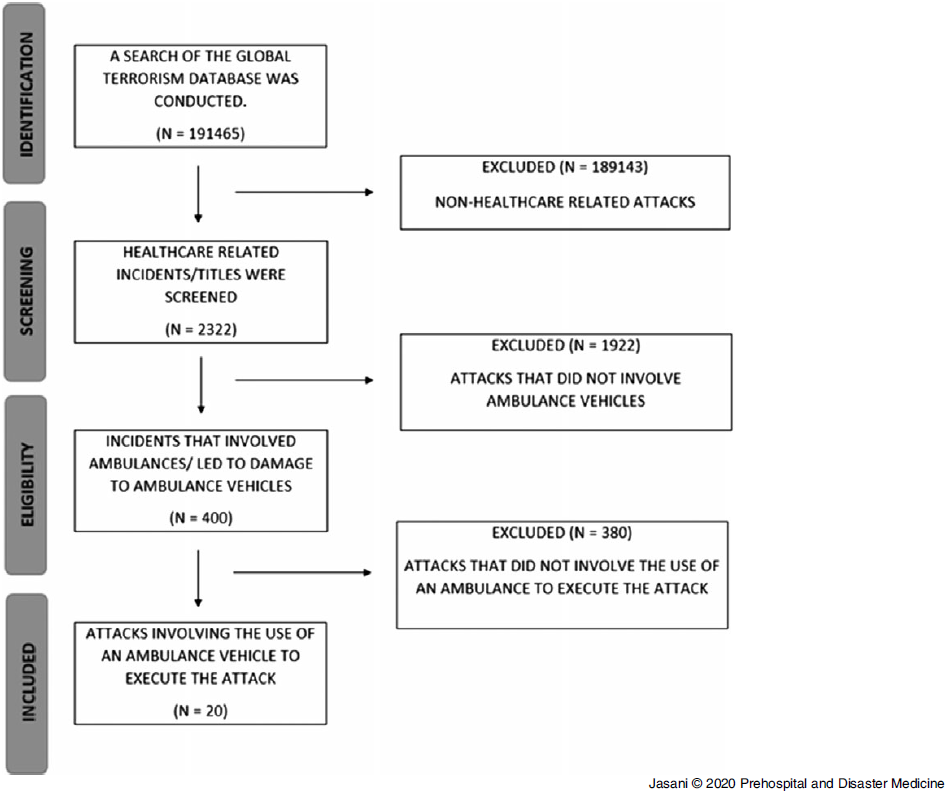
Utilizing the Preferred Reporting Items for Systematic Reviews and Meta-Analyses (PRISMA) standard, a database search of the Global Terrorism Database (GTD; Figure 1) was performed.Reference Moher, Liberati and Tetzlaff7,8 Within the date range of 1970-2018, the GTD contained 191,465 entries, which were then searched for the terms “ambulance,” “health care,” “doctor,” “nurses,” “vaccinators,” “clinic,” “first responder,” and “hospital;” this resulted in 2,322 health care-related entries. The search was further refined to exclude incidents that did not involve the use of or damage to ambulance vehicles; this resulted in 400 entries. The ambulance dataset was then manually searched for incidents that related to the use of ambulance vehicles to conduct the attack; this resulted in 20 entries. Ambiguous incidents that did not specifically relate to the use of ambulances as the vector for the attack were manually excluded.
PRISMA Chart.

The GTD is an open source database that includes information on terrorist events from 1970-2018.8 It is maintained by the National Consortium for the Study of Terrorism and Responses to Terrorism (START; College Park, Maryland USA), which is based at the University of Maryland and is part of the Department of Homeland Security Center of Excellence (Washington, DC USA). In order to qualify to be included in the database, the incident must fit the following definition: the threatened or actual use of illegal force and violence by a non-state actor to attain a political, economic, religious, or social goal through fear, coercion, or intimidation. Additionally, all three of the following attributes must be present:
-
1. The incident must be intentional;
-
2. The incident must entail some level of violence or immediate threat of violence; and
-
3. The perpetrators of the incidents must be sub-national actors.
Lastly, two of the three criteria must be present:
-
1. The act must be aimed at attaining a political, economic, religious, or social goal;
-
2. There must be evidence of an intention to coerce, intimidate, or convey some other message to a larger audience than the immediate victims; and/or
-
3. The action must be outside the context of legitimate warfare activities.
The data compiled in the GTD are from a combination of sources based on the date of the incident. Between 1970 and 1997, the raw data were collected by the Pinkerton Global Intelligence Service (Ann Arbor, Michigan USA) – a private security agency. These were handwritten records digitized in 2005. From January 1998 through March 2008, the data were collected from the Center for Terrorism and Intelligence Studies (CETIS; Lowell, Massachusetts USA), which was then transitioned to the Institute for the Study of Violent Groups in March of 2008 through October 2011. Beginning in November 2011, all GTD data collection is conducted directly by START staff at the University of Maryland. Data for the GTD are collected though both automated and manual data collection strategies. This includes daily media article sources that describe terrorist attacks in multiple languages. These are further autonomously refined for duplicate incidents and then manually reviewed prior to incorporation into the database. For an event to be recorded in the GTD, it must be documented by at least one high-quality source. The GTD defines a high-quality source as: independent (free of influence from the government, political perpetrators, or corporation); those that routinely report externally verifiable content; and those that are primarily sourced.
This study was reviewed by the University of Maryland, Baltimore institutional review board and deemed to be exempt from review, protocol number: 00091566.
Results
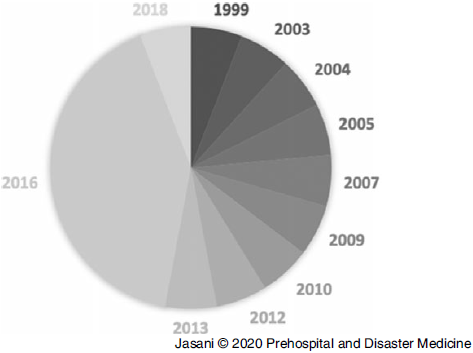
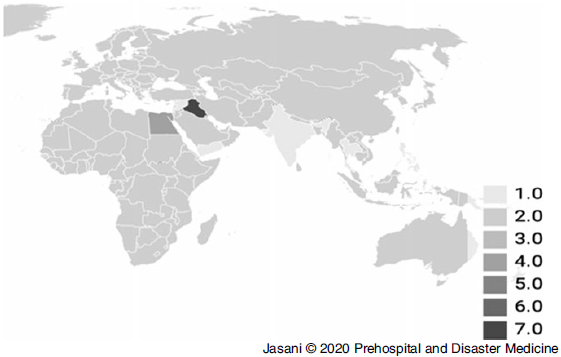
Twenty incidents were identified in the GTD that involved the use of ambulances by a terrorist organization. Nineteen attacks occurred after 2001 and the formal start to the global war on terror. Thirteen of the 20 incidents occurred after 2010, and 2016 saw the largest number of ambulance-related terrorist attacks with seven (Figure 2). Of these attacks, 15 occurred in the Middle East with the remaining five occurring in South Asia. Iraq was the country with the most terrorist attacks involving an ambulance (seven). Egypt was second with four attacks. Afghanistan and Libya both have had two ambulance-related attacks. The remaining countries had experienced one attack each (Figure 3).
Ambulance-Related Terrorist Attacks per Year.

Geographical Distribution of Attacks using Ambulance Vehicles.

The attack with the largest loss of life occurred in Kabul, Afghanistan in 2018 when an ambulance armed with explosives detonated in a crowded part of the city: 104 people were killed and another 235 wounded. Most attacks (12 of 20) resulted in up to three people killed. Six attacks had 10-20 killed. One attack did not have casualty information listed in the database. In all cases, ambulances were used as a vehicle-borne improvised explosive device (VBIED).
Discussion
This study is the first to review all terrorist events that involved the use of ambulance vehicles as an attack modality. The use of ambulances in these attacks appears to be advantageous to terrorist groups as they can offer the ability to gain access to otherwise secure areas, often bypassing checkpoints and other security measures.5,6 The use of an ambulance can also inflict substantially more damage than a civilian vehicle when used as a VBIED through their capacity to hold more explosives, as well as their ability to access vulnerable sites such as hospitals, thereby exposing a larger number of health care personnel to either primary or secondary attack.
There were 20 instances in which ambulance vehicles were used in intentional attacks by terrorist organizations identified, with over one-half of all ambulance-related attacks (11/20) occurring within the past decade. This trend is certainly troubling and demonstrates that terrorist organizations are becoming more aware and comfortable with the use of ambulances to execute their attacks. This increase in use of ambulances in these attacks points towards an alarming realization: terrorist organizations are increasingly able to acquire ambulance vehicles. Every attack in this review used an ambulance as a VBIED, rendering them unavailable for subsequent attacks. As each event requires a functioning ambulance to successfully carry-out the attack, accordingly, every attack requires a new ambulance. The rise in the number of attacks in recent years illustrates how accessible ambulances are to terrorist organizations.6,Reference Overton9-11
In addition to accessibility, the vehicles used must also resemble local ambulances in order to bypass any security checkpoints and avoid unwanted attention. It is unclear how terrorist organizations are acquiring such ambulances, but counter-terror experts warn that fully functioning ambulances can be acquired on the internet relatively cheaply.Reference Overton9,Reference Ludwig10 A study undertaken in the United States also found that the vast majority of ambulances at hospitals are left unguarded and unlocked.Reference Alves and Bissell12
All attacks reported here have occurred in either the Middle East or South Asia, suggesting that terrorist organizations can more easily acquire ambulances in these geographic areas in comparison to other locations. The lack of ambulance-related attacks on other continents may indicate difficulty in acquiring ambulances in those areas, which is speculated to be due to the differences in ambulance designs. In the Middle East, ambulances are not uncommonly converted passenger vans, while in other parts of the world, specifically designed vehicles are used.13,14
In all cases identified, attackers have used ambulances as VBIEDs. It does not appear that terrorist organizations have yet expanded their use of ambulances to include personnel transport or ballistic attacks, though ambulances have been used to bypass security checkpoints and gain access to more populated areas, as was the case in the 2018 attack in Kabul, Afghanistan.5 In addition, because they can carry more explosives than most civilian vehicles, ambulances are an attractive option for terrorist organizations that want to increase the destructive impact of their attacks. Currently, terrorists appear only to be using ambulances the same way they use other vehicles, as VBIEDs. Future ambulance-related attacks should prompt concern for the expanded use of unconventional modalities, to include chemicals or radiation, as terrorist organizations seem to be gaining increased familiarity with incorporating ambulance vehicles into their asymmetric attack strategies. Civilian responders have very limited experience in chemical weapons attack, and an ambulance delivery system able to penetrate sensitive sites would allow for a potentially devastating assault on vulnerable targets.
Limitations
This analysis was a retrospective, university-sponsored, government-funded database search of unclassified terrorist attacks. The source of the data is government and private partnership, as well as media reported incidents in a non-classified database. There is a limited means to confirm these data or know the extent of under-reporting. Additionally, the database itself does not include foiled or failed plots, attacks in which violence is threatened as a means of coercion, nor incidents reported from non-high-quality sources. Due to limited high-quality sources in certain geographic areas, this results in conservative documentation of attacks in those areas. There is also a gap in data collection from 1993, as the handwritten report cards were lost; however, some data were recovered.8 Since this is a public safety and national security issue, there is a theoretical concern that the true nature, mechanism, and extent of some attacks can be altered as to avoid giving terrorists the means to incorporate evidence-based data into their attack planning. All of these factors may mean that the true incidence of ambulances being used in terrorist attacks is under-reported or misreported. Due to the retrospective nature, no statements of causality can be made.
The significance of these data, however, shows that ambulances can be used as a terrorist attack modality and have the ability to cause significant morbidity and mortality. All attacks reported occurred in either the Middle East of South Asia. The applicability of these data for local risk stratification is reasonably questioned due to multiple confounders. These include local ambulance designs, response model, employer security, infrastructure security, hospital access security, and local culture. The goal of this article, however, was to report that ambulance-related attacks have historical precedence and are occurring more frequently, so that health care personnel, first responders, and the community are made aware of this possible public safety threat and cognizant of its implications.
Conclusion
The use of an ambulance to conduct a terrorist attack not only increases the destructive power of the attack, but also turns a symbol of healing into an agent of death, which further heightens the psychological impact of the attack and promotes the spread of terror. This is the first study to review and examine all terrorist events that utilized ambulance vehicles to conduct an attack. In the cases reviewed from the database, ambulances were only used to carry explosives, taking advantage of their larger size and ability to gain access to secure areas to increase their destructive potential. The number of attacks using ambulances has increased in recent years, indicating that terrorists are increasingly able to acquire ambulance vehicles to conduct their attacks. Future concerns include the expansion of their use to enhance asymmetric attack, including the use of nonconventional modalities like chemical weapons and radiation. Health care personnel and responders must be aware of this threat in order to properly mitigate and prepare for such events.
Conflicts of interest/funding
This research was sponsored by Department of Emergency Medicine, University of Maryland School of Medicine, Baltimore, Maryland USA. The authors declare no conflicts of interest.