The implementation of rapid response systems is associated with decreased cardiopulmonary arrests and mortality in hospitalised adults and children receiving care outside the ICU. Reference Maharaj, Raffaele and Wendon1–Reference Kotsakis, Lobos and Parshuram4 Additionally, the severity of illness at ICU admission, critical deterioration events defined as the need for ventilation and/or inotropes, and length of ICU stay after rapid response is reduced. Reference Bonafide, Localio and Roberts5,Reference Kolovos, Gill, Michelson, Doctor and Hartman6 The Joint Commission and the Institute of Healthcare Improvement endorse rapid response systems. Reference Berwick, Calkins and McCannon7,8
The effectiveness of rapid response systems is dependent on early detection of decompensation, response activation, prompt mobilisation of specialised team/equipment, and robust system administration (quality improvement, education, feedback, and data supervision). Reference Lee, Bishop, Hillman and Daffurn9–Reference Devita, Bellomo and Hillman11 The International Liaison Committee on Resuscitation published guidelines detailing best practices for the management of rapid response systems related to data capture, monitoring, reporting, and conducting research. Reference Peberdy, Cretikos and Abella12
Paediatric cardiac patients are a unique population given their atypical cardiopulmonary interactions, overall high risk of cardiac arrest, and varied haemodynamic and physiologic response to resuscitation procedures. Reference Marino, Tabbutt and MacLaren13 A prior single-centre report Reference Bavare, Rafie, Bastero, Hagan and Checchia14 found that paediatric cardiac patients had a higher incidence of cardiopulmonary arrest during rapid response events, ICU transfer rates, and hospital mortality when compared to multicentre paediatric rapid response data. Reference Raymond, Bonafide and Praestgaard15 Many hospital systems have dedicated heart centres to take care of children with congenital and acquired heart diseases. Some centres utilise hospital-wide (i.e., universal or generalised) rapid response systems for response to clinical decompensation of cardiac patients, whereas others have a dedicated cardiac rapid response system. Limited information exists about differences in generalised and cardiac rapid response systems. Potential modifications to generalised rapid response paradigms can yield robust cardiac rapid response systems that can cater to the distinct needs of paediatric cardiac patients.
With endorsement from the Paediatric Cardiac Intensive Care Society, we developed a multicentre collaborative to study paediatric cardiac rapid response practices. We sought to understand the existing practices and clinical outcomes of rapid response to paediatric cardiac patients across institutions to guide recommendations for best practices for cardiac rapid response.
Materials and methods
Setting
The Board of Directors of the Paediatric Cardiac Intensive Care Society approved this study. A Paediatric Cardiac Intensive Care Society Rapid Response Systems Special Interest Group was established which included cardiology and critical care physicians, advanced practice providers, and nurses representing ten centres across North America.
Survey design and distribution
A cross-sectional survey was created using the modified Delphi technique to assess cardiac rapid response practices and outcomes. Cardiac rapid response encompassed rapid response events in hospitalised patients with congenital or acquired heart diseases. The members of the rapid response special interest group served as content experts and provided feedback on the survey. After revisions, all group members approved the survey prior to distribution. The survey was not tested for reliability, but the content validity was derived from the method of creation. A secure web application (Research Electronic Data Capture, REDCap) was utilised to build, manage, and deliver the survey. The survey comprised 36 questions categorised into institutional demographic information followed by 4 sets of questions investigating components of the rapid response system pertaining to response team activation, resource utilisation, clinical management, and outcomes assessment (Table 1). (Survey instrument is available in Supplementary Table S1.)
Rapid response team components queried in the survey

ICU: Intensive care unit.
* Early warning scores queried included paediatric advanced warning score, paediatric early warning score, modified early warning score, Cardiac Children’s Hospital early warning score, bedside paediatric early warning score, Rothman index, and other.
The survey was sent via e-mail to cardiac and multidisciplinary paediatric ICU medical directors at centres that were performing paediatric cardiac surgery, using the contact information available through the Paediatric Cardiac Intensive Care Society. Each e-mail recipient was informed of the purpose of the study and was asked to complete the confidential survey.
Analysis
Data are summarised with descriptive statistics. Comparisons between centres with and without a dedicated cardiac ICU were made using chi-square test, Fisher’s exact test, and McNemar’s test as appropriate. The partial responses were analysed for the responded questions only. Statistical software used was Stata version 15.0 (StataCorp., College Station, TX, United States of America).
Results
Survey response
Of the 125 cardiac and multidisciplinary paediatric ICU medical directors contacted, 65 (52%) responded to the survey and 52 (42%) provided complete responses. There was no pattern to missing data.
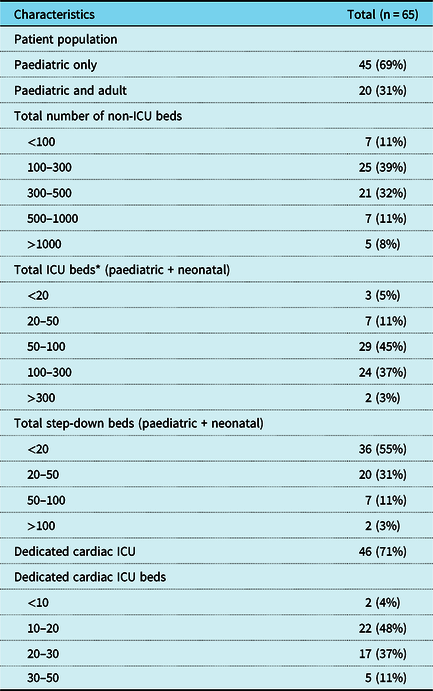
Hospital characteristics (Table 2)
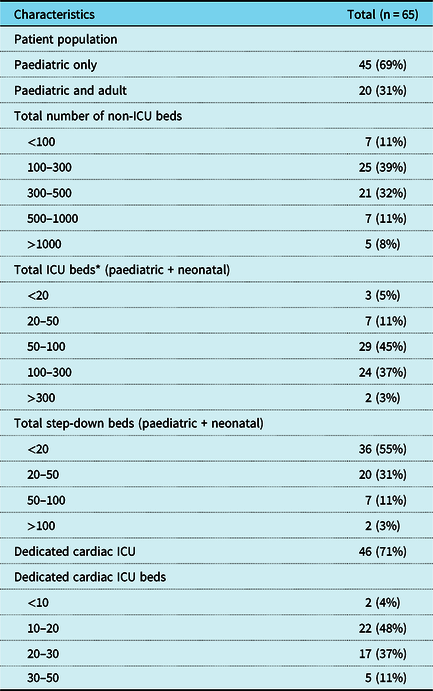
All 65 respondents were paediatric hospitals, of which 45 (69%) reported that their centre served children only and 20 (31%) centres served both paediatric and adult patients. The majority (71%) had between 100 and 500 paediatric non-ICU beds and 45% had a total paediatric ICU bed capacity of 50–100 beds. Most respondents (71%) reported that their centre had a dedicated cardiac ICU, typically with 10–30 beds. Almost all respondents (93%) reported that their cardiac ICU cared for neonatal, paediatric, and adult cardiac patients.
Hospital characteristics
ICU: Intensive care unit.
* Includes cardiac ICU.
Rapid response and code team characteristics
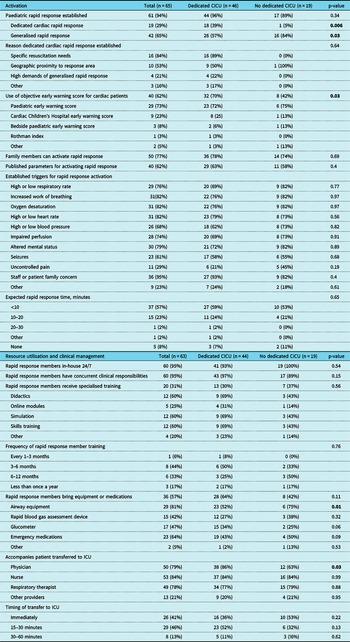
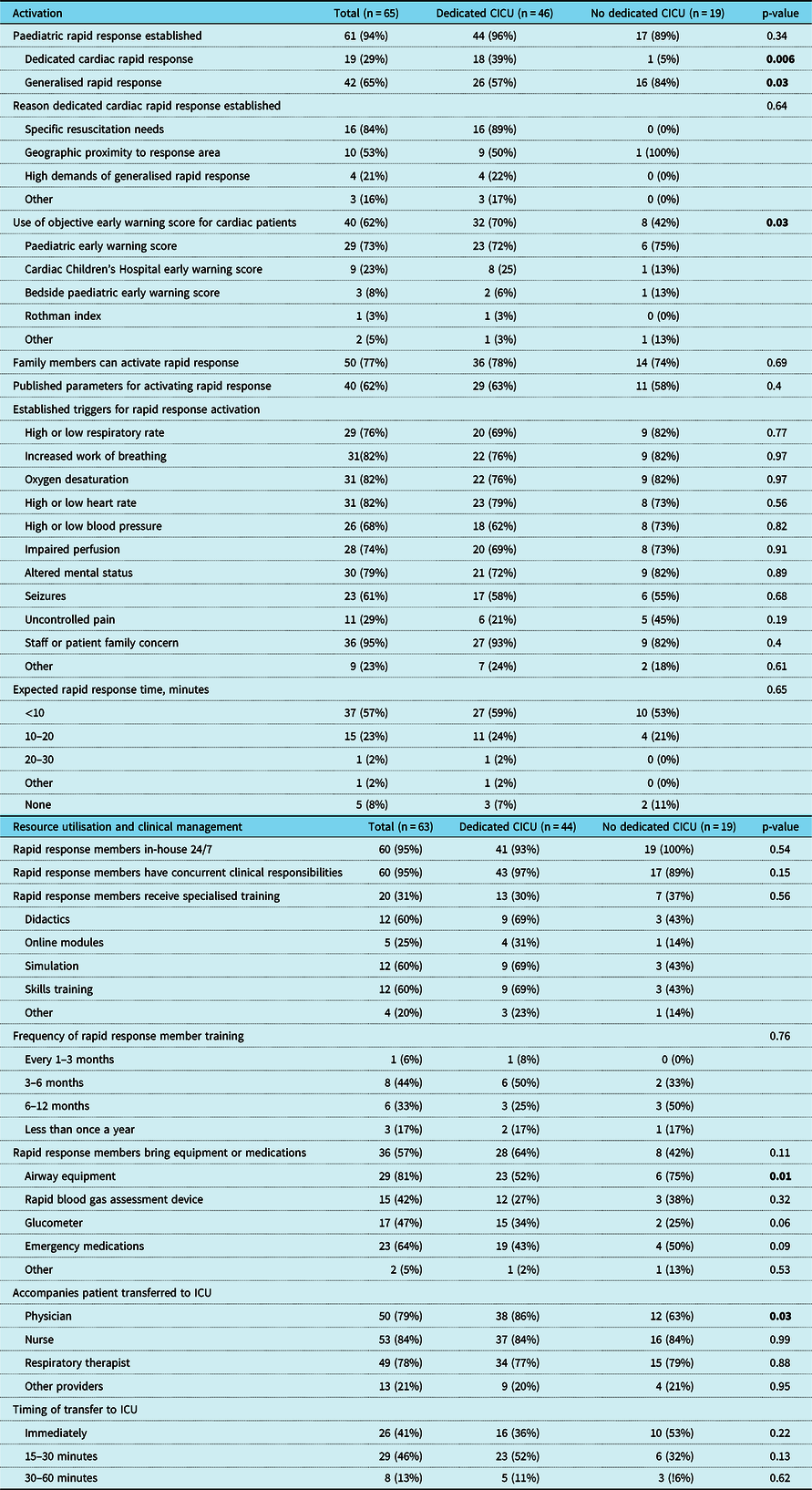
Ninety-four per cent of respondents reported that their centre had a paediatric rapid response system (Table 3). Dedicated paediatric cardiac rapid response system was present in 29% of all centres with the distribution being 39% of centres with dedicated cardiac ICUs and in only one centre (5%) with no dedicated cardiac ICU [p = 0.006]. The most common reasons cited for the implementation of a dedicated cardiac rapid response system included “specific resuscitation needs of cardiac patients” (84%) and geographic proximity of team members to the response area (53%). Code teams were reported by over two-thirds of the respondents to have more personnel and additional resources, such as equipment or medications than rapid response teams.
Rapid response event characteristics
CICU: Cardiac ICU; ICU: Intensive care unit; p-value: Comparison of dedicated CICU with no dedicated CICU.
Rapid response activation for cardiac patients
Data about rapid response team activation are summarised in Table 3. An objective early warning score was utilised in 62% of all centres (70% in centres with dedicated cardiac ICUs and 42% with no dedicated cardiac ICUs [p = 0.03]). Most common scores utilised included the Paediatric Early Warning Score (73%) and the Cardiac Children’s Hospital Early Warning Score (23%). Sixty-two per cent of centres have published parameters for rapid response team activation and most provide patient family members with the ability to activate the team (77%). The majority of centres (80%) responded that the expected rapid response time is within 20 minutes of activation.
Rapid response resource utilization
Rapid response team members (generalised or dedicated cardiac teams, whichever available in the centre for response to cardiac patients) include a nurse (91%), respiratory therapist (84%), attending physician (59%), fellow (52%), and less commonly a resident (33%). Rapid response team members were described as “in-house” 24 hours per day and 7 days per week and had concurrent clinical responsibilities in most centres (95%). Only one-third of respondents (centres with or without cardiac ICUs) reported that rapid response team members receive specialised training. Additional information regarding rapid response resource utilisation is summarised in Table 3.
Rapid response clinical management (Table 3)
Cardiac patients who undergo transfer to the ICU after rapid response events are frequently accompanied by a physician, nurse, and respiratory therapist present on the generalised or dedicated cardiac rapid response team (whichever was utilised for response to cardiac patients). Physicians accompanying patients during ICU transfer were higher in centres with dedicated cardiac ICUs than those without dedicated cardiac ICUs [p = 0.03]. Most respondents (87%) reported that cardiac patients were transferred within 30 minutes of the event. The primary drivers impacting the timing of transfer after rapid response event included clinical need for emergent transfer, ICU bed availability, and provider and/or staffing readiness. When patients remained at the original location of the rapid response activation, the respondents described a variable process for follow-up and management of such patients. Twenty-five per cent of respondents reported that patients were reassessed within 1–2 hours post-rapid response event. A structured way to communicate and document a clinical plan including frequency and specifics of investigations, monitoring, reassessment, and indications for ICU transfer exists in few centres and some highlighted the need to standardise this.
Rapid response outcomes evaluation (Table 4)
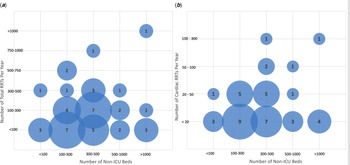
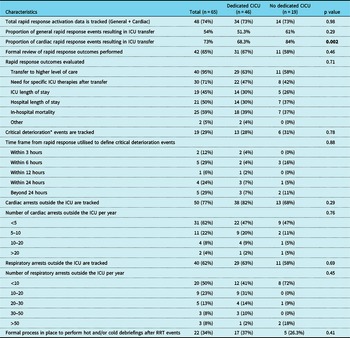
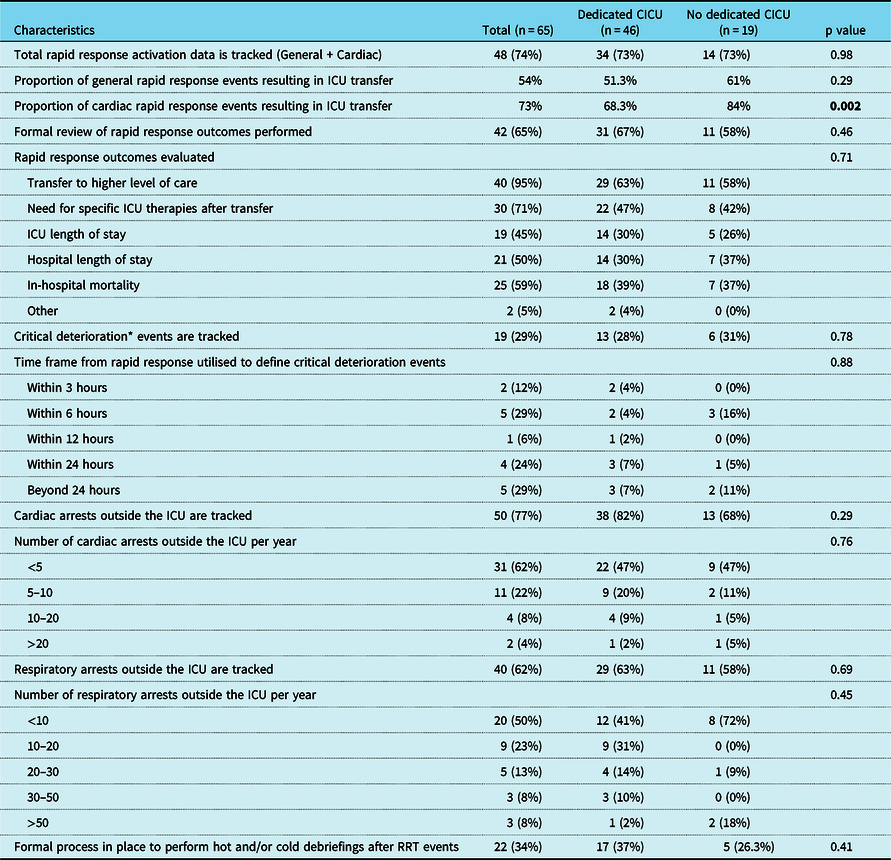
Rapid response activation data was tracked in 48 centres (74%). There was no significant difference in the number of rapid response events between centres with or without dedicated cardiac ICUs. The rapid response activations for total paediatric and cardiac patients categorised by hospital non-ICU bed capacity are depicted in Figure 1a and 1b, respectively. Twenty centres reported less than 100 total rapid response events and 26 centres has less than 20 cardiac rapid response events per year. For all centres, cardiac patients are more likely to be transferred to the ICU than general children after rapid response events (73% versus 54%, p = 0.03). The ICU transfer rates for cardiac rapid response events differed significantly between centres with dedicated cardiac ICUs (68%) and those without dedicated cardiac ICUs (84%) [p = 0.002]. Out-of-ICU cardiac and respiratory arrests are tracked in 77% and 62% of centres, respectively, and were infrequent (mostly less than 10 and less than 20 events per year, respectively). Critical deterioration events which could include near arrests are tracked at 29% of responding centres. Formal review of rapid response outcomes is performed by approximately two-third of centres, whereas “hot or cold” debriefings after rapid response events are performed at one-third of the centres. There were no significant differences in the rate of arrests, critical deterioration events, and performance of formal review of outcomes or debriefs between centres with or without dedicated cardiac ICUs.
Number of total ( a ) and cardiac ( b ) rapid response team activations per year compared to hospital size (non-ICU bed capacity). The bubbles represent the institutions with the number within the bubble and the size of the bubble depicting the number of institutions with corresponding non-ICU beds on X-axis and total ( a ) and cardiac ( b ) RRTs on Y-axis.

Rapid response outcomes evaluation
CICU: Cardiac ICU; ICU: Intensive care unit; p-value: Comparison of dedicated CICU with no dedicated CICU.
* Critical deterioration event: Need for ventilatory and/or inotropic support post-rapid response.
Discussion
To the best of our knowledge, this is the first study to describe the characteristics of cardiac rapid response systems from multiple institutions. For the response to cardiac patients, we found that only 29% have dedicated cardiac rapid response systems, whereas the remaining centres utilise generalised paediatric rapid response systems. Although the presence of a cardiac rapid response system is higher in centres with dedicated cardiac ICUs, more than half (57%) of centres with dedicated cardiac ICUs still utilise generalised rapid response systems. The majority (84%) of centres with dedicated cardiac rapid response systems cite the specific resuscitation needs of cardiac patients as a reason for cardiac rapid response system implementation, suggesting that many centres acknowledge this need. Additionally, the survey results show that cardiac ICUs mostly care for neonatal, paediatric, and adult cardiac patients. This implies that rapid response teams responding to cardiac patients have to account for age-related resuscitation differences in addition to the cardiac-specific resuscitation needs.
We found that substantial variability exists amongst centres related to cardiac rapid response practices that span across all four components of the rapid response system (activation, resource utilisation, management, and outcomes assessment). Published parameters to activate rapid response (generalised or dedicated cardiac teams responding to cardiac patients) and utilisation of early warning scores as an objective means to activate rapid response exist in 62% of responding centres each. Centres with dedicated cardiac ICUs reported higher utilisation of early warning scores which can provide a common language between nursing and physician colleagues and assist in communicating subtle clinical changes. The early warning scores most used were Paediatric Early Warning Score Reference Duncan, Hutchison and Parshuram16 and Cardiac Children’s Hospital Early Warning Score. The Cardiac Children’s Hospital Early Warning Score was specifically created for paediatric cardiac patients and accounts for considerations such as baseline cyanosis and the presence of pre-existing or newly diagnosed ectopy. Reference McLellan and Connor17 Regardless of the type of early warning score utilised, hospitals that care for patients with cardiac disease may consider adapting their rapid response activation procedures to account for cardiac-specific baseline factors.
Amongst the centres that reported their total and cardiac rapid response event numbers, there seems to be no correlation between hospital size (non-ICU bed capacity) and the rapid response event numbers. The reason for this finding is unclear, but one possibility is that variation exists amongst institutions for the thresholds for rapid response utilisation. Most respondents reported similarly structured rapid response teams across centres with team members being in-house with concurrent patient care responsibilities. Notably, only a third of centres (no significant difference for centres with or without dedicated cardiac ICUs) reported that rapid response team members receive specialised training, representing a potential area for improvement. Universal implementation of cardiac-specific training for cardiac rapid response (generalised or dedicated teams) could be beneficial. Another area of variability identified is within the management of cardiac patients, with physician-accompanied ICU transfers being more likely in centres with dedicated cardiac ICUs. Also, the approach to monitoring and reassessment of patients who are not transferred after rapid response events is variable.
Most respondents reported higher transfer to ICU rates for cardiac patients who undergo rapid response events compared to general children. Interestingly, for cardiac rapid response events, the ICU transfer rates are lower in centres with dedicated cardiac ICUs. Tracking of cardiac arrests outside the ICU, critical deterioration events, and review of outcomes is variable. Fewer than 10 cardiac arrests were reported to occur outside the ICU per year in 84% of centres. Given that catastrophic events like cardiac arrests are rare in paediatrics, a review of more commonly occurring critical deterioration events has been previously validated Reference Bonafide, Localio and Roberts5 as a metric that is pragmatic to apprehend and good surrogate for cardiac arrests. Hence, tracking critical deteriorations would potentially be useful.
Overall, the presence of dedicated cardiac ICUs correlates with the implementation of dedicated cardiac rapid response systems as well as impacts certain activation practices and resources used during and after rapid response events. However, regardless of the presence or absence of a dedicated cardiac ICU, review of outcomes after rapid response specifically critical deterioration events and clinical debriefs after rapid response events have room for improvement.
Limitations of this study are related to an electronic survey administered via e-mail. The response rate was just over 50% and hence the results are difficult to generalise. Additionally, the responses are dependent on the interpretation of the questions and the language by the reader. Despite these limitations, our study highlights the differences across institutions in cardiac rapid response paradigms and provides an opportunity to develop consensus-driven multicentre best practice guidelines. Our data can be utilised to identify the areas needed to develop recommendations for standardisation and best practices.
Conclusion
We found a discrepancy between the widespread existence of dedicated paediatric cardiac ICUs and the infrequent existence of dedicated cardiac rapid response systems. Hospitals with dedicated cardiac ICUs are more likely to have dedicated cardiac rapid response systems. The components of universal rapid response systems (activation, resource utilisation, management, and outcomes) are commonly expanded and applied to respond to cardiac patients despite their unique pathophysiology. There is an opportunity to improve standardised implementation of cardiac rapid response systems, systematize training for respondents, streamline protocols for monitoring patients after rapid response events, and broaden the scope of outcomes review and post rapid response events debriefs.
Acknowledgements
We acknowledge the expertise provided by the Paediatric Cardiac Intensive Care Society Rapid Response Special Interest Group (Amy Lay MD, Jamie Penk MD, Amy O’Connor DO: Ann and Robert H Lurie Children’s Hospital, Chicago, IL; Michael-Alice Moga MD: The Hospital for Sick Children (SickKids), Toronto, Canada; Dr Joshua Blinder MD: Children’s Hospital of Philadelphia, PA; Nikhil Chanani MD and Martha Clabby MD: Children’s Healthcare of Atlanta, GA; Nikoleta Kolovos MD: Washington University School of Medicine, St Louis, MO; Ashley Moellinger CPNP: Children’s Hospital of Alabama, Birmingham, AL; Michelle Dwyer MS PNP-AC: C.S. Motts Children’s Hospital, Ann Arbor, MI). We appreciate the assistance provided by Erin Kritz DO, Baylor College of Medicine with data gathering and summarisation.
Financial support
This research received no specific grant from any funding agency, commercial, or not-for-profit sectors.
Conflicts of interest
None.
Supplementary material
For supplementary material accompanying this paper visit https://doi.org/10.1017/S1047951121003322