About two-thirds of large US companies provide employees with a traditional defined benefit (DB) pension that pays retiree benefits in the form of a life annuity. These annuities are financed by corporate contributions to a separately managed pension fund invested under the aegis of the plan sponsor. By law, the sponsoring corporation is required to have enough assets on hand to fund, or pay for, all accrued vested benefits, even if the parent company were to go out of business. Yet there is flexibility in the funding rules, and it is often difficult to assess the current health of a corporate pension fund. Determining the plan's funded status requires knowledge of the present discounted value of future benefit flows and the market value of pension assets, yet pension fund finances are reported under rather arcane accounting conventions (McGill et al., Reference McGill, Kyle, John and Sylvester1996). In particular, current accounting and actuarial practice permits smoothing of changes in the values of pension assets and liabilities, making it difficult for investors to readily ascertain the current funded status of a DB plan.
If DB pension accounting is, in fact, ‘opaque’, this can make it difficult to properly value firms that sponsor DB plans (Gold, Reference Gold2005). While the market values of pension assets and liabilities are disclosed in the footnotes to annual financial statements, considerable expertise may be required to evaluate the value-relevance of the pension-related accruals embedded in the income statement. For instance, in the latter half of the 1990s, many corporate DB plans became significantly overfunded, and the earnings on pension fund investments substantially boosted the reported profitability of the sponsoring corporations. Some market analysts argued that this produced a misleading picture of the sponsors' core business performance. Then between 2000 and 2002, when the stock market plunged, interest rates fell and the net position of most DB plans took a 180-degree turn. The effects on sponsor financial statements – particularly their profitability – showed up only with a substantial lag.
This paper evaluates whether investors can see through the financial statement so as to value corporate sponsor DB pension funding status based on economic values of pension assets and obligations. In particular, we test the ‘transparent’ view of pension valuation, against specific alternative hypotheses in which firm equity value instead naively reflects the pension accruals located on the income statement, and thus fails to accurately reflect the economic value of net pension assets (NPAs). In doing so, we extend the work of Coronado and Sharpe (Reference Coronado and Steven2003) to include a period when the distortions to accounting statements were glaring enough to capture the attention of many market analysts and policymakers, and we assess whether increased scrutiny has brought about more accurate pension valuation.
Despite huge swings in pension valuations and heightened attention devoted to pension funding, we show that equity prices of firms sponsoring DB plans still failed to reflect the true economic value of pension assets and liabilities. Instead, we conclude that firm valuations continue to be unduly influenced by the accruals reported in firm income statements, while placing little or no weight on the incremental information in the fair value of the net pension position reported in the footnotes to annual financial statements.
Our results thus allow us to comment on the likely impact of the Financial Accounting Standards Board (FASB) current project on pension accounting that seeks to incorporate more value-relevant information on DB pensions in financial statements. That project was initiated precisely because it was felt that pension accounting standards could be misleading to stakeholders. The first phase of the project has been implemented and required pension sponsors to mark to market the pension balance sheet; the second phase is currently in process and will address pension cost on the income statement, thereby affecting profit measures. The implication of our results is that the proposed changes in the second phase of FASB's project will likely have an impact on the market values of pension sponsors, and it therefore could affect their asset allocation and funding decisions.
1 Prior analysis and regulatory trends
An economic view of DB pension fund valuation takes the perspective of a consolidated corporate balance sheet. Here, pension assets and liabilities are assumed to be marked-to-market by investors, and thus contribute to firm value dollar-for-dollar (or somewhat less once tax effects are considered).Footnote 1 During the late 1970s, the prevalence of underfunded DB plans spurred several empirical studies aimed at estimating the impact of DB pension plans on firm valuation. Many of these concluded that the market did, in fact, value net DB liabilities in a manner consistent with the consolidated balance sheet – in accordance with the ‘transparent’ hypothesis.Footnote 2
Despite these findings, many market participants suspected that the unfavorable financial position of most DB pensions was not fully reflected in share prices at the time. In particular, the financial community worried that the value of plan assets and liabilities was measured inconsistently across firms and inadequately disclosed, making it difficult for investors to accurately determine the impact of DB pensions on firm value. Firms were required to disclose their NPAs, but they were not required to do so within their financial statements.Footnote 3 Indeed, the only manifestation of such plans on corporate financial statements was the annual cash contributions to these plans, which flowed through as an expense on the income statement. Furthermore, a variety of actuarial methods and assumptions was used to determine the market value of liabilities.
To address these concerns, the FASB (FASB, 1985) issued Statement Number 87, Employers' Accounting for Pensions, stipulating a new accounting approach to be employed in fiscal years beginning after December 15, 1986. Broadly speaking, FAS 87 standardized actuarial assumptions for valuing pension liabilities and set forth a new method for measuring pension expense on the income statements of sponsoring firms. Rather than booking the actual cash contributions, companies now had to calculate pension expense using a complicated accrual methodology in which the cost of new benefits are offset by an expectation of average long-run returns on pension assets. These guidelines also required disclosure of the fair market value of pension assets and liabilities within the footnotes to the annual financial statements, although the plan's current funding position was still not reflected on the corporate balance sheet.Footnote 4
The FAS 87 efforts to boost standardization and improve measurement and disclosure of pension finances on company statements were positive steps, but of late, these too have come under fire. Analysts are concerned about the potential for conflicting signals from the income statement accruals and marked-to-market pension balance sheet information that FAS 87 has required firms to disclose in footnotes to their annual reports. Critics of pension accounting conventions express alarm that the serious funding shortfalls for many DB plans which resulted from the stock market bust at the beginning of the decade are not fully reflected in company financial statements. For instance, Zion and Carcache's work (Reference Zion and Bill2002) shows that pension costs reflected in company income statements are a lagging indicator of a pension plan's true funding status. Moreover, the financial community has been particularly vocal about its concerns. As an example, Standard and Poor's introduced a ‘core earnings’ concept which gauges corporate operating earnings after stripping out some of the components of the pension accruals as well as other items (Blitzer et al., Reference Blitzer, Robert and Howard2001). Several Wall Street firms and prominent investment gurus including Warren Buffet have also called for a fundamental revision of the way in which pension costs are measured.
Responding to growing concerns over the lack of transparency in FAS 87, the FASB (2003) continues to reevaluate and revise pension accounting. One set of changes, implemented in financial statements ending after December 15, 2006, required pension sponsors to mark their pension assets and liabilities to market on corporate balance sheets as opposed to using actuarially smoothed values. The second phase, which is to review and revise the measures of pension cost reflected on the income statement, is expected to take two to three additional years to complete and implement.
2 Pension accounting and value relevancy
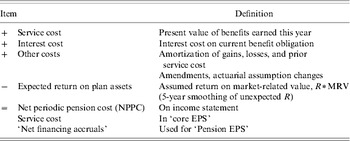
The measure of pension expense reflected in the income statement under the FAS 87 guidelines, net periodic pension cost (NPPC), is calculated as the annual accrued costs of the pension plan minus the expected return on plan assets. As shown in Table 1, two key cost components of the NPPC are service cost and interest cost. Other costs include amortization of previous gains and losses, amortization of prior service cost, and finally some ad hoc items such as charges for plan amendments and changes in actuarial assumptions. The service cost is equal to the present value of the pension benefits earned by employees during the year, in essence, the current flow of deferred compensation expense. The interest cost is calculated as the beginning-of-year value of pension obligations multiplied by the plan's assumed discount rate; this represents the cost of financing the outstanding pension obligation, that is, the increase in the benefit obligation resulting from the passage of time. Under FAS 87 guidelines, the assumed discount rate must reflect the rate at which current liabilities could be settled. As a matter of practice, firms often use Moody's AA rate.
Accounting costs for DB pension plans

Source: Adapted from Coronado and Sharpe (Reference Coronado and Steven2003).
The offset to plan costs in the NPPC is the expected return on plan assets, which is calculated as the product of two items: (i) the plan's assumed long-run rate of return, and (ii) the accounting value, or ‘market-related value’, of the plan's assets. The market-related value can be either the fair market value of assets, or a systematically smoothed accounting value whereby unexpected returns are amortized over a period not exceeding 5 years. Thus, for firms that choose the maximum amortization period – a majority of firms according to Zion and Carcache (Reference Zion and Bill2002) – the market-related value would be similar to a 5-year moving average of the true market value. Thus, the expected return component of the NPPC in many cases will reflect the actual market value of pension assets only after a substantial lag.Footnote 5
The key assumption for calculating the expected returns component is the assumed long-run rate of return on plan assets, which is generally different from the discount rate used to calculate the present value of liabilities and the current year's interest cost. In choosing the long-run return assumption, FAS 87 guidelines require the firm to consider the return currently being earned on plan assets and rates of return expected in the future. Thus, for accounting purposes, the firm is explicitly directed to use an expected rate of return without regard to the riskiness of the underlying portfolio.Footnote 6
Gold (Reference Gold2005) argued that FAS 87 formalizes a systemic financial bias in pension accounting favoring equity investments. This is because the volatility of actual returns on pension plan assets does not show through on the sponsor's financial statements, while the assumed expected return on the plan's portfolio is not adjusted for risk. In choosing the plan's expected long-run rate of return on pension assets, firms anticipate or assume an equity premium. At the same time, because of the smoothing built into net pension cost from using expected returns with amortization, little of the volatility that gives rise to the equity premium shows up on the sponsoring firm's financial statements. Rather, the underlying income volatility (as well as the effective boost to leverage) is revealed only through the disclosure of marked-to-market values for pension assets and obligations in the footnotes to the annual reports.
As a result of this smoothing, it seems plausible that the consolidated balance sheet model – or the transparent model – of pension valuation assumed in many analyses may not be operative. Instead, investors might utilize valuation techniques that rely on earnings and forecasts of earnings, which embed the stream of pension expenses reported on the income statement, while ignoring the marked-to-market value of NPAs reported in the footnotes. Because the information presented on the income statement contains a downward-biased measure of risk-adjusted pension expense, the opaque model – which assumes investors use information on the financial statements but not in the footnotes – implies that the market will overprice firms that sponsor DB pension plans.Footnote 7
To test the transparent model of valuation we divide the net pension expense (NPPC) into two components, labeled service cost and financing accruals, shown at the bottom of Table 1. Service cost is the component that measures deferred compensation accrued over the year, which we consider to be a ‘core’ labor expense of the business. The second piece, financing accruals, contains everything else; however, aside from amortizations of previous plan amendments (which recognizes changes in plan benefits over the term of employees' years of service), this second component represents accruals related to the pension asset/liability management business, unrelated to the sponsoring firm's core business. In general, current earnings or costs due to this non-operating component of total earnings should not afford the same “value multiple” as the firm's core operating earnings.
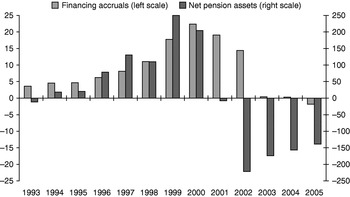
Figure 1 shows the annual flow of the financing accruals component, summed over our sample US firms with DB plans (left scale), alongside the marked-to-market value of DB plan net assets for these firms (right scale). Again, the accrual flows are embedded in the income statements while the net assets are merely disclosed in the footnotes. Beginning around 2001, the two measures give rather contradictory signals about the impact of the DB plan on the value of the sponsors' equity. When the stock market tumbled beginning in 2000, what had been a large aggregate asset became a net liability that persisted through 2005. By contrast, net pension accruals remained a sizable positive through 2002, only turning slightly negative in 2005. If investors were capitalizing, either implicitly or explicitly, the financing accruals in the income statement, rather than explicitly using the value of NPAs reported in the footnotes, market equity values would not reflect the fair market value of the firm's DB plan.
Pension net asset value vs. financing accruals

In previous work, Coronado and Sharpe (Reference Coronado and Steven2003) have explored whether investors valued sponsors' DB pension exposures based on the fair market value of pension assets and obligations disclosed in footnotes or based upon pension financing accruals in their accounting earnings. That analysis focused on S&P 500 firms over the years 1993–2001. They found that, although accounting expenses (or earnings) associated with pension plans could be a misleading measure of the underlying value of net pension obligations, the market seemed to focus on and price these accruals rather than the pension balance sheet information revealed in the footnotes. Moreover, the valuation that the market placed on the pension-related accruals was indistinguishable from that placed on sponsors' core earnings. This implied that the stock prices of S&P 500 companies providing DB pension plans were generally misvalued over that period.
More recently, other authors have asked how pension accounting or pension shortfalls influence corporate valuation. For instance, Picconi (Reference Picconi2006) examines how firms use pension assumptions to manipulate earnings and concludes that greater accounting clarity would help investors in the valuation process.Footnote 8 Hann et al. (Reference Hann, Frank and Subramanyam2007) find that the opaque approach to pension accounting embodied in FAS 87 is less value-relevant for bond investors than the transparent approach. Franzoni and Marin (2006a) find that the stocks of firms with substantially underfunded pension plans earn negative abnormal returns over the next few years, suggesting that equity investors have historically overvalued firms with underfunded pension plans. On the other hand, Jin et al. (Reference Jin, Robert and Zvi2006) report that DB pension underfunding appears to be appropriately reflected in stock return volatility. In sum, controversy remains as to whether investors are fully aware of DB pension underfunding problems, and whether further transparency would benefit investors.Footnote 9 In the next section, we evaluate these questions directly.
3 Recent and prospective accounting reform
Responding to the perception that DB plan pension accounting has been seriously deficient, the FASB is now reconsidering pension accounting standards as part of a broader effort to adopt more transparent, marked-to-market accounting standards across the board. To this end, in 2006, the FASB recommended that the pension accounting project proceed in two phases. Phase One resulted in Statement 158 and eliminated all smoothing of actuarial gains and losses in the funding position beginning with fiscal years ending after December 15, 2006. Expense calculations were not revised, and so reconciling entries were added to the ‘other comprehensive income’ section of shareholder's equity. Phase Two, expected to take several years, will completely re-evaluate pension accounting including the expense calculations reported in the income statement. Given the FASB's goal of harmonizing US with international accounting standards, it is likely that FASB will aim to produce an accounting standard similar to the one used by the UK and continental Europe, where the only effect of the pension fund on the income statement results from the inclusion of service cost. Any other changes to the value of assets and liabilities that occur from market changes must be reflected on a marked-to-market basis on the balance sheet.
These two phases of the FASB's accounting reform will eventually result in the migration of key information from the footnotes to the balance sheet. They might also cause the removal of pension-related accruals from the main body of the income statement. Previous studies would suggest that this change in accounting will influence how the market values stocks of firms sponsoring DB pensions. Alternatively, the intense focus on pension accounting since 2000 and the widespread practice of plan underfunding may have already focused investors' attention on the issue sufficiently. In this case, investors may have been valuing pensions more accurately for some time and the new reporting standards will have little effect. Next we turn to an empirical analysis that should determine which of these outcomes is more likely.
4 Empirical analysis: have financial markets caught on?
To evaluate these alternative views, we employ the empirical valuation framework advanced by Feltham and Ohlson (Reference Feltham and Ohlson1995), which is a parsimonious application of the residual income model. In the model, firm equity value (P) is expressed as the sum of the value emanating from the firm's nonfinancial operating activities plus the value of unrelated financial activities. Our application of this model divides both the balance sheet and the income statement of the firm into two components: one measures the results from the firm's core business operations, while the other measures the results from pension plan asset/liability management.
In particular, we measure core book equity value (BVC) as total book equity value minus the book value of NPAs, where the latter is defined in Compustat as prepaid pension cost (or minus accrued pension costs). We define earnings from core operations (Core EPS) as total expected earnings minus pension earnings (EPS−Pension EPS), where pension EPS represents net financing accruals defined in Table 1 (NPPC minus service cost). Thus, the accrual of new pension obligations from current labor services (the service cost) is the only piece of pension cost treated as a core expense. On the other hand, from the footnotes to the balance sheet, we measure the value of NPAs as the reported market value of pension assets minus the projected benefit obligation (PBO). Using this notation, we thus propose the following regression model for gauging contributions to firm equity value:

The transparent valuation model implies 0.65<b 3<1 and b 4=0; that is, investors value the firm as a linear function of its core book equity value and core earnings, plus the value of the outstanding NPA (or liability) as revealed in the footnotes.Footnote 10 A coefficient of 0.65 on NPA would imply that pension assets are valued on an after-tax basis, assuming the firm faces a marginal effective tax rate of 0.35. The polar alternative, the opaque view of pension valuation, holds that investors instead value the stream of pension financing accruals reported in the income statement, that is, b 3=0 and b 4>0.
The two principal data sources for our analysis are Compustat, for historical financial statement data including items related to company DB pension plans, and I/B/E/S International, for stock prices and analyst earnings forecasts.Footnote 11 We focus on firms included in the S&P 500 over the period 1993–2005, relatively mature firms which are expected to earn positive earnings in non-recessionary times. This yields a total of 7,290 firm-year observations; about two-thirds of these have DB plans. We begin our analysis in 1993 because many pension variables are unavailable in Compustat prior to that time. The 1993–2005 is also particularly interesting period as it covers the boom, bust, and subsequent recovery of the equity market.
In implementing tests of the model, we introduce some modifications. First, to remove time trends in the variables and the associated heteroskedasticity, all variables in (1) are normalized by assets (per share). We also include broad industry dummies to control for industry-related differences in valuation and growth prospects; moreover, these are interacted with year dummies to allow for time-variation in industry valuation effects. To control for other unidentified differences between firms with small DB pension exposures and those with none, we also include a dummy variable (DB) indicating whether the firm has a DB pension plan. We include non-DB firms in the sample to help identify the non-pension related coefficients, most notably, the numerous industry-year dummies; nonetheless, as a check for robustness, we estimate some regressions with non-DB firms excluded.
We also add a control for expectations of longer-term growth prospects, which we measure by the consensus (median) ‘long-term’ growth forecast from I/B/E/S. Controlling separately for longer-term growth expectations allows for more complicated dynamics than those assumed in the Feltham–Ohlson model. This could be important if long-term growth is not tightly connected to expected earnings persistence over the next few years. If we control separately for long-term growth, the coefficient on the earnings level ought to convey perceived earnings persistence, and its implication for valuation, over the current cycle. Arguably, a more complete specification might also add an interaction term between the level of expected earnings and the expected long-term growth rate. Such a specification (with two interaction terms, one for each component of earnings) complicates our hypothesis test; thus, interaction terms are only included in the analysis of robustness.
Finally, we include a control for firm size, measured by the log of total assets. Firm size is likely to affect firm valuation if, for instance, size is correlated with risk, as suggested by studies of cross-sectional returns, where size is interpreted as a risk factor. In this case, we would expect firm size to have a positive effect on equity values, holding all else equal.
4.1 Results
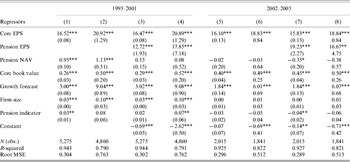
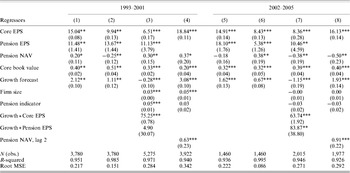
Estimation results appear in Table 2, with Columns (1)–(4) covering what we call the 1993–2001 ‘pre-conscious’ period, and Columns (5)–(8) showing the analogous estimates for the more recent period, 2002–2005. Again, we hypothesize that, due to the dramatic swing from over- to under-funding of DB plans from 2000 to 2002 and the consequent public attention on accounting distortions, investors ought to have paid closer attention to the net value of DB pension plans assets during the later period. For the base specifications, regressions are estimated using two alternative methods. The first estimates (in the odd-numbered columns) are generated using Hamilton's (Reference Hamilton1991) ‘robust regression’ algorithm, which mutes the influence of outliers and is run on the entire subsample.Footnote 12 The second alternative (in even-number columns) is estimated with OLS, but on a trimmed subsample, which excludes observations where variables have extreme values (the 1st or 99th percentiles). In the latter case, we estimate heteroskedasticity-consistent standard errors, while clustering by firm and year.Footnote 13
Regressions of stock market value on operating earnings and book value, measures of pension value and controls

Notes: Dependent variable is market equity value divided by total assets (book value). Regressors are also normalized by total assets, except for Growth Forecast and Pension Indicator. All specifications include broad industry dummies interacted with time dummies. Odd-numbered specifications are estimated using ‘robust regression’ in Stata, while the even-numbered are estimated via OLS with heteroskedasticity-consistent standard errors, clustered by firm and year. Standard errors appear below coefficient estimates, and ***, ** and * denote the statistical significance at 1, 5 and 10% levels, respectively.
We begin by testing the transparent view of pension valuation against the simple alternative that the firm's equity value fails to accurately reflect the value of NPAs. As argued above, under the transparent view, the market value of the firm will fully reflect the value of NPAs (or net liabilities) reported in the footnotes to the 10-K; for instance, the coefficient on Pension NAV in equation (1) should be between 0.65 and 1. Column (1) controls for the value of core operations, reflected in core book value and expected core earnings (Core EPS); but it excludes Pension EPS, the component of expected earnings associated with pension financing accruals. For the earlier time period, the coefficient estimated on Pension NAV is 0.95, which is positive at high levels of significance and not significantly different from unity, suggesting that the market did accurately price corporate pension assets and liabilities.
At the same time, the coefficient on core earnings suggests that an additional dollar of expected current-year earnings from a firm's core business boosted firm value by $16. This comparative static holds long-term earnings growth constant, and it is interpreted as the effect on the average firm. The size of this coefficient also seems quite plausible, given that the price-earnings ratio for the S&P 500 averaged close to 20 during the 1990s. As we would expect, the coefficient on the analyst long-term growth forecast also has a positive and significant effect on firm value: a coefficient of 3 implies that a 10 percentage point increase in expected long-term growth added 3 percentage points to the ratio of market equity value to book asset value.
The remaining coefficient estimates are also qualitatively consistent with theoretical predictions. Core book value had a positive marginal effect (0.26) on market equity value. Also, firm size has a significantly positive effect on valuation, consistent with the presumption that required returns are lower for larger firms. Finally, the coefficient on the pension indicator indicates that, all else equal, firms with DB plans had slightly higher market values on average (relative to assets), perhaps because the presence of a DB plan was correlated with omitted firm characteristics such as firm age.
The second column shows the OLS version of the same specification, with about 10% of the observations omitted. Qualitatively, the results are similar, though the estimated coefficients are all larger and some substantially larger than under the robust estimation procedure.Footnote 14 Most importantly, we estimate a coefficient of 1.13 on Pension NAV; although larger than in the first column, it is again not significantly different from unity, as predicted by theory. The coefficient on Core EPS in this case is 20.9, noticeably higher than before but not beyond credulity.
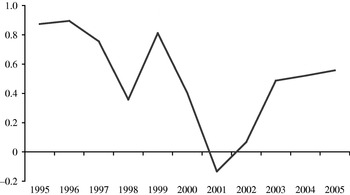
A more demanding test of the transparent view involves putting this hypothesis up against a specific alternative, the opaque view, which presumes that the market instead values the pension financing accruals (expected return and interest cost) booked in accordance with FAS 87. In this test, we include Pension EPS as an additional regressor. One concern in running this test is that Pension EPS and Pension NAV might be highly correlated. Figure 1 demonstrates the disconnect between these two measures in the aggregate time series. Figure 2 graphs the cross-sectional correlation of the two measures by year. Clearly the two are not always closely related, so the test should be econometrically sound. The early period estimates of this specification are shown in Columns (3) and (4), where the transparent view is now strongly rejected in both the robust and the OLS specification: the coefficient on Pension NAV drops to 0.15 (or 0.08), while the coefficient on Pension EPS is 12.72 (or 17.85), which is highly significant. Moreover, in each specification, we cannot reject the restriction that the market values pension accruals no differently than core earnings.Footnote 15
Cross-Sectional Correlation of Pension EPS with NAV

The central question of this paper concerns whether investors correctly focused on the disclosed value of pension assets and liabilities after the huge stock market and interest rate swings around the turn of the decade, when market strategists and regulators focused attention on the shortcomings of pension accounting standards. The answer is given by Columns (5) through (8), which show estimates of the same models on the 2002–2005 period. Perhaps surprisingly, now we reject the transparent view even with the less stringent test against the general alternative. The coefficient on Pension NAV in (5) is slightly negative and insignificant. In the more stringent test, this coefficient even becomes more negative though not statistically significant, while the coefficient on Pension EPS is 19.23 (or 16.67), in either case very close to the coefficient on Core EPS.Footnote 16 The other coefficients are mostly similar to those for the early period, though the Pension Indicator coefficient reverses sign.
4.2 Robustness analysis
To test the robustness of these results, we consider a number of alternative specifications, shown in Table 3. Again, specifications (1)–(4) are estimated on the earlier sample, while (5)–(8) show the analogous results for the later years. In all cases, regressions are estimated using robust regression as the results are less sensitive to trimming of outlier observations. In Columns (1) and (5), the main specification ((3) and (7) in Table 2) is re-estimated on sample restricted to the firms having a DB pension plan. The results are qualitatively similar to the analogous Table 2 regressions.
Regressions of stock market value on firm characteristics, robustness analysis

Notes: Dependent variable is market equity value divided by total assets (at book value). Regressors are also normalized by total assets, except for Growth Forecast and Pension Indicator. All specifications are estimated using ‘robust regression’ in Stata. Specifications 1, 2, 5 and 6 are estimated only on sample firms with DB pension plans. Specifications in Columns 2 and 6 include firm dummies (fixed effects) and time dummies; all others include broad industry dummies interacted with time dummies. Pension NAV lag2 is the two-year lag of Pension NAV. Standard errors appear below coefficient estimates, and ***, ** and * denote statistical significance at 1, 5, and 10% levels, respectively.
Specifications (2) and (6) are also estimated on the subsample of DB plan sponsors, but with the addition of firm dummies (fixed effects). Here, the estimates reflect only the within-firm valuation differences across time. The advantage of such an approach is that it removes potential omitted variable biases; the disadvantage is that it requires our measures of expected earnings and pension value to be timely measures of the variables the market is focusing on at the time the stock price is measured.Footnote 17 As shown in Column (2), the results are basically unchanged for the early period, though the coefficient on core earnings is quite a bit lower than before. For the later period, reported in Column (6), it appears that firm value is influenced somewhat by changes over time in a firm's pension net asset value, which provides the first evidence in favor of the transparent hypothesis. Even so, this is only a partial victory, since the coefficient on Pension NAV is smaller than theory would predict; moreover, given that the coefficient on Pension EPS is also significant, it appears that investors are also putting weight on the pension financing accruals. In any case, this regression suggests that the market appears to respond some to the changes in the net pension position reported in the footnotes, even if the accounting for DB pensions substantially distorts relative valuations across firms.
The regressions reported in Columns (3) and (7) consider a more complicated specification, which adds an interaction term between the long-term growth forecast and the two pieces of expected current-year earnings. In the early sample, we find a somewhat difficult-to-interpret result. On one hand, Pension NAV has a significant marginal valuation effect, though it is also significantly lower than theory would imply. Another ambiguity is that it is difficult to gauge the relative valuations placed on Core EPS and Pension EPS.Footnote 18 In any case, the results for the late sample are unambiguous. Here, the coefficient on Pension NAV is negative, while both the straight Pension EPS coefficient and its interaction are similar to the respective Core EPS coefficients, indicating that investors did not differentiate between the two earnings components.
Our final test, shown in Columns (4) and (8), provides some ancillary support for our interpretation. We have argued that Pension EPS is a poor measure of the plan sponsor's true pension position (and cost) because smoothing delays the impact of recent plan performance on expense/earnings; in effect, Pension EPS reflects a three-to-five-year moving average of the plan's condition. If so, then lagged values of Pension NAV might have incremental explanatory power for sponsors' current stock price; that is, the market prices stale information. We test this taking our initial specification in Table 2, where Pension EPS is excluded (Columns 1 and 5) and add the twice-lagged Pension NAV, a stale measure of net pension value. Consistent with our conjecture, the second lag comes in significantly. This is particularly notable in the later period, where the twice-lagged measure has a coefficient of 0.91, and the current value of Pension NAV has a negative coefficient.
5 Implied valuation errors
We conclude that market participants are not pricing the fair market value of pension assets and liabilities but instead appear to value pension earnings no differently than operating earnings. As a result, some firms with DB plans could be substantially misvalued. To assess the possible magnitudes of resulting valuation errors, we use a simple PE ratio model of valuation together with the assumption that Pension EPS is priced the same as Core EPS. Accordingly, we first estimate the value placed on each firm's earnings in each year by estimating a model of the PE multiple, which includes time and broad industry dummies, firm size, and two key ‘fundamental’ determinants of PEs, the dividend payout rate and expected earnings growth. Regression results, together with standard errors (in parentheses), are:

where EPS is (total) expected current-year earnings per share, div represents the current dividend payout rate, growth refers to the analysts' consensus long-term growth forecast, and assets is the total book value of firm assets, a proxy for firm size.
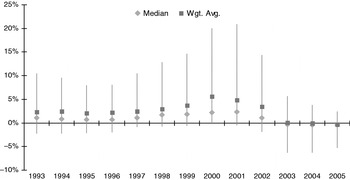
Given our finding that investors do not distinguish between operating and pension earnings, one can estimate the market's implicit value of the pension plan by multiplying the firm's Price-Earnings multiple by the Pension EPS. The resulting figure is an estimate of the incremental value to the firm's equity attributable to the market's valuation of pension accruals. To construct estimates of the valuation errors (on the stocks of pension plan sponsors), we subtract the pension net asset value reported in the footnotes (the fair market value of pension assets minus the PBO). Figure 3 shows the resulting distribution of firm valuation errors as a per cent of firm market capitalization from 1993 to 2005. Each vertical line represents the 10th to 90th percentile range for each year, and the diamonds indicate the median valuation error. Also shown are the weighted average valuation errors for each year, a measure of the aggregate impact on the market capitalization of S&P 500 firms with DB plans.
Valuation errors: annual distribution (as % of firm market capitalization)

The results clearly indicate the impact of investors failing to distinguish between pension accruals and NPAs. The rise in the top end of the distribution by 2000 and 2001 illustrates the extent to which investors were overvaluing certain firms that continued to show large positive pension accruals during this period, even as their pension net asset values fell due to the market decline. In fact, during this period, model estimates suggest that some firms were as much as 20% overvalued, even though the aggregate effect for our sample was a 5% valuation error. Since 2002, firm valuation errors have fallen and become more evenly distributed around zero. Indeed, in the last couple of years, some firms were apparently undervalued because their pension accruals were highly negative from the lagged effects of the earlier market decline despite the rebound in the reported value of NPAs.
6 Discussion and conclusions
There has long been an important disconnect between the financial impact of a firm's DB pension plan implied by accounting accruals, and the information disclosed in the financial footnotes. Despite much attention from the accounting profession and Wall Street, our results suggest that investors still do not correctly perceive how DB pension plans influence corporate valuation in the US marketplace. As a result, over the past decade, pension accruals embedded in the financial statements have been particularly poor stand-ins for pension value. Indeed, pension accruals are potentially worse than noise, as there are times when they have been negatively correlated with the value of pension assets.
While the valuation errors we estimate are not large in the aggregate, they can be fairly sizable for individual companies. Since the disconnect between net asset values and pension accruals ought to error-correct over time, our results suggest that investors who do understand the oddities of pension accounting ought to be able craft a strategy to earn abnormal returns. Indeed, Franzoni and Marin (Reference Franzoni and Jose2006a, Reference Franzoni and Joseb) find that, over roughly the same period as the one we study, investors would have earned excess returns over 3–5 year holding periods by shorting firms after they report large pension deficits in their footnotes.
These results thus suggest that the second phase of FASB's reform efforts may have important consequences for the market values of firms sponsoring DB pensions, despite the fact that it mainly rearranges information that is already available in the footnotes. The longer-term consequences for asset allocation are less clear. Much of the financial literature has concluded that the optimal asset allocation for pension funds is almost exclusively to bonds, which sponsors can use to exactly match their liability cash flows. However this presumes that the sponsor is the residual risk-holder of the pension fund and therefore the plan's asset allocation should reflect the firm's risk-neutral preferences. But the volatile pension accruals – including pension freezes – that have accompanied recent swings in pension fund finances imply that some risk-sharing is occurring between employees and employers. For this reason, as Bulow et al. (Reference Bulow, Robert, Lawrence, Bodie, Shoven and Wise1987) first noted, the risk preferences expressed in asset allocation may be a blend of the two, in which case the pension plan's optimal asset allocation is less clear.
There is some evidence that pension funds of late have been reallocating their portfolios to fixed income; for instance, fixed income allocation rose to 33% for S&P 500 sponsors in 2007 up from 29% in 2004, and liability-hedging activity through interest rate swap contracts has also risen (Ehrhardt and Morgan, Reference Ehrhardt and Paul2008). Simultaneously, DB plans have moved away from equity, to 55% from over 60% only a few years before. At the same time, however, pension plans have also been reallocating funds towards other asset classes including commodities, infrastructure, hedge funds, and real estate, motivated in part by a desire to find less correlated asset classes. Although pension sponsors appear to be more interested than before in matching cash flows and managing liability risk, they are still taking risk in their portfolios for the sake of higher potential returns.
We do not believe our results have much to do with the long-term trend away from DB plans toward DC plans observed in the US marketplace over the last several decades. That trend has been attributed to increased regulation, longer life expectancies and the inability to adjust benefits accordingly in the DB framework, technological changes that diminish the returns to long worker tenure, and a rise in worker mobility (Aaronson and Coronado, Reference Aaronson and Julia2005). Ultimately, however, our results do suggest that the FASB's reform efforts may substantially help investors to better value firms that do have DB pensions.
Data Appendix
The dataset used for this analysis includes all firms included in the S&P 500 over the period 1993–2005; that is, we included all years for any firms in the index at any point over that time span. The resulting sample includes 7,290 firm-years, or an average of 561 data points per year. Companies with DB plans comprise 71% of the sample; firms without DB pension plans are 29% of our sample (nonDB companies are flagged with an indicator (0,1) variable). Wharton Research Data Service (WRDS) made available to us the two data sources necessary, namely, Compustat for historical financial data, and I/B/E/S International for analyst forecasts and stock price data.
Variables from Compustat included firm financial data from 1993 to 2005, including book equity values, total assets, pretax income, and several variables related to the financial position of DB pension plans. Compustat data were then merged with earnings forecasts and pricing data from I/B/E/S using firm CUSIP numbers. Variables taken from I/B/E/S included annual observations of share price, shares outstanding, dividends per share, consensus (mean) forecasts of earning per share for both the current and subsequent fiscal years, and the median analyst forecast for long-term growth. The timing of the data match is chosen such that the date of pricing and forecast data follows the date of the financials reported in each firm's 10-K. This is intended to ensure that market and analyst forecasts incorporate reported financial data as of the measurement date. To do so, our sample is broken into two halves: firms with fiscal years ending in October through March are matched with price and forecast data from May of the subsequent year; and firms with fiscal years ending April through September are matched with price and forecast data from November of the same year.