INTRODUCTION
Sardine Sardinops sagax is a small epipelagic Clupeid found off southwestern Africa from southern Angola (approximately 15°S) to northern KwaZulu-Natal (approximately 28°S) on the South African east coast (Beckley and van der Lingen, Reference Beckley and van der Lingen1999). The habitat of this species encompasses coastal and shelf waters in the cold Benguela Current upwelling ecosystem situated off the west and southwest coast between the Angola-Benguela Front and Cape Agulhas, and in the Agulhas Bank ecosystem off the South African coast east of Cape Agulhas. The Benguela is divided into northern and southern sub-systems by a perennial and intense upwelling cell situated off Lüderitz in southern Namibia (Hutchings et al. Reference Hutchings, van der Lingen, Shannon, Crawford, Verheye, Bartholomae, van der Plas, Louw, Kreiner, Ostrowski, Fidel, Barlow, Lamont, Coetzee, Shillington, Veitch, Currie and Monteiro2009) which, because of strong winds, high offshore advection, low water temperatures and strong turbulent mixing there, acts as an environmental barrier to epipelagic fish (Lett et al. Reference Lett, Veitch, van der Lingen and Hutchings2007) and separates sardine in this ecosystem into northern and southern populations. These populations have different dynamics (Roux et al. Reference Roux, van der Lingen, Gibbons, Moroff, Shannon, Smith and Cury2013), spawn in widely separated areas (Boyer and Hampton, Reference Boyer and Hampton2001), display different biological characteristics (Kreiner et al. Reference Kreiner, van der Lingen and Fréon2001) and show minimal mixing as indicated by tagging studies conducted in the late 1950s and early 1960s (Newman, Reference Newman1970). In both the Benguela and Agulhas systems sardine are important and frequently dominant prey of several species and hence play a critical role in pelagic food webs.
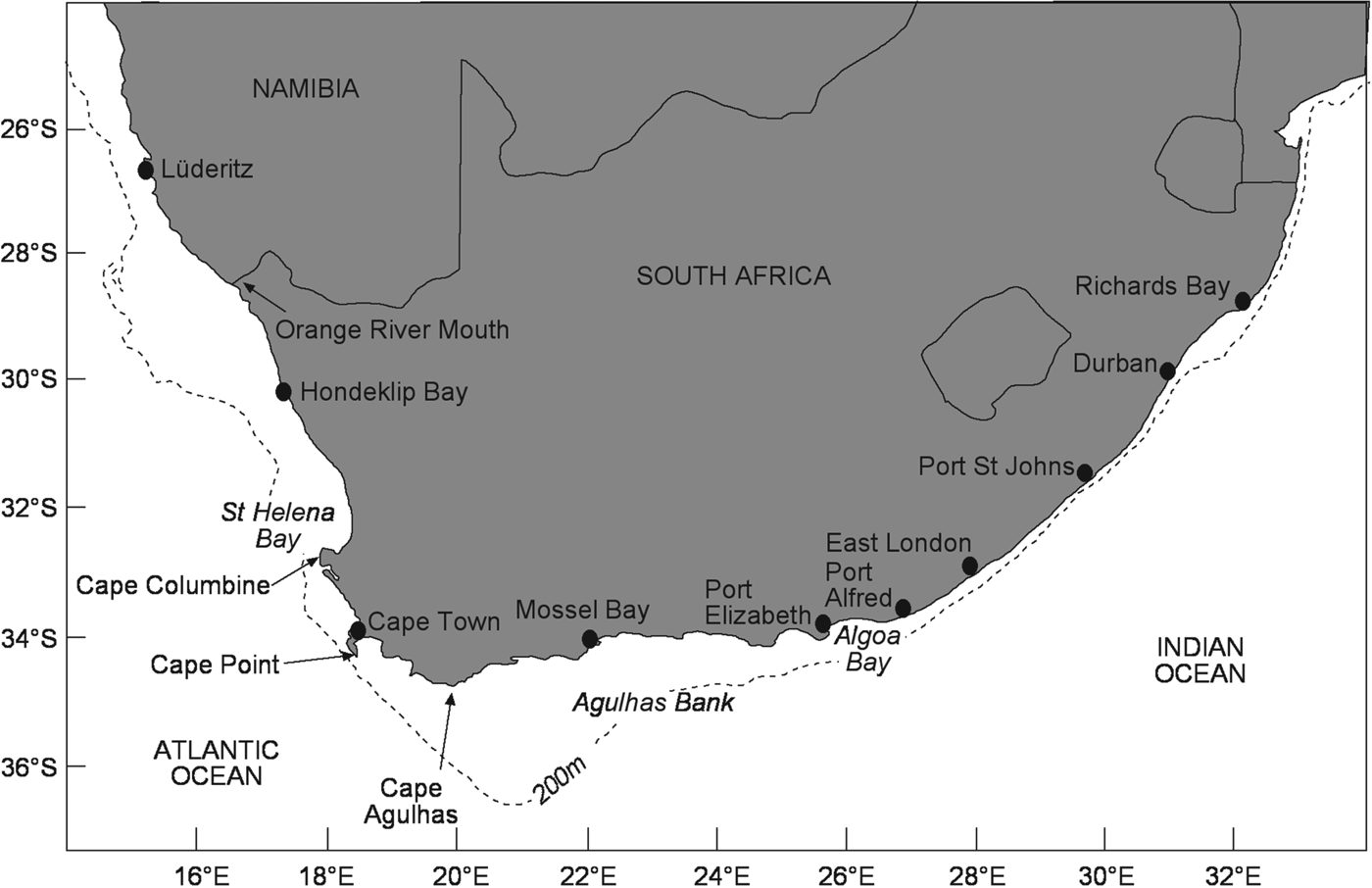
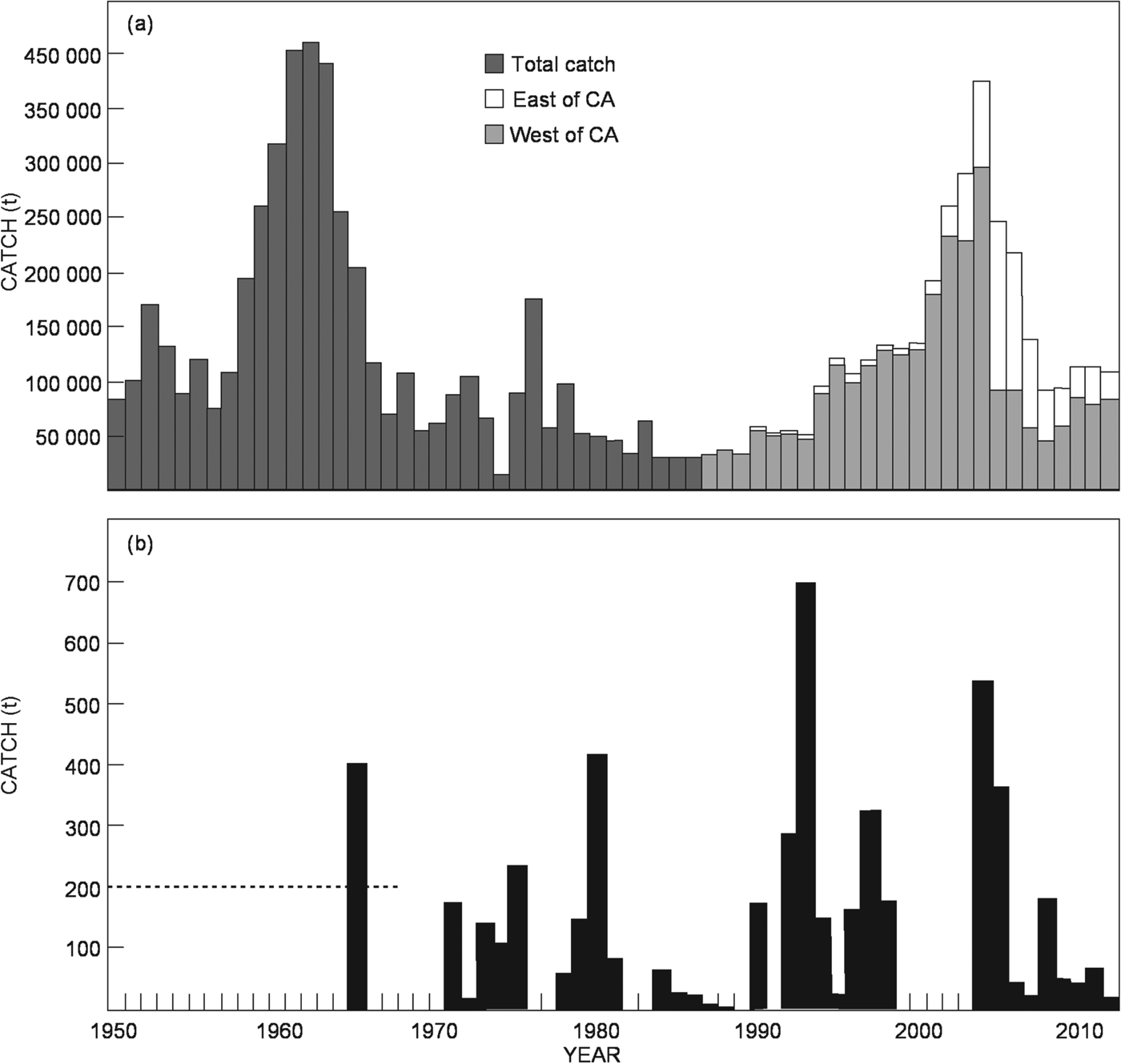
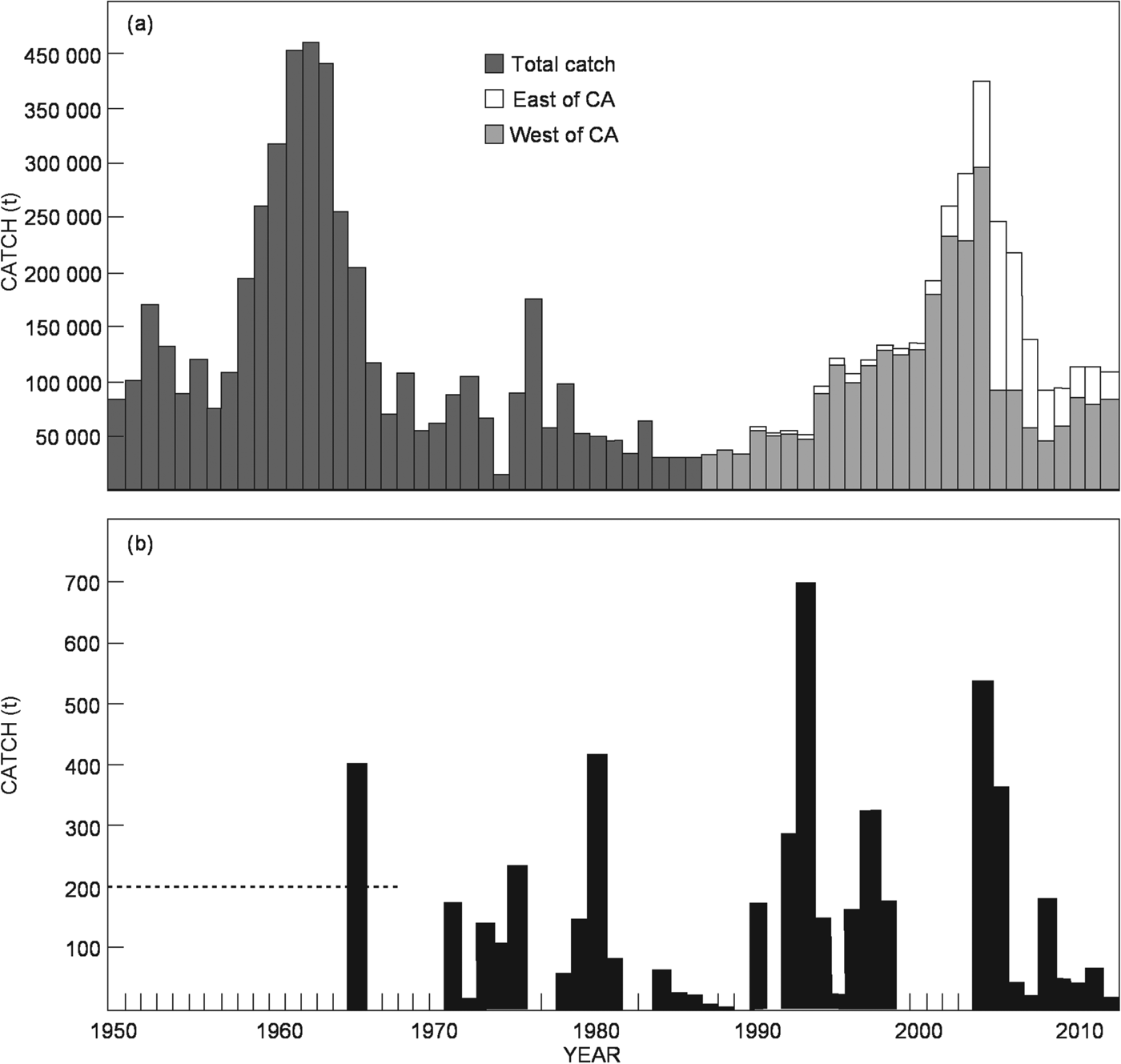
Sardine is commercially important in the Benguela and supports fisheries off both Namibia and South Africa, and because the two populations are considered to be separate they are managed separately (Boyer and Hampton, Reference Boyer and Hampton2001). Off South Africa, adult sardine are the major target of the small pelagic fishery, the country's largest and second-most valuable, and are caught by purse-seiners off the west coast between St Helena Bay and Cape Agulhas, and off the south coast around Mossel Bay and Port Elizabeth (Fig. 1). The fish are canned or frozen for human consumption, pet food or bait. The South African small pelagic fishery has been established since the late 1940s and sardine has been caught continuously since then with two periods of peak catches, the first during the early-to-mid 1960s and the second during the early 2000s (Fig. 2a). Annual catches (adults and juveniles combined) have ranged from 16 000 to 410 000 tonnes and have averaged 130 000 tonnes over the period 1950–2012. Sardine are also the target of a small seasonal fishery off the South African east coast (predominantly around and southwards of Durban; Fig. 1) where they are caught using beach-seine nets during the KwaZulu-Natal sardine run (van der Lingen et al. Reference van der Lingen, Coetzee and Hutchings2010a ). The sardine run is an annual, northeasterly migration of fish from the Agulhas Bank to the east coast that occurs almost every austral winter and is accompanied by an abundant suite of predators including piscivorous fish and sharks, marine mammals and seabirds. Maximum recorded catches of the beach-seine fishery have not exceeded 700 tonnes over the past six decades (Fig. 2b), <1% of average annual catches taken off the west and south coasts. However the sardine run is substantially more valuable from an eco-tourism than a fishery perspective, with an industry focused on diving with sardine and associated predators during the sardine run developing in recent years that has become a major tourist attraction with economic benefits that substantially exceed that of the fishery (van der Lingen et al. Reference van der Lingen, Coetzee and Hutchings2010a ).
Map of the southern African coastline showing places mentioned in the text and the 200 m depth contour (dashed line). The South African west coast extends westwards from Cape Agulhas to the Orange River mouth; the south coast extends from Cape Agulhas to Port Alfred; and the east coast extends from Port Alfred to the South African/Mozambique border. The Agulhas Bank is the continental shelf between Cape Point and Port Alfred, and is divided into western (Cape Point to Cape Agulhas), central (Cape Agulhas to Mossel Bay) and eastern (Mossel Bay to Port Alfred) sections.

Catch time series of sardine for (a) the South African purse-seine fishery (adult and juvenile sardine combined) from 1950–2012 with catches taken to the west and east of Cape Agulhas indicated from 1987 onwards (updated from Coetzee et al. Reference Coetzee, van der Lingen, Hutchings and Fairweather2008); and (b) the beach-seine fishery off the east coast during the winter sardine run from 1950–2012 (note that data are not available for 1970 and 1999–2002 and that the maximum catch level from 1950 to 1969 but excluding 1965 is shown as a dashed line; updated from van der Lingen et al. Reference van der Lingen, Coetzee and Hutchings2010a ).
Management strategies for the two fisheries for sardine off South Africa differ markedly as a consequence of their respective size and economic importance. The purse-seine fishery is managed via an operational management procedure (OMP; de Oliveira and Butterworth, Reference de Oliveira and Butterworth2004) that specifies input data and governs subsequent calculations to set an annual sardine total allowable catch (TAC). In contrast, present management of the beach-seine fishery on the east coast is through effort limitation, with 25 current right-holders of which only 3–7 have been active in recent years (van der Lingen and Lamberth, Reference van der Lingen and Lamberth2013). Management of the purse-seine fishery has assumed that sardine off the South African west and south coasts comprise a single population, but consideration has recently been given to the hypothesis that western and southern sardine sub-populations, or stocks, may exist (de Moor and Butterworth, Reference de Moor and Butterworth2009). This hypothesis was initially based on observations from research surveys of a consistent break, situated between Cape Agulhas and Mossel Bay, in the distribution of sardine at low and medium biomass levels, with sardine distribution becoming continuous around the coast from Cape Columbine to Port Alfred only observed at high biomass levels (Coetzee et al. Reference Coetzee, van der Lingen, Hutchings and Fairweather2008). The distribution of sardine eggs collected during those research surveys also shows two discrete spawning areas that are separated by the Central Agulhas Bank (Fig. 3) which further suggests separate spawning units, one on either side of Cape Agulhas. An individual-based model (IBM) coupled with a 3-D hydrodynamic model of the region used to explore to how spatial variability in sardine spawning affected the transport or retention of eggs and larvae concluded that sardine reproductive strategies could be divided, at Cape Agulhas, into two main (west coast and south coast) systems (Miller et al. Reference Miller, Moloney, van der Lingen, Lett, Mullon and Field2006). Sardine also spawn off the east coast during the KwaZulu-Natal sardine run (Connell, Reference Connell2010) and hence show a third reproductive strategy off South Africa, and the sardine run is considered to most likely correspond to a ‘seasonal reproductive migration of a genetically distinct sub-population’ (Fréon et al. Reference Fréon, Coetzee, van der Lingen, Connell, O'Donoghue, Roberts, Demarcq, Attwood, Lamberth and Hutchings2010).
Composite sardine egg density (eggs per square metre; circles with diameter proportional to abundance and the maximum size =4232 eggs m−2) map derived from CalVET net samples collected during annual research surveys conducted in austral spring (late October to early December) from 1986–2009 and showing the separation in egg density over the Central Agulhas Bank between Cape Agulhas and Mossel Bay (from van der Lingen, Reference van der Lingen2011).

Given these observations of separated distributions and discrete spawning grounds, a multidisciplinary approach (as recommended by Begg and Waldman, Reference Begg and Waldman1999) has been applied to examine the population structure of South African sardine, comprising initially of studies of spatial variability in phenotypic characteristics but more recently including some parasitological studies. Samples of sardine from Namibia were included in some of these studies as a method test, since it was assumed that if a given technique could not distinguish between Namibian and South African sardine it would be unlikely to be useful in discriminating between putative stocks of South African sardine. These studies are described below, and the relative efficacy of parasites in addressing the question of population structure in South African sardine evaluated.
STUDIES OF SOUTH AFRICAN SARDINE POPULATION STRUCTURE
Published and unpublished information on biological characteristics of sardine from the west and south coast collected from commercial catch and research survey samples was collated by van der Lingen et al. (Reference van der Lingen, Durholtz, Fairweather and Melo2009) in order to examine whether spatial variability in these characteristics occurred and, if so, whether such provided plausible evidence for the existence of two stocks. Sardine condition factor (calculated as the ratio of observed to expected wet body mass) showed significant spatial variation, with fish from east of Cape Agulhas showing higher condition factor values than those from the west coast (van der Lingen et al. Reference van der Lingen, Fréon, Fairweather and van der Westhuizen2006). Significant spatial variability in vertebral count and body shape of sardine from the South African west and south coasts and also from Namibia has also been reported (Wessels, Reference Wessels2009). Sardine from Namibia tended to have more vertebrae than did South African fish, whilst no difference between sardine from the west and south coast was observed. Namibian sardine differed from South African in several head measurements whilst sardine from the South African west and south coast differed in head measurements and the position of the pelvic fin. Subsequent analyses of vertebral count and body shape data from sardine collected from South Africa's east coast showed that fish from this region had significantly fewer vertebrae and a different body shape compared with those from the west or south coasts (van der Lingen et al. Reference van der Lingen, Hendricks, Durholtz, Wessels and Mtengwane2010b ).
Spatial differences in South African sardine reproductive characteristics have also been observed, with average gonadosomatic index decreasing from west to east (Kreiner et al. Reference Kreiner, van der Lingen and Fréon2001) and relative gonad size (standardized gonad mass) of immature and female sardine significantly higher for fish from the west than the south coast (van der Lingen et al. Reference van der Lingen, Fréon, Fairweather and van der Westhuizen2006). A consistent difference in annual length-at-50% sexual maturity of female sardine has also been documented, with fish off the south coast maturing at a larger size than those off the west coast (van der Lingen et al. Reference van der Lingen, Durholtz, Fairweather and Melo2009). Mean size-at-age and otolith length-at-age were not significantly different for sardine from the South African west and south coasts, although in both cases there was a slight tendency for values to be higher for fish from the east of Cape Agulhas (van der Lingen et al. Reference van der Lingen, Durholtz, Fairweather and Melo2009).
Analyses of variability in branchial basket meristics (gill raker number) and morphology (gill arch length and gill raker gap) of sardine from around southern Africa have also been conducted (Idris, Reference Idris2010), with significant spatial differences seen in most of these characteristics although not always consistently across all size classes. Sardine from the South African west and south coasts showed significant differences in gill arch length and gill raker number (Idris, Reference Idris2010), and subsequent analysis of fish from the east coast showed that they also differed in terms of gill arch length and gill raker gap (Idris et al. unpublished data). These significant differences in most of the sardine phenotypic characteristics studied were taken as support for the hypothesis of multiple sardine stocks off South Africa (van der Lingen et al. Reference van der Lingen, Durholtz, Fairweather and Melo2009).
USING PARASITES IN STUDIES OF SOUTH AFRICAN SARDINE POPULATION STRUCTURE
Parasites have been used as biological tags in populations studies of marine fish, including small pelagic species, for several decades in many parts of the world's oceans (MacKenzie, Reference MacKenzie2002), and this method has recently been applied to South African sardine. Following the approach suggested by MacKenzie and Abaunza (Reference MacKenzie and Abaunza1998) for host species that are available for examination in large numbers, a preliminary survey of parasites infecting South African sardine was conducted by Reed et al. (Reference Reed, MacKenzie and van der Lingen2012) in order to assess the potential of using parasites as biological tags for stock discrimination and identify a possible biotag or biotags. Those authors examined 102 sardine ranging in size from 12 to 23 cm caudal length (CL) collected during 2010 from seven samples between Cape Columbine and Algoa Bay, and recorded seven parasite taxa, three of which were new host records. Digenean metacercariae of the ‘tetracotyle’ type that were found only in the humours of sardine eyes showed the highest prevalence of infection (46%) of all parasite taxa.
The digenean metacercariae reported by Reed et al. (Reference Reed, MacKenzie and van der Lingen2012) are typical of the Family Strigeidae, members of which have complex life cycles including a gastropod first intermediate host, a fish second intermediate host and a piscivorous bird final host in which parasite sexual maturity is achieved and reproduction occurs (Niewiadomska, Reference Niewiadomska, Gibson, Jones and Bray2002). ‘Tetracotyle’ type metacercariae have previously been reported in the eyes of S. sagax from the southeast Atlantic by Parukhin (Reference Parukhin1975), who conducted the only previous parasite survey of sardine from this region. Metacercariae of this type and of the genus Cardiocephaloides were amongst the parasites used by Timi (Reference Timi2003) in population structure studies of Argentine anchovy Engraulis anchoita in the southwest Atlantic. Adult strigeid worms identified as Cardiocephaloides physalis have been reported from African penguin Spheniscus demersus in South Africa (Randall and Bray, Reference Randall and Bray1983; Horne et al. Reference Horne, Bray and Bousfield2011), birds that feed on sardine, and Reed et al. (Reference Reed, MacKenzie and van der Lingen2012) considered the ‘tetracotyle’ type parasite observed in sardine eyes were possibly of this species.
The ‘tetracotyle’ type metacercariae in sardine showed a spatial difference in infection loads, with fish from the west coast having higher prevalence and infection intensity values than those from the south coast (Reed et al. Reference Reed, MacKenzie and van der Lingen2012; Fig. 4a). Because of this discontinuous distribution in infection, site specificity in the host and likely long lifespan, all of which are established criteria for a good parasite biotag (MacKenzie and Abaunza, Reference MacKenzie, Abaunza, Cadrin, Friedland and Waldman2005), Reed et al. (Reference Reed, MacKenzie and van der Lingen2012) considered ‘tetracotyle’ type metacercariae as having the most potential as a biological tag of those documented, and recommended the examination of further samples of sardine of different sizes and ages for population structure studies using this biological tag.
(a) Prevalence of infection (%; black circles with diameter proportional to % and a maximum value of 93%) of sardine by Cardiocephaloides sp. parasites in 102 fish from 7 localities as reported by Reed et al. (2012; redrawn using data in Reed et al. Reference Reed, MacKenzie and van der Lingen2012; black crosses show sample locations); and (b) infection prevalence (%; black circles with diameter proportional to %; black crosses show sample locations) and length frequency distributions (n; histograms) and infection prevalence (%; thick black lines) as a function of caudal length of 484 sardine from 28 localities off the West (<21°E), South (21–28°E) and East (>28°E) coasts, respectively (note that this plot includes data shown in Reed et al. (Reference Reed, MacKenzie and van der Lingen2012); from van der Lingen, Reference van der Lingen2011).

Processing of a further 382 sardine (to give a dataset comprising 484 fish including those analysed by Reed et al. Reference Reed, MacKenzie and van der Lingen2012) ranging in size from 7 to 21 cm CL collected during research surveys and from commercial (both purse-seine and beach-seine) catch samples from localities between Hondeklip Bay on the west coast and Durban on the east coast during 2010 and 2011 again showed a discontinuous distribution in infection (van der Lingen, Reference van der Lingen2011), with sardine from the west coast having substantially higher prevalence rates (Fig. 4b) and higher mean infection intensities than sardine from the south and east coasts. A comparison of prevalence as a function of fish CL for fish from the three regions showed that infection in sardine off the west coast first occurred for fish <10 cm CL and that infection prevalence increased rapidly to >50% for fish >14 cm CL (Fig. 4b). Sardine from the south coast appeared to become infected at a larger size, and prevalence levels were lower at a given CL than for fish off the west coast, although sample sizes for small and large fish from the south coast were low. Large (17–19 cm CL) sardine from the east coast had substantially lower prevalence levels compared with fish of the same size from both the west and south coast. Those results were again seen as supporting the hypothesis of multiple stocks in the southern Benguela sardine population, with ‘tetracotyle’ type metacercariae infection levels potentially being able to discriminate between fish from each stock (van der Lingen, Reference van der Lingen2011).
Weston (Reference Weston2013) assessed spatial and temporal variation in ‘tetracotyle’ type metacercariae infection of sardine by examining a total of 773 adult fish of 14 to 22 cm CL collected monthly from commercial (purse-seine only) catches taken from the putative western and southern sardine stocks over the period March 2011 to December 2012. Generalized linear models were used to assess the effects of putative stock (western or southern), season (autumn, winter, spring and summer), year (2011 and 2012) and fish size (CL) on prevalence, infection intensity and parasite abundance, with a binomial distribution assumed for the prevalence data and a negative binomial distribution for infection intensity and parasite abundance. Significant models were derived for all three parasite indices and all factors contributed significantly to all models, with putative stock being the most significant contributor to observed deviance in prevalence of infection and parasite abundance, and the second-most important contributor (only slightly less important than season) to infection intensity (Weston, Reference Weston2013). Sardine from the putative western stock had significantly higher parasite loads than those from the putative southern stock, with temporally averaged parasite abundance (defined as the average number of parasites per sardine examined; Bush et al. Reference Bush, Lafferty, Lotz and Shostak1997) for a fish of 18·3 cm CL (normalized length) ranging from 3–10 parasites fish−1 for the former compared with 1–4 parasites fish−1 for the latter. Fish from both stocks showed seasonality in infection, although the pattern differed between the two with peak infection in winter in fish from the putative western stock and in spring in the putative southern stock. Hence the interaction between putative stock and season was also significant, although markedly less so than the single input parameters. Parasite loads were higher in 2012 compared with 2011 for fish from both putative stocks. Infection intensity increased with fish size and hence presumably age, likely indicating cumulative infection and also that this parasite is long-lived in sardine since long-lived parasites may accumulate with host age (Rohde, Reference Rohde1984).
Weston (Reference Weston2013) concluded that the clear spatial difference in the infection of sardine by ‘tetracotyle’ type metacercariae supported the hypothesis of discrete western and southern stocks of sardine off South Africa, despite the observed temporal variability. She hypothesized that the endemic area of the ‘tetracotyle’ type metacercariae occurred off the cool west coast, and that the occurrence of these metacercariae in sardine off the south coast indicated some mixing between the two stocks. Similarly, Timi (Reference Timi2003) reported that Cardiocephaloides metacercariae were characteristic of Argentine anchovy from the southern part of the study area influenced by the cold Falklands Current, but were not observed in fish from the northern, warmer part. Digenean parasites typically infect a mollusc first intermediate host, which Reed et al. (Reference Reed, MacKenzie and van der Lingen2012) presumed to be a gastropod. Weston (Reference Weston2013) suggested the intertidal whelk Burnapena papyracea as a possible first intermediate host based on its high abundance in the sub-tidal zone between Lüderitz and Cape Agulhas but not further east, an area corresponding to the hypothesized metacercariae endemic area. The addition of parasite data from more fish collected from commercial catch samples during the same period (giving a total dataset comprising 1315 fish from 55 commercial catch samples) did not appreciably change these results, with putative stock the most significant contributor by far to observed deviance for GLMs for infection intensity and parasite abundance, and fish size and putative stock the most significant for and explaining similar proportions of observed deviance in prevalence (Weston et al. unpublished data). Sardine off the west coast showed infection at a size of 14 cm CL whereas only sardine from the south coast that were >17 cm CL showed infection.
Continued collection of sardine from research surveys and from sardine run catch samples has resulted in a dataset (separate to that comprising samples from commercial catches analysed by Weston et al. unpublished data) now comprising a total of almost 3500 fish (including the 484 fish reported on by van der Lingen, Reference van der Lingen2011) from 130 locations off South Africa, as well as 174 fish from the northern Benguela off Namibia (van der Lingen et al. unpublished data). These data have yet to be subjected to detailed statistical analysis but preliminary data exploration has confirmed the pattern of spatial variability in ‘tetracotyle’ type metacercariae infection of sardine in the Benguela system. No infected sardine from Namibia were recorded, and fish from the putative eastern stock (n = 388) showed a very low (1·8%) prevalence of infection. Prevalence levels of sardine from the putative western and southern stocks (separated at Cape Agulhas; 20°E) were similar at 22·5% for fish from the putative western stock and 17·2% in fish from the putative southern stock. However analysis of mean parasite abundance by size shows a clear spatial pattern of declining abundance eastwards for all three size classes (Fig. 5). Few infected juvenile (<12·5 cm CL) sardine were found, and of the 43 locations where fish of this size were collected only 10 had infected fish, and seven of these were to the west of Cape Agulhas (Fig. 5a). Sub-adult (12·5–16·5 cm CL) and adult (>16·5 cm CL) sardine also showed strong gradients in mean parasite abundance, values being highest off the west coast and western part of the south coast, low to moderate off the remainder of the south coast, and close to zero for fish off the east coast (Fig. 5b and c).
Mean parasite abundance (number per fish; black circles with diameter proportional to abundance) per sample for sardine of (a) <12·5 cm CL (approximately 0+ years old), (b) 12·5–16·5 cm CL (approximately 1+ years old), and (c) >16·5 cm CL (approximately 2+ years old) around the South African coast. Black crosses show sample locations and the inserts on each map show a scatterplot of mean abundance (y-axis; number per fish) against longitude (x-axis) (from van der Lingen et al. unpublished data).

Sardine have also been processed for another common parasite reported by Reed et al. (Reference Reed, MacKenzie and van der Lingen2012), namely the coccidian Eimeria sardinae that was found in the testes of 40% of fish examined by those authors. Ssempa (Reference Ssempa2013) examined 553 adult male sardine collected from 36 localities around southern Africa, including fish from the South African west, south and east coasts and also from Namibia. No infected sardine from the South African east coast or Namibia were observed, whilst fish from the South African west and south coasts were infected with E. sardinae at prevalence levels of 49·3±7·1 and 48·1±8·3%, respectively. Given that transmission of this parasite between hosts is direct, with oocysts released during spawning by infected fish and being ingested by new hosts (Dykova and Lom, Reference Dykova and Lom1981), the spatial patterns in infection of sardine by E. sardinae suggest that in South Africa this parasite is restricted to the west and south coasts. This supports the hypothesis that sardine off Namibia and South Africa's east coast comprise separate stocks from those off the South African west and south coasts, although the relatively small sample size precluded a firm conclusion (Ssempa, Reference Ssempa2013).
HAVE PARASITES BEEN USEFUL IN IDENTIFYING DISCRETE SARDINE STOCKS?
The hypothesis of multiple stocks of Southern Benguela sardine was discussed in detail at a workshop on South African stock assessment procedures held in late 2011 that was attended by a panel of internationally recognized experts in the field who were asked to provide comment on several aspects of local stock assessment and management practices. Results from some of the analyses described above, including fish distributions, spawning areas and IBM model results, spatial variability in vertebral count, body shape, branchial basket meristics and morphometrics, length-at-maturity and length-at-age, preliminary results regarding otolith microchemistry and genetics (not described here), and results from the analysis of 484 sardine for the ‘tetracotyle’ type parasite described above (but not those from the studies by Weston, Reference Weston2013 and Ssempa, Reference Ssempa2013) were presented (van der Lingen, Reference van der Lingen2011). As part of their brief the panel were asked for suggestions regarding management options and choices for the purse-seine fishery for sardine, amongst them ‘How to assign relative plausibility to alternative hypotheses for alternative stock structures’.
In their report, the Panel (Smith et al. Reference Smith, Fernandez, Parma and Punt2011) responded that ‘There are three primary stock structure hypotheses for sardine: (a) panmixia (one perfectly mixed stock), (b) two separate unrelated stocks [note that because the panel was making reference to management of the purse-seine fishery and not the beach-seine fishery for sardine, only the existence of putative western and southern sardine stocks was considered] and (c) two stocks, but with mixing between them. Care needs to be taken when interpreting data which informs stock structure not to confuse the impact of environmental factors on population processes and parameters from the impact of stock structure. The hypothesis of separate unrelated stocks is not supported by the data (e.g. van der Lingen, Reference van der Lingen2011), while the data on, for example, parasites, gill-raker gaps and vertebral counts, and length-at-maturity are not consistent with a single-stock in which biological parameters are spatially invariant. Given the available information, the Panel consequently considers the hypothesis of two stocks which are linked through some form of mixing as the most likely.’ (Italics added.) Additionally, Smith et al. (Reference Smith, Fernandez, Parma and Punt2011) wrote: ‘There are three ways in which two putative stocks of sardine could be linked through mixing: (a) a common spawning biomass determining density-dependence on total recruitment; (b) movement of age-1 animals (animals spawned the previous November); and (c) movement of age-2+ animals’. The spatial discontinuity in the spawning aggregations and information from the Individual Based Model on egg and larval behaviour are inconsistent with option (a), while the differences in parasite loads and the presence of large differences in the length-at-50% maturity between the south and the west coasts suggests that any movement of 2+ animals (option c) is likely low. The Panel therefore supports using the stock structure hypothesis (b) with movement of age-1 animals as the initial basis for allowing the two putative stocks of sardine to be linked.’ (Italics added.)
Parasite data presented at the 2011 stock assessment workshop were not subject to detailed analysis but instead documented spatial variation in the prevalence of infection by ‘tetracotyle’ type metacercariae of sardine around the South African coast, and how prevalence varied with fish size for sardine from each putative stock. The report by Smith et al. (Reference Smith, Fernandez, Parma and Punt2011) clearly indicated that this simple approach provided convincing support for the sardine multiple stock hypothesis, and could also be used to infer mixing between discrete stocks. A subsequent and more sophisticated analysis that applied generalized linear modelling to three indices of ‘tetracotyle’ type metacercariae infection from a different and larger dataset and explicitly tested the hypothesis of discrete western and southern sardine stocks documented highly significant spatial differences in prevalence, mean infection intensity and mean abundance, with stock being the dominant parameter in explaining this difference (Weston, Reference Weston2013; Weston et al. unpublished data). This result has further strengthened support for the sardine multiple stock hypothesis, as have results regarding spatial variability in the coccidian parasite E. sardinae (Ssempa, Reference Ssempa2013). The parasite work has also provided results that complement results from other studies of spatial variability in sardine phenotypic characteristics (see above).
DISCUSSION
In contrast to many published studies where several parasite species have been used as biotags to infer population structure in marine fish (see Table 1 of Baldwin et al. Reference Baldwin, Banks and Jacobson2012) only single parasite taxa (‘tetracotyle’ type metacercariae considered likely to be of the genus Cardiocephaloides, and E. sardinae) have been used to date for South African sardine. This single biotag approach has both strengths and weaknesses. The ‘tetracotyle’ type metacercariae used in this instance met several of the criteria for a suitable biotag as suggested by MacKenzie and Abaunza (Reference MacKenzie and Abaunza1998, Reference MacKenzie, Abaunza, Cadrin, Friedland and Waldman2005) including: (i) showing significantly different levels of infection in different parts of the study area; (ii) being endoparasitic and hence unable to fall off during capture or transit from one environment to another; (iii) being long-lived (a criterion considered by some to be by far the most important for an effective parasite marker – Lester, Reference Lester1990; Lester and MacKenzie, Reference Lester and MacKenzie2009); and (iv) being easy to detect and identify (albeit not definitively) because of their relatively large (1 mm) size and site-specificity. Disadvantages of using this parasite include the complex life cycle of digeneans that typically involves three hosts, one of which (the gastropod first intermediate host) is presently unidentified, and the observed temporal (both seasonal and interannual) variability in infection level. However, neither of these disadvantages significantly compromise the utility of using this biotag, as digenean life cycles are broadly understood and temporal patterns in ‘tetracotyle’ type metacercariae infection have been documented for a 2-year period and accounted for in statistical analysis (Weston, Reference Weston2013; Weston et al. unpublished data). ‘Tetracotyle’ type metacercariae are therefore considered to be a good biotag for examining population structure of South African sardine and have provided plausible and convincing evidence for discrete stocks. The coccidean E. sardinae also showed significantly different levels of infection of sardine from different parts of the study area, is also endoparasitic and has a simple (direct) life cycle. However this parasite is considered to be a less-suitable biotag because of its likely short lifespan in sardine arising from its release during spawning, and its relatively difficult detection requiring dissection of the fish, removal of the testes and examination of a subsample of tissue under a compound microscope which means that only relative estimates of infection can be determined unless the entire testes is examined.
Whereas a single parasite taxon can be and has been (see Table 1 of Baldwin et al. Reference Baldwin, Banks and Jacobson2012) used to discriminate between host sub-populations, individual hosts are frequently infected by several parasite taxa and examination of population structure using several biotags and applying multivariate statistics such as canonical discriminant function analysis can provide statistically robust results. However, the analysis of multiple parasites may not be necessary: Moore et al. (Reference Moore, Buckworth, Moss and Lester2003) used five permanent parasite species to identify and discriminate between six stocks of Spanish mackerel Scomberomorus commerson off northern Australia but reported that ‘All parasite species were capable of discrimination in their own right’. Given that locating, identifying and enumerating several parasite species from a variety of locations in an individual host likely takes longer and requires more expertise than processing samples for a single parasite from a single site, it can be argued that analysis of a single biotag is a more efficient approach providing that it provides sufficient discriminatory power between sub-populations. Using a single parasite biotag can also be an efficient technique compared with other methods, as illustrated in this instance where the uncomplicated sample collection and storage requirements and easy detection and identification of ‘tetracotyle’ type metacercariae facilitated the processing of a large number of South African sardine in substantially less time and using simpler equipment than would be required to generate similarly sized datasets on fish morphometrics. This is an important consideration given that selection of a particular method of stock identification depends on the relative (per sample) cost of data generation and analysis, the technical expertise and equipment required for sample collection and processing, and the levels of stock resolution, accuracy and precision required (Beacham et al. Reference Beacham, Margolis and Nelson1998).
CONCLUSIONS AND FUTURE DIRECTIONS
Baldwin et al. (Reference Baldwin, Banks and Jacobson2012) reviewed the use of fish morphometrics, artificial tags, fish genetics, parasite genetics and parasites as biotags to identify subpopulations of Pacific sardine (S. sagax) in the California Current upwelling ecosystem, and suggested that an integration of fish- and parasite-based techniques provided an appropriate approach that could clarify ecological and evolutionary events responsible for structuring populations of pelagic fish species, particularly those with environmentally driven population fluctuations. Similarly, parasite community and fish morphometric data provided the strongest evidence for multiple stocks of horse mackerel (Trachurus trachurus) in the North Atlantic Ocean, and parasite genetic data the strongest evidence for discrete horse mackerel stocks in the Mediterranean Sea (Abaunza et al. Reference Abaunza, Murta, Campbell, Cimmaruta, Comesańa, Dahle, García Santamaría, Gordo, Iversen, MacKenzie, Magoulas, Mattiucci, Molloy, Nascetti, Pinto, Quinta, Ramos, Sanjuan, Santos, Stransky and Zimmerman2008). Using parasites as biotags has proved to be a powerful tool for population structure studies of South African sardine that has provided convincing and reinforcing support for the sardine multiple stock hypothesis and has contributed to the development of stock-specific assessments and consideration of alternative management strategies for South African sardine (de Moor and Butterworth, Reference de Moor and Butterworth2013). The biotag approach has also recently been applied to Cape horse mackerel (Trachurus capensis) in the Benguela ecosystem with parasite communities found to be able to differentiate between fish from the northern and southern sub-systems with a high (>90%) degree of accuracy (Le Roux, Reference Le Roux2013).
Research comprising a genetic comparison of ‘tetracotyle’ type metacercariae from sardine with C. physalis from African penguins is presently underway in order to attempt a definitive identification of the sardine parasite (G. Froeschke, University of Stellenbosch, personal communication), as is detailed analysis of the large dataset on infection by this parasite of sardine already collected from research survey samples and from which preliminary results have been shown (Fig. 5). The regular collection of data from commercial catch and research survey samples is continuing in order to further document spatial and temporal patterns in infection, and the biotag approach using ‘tetracotyle’ type metacercariae is one of a suite of methods (including several of those described above) currently all being applied to the same individual fish (N. Ukomadu, University of Cape Town, personal communication) in contrast to earlier studies where data were collected from different sets of samples of sardine. Investigations to determine the identity of the first intermediate host of the ‘tetracotyle’ type metacercariae are also planned, as are assessments of the parasite communities of the co-occurring anchovy Engraulis encrasicolus, west coast round herring Etrumeus whiteheadi and east coast round herring E. teres, all of which are exploited small pelagic species. This work will further understanding and enable clarification of the population structure of these economically and ecologically important fish, with associated benefits for management of their fisheries.
ACKNOWLEDGEMENTS
We thank the editors of this Special Issue, Juan Timi and Ken MacKenzie, for their invitation to submit this paper. Our colleague Ken Mackenzie (University of Aberdeen) is warmly and gratefully acknowledged for his expertise and enthusiasm in conducting parasite work on commercially important South African marine fish. Marc Hendricks, George Kant, Tendani Mariba, Jo Mhlongo, Nwabisa Malongweni and others from DAFF who assisted with the sardine collections and dissections are thanked, as are Brent Chiazzari (University of KwaZulu-Natal) for supplying sardine from KwaZulu-Natal, Hilkka Ndjaula (University of Cape Town) for supplying sardine from Namibia, and Götz Froeschke and Sophie von der Heyden (University of Stellenbosch) for parasite genetic collaboration. Cathy Boucher (DAFF) is warmly thanked for producing the figures.
FINANCIAL SUPPORT
This work is based on research supported by the South African Department of Agriculture, Forestry and Fisheries (DAFF), the University of Cape Town (UCT) Research Committee, and the National Research Foundation (NRF). Any opinion, finding and conclusion or recommendation expressed in this material is that of the authors and the NRF does not accept any liability in this regard.