The gap between the medically possible and economically acceptable is becoming wider. Because of the significant opportunity costs in health care, only the cost-effective techniques ought to be subsidized. A health technology that does not meet this criterion takes resources from another that does. A minimum of three questions should be considered when a medicine is being subsidized by national health insurance: (i) Is the drug effective? (Does the patient recover faster with the new drug compared with placebo?) (ii) Does it offer bigger health gain than the recent standard therapy? (iii) Is the price of this extra health gain acceptable for the society? It is also important to see whether there is enough money to subsidize the drug, the infrastructure is ready, and the equality of the access can be guaranteed. Because of the opportunity costs, financing technologies that do not meet these criteria is wasteful.
Rheumatoid arthritis (RA) is a chronic inflammatory disease, characterized by chronic and erosive synovitis of peripheral joints (Reference Yun and Bae21). It is progressive, and because of the deformity and disability, it has a great impact on quality of life (Reference Péntek, Szekanecz and Czirják16). Today's first-line therapies are disease modifying antirheumatic drugs (DMARDs), and increasingly biological therapies are becoming more and more important; however, many patients take nonsteroidal anti-inflammatory drugs (NSAIDs) or oral steroids to fight inflammation. NSAIDs are widely used and effective pain relievers and anti-inflammatory agents, but have serious gastrointestinal (GI) side effects (dyspepsia, peptic ulcer, bleeding) if they are taken continuously (Reference Laine11;Reference Loyd, Rublee and Jacobs12). The solution to this problem could be the use of gastroprotective co-therapy (adjuvant proton pump inhibitors [PPIs], H2 antagonists, and misoprostol) (Reference Cantor1;Reference El-Serag, Graham, Richardson and Inadomi5;Reference Maetzel, Ferraz and Bombardier13). Since 1999, cyclooxygenase-2 (COX2) inhibitors are available as another strategy. This group of drugs has a GI friendly side effect profile (Reference Dai, Stafford and Alexander3;Reference Loyd, Rublee and Jacobs12;Reference Spiegel, Chiou and Ofman20); however, recent studies questioned this finding (Reference Silverstein, Faich and Goldstein19), or found that the GI benefit is so insignificant that it can be suppressed by concomitant 100 mg of acetyl salicylic acid (ASA) (Reference Maetzel, Krahn and Naglie14). The withdrawal of rofecoxib pointed to the potential cardiovascular (CV) toxicity of this group of drug(Reference Coruzzi, Venturi and Spaggiari2;Reference Maetzel, Krahn and Naglie14;Reference Spiegel, Chiou and Ofman20). A new member, lumiracoxib, was associated with elevated liver toxicity and withdrawn from the Australian drug market (Reference Fleischmann, Tannenbaum and Patel6). Now it seems, that only celecoxib has the potential to be marketed widely in the Central and Eastern European regions.
The aim of this study is to evaluate the cost-effectiveness of celecoxib compared with NSAID monotherapy and NSAID + PPI combination therapy in the treatment of rheumatoid arthritis.
METHODS
To gain clinical data, we performed a systematic literature search in Medline between 1998 and 2007. Keywords were as follows: cox, (MeSH: cyclooxigenase inhibitors, cyclooxigenase 2 inhibitors, anti-inflammatory agents, nonsteroidal), cost effectiveness, (MeSH: Cost benefit analysis Cost eff. mp. as keyword). Fifty-six full-text results met our inclusion criteria. We developed a decision tree model to identify costs and outcomes (Reference Drummond, Schulper, Torrance, O'Brien and Stoddart4). Most of the clinical data, concerning probabilities of GI side effects (probabilities are listed in Supplementary Table 1, which can be viewed online at www.journals.cambridge.org/thc) were adopted from a study (a review of the medical library from 1966 to 2000) (Reference Yun and Bae21), others (CV probabilities, mortality rates) were gained from a detailed review by National Institute for Clinical Excellence (NICE) (15) and OEP (the Hungarian health insurance) (9;10) databases. The current Hungarian treatment protocol used in this study is based on international guidelines (17).
Decision Tree
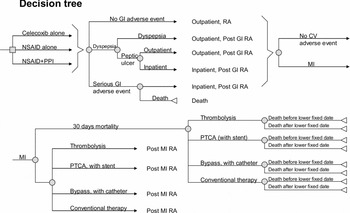
According to other NSAID studies (Reference Dai, Stafford and Alexander3;17), the efficacy of the different active agents of NSAIDs in therapeutically relevant doses was assumed to be the same. Consequently, in the decision tree, GI and CV side effect profiles were distinguished (as shown in Figure 1).
Decision tree model. RA, rheumatoid arthritis; GI, gastrointestinal; NSAID, nonsteroidal anti-inflammatory drugs; PPI, proton pump inhibitor; CV, cardiovascular; MI, myocardial infarction; PTCA, percutaneous transluminal coronary angioplasty.

Three GI outcomes were identified among arthritis patients: (i) no GI side effect outcome, (ii) dyspepsia, (iii) serious GI side effects (such as bleeding). For these, we assigned different probabilities in each strategy based on Yun and Bae (Reference Yun and Bae21), while in dyspepsia, the probability of peptic ulcer was .25 (15); and the probability of hospitalization was .2 (Reference Ray, Chung and Stein18) in all three strategies. (Probabilities are displayed in Supplementary Table 1.) Because we did not find Hungarian hospitalization rates, this forced us to adopt data from a large cohort study (Reference Ray, Chung and Stein18). For serious GI outcomes, a 0.08 mortality rate was used in all arms (Reference Yun and Bae21). Because of the similarity of international guidelines and current Hungarian protocols, we allowed these assumptions; and still all of the data were included in the sensitivity analyses.
We identified two CV outcomes: (i) no CV disease and (ii) acute myocardial infarction (AMI). The probability of AMI was identified for all three strategies based on the study by Maetzel et al. (Reference Maetzel, Krahn and Naglie14); whereas a 0.192 AMI mortality rate (dying because of AMI in 30 days) was used (9) in all three arms, based on Hungarian health insurance database.
The Hungarian inpatient financing system pays the full diagnosis-related group (DRG) only if the patient survives the defined number of days after the intervention (7). If death occurs before this, the hospital is reimbursed only with a lower DRG (with a 0.8 multiplier), even if the intervention was completed (Supplementary Table 2, which can be viewed online at www.journals.cambridge.org/thc). AMI was treated with one of the following treatments: (i) thrombolysis, (ii) percutaneous transluminal coronary angioplasty (PTCA; with stent), (iii) bypass operation with catheter, or (iv) other, according to a Hungarian survey of AMI treatment strategies (10). Thirty days mortality was also taken into consideration, with special care for the problem mentioned above.
Costs and Quality-Adjusted Life-Years
To evaluate costs, we used the third party payer's perspective. The following types of costs were identified. Direct medical costs: inpatient costs (DRGs, listed in Supplementary Table 2), drug costs of the three therapeutic strategies, the cost of post CV and/or GI drug therapy for 6 months; if having GI side effects: +20 mg of omeprazole (Reference Loyd, Rublee and Jacobs12); after AMI: ß-blockers, ASA, statins, angiotensin-converting enzyme (ACE) inhibitors, and Ca-channel blockers were administered in relevant therapeutic dose as shown in Supplementary Table 3 (www.journals.cambridge.org/thc). The dosage of the three therapeutic strategies was adopted from the review by Yun and Bae (Reference Yun and Bae21). Drug costs were derived from the average costs of the brands in each relevant group of active agents, based on the drug formulary named Pharmindex (8). All costs were originally calculated in HUFs (Hungarian forint). Costs are displayed in euros in the study based on the Hungarian National Bank's average exchange rate (2007).
To identify effectiveness, quality-adjusted life-year (QALY) was used as an end point measure. Because there were no specific Hungarian data focusing on these GI and CV outcomes, we adopted QALY values for a 3-month period from Maetzel et al. (Reference Maetzel, Krahn and Naglie14). Because of the cultural similarities, we assumed these utility values to be similar in Hungary. The GI and/or CV event could occur any time with the same chance within that 3-month period. So in each quarter, assuming a continuous distribution, the occurrence of the event happened after 1.5, 4.5, 7.5, 10.5 months, respectively. Consequently, every QALY value was gained from the average of the four scenarios, as displayed in Supplementary Figure 1 (www.journals.cambridge.org/thc). QALYs are summarized in Supplementary Table 4 (www.journals.cambridge.org/thc). Due to incidental uncertainty of this adaptation method, QALYs were included in the sensitivity analyses. Incremental cost-effectiveness ratio (ICER) was calculated for a 1-year period.
RESULTS
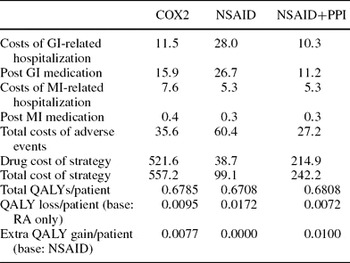
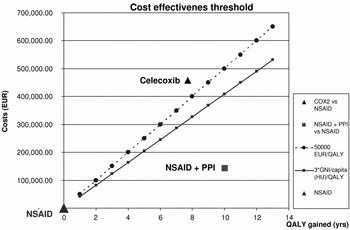
Although both of the two gastroprotective therapeutic strategies (NSAID + PPI, ICER: 14,287 euro/QALY; and COX2 inhibitor celecoxib, ICER: 59,486 euro/QALY) offer extra health gains compared with conventional NSAIDs for extra costs, our model suggests that celecoxib is dominated by combination therapy, as shown in Figure 2. Table 1 illustrates that the combination therapy was better in every cost category compared with celecoxib, even in the cost of GI-related hospitalization, where COX2 inhibitors are supposed to have an advantage.
Cost and Effectiveness Evaluationa

aData expressed in cost in euro/patient/year.
COX2, cyclooxygenase-2; NSAID, nonsteroidal anti-inflammatory drug; PPI, proton pump inhibitor; GI, gastrointestinal; MI, myocardial infarction; QALY, quality-adjusted life-year; RA, rheumatoid arthritis.
Cost-effectiveness plan for the three therapeutic strategies. Note: the two threshold lines symbolize 50,000 euro/QALY threshold (Western Europe) and 3X GNI/capita (2005) in euro for Hungary. COX2, cyclooxygenase-2; NSAID, nonsteroidal anti-inflammatory drugs; PPI, proton pump inhibitors; QALY, quality-adjusted life-year; GNI, gross national income.

Sensitivity Analysis
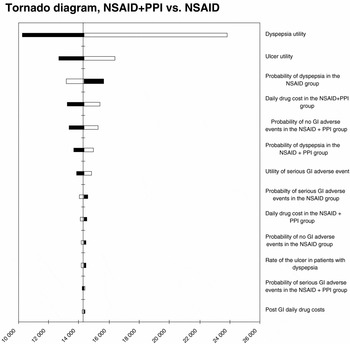
We performed one-way deterministic sensitivity analysis; tornado diagrams were used to present the results. All (more than fifty) input variables, including clinical probabilities, QALYs, DRGs, drug costs, and so on, were considered to identify the sensitivity of our model. The variables were changed within a 95- to 105-percent interval. In the tornado diagrams, only those variables were presented that influenced the base ICER by more than ± 1 percent. Figure 3 summarizes the comparison of NSAID + PPI versus NSAID. Because NSAID + PPI was found to be cost-effective compared with the monotherapy, it should be regarded as the standard therapy from the third party payer's perspective. Consequently, combination therapy should be considered to be the adequate comparator for celecoxib in economic evaluation instead of conventional NSAIDs. If comparing NSAID + PPI versus COX2, none of the above-mentioned changes within the examined interval influenced the dominancy. Neither hospitalization rates, nor other adapted mortality rates affected the ICER by more than ± 1 percent. The results of the sensitivity analyses indicate that the utility values for dyspepsia and peptic ulcer had the highest influence on ICER.
Tornado diagram for one-way sensitivity analysis (NSAID + PPI vs. NSAID). Note: ICERs in EUR.

DISCUSSION
Our results indicate that combination therapy is the preferable choice instead of COX2 inhibitors in patients with average risk factors. Table 1 shows that the majority of differences of cost-effectiveness (C/E) ratios between the two strategies can be derived from drug costs. Because of the relatively underfinanced state of the Hungarian inpatient health care system, drug costs are represented more significantly in Hungary, than in other developed countries. According to Supplementary Table 3, the daily drug cost of COX2 inhibitor's is thirteen times higher than the cost of conventional NSAIDs. This finding may explain the difference between the results of our study and those of Yun and Bae (Reference Yun and Bae21), who maintained that celecoxib could be the best option to prevent GI toxicity compared with the combination strategy. However, they found that the C/E ratio between COX2 inhibitors and no prophylaxis exceeds the $50,000 threshold, NSAID + PPI would have an even higher C/E ratio. Examining the Hungarian drug prices of NSAID, PPI, and COX2 inhibitors, a remarkable price advantage can be seen, favoring in general NSAIDs and PPIs (Supplementary Table 3); whereas in the study by Yun and Bae, PPI's price reaches nearly 70 percent of the COX2 inhibitor's daily drug cost. Maetzel et al. (Reference Maetzel, Krahn and Naglie14) found that COX2 NSAIDs are not a cost-effective treatment option in patients with average risk, but might be in high risk patients, which is in compliance with our findings concerning celecoxib. After all, this price gap present in Hungary between NSAIDs, PPIs, and celecoxib cannot be seen in the study by Maetzel et al.; which seems to be an important component of celecoxib being dominated.
Our study has done an extensive investigation of CV risks, because this could be an important aspect of COX2 inhibitor's C/E ratio. Yun and Bae have not taken the elevated cardiovascular toxicity of celecoxib into consideration. Further differences between the study by Yun and Bae and our study can be derived from the different model structure and perspective, as Yun and Bae applied the Markov model and societal perspective, which may also influence the results.
So, different local settings (such as generic drug price and inpatient financing system) may lead to rather different results, which suggests the adoption of C/E ratios from other countries with great circumspection.
Our model has the following limitations: decision tree models cannot handle the long-term effect of chronic diseases, such as RA. It is also unable to consider the increased risk after the recrudescence of peptic ulcer and AMI. The same hospitalization rate was used for peptic ulcer in all three strategies, which may differ in the three different therapeutic strategies. Because of the current questions concerning celecoxib's advantages in the GI profile, we did not applied crossover, or switching from NSAID to celecoxib after experiencing a GI side effects, although, added 20 mg of omeprazole was supposed to be given in this case. Data of the MI treatment strategies are from 2005. Since then, interventional trends may indicate an expanding number of the relatively more expensive technology (bypass, PTCA). Utility values were derived from a 3-month period; future clinical study from Eastern Europe focusing on GI and CV diseases could offer more precise data. The model did not concern medicine allergy.
CONCLUSIONS
Our model indicates that NSAID + PPI is the preferable choice for patients suffering from RA, with average GI risk condition. This strategy is cost-effective compared with conventional NSAIDs. The selective COX2 inhibitor celecoxib seems to be valuable in a group of patients with specific conditions, such as drug allergy or serious GI risk without CV risk, possibly in combination with PPI co-therapy. CV adverse events restrict the usage of celecoxib because the concomitant cardioprotective aspirin may eliminate it's GI benefit.
The skepticism induced by the withdrawal of rofecoxib is still perceptible on the selling volume of selective COX2 inhibitors. Our model indicates the elevated efficacy of celecoxib versus conventional NSAIDs; however, its price premium is too high to be used in patients with average risk conditions. Its cost-effectiveness could be justified in high risk patients. The combination of celecoxib and PPIs in Hungary requires further research. After the patent expiry, generic price erosion might make celecoxib a widespread NSAID. Hopefully, this will be followed by the elucidation of recent questions concerning its GI benefits and CV risks.
CONTACT INFORMATION
Andras Inotai, PharmD (inotai.andras@freemail.hu), PhD student, Ágnes Mészáros, PharmD, PhD (meszagi@gytk.sote.hu), Senior Lecturer, University Pharmacy Department of Pharmacy Administration, Semmelweis University, Hőgyes Endre. 7–9, Budapest, 1092, Hungary