Introduction
The victory of Sebastián Piñera and his right-wing Coalición por el Cambio (Coalition for Change) in a fairly close second-round presidential election marked the end of 20 years of government (1990–2010) by the centre-left Concertación, a four-party coalition that had triumphed in four successive presidential elections. Two decades of government by the same coalition is unusual anywhere in the world, and a true rarity in Latin America. Without wishing to revive the vague thesis of the ‘Chilean exception’ that has for years been so fashionable among first-world academics and policy-makers,Footnote 1 it is useful to explain the reasons for the Concertación's long hegemony. To this end, it is important to look at a specific group of agents whose common denominator is that they provided guidance and collective leadership both to the government coalition and to the parties that formed it. This small and particular group of agents can be characterised using the ‘technopol’ category so as to highlight their competence and power over the parties as well as their prominent role in the policy-making process, based on the resources of a ‘technical’ and ‘political’ nature that they demonstrate.Footnote 2 This article, therefore, seeks to present a systematic analysis of the group, which requires identifying them clearly on the basis of the resources that they, and only they, possess.
In order to understand these agents it is useful to start by discussing the ‘technopol’ category, a term used quite often in the social scientific literature, in order to define the exact scope I give it and the way I select the empirical individuals to be included in it. Subsequently, this essay will examine the relationship between these agents, their capital and the nature of their collective leadership over the parties and the policy-making process. My hypothesis is that the Concertación's sustained electoral success and its two decades in government were due to a significant extent to the existence of a cohesive network of technopols operating under conditions that were inherited from the previous Pinochet regime but were also modified by their actions.
Origin of the Concept: The Technopols as Agents and Resources for Reform
As is well known, the term ‘technopol’ was coined by Domínguez and Feinberg at the beginning of the 1990s and was subsequently popularised by Williamson in the context of the design of the reform programme for Latin America that was to become known as the Washington Consensus.Footnote 3 The term probably owes its success to the extraordinary fortunes of both this reform programme and the name under which it was known, which should, according to Williamson, be understood as a reference to the economic mainstream at a given moment in time, not to an ideology.Footnote 4 This is often forgotten, giving rise even today to many disagreements and much confusion between what corresponds to a scientific discipline and what is intrinsic to an ideological conception.Footnote 5
In these early papers, Williamson envisages a certain group of economists as technopols as distinct from ‘technocrats’. A technocrat, also an economist, is a person who ‘uses his or her professional and technical skills in government with a view to creating and managing an economic system that will further the general good’.Footnote 6 Technopols are ‘those technocrats who have taken the risk of accepting political appointments’.Footnote 7 In other words, the difference between technocrats and technopols is not their participation in government (since this is common to both categories) but rather the type of positions they hold and the way in which they fulfil these roles.
This functional definition of a technopol does have a serious limitation, however, since it means that membership of the category depends exclusively on the magic wand of political appointment. In this context, Domínguez, one of the authors who definitively established the category, focuses on the characteristics of its members rather than on their positions. Noting that ‘technopols fear politics much less’ than technocrats because, in their view, ‘a rational policy is not just technically correct but also politically enduring’, he has chosen to study their political skills.Footnote 8 For this purpose, Domínguez and his colleagues studied a small universe of technopols, using in-depth interviews and secondary and biographic information to show that they ‘gained power thanks to their association with political parties’.Footnote 9 Although these technopols were mostly economists and, in a few cases, social scientists familiar with the economic mainstream, this study interestingly attempts to identify a particular type of capacity or, rather, competence common to these agents.Footnote 10 This competence is at the same time both technical and political – or, in other words, corresponds to two types of resources (‘tech’ and ‘pol’) that converge in the same category (‘technopol’) to describe a specific group of agents.
What are these ‘technopolic’ resources and skills that can be used to identify a particular group of agents whose performance in government positions of political trust is often described as decisive? Williamson identifies these agents as having two types of ‘skills’: those of ‘a successful applied economist, able to judge what institutions and policies are needed in specific circumstances in order to further economic objectives’, and those of ‘a successful politician, able to persuade others to adopt the policies’ that he or she considers necessary.Footnote 11
For some authors working on Latin American countries, technopols – who, in the literature, continue to be mainly economists – can be identified by comparing ‘old politics’ with the ‘new economy’ in the sense of the implementation of liberalisation and market-opening reforms. This is a distinction which reflects the rivalry that was resolved in Argentina and Brazil through a successful alliance between ‘traditional politicians’ and ‘economic reformers’.Footnote 12 This conclusion is acceptable providing one understands the nature of this alliance (assuming that we know what is ‘traditional’ and what is ‘modern’) and how politics as such (traditional or otherwise) converges with the intrinsic characteristics of technopols. Treisman addresses only the first of these issues. He shows that, in Argentina and Brazil, economic reforms were achieved through the use of ‘particular political strategies’ chosen by the leaders – that is, through co-opting and expropriation of resources. Treisman's thesis is made under the assumption that Menem and Cardoso ‘would have read Machiavelli’, since the actions of both reveal a certain idea of virtù, which I will refer to here as a particular form of political competence.Footnote 13
It is this political competence of the technopols that Wallis analyses in the context of the implementation under governments of different colours of the so-called ‘New Zealand experiment’ of far-reaching economic reforms, applied gradually from 1984 onwards rather than as a ‘big bang’.Footnote 14 Although the most visible role in the reform process was played by two finance ministers, with firm support from their heads of government, the key to the process lay in a network of technopols, government agencies and ‘cognitive institutions’ that worked together to promote ‘cohesive action’.Footnote 15 In this sense, although technopols tend to form a small group, their political competence based on ‘tech’ and ‘pol’ resources allowed them to fulfil the role of coordinators of an ‘informal network’ in which they converged with individuals and institutions that ‘collectively provided the policy leadership’ and among which reform and policy ideas could circulate.Footnote 16
In order to draw up a profile of a technopol it is essential to place this agent at the meeting point between political practice and expert activity and between political know-how and the expertise of applied science, at the most disaggregated level of public action. A recent study by Marier is important in examining the interaction between politicians and experts within the framework of Sweden's complex pension reform.Footnote 17 He takes the notion of ‘epistemic community’ coined by Haas and extends its meaning and application precisely to the areas where the political and technical spheres meet or, in the case analysed in this article, where technopols and experts meet.Footnote 18 Technopols as understood by Marier are, therefore, agents who interact effectively with both their political peers and their expert counterparts during complex policy-making processes and in the framework of difficult negotiating situations.
But who exactly are the technopols? How can they be identified with precision and distinguished from technocrats and from professional politicians? In order to answer these questions, it is not sufficient to look just at the institutional conditions in which they operate. What is required is a serious look at the type of political competence that is so characteristic of technopols, examining the resources they have at their disposal after political and social processes of internalisation of a specific habitus. The concept of habitus has its origin in the work of Pierre Bourdieu and refers to social schemata of perception as well as different types of skills for inhabiting and participating in the political and social world.Footnote 19 This habitus is the result of socialisation processes and the social conditions of existence, explaining why socialised individuals in similar contexts share a common perception of the world, giving rise to true groups bound by an esprit de corps.Footnote 20 In the case of the technopols, this habitus and the political competence to which it gives rise means that they can be defined as agents in whom rational resources converge with political resources. Rational resources are usually prestigious university credentials that demonstrate the individual's internalisation of some specific mainstream discipline; or, in the absence of such credentials, they are acquired through regular contact with intellectuals and familiarity with their work. Political resources equip technopols with the ability to exercise a collective influence on the policy-making process as well as the management of government and the political party – or coalition – to which they belong. The cosmopolitan dimension of the technopols’ habitus was highlighted by Dezalay and Garth in order to draw attention to both the mobility of these agents in the framework of transnational networks and the international circulation of ideas for governing which they appropriate and adapt locally in their own countries.Footnote 21
This implies that technopols, and only technopols, have specific resources as well as a particular way of acting and a special political competence. Verification of the empirical validity of this definition calls for the study of individual technopols and the collective leadership they form in order to demonstrate their method of involvement in the areas where political know-how and scientific expertise meet and to identify precisely the ‘tech’ and ‘pol’ resources that are at the root of their practices.
The Chilean Technopols: Genesis of Capital, Use of Resources and Efficacy of Political Competence
The literature on technopols shows that their role is particularly marked in situations where far-reaching economic reforms – usually aimed at fostering conditions for the development of a free market – are at stake. In the case of Chile, however, it was not so much implementation of reforms of this type that was at stake as the maintenance of the existing economic and social order and the country's transition to democracy, a process that began formally with the election of President Patricio Aylwin (1990–4). These were the two overriding issues of this period and, moreover, had to be addressed simultaneously.
The first of these issues involved the so-called ‘Chilean model’, whose construction dates back to the second half of the 1970s. Its adoption implied abandoning the import substitution model in favour of a set of free-market reforms (opening the economy to foreign trade and investment, massive privatisation of state enterprises, strict control of inflation, deregulation of the financial and labour markets, and so forth). These early neoliberal reforms were based on an economic doctrine that established a true ‘intellectual jurisdiction’,Footnote 22 definitively displacing the ECLAC school of thought.Footnote 23 This model and its implementation had their origin in the so-called Chicago Boys, a group of economists who had trained at important US universities and were deeply influenced by the thought of Milton Friedman.Footnote 24 In the literature on this model, there tends to be some confusion about these agents of reform, who are generally referred to both as ‘technocrats’ and as ‘technopols’, almost as if the terms were synonyms.Footnote 25 This confusion is explained by the importance of the university credentials and ‘tech’ resources that are found in both types of agents, rendering them equivalent from this point of view. However, this ignores the fact that a technopol also has political resources, generally in the form of previously held positions of formal power in a political party or parties before joining the government, which is precisely not a characteristic of a technocrat. In this sense, it is a mistake to classify Chile's Chicago Boys as technopols because, although possessing ‘tech’ resources, they certainly did not have political resources acquired from prior party careers.
With the arrival of democracy, the Chilean model posed a challenge for the technopols who entered government from 1990 onwards since the model could not be changed (given the risk of regression to authoritarianism that this would have involved) nor conserved in its entirety (due to the political and electoral costs this would have entailed in terms of the Concertación's grassroots support).Footnote 26 Room for manoeuvre was therefore very limited, calling for remarkable ‘abilities’ and ‘skills’ on the part of the technopols – or rather, a special competence.
A second issue had to do with the general political process of making a successful transition to democracy within an inherited and restrictive constitutional framework that placed the new civil authorities under military jurisdiction with Pinochet as commander-in-chief of the army until 1998. In addition, popular sovereignty was limited by a number of ‘authoritarian enclaves’ in the form of nine non-elected senators and institutions such as the National Security Council, and by collective actors with veto power such as the military and the business community. As in the case of the economic model, Chilean technopols also faced the conflicting need for change and, at the same time, constitutional continuity in a context in which the Concertación's elected majorities were insufficient to implement without negotiation the reforms envisaged in its government programme.
It is important to remember that both economic and constitutional continuity had been the subject of considerable research by different disciplines – economics in the first case and political science and sociology in the second – often using comparative analysis.Footnote 27 Moreover, Chile's transition to democracy was the last political process of this type in South America, giving the new civilian authorities and particularly the technopols a basis for comparison from which to draw lessons.Footnote 28 It was these prior experiences, understood through reading, participation in international seminars and work on research projects financed by European and US agencies such as the Ford Foundation, that helped to establish a fluid exchange of ideas among experts in the social sciences (all members of Chile's opposition parties) and politicians throughout most of the 1980s. This is the genesis of those who would subsequently become the technopols.Footnote 29
Technopols therefore constitute a specific group of agents that was formed early in the 1980s, bringing together ‘tech’ and ‘pol’ resources that permitted the ready circulation of ideas about reform and government and facilitating their common appropriation. In this way, the technopols who would occupy positions in the frontline of government after 1990 formed a group that comprised:
• 14 professional social scientists (economists, sociologists and political scientists) trained at prestigious international universities, who were familiar with the mainstream of their respective disciplines and were members of the parties who opposed the Pinochet dictatorship in the 1980s (this is the ‘tech’ dimension of their resources); and
• six political leaders who, though without prestigious university degrees, benefited from years of continuous interaction with social scientists through which they became familiar with the main debates within these disciplines.
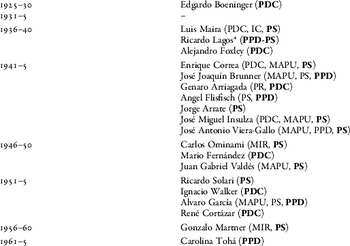
This small group (see Table 1), whose 20 members served as ministers and undersecretaries (out of a total of 281 people who occupied these posts) at different times between 1990 and 2010, can be said to be the Concertación's foundational nucleus and, at the same time, the true cement behind a form of collective leadership.Footnote 30 The group's specific characteristics are determined by the convergence of the two types of resources internalised by its agents – and at the same time, this is the origin of the competence that was used to govern politically through ideas. These ideas took the form of ‘cognitive maps’ for directing the policy-making process, which meant retranslating disciplinary knowledge into political language so it could be adopted by the general universe of Concertación legislators and party leaders.Footnote 31
The systematic study of these 20 technopols serves to explain their political performance and homogeneity over two decades, shifting the focus onto the collective leadership provided by a specific group of agents and away from an institutional analysis that ‘does not evaluate the performance of individuals responsible for making or implementing policy’.Footnote 32 As indicated above, in order to explain the technopols’ competence, it is essential to understand their practices in the areas where technocratic rationality met the political logic of public policies and government positions. This represents a research strategy that goes far beyond the work of Hira, who studied the educational qualifications of the leaders of a number of countries around the world between 1960 and 2005 and concludes that ‘in the developing world there has been a notable rising importance of economics as a background for leaders in Latin America, Africa, and Asia’.Footnote 33 It is therefore clearly necessary to describe these 20 technopols as precisely as possible in order to define the resources they share, the similarities (in French, homologies) between their careers and the political competence they have in common.
Homologous Resources, Elective Affinities and Collective Leadership
The first aspect to be considered, as well as the fact that the technopols are predominantly male, is that of the common socialising experiences of this small group of agents. This is achieved by dividing them by date of birth and setting out the political parties to which they successively belonged (see Table 1). They are classified in eight five-year age groups. Five years is the approximate period required for an undergraduate degree at a Chilean university and was chosen on the assumption that this is where some of these individuals met.Footnote 34 The largest group (seven technopols) corresponds to those born between 1941 and 1945, followed by 1936–40, 1946–50 and 1951–55. Only three of the 20 do not fall into one of these periods: Edgardo Boeninger (1925–30), Gonzalo Martner (1956–60) and Carolina Tohá (1961–65). There was great dynamism in Chilean political life from the mid-1960s onwards, when at least three new political forces were created: the Movimiento de Izquierda Revolucionaria (Revolutionary Leftist Movement, MIR) in 1965, the Movimiento de Acción Popular Unitaria (Unitarian Popular Action Movement, MAPU) in 1969 and the Izquierda Cristiana (Christian Left, IC) in 1971. Accordingly, 12 of the 20 technopols were party immigrants who had belonged to two or even three parties before entering government after 1990. Half of them were at some point, or still are, part of the Partido Demócrata Cristiano (Christian Democrat Party, PDC), giving this party an important role in fostering the emergence of technopols, followed by the MAPU and, in two cases, by the MIR. At the same time, the MAPU serves as a bridge or springboard to definitive membership of left-wing parties. Out of six technopols who belonged to this party, two had previously been members of the PDC, four eventually joined the Partido Socialista (Socialist Party, PS) and two joined the Partido por la Democracia (Party for Democracy, PPD). In all, out of the 20 technopols, six finally became members of the PDC, nine became members of the PS and four became members of the PPD, while one was a member of both the PS and the PPD – in other words, three of the four parties that founded the Concertación.
Technopols by Date of Birth and Party Membership

Note: This table shows the technopols’ membership of different political parties in chronological order, with bold type indicating the party to which they belonged during their period in government.
Acronyms: PDC: Partido Demócrata Cristiano (Christian Democrat Party); IC: Izquierda Cristiana (Christian Left); PS: Partido Socialista (Socialist Party); MAPU: Movimiento de Acción Popular Unitaria (Unitarian Popular Action Movement); PPD: Partido por la Democracia (Party for Democracy); MIR: Movimiento de Izquierda Revolucionaria (Revolutionary Leftist Movement); PR: Partido Radical (Radical Party).
* Ricardo Lagos is a special case in that he is the only technopol recognised as a member by both the PPD and the PS.
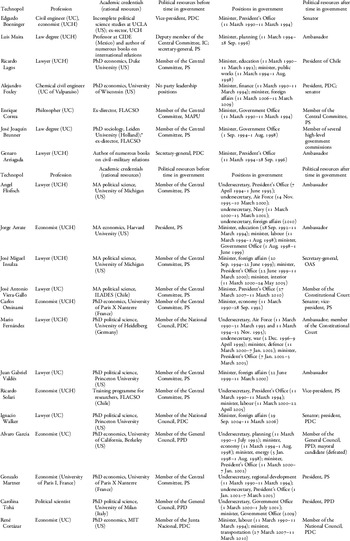
Given that the technopols became party members at an early age (usually at university), it is interesting to note that, for 19 of them, this happened at either the University of Chile (UCH) or the Catholic University (UC) (see Table 2).Footnote 35 This confirms the importance of these universities as arenas for political socialisation and breeding grounds for political leaders (this is equivalent to a first homologie of position, in this case as the start of a party career). Given the short period represented by each quintile, we can see that a number of these agents became acquainted early in life because they studied at the same university and, particularly, because they often undertook the same type of studies. The clustering and similarity of professional career choices is, in fact, extremely marked. Eight of the technopols are lawyers and seven are economists, and they have a clear tendency to hold postgraduate degrees or PhDs from overseas universities. These are generally in political science (six out of eight) in the case of the lawyers, and to a lesser extent, economics in the case of the economists (five out of seven). The literature shows that, in a number of Latin American countries, including Chile, there has been a clear displacement of the legal elite by the economic elite.Footnote 36 In the case of Chilean technopols, however, this view needs to be qualified to take account of the fact that lawyers, rather than being passively displaced, adopted a strategy of reconversion to political science while economists continued to train within their original discipline. In all, just over half the technopols have a doctorate and four hold a Master of Arts degree.
During the 1980s, Chilean technopols converged not in universities but in independent research centres such as the Corporación de Investigaciones Económicas para América Latina (Economic Research Corporation for Latin America, CIEPLAN), the Facultad Latinoamericana de Ciencias Sociales (Latin American Social Sciences Faculty, FLACSO), the Centro de Estudios del Desarrollo (Development Studies Centre, CED), the Instituto Latinoamericano de Estudios Transnacionales (Latin American Institute for Transnational Studies, ILET) and SUR Profesionales. There they carried out political and social research often as part of programmes of international scientific cooperation and supported by a strategy of networks with US and other Latin American academics. This international insertion gave these agents a high degree of mobility within the region and in the United States, with frequent participation in roundtables and seminars in the social sciences that generally led to publications on a wide range of subjects. Two of these topics were to have political importance in Chile: on the one hand, free-market reforms and the conditions for their political viability, and on the other, processes of transition to democracy. This is the origin of the leading role that would be played by the technopols in uniting the opposition to the dictatorship after years of exchange with some of its main political leaders and, subsequently, in governing.
Technopols’ Initial Profession, Rational Resources (‘Tech’) and Political Resources (‘Pol’) Before and After Spending Time in Government

Acronyms: UC: Catholic University; UCH: University of Chile.
* Obtained after his time in government.
Once the origin, method of acquisition and use of scarce knowledge (‘tech’ resources) have been established, along with the form of access to party membership (genesis of ‘pol’ resources), it is necessary to underline the importance of the technopols’ political capital. Out of the 20, 19 served as party leaders at a national level at some point in their political careers, either individually or as part of a collective body (Central Committee, General Council or National Council).Footnote 37 The only exception is Alejandro Foxley, who served in the 1960s as deputy director of the PDC's technical department and, in the 1980s, as head of its economic team.Footnote 38 The fact that these were technical posts, not positions of political leadership, puts Foxley rather in the ‘political technocrat’ category defined by Camp, or, in other words, makes him an agent with outstanding professional skills in the field of economics and important political capacities that had yet to be reflected in positions of party leadership.Footnote 39 Given that, throughout the literature, Foxley is recognised as an influential political and technical agent,Footnote 40 this anomaly of the lack of a party post prior to becoming a minister can be seen as an initial condition of a career that would subsequently make a technopol of him. Moreover, ten of these agents served as either president of their party (four), as vice-president (four), as secretary-general (three) or in two of these three positions (one), with just under half (four) of these holding their posts before entering government and six doing so after serving as minister or undersecretary. This raises the question of whether it was prior party influence that explained their access to government posts or whether having served as minister or undersecretary subsequently allowed them to become president, vice-president or secretary-general of their party. In order to answer this question, it is important to bear in mind that technopols served as part of a party's collective national leadership before the start of the transition to democracy, providing evidence of their early acquisition of political resources. The ability to influence party life can also be readily explained indirectly, usually by one or more party leaders sponsoring the agent's entry into government. This, in turn, allowed the technopol to influence the party using the support of those who contributed to his or her career in government. As a result, the technopols’ sources of power consist of, on the one hand, prestigious university qualifications that certify their internalisation of scarce knowledge (or, as a substitute, the study of certain relevant political issues), and, on the other, the acquisition of party resources (by having held leadership positions) or sponsorship by some party leader.Footnote 41
Political competence, resources and ways of distribution in government posts
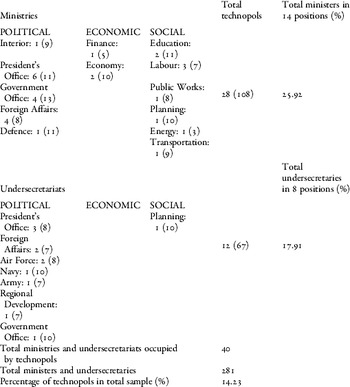
On the basis of these two types of resources (‘tech’ and ‘pol’), which constitute a certain idea of political competence, the technopols’ participation in government can be divided into two types of post: that of minister and that of undersecretary in three types of ministry (‘political’, ‘economic’ and ‘social’).Footnote 42 As shown in Tables 3 and 4, the distribution of technopols in government clearly reflects certain patterns of appointment.
Types of Ministries and Undersecretariats Occupied by Technopols, 1990–2010

Table 3 shows the number of technopols serving in each position, along with the total number of people who occupied the same post (in brackets). The two columns on the right provide a summary by ministry and undersecretariat, indicating the number of technopols and the total number of ministers or undersecretaries occupying the same posts. It can be seen that Chilean technopols occupied an average of two posts each over the two decades (20 technopols for 40 posts as minister or undersecretary). More significantly, however, 16 of the 52 ‘political’ ministers were technopols. This is particularly marked in the case of the Ministry for the President's Office (six technopols out of a total of 11 ministers, as well as three technopols who served as undersecretaries). This reflects the ministry's importance in the policy-making process, given its role in coordinating not only the different government ministries but also relations with a Congress in which the right-wing opposition had the power of veto. It is no accident that Boeninger, who headed this ministry from 1990 to 1994, was the agent who fostered a transactional style of government based on a road map (the famous ‘navigation charts’) that had broad support among his technopol peers in this period. The ideas behind the content of the navigation charts can be clearly seen in the reserved reports prepared by the President's Office, which were circulated to technopol ministers in the political area of the government and to the president. These reports (of which a total of 113 were prepared between 1990 and 1994)Footnote 43 reveal the rationale of the Chilean technopols and their general strategies for managing the transition to democracy, based on government use of scientific knowledge (‘transitology’, dilemmas addressed using game theory, comparative politics, and so forth) and its practical application in a logic of agreement-building.Footnote 44 Obviously, justifying this definition of what it means to govern called for the disciplinary knowledge that the technopols had acquired during the 1980s through comparative research, as well as the type of political competence required to implement it – that is, the ability to negotiate with adversaries on the basis of a realistic judgment of what could feasibly be undertaken and achieved and to translate the expected outcome of the negotiations into the political language of non-technopols (senators, members of the lower house and leaders of the Concertación political parties). It is this type of political competence that was at the root of the technopols’ collective leadership (referred to and criticised by some politicians as a ‘transversal party’) and explains their presence in other political ministries.Footnote 45
This was the case with the Defence Ministry, where, curiously, only one technopol was a minister, but four others headed the different undersecretariats for long periods. This situation has a simple explanation in that General Pinochet continued as the army's commander-in-chief until 1998, calling for special handling of the various civil–military crises that occurred in the 1990s, a need that became even more pressing after the former dictator's arrest in London. In addition, there was the sensitive issue of the dictatorship's violations of human rights, which often had to be broached with each branch of the armed forces individually and always in a transactional way.
Similarly, in the Foreign Ministry, four out of eight ministers between 1990 and 2010 were technopols while two served as undersecretary, reflecting the growing realisation of the need for negotiation on a series of issues that posed a threat both to Chile's political stability (Pinochet's arrest in London) and to its interests with neighbouring countries (in a context of long-standing border disputes).
The Finance Ministry warrants particular mention. It was headed by only one technopol (Foxley) during the Aylwin administration, while two technopols served as economy minister. However, although finance ministers had long tenure (there were only five in 20 years), Foxley played an outstanding role, stabilising the confidence of economic agents in the new political authorities and promoting negotiated reform of the model. Moreover, he established the key role of finance ministers in the policy-making process. This would be maintained under subsequent administrations in a framework of consensus on the need for limited reform of a social market economy model through a programme of gradual, negotiated modifications based on consensus.Footnote 46
In the case of the ministries referred to here as ‘social’ ministries, the nine technopols who served as minister and the one who served as undersecretary reflected the need to contain conflicts, particularly in the Education Ministry and the Labour Ministry, in the face of predictable redistributive demands during the early years of the transition to democracy.Footnote 47
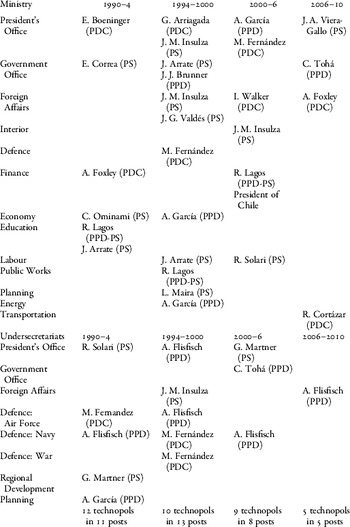
Technopols by Presidential Period, 1990–2010

As shown in Table 4, technopols had an important and stable presence in the cabinet from 1990 to 1994 and were equally important from 1994 to 2000, but with more horizontal and vertical mobility between ministries and posts. Their role then diminished slightly in 2000–6 before becoming definitively marginal in the Bachelet administration (2006–10). These changes reflect the different types of difficulties and demands faced by each administration. It was a matter of survival in 1990–4, the period in which the viability of the transition to democracy was at stake, explaining the almost perfect stability of the 12 technopols in the cabinet. The 1994–2000 period was all about modernisation, although there were still difficulties in the transition to democracy, explaining the shifting presence of the ten technopols in 13 posts. Modernising reforms in justice and education were ‘contaminated’ by the arrest of Pinochet in London and the Asian crisis. The 2000–6 period saw the conclusion of the transition in a context of the creation of redistributive welfare policies, with the technopols becoming less important following the stabilisation of civil–military relations and the approval of the last important constitutional reforms in 2005. The 2006–10 administration enjoyed democratic normality in a framework of ongoing redistributive reforms and the creation of a small welfare state, relegating the technopols to an ever more marginal role.
What explains the decline in the role of the technopols from one administration to another? My hypothesis is that they played a leading role in the early development of the transition to democracy because their political competence and mental universe were well suited to the issues it raised. Indeed, it is this group which must take the credit both for having provided the governments, particularly the first two Concertación administrations, with a road map and for having supported them during the most critical events that called for negotiation with the armed forces. The same can also be said of relations with business since it was the technopols, especially Cortázar and Foxley, to whom it fell to negotiate reforms of the economic model, such as increases in VAT and changes to labour laws, precisely because these were issues that could pose a risk to both the country's economic stability and the continuity of the government coalition itself. This role lost importance under the Lagos government and, particularly, that of Bachelet, since the issues became ever less transitional and more characteristic of a democracy on the road to definitive normalisation. In this sense, it is no accident that the last constitutional reforms in 2005 were negotiated by a technopol (José Miguel Insulza) under the presidency of another technopol (Ricardo Lagos). Nor is it an accident that the crisis caused at the beginning of the Bachelet government by the reform of Santiago's public transport system (Transantiago) was addressed by the appointment of a technopol (Cortázar) as transport minister or, similarly, that another technopol (Viera-Gallo) was appointed to the President's Office in order to give negotiating capacity to a government in which the dilemmas of the transition no longer predominated. This means that the technopols formed a group of agents that was suited to governing during the transition and in crises, but not to leading a coalition government in a consolidated democracy.
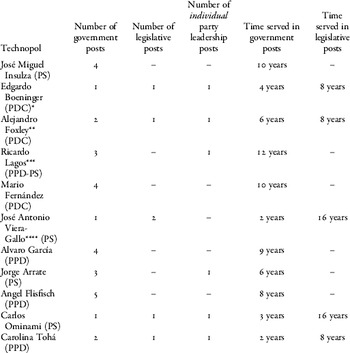
Among the 20 technopols, it is also possible to identify a smaller subgroup with a great capacity for staying in government. To this end, Table 5 identifies the technopols who demonstrated a high level of ‘security in leadership’ using an index developed by Tiberghien.Footnote 48 For this author, ‘security in leadership’ is one of the four components of the political autonomy enjoyed by certain categories of agents. In this paper, security in leadership is represented by the weight and length of a technopol's government, legislative and party career as measured by five indicators: the number of government posts held (as minister or undersecretary); the number of legislative posts (as senator or lower house representative) to which the agent was elected or appointed; the number of individual party leadership posts held; the total time served in government posts; and finally, the total time served in legislative posts.
Security in Leadership of the Principal Technopols, 1990–2010

* Edgardo Boeninger served as a non-elected senator from 1998 to 2006.
** Alejandro Foxley served as an elected senator from 1994 to 2002.
*** In the case of Ricardo Lagos, the presidency of Chile (2000–6) is considered just another government post as regards the time served.
**** José Antonio Viera-Gallo served as a lower house representative (and president of the lower house) and as an elected senator from 1990 to 2006.
As can be seen in Table 5, 11 of the 20 technopols demonstrate an important degree of security in leadership, holding political posts in one, two or three spheres (government, legislative and party). In other words, they are agents with a great capacity for mobility between posts within one sphere and between positions in different spheres. It is interesting to note that five of the 11 technopols were lower house representatives or senators and that, of these, four joined the legislature after serving as ministers while one took the reverse route. This is in an arena where political negotiating and translation competences were extremely relevant, making this group of legislators a bridge between the government and the Concertación parties in Congress. Of course, the security in leadership in government positions shown by some technopols is less than that of others, but as a general rule, the technopols stand out because of the political and hierarchical importance of their posts and the period of time for which they occupied those posts. In other words, Table 5 approximately reflects the extent to which this subgroup of agents was central to politics.
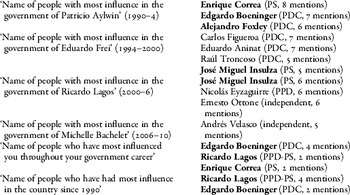
The security in leadership of four of these 11 key agents is confirmed by their technopol colleagues, and through six questions asked to the 20 technopols and answered by nine (Table 6), it is possible to identify an inner circle of technopols.Footnote 49
The Technopol Elite, 1990–2010 (by Number of Mentions)

Notes: All open questions. The names of the technopols are set in bold type to distinguish them from other agents who were influential in the different presidential periods.
In each presidential period (except the first), the names mentioned in response to these questions include ministers (and a presidential adviser, Ottone) who did not form part of the group of technopols. However, there are five technopols whose names recur: Boeninger (PDC), Foxley (PDC), Lagos (PPD-PS), Insulza (PS) and Correa (PS). Out of these five agents, I found that, in four cases, their security in leadership was confirmed by the perception of their peers.Footnote 50 In answer to the question about the technopol who most influenced those surveyed during their career in government, the number of agents drops to three, and in response to the question as to who has had most influence in the country since 1990, to only two. This indicates that the 20 technopols effectively exercised collective leadership, based on elective affinities with roots in their ‘tech’ and ‘pol’ resources and a political competence that gave them a central role during two decades of government, and that this group produced its own elite. In view of the existence of this community of agents, it is important not to lose sight of some institutional aspects of Chile's presidentialism that were used by the technopols to consolidate their leadership. In this sense, Chile's highly presidential system, as well as the institutional features of the public policies within it, provided an ideal framework for the effective deployment of the technopols’ political competence.
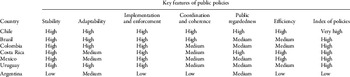
Key Features of Chilean Public Policies as Compared to Six other Latin American Countries

Source: Adapted from Stein et al., La política de las políticas públicas, p. 147.
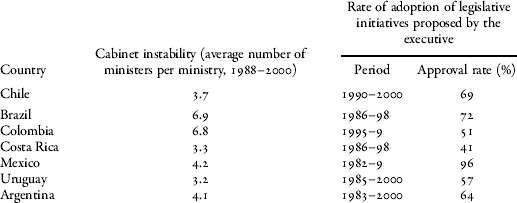
Indeed, in Chile the head of state has broad powers of legislative initiative, the effectiveness of which depends on their strategic use to set debate priorities in Congress. Their use was guided by the road maps which were drawn up during the Aylwin government and whose goals were updated by the technopols in each presidential period. Although the first democratic government (1990–4) benefited particularly from the Concertación's extraordinary discipline in implementing its road map, there is no doubt that this was a constant feature of the way in which the coalition worked, given that Chile has one of the highest rates of ministerial stability as well as of approval of legislative initiatives presented by the executive as compared to a select group of Latin American countries (Tables 7 and 8).Footnote 51
Chilean Cabinet Instability as Compared to Six other Latin American Countries
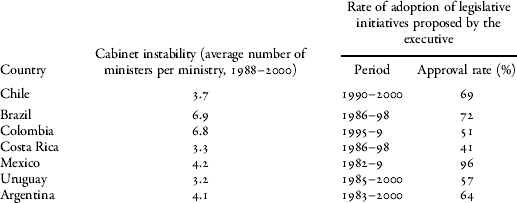
Source: Adapted from Stein et al., La política de las políticas públicas, pp. 45, 67.
This is the institutional background to the political performance of Chile's technopols, but these figures do not just reflect the intrinsic characteristics of this small group of powerful agents. The deeper explanation for their long predominance lies in the virtuous interaction between their resources and their competence, the properties of public policies and of government institutions, and this is a clue to avoiding the trap of the ‘heroic illusion’ which sees the performance of the technopols as a strategic rationality disembodied from the social properties that make them a particular group with a lasting dominance.Footnote 52 It is, however, important to place this Chilean group of technopols in the already long history of technocracy. As Silva's recent book demonstrates so clearly, the technocratic idea took very early root in Chile at the end of the nineteenth century, creating fertile ground for all types of reform experiments and tests by engineers, técnicos and economists under different governments.Footnote 53 From this point of view the technopols are part of the continuity of the history of technocracy in Chile, but we should not lose sight of the unprecedented originality of the Chilean technopols since, as I have argued, they constitute the only group of agents to deploy both technical and political resources, allowing them to play a leading role for two decades.
It is true that the category of ‘technopol’ is ideological, because of its connection with a programme of economic reforms (the Washington Consensus), in spite of the good intentions of those who praise and promote those reforms. However, I believe in the conceptual virtue of this category, and my goal was to transform it into a useful concept for sociology and political science. Thus, this paper does not aim to be an exhaustive study. It would also be important to examine the forms of succession of the technopols within the political parties and from within the government. All the signs are that this generation of Chilean technopols is in marked decline and is probably headed for extinction. In his last book, published just before his death, Boeninger lamented that, ‘I do not more often see among ourselves the figures that, in the United States, are referred to as technopols, that is technocrats who take on political roles or politicians with a strong technical background, who bring together in the same person both aspects of effective public action’.Footnote 54
Although technopols are present in the government of Sebastián Piñera (2010–14), both at the head of the state and in some ministries, they coexist with government authorities drawn from the parties and, above all, from the management of important private Chilean companies. Although a government of managers is not new in Chile – the government of Jorge Alessandri (1958–64) was known as the government of managers – the composition of President Piñera's first cabinet could transform the technopols (first among whom is Cristián Larroulet, the minister for the President's Office) into the group that is able to articulate the party and managerial competences of a government which is carrying on the tradition of the technocratic idea in Chile and its relationship with politics.
Conclusion
This article has shown how a specific strategic elite was formed, setting out the interaction between resources, political competence and methods of recruitment and appointment in the government between 1990 and 2010.Footnote 55 Although the multiplicity of positions from which some of these agents benefited is, as a general rule, a subject of research in itself – not least because the simultaneous holding of two or more positions in two or more fields acts as a ‘multiplier coefficient of actions‘Footnote 56 – this article's analysis of the ‘technical’ and ‘political’ resources of 20 figures who are notable for their careers and competence gives greater sociological depth to the ‘technopol’ category. In this sense, by returning to the elective affinities that bound together this true community of agents, it shows how the Chilean technopols formed and acted as an inner circle – or, in other words, as a group of powerful agents whose distribution in different government posts over a period of 20 years allowed them to provide transversal leadership to a coalition of centre-left parties. By giving priority to a form of social loyalty to the community of their peers and relativising political loyalty to their parties, the technopols formed a dominant group in the name of both reason and political force, thereby emulating in their own way Chile's national motto, ‘By reason or force’ (‘Por la razón o la fuerza’).