On October 8, 2005, a catastrophic earthquake struck parts of the Northwest Frontier Province (NWFP, Pakistan), Azad Kashmir (Pakistan), and northern India. The epicenter was located 50 mi northeast of Islamabad, Pakistan. The earthquake measured 7.6 on the Richter scale and was followed by strong aftershocks. The death toll was more than 79 000 and in excess of 3 million people were left homeless.1 A major concern, apart from epidemics and physical trauma, among survivors of natural disasters such as earthquakes is the effect on their mental health. Adverse negative mental health outcomes after earthquakes are common.Reference Onder, Tural, Aker, Kiliç and Erdoğan2 The defining characteristic of posttraumatic stress disorder (PTSD) is the development of characteristic symptoms after exposure to an extreme traumatic stressor involving direct personal experience (or witnessing family members' or others' experience) of an event that involves actual or threatened death, serious injury, or other threat to one's physical integrity.3
Both personal and societal factors appear to affect the likelihood of developing PTSD after a traumatic event and the clinical presentation of PTSD, which is the most commonly occurring mental health disorder after a natural disaster.Reference Onder, Tural, Aker, Kiliç and Erdoğan2 The frequency with which PTSD incidents occur after a traumatic event depends upon the inciting event and the characteristics of the individual affected by the event.
The population affected by the earthquake consisted of people residing in Azad Kashmir and NWFP. One of the world's most intractable and long-standing conflicts is between India and Pakistan over Kashmir. The people living across the line of control (between India and Pakistan) have been both witness to and victims of violence. Exposure to war or war-related traumatic events are linked strongly to the development of PTSD.Reference Farhood, Dimassi and Lehtinen4 During conflict, individuals who live with PTSD in general have a less positive attitude toward community beliefs and interdependence on other ethnic groups.Reference Pham, Weinstein and Longman5
The individuals affected by the earthquake had fewer resources on which to draw to cope with the disaster. The population in this area is impoverished. They rely on strong ties to religion and family and lack organized community resources or government support. These factors make the population of this area uniquely vulnerable to psychological morbidity after a natural disaster. People in developing countries with low socioeconomic status, social isolation, and particularly women are reported to have higher levels of depressive symptoms postdisaster.Reference Seplaki, Goldman, Weinstein and Lin6Reference Norris, Murphy, Baker and Perilla7Reference Thavichachart, Tangwongchai and Worakul8 Survivors in Agadir of the 1961 Moroccan earthquake not only had significantly more PTSD than the control group (people who experienced accidental events other than the earthquake) but also 40 years after the quake, the lives of the survivors were still disturbed.Reference Kadri, Berrada, Douab, Tazi and Moussaoui9 Early recognition of PTSD is crucial to prevent long-term psychological comorbidity, which may have a tremendous financial and social impact on society.Reference Kessler10Reference Roberts, Kitchiner, Kenardy and Bisson11 Strong family support systems, faith, and spirituality are factors that have been linked with survivors being better able to cope during the early phase of natural disasters.Reference Math, John and Girimaji12
To our knowledge, there are no published studies that have examined the psychological morbidity in the Pakistani geographic area postearthquake. The population in this area is unique because religion is deeply embedded in the culture and lifestyle, which may play a significant role in readjusting and coping after a disaster. Since the earthquake, Taliban militants based in the Swat Valley of northern Pakistan, near the epicenter of the earthquake, have conducted bomb attacks and have engaged in other threats to local businesses and schools.Reference Luxton, Skopp and Maguen13 We hypothesized that the prevalence of PTSD in earthquake survivors who resided near the conflict zone was increased further by the conflict. We also postulated a higher prevalence of PTSD symptoms among female residents because numerous prior studies showed a significant association between sex and PTSD. Studies of the effects of the 2004 southeast Asian tsunami on developing countries have shown sex-based differences in psychological outcomes.Reference Thavichachart, Tangwongchai and Worakul8Reference Ward14Reference Becker15 Based on a literature review of the development of mental health disorders in developing countries after natural disasters,Reference Madakasira and O’Brien16Reference Kohn, Levav, Garcia, Machuca and Tamashiro17 we formulated the hypothesis that there was a high prevalence of mental health disorders among the survivors of this earthquake, that residents of Azad Kashmir were at higher risk of developing PTSD compared to those residing in NWFP, and the prevalence of PTSD was higher in women as compared with men.
METHODS
Study Design and Sample
We conducted a cross-sectional study among randomly sampled survivors of the earthquake who were living in camps when interviewed. The main comparison groups were residents of Pakistani-controlled Kashmir, which is known as Azad Kashmir, and the NWFP. The border between Pakistan and India was not crossed during the study.
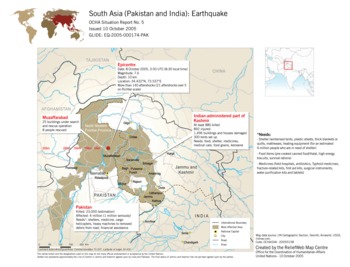
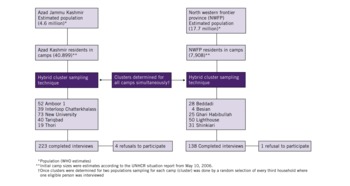
The epicenter of the earthquake was located in Balakot (Mansehra District), which is at the border of Pakistan and Azad Kashmir (Figure 1). The largest populated regions in NWFP and Kashmir affected by the earthquake were the Mansehra and Muzaffarabad districts, respectively. We traveled to the main cities of these districts and searched for existing camps that were supervised by the Office of the United Nations High Commissioner for Refugees (UNHCR). Data have been obtained from 11 of 92 camps that remained as of May 10, 2006, each of which had ≥30 tents (90% of the camps had ≥50 tents according to UNHCR).19 To sample from both Azad Kashmir and NWFP, a hybrid cluster sampling technique was used, in which each cluster consisted of a convenience sample, to obtain information about both regions. Inside the camps, the UNHCR directors were asked to identify the first tent in the block. The first surveyed tent was randomly selected among the first 3 tents in the block. Subsequently, every third tent was selected. In each selected tent, after a brief introduction and consent obtained, the survey was explained to the tent's inhabitants. The inhabitants were asked to count the number of eligible adults residing in the tent and a random-hat method was used to select an adult for a one-to-one interview. The inclusion criteria (eligibility) were adults older than 15 years. The exclusion criteria were individuals who were unable to communicate, provide consent, or participate voluntarily based on a history of a severe acute illness such as schizophrenia or mental retardation. Interviews were conducted at various times of the day and week and in privacy (either inside or outside the tent depending on which offered more privacy) after obtaining a detailed informed consent. Of the 361 interviews, 223 were conducted in Azad Kashmir and 138 were conducted in the NWFP (Figure 2).
Map of the area affected by the 2005 Pakistani earthquake.18

Populations adapted from the United Nations High Commissioner for Refugees.19

The medical personnel conducting the study were trained in the assessment of PTSD and major depressive disorder and in the administration of the Primary Care Posttraumatic Stress Disorder (PC-PTSD, translated and reverse-translated English-Urdu by 2 separate bilingual researchers) scale and the HSCL. The interviewers were physicians of Pakistani origin who are fluent in both Urdu and English. They immediately referred any individuals presenting symptoms of severe PTSD and major depressive disorder to the local psychiatric authorities for treatment. Two interviewees displaying symptoms of severe suicidal ideation were referred to the psychiatric authorities and thus excluded from the analysis. No intervention took place during our study. The study was approved by the institutional review board of Griffin Hospital.
Measurement of Study Variables
The medical personnel conducting the study were trained in the assessment of PTSD and major depressive disorder and in the administration of the Primary Care Posttraumatic Stress Disorder (translated and reverse-translated English-Urdu by 2 separate bilingual researchers) scale and HSCL. The HSCL has been shown to be a sensitive tool in detecting anxiety and depression symptoms after natural disasters and has been validated for use in Pakistan (an Urdu-translated version already existed).Reference Halepota and Wasif20 Data on age, sex, educational level, marital status, employment status, loss of family and friends in the earthquake, loss of residence, separation from immediate family, experience of direct or indirect violence to family and friends, general health, general hopefulness, level of social support, and a derived variable for multiple traumas (multiple events leading to stress and anxiety) were collected.
Participants were first asked a lifetime trauma screening question to identify whether they had experienced a traumatic event or events before the earthquake. Next, they were asked to identify the most traumatic event in their lifetime. Then they were instructed to answer the 17 questions in the PCL on the basis of the 2005 earthquake. Other possible stressors, specifically the dispute along the border region of Kashmir, were considered relevant to increases in PTSD symptoms in the aftermath of the earthquake, but they were assessed under the lifetime trauma screening questions and not when participants were questioned specifically about the earthquake.
The primary outcome was PTSD based on the 17 questions of the PCL (previously validated), using a scale of 1 to 4: (1) not at all, (2) a little bit, (3) quite a bit, and (4) extremely. To arrive at a final score, the total values of the responses were added and divided by the number of questions answered. If the value of the average score was ≥2.5, the subject was considered to have PTSD.Reference Ventureyra, Yao, Cottraux, Note and De Mey-Guillard21
The 25-question HSCL was used to assess each participant's anxiety and depression symptoms. The HSCL is computed in the same manner as the PCL. Each participant's total score is tallied and the average is taken, with ≥1.75 constituting a positive screen. Anxiety and depression symptoms also were scored individually using the same cutpoint as the total HSCL.Reference Ventureyra, Yao, Cottraux, Note and De Mey-Guillard21
Statistical Analysis
The data were analyzed using SAS version 9.1.3 (SAS Institute Inc, Cary, NC). We described the demographic and general characteristics of the sample by residence (Azad Kashmir vs NWFP). Means and frequencies were generated with the help of univariate and bivariate analyses (χ2 test). All of the variables collected in the questionnaire were assessed for inclusion in the final model. Variables included in this analysis were based on previous studies and initial analyses of our comparison groups and relevance to the current hypotheses. Univariate models were run on all of the variables considered to be predictors of positive PCL and HSCL scores. Any predictor with P < .20 was considered for the final multivariate models for PCL and HSCL.
All of the variables fitting this definition were included in the model that was used to generate the final predictive models. Because the final outcome (PCL and HSCL scores) was binary (scores were categorized and assessed and a cut point was used to dichotomize), logistic regression was used to model PCL and HSCL. All of the predictors meeting the above criteria were input into the multiple logistic regression models and run using backward selection criteria. We used a Wald test to remove the least significant variable one at a time until all of the remaining variables were significant, resulting in the final predictive model. Based on the data analysis, we present risk factors for PTSD development and the extent to which these occurrences take place after natural disasters such as earthquakes.
RESULTS
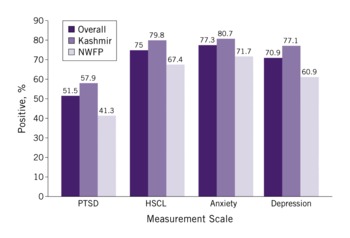
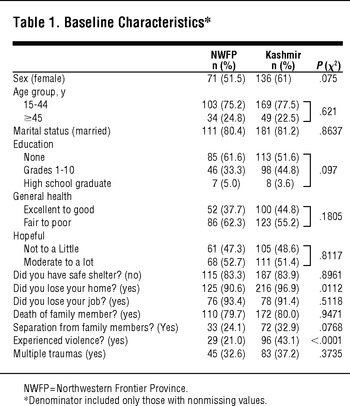
Of the 361 participants, 62% lived in camps in Azad Kashmir and 38% lived in camps in the NWFP. The average age of the participants was 35 years (standard deviation 13.8). The majority were married (81%), women (57%), and reported their health as poor (57%). The prevalence of PTSD in the total sample was 51.5% and the prevalence of a positive score on the HSCL in the total sample was 75%. The prevalence of anxiety symptoms was 77.3% and depression symptoms were 70.9% (Figure 3). The distributions for the HSCL and PCL scores for all of the questions were similar, meaning that each participant answered most of the HSCL and PCL questions with relatively similar responses (eg, if a respondent gave a response score of 3 (quite a bit) to question 1, the majority of his or her responses were rated with a 3). Figure 3 shows the prevalence for each group in the sample population. All of the baseline characteristics by location are presented in Table 1. All of the characteristics are statistically similar between the 2 locations excluding having experienced violence and loss of residence, which were higher in Azad Kashmir, as expected. Other variables considered included death of a person other than family member, violence to others, return to work, religion, ethnic origin, and additional living arrangements, all of which were assessed but did not show significance and were found to be unimportant factors in this setting and analysis.
Prevalence measures for each scale by location.

Baseline Characteristics*

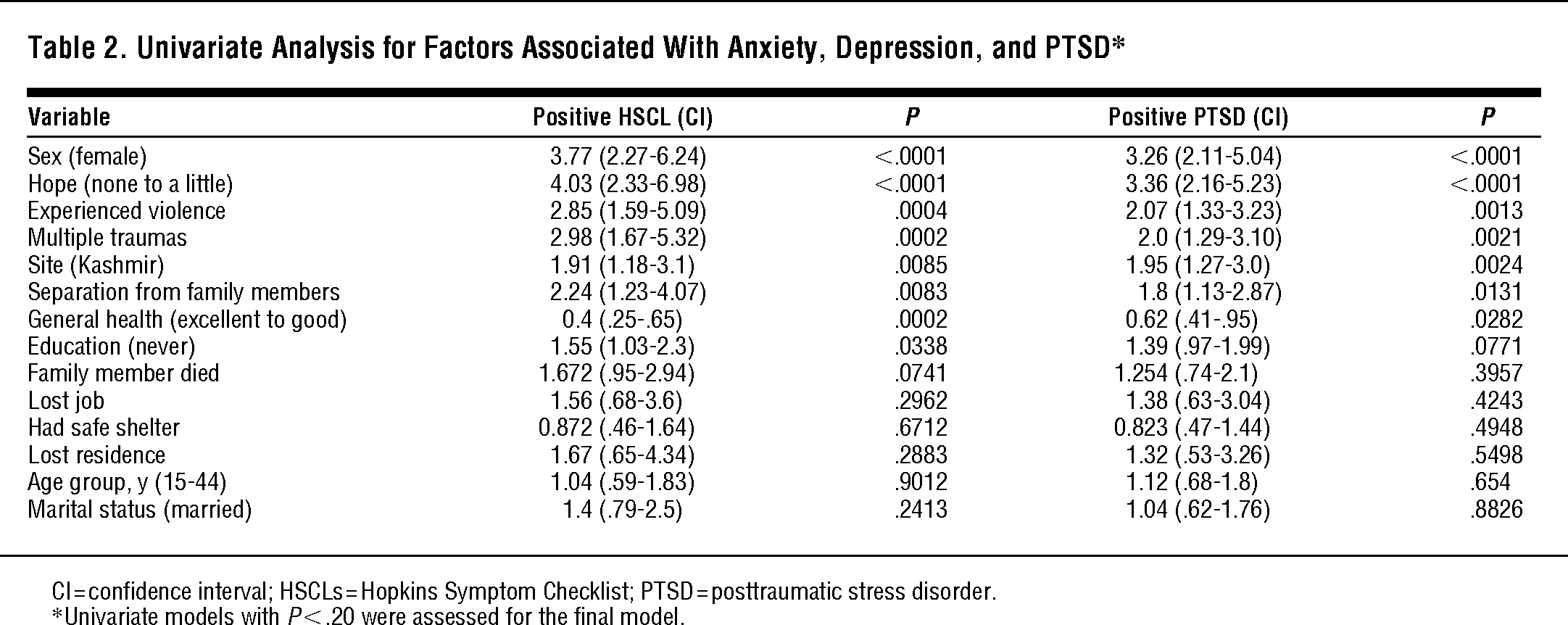
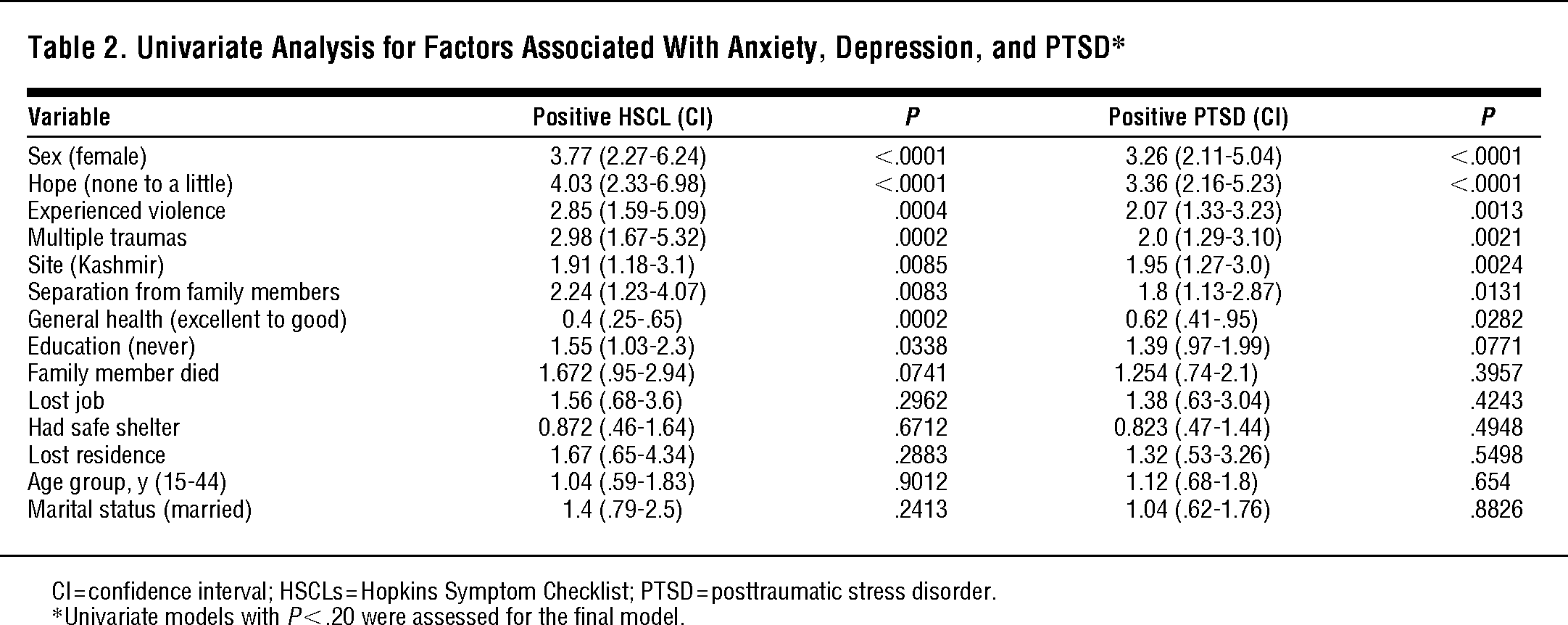
The univariate analysis examined all of variables for HSCL and PCL. Table 2 includes a univariate analysis of all of the significant variables and the variables that were shown to be significant predictors in previous studies: geographic location (Azad Kashmir vs NWFP), sex, respondents' lack of hopefulness, experience of violence, experience of multiple traumas, separation from family members, respondents' general health, respondents' education level, and respondents with family members who died. Based on the univariate analysis, women were more than 3 times as likely than men to have PTSD (odds ratio [OR] 3.26, confidence interval [CI] 2.11-5.04; P < .0001]. The participants from Azad Kashmir were approximately 2 times as likely to have PTSD compared to those from the NWFP (OR 1.95, CI 1.27-3.0; P = .0024). The HSCL showed similar results (Table 2 shows univariate results).
Univariate Analysis for Factors Associated With Anxiety, Depression, and PTSD*
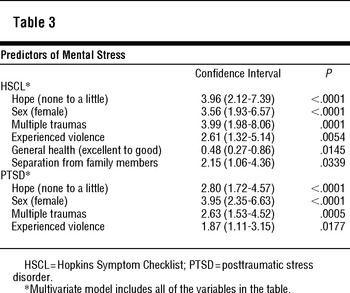
The initial multivariate models included all of the variables with P < .20 (Table 2), which included sex, location, education, general health, hopefulness, separation from family members, experience of violence, experience of multiple traumas, and death of other family members. Both the HSCL and PTSD final models included sex, experience of multiple traumas, experience of violence, and hopelessness. The HSCL model also included respondents' general health and separation from family members. The final PTSD model showed an increased risk of PTSD in women (OR 3.95, CI 2.35-6.63; P < .0001) and those who reported hopelessness (OR 2.80, CI 1.72-4.57; P < .0001), experience of multiple traumas (OR 2.63, CI 1.53-4.52; P = .0005), and experience of violence (OR 1.87, CI 1.11-3.15; P = .0177). The HSCL model also included increased risk with separation of family members (OR 2.15, CI 1.06-4.36; P = .0339) and a protective effect with self-reported better general health (OR 0.48, CI 0.27-0.86; P = .0145]. Table 3 shows the final predictive models for both HSCL and PTSD.
Predictors of Mental Stress

COMMENT
Our findings indicate an increased prevalence of PTSD symptoms among individuals residing in Azad Kashmir as compared with the NWFP, women compared with men, and in those who experienced violence and traumatic events. This study has been consistent with numerous other studies that have shown a significant relation between sex and PTSD, and women from the developing world are no exception.Reference Ventureyra, Yao, Cottraux, Note and De Mey-Guillard21Reference Mills, Edmondson and Park22 Overall, approximately half of the study population was found to have symptoms of PTSD. The finding of an increased prevalence of PTSD symptoms in the total study population is consistent with previous surveys in developing Asian countries after natural disasters. In general, mental health has not been a primary focus of the medical community in Pakistan in the immediate aftermath of the earthquake.Reference Naqvi and Khan24 This study highlights the need to address mental health issues after such natural disasters particularly among populations in the areas with ongoing geopolitical conflicts.
The residents of Azad Kashmir were twice as likely as the residents of the NWFP to develop PTSD symptoms. The prevalence of PTSD and positive HSCL scores were found to be higher in Kashmir. Higher rates of positive PTSD and HSCL scores may be explained in 3 ways: the baseline prevalence of PTSD and HSCL may have been higher, subjects in areas with ongoing conflicts may react more adversely to traumatic events with more pronounced increases in PTSD symptoms, and subjects in Kashmir may have experienced excessive traumatic events. Our data confirm a higher prevalence of traumatic experiences among subjects in Azad Kashmir. Perhaps the observed difference in PTSD and HSCL scores is multifactorial, including the presence of political violence in the area, hardships in daily living in this region, and lack of economic progress. Independent research has indicated that approximately 95% of all of the families in Azad Kashmir have been exposed to violence.Reference Petersen, Larsen, Mannstaedt, Skytt, Vedel and Wandall25 Even cases of severe physical torture have been found in Kashmiri children living in camps.Reference Petersen and Wandall26
Our study had several limitations. It may lack external validity because the unique characteristics of the region and subjects lend themselves to findings that may not be applicable to other regions or populations. Given the ongoing geopolitical conflict in Kashmir, it is possible that subjects there have higher baseline PTSD rates. Studies show that direct exposure to warfare is an extremely traumatic event that has long-lasting adverse consequences on mental health, particularly the development of PTSD.Reference Hashemian, Khoshnood, Desai, Falahati, Kasl and Southwick27 In addition, selection bias is possible because we selectively recruited displaced subjects from camps (the most severely affected individuals). This can result in an overestimation of our prevalence figures compared to what may be expected from a survey that included subjects both inside and outside the camps.
Our study also was limited in its ability to be extrapolated to all of the survivors of the earthquake. Few camps were still functioning 6 months after the earthquake, when the study was conducted. Individuals still living in camps 6 months postdisaster are likely more traumatized than individuals who were able to return to their homes. The rate of PTSD, anxiety, and depression symptoms seen in this population therefore may not be applicable to the general population affected by an earthquake. As inherent in any cross-sectional study, trends in symptom prevalence cannot be assessed. It is possible that rates have not changed in the aftermath of the earthquake, although it is unlikely, given the abundant evidence from other studies that such a traumatic event would result in an increase in PTSD incidence and prevalence among affected individuals.
Despite our study's limitations, it is the first study to our knowledge that has estimated the prevalence of PTSD symptoms in the affected region of the 2005 Pakistani earthquake. Recognition of the burden of mental health diseases is extremely important at both individual and policy levels. It is unfortunate that mental health services available immediately after the earthquake were limited. A 2007 review suggested that mental health services research are weak in Pakistan.Reference Naqvi and Khan24
It is important to recognize symptoms of PTSD, anxiety, and depression, because these disorders are treatable.Reference Fairbank and Nicholson28Reference Davidson, Rothbaum, van der Kolk, Sikes and Farfel29Reference Connor, Sutherland, Tupler, Malik and Davidson30 Our study has shown that the mental health of survivors of natural disasters is compromised and additional resources to manage mental health should be included in the immediate response to disasters, in particular the availability of psychiatrists, clinical psychologists, and mental health workers.Reference Watson and Ruzek31Reference Rodriguez and Kohn32 This study points to factors that are closely associated with PTSD in this population, particularly separation from family members, multiple traumas, and female gender. Immediately after a natural disaster, this vulnerable subgroup of subjects should be screened for mental health disorders and treated accordingly. In the absence of the availability of mental health professionals on scene, an organized referral system should be put in place.
The increase in Taliban activity and subsequent terrorist attacks in this region and the nearby Swat Valley has put additional physical and psychological stress on the local population. With the escalation of violence in the region, it is likely that rates of psychological stress will increase. Therefore, the present study should help general and public health care workers and health care officials to adequately plan for and address the mental health care needs of the local population.
Author disclosures: The authors report no conflicts of interest.