INTRODUCTION
In the years leading up to the 2012 presidential election, it was widely assumed that religion would prove a stumbling block to former Massachusetts Governor Mitt Romney. In particular, his affiliation with the Church of Jesus Christ of Latter-day Saints (LDS) supposedly doomed his chances of securing the Republican nomination. Many evangelical Christians, who are a crucial element of the Republican electoral coalition, are deeply suspicious of Mormons and many do not even consider them Christians. For this reason, Romney faced a hard battle to win support from his fellow Republicans.
Following Romney's victory in the 2012 Republican primaries, it was clear that many evangelicals were less perturbed by Romney's religion than some commentators anticipated. The Religious Right appeared to fall in line behind the Republican nominee for the general election, and there has not been widespread suspicion that Republicans with anti-Mormon sentiments defected to the Democratic Party or simply chose to stay home on Election Day. While Romney lost the popular vote to President Obama by about five-million votes, his failure has not generally been blamed on his religion.
While Obama's successful reelection campaign in 2012 can be ascribed to many factors, the hypothesis that Romney suffered at the ballot box due to anti-Mormon prejudices should not be dismissed without further investigation. This article examines the relationship between voter behavior and attitudes toward Mormons in the 2012 presidential election. While it does not indicate that religion was a primary explanation for Obama's success at the ballot box, it does indicate that negative attitudes toward Mormons decreased the probability that political Independents turned out to vote on Election Day, and voters of all party identifications with strong anti-Mormon feelings were less likely to vote for Romney.
ROMNEY, MORMONISM, AND VOTING
In the years preceding the 2008 presidential primaries, when Mitt Romney was first discussed as a potential Republican candidate, a number of voices declared that Romney's religion would torpedo his chances at securing the Republican nomination, let alone the presidency. Mormons have long struggled to gain approval from other religious groups in the United States, as I will develop below. To many Christians, Mormonism is not just another Christian denomination, but another religion altogether. Romney's problems were increased by the fact that evangelical Christians, who are one of the largest elements of the Republican coalition, also, on average, are more likely to exhibit hostility toward Mormons. In Reference Sullivan2005, Amy Sullivan wrote the following in The Washington Monthly:
[Romney's] obstacle is the evangelical base — a voting bloc that now makes up 30% of the Republican electorate and that wields particular influence in primary states like South Carolina and Virginia. Just as it is hard to overestimate the importance of evangelicalism in the modern Republican Party, it is nearly impossible to overemphasize the problem evangelicals have with Mormonism. Evangelicals don't have the same vague anti-LDS prejudice that some Americans do. For them it's a doctrinal thing, based on very specific theological disputes that can't be overcome by personality or charm or even shared positions on social issues. Romney's journalistic boosters either don't understand these doctrinal issues or try to sidestep them. But ignoring them won't make them go away. To evangelicals, Mormonism isn't just another religion. It's a cult.
While Mormonism is one of the few “home-grown” American religions, American Christians of other denominations have long found Mormon theology problematic. The practice of plural marriage, for example, led to a deep distrust of Mormons, and polygamy proved a barrier to Utah's admission to the Union (Thatcher Reference Thatcher2008). Mormonism furthermore deviates from other Christian denominations on key points of theology. It denies the Holy Trinity, for example, which led the prominent evangelical leader Rick Warren, among others, to publicly state that Mormons cannot be classified as Christians (Weinger Reference Weinger2012).
Those who predicted his religious faith would harm Romney's electoral fortunes had survey data on their side. A survey conducted in May 2011 by the Pew Research Center indicated that a substantial percentage of Republicans (25%), Democrats (31%), and Independents (20%) would be less likely to vote for a Mormon candidate. They also had history in their favor: Romney failed in his effort to secure the 2008 Republican presidential nomination, despite facing a field of relatively weak candidates.
This was not the first time a presidential candidate's status as a religious minority was a source of concern. Democratic candidate Al Smith's Catholicism likely hurt him in the 1928 presidential election. As recently as 1960, John F. Kennedy had to assure voters that his Catholic faith did not disqualify him as a presidential candidate. Whereas Kennedy faced these concerns directly with a famous speech in Houston, Texas, Romney opted to avoid direct discussions of his affiliation with the Mormon Church (Powell and Hickson Reference Powell and Hickson2013). Romney is not only a Mormon believer, but served as a bishop in the Church of Jesus Christ of Latter-day Saints, yet this biographical detail was not made a major component of Romney's campaign.
Mitt Romney was not the first Mormon candidate to face concerns about his religion. In fact, he was not the first Romney to deal with this issue. Mitt Romney's father, Michigan Governor George Romney, was a failed Republican presidential candidate in 1968. However, it is difficult to argue that his candidacy was undone by his religion rather than his political gaffes, such as his claim to have been “brainwashed” on the issue of the Vietnam War, or his awkward handling of questions related to the LDS Church's stance on African-Americans and equality (Lythgoe Reference Lythgoe1971). Other Mormons who pursued their party's presidential nomination include Morris Udall (a Democrat who pursued the 1976 nomination), Orrin Hatch (a Republican who pursued the 2000 nomination), and Jon Hunstman (a Republican who also sought the 2012 nomination).
Mitt Romney's religious affiliation was no secret to anyone with even a passing knowledge of presidential politics. While Romney may have downplayed his religious affiliation while campaigning, his religious identity was a consistent element of the media's coverage of Romney's campaign. Baker and Campbell (Reference Baker and Campbell2010) examined how the media discussed Romney prior to the 2008 presidential primaries. They found that Romney's religion accounted for 50% of all of the presidential campaign stories involving religion in 2007. Thirty percent of all the media stories about Romney mentioned his religion in that year.
Romney's religion may have harmed him in the 2012 Republican primaries, but there is little empirical evidence to demonstrate this. Romney lost in many key states where evangelicals represent a substantial percentage of Republican voters; many states in the Deep South and Midwest gave their support to Newt Gingrich or Rick Santorum. These defeats lend plausibility to the argument that evangelicals were hesitant to back a Mormon candidate. However, there are alternative explanations for Romney's poor showing in these states — such as his record on policy, which was not consistently conservative.
After Romney secured the presidential nomination in 2012, the fear that evangelicals and other conservative Christians would abandon the Republican Party appeared to be unwarranted. Whatever their previous misgivings, evangelicals remained the cornerstone of the Republican coalition in the presidential election in 2012, and white evangelicals overwhelmingly backed Romney in the general election (Calfano et al. Reference Calfano, Friesen and Djupe2013). Romney performed better among Catholics and Protestants in the electorate than John McCain, a Baptist, performed in 2008 (Brewer and Powell Reference Brewer, Powell, Cavari, Powell and Mayer2013).
Romney's opponent may help explain why religion did not necessarily play a major role in the outcome of the 2012 presidential election. President Obama had religious challenges of his own. As recently as July 2012, 17% of Americans still believed Obama was a Muslim (Pew Research Center 2012). Of those who were aware that Obama was a Christian, many voiced concerns about Obama's former pastor, Jeremiah Wright, who famously made many inflammatory remarks critical of the United States government (Brewer and Powell Reference Brewer, Powell, Cavari, Powell and Mayer2013).
Since Romney first began to receive consideration as a serious contender for the Republican presidential nomination, political scientists have been giving greater attention to attitudes toward Mormons. Multiple surveys have asked respondents whether a candidate's affiliation with the Mormon Church would impact their likelihood of voting for that candidate. Much of the evidence indicates that Mormon candidates are penalized by the electorate. A 2007 survey showed that Mormons were viewed much less favorably than most other religious groups (Penning Reference Penning2009). Only 53% of respondents had a “very” or “mostly” favorable view of Mormons — a much lower favorability rating than Jews (76%), Catholics (76%), or evangelical Christians (60%). The favorability of Mormons was similar to that of American-Muslims (53%). Putnam and Campbell (2010) reported that Mormons were one of only three religious categories that received negative average favorability ratings — the other two categories were Buddhists and Muslims.
It is interesting to note that prejudice against individuals based on a number of characteristics — such as race and gender — has undoubtedly declined, at least at the ballot box. While the percentage of Americans who would not vote for an African-American, a Catholic, or a female president has clearly decreased dramatically in recent decades, survey research indicates there has not been a similar drop in anti-Mormon prejudice. A 2007 Gallup poll showed that the percentage of Americans willing to vote for a Mormon presidential candidate had actually declined since 1967 (Jones Reference Jones2007). Benson et al. (Reference Benson, Merolla and Geer2011) pointed out that at the percentage of Americans who would not vote for an otherwise-qualified Mormon had held steady since George Romney first ran for president more than 40-years earlier.
None of this explains why Mormons face prejudice from voters. The fact that their religious beliefs differ from those of Catholics and Protestants cannot alone account for this group's low average favorability. After all, the theological differences between Mormons and other Christians denominations is certainly no greater than the theological differences between Christians and Jews — yet Jews generally receive high levels of favorability from other Americans, including evangelical Christians. A difference between Mormons and Jews, however, is that the former have a reputation for enthusiastic evangelism and the latter do not. Thus, Christians are not concerned that Jews will try to convert their friends and family. Mormons also describe themselves as a branch of Christianity, and other Christian denominations dispute the accuracy of this self-description.
A major problem for Mormons is that they face hostility from both the religious right and secularists on the left, for different reasons. The religious right, particularly the evangelical component, has a propensity to dislike Mormons for the reasons already discussed. However, the secular left is also skeptical of Mormons because they associate them with religious authoritarianism and intolerance of gays and other marginalized groups. High levels of Mormon opposition to policies such as gay marriage and abortion, for example, lead to increased anti-Mormon sentiments from secular progressives. As David T. Smith put it, “Mormons are in a uniquely awkward position, regarded by many secular liberals as hardcore theocratic conservatives but seen as possible heretics by other religious groups on the right. Romney's Mormonism could have had the effect of arousing the anger of liberal Democrats while suppressing the enthusiasm of conservative Republicans” (2014, 2).
Relatively high levels of social isolation may also be a stumbling block to greater Mormon acceptance in the United States. Social scientists have long posited that group contact can, in certain circumstances, lead to the alleviation of prejudice and inter-group conflict (Allport 1954). Campbell et al. (Reference Campbell, Green and Quin Monson2012) found that sustained contact with Mormons leads to greater tolerance of Mormons. However, for a number of reasons, a large percentage of Americans have relatively few day-to-day interactions with Mormons. Mormons tend to be geographically concentrated in a handful of western states such as Utah and Idaho. Compared to other religious groups, Mormons are also unlikely to marry outside of their faith, thus few non-Mormons have Mormon family members (Putnam and Campbell 2010). The fact that many Americans lack regular social contact with Mormons may be an additional hindrance to greater tolerance.
While Obama won the 2012 presidential election by a substantial margin, his success has not generally been credited to Romney's failure to generate enthusiasm for his candidacy among conservative evangelicals, who clearly supported Romney by a substantial margin. Furthermore, even if Romney failed to achieve a high level of enthusiasm from conservative evangelical voters, his religion may not have been the reason. His record as a relatively moderate governor of a solidly Democratic state may have been a much greater turnoff for conservatives than his personal faith.
This does not mean that Romney's religion played no role in the 2012 presidential election. This is not the first study to consider whether the 2012 presidential election was influenced by Romney's religion. Smith (Reference Smith2014) considered this issue, finding that attitudes toward Romney were influenced by attitudes toward Mormonism. He further noted that this remained true even after controlling for a number of additional individual characteristics. Sides and Vavreck (Reference Sides and Vavreck2013) examined how attitudes toward Mormons influenced voter behavior in 2012, finding that these attitudes did matter, but not enough to put Romney at a significant disadvantage. Campbell et al. (Reference Campbell, Green and Quin Monson2014) similarly found that Americans who believed negative stereotypes about Mormons were less likely to vote for Romney, but the percentage of the population that had these strong negative attitudes was small. This study builds on these earlier works, but it includes an important addition; the forthcoming statistical models test whether the effect of attitudes toward Mormons differed systematically for different partisan groups. This additional test is especially important with respect to turnout, as I will argue below.
VOTER TURNOUT IN 2012
Voter turnout in the 2012 presidential elections broke with many previous patterns, and the anomalies of that year have not yet been fully explained. Whereas the turnout rate of non-Hispanic whites was once far higher than the turnout rate of most other racial groups, this was not true in 2012. In that year, the voter turnout rate for African-Americans was not just higher than the turnout rate for other minority groups; some evidence suggests it was higher than the turnout rate for whites (Yen Reference Yen2013). White voter turnout in the 2012 presidential election was significantly lower than had been the case in previous election cycles. According to the Current Population Survey conducted by the United States Census Bureau, 64.1% of whites over the age of 18 voted in 2012, compared to 66.1% in 2008 and 67.2% in 2004.
Compared to other racial groups in the electorate, non-Hispanic whites are closely divided in terms of vote choice, so it is difficult to say definitively that a decline in white voter turnout hurt the Republican candidate. One might expect this to be the case, given that non-Hispanic whites represent an overwhelming majority of Republican voters. Some commentators have speculated as to the consequences of the “missing” white voters. Sean Trende (Reference Trende2013) argued that the decline in white voter turnout probably hurt Romney more than Obama, though others have challenged his analysis (Teixeira and Abramowitz Reference Teixeira and Abramowitz2013). We can say with great certainty that this decline in white voter turnout did not make the difference in the outcome of the presidential election. President Obama defeated Governor Romney by about five million votes. If white voter turnout had been as high in 2012 as it had been in 2004, there would have been an additional 4.7 million votes cast — thus, even if Romney had won every one of these additional votes, he would still have failed to win the popular vote.
That being said, the recent voter turnout decline of the demographic category of the electorate most likely to support Republican candidates is an interesting development and deserves greater attention. Given the widespread suspicion that feelings toward Mormons would keep many Republican voters from the polls in 2012, it is worth investigating whether this was the case.
It is important to consider whether attitudes toward Mormons had different effects on Republicans, Democrats, and Independents. There is little reason to expect that Democrats with misgivings about Mormons would choose to stay home on Election Day because Mitt Romney was on the ballot. If anything, such voters should have been more likely to turn out to vote, and to vote for Obama. However, Republicans — particularly conservative evangelicals — with negative attitudes toward Mormons likely also had a negative opinion of President Obama. In the absence of an ideal candidate, we can reasonably anticipate that such voters chose to sit out the election. For this reason, it is important to interact feelings toward Mormons with party identification.
VOTE CHOICE IN 2012
The 2012 election was also unusual in that it is uncommon for a presidential incumbent to both decrease his share of the vote and secure a victory — prior to 2012, 1944 was the last time this occurred. Compared to 2008, President Obama's margin of victory in the popular vote dropped by 3.41% points. He also lost two states in 2012 that he had won in 2008 (Indiana and North Carolina). Part of the reason for this change was a boost in Republican support from non-Hispanic whites. According to exit polls, in 2008, John McCain won 55% of the white vote. In 2012, Mitt Romney won 59% of the white vote. For Obama, these losses were partially offset by further gains among Latinos; Obama won 67% of the Latino vote in 2008, but 71% of the Latino vote in 2012.
When we break these exit polls down by race and religion, we see little evidence that observant Christians abandoned the Republican Party in 2012 because of Romney's religion or any other reason. In fact, among whites, the Republican share of the vote among both Protestants and Catholics increased. In 2008, John McCain earned 65% and 52% of the white Protestant and Catholic vote, respectively. Mitt Romney won an even greater majority among these demographic categories (69% of white Protestants and 59% of white Catholics). For all of these reasons, it is understandable that little of the post-election analysis entertained the possibility that his religious affiliation harmed Romney on Election Day.Footnote 1
That being said, the fact that the Republican candidate did not experience a drop-off in support among white Christians compared to the previous election cycle does not prove that religion was not a factor. It is possible that Romney would have won an even greater share of this group had he belonged to a different Christian denomination.
HYPOTHESES
There are two ways in which anti-Mormon sentiments may have influenced the 2012 presidential election: voter turnout and vote choice. The effect of anti-Mormon feelings may have been different for different categories of the electorate, however. As noted previously, there may be multiple sources of anti-Mormon prejudice. While much commentary is focused on the theological disputes between Mormons and other Christian denominations, and the particular hostility that conservative evangelicals exhibit toward the LDS Church, many secular liberals may also feel hostile toward Mormons. As noted above, this may be due to Mormons' reputation for conservative political preferences (Mormons, on average, are some of the most reliably Republican members of the electorate) and the Mormon Church's outspoken opposition to liberal causes such as gay marriage and abortion.
Just as different elements of the electorate may have different reasons for exhibiting anti-Mormon prejudice, the practical results of that prejudice may be different for different partisan groups. For example, a Democrat with hostile feelings toward Mormons may have been more likely to vote in 2012, and a Republican with similar hostility may have been less likely. It seems unlikely that a conservative Republican who disliked Mormons on theological grounds would have gone to the polls and voted for Obama based on those feelings, rather than simply staying home on Election Day, but we cannot discount the possibility that feelings toward Mormons also had a direct impact on vote choice. Formally stated, this paper tests the following hypotheses:
H1: Republicans with a strong prejudice against Mormons were less likely to vote in the 2012 presidential election than other Republicans.
H2: Democrats with a strong prejudice against Mormons were more likely to vote in the 2012 presidential election than other Democrats.
H3: All partisan groups, including Independents, with a strong prejudice against Mormons were less likely to vote for Romney in the presidential election.
DATA AND METHODS
The 2012 American National Election Study (ANES) included a series of “feeling thermometer” questions about different groups. Respondents were asked to rate different groups on a 0–100 scale, with higher “temperatures” corresponding to a greater favorability for that group. After being transformed via a method that will be discussed shortly, this variable served as the measure of respondent attitudes toward Mormons throughout the forthcoming analysis.
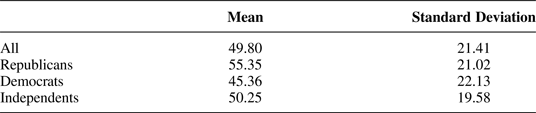
The survey also included a large number of questions regarding party identification, vote choice, voter turnout, issue preferences, and demographic information. Using these data, it was straightforward to discern the attitudes of different partisan groups toward Mormons. This distribution can be seen in Table 1, which excludes self-identified Mormons from the sample.Footnote 2
Mormon feeling thermometer score by partisan group

Source: 2012 ANES.
We immediately see that most respondents were close to neutral in their feelings toward Mormons. Among all respondents, the mean thermometer score was 49.8, indicating that they felt neither “hot” nor “cold” toward Mormons. It is interesting to note that, although much of the discussion about Mormonism and voting in the 2012 election was focused on conservative Republicans feeling uncomfortable with the idea of a Mormon president, Republicans, on average, had a higher affinity toward Mormons compared to Democrats. Independents were similar to the electorate overall when it comes to feelings toward Mormons.
A look at the means alone may not be the most helpful way to discern the public's attitudes toward Mormons, however. We see that for all groups the standard deviation for the Mormonism scale was substantial. If the public was polarized in its attitudes (that is, most people felt extremely warm toward Mormons or extremely cold) the mean would nonetheless indicate that the public was neutral, on average, in its attitudes. For this reason, a closer examination of the distribution of opinions will be helpful.
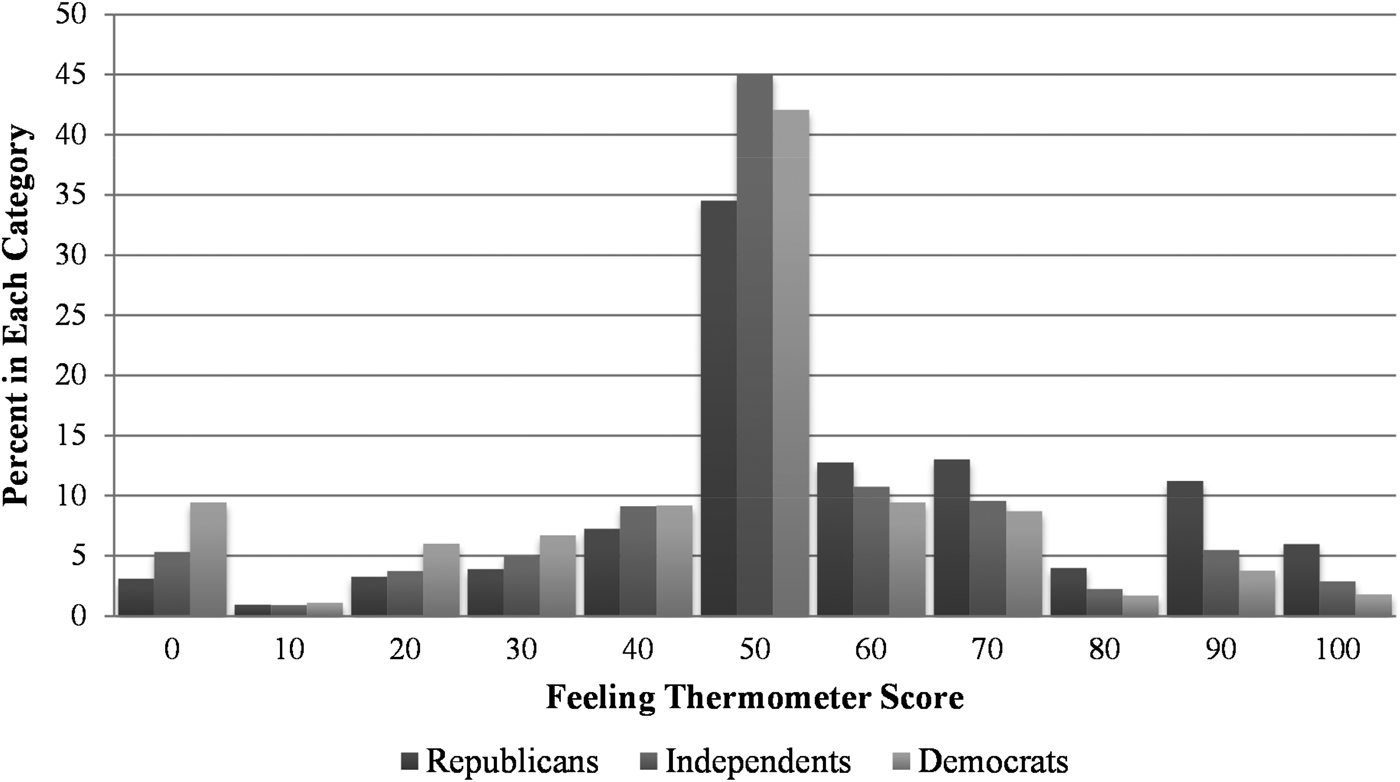
Figure 1 shows the distribution of feelings toward Mormons for Republicans, Independents, and Democrats. While the original variable was coded in intervals of 1°, in this table all responses were rounded up or down to the nearest multiple of 10.
Distribution of feeling thermometer score by partisan groups.

This figure indicates that, for all partisan groups, a large percentage of respondents were neutral or nearly neutral in their feelings toward Mormons. We do see, however, that Republicans were much more likely to have a high feeling thermometer score compared to Democrats, and less likely to have a very low score. That being said, a meaningful minority of Republicans (19.2%) provided a thermometer score for Mormons that was lower than the neutral temperature of 50°. If a large percentage of these Republicans chose not to vote as a result of those attitudes, Romney would have suffered a considerable loss of votes.
For decades, political scientists have effectively used thermometers in survey research as a measure of subjective variables — such as attitudes toward groups and individuals. However, there is some concern about the validity of these kinds of questions, given the degree to which different individuals exhibit different response patterns. That is, some people systematically rank all groups and individuals higher, and identical feeling thermometer scores may mean different things for different survey respondents (Wilcox et al. Reference Wilcox, Sigelman and Cook1989). For example, we can imagine two people who gave Mormons a feeling thermometer score of 50°. However, for the purpose of this example imagine that one of these people gave all other groups a feeling thermometer score of 100°, and the other person gave all other groups a feeling thermometer score of 50° — the same score she gave Mormons. Clearly, we cannot infer that these people have identical attitudes toward Mormons in spite of giving Mormons identical scores.
For this reason, scholars often implement a number of adjustments to feeling thermometer scores to account for these differences before including them as variables in regression models. The simplest solution is to subtract the mean score for multiple groups from the score of your group of interest (Knight Reference Knight1984), which was the solution implemented here.Footnote 3 This variable was then standardized to take a mean of zero and a standard deviation of one. All of the forthcoming models rely on this new, transformed feeling thermometer variable.
Respondents were asked whether they voted in the 2012 presidential election. These self-reported measures are always somewhat problematic, as most surveys of voter turnout include a degree of over reporting (Silver et al. Reference Silver, Barbara and Abramson1986). That is, some respondents claim that they voted when, in fact, they did not. This would not be particularly problematic if all social groups had an equal propensity to over-report voting. However, some groups appear systematically more likely to over-report, which can introduce bias into models of voter turnout. Specifically, over-reporting leads to biased coefficients for variables such as race and education (Bernstein et al. Reference Bernstein, Chadha and Montjoy2001; Ansolabehere and Hersch Reference Ansolabehere and Hersch2012). For this reason, it is important to be cautious when drawing inferences from models of voter turnout based on self-reporting. Scholars may take some comfort from Cassell's (Reference Cassel2003) study that found most models of voter turnout are only modestly affected by the problem of over-reporting. There is furthermore little reason to anticipate that there was a systematic relationship between falsely claiming to have voted and feelings toward Mormons. It is possible that some respondents' greater propensity to give inaccurate but, in their view, socially desirable answers on a survey may lead them to both give misleadingly-high feeling thermometer ratings to all social groups and to lie about voting. However, the fact that the Mormon feeling thermometer variable was transformed in the manner described above should alleviate this concern. That being said, unless votes are actually validated, we cannot know with certainty that a model of voter turnout is unbiased.
An easy initial method to determine whether there was a relationship between voter turnout and attitudes toward Mormons is simple correlation analysis. The Pearson's r for adjusted feeling thermometer scores and voter turnout is only 0.12 (p-value 0.00). When we break it down by partisan groups, the results change slightly. For Democrats, the correlation coefficient was almost zero and not statistically significant (0.01, p-value 0.64), but slightly higher for Republicans (0.16, p-value 0.00) and Independents (0.18, p-value 0.00). This does not provide powerful evidence that the few Republicans with extremely negative attitudes toward Mormons chose to stay home on Election Day.
We can conduct a similar analysis of the relationship between vote choice and attitudes toward Mormons. Among the entire electorate, there was a moderate correlation between attitudes toward Mormons and casting a vote for Romney (Pearson's r = 0.28, p-value 0.00). Inferring a great deal from this finding is problematic; however, as we have already seen that there was a relationship between party identification and attitudes toward Mormons. When we disaggregate by party identification, this relationship was small for Republicans (Pearson's r = 0.21, p-value 0.00) and Independents (Pearson's r = 0.2, p-value 0.00), and even smaller for Democrats (Pearson's r = 0.07, p-value 0.01).
This simple analysis indicates that feelings toward Mormons had, at most, a small impact on both voter turnout and vote choice in the 2012 presidential election. However, a more sophisticated analysis is necessary prior to rejecting this article's hypotheses. The forthcoming section provides the results of four logistic regression models. In the first two models, self-reported voter turnout was the dependent variable; whether the respondent reported vote for Romney was the dependent variable in the second two models.Footnote 4
Because a large number of variables may be correlated with both feelings toward Mormons and vote choice and turnout, a number of control variables were necessary. Party identification was the most important of these variables, as it is strongly correlated to vote choice and also weakly correlated with attitudes toward Mormons. Party identification was included in the model as dummy variables (Republican, Democrat, and Independent), with Independents serving as the base category. Ideology was also included as a control variable for the same reason as party identification. Ideology was categorized as a seven-point scale, with zero indicating the respondent was “extremely liberal” and six indicating that the respondent was “extremely conservative.” All models also include a variable measuring the respondent's interest level in the political campaign — a three-point scale indicating that whether the respondent was “very much interested,” “somewhat interested,” or “not much interested.”
Other common controls were also included, such as age (a series of dummy variables with the youngest cohort serving as the base category), income (broken down by quartiles with the lowest quartile serving as the base category), education (whether or not the respondent had a four-year college degree), gender, race, ethnicity, and marital status. Given the relationship between religious attitudes and affiliation and feelings toward Mormons, it was necessary to control for religious affiliation in the model. In these models, respondents who described themselves as “not religious” served as the base category. Other religious categories included mainline Protestants, Evangelical Protestants, Black Protestants, Catholics, “other” Christian, Jews, and those who belonged to some other religion.
The previous section specifically hypothesized that the relationship between feelings toward Mormons and voter turnout would be different for different partisan categories, thus two of the forthcoming models included an interaction between party identification and the Mormon feeling thermometer.
RESULTS
Voter Turnout
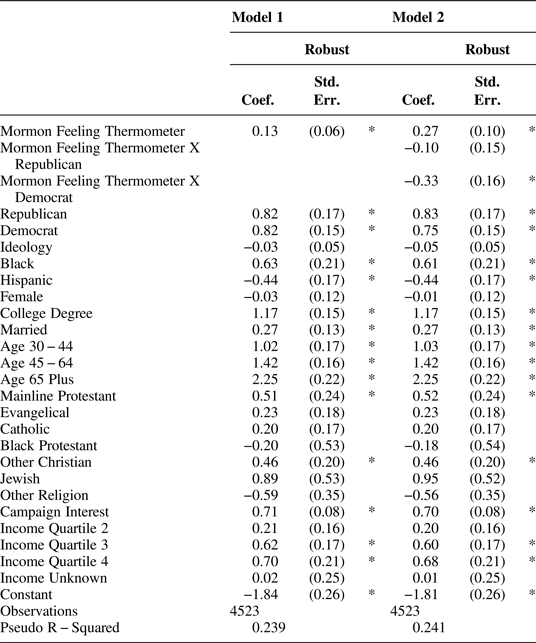
Results for the logistic regression models in which voter turnout were the dependent variable can be found in Table 2. This table contains two models. In the first, the transformed Mormon feeling thermometer was the key independent variable; the second model contained the same independent variables, but interacted the feeling thermometer with partisan category.
Logit Models for Probability of Voting

*p < 0.05
source: 2012 ANES
Model 1 demonstrates that, controlling for all other variables, there was a significant, positive relationship between feelings toward Mormons and the probability of voting. If the coefficient for the Mormon feeling thermometer is transformed into an odds ratio, we see that a one-unit change in feelings toward Mormons was associated, on average, with being 1.14 times more likely to vote. Recall that the variable was transformed to indicate that a one-unit change indicated a change of one-standard deviation.
The coefficients of Model 2 are congruent with H1 and H2. That is, we see that the effect of attitudes toward Mormons on the probability of voting is different for different partisan groups. For Independents, the odds ratio indicates that a one standard deviation increase in positive feelings toward Mormons was associated, on average and controlling for all other variables, with being 1.31 times as likely to vote. The effect of these attitudes on Republicans was not statistically discernable from their effects on Independents — that is, we cannot reject the hypothesis that these attitudes had the same effect on both Republicans and Independents. The effect of attitudes toward Mormons on the likelihood a Democrat voted, however, was statistically different from the coefficient for Independents and in the expected direction — a Democrat with strong positive feelings toward Mormons was less likely to vote.
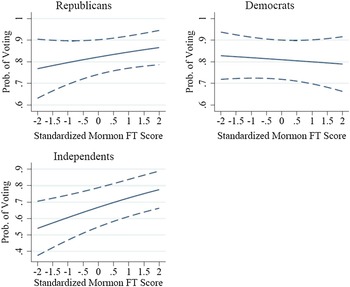
The coefficients in Table 2 provide useful information regarding the direction and statistical significance of these variables. To better understand the relationships described in this table, however, a visual representation will be helpful. There are multiple ways in which models such as these could be presented visually. For example, we could show how a change in the key independent variable leads to changes in the predicted probability of voting when we hold all other independent variables at their means. However, given that most of the control variables are categorical, holding them at their mean value would be nonsensical, as it would provide us a figure for an individual who could not exist in the real world (someone who is 0.52 female, for example). Another option would be to specify the particular attributes of the other variables, and show how the predicted value of the dependent variable changes for a person with those attributes as a result of changes in the key independent variable. This was the method chosen to present these results visually. Specifically, Figure 2 shows how changes in feelings toward Mormons influence the probability of voting for a married white female between the ages of 30 and 45 who is in the second income quartile, describes herself as a mainline Protestant, does not have a four-year college degree, and is an ideological moderate with a moderate amount of interest in the campaign. The figure presents three different slopes, depending on whether this example person is a Democrat, an Independent, or a Republican. The figure also provides 95% confidence intervals.
How the probability of voting shifted by feeling toward Mormons for partisans.

Figure 2 shows that Democrats and Republicans with the ascribed characteristics, on average, had a high probability of voting regardless of their feelings toward Mormons. For Democrats, the slope of the line is negative, which suggests that Democrats with a high estimation of Mormons were less likely to vote than other Democrats. In contrast, we see that Republicans and Independents with cold feelings toward Mormons were less likely to vote than those with very warm feelings toward Mormons. This indicates that, although relatively few Republicans and Independents had strong negative feelings about Mormons, those that did were less likely to show up to the polls. However, the modest slopes of these lines and the wide confidence intervals demonstrate that, although the slope for Democrats is negative, and thus congruent with H2, we cannot reject the null hypothesis that feelings about Mormons had no impact on the probability a Democrat voted in 2012. Similarly, we cannot reject the null hypothesis that Republican voter turnout was not impacted by feelings toward Mormons. Only for Independents was there strong, statistically-significant evidence that feelings toward Mormons influenced the likelihood of voting.
Figure 2 makes it clear that the effect of attitudes toward Mormons had only a small effect on voter turnout, particularly among partisans. It is further important to note the wide range of the x-axis when interpreting this figure — from two standard deviations below the mean for the transformed Mormon feeling thermometer to two standard deviations above the mean. Obviously, very few respondents had such extreme values. If we just consider a more modest change, the minimal effect of attitudes toward Mormons on voting becomes even clearer. For an independent with the other noted characteristics, the predicted probability of voting when attitudes toward Mormons were at the mean was 67%. A one standard deviation increase in warm feelings toward Mormons increased the probability of voting to 73%. When interpreting this change, it is additionally important to remember that Independents were much less likely than partisans to have either strong positive or strong negative attitudes toward Mormons. Among partisans, Figure 1 showed that strong feelings about Mormons were more common, but Figure 2 demonstrates that the effect of those feelings on the probability of voting was much smaller. For Republicans, an increase in feelings toward Mormons from the mean to one standard deviation above the mean increased the probability of voting from 82% to 85%. For Democrats, such a change decreased the probability of voting, but only from 81% to 80%.
While not directly related to the hypotheses tested in this article, it is worth noting a few of the other statistically-significant and substantively-important predictors of voter turnout in these models. The table shows, unsurprisingly, that Republicans and Democrats were both more likely to report voting than self-described Independents (odds ratios 2.29 and 2.12, respectively). Compared to non-Hispanic whites, blacks were more likely to report voting — a finding congruent with other evidence indicating that in 2012 black voter turnout exceeded white voter turnout for the first time. Turning to the religion variables, only two categories were significantly different from the irreligious when it comes to the likelihood of voting after controlling for all other variables — mainline and “Other” Christians (odds ratios 1.67 and 1.58, respectively).
Vote Choice
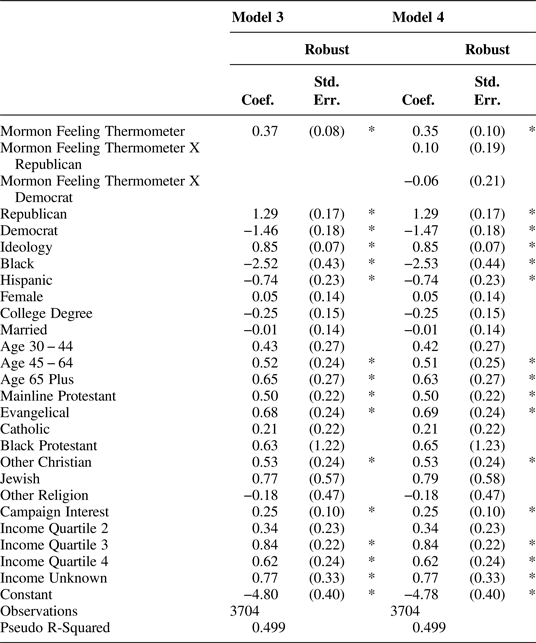
Our next question is whether or not feelings toward Mormons had an actual impact on vote choice among those that did vote. This can again be tested via logistic regression models. In this case, the dependent variable was a vote for Romney (coded as 1) and a vote for Obama or a third-party candidate was coded as zero. The same independent variables, as well as the interactions, were included in these models. These results of these models can be found in Table 3.
Logit Models for Probability of Voting Romney

*p < 0.05
source: 2012 ANES
The results of these models are similar to those in Table 2. We see that feelings toward Mormons were a statistically significant determinant of vote choice, even after we control for a myriad of other variables, including religious affiliation, ideology, and party identification. In Model 3 we see that warmer feelings toward Mormons were associated, on average and controlling for all other variables, with a greater likelihood of voting for Romney. Specifically, the odds ratio indicates that a one-unit change in the transformed measure of feelings toward Mormons was associated, on average, with being 1.45 times as likely to vote for Romney. When we include the interaction term, we see that the effect of feelings toward Mormons on vote choice was not different for different partisan categories — the interaction terms were not statistically significant. This finding is congruent with H3.
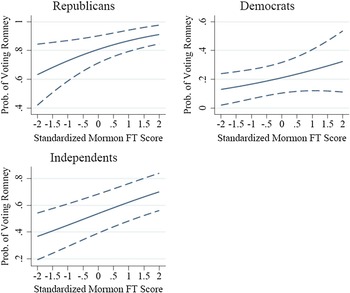
Again, these relationships can be best demonstrated visually. Figure 3 was generated using the same method used to generate Figure 2. Once again, the figure presents results for the three partisan groups, holding other variables to the same values as Figure 2 and again providing 95% confidence intervals. The figure demonstrates that the relationship between attitudes toward Mormons and vote choice was similar for all partisan categories, but the effect was considerably larger for Independents.
How the probability of voting Romney shifts by feeling toward Mormons for partisans.

For Independents with the characteristics noted above and a transformed Mormon feeling thermometer score at the mean value, the predicted probability of voting for Romney was 54%. A one-standard deviation increase in warm feelings toward Mormons increased this probability to 62%. For Republicans, such a change in feelings toward Mormons increased the probability of voting for Romney from 80% to 87%. For Democrats, such a change increased the probability of voting for Romney from 21% to 26%.
DISCUSSION
The results of these models indicate that feelings toward Mormons did play a role in the 2012 presidential election, but that role was small. These results are generally congruent with Sides and Vivreck's (2013, 212) conclusion that “Romney's religion appeared to be a minimal factor in his loss.” Among Independents, those with a very low regard for Mormons were less likely to vote. While we can speculate that Independents who stayed home because of their feelings toward Mormons would have turned out and voted Republican had a candidate from a different Christian denomination been on the ballot, we cannot state this with any certainty and thus we cannot estimate the effect this had on the share of the vote earned by each candidate.
Those with cold feelings toward Mormons were less likely to vote for Romney compared to those voters with very warm feelings toward Mormons. However, the effect of party identification was much stronger than the effect of attitudes toward Mormons. Republicans with very low estimations of Mormons were still very likely to vote for Romney, and Democrats with a very high opinion of Mormons were still very likely to vote for Obama. The small effect that attitudes toward Mormons had on vote choice among party identifiers is not surprising when we consider the research demonstrating the powerful effect of party identification on voter behavior (Bartels Reference Bartels2000; Green et al. Reference Green, Palmquist and Schickler2002). While we saw that few respondents of either party had extraordinarily negative feelings toward Mormons, partisans did, on average, have a very negative opinion of the opposing party. Among Republicans, the mean feeling thermometer score for Democrats was a cold 27.6. For Democrats, the mean feeling thermometer score for Republicans was an even colder 24.6. For most voters, these strong feelings about the competing parties surely trumped their feelings about Mormons. The relationship between attitudes toward Mormons and vote choice was clearly stronger for Independents, but we should again recall that few Independents had strong feelings about Mormons in either direction — only 8% of Independents gave Mormons a feeling thermometer score of 25 or below, and 18.7% gave them a score of 75 or above.
These results do little to further explain the “missing” white voters of 2012. While there has been some speculation as to the characteristics of the white voters who dropped out of the electorate in 2012 (Trende Reference Trende2013; Hawley Reference Hawley2014), their specific religious, economic, partisan, and demographic attributes remain unclear. The wide confidence intervals and modest slopes for partisans in Table 2 mean we cannot definitively say that attitudes toward Mormons influenced the aggregate turnout for partisans; the fact that these slopes were in the opposite direction suggests that any effect these feelings had cancelled each other out. The preceding results do indicate that Independents with anti-Mormon attitudes account for at least some of these “missing” votes. That being said, the small effects we see here indicate that the substantive effect of anti-Mormon attitudes was insufficient to explain the 4.7 million vote decline among whites between 2004 and 2012. In the ANES data, 25% of respondents identified as white Independents. Of these, 6% gave Mormons a feeling thermometer score of 25% or lower — equaling about 1.5% of all respondents. Even if none of the eligible white Independents with such strong anti-Mormon feelings turned out in 2012 — which would indicate a much stronger effect of feelings toward Mormons on voting than indicated by the preceding analysis — it still would not have led to a 4.7 million vote decline.
We further should not discount the possibility that, among some respondents, feelings toward Mormons were specifically driven by their attitudes toward Romney. That is, before Romney became a well-known figure in American politics, many Americans may have had no strong feelings toward Mormons. It was only after they developed attitudes toward Romney — and learned Romney's religious identification — that they developed attitudes toward Mormons. Campbell et al. (Reference Campbell, Green and Quin Monson2014) considered this possibility. They found that, on average, American attitudes toward Mormons barely changed between 2006 and 2012. This indicates that Romney had a negligible impact on Americans' feelings about Mormons. However, this mean value is somewhat misleading. While the mean favorability changed little, over this period Republicans became, on average, more favorable toward Mormons and Democrats became less favorable. That is, Romney's presidential campaigns led to greater partisan polarization in attitudes toward Mormons.
This article hypothesized that anti-Mormon attitudes drove down support for the Republican presidential candidate in 2012 because that candidate was a Mormon. While this is a plausible hypothesis, it would have been useful to see how, if at all, attitudes toward Mormons shaped political behavior in previous elections. There is no theoretical reason to believe attitudes toward Mormons influenced voter behavior in the 2008 general election, after controlling for all other variables; however, if there had been such a relationship, and the relationship was similar to what we found using 2012 data, such a finding would have weakened the argument that Romney's faith hampered his presidential ambitions. It would have been ideal to create identical models using 2008 data in order to verify that the relationship between attitudes toward Mormons and voter behavior was unique to the 2012 presidential election. Unfortunately, the 2008 ANES study did not include a feeling thermometer question about Mormons.
Prior to the 2012 presidential election, a great deal of analysis was focused on the degree to which Mitt Romney's religious affiliation would prove a major obstacle in his presidential bid. While Romney did lose the 2012 presidential election, his failure was not subsequently ascribed to his religion. This is understandable, given Romney's impressive support from the very groups that were ostensibly most opposed to his candidacy on religious grounds (white conservative Christians, in particular). However, it would be an over-statement to say that anti-Mormon attitudes played no role in 2012. We saw that feelings toward Mormons were a statistically-significant determinant of both voter turnout and vote choice — though the effects were modest.
This study indicates that Romney's religion did not cost him the White House. Given President Obama's five-million vote margin of victory in 2012, and the relatively small effects that attitudes toward Mormons had on turnout and vote choice, Romney would have likely lost even if he was affiliated with a different religion. Nonetheless, the finding that attitudes toward Mormons consistently had a strong statistical significance in the preceding models — which included a large number of relevant control variables — indicates that attitudes toward Mormons did influence voter behavior in the 2012 presidential election. The percentage of Americans with very negative attitudes toward Mormons may seem relatively small (11% of ANES respondents gave them a feeling thermometer score of 25 or below). However, far more respondents reported such negative feelings about Mormons than reported such feelings about blacks, Hispanics, or Catholics (3.3%, 4.25%, and 7.12%, respectively). It would thus be premature to declare that Mormon candidates do not suffer a penalty on Election Day, or that anti-Mormon prejudice is no longer present in American society.