Introduction
Attention-deficit/hyperactivity disorder (ADHD) is a childhood-onset neurodevelopmental disorder characterised by symptom dimensions inattention and/or hyperactivity/impulsivity (American Psychiatric Association, 2013). Childhood ADHD persists into adulthood in 40–60% of the cases (Faraone, Biederman, & Mick, Reference Faraone, Biederman and Mick2006; Fayyad et al., Reference Fayyad, Sampson, Hwang, Adamowski, Aguilar-Gaxiola and Al-Hamzawi2017) with a 2.8% cross-national estimated prevalence in adults (Fayyad et al., Reference Fayyad, Sampson, Hwang, Adamowski, Aguilar-Gaxiola and Al-Hamzawi2017). ADHD symptoms decrease with age, although inattention seems more persistent than hyperactivity/impulsivity (Biederman, Mick, & Faraone, Reference Biederman, Mick and Faraone2000; Kessler et al., Reference Kessler, Green, Adler, Barkley, Chatterji, Faraone and Van Brunt2010; Oerbeck et al., Reference Oerbeck, Overgaard, Pripp, Aase, Reichborn-Kjennerud and Zeiner2015). ADHD symptoms can be considered a dimensional trait in the general population (Marcus & Barry, Reference Marcus and Barry2011; Vogel et al., Reference Vogel, Ten Have, Bijlenga, De Graaf, Beekman and Kooij2018), with 5.0–5.3% of adults meeting criteria for a diagnosis (Fayyad et al., Reference Fayyad, Sampson, Hwang, Adamowski, Aguilar-Gaxiola and Al-Hamzawi2017; Vogel et al., Reference Vogel, Ten Have, Bijlenga, De Graaf, Beekman and Kooij2018). Comorbidity is high among adults with ADHD: 70–75% have at least one comorbid diagnosis (Fisher et al., Reference Fisher, Garges, Yoon, Maguire, Zipay and Gambino2014), such as obesity or sleep, mood, anxiety, or substance use disorders (Fayyad et al., Reference Fayyad, Sampson, Hwang, Adamowski, Aguilar-Gaxiola and Al-Hamzawi2017; Instanes, Klungsoyr, Halmoy, Fasmer, & Haavik, Reference Instanes, Klungsoyr, Halmoy, Fasmer and Haavik2016).
Adult ADHD has been associated with reduced quality of life (QoL), lower productivity, and increased health care use in numerous clinical and population studies (Agarwal, Goldenberg, Perry, & IsHak, Reference Agarwal, Goldenberg, Perry and IsHak2012; Uneri, Senses-Dinc, & Goker, Reference Uneri, Senses-Dinc and Goker2015). Population studies have shown that even subclinical ADHD symptoms were associated with poorer QoL (Das, Cherbuin, Butterworth, Anstey, & Easteal, Reference Das, Cherbuin, Butterworth, Anstey and Easteal2012; Estevez et al., Reference Estevez, Eich-Hochli, Dey, Gmel, Studer and Mohler-Kuo2014; Gudjonsson, Sigurdsson, Smari, & Young, Reference Gudjonsson, Sigurdsson, Smari and Young2009; Oerbeck et al., Reference Oerbeck, Overgaard, Pripp, Aase, Reichborn-Kjennerud and Zeiner2015; Vogel et al., Reference Vogel, Ten Have, Bijlenga, De Graaf, Beekman and Kooij2018). Inattention related more strongly to QoL than hyperactivity/impulsivity (Das et al., Reference Das, Cherbuin, Butterworth, Anstey and Easteal2012; Oerbeck et al., Reference Oerbeck, Overgaard, Pripp, Aase, Reichborn-Kjennerud and Zeiner2015) in population samples. In clinical studies, results were mixed (Da Silva et al., Reference Da Silva, Chaim, Cavalett, Serpa, Zanetti, Vieira and Louzã2014; Kettaneh, Reference Kettaneh2015; Weiss et al., Reference Weiss, Gibbins, Goodman, Hodgkins, Landgraf and Faraone2010). However, most of the aforementioned studies did not control for comorbidities. In two previous population studies we controlled for sociodemographic characteristics and a wide range of comorbid psychiatric disorders, and still found associations between ADHD symptoms and impaired psychosocial, mental, and physical functioning (Kooij et al., Reference Kooij, Buitelaar, van den Oord, Furer, Rijnders and Hodiamont2005; Vogel et al., Reference Vogel, Ten Have, Bijlenga, De Graaf, Beekman and Kooij2018). The current paper builds on this by adding productivity and health care use to the outcomes, and by investigating the effects of sleep problems in addition to those of ADHD symptoms.
Sleep problems are important as they are highly prevalent in adults with ADHD (Bijlenga, Vollebregt, Kooij, & Arns, Reference Bijlenga, Vollebregt, Kooij and Arns2019; Gregory, Agnew-Blais, Matthews, Moffitt, & Arseneault, Reference Gregory, Agnew-Blais, Matthews, Moffitt and Arseneault2017). One of the most common sleep problems in ADHD is insomnia, with a cross-sectional prevalence of 43–78% in clinical ADHD samples (e.g. Brevik et al., Reference Brevik, Lundervold, Halmoy, Posserud, Instanes, Bjorvatn and Haavik2017; Fisher et al., Reference Fisher, Garges, Yoon, Maguire, Zipay and Gambino2014; Fuller-Thomson, Lewis, and Agbeyaka, Reference Fuller-Thomson, Lewis and Agbeyaka2016; Van Veen, Kooij, Boonstra, Gordijn, and Van Someren, Reference Van Veen, Kooij, Boonstra, Gordijn and Van Someren2010; for reviews, see Instanes et al., Reference Instanes, Klungsoyr, Halmoy, Fasmer and Haavik2016; Wynchank, Bijlenga, Beekman, Kooij, and Penninx, Reference Wynchank, Bijlenga, Beekman, Kooij and Penninx2017). Insomnia is diagnosed when there is dissatisfaction with sleep quantity or quality, difficulty initiating and/or maintaining sleep, and early morning awakenings, causing functional daytime impairments, for a minimum of three nights per week over a period of at least 3 months (American Psychiatric Association, 2013). Insomnia is the most common sleep disorder in the general population, with symptoms being present in about one-third of the population (Ohayon, Reference Ohayon2002; Roth, Reference Roth2007). Similar to ADHD, population studies have shown associations between insomnia and poorer QoL, reduced productivity, and increased health care use (Baldwin et al., Reference Baldwin, Griffith, Nieto, O'connor, Walsleben and Redline2001; Bin, Marshall, & Glozier, Reference Bin, Marshall and Glozier2012; Kessler et al., Reference Kessler, Berglund, Coulouvrat, Hajak, Roth, Shahly and Walsh2011; Lallukka et al., Reference Lallukka, Sivertsen, Kronholm, Bin, Øverland and Glozier2018; LeBlanc et al., Reference LeBlanc, Beaulieu-Bonneau, Mérette, Savard, Ivers and Morin2007; Léger, Scheuermaier, Philip, Paillard, & Guilleminault, Reference Léger, Scheuermaier, Philip, Paillard and Guilleminault2001; Roth & Ancoli-Israel, Reference Roth and Ancoli-Israel1999; Roth et al., Reference Roth, Jaeger, Jin, Kalsekar, Stang and Kessler2006; Soehner & Harvey, Reference Soehner and Harvey2012; Stewart et al., Reference Stewart, Besset, Bebbington, Brugha, Lindesay, Jenkins and Meltzer2006; Ten Have et al., Reference Ten Have, Penninx, Van Dorsselaer, Tuithof, Kleinjan and De Graaf2016; Zammit, Weiner, Damato, Sillup, & McMillan, Reference Zammit, Weiner, Damato, Sillup and McMillan1999). A negative association with QoL is inherent to insomnia, as impaired functioning is a DSM-5 criterion. Analogous to ADHD, there is a linear pattern between insomnia severity and poorer QoL in clinical insomnia samples that remains after controlling for mental or physical comorbidities (IsHak et al., Reference IsHak, Bagot, Thomas, Magakian, Bedwani, Larson and Zaky2012; Katz & McHorney, Reference Katz and McHorney2002; Kyle, Morgan, & Espie, Reference Kyle, Morgan and Espie2010; Scalo, Desai, & Rascati, Reference Scalo, Desai and Rascati2015). Psychiatric comorbidities occur in 40% of insomnia patients (Ford & Kamerow, Reference Ford and Kamerow1989; McCall, Reference McCall2001), which are mostly mood, anxiety, or substance use disorders (Ancoli-Israel, Reference Ancoli-Israel2006; Taylor, Lichstein, & Durrence, Reference Taylor, Lichstein and Durrence2003), similar to ADHD. Two population studies showed that the relationship between insomnia symptoms and poorer QoL remained after controlling for such comorbidities (Lallukka et al., Reference Lallukka, Sivertsen, Kronholm, Bin, Øverland and Glozier2018; Ten Have et al., Reference Ten Have, Penninx, Van Dorsselaer, Tuithof, Kleinjan and De Graaf2016). In two other population studies, 43–54% of adults with clinically relevant ADHD symptoms reported clinically significant insomnia symptoms (Voinescu, Szentagotai, & David, Reference Voinescu, Szentagotai and David2012; Wynchank et al., Reference Wynchank, Ten Have, Bijlenga, Penninx, Beekman, Lamers and Kooij2018). The ADHD dimensions inattention and hyperactivity/impulsivity may relate to insomnia symptoms in different ways, although results are mixed (Instanes et al., Reference Instanes, Klungsoyr, Halmoy, Fasmer and Haavik2016; Voinescu et al., Reference Voinescu, Szentagotai and David2012; Wynchank et al., Reference Wynchank, Ten Have, Bijlenga, Penninx, Beekman, Lamers and Kooij2018). A previous study showed that both total number of ADHD symptoms and the two dimensions were correlated to the number of insomnia symptoms in the general population, indicating that ADHD severity and sleep problems are strongly associated (Wynchank et al., Reference Wynchank, Ten Have, Bijlenga, Penninx, Beekman, Lamers and Kooij2018).
As mentioned, both ADHD and insomnia symptoms are associated with the same negative outcomes in the general population: reduced QoL, loss of productivity, and increased health care use. As comorbidities were often not controlled for, it is uncertain if these relationships are direct or influenced by confounders. Productivity loss and increased health care use associated with ADHD and insomnia lead to considerable societal costs (Doshi et al., Reference Doshi, Hodgkins, Kahle, Sikirica, Cangelosi, Setyawan and Neumann2012; Kessler et al., Reference Kessler, Berglund, Coulouvrat, Hajak, Roth, Shahly and Walsh2011; Mai & Buysse, Reference Mai and Buysse2008; Roth, Reference Roth2007).
This population study uses data from the Netherlands Mental Health Survey and Incidence Study-2 (NEMESIS-2), an epidemiological study among the general adult population (De Graaf, Ten Have, & Van Dorsselaer, Reference De Graaf, Ten Have and Van Dorsselaer2010). The independent effects of ADHD and insomnia symptoms on QoL, productivity, and health care use are investigated. A wide range of confounders and comorbidities is controlled for, and the ADHD dimensions inattention and hyperactivity are examined separately. Most importantly, the combined effects of ADHD and insomnia symptoms on QoL, productivity loss, and health care use are investigated. It is hypothesised that ADHD and insomnia together have stronger negative associations with these outcomes than they do separately, i.e. that having symptoms of insomnia on top of ADHD, or vice versa, increases an individual's burden. Since the NEMESIS-2 study was not designed specifically for this purpose, the current study should be considered exploratory.
Methods
Participants
Data were used from the NEMESIS-2, a longitudinal, epidemiological study on the prevalence, incidence, course, and consequences of psychiatric disorders in the Dutch general adult population. NEMESIS-2 is based on a multistage, stratified, random sampling of households, with one respondent randomly selected from each household. Insufficient fluency in the Dutch language was an exclusion criterion. In each wave, trained interviewers visited the participants for an extensive research interview. The baseline wave was conducted from November 2007 to July 2009, included 6646 subjects aged 18–64, and had a response rate of 65.1%. The sample was nationally representative, albeit with a slight underrepresentation of younger participants. The second wave (response rate 80.4%; N = 5303) was performed 3 years after the baseline interview. The third wave, again 3 years later, had a response rate of 87.8% and included 4618 participants. The research proposal was approved by a medical ethics committee (the Medical Ethics Review Committee for Institutions on Mental Health Care, METIGG) and all respondents gave written informed consent at each wave. The authors assert that all procedures contributing to this work comply with the ethical standards of the relevant national and institutional committees on human experimentation and with the Helsinki Declaration of 1975, as revised in 2008. A full description of NEMESIS-2 has been reported elsewhere (De Graaf et al., Reference De Graaf, Ten Have and Van Dorsselaer2010). This study uses data from the third wave only, because this wave included sleep variables.
Measures
Adult ADHD symptoms
ADHD symptoms in adulthood were assessed using the Adult ADHD Self-Report Scale (ASRS) Screener version 1.1 (Kessler et al., Reference Kessler, Adler, Ames, Demler, Faraone, Hiripi and Walters2005). This has six items, indicating four symptoms of inattention and two of hyperactivity. The frequency of symptoms over the past 6 months was rated on a five-point Likert scale ranging from 0 (never) to 4 (very often). Sum scores ranging from 0 to 16 for inattention and 0–8 for hyperactivity were calculated. Additionally, these sum scores were dichotomised at a cut-off point of ⩾9 for inattention and ⩾6 for hyperactivity. A sum score of all items (0–24) was calculated for total ADHD symptoms. Also, scores on each item were converted into binary values according to the official scoring system (Kessler et al., Reference Kessler, Adler, Ames, Demler, Faraone, Hiripi and Walters2005), producing a value between 0 and 6 representing how many symptoms were present. An indication for a diagnosis of ADHD was applied when four or more of the six symptoms were present (Kessler et al., Reference Kessler, Adler, Gruber, Sarawate, Spencer and Van Brunt2007). The ASRS screener has moderate sensitivity (68.7%), excellent specificity (99.5%), and excellent total classification accuracy (97.9%) for ADHD (Kessler et al., Reference Kessler, Adler, Ames, Demler, Faraone, Hiripi and Walters2005). The internal consistency of the ASRS Screener lies within the range of 0.63–0.72 (Kessler et al., Reference Kessler, Adler, Gruber, Sarawate, Spencer and Van Brunt2007).
Insomnia
The Women's Health Initiative Insomnia Rating Scale (IRS) (Levine et al., Reference Levine, Kaplan, Kripke, Bowen, Naughton and Shumaker2003a) assessed insomnia symptoms. Though originally designed for women, it has been used in clinical and population studies for both sexes (Bamer, Johnson, Amtmann, & Kraft, Reference Bamer, Johnson, Amtmann and Kraft2008; Ten Have et al., Reference Ten Have, Penninx, Van Dorsselaer, Tuithof, Kleinjan and De Graaf2016; Van Mill, Hoogendijk, Vogelzangs, Van Dyck, & Penninx, Reference Van Mill, Hoogendijk, Vogelzangs, Van Dyck and Penninx2010; Van Mill, Vogelzangs, Hoogendijk, & Penninx, Reference Van Mill, Vogelzangs, Hoogendijk and Penninx2013). This scale has good test-retest reliability and a high convergent correlation with objective actigraphy sleep measures (Levine et al., Reference Levine, Kripke, Kaplan, Lewis, Naughton, Bowen and Shumaker2003b). It contains five questions evaluating sleep over the past 4 weeks, addressing four domains of insomnia symptoms: difficulties initiating sleep, difficulties maintaining sleep, early morning awakening, and overall sleep quality. Answers were given on a 5-point scale ranging from 0 (‘less than once a week’) to 4 (‘five times or more a week’) for the first four questions, and the last question on sleep quality ranged from 0 (‘very sound or restful’) to 4 (‘very restless’). The continuous IRS sum score (0–20) was calculated. Additionally, the total score was dichotomised at the cut-off point of ⩾9, indicating clinically significant insomnia symptoms (Levine et al., Reference Levine, Kripke, Kaplan, Lewis, Naughton, Bowen and Shumaker2003b).
Quality of life
QoL was assessed using the Medical Outcomes Study Short Form-36 (SF-36), which assesses domains of physical and mental functioning (Ware & Sherbourne, Reference Ware and Sherbourne1992). Answers were given on a 2-, 3-, 5-, or 6-point Likert scale. Item scores were transformed to generate total scores for the physical (PCS) and mental (MCS) component scales, ranging from 0 (low) to 100 (high) QoL.
The PCS contains four subscales: (1) bodily pain: bodily pain and resulting limitations in daily activities (Cronbach's α = 0.84); (2) general health perceptions: perceptions about one's own health (Cronbach's α = 0.76); (3) role physical functioning: how physical problems affect work or other daily activities (Cronbach's α = 0.90); and (4) physical functioning: limitations in physical activities (Cronbach's α = 0.92) (Ware & Sherbourne, Reference Ware and Sherbourne1992).
The MCS contains four subscales: (1) social functioning: how somatic or emotional problems influence normal social activities (Cronbach's α = 0.78); (2) role emotional functioning: how emotional problems affect work or other daily activities (Cronbach's α = 0.88); (3) mental health: general mood, depressive and anxious feelings, and psychological well-being (Cronbach's α = 0.79); and (4) vitality: energy and tiredness (Cronbach's α = 0.77) (Ware & Sherbourne, Reference Ware and Sherbourne1992).
Productivity loss
Productivity loss was determined by three questions based on the World Health Organization Disability Assessment Schedule (WHODAS; Von Korff et al. Reference Von Korff, Crane, Alonso, Vilagut, Angermeyer, Bruffaerts and Ormel2008). These were: ‘during how many of the past 30 days (1) were you unable to work or perform your usual activities; (2) were you able to work and perform your usual activities, but did you have to take a step back or were you less productive than usual; (3) were you less able to pay attention to the quality of your work?’ Productivity loss ranged from 0 to 30 days. Each day reported on question 1 counted as 1 day of productivity loss, and each day reported on questions 2 and 3 counted as 0.5 day. If the total was more than 30 days, it was put at 30 days.
Health care use
Health care use (yes/no) referred to at least one contact made in general medical (e.g. general practitioner) or mental health (e.g. psychologist or psychiatrist) care for emotional, alcohol, or drugs problems in the previous 12 months.
Covariates
Sociodemographic characteristics and possible covariates in the studied associations were: sex, age, education level, partner status, employment status, any chronic somatic disease (presence of ⩾1 of 17 chronic physical disorders treated or monitored by a medical doctor in the previous 12 months, assessed with a standard checklist), smoking in the last month (yes/no), exercise in the last week (⩾1 hr), body mass index (BMI), and the presence of any 12-month mood, anxiety, or substance use disorder as established by the Composite International Diagnostic Interview (CIDI) version 3.0 (Kessler & Üstün, Reference Kessler and Üstün2004). This is a fully structured interview based on the Diagnostic and Statistical Manual of Mental Disorders 4th edition criteria (DSM-IV; American Psychiatric Association, 1994) that has shown to be a reliable and valid instrument to assess common mental disorders (Haro et al., Reference Haro, Arbabzadeh-Bouchez, Brugha, de Girolamo, Guyer, Jin and Kessler2006). These covariates were chosen as they were related to either ADHD, insomnia, or both in the current dataset.
Statistical analyses
Weighted data were used to correct for different response rates between sociodemographic groups at the different waves and for differences in the probability of respondent selection at baseline. Two-tailed testing procedures were used with statistical significance inferred at α < 0.05.
Sociodemographic characteristics were calculated using simple descriptive analyses: frequencies and percentages, and means and standard errors. Multiple linear regression analyses were performed to examine the effects of ADHD and insomnia on PCS, MCS, and productivity. Results were adjusted for sex and age in model 1a and in model 2a additionally for education, partner status, employment status, any chronic somatic disorder, BMI, smoking during the last month, exercise during the last week, and any 12-month mood, anxiety, or substance use disorder. Similar analyses were carried out for ADHD dimensions inattention (models 1b and 2b) and hyperactivity (models 1c and 2c). Cohen's f 2 effect size was calculated: R 2/(1–R 2).
The binary value of health care use was analysed using logistic regression. Stepwise multiple logistic regression calculated adjusted odds ratios (ORs) for investigating the independent effects of clinically relevant ADHD scores (⩾4 symptoms) and clinically relevant IRS scores (⩾9) in partly adjusted model 1a and fully adjusted model 2a. The detection of interaction effects was done using an additive model as in Ten Have et al. (Reference Ten Have, Penninx, Van Dorsselaer, Tuithof, Kleinjan and De Graaf2016). If the combined effect of clinically relevant ADHD and IRS scores was stronger than the sum of their independent effects, additive interaction existed. Such effects were assumed to be present if the expected ORs lay below the lower limits of the confidence intervals of the combined effects. Similar analyses were performed for ADHD dimensions inattention (models 1b and 2b) and hyperactivity (models 1c and 2c).
Interaction plots were made for significant interaction effects between dichotomised values for insomnia and ADHD on continuous outcomes (MCS, PCS, productivity loss) in fully adjusted models.
In all regression analyses, step 1 included main effects only and the interaction term was entered in step 2. All analyses were performed with STATA version 12.1.
Results
Sociodemographic characteristics
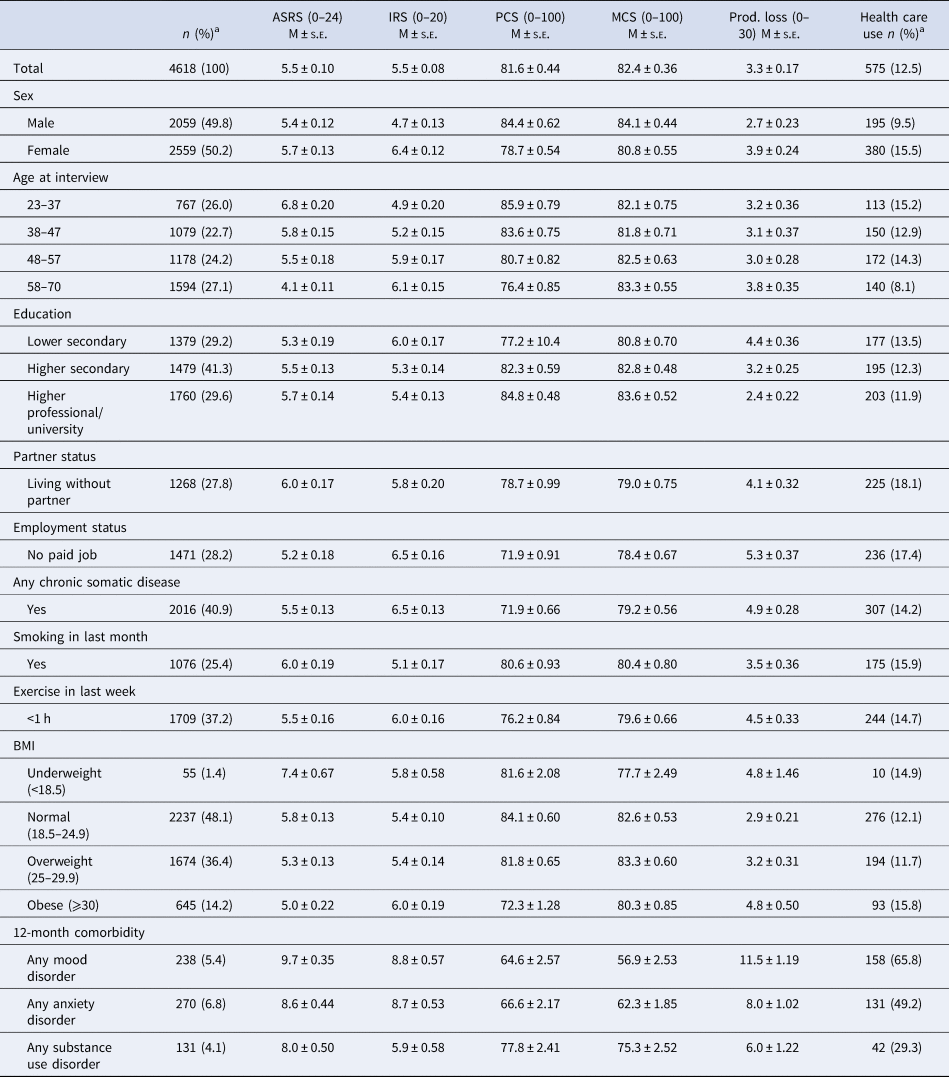
Table 1 shows the outcomes of the questionnaires on ADHD, insomnia, QoL, productivity loss, and health care use.
Outcomes of quality of life, productivity loss, and health care use in the general population (N = 4618)

ASRS, Adult ADHD Self-Report Scale; IRS, (Women's Health) Insomnia Rating Scale; PCS, Physical Component Scale of SF-36; MCS, Mental Component Scale of SF-36; Prod. loss, productivity loss in days; Health care use: percentage of people with a positive score on health care use (any health care use in the last 12 months).
a Unweighted numbers and weighted percentages.
QoL & productivity loss
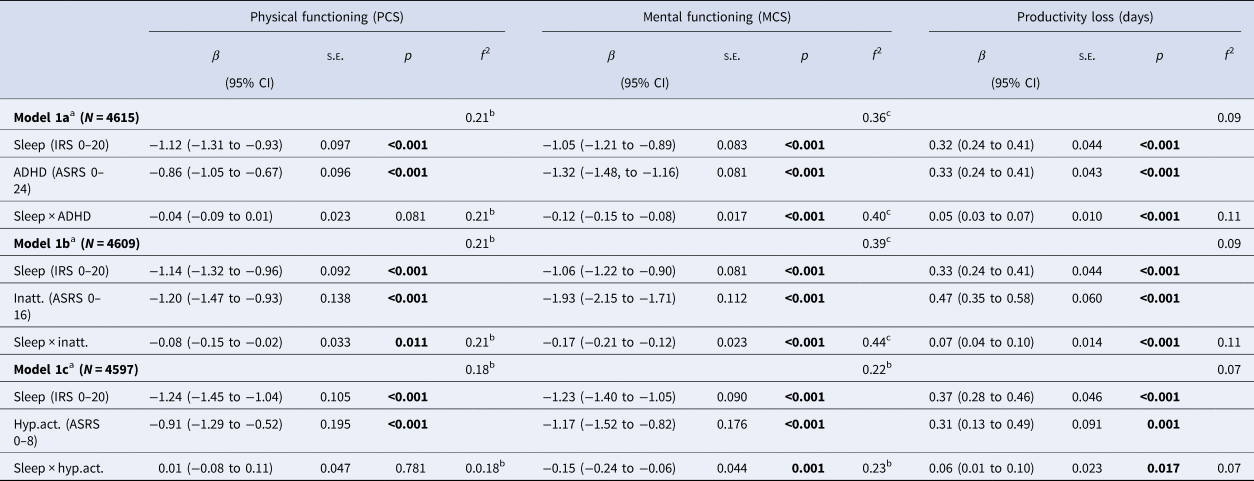
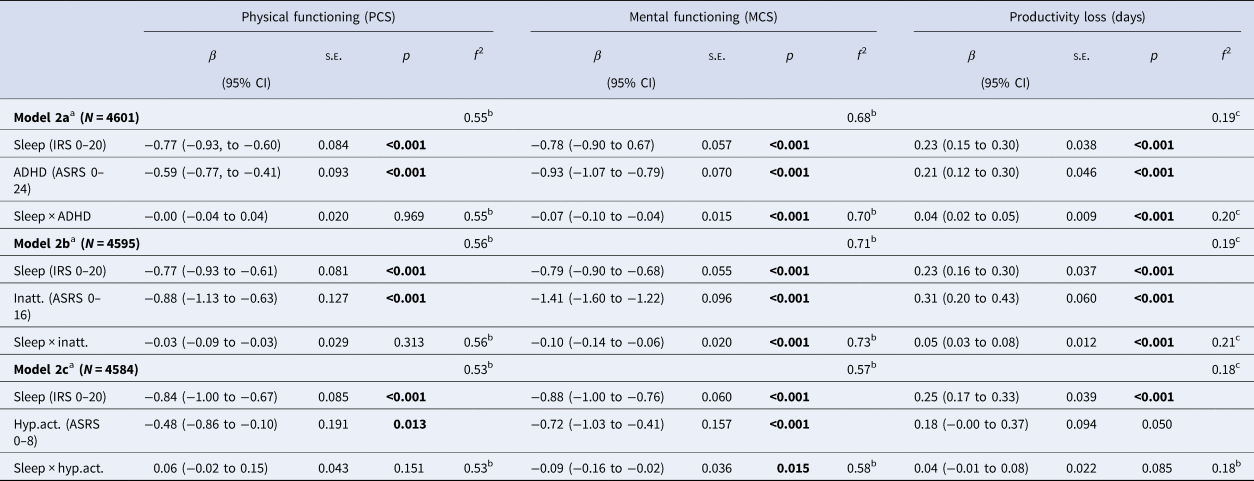
Multiple linear regression analyses were used to analyse if insomnia (IRS) and ADHD (ASRS) scores were associated with physical (PCS) and mental functioning (MCS) and productivity loss. Table 2 depicts the outcomes of the partly adjusted models for total ASRS (1a), inattention (1b), and hyperactivity (1c) scores. The outcomes of the fully adjusted models for total ASRS (2a), inattention (2b), and hyperactivity (2c) are shown in Table 3. The fully adjusted models (Table 3) show large effect sizes for ADHD and sleep on PCS and MCS (f 2 ⩾ 0.35) and medium effect sizes on productivity loss (f 2 ⩾ 0.15).
Main and interaction effects of ADHD, its symptom dimensions, and insomnia symptoms on quality of life and productivity loss: linear regression in models adjusted for sex and age

β: unstandardised coefficient; s.e.: linearised standard error; p-value: statistical significance was inferred at α = 0.05; statistically significant values are shown in bold; f 2: Cohen's f 2 effect size; inatt: inattention; hyp.act.: hyperactivity.
a Step 1 included only the main effects of the independent variables, step 2 included interaction effects.
b Medium effect size (Cohen's f 2 ⩾ 0.15).
c Large effect size (Cohen's f 2 ⩾ 0.35).
Main and interaction effects of ADHD, its symptom dimensions, and insomnia symptoms on quality of life and productivity loss: linear regression in fully adjusted models

β: unstandardized coefficient; s.e.: linearised standard error; p-value: statistical significance was inferred at α = 0.05; statistically significant values are shown in bold; f 2: Cohen's f 2 effect size; inatt: inattention; hyp.act.: hyperactivity.
a Model 2: Adjusted for model 1 (sex and age; Table 2) and additionally education, partner status, job status, any chronic somatic disorder, BMI, smoking last month, exercise last week, any 12-month mood disorder, any 12-month anxiety disorder, and any 12-month substance use disorder. Step 1 included only the main effects of the independent variables, Step 2 included interaction effects.
b Large effect size (Cohen's f 2 ⩾ 0.35).
c Medium effect size (Cohen's f 2 ⩾ 0.15).
Physical functioning (PCS)
Insomnia, total ADHD, and both inattention and hyperactivity were significantly related to physical functioning in all partly and fully adjusted models (p < 0.05). Insomnia interacted significantly (p < 0.05) with inattention in the partly adjusted models (Table 2), but this interaction was no longer significant in the fully adjusted models (Table 3).
Mental functioning (MCS)
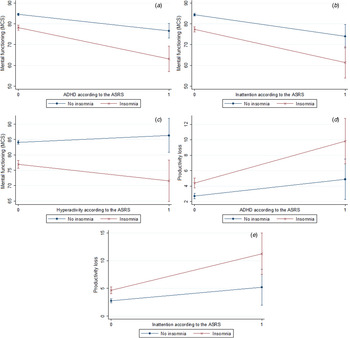
Mental functioning was highly significantly related to insomnia, total ADHD, inattention, and hyperactivity in all partly and fully adjusted models (all p < 0.001; Tables 2 and 3). Interactions between insomnia and ADHD, inattention, and hyperactivity were significant (p < 0.05) in all partly adjusted models (Fig. 1a–c) and remained significant even after adjusting for confounders.
Interaction plots for significant interaction effects between insomnia and ADHD on continuous outcomes in fully adjusted models. Plots show predictive margins of insomnia with 95% CIs for interaction between insomnia and (a) total ADHD and on MCS; (b) inattention on MCS; (c) hyperactivity on MCS; (d) total ADHD on productivity loss; (e) inattention on productivity loss.

Productivity loss
Insomnia, total ADHD, and both inattention and hyperactivity were significantly related to productivity loss (all p < 0.05) in the partly adjusted models. They all remained significant in the fully adjusted models. Insomnia interacted significantly (p < 0.05) with total ADHD, inattention, and hyperactivity in all partly adjusted models. Even in the fully adjusted models, these interactions remained significant except the interaction with hyperactivity (Fig. 1d–e).
Health care use
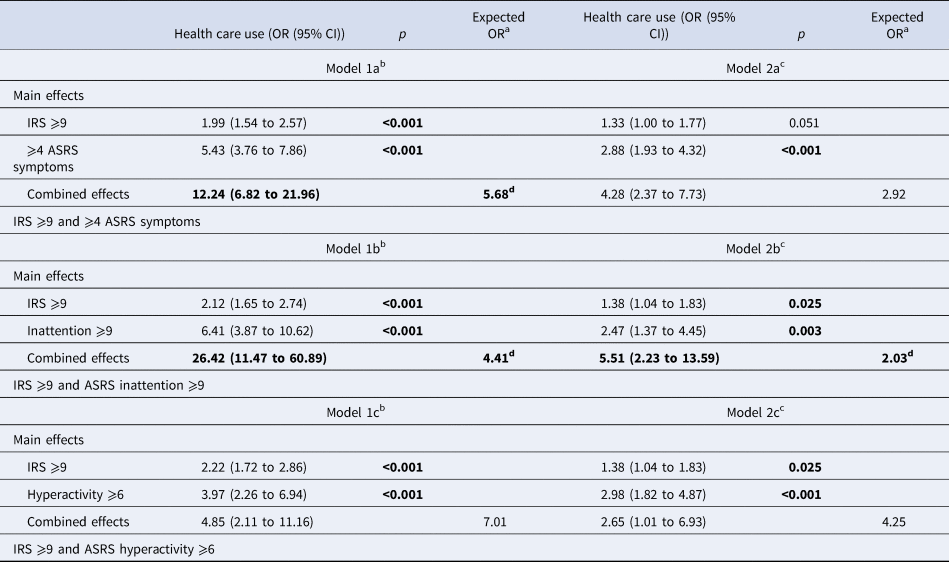
Multiple logistic regression analyses were used to test if clinically relevant scores of insomnia (IRS ⩾9), ADHD (⩾4 symptoms on ASRS), inattention (⩾9), and hyperactivity (⩾6) were associated with health care use. Table 4 shows the outcomes of the partly adjusted models for total ASRS (1a), inattention (1b), and hyperactivity (1c), and the fully adjusted models for total ASRS (2a), inattention (2b), and hyperactivity (2c).
Main and combined effects of ADHD, its symptom dimensions, and insomnia on health care use in the last 12 months: bivariate logistic regression in partly and fully adjusted models

IRS, (Women's Health) Insomnia Rating Scale; ASRS, Adult ADHD Self-Report Scale.
a Expected ORs in the case of no interaction. Additive interaction effects are considered significant if the expected ORs lay below the lower limits of the confidence interval of the combined effects.
b Model 1: Adjusted for sex and age.
c Model 2: Adjusted for model 1 (sex and age) and additionally education, partner status, job status, any chronic somatic disorder, BMI, smoking last month, exercise last week, any 12-month mood disorder, any 12-month anxiety disorder, and any 12-month substance use disorder. Main effects were taken from models without interaction terms.
d Statistically significant interaction (seea).
Clinically relevant insomnia and ADHD were independently significantly related to health care use in all partly adjusted models (p < 0.05). All these effects remained significant in the fully adjusted model, except for the total ADHD score, which just failed to reach statistical significance (p = 0.051). In the partly adjusted models, there were significant interactions between insomnia and total ADHD [OR 12.24, 95% CI (6.82–21.96); cf. 5.68 for no interaction] and insomnia and inattention [OR 26.42, 95% CI (11.47–60.89); cf. 4.41 for no interaction]. Only the interaction between insomnia and inattention remained significant in the fully adjusted model [OR 5.51, 95% CI (2.23, 13.59); cf. 2.03 for no interaction].
Discussion
The present study investigated the independent and, most importantly, combined effects of symptoms of ADHD and insomnia on QoL, productivity, and health care use in the general population. It took into account a broad range of possible confounders and comorbidities and examined the ADHD symptom dimensions inattention and hyperactivity separately. ADHD symptoms and insomnia symptoms together were very strongly related to poorer outcomes. The present results show that mental functioning and productivity werevery negatively affected if ADHD and insomnia symptoms co-occurred. These combined effects remained strong even after correcting for confounders and comorbidities. Poorer physical functioning and increased health care use were also linked to the co-occurrence of ADHD and insomnia symptoms, although these interaction effects did not hold after correcting for comorbid disorders and other confounders.
In line with the hypothesis, the combination of ADHD and insomnia symptoms had a stronger negative association with outcomes than they did separately, at least with mental functioning and productivity. Having insomnia symptoms on top of ADHD symptoms, or vice versa, thus places a stronger burden on an individual. The question how exactly ADHD and insomnia interact remains intriguing, and one that cannot be answered on the basis of the present results. Insomnia can be a primary disorder or secondary to other (sleep) disorders. Looking at sleep more broadly, there is growing evidence that sleep problems can be consequences, causes, or intrinsic features of ADHD and vice versa (Bijlenga et al., Reference Bijlenga, Vollebregt, Kooij and Arns2019; Hvolby, Reference Hvolby2015). The relationship between ADHD and sleep is complex and bidirectional, and may be influenced by (psychiatric) comorbidity, medication use, and many other factors (Bijlenga et al., Reference Bijlenga, Vollebregt, Kooij and Arns2019).
A clinically relevant number of ADHD symptoms was reported by 6% of the population. Previous results from the same dataset showed that insomnia symptoms were clinically relevant in 23%, but in the probable ADHD group this was as high as 43% (Wynchank et al., Reference Wynchank, Ten Have, Bijlenga, Penninx, Beekman, Lamers and Kooij2018), confirming that ADHD and insomnia are indeed strongly associated. As expected, clinical and subclinical symptoms of both ADHD and insomnia were related to poorer QoL, lower productivity, and increased health care use. This corresponds with previous findings in numerous studies (e.g. Baldwin et al., Reference Baldwin, Griffith, Nieto, O'connor, Walsleben and Redline2001; Das et al., Reference Das, Cherbuin, Butterworth, Anstey and Easteal2012; Estevez et al., Reference Estevez, Eich-Hochli, Dey, Gmel, Studer and Mohler-Kuo2014; Gudjonsson et al., Reference Gudjonsson, Sigurdsson, Smari and Young2009; Oerbeck et al., Reference Oerbeck, Overgaard, Pripp, Aase, Reichborn-Kjennerud and Zeiner2015; Vogel et al., Reference Vogel, Ten Have, Bijlenga, De Graaf, Beekman and Kooij2018; for reviews, see Agarwal et al., Reference Agarwal, Goldenberg, Perry and IsHak2012; Uneri et al., Reference Uneri, Senses-Dinc and Goker2015).
The current findings provide no indication of differences between the symptom dimensions. Inattention and hyperactivity showed largely the same effects as total ADHD score on all outcomes: independently they were related to poorer outcomes on all measures, and combined associations with poorer mental functioning and productivity loss remained even after controlling for confounders and comorbidities. The only difference between total ADHD symptoms and the dimensions was in health care use: inattention and insomnia together were associated with increased health care use even after adjusting for possible confounders, while such relationships were not found for hyperactivity. Previous population studies on QoL reported stronger effects of inattention than of hyperactivity/impulsivity (Das et al., Reference Das, Cherbuin, Butterworth, Anstey and Easteal2012; Oerbeck et al., Reference Oerbeck, Overgaard, Pripp, Aase, Reichborn-Kjennerud and Zeiner2015), but these findings should be interpreted with caution as comorbidities were not considered. In clinical samples, results have been mixed (Da Silva et al., Reference Da Silva, Chaim, Cavalett, Serpa, Zanetti, Vieira and Louzã2014; Kettaneh, Reference Kettaneh2015; Weiss et al., Reference Weiss, Gibbins, Goodman, Hodgkins, Landgraf and Faraone2010).
This study had a large sample size and looked at the distribution of symptoms of ADHD and insomnia in the general population, rather than only at clinically diagnosed ADHD and insomnia. Moreover, a wide range of possible confounders and comorbidities was controlled for. Validated instruments were used to assess these symptoms, comorbidities, and QoL outcomes. Some limitations do however need considering. A disadvantage was that the NEMESIS-2 study was not specifically designed to answer the current questions and should thus be considered exploratory. Even though the sample was largely nationally representative, people who had insufficient mastery of the Dutch language, no fixed address, or who were institutionalised were underrepresented. The findings can therefore not be generalised to these groups. Moreover, this study used cross-sectional analyses, so causality could not be tested. Although data were weighted to account for non-response at the first wave and drop-out at subsequent waves, it is not known whether attrition was related to the non-sociodemographic measures included in this study. Furthermore, the ASRS is a retrospective self-report scale asking people about ADHD symptoms over the past 6 months and does not cover all diagnostic criteria of ADHD. The short version of the ASRS used in this study is mostly used as a screening tool and is not as precise as longer versions used for diagnostics. There are no questions on childhood onset of symptoms and it only contains two questions on hyperactivity. Impulsivity, another ADHD dimension, is not assessed with this instrument. Still, it has shown good concordance with clinician diagnoses (Kessler et al., Reference Kessler, Adler, Ames, Demler, Faraone, Hiripi and Walters2005). Lastly, insomnia symptoms were also assessed with retrospective self-reports. The IRS evaluates insomnia over the last 4 weeks, whereas a clinical diagnosis requires problems for at least 3 months. Symptom duration was not evaluated in the IRS, so possibly less severe insomnia was studied. Significant associations with insomnia were still found and may be even stronger with more stringent criteria. Further information on sleep characteristics and circadian rhythm was not available, whereas especially the latter might play a role in insomnia symptoms in ADHD (Bijlenga et al., Reference Bijlenga, Vollebregt, Kooij and Arns2019).
Despite these limitations, the present results have high relevance, both clinically and from a health economics viewpoint. They underscore the importance of assessing and treating insomnia symptoms in clinical ADHD, and ADHD symptoms in clinical insomnia, as together they have an even stronger negative impact on QoL, productivity, and health care use than they do separately. In addition, professionals working with people displaying subclinical symptoms of either ADHD or insomnia, e.g. general practitioners, should be aware of their interplay. There is already some evidence that treating sleep problems alleviates ADHD symptoms in adults (Fargason et al., Reference Fargason, Fobian, Hablitz, Paul, White, Cropsey and Gamble2017; Rybak et al., Reference Rybak, McNeely, Mackenzie, Jain, Levitan, Umesh and Levitan2006), although not much is known yet for insomnia specifically. A better understanding of the relationships between ADHD and various sleep problems can lead to more targeted and effective treatment and may prevent subclinical symptoms from developing into clinical diagnoses.
Acknowledgements
The Netherlands Mental Health Survey and Incidence Study-2 (NEMESIS-2) is conducted by the Netherlands Institute of Mental Health and Addiction (Trimbos Institute) in Utrecht, The Netherlands. Financial support has been received from the Ministry of Health, Welfare and Sport, with supplemental support from the Netherlands Organization for Health Research and Development (ZonMw) and the Genetic Risk and Outcome of Psychosis (GROUP) investigators. These organisations had no further role in study design, the collection, analysis, and interpretation of data, in the writing of the report, or in the decision to submit the paper for publication.
Conflict of interest
None.