Introduction
Taenia solium cysticercosis is a major public health problem in developing countries, including India (Prasad et al., Reference Prasad2008). Humans are the only definitive hosts of T. solium harbouring the adult tapeworm in the intestine (taeniasis), while both humans and pigs can act as intermediate hosts and harbour the larvae in various internal organs of the body (cysticercosis), including the brain (neurocysticercosis). Neurocysticercosis (NCC) is the single most common cause of acquired epilepsy in developing countries (Garcia and Del Brutto, Reference Garcia and Del Brutto2003). NCC is common in communities where pigs are raised openly and roam freely, and where residents consume undercooked pork, and basic sanitary facilities are lacking (WHO, 1983). In India, pigs are sold in local markets without any inspection, leading to infected pork being frequently consumed. Swine cysticercosis is highly endemic in this part of the country. A study showed that 26% of slaughtered pigs had cysticerci in their muscles (Prasad et al., Reference Prasad2002). The consumption of infected pork leads to taeniasis. There is an urgent need to develop a reliable diagnostic test that can identify infected swine. Tongue examination is frequently used for the detection of cysticerci, but its sensitivity is low and it requires skilled workers (Gonzalez et al., Reference Gonzalez1990). Detection of anti-cysticercal antibodies in serum by enzyme-linked immunosorbent assay (ELISA) or immunoblot is an important diagnostic tool for swine cysticercosis. Infection with T. solium cysticerci provokes an antibody response, mainly IgG but also, to a lesser extent, IgM, IgA and IgE (Goodman et al., Reference Goodman, Carpio and Ballagh1997). Improved protein purification techniques have resulted in much more reliable serological tools (Gottstein et al., Reference Gottstein, Tsang and Schantz1986; Parkhouse and Harrison, Reference Parkhouse and Harrison1987; Ito et al., Reference Ito1998; Tsang et al., Reference Tsang, Brand and Boyer1989). The most specific test developed for cysticercosis is enzyme-linked immunoelectrotransfer blot (EITB). However, studies evaluating EITB as a diagnostic tool for swine cysticercosis in endemic areas with antigens prepared from whole T. solium cysticercus antigens (WCA) are lacking. We developed WCA-based EITB for the diagnosis of swine cysticercosis in a cysticercosis/neurocysticercosis highly endemic area of North India.
Materials and methods
Study subjects
A total of 36 swine were identified initially and selected for the study based on clinical signs, as described earlier (Prasad et al., Reference Prasad2006), followed by examination of the neck muscle, tongue and eyelids for the presence of cysticerci (Singh et al., Reference Singh2013). Cysticercosis/neurocysticercosis was confirmed in 30 individuals by magnetic resonance imaging (MRI), following the protocol described earlier (Prasad et al., Reference Prasad2002), and these animals were included in the study. Fifty swine raised on a government farm with enclosed housing were included as negative controls; these animals were presumed to be negative for cysticercosis, as they were fed with commercial food and not allowed to roam freely, with no exposure to human faeces or other transmission vectors. Blood samples were collected from the ear vein of all 30 MRI-confirmed and 50 control pigs; sera were separated and subjected to EITB with WCA.
Preparation of WCA
The WCA was prepared following the standard protocol described earlier (Prasad et al., Reference Prasad2011). Briefly, T. solium cysticerci were isolated from pig muscles, washed five times in phosphate buffered saline (PBS) and homogenized using a motor-driven tissue homogenizer (Labo stirrer, LR-41C, Yamato, Japan). Finally, a protease inhibitor cocktail (Sigma, MO, USA) was added and then centrifuged (SCP85, Himac, Japan) at 200,000 g for 30 minutes. The supernatant was aspirated and filtered through 0.45 μm filter (Whatman, New Jersey, USA). Protein in the filtrate was quantified by the Bradford method (Reference Bradford1976) and the filtrate (WCA) was stored at −80°C until use.
Sodium dodecyl sulphate polyacrylamide gel electrophoresis (SDS-PAGE)
SDS-PAGE was performed on the WCA according to LAEMMLI (1970) in 10% separating gel and 4.5% stacking gel. The gels were stained with Coomassie Brilliant Blue, and the molecular weight of protein bands was determined using standard molecular weight markers (Genei, Bangalore, India).
Enzyme-linked immunoelectrotransfer blot (EITB)
The WCA as prepared above was used as antigens for EITB. On a preparative comb of SDS-PAGE (15%) mini gel, 40 μg of protein was loaded on Biorad-Protean II, and after running the gel, proteins were electro-blotted on nitrocellulose membrane (Sigma- Aldrich, MO, USA) at 20 V for 6 h. The membrane was blocked with 5% w/v skimmed (non-fat dry) milk, and then cut into 3 mm strips. The strips were incubated with serum (1 : 200 dilutions) at 4°C overnight and were washed with PBS three times and then incubated with horseradish peroxidase (HRP) labelled goat anti-swine IgG (1 : 1000 dilutions) (Santacruz Biotechnology, USA) for 3 h with constant shaking at room temperature. The blots were developed by diaminobenzedine (Genei, Bangalore, India) as per the manufacturer's guidelines. An immunoblot was considered positive on appearance of one or more bands of < 50 kDa (Tsang et al., Reference Tsang, Brand and Boyer1989; Prabhakaran et al., Reference Prabhakaran2004).
Results
SDS-PAGE
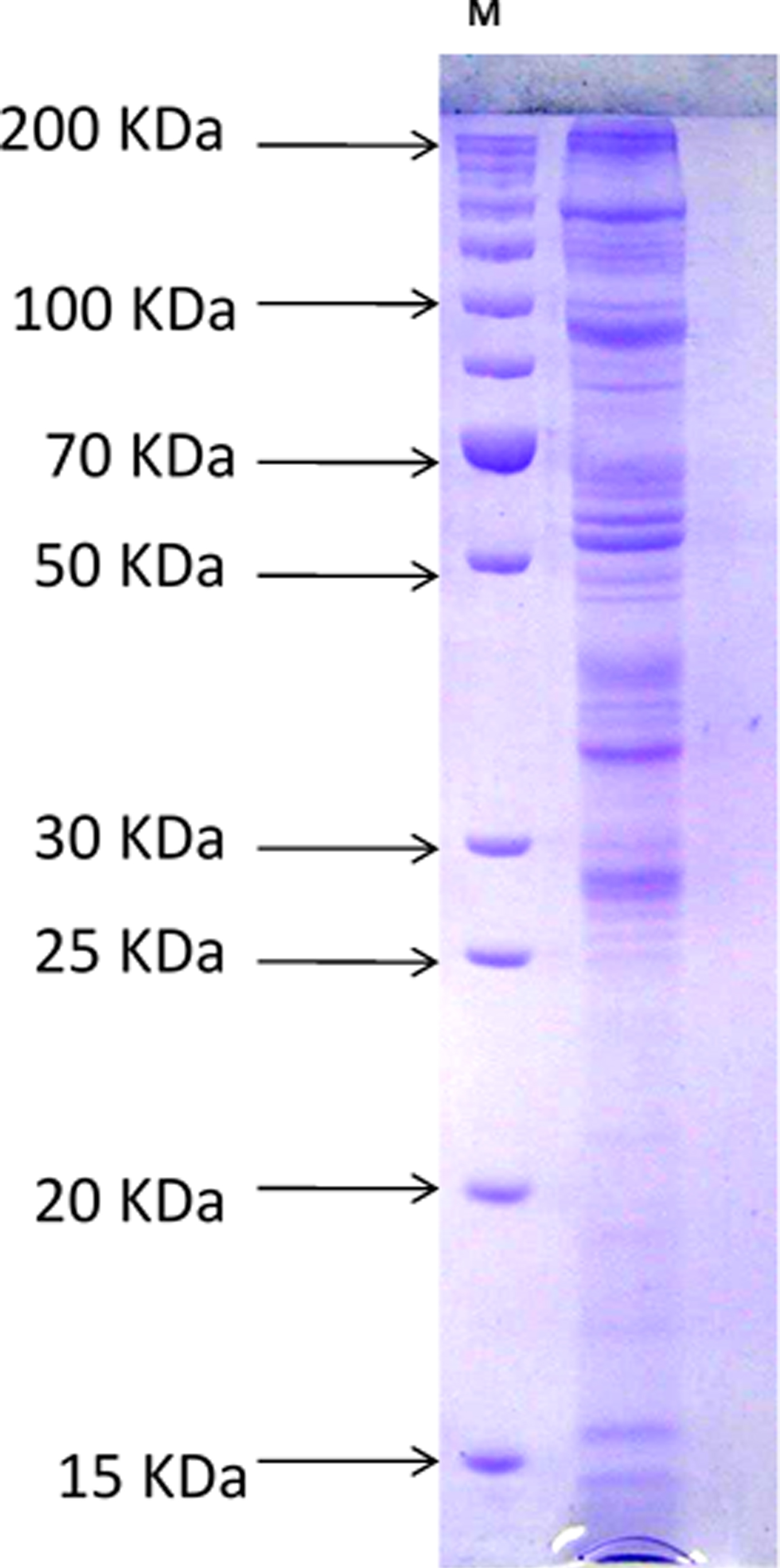
The protein patterns of WCA analysed by SDS-PAGE revealed bands ranging from 8 kDa to 200 kDa (fig. 1).
Sodium dodecyl sulphate polyacrylamide gel electrophoresis profile of whole crude Taenia solium cysticercus antigens from swine.

Immuno-reactive proteins of WCA
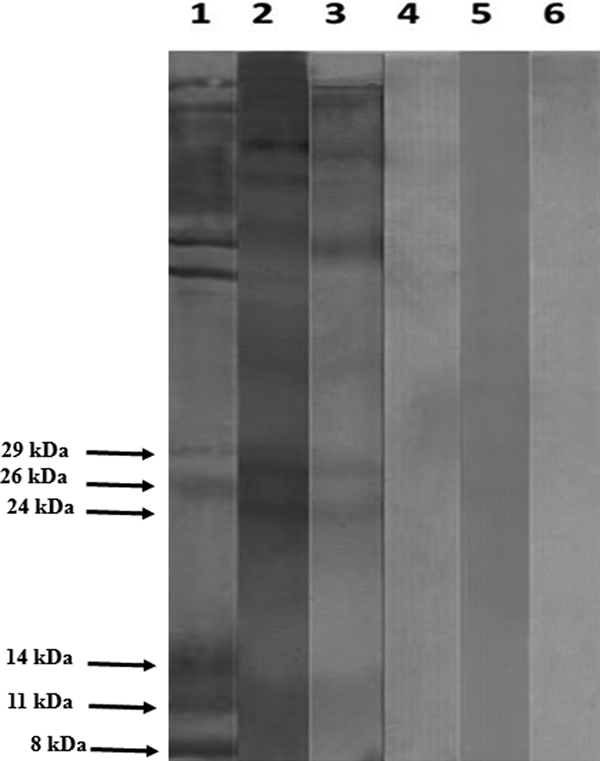
Sera from 28 naturally infected swine were found to be immuno-reactive on EITB (fig. 2). Overall, two or more of the six antigens (8, 11, 14, 24, 26 and 29 kDa) showed immuno-reactive bands with sera of these 28 infected swine. None of the sera from the 50 swine raised on the government farm showed any immuno-reactive bands on EITB. The overall sensitivity and specificity of the test (EITB) were 93.3% (95% confidence limits 0.7793–0.9913) and 100% (95% confidence limits 0.9289–1.000), respectively.
Whole crude Taenia solium cysticercus antigen based enzyme-linked immunoelectrotranfer blot of serum samples from pigs. Lanes 1, 2 and 3 represent the blot profile with sera from swine with cysticercosis, and lanes 4, 5 and 6 represent the blot profile with sera from control swine.

Discussion
EITB based on glycoproteins of T. solium cysticerci has been broadly accepted for sero-diagnostic purposes, and bands of < 50 kDa have been identified as major diagnostic markers. However, the process of preparing purified glycoproteins is quite difficult and expensive for laboratories in developing countries. This is the first study in which serum samples from swine with cysticercosis confirmed by MRI were used for EITB. Gottstein et al. (Reference Gottstein, Tsang and Schantz1986) used crude T. solium antigens in Western blot based immunodiagnosis of human cysticercosis. In the present study, we followed the same approach and the WCA was tested for diagnosis of swine cysticercosis. The SDS-PAGE protein profile of WCA revealed bands ranging from 8 to 200 kDa. A similar protein profile had been reported in an earlier study (Pathak et al., Reference Pathak1994). In the present study, when sera from naturally infected swine were subjected to WCA on blot, two or more bands of 8, 11, 14, 24, 26 and 29 kDa were found to be immunoreactive. In an earlier study on swine cysticercosis, bands of 8, 11, 16 and 23 kDa were found to be immunoreactive on EITB (Pathak et al., Reference Pathak1994). The sensitivity (93.3%) and specificity (100%) of the EITB in the present study were in the estimated range as reported by other authors (Pathak et al., Reference Pathak1994; Ito et al., Reference Ito1999; Sreenivasamurthy et al., Reference Sreenivasamurthy, D'Souza and Jagannath1999). All the infected swine except two were positive by EITB assay. The probable explanation for negative results in two swine may be due to inappropriate or lack of immune response in these two individuals. Similar false negative results in infected pigs had been reported previously (Flisser, Reference Flisser1988). The authors in this study further observed that some cysticercotic pigs with brain involvement did not show immune response, and these pigs had oedema around the cysticerci. The sera from healthy swine recruited from a government farm were found to be non-reactive on EITB as expected, as these swine were not allowed to roam freely and were maintained on commercial food. These swine were unlikely to be infected as they had no access to human faeces or other likely infectious vectors. Another study carried out on swine raised in an enclosed corporation slaughterhouse in Bengaluru, South India, in which the conditions were similar to our controls, also did not show any immunoreactive bands on EITB (Dhanalakshmi et al., Reference Dhanalakshmi, Jagannath and D'Souza2005). However, the sensitivity and specificity of EITB may vary based on the type of antigens used in the assay, parasite load, stage of the parasite and infection by other Taenia species. The calcified stage of the parasite mounts little or no immune response. Infection by cysticerci of Taenia hydatigena in pigs was observed to mount an immune response that cross-reacted to T. solium cysticeri-based ELISA (Brandt et al., Reference Brandt1992). However, glycoprotein- and recombinant chimeric antigen-based serology was found to be specific for T. solium and did not cross-react with sera from T. hydatigena infected pigs (Sato et al., Reference Sato2003). In an experimental swine model, the antibody response was detectable in all pigs harbouring 16 or more vesicular cysticerci (Sato et al., Reference Sato2003). Hence, the false negative serology may occur in pigs with low cysticerci burden. Studies on cross-reactivity with sera from Taenia asiatica infected swine are lacking. However, sera from species-specific adult taeniid infection in humans have shown cross-reaction with other Taenia species (Jeon and Eom, Reference Jeon and Eom2009). The disease endemicity, the intensity of exposure to the parasite by the pig population, and the ability of the swine to mount an immune response may also influence the serological test results.
Finally, we conclude that the WCA-based EITB may be a good diagnostic tool for swine cysticercosis. The antigen preparation is less laborious and is cost-effective. Overall, the assay is quite sensitive and specific. It is likely to be a valuable tool in assessing the disease burden in swine in endemic areas, with better understanding of the disease epidemiology. The test needs further validation in other endemic areas with larger sample sizes.
Acknowledgements
Kamlesh Kumar Gupta duly acknowledges the University Grant Commission [22/12/2013 (ii) EU-V], New Delhi, India.
Financial support
The study was supported by Grant SR/SO/HS-21/2008 from the Department of Science and Technology, Government of India, New Delhi.
Conflict of interest
None.
Ethical standards
This work was approved by the ethics committee of Sanjay Gandhi Postgraduate Institute of Medical Sciences, Lucknow, India.