Introduction
The present study investigates aspectual marking in adult Heritage Speakers (HSs) of Greek. It aims to explore whether HSs’ grammar deviates from that of monolingual controls, and if so, whether there is a certain acquisition strategy employed (i.e., use the default aspectual marking). Furthermore, the study explores the impact of the dominant language on the heritage language. Thus, it tests the production and comprehension of two groups of HSs with different majority languages, namely Greek HSs who are born and raised in Germany and HSs who are born and raised in the US. With the term HSs, we refer to second-generation immigrants exposed to a minority language early in childhood naturalistically in an area where a majority language was spoken (Montrul, Reference Montrul2004; Polinsky, Reference Polinsky2011; Valdés, Reference Valdés, Peyton, Ranard and McGinnis2001). While heritage language research has shown that certain structures are (more) subject to change, today it is still less clear how and why certain elements are more vulnerable than others and which factors are involved in this process (Osch, Reference Osch2019).
Aspect in heritage Greek remains underexplored, yet it is an intriguing grammatical phenomenon for studies with HSs: first, due to its late-acquired nature (even) by Greek monolingual (L1) children (e.g., Greek L1 children fully acquire aspectual distinctions 1–2 years after they have entered the educational system, see Delidaki, Reference Delidaki2006), and second, because it stands at the interfaces (Sorace, Reference Sorace2011; Tsimpli & Sorace, Reference Tsimpli, Sorace, Bamman, Magnitskaia and Zaller2006) between morphosyntax and semantics but also pragmatics, which may have an impact on the choice of a certain aspectual form (e.g., Andreou et al., Reference Andreou, Dosi and Bongartz2021; Kaltsa & Tsimpli, Reference Kaltsa, Tsimpli, Gavriilidou, Efthymiou, Thomadaki and Kambakis-Vougiouklis2012). Thus, Greek HSs may exhibit vulnerability to aspect given that the time child HSs start becoming more dominant in the majority language through their entrance to its educational system coincides with the time of aspect acquisition in Greek. Thus, Greek may start lagging under the influence of the majority language, and consequently, some parts of aspect may not be fully acquired or may be acquired later.
Meanwhile, the role of the majority language on the heritage one has not been explored adequately (Lopez-Otero & Cuza, Reference Lopez-Otero, Cuza, Ortiz, Guzzardo Tamargo and González Rivera2020; Osch, Reference Osch2019; Tao et al., Reference Tao, Cai and Gollan2019; Valenzuela et al., Reference Valenzuela, Iverson, Rothman, Borg, Cabo, Pinto, Gumiel-Molina and Pérez-Jiménez2015; Zuban et al., Reference Zuban, Rathcke and Zerbian2020). Existing studies show that the majority language may cause either facilitation or inhibition in the performance of a distinct grammatical structure in the other language (e.g., due to cross-linguistic influence from the dominant language). This line of research can reveal whether and which deviations in the heritage language are attributed to the structure and influence of a certain majority language (e.g., Montrul & Ionin, Reference Montrul and Ionin2010) or to internal changes to the heritage language itself (e.g., Polinsky, Reference Polinsky2011; Pires & Rothman, Reference Pires and Rothman2009; Silva-Corvalán, Reference Silva -Corvalán1994). Our study aims to further explore this question.
Grammatical aspect
The literature mostly distinguishes three categorizations of aspect: lexical aspect (situation/Aktionsart) is a semantic property inherent in the meaning of the verb (e.g., the lexical aspect of activities, accomplishments, achievements) and refers to the internal temporal constituency of events (see Vendler, Reference Vendler1967), grammatical (viewpoint) aspect is morphologically encoded with distinct aspectual marking (Comrie, Reference Comrie1976), and compositional (VP) aspect which refers to the relation of the verb with other elements in the verb phrase (Verkuyl, Reference Verkuyl1972). Greek verbs are morphologically marked for aspect, tense, person, number, and voice. The aspectual distinction appears only in past and future tenses in indicative and subjunctive mood (Holton et al., Reference Holton, Mackridge and Philippaki-Warburton1997; Mozer, Reference Mozer, Philippaki-Warburton, Nicolaidis and Sifianou1994). The present study specifically focuses on the past perfective and past imperfective aspect. The augment é- in all active past forms may precede both the perfective and imperfective stem depending on the number of their syllables across the inflectional system (Ralli, Reference Ralli2003). Imperfective aspect (1) is morphologically unmarked (Ralli, Reference Ralli2005) and corresponds to both the continuous (2a) and habitual (2b) interpretation without any morphological differentiation on the verb, while disambiguation between the two interpretations can be solved either lexically with temporal modifiers or via context. Imperfective bears the semantic features [-bounded] and [+/- iterative] (Mozer, Reference Mozer, Philippaki-Warburton, Nicolaidis and Sifianou1994).

On the other hand, perfective is [+bounded] and involves either regular or irregular processes in its morphological realization. The regular/sigmatic formation involves the addition of the affix -s- in the imperfective stem (3a-b) accompanied by either predictable phonological changes of the stem (3a) depending on its final consonant in verbs of the first conjugation or stem allomorphy (3b) in verbs of the second conjugation (Ralli, Reference Ralli2005). The irregular/asigmatic formation lacks the affix -s-, and it usually involves more unpredictable stem allomorphy (3c). Perfective aspect in Greek denotes either completion or instantaneity (4) of events (Mozer, Reference Mozer, Philippaki-Warburton, Nicolaidis and Sifianou1994) and makes the endpoint of the event visible and views the event as a whole (Smith, Reference Smith1991).

In English, perfective aspect denotes completed events in the past (5a) but also habituality (5b). Habituality is also encoded via the periphrastic expression (used to/would) (5b). English encodes progressivity with the -ing marker in combination with the auxiliary “be” to denote ongoing events in the past (6). Thus, as opposed to Greek, English encodes progressivity and not continuity, and it can also encode habituality with the perfective (non-progressive) formFootnote 1 . Furthermore, in the past tense, morphologically and typologically, English encodes progressivity analytically, while Greek encodes perfectivity synthetically (see above).

German lacks aspectual marking, and aspectual distinctions are made via lexical/periphrastic cuesFootnote 2 (see Sioupi, Reference Sioupi2014) in terms of continuity and habituality. Thus, in the past tense, habituality, for example, can be expressed via the form pflegten + zu + infinitive, die Gewohnheit hatten zu + infinitive (“used to/had the habit to”) (7a). Continuity can be expressed periphrastically, for example, am/beim + nominalized infinitive or dabei sein (Past) zu + infinitive (“be in the process of”) or with gerade (“now”) (7b). The next section refers to previous studies on aspect in monolingual and bilingual acquisition with a special focus on (Greek) HSs.

Acquisition of aspect in L1 and L2
Most acquisition studies on aspect have focused on the interaction between grammatical and lexical aspect, aspectual marking, and the role of the other language. Thus, certain hypotheses have been proposed to account for aspect acquisition in L1 and L2 (e.g., from Aspect Hypothesis: Andersen and Shirai, Reference Andersen and Shirai1994, to the Interface Hypothesis in L2 and bilingual children: Sorace, Reference Sorace2011). Overall, studies on L1 acquisition of aspect do not provide a uniform picture of acquisition cross-linguistically. For example, English children seem to show acquisition difficulties with aspect up to the ages of 5;0-6;0 especially with imperfective (Wagner, Reference Wagner2006; Jeschull, Reference Jeschull, Belikova, Meroni and Umeda2007). Russian and Polish children seem to acquire aspect up to the age of 3;0 (e.g., Gagarina, Reference Gagarina2004; Kazanina & Phillips, Reference Kazanina, Phillips, Beachley, Brown and Conlin2003; Vinnitskaya & Wexler, Reference Vinnitskaya and Wexler2001; van Hout, Reference van Hout, Belikova, Meroni and Umeda2007; Weist et al., Reference Weist, Wysocka, Witkowska-Stadnik, Buczowska and Konieczna1984), while Italian children continue exhibiting difficulties with perfective after that age (van Hout, Reference van Hout, Greenhill, Hughes and Littlefield1998).
In L1 Greek, several studies have been conducted (Christofidou & Stephany, Reference Christofidou, Stephany, Bittner, Dressler and Kilani-Schoch2003; Delidaki & Varlokosta, Reference Delidaki and Varlokosta2003; Delidaki, Reference Delidaki2006; Kaltsa, Reference Kaltsa2012; Konstantzou et al., Reference Konstantzou, Varlokosta, van Hout and Vlassopoulos2013; Panitsa, Reference Panitsa2010; Papakonstantinou, Reference Papakonstantinou2015; Stephany, Reference Stephany, Dale and Ingram1981; Tsimpli & Papadopoulou, Reference Tsimpli and Papadopoulou2006). According to early studies, perfective is acquired from age 1;10 (Stephany, Reference Stephany and Slobin1997), past imperfective only emerges at the age of 2;4 and is acquired quite later (Katis, Reference Katis1984, p. 197), and habitual is acquired later than the continuous interpretation of imperfective. Earlier acquisition of perfective compared to imperfective has also been reported more recently (Kaltsa, Reference Kaltsa2012; Konstantzou et al., Reference Konstantzou, Varlokosta, van Hout and Vlassopoulos2013; Papakonstantinou, Reference Papakonstantinou2015). Thus, Greek children seem to distinguish between the two aspectual markers in Greek from age 3;0 (Katis, Reference Katis1984; Tsimpli, Reference Tsimpli1996), although the mapping between an aspectual value (form) and a certain meaning (e.g., habitual) is in progress until the ages of 5-6;5 (Delidaki, Reference Delidaki2006; Panitsa, Reference Panitsa2010) and aspectual adverbials, when present, facilitate children’s performance (Panitsa, Reference Panitsa2010). Finally, sigmatic past perfective forms are acquired earlier than asigmatic perfective ones (Stavrakaki & Clahsen, Reference Stavrakaki and Clahsen2009).
With respect to L2 aspect acquisition, studies have shown that L2 learners exhibit difficulties (e.g., Andersen, Reference Andersen, Huebner and Ferguson1991; Ayoun, Reference Ayoun, Ayoun and Salaberry2005; Robison, Reference Robison1990; Salaberry, Reference Salaberry, Salaberry and Shirai2002; Slabakova & Montrul, Reference Slabakova and Montrul2003). One issue which is relevant to the present study is the role of L1 on L2. Studies testing this factor (e.g., Flashner, Reference Flashner, Dechert and Raupach1989; Izquierdo & Collins, Reference Izquierdo and Collins2008; McManus, Reference McManus2015) found that L1 may facilitate aspect acquisition in L2 when both languages (e.g., Spanish and French) encode aspect quite similarly morphologically (similar form-meaning mapping), otherwise L1 may cause inhibition on L2 aspect acquisition (different form-meaning mappings).
In L2 Greek, Tsimpli and Papadopoulou (Reference Tsimpli, Papadopoulou, Leung and Sharwood-Smith2009) found that adult L2 learners of Greek from various language backgrounds perform well with aspectual marking, although they relied more on the lexical properties of verbs than grammatical aspect to encode telicity. Furthermore, L2 learners of lower proficiency as well as Greek-Albanian early-sequential bilingual children acquiring Greek as L2 exhibit acquisition difficulties (Kaltsa & Tsimpli, Reference Kaltsa, Tsimpli, Gavriilidou, Efthymiou, Thomadaki and Kambakis-Vougiouklis2012; Papafilippou, Reference Papafilippou2017). Andreou, Dosi and Bongartz (Reference Andreou, Dosi and Bongartz2021) explored aspect in the oral narrations of bilingual children with Greek as their majority language. They found that the monolingual children and the Greek-Italian children exhibited similar number of uses for perfective and imperfective, while Greek-English children exhibited more uses of perfective compared to the other two groups. This finding was attributed to cross-linguistic influence from English: that is, more uses of perfective in the English group due to influence from English which enhances perfective uses in habitual contexts, although it is illicit in Greek. However, the Greek-English group exhibited less input in Greek compared to the Greek-Italian group, which may also account for the differences found in the uses of perfective between those groups. Dosi et al. (Reference Dosi, Papadopoulou, Tsimpli, Howard and Leclercq2016b) tested aspect acquisition in Greek-English bilinguals living in Greece and found low accuracy (<70%), mainly because of the habitual imperfective condition, due to cross-linguistic influence from English.
Zooming in minority languages: acquisition of aspect in heritage populations
HSs’ performance on aspect has been reported to be both divergent (e.g., Cuza et al., Reference Cuza, Pérez-Tattam, Barajas, Miller, Sadowski and Schwieter2013; Lopez-Otero & Cuza, Reference Lopez-Otero, Cuza, Ortiz, Guzzardo Tamargo and González Rivera2020; Montrul, Reference Montrul2002; Montrul & Perpiñan, Reference Montrul and Perpiñán2011; Polinsky, Reference Polinsky, Corbett and Noonan2008) and convergent (e.g., Isurin & Ivanova-Sullivan, Reference Isurin and Ivanova-Sullivan2008; Kupisch & Rothman, Reference Kupisch and Rothman2018; Diaubalick et al., Reference Diaubalick, Guijarro-Fuentes, Schmitz, Guijarro-Fuentes and Suárez-Gómez2020) to the language of monolingual controls.
Studies finding divergence from the monolingual controls explain their findings under various hypotheses. The Incomplete Acquisition Hypothesis (Montrul, Reference Montrul2008) predicts that morphosyntactic deviations arise due to incomplete development of the heritage language under reduced input and use. Alternatively, these deviations have been explained under Attrition/reanalysis (Polinsky, Reference Polinsky2011) which predicts that morphosyntactic deficits are attributed to a loss/reanalysis of the previously established knowledge during the development of the heritage language including evidence from aspect acquisition in HSs (Polinsky, Reference Polinsky, Corbett and Noonan2008 for non-fluent Russian HSs). Note that Incomplete Acquisition cannot be easily dissociated from Attrition without longitudinal or cross-sectional data from both heritage adults and children (Polinsky, Reference Polinsky2011). Thus, following Mikhaylova (Reference Mikhaylova2018) and Montrul (Reference Montrul2008), the two hypotheses will be treated under the same group of hypotheses that have been made to describe the “mature linguistic state” (Montrul, Reference Montrul2008, p. 21) of adult HSs and to predict the possible outcome of the heritage language acquisition in the absence of sustained input (either stemming from language acquisition that is not complete or from Attrition and reanalysis).
Furthermore, the interface nature of the phenomenon imposes additional acquisition difficulties (Dosi, Reference Dosi2016; Laleko, Reference Laleko2010, Mikhaylova, Reference Mikhaylova2018) with HSs performing less accurately. For example, distinct interpretations of the same aspectual value are resolved at discourse or sentence level. Furthermore, the interface also regards the interaction between grammatical and lexical aspect: when the lexical and grammatical aspects of a verb are in non-prototypical alignment with each other (Smith, Reference Smith1991), that is, when perfective aspect [+bounded] is combined with atelic predicates (non-inherent limit of the event, as in activities), and imperfective aspect [-bounded] with telic predicates (with inherent limit, as in accomplishments or achievements), compared to when they are in prototypical alignment, that is, when perfective aspect [+bounded] is combined with telic predicates and imperfective aspect [-bounded] with atelic predicates. Given that the present study focuses on grammatical aspect and its design does not target the interaction between grammatical and lexical aspect, the latter is only approached exploratorily due to the absence of data on the topic in adult heritage Greek (via modeling the interaction between grammatical and lexical aspect and the interaction between grammatical aspect and telicity, see 4.1, 4.2.3 and 4.3.3).
Finally, under the Bottleneck Hypothesis (Slabakova, Reference Slabakova2008) extended to HSs (Polinsky, Reference Polinsky2011), functional morphology may cause acquisition difficulties for HSs of low or even of high fluency (Laleko, Reference Laleko2010; Mikhaylova, Reference Mikhaylova2018; Polinsky, Reference Polinsky, Corbett and Noonan2008) in the sense that, while syntactic and semantic representations may be intact, the corresponding overt morphology may be lacking (Polinsky, Reference Polinsky2011; Slabakova, Reference Slabakova2008) leading to performance errors. These “performance errors eventually become the essence of the mental representation of a language—a divergent, restructured grammar that grows out of a morphological bottleneck” (Polinsky, Reference Polinsky2011, p. 323).
Previous studies in adult heritage Russian in the US have reported vulnerability or loss of aspectual distinctions, which they mostly attribute to Attrition over the lifespan (e.g., Polinsky, Reference Polinsky, Corbett and Noonan2008), the Bottleneck Hypothesis (e.g., Mikhaylova, Reference Mikhaylova2018), and the Interface Hypothesis (e.g., Laleko, Reference Laleko2010). Moreover, studies on heritage Spanish in the US found inaccurate production of aspect, avoidance errors, and low accuracy which they attribute to Attrition and/or Incomplete Acquisition of aspect in Spanish (Cuza et al., Reference Cuza, Pérez-Tattam, Barajas, Miller, Sadowski and Schwieter2013; Corbet & Dominguez, Reference Corbet and Dominguez2020; Montrul, Reference Montrul2002; Montrul & Perpiñan, Reference Montrul and Perpiñán2011; van Buren, Reference Van Buren2012) and an overuse of the perfective form which they attribute to cross-linguistic influence from English.
Other studies in heritage Spanish and Russian found that HSs have fully acquired and retained the features of verbal morphology associated with aspect and tense (e.g., for heritage Russian in the US: Isurin & Ivanova-Sullivan, Reference Isurin and Ivanova-Sullivan2008; for heritage Spanish in Germany: Diaubalick et al., Reference Diaubalick, Guijarro-Fuentes, Schmitz, Guijarro-Fuentes and Suárez-Gómez2020) in line with the view that HSs can be indistinguishable from the monolingual controls especially when the heritage language is the medium of instruction (Kupisch & Rothman, Reference Kupisch and Rothman2018). For example, several studies report that advanced or even less fluent HSs maintained mostly an error-free production of aspectual marking (Isurin & Ivanova-Sullivan, Reference Isurin and Ivanova-Sullivan2008; Laleko, Reference Laleko2010 for heritage Russian in the US; Diaubalick et al., Reference Diaubalick, Guijarro-Fuentes, Schmitz, Guijarro-Fuentes and Suárez-Gómez2020).
Furthermore, the processing of aspect via timed judgments in heritage populations has been scarcely explored. Mikhaylova (Reference Mikhaylova2018) shows that English dominant heritage speakers of Russian were less accurate with aspectual morphology in their real-time judgments than the control group with the idiosyncratic telicity morphemes. Bowles (Reference Bowles2011) compared L2 English learners of Spanish with English dominant heritage speakers of Spanish via a test battery including timed judgments for aspect (among other morphosyntactic phenomena) and she found that HSs scored higher than L2 learners.
Focusing on heritage Greek, evidence comes from Dosi and colleagues for child HSs. Overall, they found that aspect is vulnerable, although not to the same extent for all groups and language combinations. Thus, child HSs of Greek living in Germany exhibited a performance closer to monolingual children with a mean accuracy of 77% and 82% in comprehension and production, respectively (Dosi & Papadopoulou, Reference Dosi and Papadopoulou2019), although their dominant language does not encode aspect morphologically. On the other hand, Greek-Albanian heritage children living in Albania exhibited an overall lower performance with a mean accuracy of 62.2%, although their dominant language encodes aspect (Dosi et al., Reference Dosi, Papadopoulou and Tsimpli2016a), perhaps due to their lower exposure to Greek. Finally, child HSs of Greek in the US (Dosi, Reference Dosi2017) exhibited chance performance with a mean accuracy of 53.8% and 51.6% across conditions in comprehension and production, respectively, although their dominant language (English) encodes aspect, perhaps due to their low exposure to Greek or the differences in the grammatical encoding of aspect between Greek and English.
With respect to the role of the majority language, HSs have been found to exhibit cross-linguistic influence from their dominant language when the latter encodes aspect morphologically differently from the heritage one (e.g., Cuza et al., Reference Cuza, Pérez-Tattam, Barajas, Miller, Sadowski and Schwieter2013 for Spanish HSs in the US). In studies where the dominant language does not encode aspect morphologically, HSs exhibited high acquisition rates (Diaubalick et al., Reference Diaubalick, Guijarro-Fuentes, Schmitz, Guijarro-Fuentes and Suárez-Gómez2020 for Spanish HSs in Germany). The latter finding may be associated with the fact that there is no influence to hinder or delay acquisition in the heritage language (see Cuza et al., Reference Cuza, Pérez-Tattam, Barajas, Miller, Sadowski and Schwieter2013 and Andreou & Tsimpli, Reference Andreou and Tsimpli2017 for discussion). For example, Andreou and Tsimpli (Reference Andreou and Tsimpli2017) found that their heritage and non-heritage Greek-German child group performed similarly to the Greek control group, while the non-heritage Greek-English group exhibited a different pattern from the other two groups. Thus, these early studies on the role of the dominant language on the heritage one seem to show that the absence of grammatical aspect in the dominant language does not hinder acquisition in the heritage language. Rather, the presence of aspect in the dominant language may facilitate or hinder acquisition in the heritage language depending on the degree of similarity in the encoding of aspect between the two languages. To our knowledge, studies with adult HSs directly comparing HSs with different majority languages are scarce and the present study aims to address this gap.
The present study investigates aspect in adult Greek HSs in comprehension and production. As opposed to previous research on Greek aspect in heritage children, the present study focuses on adults a) to offer new evidence for aspect in the adult heritage grammar, that is, after acquisition has been completed (e.g., the grammar of adult Greek HSs in Germany, the grammar of Greek HSs in the US), and b) to add Greek on the cross-linguistic puzzle of aspect in adult HSs. The study explores the role of cross-linguistic influence by examining the same language under two different majority languages, while considering at the same time the role of experiential/language background variables (e.g., bilingual education, language use).
The present study
The present study is one of the first studies that combines evidence from both production and speeded comprehension in Greek HSs while considering the role of the dominant language.
Research questions (RQs)
The present study addresses four main research questions.
RQ1: Does heritage bilingual performance deviate from that of the monolingual adult controls in aspectual marking in Greek?
Prediction: Incomplete Acquisition and Attrition/reanalysis (e.g., Montrul, Reference Montrul2008; Polinsky, Reference Polinsky2011) would predict that aspect in adult HSs is overall expected to show deviations from the monolingual controls (see 3.1). Thus, they would predict lower performance for Greek HSs compared to monolingual controls in both production (Experiment 1) and comprehension (Experiment 2) due to insufficient and inconsistent exposure to Greek. Focusing on Greek imperfective, the Interface Hypothesis (Sorace, Reference Sorace2011) would predict lower performance of HSs due to its mapping with either the habitual or the continuous interpretation (which is discourse dependent and resolved at the sentence level in the current study) as a result of constant contact with the dominant language which provides HSs with either opposing cues (perfective for habitual interpretation in English) or no grammatical cues at all (German). For the exploratory part of the study, the Interface Hypothesis would also predict that HSs would exhibit lower performance from monolingual controls in the non-prototypical combinations of grammatical and lexical aspect compared to the prototypical ones (see 3.1). Finally, the Morphological Bottleneck hypothesis (Slabakova, Reference Slabakova2008; Polinsky, Reference Polinsky2011) would predict that HSs of Greek will be significantly less accurate than their monolingual controls with perfective due to its morphological marked nature, its stem allomorphy, and irregular forms (see Section 2 and 3.1).
RQ2: Do the two heritage groups exhibit the same performance on aspect? RQ2 asks whether the different encoding of aspect in the dominant language (in terms of typological differences on aspectual marking and of form-meaning mappings, such as in English) can inhibit performance on aspect in Greek as a heritage language.
Prediction: HSs whose dominant language is English may perform worse (inhibitory role of the dominant language) than HSs whose dominant language is German. This may be attributed to cross-linguistic influence from the aspectual system of English and/or the different typological formation of aspectual marking in the past tense between Greek and English (synthetic form to encode perfectivity vs. analytic form to encode progressivity).
RQ3: If heritage performance deviates from the monolingual controls, do HSs adopt the Greek L1 acquisition default strategy? In other words, do they show better performance with perfective?
Prediction: If adult HSs exhibit similar patterns with Greek monolingual children, perfective is predicted to be used as default when errors occur because this is the acquisition default in L1 Greek and bilingual children.
RQ4: Do Greek HSs produce any novel verbal forms when they produce non-target responses and what is the relation of these novel forms with aspect? RQ4 is exploratory and aims to describe the novel patterns within the verbal inflection. This is done because these forms would reveal tendencies of (re-)organization within the verbal inflectional system in heritage Greek as a linguistic variety spoken outside Greece with its own internal structure and rules.
Experiment 1
Method
Subjects
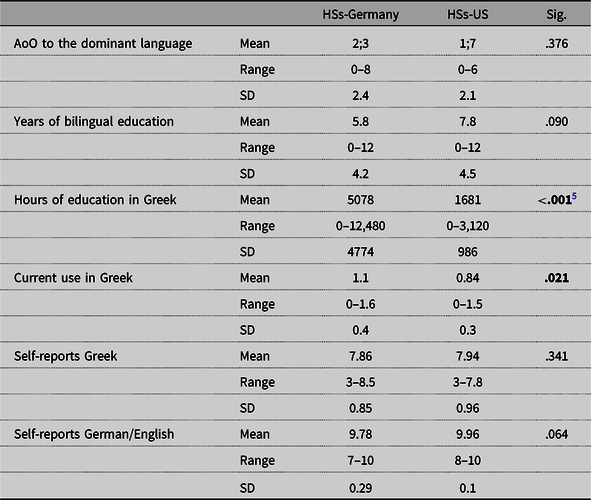
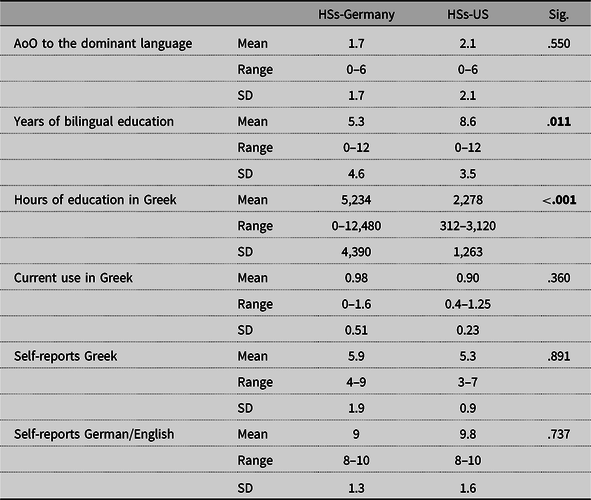
Ninety participants administered the oral elicitation task. Thirty-one MSs (mean age = 28;5, range = 25–35) were recruited in Thessaloniki, Greece consisting of the control group. Twenty-six HSs from Germany (mean age = 28;8, range = 21–36), and 33 HSs from the US (mean age = 29;6, range = 24–35) were also recruited and tested. HSs-Germany were born and raised in Berlin. There were 17 participants from HSs-Germany whose parents were Greek first-generation immigrants, seven participants with one German and one Greek parent (first-generation immigrant from Greece), and two participants with one first-generation and one second-generation immigrant parent. HSs-US were born and raised in Chicago or New York. There were 24 participants from HSs-US whose both parents were Greek first-generation immigrants, two participants whose both parents were second-generation Greek immigrants, and seven participants with one first-generation and one second-generation Greek immigrant parent. Table 1 summarizes the means of their Age of Onset (AoO) to the dominant language, years, and hours of Greek education in the past either in formal bilingual schools (German-Greek/English-Greek) or Greek weekend schools, current use in Greek, and self-reports in Greek and the majority language. These data were collected by means of a questionnaire like the one used in Paspali (Reference Paspali2019) for similar populations.
HSs’ language background and subsequent between-group comparisons in Experiment 1

Both heritage groups were exposed to Greek from birth, and exposure to the dominant language was early: 12 HSs-Germany were exposed to German before age 2;0, 13 between the ages 2;0-6;0 and 1 at the age of 8;0. Twenty HSs-US were exposed to both languages before age 2;0 and 13 between the ages 2;1-6;0. The two groups did not differ in their AoO to the majority language (Table 1). Regarding the language(s) of education, 18 participants from HSs-Germany used to attend bilingual schools and the rest eight participants did not receive education in Greek. Twenty-three participants from HSs-US used to receive bilingual education, seven participants attended a Greek weekend school in addition to their daily English school, and the rest three participants did not receive education in Greek. The two groups did not differ from each other in the years of bilingual education. However, HSs-US received less hours of education in Greek in addition to their education in their majority language compared to HSs-Germany. With respect to current use of Greek, HSs-US exhibited lower current use of Greek compared to US-Germany. Both groups rated their skills in each language for listening, speaking, reading, and writing in a 1-10 scale. The ratings were averaged by language and transformed into a language score for each language. Both groups rated themselves with higher scores in their majority language compared to Greek (HSs-US: t = 7.22, p < .001, HSs-Germany: t = 5.37, p = <.001). The two groups did not differ from each other in their self-ratings in Greek or the majority language.
Materials
To investigate the aspectual marking on the verb in Greek, the oral elicitation task used in Agathopoulou and Papadopoulou (Reference Agathopoulou, Papadopoulou, Roberts, Véronique, Nilsson and Tellier2009) was employed, as adopted in Dosi (Reference Dosi2016), which has been successfully used in previous studies with bilingual populations (Kaltsa & Tsimpli, Reference Kaltsa, Tsimpli, Gavriilidou, Efthymiou, Thomadaki and Kambakis-Vougiouklis2012). The task included 30 sentences, every ten of each exclusively targeting three different mappings between aspectual form and meaning: perfective (8a), imperfective continuous (8b), and imperfective habitual (8c). All verbs used were followed by an argument (DP or PP-goal) or a locative modifier. In terms of verb class, there were 15 accomplishments, two achievements, ten activities, and three states. For the sentences targeting the habitual interpretation, time adverbials such as kathe mera (every day) and sihna (often) were used. For the sentences targeting the continuous interpretation, time adverbials such as olo to proi (all morning) and sinehia (continuously) were used. For perfective time, adverbials such as hthes (yesterday) and oute mia fora (not once) were used (see Appendix for the complete set of items). Thus, the event was rendered unambiguously bounded (perfective) or unbounded (imperfective). The target form was always in active voice, indicative mood, past tense, and third person.

Procedure and data analysis
The participants were presented with the sentence in auditory mode. The sentence was orally presented without including the verb. Immediately after the end of the sentence, the participants were provided with the verb in the first-person singular form and they were asked to produce the correct verb form (i.e., marked for tense, number, person, and aspect). After their response, the experimenter wrote down the verb form produced by the participant. There were two practice sentences at the beginning of the task, and each participant was tested individually in a quiet room of the lab/university library. As for the criteria of participation in the procedure, the participants had to be born and raised in the host country, being between 18–35 years old, having at least one Greek parent (first or second-generation immigrant from Greece), and should never have stayed in Greece for a period of more than six months consecutively at any point in their life. The answers of the participants were first coded in each individual answer sheet and then were coded in a collective spreadsheet. Responses that it was not clear what aspectual form the participant tried to produce were deleted from the dataset affecting 0.22% of the data.
For the statistical analysis, accuracy was analyzed using the lme4 package and mixed-effects logistic regression models in R (R Development Core Team, 2017). The fixed-effects of the model were the three levels of Condition (1: imperfective continuous, 2: imperfective habitual, 3: perfective) and Group (1: MSs, 2: HSs-Germany, 3: HSs-US). Sum contrasts were used for Condition (assimilating ANOVA contrasts), and treatment contrasts were used for Group to obtain the coefficients for the comparisons between the groups (RQ1). Thus, Condition contributes to the Intercept of the model at the mean and Group contributes to the Intercept at its reference level (MSs). To obtain the comparison between the two heritage groups as well as the estimate for perfective (the third level of Condition) (RQ2-3), releveling was applied. Thus, HSs-Germany consisted of the reference level and perfective corresponded to the first level of Condition. The part with the random effects consisted of the maximal factor specification that converged (Barr et al., Reference Barr, Levy, Scheepers and Tily2013). Thus, the random structure was consisted of random intercepts by participants and slopes for Condition. We report effect sizes using the model estimates (Ê), standard errors (SE), z-statistics, and p-values.
Results
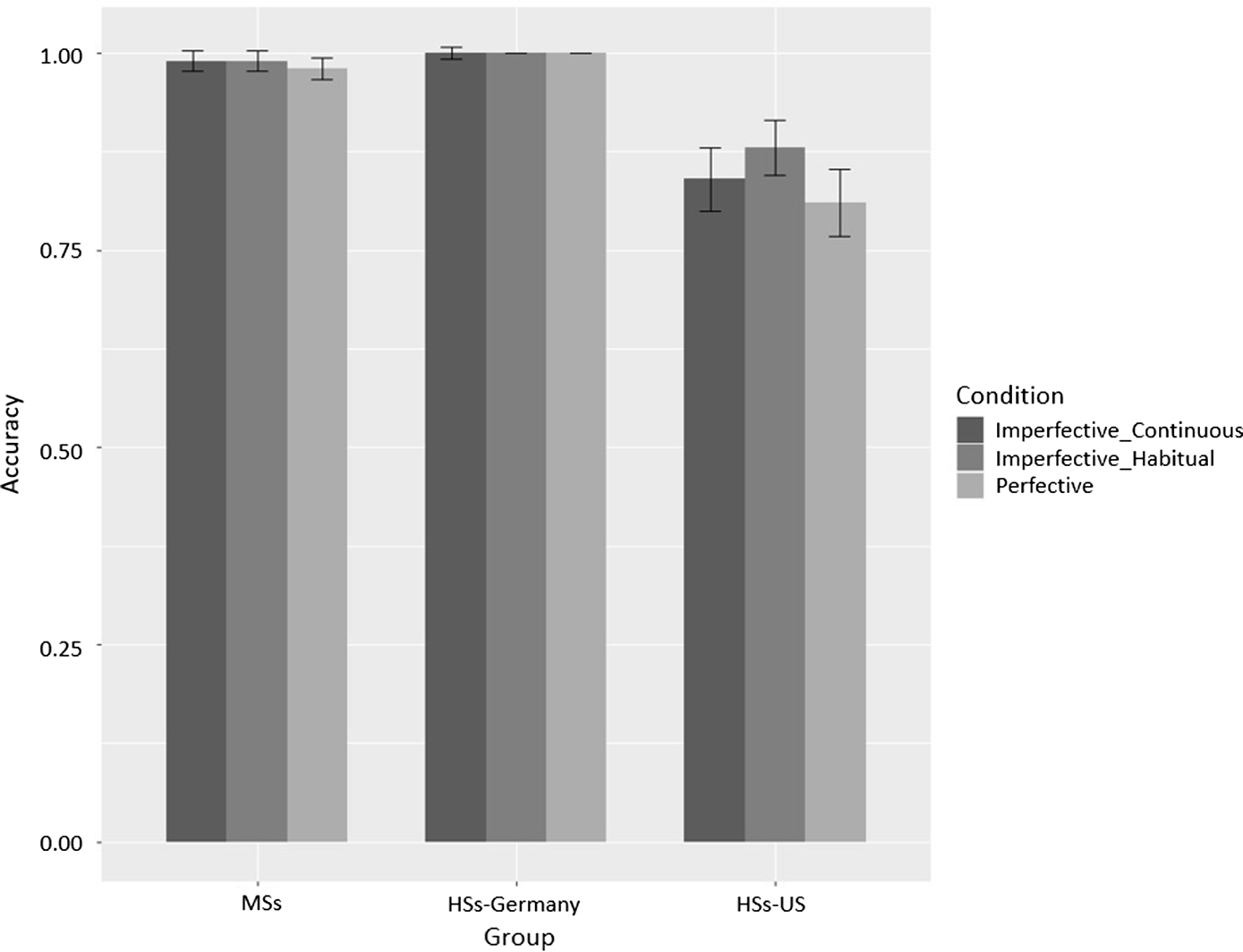
Figure 1 shows participants’ accuracy by group in each condition. Table 2 shows the results of the statistical analysis. Overall, all groups exhibited high performance.
Participants’ mean accuracy by Group and Condition in Experiment 1. Error bars represent confidence intervals (CIs).

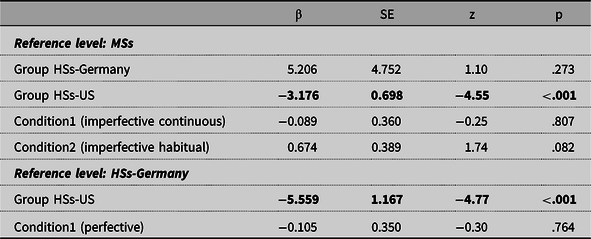
Mixed-effects model results of participants’ accuracy in Experiment 1

The interaction between Condition and Group did not provide a significantly better fit to the data compared to the additive model (x 2 (1) = 2.574, p = .631). Thus, we proceeded with our analysis using the additive model. The analysis (RQ1) revealed that HSs-Germany did not differ from the reference level (MSs) with a mean accuracy of 99%. HSs-US were statistically less accurate when compared to the reference level of both MSs and HSs-Germany (RQ1-2), reflecting that they overall produced more errors on aspect with a mean accuracy of 84%. The levels of Condition did not significantly differ from their mean (RQ3).
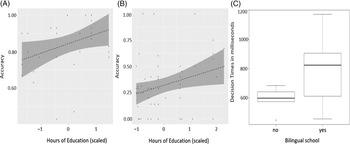
Since HSs-US was the only group exhibiting a significantly lower performance, we further explored the role of Greek education (total hours of Greek education), current use in Greek, AoO to the dominant language (English), past exposure/input to Greek (via parents’ generation: both parents first-generation immigrants vs. all other combinations), and whether they had received formal bilingual education through attending bilingual (English-Greek) schools. Model comparisons by means of backward elimination revealed that the hours of education significantly improved the model fit (x 2 (4) = 5.346, p = .021), reflecting that those participants who had received less hours of Greek education in the past were more likely to produce an incorrect aspectual value (β = 0.052, SE = 0.024, z = 2.16, p = .039). Panel A in Figure 2 shows this relation.
A: Mean accuracy of HS-US by mean Hours of Education they used to receive in the past in Experiment 1. B: Mean accuracy of HSs by mean Hours of Education they used to receive in the past in the ungrammatical perfective of Experiment 2. C: Mean Decision Time of HSs-US grouped by previous attendance of a bilingual school in the ungrammatical conditions in Experiment 2.

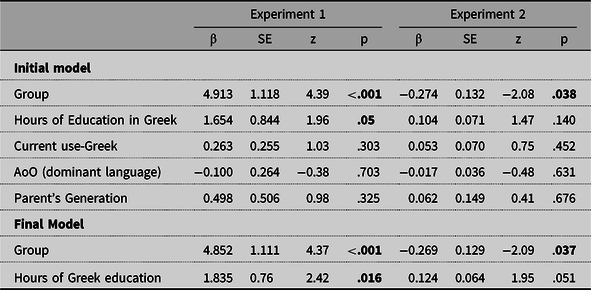
Since hours of education in Greek predicted the performance of HSs-US on aspect, an additional analysis was conducted to better assess the individual differences between the two bilingual groups. Thus, an analysis predicting HSs’ accuracy with Group (HSs-Germany vs. HSs-US), hours of education in Greek, current use in Greek, AoO to the dominant language (German/English), and parents’ generation to tap into past input in Greek was conducted using backward elimination. Table 3 (Experiment 1) shows the model coefficients of the initial and final (best-fit) model. Both Group (x 2 (1) = 50.605, p < .001) and Hours of Education in Greek improved the model fit (x 2 (1) = 6.50, p = .011).
Summary of the multiple regression model predicting accuracy on aspect by the language background variables

Finally, since no aspectual asymmetries were observed in the analysis, we further explored the prototypical and non-prototypical combinations of lexical and grammatical aspect via modeling telicity and verb class, the (ir)regular formation of perfective, and conjugation in HS-US, and no significant differences were obtained (Appendix, A2.1). Overall, despite the lower performance of HSs-US, Experiment 1 shows that aspectual marking has been established in adult HSs of Greek, although HSs-US made significantly more errors.
We also explored the novel verbal forms (9) of 5 participants from both heritage groups in line with RQ4. The forms consisted of one-syllable stems of Conjugation A and were inflected according to Conjugation B (instead of A).

As we see in (9), HSs omitted the augment é-, the function of which is “to receive stress when the antepenultimate-syllable stress law causes a left-hand stress shift outside the confines of the word” (Ralli, Reference Ralli2003, p. 84). Instead, HSs produced these novel forms based on the inflectional paradigm of verbs belonging in Conjugation B ending in -áo/-ó (10) either in perfective (9c, d) similarly to (10b) or in imperfective (9a, b, e) similarly to (10a, 10c). Thus, in these examples, HSs have moved one-syllable verb stems of Conjugation A to Conjugation B.

Experiment 2
Method
Subjects
Ninety-six participants administered the speeded-Grammaticality Judgment task (sGJt). Forty MSs (mean age = 23, range = 18–30) were recruited in Thessaloniki, Greece. Thirty-two HSs from Germany (mean age = 25, range = 18–36) and 24 HSs from the US (mean age = 28, range = 18–35) were also recruited and tested. HSs-Germany were born and raised in Berlin. None of the participants in Experiment 2 had participated in Experiment 1. There were 14 participants from this group whose parents were both Greek first-generation immigrants, eight participants with one German and one Greek parent (first-generation immigrant), nine participants with one first-generation and one second-generation immigrant parent, and one participant whose both parents were second-generation immigrants. HSs-US were born and raised in Chicago and New York. There were 13 participants in this group whose both parents were Greek first-generation immigrants, three participants whose both parents were second-generation immigrants, and eight participants with one first-generation and one second-generation immigrant parent. Table 4 summarizes the means of AoO to the dominant language, years, and hours of bilingual education, current use in Greek, and self-reports in Greek and the majority language.
HSs’ language background and subsequent between-group comparisons in Experiment 2

Both heritage groups were exposed to Greek from birth and exposure to the dominant language was early: 16 HSs-Germany were exposed to German before age 2;0, and the other 16 participants between the ages 2;1-6;0. Thirteen HSs-US were exposed to both languages before age 2;0 and 11 between the ages 2;1-6;0. The two groups did not differ in their AoO to the majority language (Table 3). Regarding the language(s) of education, 22 participants from HSs-Germany used to attend bilingual schools, seven participants attended Greek courses every weekend for 1–4 years, and three participants never received Greek education/courses. Eighteen participants from HSs-US used to receive bilingual education, and the rest six participants attended Greek courses every weekend for 1–4 years. Furthermore, HSs-US received more years of bilingual education compared to HSs-Germany (Table 3). However, HSs-US received less hours of education in Greek compared to HSs-Germany throughout these years, given that the American-Greek curriculum was not as enriched as the German-Greek one in terms of hours of Greek courses. The two groups did not differ in current use in this Experiment. Both groups rated themselves with higher scores in their majority language compared to Greek, their minority language (HSs-US: t = 6.47, p < .001, HSs-Germany: t = 6.15, p < .001). The two groups did not differ from each other in their self-ratings in Greek nor the majority language.
Materials
The experimental sentences for aspect were similar to Experiment 1. In this Experiment, the design was a repeated measures within-subjects design by crossing the variables Grammaticality (grammatical, ungrammatical) and Aspect (perfective, imperfective), leading to four conditions: grammatical perfective, ungrammatical perfective, grammatical imperfective, and ungrammatical imperfective (11a-d). There were six items by condition. Half of the imperfective sentences targeted the habitual interpretation and the rest half the continuous interpretation. Thus, there were overall 24 items which were distributed across four lists in a Latin square design and appeared in pseudo-random order. Thus, all participants were exposed to all items and conditions, but only in one condition of each item.

Seventy-two filler sentences were also included in the Experiment, consisting of various structures such as object relative clause attachment, subject-verb agreement constructions, gender, and number agreement with first and secondary predication, object clitic, clitic left dislocation, and clitic doubling. Half of the filler sentences were ungrammatical for reasons of balance given that half of the experimental sentences were also ungrammatical.
Procedure and data analysis
Sentences were auditorily presented to the participants. Immediately after the end of the sentence, the participants had to decide whether the sentence sounded acceptable or unacceptable within 2,000 ms. This threshold was made through trial and error and based on previous literature with HSs employing this task (Lago et al., Reference Lago, Gracanin-Yuksek, Safak, Demir, Kırkıcı and Felser2018; Paspali, Reference Paspali2019). Participants had to press the acceptable (K) or unacceptable (D) option on the keyboard, and no feedback was given to them. There were eight practice trials in the beginning of the task. Participants received 10 Euros/hour (same holds for Experiment 1). The task was built and run in E-prime (Psychology Software Tools Inc. [E-Prime 3.0], 2016 Pittsburgh, PA, United States). Participants completed the sGJt and the language background questionnaire within a single session which lasted 40 minutes approximately.
Statistical analysis was conducted similarly to Experiment 1. In addition, linear mixed-effects models were used for Decision Times (DTs). DTs were transformed using the logarithmic transformation based on the boxcox function. Sum contrasts were assigned to Grammaticality and Aspect, and treatment contrasts were assigned to the Group to report the differences between MSs and the heritage groups (reference level: MSs) (RQ1) as well as between the two heritage groups with releveling (reference levels HSs-Germany) (RQ2). Thus, given that interactions were included in the model (see below) the mean differences between the levels of Grammaticality (grammatical, ungrammatical) and Aspect (perfective, imperfective) (RQ3) are each time nested within the reference level of Group (MSs or HSs-Germany via releveling). The maximal random effects structure in this Experiment consisted of random intercepts by participants and items and slopes for Grammaticality and Aspect.
Results
Accuracy
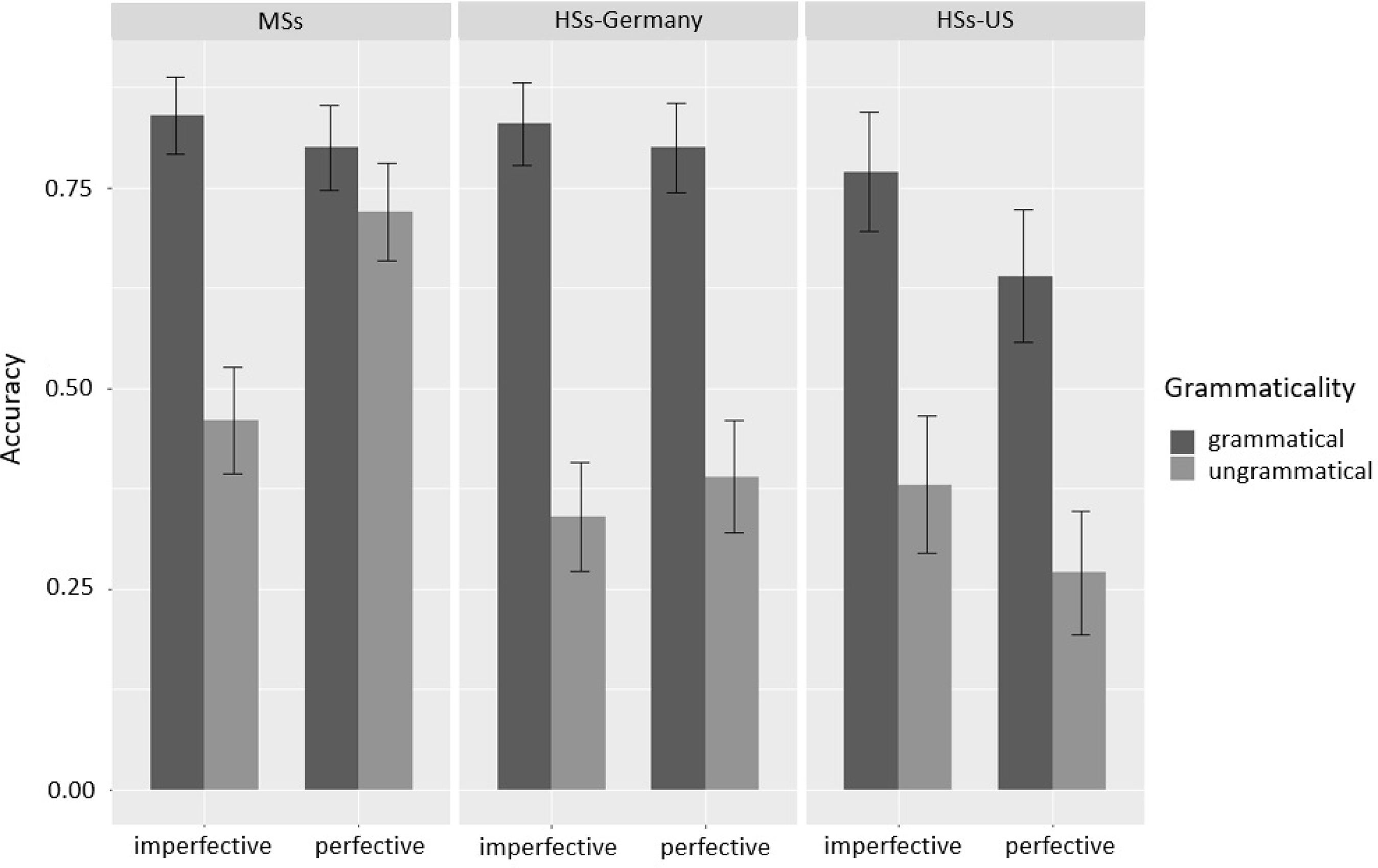
In the filler sentences, all groups scored above chance levels (mean accuracy for MSs 88%, HSs-Germany 74%, and HSs-US 61%), reflecting proper participation and overall lower rates of sentence comprehension under time pressure for HSs (Paspali, Reference Paspali2019; Lago et al., Reference Lago, Gracanin-Yuksek, Safak, Demir, Kırkıcı and Felser2018). The data of two participants (1 from HSs-Germany and 1 from HSs-US) were removed due to low accuracy (<60%). In the experimental sentences, 7.5% of the trials were removed due to responses exceeding the time threshold (MSs: 9.2%; HSs-Germany: 5%; HSs-US: 8.2%). Figure 3 shows accuracy for each group by condition.
Participants’ mean accuracy by Aspect and Grammaticality for each group in Experiment 2. Error bars represent CIs.

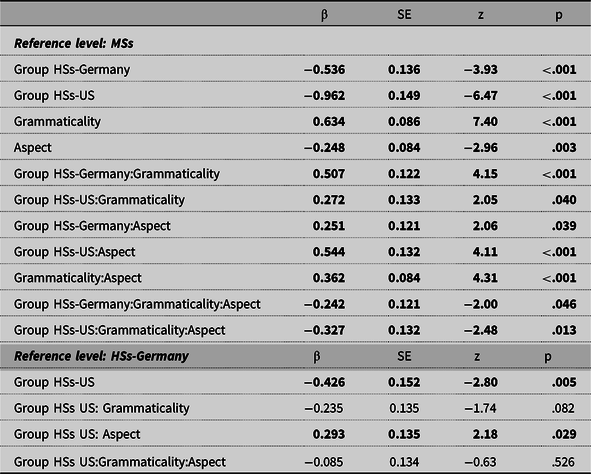
The model with the interactions provided a significantly better fit to the data compared to the additive model (x 2 (7) = 59.475, p < .001). Table 5 summarizes the model results.
Mixed-effects model results of participants’ accuracy in Experiment 2

The significant effects of both heritage groups reflected that they were overall less accurate than MSs (RQ1). There was also a significant effect of Grammaticality such that grammatical sentences exhibited higher accuracy than ungrammatical sentences and a significant effect of Aspect such that perfective exhibited higher accuracy than imperfective (both effects nested within the reference level/MSs). Both heritage groups were also involved in significant two-way as well as three-way interactions with Grammaticality and Aspect reflecting that they treated certain conditions differently from MSs. In the releveled model (HSs-Germany as reference level), there was a significant effect for HSs-US reflecting that they were overall less accurate than HSs-Germany (RQ2). There was also a significant interaction between HSs-US and Aspect, reflecting that HSs-US were less accurate in perfective (RQ3) compared to HSs-Germany. Since there were two- and three-way interactions in the initial and releveled model, these interactions were unpacked by performing further analysis for each group separately. Table 6 summarizes the model results of each group.
Mixed-effects model results of participants’ accuracy in each Group in Experiment 2

For the group of MSs, there were significant effects of Grammaticality and Aspect, such that grammatical sentences exhibited higher accuracy than ungrammatical sentences and sentences with imperfective exhibited lower accuracy than sentences with perfective. Crucially, there was a significant interaction between these two variables, such that MSs were less accurate in the ungrammatical imperfective than in the ungrammatical perfective condition (see Appendix A4-(3) for pairwise comparisons). For the group of HSs-Germany, there was a significant effect of Grammaticality such that HSs-Germany were more accurate in grammatical sentences than in ungrammatical ones. For the group of HSs-US, there was a significant effect of Grammaticality, such that HSs-US were more accurate in grammatical sentences than in ungrammatical ones, and an effect of Aspect, such that HSs-US were more accurate with imperfective than with perfective.
Imperfective was analyzed comparing habitual vs. continuous. No significant difference between the two interpretations was found for any of the groups (see Appendix A.2.2-(5)).
As in Experiment 1, we further explored the individual differences for the cases where significant differences between the heritage groups and the monolingual controls were found: a) in ungrammatical perfective where both heritage groups exhibited lower accuracy than MSs, and b) in the perfective sentences of HSs-US. Model comparisons revealed that the hours of Greek education HSs used to receive in the past (see panel B Figure 2) significantly improved model fit (x 2 (1) = 10.619, p = .001) in ungrammatical perfective, reflecting that the more hours of Greek education HSs received in the past the better their accuracy was in ungrammatical perfective (β = 0.547, SE = 0.152, z = 3.59, p < .001).
As in Experiment 1, since hours of education in Greek predicted HSs’ performance an additional analysis was conducted to better assess the individual differences between the two bilingual groups. Table 3 (Experiment 2) shows the model coefficients of the initial and final (best-fit) model. In Experiment 2, Group (x 2 (1) = 9.497, p = .002) and Hours of Education in Greek (marginally) improved the model fit (x 2 (1) = 3.829, p = .051). Thus, even when taking between-group differences under consideration, the difference between the two groups on how they perform on aspect remains significant.
Decision times
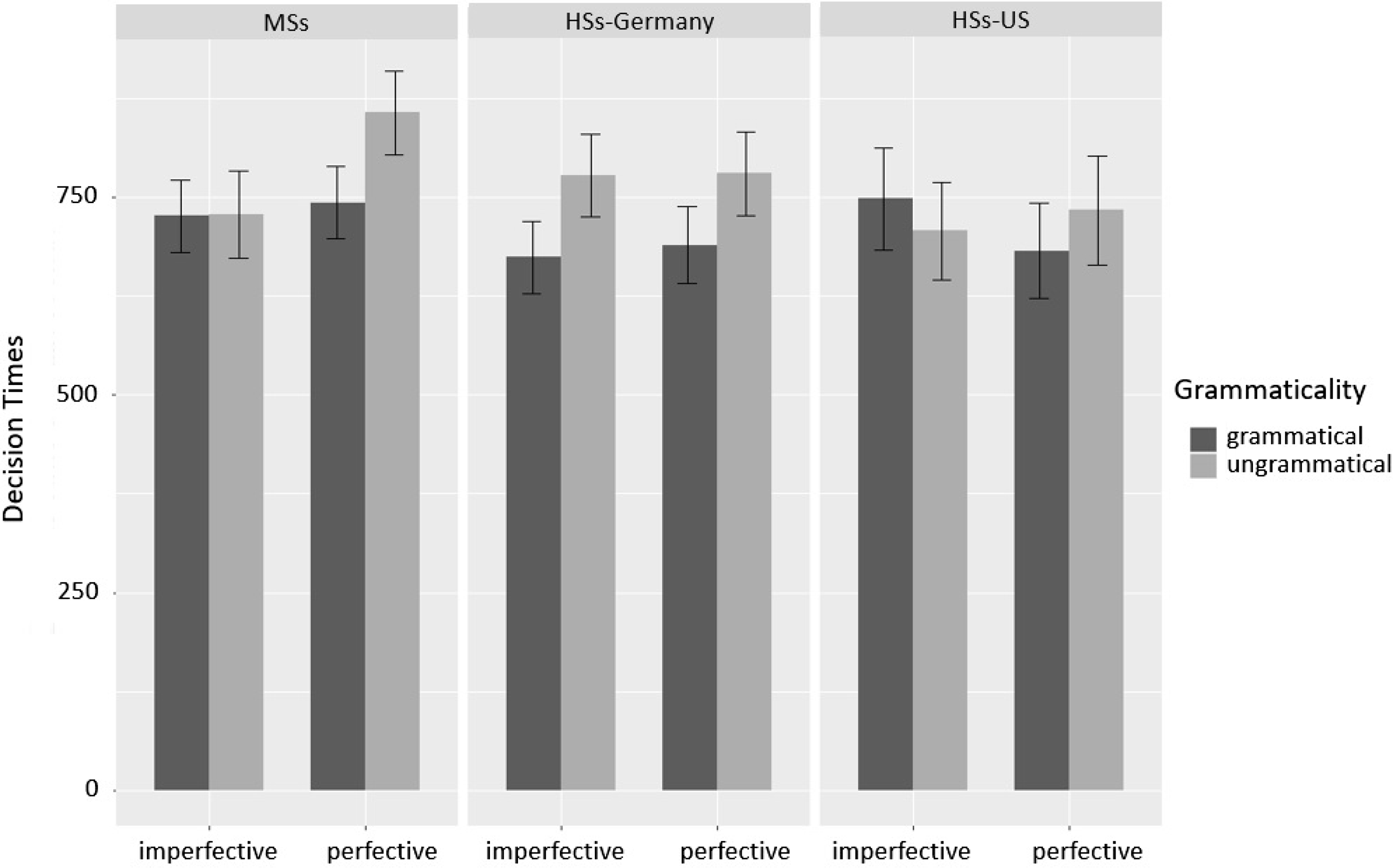
An analysis of the participants’ DT was also conducted to better tap into their implicit knowledge of their morphological realization of Greek verbal aspect, since it has been shown that DTs in the end of speeded judgments reflect certain processes of sentence comprehension occurring before metalinguistic knowledge comes into play (Lago et al., Reference Lago, Shalom, Sigman, Lau and Phillips2015; Paspali & Marinis, Reference Paspali and Marinis2020) that is, the time participants needed from the end of the auditory sentence until the time they pressed one of the two corresponding buttons on the keyboard to judge the sentence as acceptable or unacceptable. For RQ1-3, we analyze the results only from the correctly responded trials in line with previous studies using this methodology. DTs before the end of the sentence trials were removed from further analysis affecting 0.3% for MSs, 0.4% for HSs-Germany, and 1.2% for HSs-US. Figure 4 shows the DT means of each group in each condition.
Participants’ mean Decision Times by Aspect and Grammaticality for each group in Experiment 2. Error bars represent CIs.

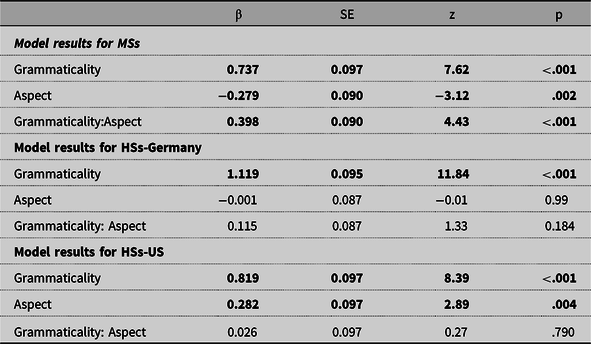
Participants are expected to show increased DTs for the ungrammatical conditions if they are sensitive to violations of aspect. Overall, MSs and HSs-Germany exhibited higher DTs in (some of) ungrammatical sentences, while HSs-US did not. Table 7 summarizes the results reporting the model coefficients.
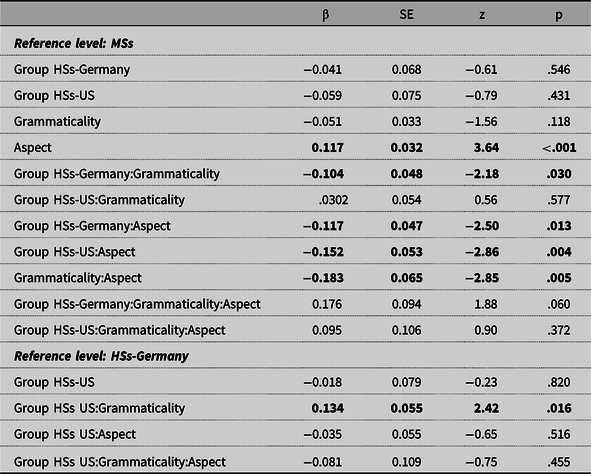
Linear mixed-effects model results of participants’ Decision Times in Experiment 2

There was an effect of Aspect nested within MSs such that perfective sentences exhibited longer DTs than sentences with imperfective. There were also significant interactions. An interaction between Grammaticality and Aspect nested within MSs was found reflecting that DTs were different between conditions. There was also an interaction between HSs-Germany and Grammaticality reflecting that DTs for HSs-Germany were different from MSs (reference level) in terms of Grammaticality, and an interaction between Aspect and HSs-Germany reflecting that DTs of MSs (reference level) and HSs-Germany were different in terms of Aspect (RQ1). There was also a significant interaction between HSs-US and Aspect reflecting that DTs for HSs-US compared to MSs (reference level) were different in terms of Aspect (RQ1). To compare the heritage groups with each other (RQ2), releveling was applied to the initial model changing the reference level of Group from MSs to HSs-Germany. A significant interaction between Grammaticality and Group HSs-US was observed, reflecting that DTs of HSs-Germany (reference level) compared to HSs-US were statistically different in terms of Grammaticality.
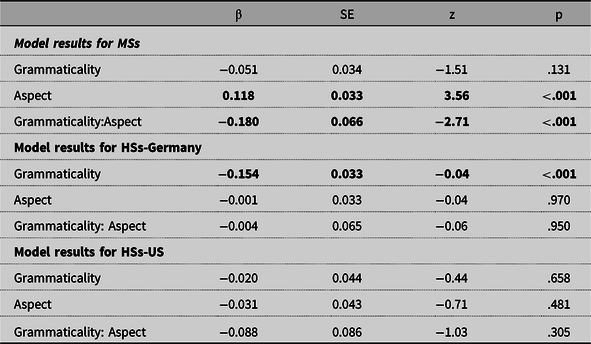
Since there were interactions in the initial and releveled model between the within-subject variables and Group, these interactions were unpacked by performing further analysis for each group separately to target the differences between conditions (RQ3). Table 8 summarizes the model results.
Mixed-effects model results of participants’ Decision Times in each Group in Experiment 2

For the Group of MSs, there was a significant effect of Aspect such that perfective exhibited longer DTs than imperfective and a significant interaction between Grammaticality and Aspect such that ungrammatical perfective exhibited longer DTs than ungrammatical imperfective (see Appendix, A4-(4) for the pairwise comparisons). As for HSs-Germany, there was a significant effect of Grammaticality such DTs in grammatical sentences were shorter than DTs in ungrammatical sentences. Turning to HSs-US, no significant differences were found reflecting that DTs for this group were not statistically different across conditions.
Overall, for both heritage groups we found different DT patterns compared to MSs when judging ungrammatical sentences, although accuracy was equally poor for both heritage groups and in both ungrammatical conditions. The DTs of HSs-Germany in ungrammatical sentences seem to compensate their low accuracy in both ungrammatical conditions, given that they exhibit a significant difference in their DTs for ungrammatical sentences compared to grammatical ones. However, this difference is weaker than the one MSs exhibited in the ungrammatical condition, reflecting that MSs show quantitatively stronger effects than HSs-Germany when the former exhibit sensitivity to violations. On the other hand, DTs of HSs-US did not reveal any strategy across conditions.
As for the differences within imperfective (between continuous and habitual), the analysis revealed no differences between imperfective continuous vs. imperfective habitual for any of the groups (see Appendix A.2.2-(5)).
As in Experiment 1 and the analysis of accuracy in the present Experiment, given that HSs-US was the group which did not show increased DTs for ungrammatical sentences of aspect violations, we further explored their DTs in ungrammatical sentences. Model comparisons revealed that receiving formal bilingual education (Panel C, Figure 2) tended to improve the model fit (x 2 (1) = 3.65, p = .056). This tendency marginally predicted their DTs (β = 0.288, SE = 0.147, z = 1.96, p = .064) meaning that HSs-US who attended a bilingual school were more likely to exhibit higher DTs in ungrammatical sentences, reflecting that sensitivity to aspect violations is dependent on bilingual education.
Discussion
The present study explored whether aspectual marking is vulnerable in heritage Greek (RQ1) testing the role of the dominant language (RQ2), the acquisition default value (RQ3), and HSs’ novel forms within the verbal inflection in their non-target production (RQ4). In Experiment 1 (oral elicitation task), MSs and HSs-Germany exhibited high scores, although HSs-US were significantly less accurate. In Experiment 2 (sGJt), accuracy was overall lower than in Experiment 1: in grammatical sentences, MSs and HSs-Germany exhibited high accuracy, while HSs-US exhibited significantly lower accuracy. In ungrammatical sentences, accuracy for all groups was affected, and this was more evident for the two heritage groups. MSs exhibited lower accuracy only in ungrammatical imperfective. HSs-US exhibited lower accuracy with the morphologically marked value (perfective). DTs revealed that MSs and HSs-Germany were sensitive to violations of aspect exhibiting longer DTs for ungrammatical sentences. In contrast, HSs-US lacked a DT penalty for ungrammatical sentences. In both experiments, past education in Greek was (marginally) a reliable predictor of accuracy and DTs.
Our results converge with previous bilingual studies on aspect and provide decision time measurements for the sensitivity of HSs to aspect violations. HSs-Germany overall perform highly accurately as in previous studies (Diaubalick et al., Reference Diaubalick, Guijarro-Fuentes, Schmitz, Guijarro-Fuentes and Suárez-Gómez2020 for adult Spanish HSs in Germany; Dosi &Papadopoulou, Reference Dosi and Papadopoulou2019 for child HSs in Germany). In the present study, this is also reflected in their DTs indicating sensitivity to aspect violations. Crucially, HSs-Germany perform more on par with Greek MSs, while HSs-US perform differently from the other two groups. Andreou and Tsimpli (Reference Andreou and Tsimpli2017) report similar pattern of results for Greek aspect in bilingual children with the same language combinations. This picture reflects that HSs can perform similarly to MSs, although this is not necessarily uniform across all heritage groups (Valenzuela et al., Reference Valenzuela, Iverson, Rothman, Borg, Cabo, Pinto, Gumiel-Molina and Pérez-Jiménez2015; Kupisch & Rothman, Reference Kupisch and Rothman2018; Osch, Reference Osch2019; Diaubalick et al., Reference Diaubalick, Guijarro-Fuentes, Schmitz, Guijarro-Fuentes and Suárez-Gómez2020) and tasks (Dosi, Reference Dosi2016). Furthermore, Alexiadou et al. (Reference Alexiadou, Rizou, Tsokanos and Karkaletsou2021) report similar results for gender agreement in Greek HSs with the same language combinations and highly similar sociolinguistic backgrounds (HSs-US exhibited deviation from MSs, while HSs-Germany did not). Paspali (Reference Paspali, Chondrogianni, Courtenage, Horrocks, Arvaniti and Tsimpli2017; Reference Paspali2019) also found ceiling performance for HSs-Germany in simple gender agreement tasks but also deviations in more cognitively demanding tasks (oral narrations and self-paced listening) similarly to the present findings. Furthermore, education in the heritage language in the current study seems to enhance performance on aspect in line with previous studies (see Andreou et al., Reference Andreou, Dosi and Bongartz2021; Dosi & Papadopoulou, Reference Dosi and Papadopoulou2019; Kupisch & Rothman, Reference Kupisch and Rothman2018, for discussion).
In line with the prediction of RQ1, aspect in heritage Greek seems to be vulnerable to some extent. According to Incomplete Acquisition and Attrition, HSs exhibited deviations from MSs in their heritage language (either due to Incomplete Acquisition or later loss/Attrition), especially when past Greek education was less frequent or not official (via formal bilingual schools). The current findings do not seem to confirm the Interface Hypothesis, first because the two interpretations of imperfective did not differ with each other, and second, because the exploratory analysis on the interaction between grammatical and lexical aspect did not reveal significant effects either. As for the Morphological Bottleneck Hypothesis, the data confirm that functional morphology (perfective, marked form) may pose difficulties for HSs. This is true mainly for HSs-US and only in the sGJT, where participants are under time pressure and the processing load increases (Paspali, Reference Paspali2019). Crucially, HSs-US do not show sensitivity to aspect in their DTs as opposed to the other two groups. Overall, Greek HSs do not seem to lack aspectual distinctions (Experiment 1), although they exhibit clear difficulties with aspect (Experiment 2).
The higher accuracy in Experiment 1 compared to Experiment 2, especially for HSs-US, could be attributed to difficulties in employing aspectual marking in a more cognitively demanding task, such as in speeded judgments. Whether this finding could potentially be perceived as a precursor of upcoming Attrition/reanalysis in the aspectual marking, mostly detected in a measure of high sensitivity such as speeded judgments, is something which remains open to future research. Overall, the present findings do not allow an interpretation in favor of established/early restructuring of aspect. Also note that even MSs’ accuracy was affected under time-pressureFootnote 3 (Experiment 2). The present data show that, although HSs (mostly HSs-US) show deviations in their performance in aspect, they can still retain aspectual distinctions to an efficient extent, that is, they do not show (entire) loss of aspect in all/a specific condition in production. Rather, when errors occur, a tendency towards restructuring seems to apply at the level of the verbal inflection system when interacting with the morphophonological realization of the past tense (see below the discussion for RQ4).
With respect to RQ2, the results are partially compatible with the scenario that the presence or absence of grammatical aspect in the dominant language may affect the heritage language. The fact that German does not encode aspect morphologically may have played a facilitatory role in aspect in Greek for HSs-Germany. Alternatively, the cross-linguistic differences/mismatches in the way aspect is encoded (e.g., aspectual marking for habitual, encoding of continuity vs. progressivity) between Greek and English may have caused greater inhibition on aspect for HSs-US. However, HSs-US did not exhibit significantly lower performance to these mismatches specifically. On the other hand, the different typological formation of aspect in the past tense between the two languages (see Section 2) could remain a possible factor leading HSs-US to an overall lower performance. Thus, what the present findings may be compatible with is that either the absence of the morphological encoding of aspect in the dominant language facilitates HSs with aspect in the minority one, in the sense of less interference throughout bilingual language development, or the different typological formation let alone for different aspectual markings (English progressive vs. Greek perfective) in the past tense between the dominant and the heritage language may inhibit HSs’ aspect in the heritage language. However, cross-linguistic influence, that is, lower accuracy specifically in the aspectual mismatches between Greek and English, is not supported by the present findings.
On the other hand, previous studies on the acquisition of Greek aspect in Greek bilingual children (Andreou et al., Reference Andreou, Dosi and Bongartz2021; Dosi, Reference Dosi2016; Dosi, Reference Dosi2017) have found a facilitatory role of the other language when the latter encodes aspect morphologically, which is the exact opposite of the present finding. Crucially, these studies tested languages which encode aspect more similarly to Greek than English does, in terms of both the morphological and typological formation and aspectual matches. Thus, the degree of similarity on how the phenomenon is encoded in the other language may also matter (Andreou & Tsimpli, Reference Andreou and Tsimpli2017; Andreou et al., Reference Andreou, Dosi and Bongartz2021; Cuza et al., Reference Cuza, Pérez-Tattam, Barajas, Miller, Sadowski and Schwieter2013; Lopez-Otero & Cuza, Reference Lopez-Otero, Cuza, Ortiz, Guzzardo Tamargo and González Rivera2020; Osch, Reference Osch2019 for discussion).
Alternatively, the lower performance of HSs-US both in terms of their accuracy as well as the absence of sensitivity to aspectual violations in their DTs may be attributed to external differences between the two heritage groups. Indeed, HSs-US had received less hours of Greek education in both Experiments and they also exhibited lower current use in Greek in Experiment 1. Notice, though, that when individual differences were assessed including Group (HSs-Germany vs. HSs-US) as a factor (see Table 3), Group remained significant despite the differences explained by the predictor Hours of Greek education (significantly in Experiment 1 and marginally in Experiment 2). Thus, further research is needed to safely dissociate the role of the other language from differences attributed to external factors such as education in the heritage language.
We also consider other factors that may influence the present study and may account for the better performance of HSs-Germany compared to HSs-US. Geographical distance and consequently frequency of visits to Greece may also have an impact on HSs’ performance, given that HS-Germany traveled more often to Greece than HSs-US. Thus, performance on aspect may also have been modulated by geographical distance between the host country (Germany vs. HSs-US) and the metropolis (Greece) resulting in less frequent past and current use of HSs-US to the Greek monolingual norm. Note, though, that these variables which may be affected by geographical distance and frequency of visits were not statistically significant and thus cannot account for the current findings. Furthermore, the differences between MSs and HSs may be more evident in bilinguals in the US probably because American context is less inclined towards bilingualism, which may have an impact on language policies (Diaubalick et al., Reference Diaubalick, Guijarro-Fuentes, Schmitz, Guijarro-Fuentes and Suárez-Gómez2020). Thus, this factor may lead to lower frequency of past and current use in the heritage language with no/very limited hours of education on it and less opportunities to exercise bilingualism. Note, though, that only education in the heritage language predicted HSs’ performance. Interestingly, Andreou and Tsimpli (Reference Andreou and Tsimpli2017) found similar results for their child participants with the same language combinations as in the present study, although their Greek-English group resided in Greece (thus, Greek was the majority language) and not in the US as in our study. This similarity may reflect the role of one language on the other. However, in Andreou and Tsimpli (Reference Andreou and Tsimpli2017) certain between-group differences (input) were also present. Thus, further researchFootnote 4 is needed to dissociate these differences more clearly from the role of language combination in Greek as a heritage/majority language.
As for RQ3, the prediction of higher accuracy with perfective (the Greek L1 acquisition default) is not confirmed for the adult Greek HSs of the present study. Rather, perfective exhibited lower accuracy in HSs-US in Experiment 2, which is compatible with the Bottleneck Hypothesis (Mikhaylova, Reference Mikhaylova2018; Polinsky, Reference Polinsky2011) (see discussion above). Notice that MSs also exhibited an asymmetry in their speeded judgments and DTs (Experiment 2), although only in ungrammatical sentences they were accepting imperfective in cases where perfective was the only grammatical choice, which may also reflect a different treatment between the morphologically marked and the morphologically default form. The fact that HSs-Germany did not reveal any asymmetry between perfective and imperfective could be possibly associated with equal treatment of both aspectual values, in the sense that they share less experience and input in the morphological encoding of aspect compared to MSs and HSs-US. The present results indicate that the morphologically marked value in Greek (perfective) may sometimes lead to an accuracy penalty due to the morphophonological rules applied (see the elicitation task in Dosi, Reference Dosi2016 for similar results in child HSs).
With respect to RQ4, the pattern found (i.e., novel verbal forms the stem of which belongs to Conjugation A but were inflected similarly to verbs of Conjugation B) may be associated with difficulties at the interface between morphology and phonology occurring outside the confines of the word: due to the lack of a certain existing position within the confines of the word for the application of stress shift (Revithiadou et al., Reference Revithiadou, Markopoulos and Spyropoulos2019), HSs may change the verb paradigm. This would probably reflect a gradual reorganization/reanalysis within the system of verbal inflection, a process which may signal internal language change to the heritage language itself.
The present study tested aspect in adult Greek HSs living in the US and Germany. The results revealed that the aspectual morphological distinction is retained at good levels in elicited production (Experiment 1), and it is mostly affected under speeded comprehension especially for the morphologically marked form (Experiment 2) and for the group of HSs-US. Differences between HSs-US and HSs-Germany found in their backgrounds in terms of their Greek education may account for the lower performance of HSs-US compared to HSs-Germany in Experiments, although the (non-)encoding of aspect in the dominant language (English vs. German) and/or typological differences from the corresponding encoding in Greek may also play a role and explain the present findings. Finally, HSs were found to produce the past tense of one-syllable stems of Conjugation A similarly to the corresponding ones of Conjugation B, reflecting a gradual merge of these two categories.
Supplementary material
To view supplementary material for this article, please visit https://doi.org/10.1017/S0142716421000539
Acknowledgments
Parts of the present study have been presented and reported to the Proceedings of 24th International Symposium on Theoretical and Applied Linguistics (Thessaloniki, 2-4 October 2020) and the Heritage Language Syntax Workshop (Utrecht, 24–26 August 2020). We thank Ifigenia Dosi and Ianthi Tsimpli for their feedback at previous stages of this work. We also thank the three anonymous Reviewers and the Associate Editor for their careful reading of the manuscript and their insightful comments and suggestions.
Author contributions
AP, VR, and AA conceived and designed the study. AP wrote the manuscript with help from VR and AA during the writing process. AP and VR transcribed and coded the data together with two student assistants, namely Fotini Karkaletsou and Nikolas Tsokanos. AP and AA oversaw the implementation of the study. AP and VR collected the data, and AP conducted the statistical analyses and interpreted the data.
Funding
This work was funded from AL 554/8-1, DFG Gottfried Wilhelm Leibniz Preis 2014 awarded to Artemis Alexiadou, and Project P1 of the FOR2537, Research Unit Emerging grammars in language contact situations: a comparative approach, grant number AL 554/13-1, 394836232.
Competing interests declaration
Competing interests: The author(s) declare none.
Ethics statement
All participants gave written informed consent in accordance with the Declaration of Helsinki. The study has been reviewed by the Ethics Committee of the Deutsche Gesellschaft für Sprachwissenschaft (German Linguistics Association) and has been given a favorable ethical opinion for conduct.