In the 1960s, 1970s, and 1980s, women were scarce in Latin American politics, and those women who did run for and win office tended to be older, married with children, and university educated; to have occupational experience as teachers, secretaries, or social workers; to have family ties to politics and to have little political ambition (Camp Reference Camp1995; Chaney Reference Chaney1979; Saint-Germain Reference Saint-Germain1993). Today, women are winning office in much larger numbers, emerging from a society that has progressed significantly in terms of gender equality (though is still widely characterized as “machista”), and competing for office in democracies that have clear rules and norms for elections. Little information exists, however, about the characteristics of women winning office in Latin America in the 2000s or how they may differ from men in office. Given the significant political changes in Latin America over the past 20 years, the composite of the typical female legislator described here may no longer hold, and female elites today may be far more similar to male elites.
This article examines the social backgrounds, paths to power, and political ambition of women and men elected to national legislatures in Argentina, Colombia, and Costa Rica. It builds on existing literature on political elites, Latin American legislatures, and gender politics to articulate hypotheses about how gender affects legislators' backgrounds, political careers, and ambition and test these hypotheses using data from a survey of legislators conducted in the three countries in 2001 and 2002. “Social backgrounds” refer to a range of descriptive characteristics of legislators, including age, marital and family status, education, and occupational experiences. Political careers, or “paths to power,” provide information about the political experience, both appointed and elected, that elites bring to office. Political ambition focuses on legislators' future political goals, specifically whether they expect to return to the private sector, run for reelection, or seek higher political office.Footnote 1 Overall, the research shows that female legislators in Latin America today are more similar than different from men in their backgrounds, paths to power, and political ambition. Women who win legislative office in Latin America do so by playing the traditional, male-defined, political game.
Literature on political elites in Latin America, particularly female elites, is quite small. In addition, it often focuses only on women, rather than comparing women to men (Chaney Reference Chaney1979; Marx, Borner, and Caminotti Reference Marx, Borner and Caminotti2007; Rivera-Cira Reference Rivera-Cira1993; Saint-Germain Reference Saint-Germain1993; Saint-Germain and Metoyer Reference Saint-Germain and Metoyer2008). However, the question of whether male and female legislators differ in their social backgrounds, paths to power, and political ambition is important for many reasons.
First, the presence or absence of significant differences among men and women sheds light on the representativeness of legislatures and the characteristics that we associate with the typical legislator. Specifically, are women replicating the image of the traditional male legislator in Latin America, or are they bringing nontraditional social backgrounds, different educational and work experiences, and distinct political experiences to elected office?
Second, the recent adoption of gender quotas in Latin American legislatures has raised questions about whether women elected under quotas are mere “tokens” or are well-qualified and politically ambitious representatives (Franceschet and Piscopo Reference Franceschet and Piscopo2008; Murray Reference Murray2010; Zetterberg Reference Zetterberg2008). Comparing composites of female legislators in Argentina and Costa Rica, who adopted quotas in the 1990s, to those in Colombia, where no legislative gender quotas exist, can shed some light on this question.
Third, research on legislators' backgrounds, political experience, and ambition has important implications for substantive representation. Who the representatives are, what they have experienced on the road to the national legislature, and how they view their political future motivates their policy preferences, the legislation they work to pass, and the way they relate to their constituents. Gender differences in these characteristics could explain differences in the way representatives “act for” their constituents (Jones Reference Jones1997; Schwindt-Bayer Reference Schwindt-Bayer2006, Reference Schwindt-Bayer2010; Taylor-Robinson and Heath Reference Taylor-Robinson and Heath2003). In an effort to shed light on these issues, this study renews research on the backgrounds, paths to power, and political ambition of women.
GENDER AND POLITICAL ELITES IN LATIN AMERICA
Research on political elites has long examined social backgrounds, paths to power, and political ambition among representatives (see, for example, Fowler and McClure Reference Fowler and McClure1989; Schlesinger Reference Schlesinger1966; Smith Reference Smith1979; Williams and Lascher, Jr., Reference Williams and Lascher1993), but interest in this literature has renewed in recent years as the election of nontraditional groups, such as African Americans in the United States, indigenous communities in Latin America, and women, has diversified legislatures. New questions arise about whether representatives from underrepresented groups are similar to or different from traditional political elites in their social requisites for office, political paths to power, and future political goals (Best and Cotta Reference Best and Cotta2000; Burrell Reference Burrell1994; Carroll Reference Carroll1994; Diamond Reference Diamond1977; Dodson Reference Dodson1997; Dolan and Ford Reference Dolan and Ford1997; Gertzog Reference Gertzog and Rosenthal2002; Norris Reference Norris1997; Norris and Lovenduski Reference Norris and Lovenduski1995; Rosenthal Reference Rosenthal1997; Thomas Reference Thomas1994), why they are similar or different, and what the implications are for representation (Norris Reference Norris, Lovenduski and Norris1996; Norris and Franklin Reference Norris and Franklin1997). Very little of it, however, focuses on the new democracies of Latin America.
Latin America has undergone significant cultural, socioeconomic, and political changes over the past 40 years. Women are increasingly educated, working outside the home, and making headway into educational and occupational areas that have traditionally been dominated by men, such as business and law (Craske Reference Craske1999; Htun Reference Htun, Dominguez and Shifter2003). This change also has coincided with more supportive cultural views of women's participation in the public sphere, although it has not improved equally across countries (Gallup Organization Reference Organization2001; Latinobarómetro 2004, 2009). In addition, almost all Latin American countries have democratized in the past 20 years, and established clear rules for elections and legislative politics (Payne et al. Reference Payne, G., Florez and Zavala2002). All of these changes have led to growing numbers of women running for and winning political office (Inter-American Dialogue 2008; IPU 2010).
Changing cultural, socioeconomic, and political conditions in Latin America, along with the growing number of female representatives, suggest two possible patterns concerning how male and female representatives may compare in their backgrounds, political experience, and ambition. One pattern is that men and women will exhibit significant differences. Women may come from different social backgrounds, take different paths to power, and have different political outlooks. This would diversify the composition of the legislature and make it more representative, not just in terms of gender but in terms of class, economic sector, and the range of experiences that representatives bring to the arena. It also would support arguments that the election of more women is important because it will change the way the legislature looks, perhaps “feminize” it, and lead to more diverse policy (Mansbridge Reference Mansbridge1999; Phillips Reference Phillips1995; Williams Reference Williams1998). At the same time, however, if women have lower levels of education, less political experience, and less political ambition, it could also support the concerns of critics of women's representation who suggest that women are not as qualified for political office and may not be “good” legislators. These differences in countries with gender quotas would also underscore arguments that quotas are bad for women because they encourage the election of unqualified and inexperienced women.
The other pattern that could emerge, and the one that I argue is more likely in Latin America, is that female and male representatives will be more similar than different in their backgrounds, paths to power, and political ambition. Latin American scholars and activists have traditionally emphasized women's differences from men as justification for feminism (e.g., maternal feminism) and women's movements (Chaney Reference Chaney1979; Craske Reference Craske1999; Franceschet Reference Franceschet2005; Jaquette and Wolchik Reference Jaquette and Wolchik1998). Women's status as mothers was paramount in the success of social groups such as the Madres de la Plaza de Mayo in Argentina. Female political leaders, such as Eva Perón, often drew on their femininity as a source of political power. Yet, “difference theory” may no longer be the sole driving force for feminism in the region. Today, democracies dominate in what was previously a region of authoritarianism, and coupled with these transitions may be growth of an “equality view” of women in politics. Equality theory “stresses women's entitlements to be in politics on the same terms and in the same numbers as men” (Lovenduski Reference Lovenduski2005, 2). Women in Latin America may seek political office not by drawing on their differences from men but by asserting their similarities—emphasizing that they are well qualified for public office and have sufficient political experience.Footnote 2
Women in Latin America must compete against men to win access to politics. Female candidates are likely to need educational and occupational qualifications similar to those of men, such as advanced degrees and employment in the feeder occupations for politics (business, law), to get into the pool from which parties typically seek candidates. Once in the candidate pool, they are likely to need political experience to get on party ballots and win legislative seats. To even consider a run for politics, they need at least some political ambition.
These qualifications should be important regardless of the different electoral rules that structure the election process in Latin American democracies. In countries where parties have tight control over their ballots, as in Argentina and Costa Rica, party leaders are rational actors seeking candidates who, they believe, will help the party win election. Male party leaders are unlikely to select female candidates who do not have the qualifications that have traditionally helped their party get into power (i.e., the qualifications that men usually have). Even in countries with gender quotas, where parties are required to put women on the ballot, they are unlikely to want to weaken the ballot with unqualified women or face criticism from voters or the media that they are supporting weak female candidates.Footnote 3 Indeed, some existing research on the party-centric systems of Mexico and Argentina finds that women in legislatures with quotas have extensive political experience and high levels of education (Marx, Borner, and Caminotti Reference Marx, Borner and Caminotti2007; Zetterberg Reference Zetterberg2008). In countries where parties have less control over the ballot, such as Colombia, women have a strong incentive to emphasize their equality with men—to win over voters. Thus, I argue that the new democratic climate in Latin America, coupled with changing social and cultural norms that are more accepting of women in politics, may well produce a set of female legislators who will be similar to men in their social backgrounds, paths to power, and political ambition.
Anecdotal evidence from the region also suggests that a growing pool of women aspire to politics and have the experience and qualifications that men have long had. Silvia Augsburger, an Argentine Socialist Party deputy from Santa Fe says that in her party, which is not a large party in the country, “it is not difficult to find female candidates who want to, are prepared to, and ready to do the job” (personal interview, Chamber of Deputies, June 29, 2005). In Costa Rica, not a single female deputy that I interviewed in 1999 mentioned lack of experience or qualifications as an obstacle for women running for office. In fact, Isabel Chamorro, a national deputy from the province of Heredia from 1998 to 2002, suggested that “there are women who are more prepared than men, but nevertheless, men get elected” (personal interview, San Jose, July 8, 1999).
This evidence is further supported by recent research on women's backgrounds and trajectories to political office. In a study of female legislators in Central America, Michelle A. Saint-Germain and Cynthia Chavez Metoyer (Reference Saint-Germain and Metoyer2008) found that almost all female representatives in Costa Rica had college or advanced degrees. Education levels were lower in Guatemala, El Salvador, Honduras, and Nicaragua, but still over half had at least college educations. Similarly, Jutta Marx, Jutta Borner, and Mariana Caminotti (Reference Marx, Borner and Caminotti2007) found that female legislators in Argentina and Brazil are highly educated, which makes them very competitive for political office. They also reported that female legislators in the two countries saw the “political capital” that they bring to the table as the key characteristic that endeared them to parties (p. 171).Footnote 4 Building on this theory and literature, I expect that female representatives in Argentina, Colombia, and Costa Rica are likely to be more similar to men than different.
DATA, CASE SELECTION, AND METHODOLOGY
In the remainder of this article, I articulate specific expectations about gender's effects on social backgrounds, paths to power, and political ambition and then present statistical analyses that evaluate gender differences in each area. The empirics are based on an original survey of legislators in Argentina, Colombia, and Costa Rica that I conducted in 2001–2, which asked legislators to provide information on their social backgrounds, political careers, and future aspirations, among other questions.Footnote 5 In Colombia and Costa Rica, legislators were in the last year of the 1998–2002 congress, giving them considerable experience as representatives, even if this was their first term in office. Argentine deputies were more than halfway finished with the 2001–3 congressional session.Footnote 6 In total, I surveyed 292 legislators across the three countries—176 in Colombia, 50 in Costa Rica, and 68 in Argentina. The appendix provides detailed information on the gender and party representativeness of the survey. Overall, the survey was quite representative of the population in each legislature.Footnote 7
The countries of Argentina, Colombia, and Costa Rica were selected for study because they are representative of much of the diversity in Latin American legislatures. Argentina, Colombia, and Costa Rica are presidential systems, as are all 19 countries in Latin America, with legislatures that play a considerable role in policymaking. The three countries provide four legislative chambers in which to test for gender differences. Costa Rica's National Assembly is unicameral, whereas Argentina and Colombia have bicameral legislatures; however, I only examine the lower house in Argentina, the Chamber of Deputies, because the Senate was appointed up until 2001. The proportion of women in office across the three countries in 2001–2 varies from a low of 12% in Colombia to 19% in Costa Rica to 26% in the Argentine Chamber of Deputies. Electoral rules vary from an extremely personalistic system in Colombia to more party-centered systems in Argentina and Costa Rica. Argentina and Costa Rica adopted legislative gender quotas in 1991 and 1996, respectively, while Colombia has yet to adopt similar legislation. In addition, the 2000 Gender Development Index, which estimates levels of development weighted by gender inequality, gives Argentina the highest rating of the three countries, 0.836, with Costa Rica in the middle, 0.814, and Colombia at the bottom, 0.767 (United Nations Development Programme 2002). The three countries represent much of the political and socioeconomic diversity found within Latin America.Footnote 8
I analyze the survey data with bivariate statistics. Specifically, I use means tests and cross-tabulations to compare men and women on various indicators of their backgrounds, political experience, and ambition and present the results in Tables 1 and 2.Footnote 9 I opt for bivariate over multivariate analyses for two reasons. One, the study is a descriptive analysis of legislators' characteristics, rather than explanatory or predictive. The question is not so much what explains or predicts Latin American legislators' backgrounds, previous political experience, or ambition but, more descriptively, whether men and women differ in these areas.Footnote 10 Two, the number of observations is relatively small, once disaggregated by legislative chamber and gender. The small number of observations combined with small degrees of freedom in multivariate models, often leads to overdetermined models for which estimation is impossible. Where gender differences (or the lack thereof) may result from an omitted or alternative variable, I test additional analyses and discuss them in the text and footnotes.
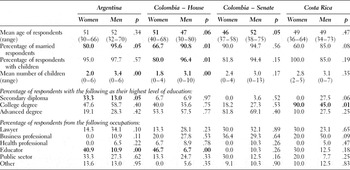
Social backgrounds of legislators in Argentina, Colombia, and Costa Rica

Note: p-values are for a chi-square test (where percentages are reported) or a one-tailed t-test of means (where means are reported). Bold entries are statistically significant at the p ≤ 0.05 level.
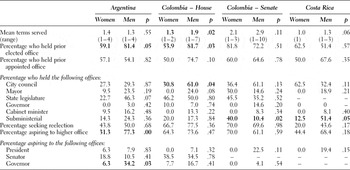
Political backgrounds and future ambition

Note: p-values are for a chi-square test (where percentages are reported) or a one-tailed t-test of means (where means are reported).
Bold entries are statistically significant at the p ≤ 0.05 level
GENDER AND SOCIAL BACKGROUNDS
Research on the social backgrounds of women in politics in Latin America is rare, and most of that which does exist was conducted prior to or in the early years of the region's cultural, socioeconomic, and political changes (Camp Reference Camp1995; Chaney Reference Chaney1979; Rivera-Cira Reference Rivera-Cira1993; Saint-Germain Reference Saint-Germain1993). In her 1967 survey of Peruvian and Chilean female politicians, Elsa M. Chaney (Reference Chaney1979) found that women came to office through “traditional” occupations, such as education, social welfare, and health care, rather than “modern” ones, such as public administration, engineering, and social sciences (p. 134). She also found that women in high-level political positions had several similarities. They all had a university education, most were from upper-middle or upper classes, many had family connections to politics, and most were older, unmarried (either single or widowed), and with fewer than four children.
In a similar study of the 14 women who won legislative office in Costa Rica in the 1986 and 1990 elections, Saint-Germain (Reference Saint-Germain1993, 128) characterized female legislators similarly. Most women were in their fifties, had university degrees but no advanced degrees, and came to office after careers in education, social work, and law. In contrast to Chaney's report, Saint-Germain's finds that most Costa Rican female legislators were married and had between two and four children. This picture, however, contrasts with the case of Nicaragua during the Sandinista period of the 1980s:
Some of the women were in their early 20s when elected, and most were in their 30s or 40s—young by most political standards. A university degree was the rare exception, with most having interrupted their education during the years leading up to the popular overthrow of the former government. Women elected from rural areas, or those representing the poor and working class, had only a few years of formal schooling. Reflecting the turbulent social changes that accompanied the revolution, Nicaraguan women delegates reported being single, separated, or divorced as often as being married. Most had two or three children, although one had nine and another ten. (Saint-Germain Reference Saint-Germain1993, 128–29)
More recent research on Central America and Argentina also finds that women in office are highly educated (Marx, Borner, and Caminotti Reference Marx, Borner and Caminotti2007; Saint-Germain and Metoyer Reference Saint-Germain and Metoyer2008).
Unfortunately, these studies only examined women, making it impossible to know whether the characteristics of women differed from those of the typical man elected to office. Roderic Ai Camp (Reference Camp1995) includes both men and women in a study of gender differences among Mexican elites and finds that female elites had lower levels of education and emerged out of less prestigious educational institutions than did men. Women in Mexico also lacked backgrounds in the fields of law, engineering, and health and instead emerged from teaching and social work. This is the only study, thus far, that searches for gender differences among political elites and does so with a relatively limited set of social background characteristics. In addition, that study and the previous ones focus on women in politics prior to or in the early years of the social and political changes (between the late 1960s and 1991) that have occurred in Latin America recently. I expect that in the 2000s, women and men are likely to be quite similar to one another in their age, family situations, educational experiences, and occupational backgrounds. Indeed, Table 1 shows that few statistically significant differences exist in men's and women's social backgrounds.
Age
Early research on women in politics in Latin America found that female officeholders tended to be older—often in their fifties (Chaney Reference Chaney1979; Saint-Germain Reference Saint-Germain1993). This is similar for female legislators in Argentina, Colombia, and Costa Rica today, and women do not differ significantly from men in age, except in Colombia. In Argentina, the average legislator is slightly over 50—the average woman is 51 and the average man is 52. Legislators in Costa Rica are slightly younger, with the average age being 49 for both women and men. These differences are not statistically significant, however.
Significant gender differences do exist in Colombia, and it is interesting to note that the differences reverse themselves across the two legislative chambers. In the Chamber of Representatives, women are older than men—women's average age is 51 (median = 52) compared to only 47 for men (median = 46). However, in the Senate, women are younger than men. Women's average age is 46 (median = 46) compared to men's average age of 52 years (median = 50). The age range for women in both chambers is narrower than it is for men. In the lower house, women range in age from 40 to 68, whereas men range from 30 to 80. In the upper house, women's ages range from 37 to 58, compared to men's ages ranging from 38 to 75. The differences in men's and women's mean ages are not an artifact of a few outlier men and women; instead, they represent a statistically significant disparity during the 1998–2002 congress. That said, the substantive differences are relatively small—the average man and woman in the Colombian Congress was middle aged, just as in Argentina and Costa Rica.
Marital Status
Gender differences in marital status exist in all three countries, and female legislators are less likely to be married than male legislators in each case (see Table 1). In the three countries' lower chamber or unicameral assembly, anywhere from 15% (in Argentina) to 25% (in Costa Rica) fewer women than men are married.Footnote 11 Not only is the difference between men and women large, but the percentage of women married is as low as 60% in Costa Rica and 67% in the Colombian House of Representatives. It is 80% in Argentina, but this is low compared to the 96% of male deputies in Argentina who are married.Footnote 12 In contrast with the findings in Argentina, Costa Rica, and the Colombian House of Representatives, nearly all female senators in Colombia are married (90%), and this is comparable to the marriage rate for men (95%).
From the survey results, it is unclear why women are less likely to be married than are men in three of the four chambers. However, existing research and interviews with female legislators in the countries suggest several possible reasons. Mark P. Jones (Reference Jones, Siavelis and Morgenstern2009) reports similar findings for Argentine deputies elected between 1991 and 1999 and suggests that the machista culture is one of the biggest reasons for women's lower marriage rates. Despite cultural changes over the past 30 years, machista attitudes persist in many places; women whose primary responsibility is not home and family are looked down upon. Marx, Borner, and Caminotti (Reference Marx, Borner and Caminotti2007) suggest that the presence of gender quotas may explain the younger age and lower marriage rates that they find for women in Argentina and Brazil. The new demand for women in politics has brought younger women and those not bound by the constraints of marriage and family into the political arena. This may be true in Argentina and Costa Rica, but it does not explain why fewer women than men are married in the Colombian Chamber of Representatives.
Another possible reason is the difficulty of balancing a family life with a political career. Several female legislators in Costa Rica that I interviewed in 1999 emphasized this obstacle for women. Virginia Aguilar, a married national deputy from the Province of Limón from 1998 to 1002, said that “during the political campaign, I left at 6 in the morning and returned at midnight” (personal interview, San José, July 13, 1999). Sonia Picado, a divorced Partido Liberación Nacional (PLN) national deputy from the Province of San José from 1998 to 2002, says that women “have the disadvantage of divided lives. Especially when they have young children, it is very hard for them because the political activities are very demanding, very time-consuming. They often have to move from one end of the country to the other” (personal interview, San José, July 1, 1999). Those who are successfully balancing a marriage and political career highlighted the importance of family support. Isabel Chamorro of the PLN in Costa Rica is 45 years old and married with three children. She says in her interview: “I had a very tolerant family. My parents, my brothers gave me a lot of independence and never limited my participation in politics. . . . My husband's family helped me a lot. They supported me in the sense that they looked after my children when they were small and I had to attend meetings. Now that my children are grown, my children support it.”
Marx, Borner, and Caminotti (Reference Marx, Borner and Caminotti2007) also found that female legislators in Argentina and Brazil credited their presence in politics with spousal support. Thus, an additional reason that fewer women than men are married may be that women find it more difficult to hold together a marriage or family while pursuing a political career. Some women may put off marriage to pursue that career or pursue politics after a marriage has ended (or undergo a divorce while in office).
Children
As several of the interviewees just discussed noted, having children, particularly young children, while in politics can be an obstacle for women. Yet the survey reveals few gender differences in whether legislators have children. In Argentina and Costa Rica, nearly all women and men have children. Fewer women than men have children in Colombia, but it is only statistically significant in the Chamber of Representatives. Only 80% of female representatives have children, compared to 96% of men. Eighty percent is still quite high, however, revealing that the norm is still for women (and men) in politics to have children. In addition, the women in the Chamber with kids range in age from 44 to 68. This suggests that women in politics are waiting until later in life to serve in congress, perhaps when they feel they may be better able to balance family and a political career. Only 3 of the 15 female respondents did not have kids. Those three were not married and span the age range for women in the lower house—they were 40, 55, and 56.
Previous research on women in politics in Latin America found not only that women had children but that they had several. Chaney (Reference Chaney1979) and Saint-Germain (Reference Saint-Germain1993) found that women in Chile, Peru, Costa Rica, and Nicaragua had between two and four children. Marx, Borner, and Caminotti (Reference Marx, Borner and Caminotti2007) reported an average of 2.1 children for women and 2.6 for men in the 2003–5 Argentine congress. Much like these researchers, I find that a large majority of women in Argentina, Colombia, and Costa Rica had four or fewer children. In Argentina, women had between 0 and 6 children, but only one woman had none and one woman had 6 (the next highest had 4). In Colombia, women had between 0 and 4 children, and in Costa Rica, they ranged between 2 and 5 (and only one woman had 5). The survey results do, however, show that women have fewer children than men in all three countries. The differences are only statistically significant, however, in Argentina and the Colombian Chamber of Representatives. In Argentina, the average number of children for women is 2, but it is 3.4 for men. In the Colombian Chamber, it is 1.9 compared to 3.1. Comparing the median number of children reduces some of the skew caused by one man in the Colombian Chamber who had 10 children. The median number of children for women in both Argentina and the Colombian lower house was 2 for women and 3 for men.
Although some differences in the number of children do exist, these differences are not very large. In addition, differences in the number of children may be less of an obstacle for women in politics than simply having children. Being away from home for long periods of time while the legislature is in session may be equally burdensome if a woman has one child or if she has three.
Education Levels
Few differences exist in the educational backgrounds of male and female legislators in Argentina, Colombia, and Costa Rica. In Colombia, advanced degrees among legislators are common—the vast majority of both women and men have them.Footnote 13 In all three countries, the majority of legislators, both men and women, have at least a college degree. In Argentina, women have slightly lower levels of education than men, illustrated by the fact that more women than men have only a secondary school diploma. Specifically, 33% of women have only completed secondary school compared to 13% of men. In Costa Rica, the trend is reversed. All women in the Assembly had at least a college degree, but only 70% of men had post–secondary school degrees. More men than women had advanced degrees (27.5% compared to 10%), but this difference does not attain statistical significance.
The women winning office in Argentina, Colombia, and Costa Rica more often than not are highly educated, just as men are. Even in Argentina where more women than men have secondary school diplomas, two-thirds of women have at least a college degree. This contrasts with Camp's (1995) findings for Mexico but supports those of Marx, Borner, and Caminotti (Reference Marx, Borner and Caminotti2007), who describe female legislators in Argentina as highly educated. These findings support the theory that more educated women are running for office and that parties and voters may be selecting women with educational backgrounds that are more similar to those of men.
Work Experience
The most common occupational backgrounds for legislators in Argentina, Colombia, and Costa Rica are law, business, health professions, education, and the public sector, I find that the backgrounds of women and men diverge from one another in only three instances. Two of these occur in Argentina and the Colombian lower house where women are more likely than men to have been educators. In Argentina, 41% of women had careers in education compared to 11% of men. In the Colombian Chamber, it was 47% compared to 7%. No significant differences exist in the proportions of women and men with backgrounds in education in the Colombian Senate, where no women claimed to be educators, or in Costa Rica, where 30% of women were educators (13% of men were educators, but the difference is not statistically significant). The only other statistically significant difference in the occupational backgrounds of men and women is that fewer female deputies in Costa Rica came from business backgrounds. Fifty percent of male legislators in Costa Rica were business professionals compared to only 20% of women.
These findings of more similarities than differences for occupational experience among men and women diverge from what earlier studies suggested about the backgrounds of male and female candidates. As noted, those studies often found that women had a different set of occupational skills than their male counterparts, with fewer women emerging from legal and business professions and most women in office with backgrounds in education (Chaney Reference Chaney1979; Saint-Germain Reference Saint-Germain1993). In Latin America today, however, gender differences in occupational experience appear to be limited.
GENDER AND POLITICAL CAREER PATHS
The political offices that comprise common career paths for national legislators often vary across countries. For example, unitary states exhibit more hierarchical paths from local to state to national office, whereas federal states have more porous paths because state level offices are often more powerful than national offices. That said, representatives to national legislative offices in all countries generally need some political experience in elected or appointed offices to be competitive candidates and win seats. Do gender differences exist in the political careers that men and women follow on their way to being a national representative?
In Latin America, Saint-Germain (Reference Saint-Germain1993) found that women in Costa Rica had “distinguished careers outside politics” prior to running for office, and many had served in elected or appointed office prior to service in the Assembly. She concluded that “the picture that emerged was one of women who had ascended in the hierarchical structure of their political party through dedication, solid reputation, hard work, and demonstrated ability to deliver votes at election time” (p. 128). Marx, Borner, and Caminotti (Reference Marx, Borner and Caminotti2007) also found that female legislators in both Argentina and Brazil had long histories of participating in politics before getting elected to the national legislature. In both of these studies, however, it is impossible to know whether women were different from men in this sense because the researchers drew their conclusions from interviews with female legislators only. Political experience in the party, in the district, in appointed political positions, or in elected offices from municipal councils to state government provides representatives with qualifications for serving in national political office, and has been a long-standing criterion for recruitment in the male-dominated candidate selection process in Latin America (Samuels Reference Samuels2003; Smith Reference Smith1979). Indeed, the survey results show that female legislators in Latin America in the 2000s follow the example set by their predecessors (see Table 2). Similarities in the career paths of men and women outnumber the differences in Argentina, Colombia, and Costa Rica.
Legislative Experience
The number of terms that a legislator has served in office is one indicator of legislative experience. Those having served more terms may find it easier to get elected or stay in office once elected the first time—otherwise known as an “incumbency advantage.” If fewer women are incumbents, they may find it difficult to get elected or negotiate their way through the legislative process once in power. In fact, women and men have served similar numbers of terms in Argentina, Colombia, and Costa Rica (see Table 2).Footnote 14 In Argentina, women have served an average of 1.4 terms and men have served an average of 1.3 terms. The total number of terms that both men and women have spent in office ranges from 1 to 4, but the median is 1 for both men and women. Incumbency is not common for men or women in Argentina.Footnote 15
In Colombia, women have served fewer terms than men in both chambers, but it is only statistically significant in the lower house, where women have served an average of 1.3 terms compared to 1.9 for men. And this is skewed somewhat by 6 men who have served between 4 and 7 terms. The median number of terms for women is 1, and it is 2 for men. No woman has served more than two terms in the Chamber nor have 80% of the men. Making a political career out of service in the Colombian Congress is not common for men or for women.
In Costa Rica, women have served fewer terms in office than men—1.0 compared to 1.3—but the difference is only borderline statistically significant (p = 0.06). Costa Rica is complicated by legislative term limits that prohibit immediate reelection, thus allowing legislators to run for office only after having sat out a term. Some, though relatively few, do so. In the 1998–2002 congress, no women had served previously. However, 8 men had served once before and 1 man had been in the Assembly twice before. One reason for the slight difference may be that prior to 1998, so few women had served in the legislature that there were not many women to even potentially serve again after sitting out a term. Another possibility is that something is systematically hindering women, but these data do not give any indication of what that may be. Women and men in Costa Rica are similar in age, educational background, and occupational experience, such that these factors do not explain the difference.
Previous Officeholding Experience
Legislators in Latin America often gain political experience by holding other elected and appointed political offices prior to running for a seat in the national legislature (Botero Reference Botero2008; Jones et al. Reference Jones, Saiegh, Spiller and Tommasi2002; Samuels Reference Samuels2003; Smith Reference Smith1979). Yet paths to power can vary across countries due to differences in national government structures and the degree of political decentralization. Argentina is a federal system with 24 provinces (including the federal capital), each of which has an elected legislature and directly elected governor. Within each province are municipal governments, with mayors and municipal councils that are both directly elected. In Argentina, municipal and provincial legislatures are common stepping stones to the national legislature, but governorships are an office that many national legislators aspire to in the future. Jones (Reference Jones, Morgenstern and Nacif2002, 176–77) describes the diversity in paths to power in Argentina:
Some individuals begin as mayors, move on to a post as a national deputy, and finally reach the Senate. Others are second-tier party activists who spend one term in the Chamber (normally placed on the list by a powerful sponsor within the party) and then go back to their province either to continue their work within the party or to hold a position in the provincial executive branch or provincial legislature. Still others start as a provincial legislator, eventually arriving as a national deputy, and then either return home (from which they may return to Buenos Aires as a national deputy in the future) or move on to the Senate.
Colombia, in contrast, is a unitary system where political power is centralized in the national government. The 32 departments have elected governors, who have been directly elected only since 1991, and departmental assemblies with 11 to 42 members (Botero Reference Botero2008). At the local level, municipalities have mayors and municipal councils, but mayors have been elected only since 1988. Most legislators gain political experience in municipal councils, department assemblies, or as mayors prior to election to the national legislature. The bicameral congress also shapes paths to power because the lower chamber can, but does not always, act as a step toward election to the Senate.Footnote 16
Costa Rica is a unitary system with the majority of political power resting in the national government. The country is divided into 7 provinces, 81 municipalities, and 463 districts. Each province has a governor, but the governor is appointed and exercises almost no political power. Each municipality has an elected municipal council, with the number of members ranging from 5 to 13 depending on the population of the municipality. Prior to 2002, the mayor of each municipality was appointed by the municipal council. Beginning in 2002, mayors have been directly elected. At the district level, additional councils and mayors exist, but these also have been directly elected only since 2002. Paths to the national legislature in Costa Rica are often through city councils or appointed positions in the government bureaucracy, but rarely through local executive or provincial-level offices.
According to my survey, most legislators (89%) have held some type of political office prior to winning a seat in the national legislature. In terms of elected offices, the percentage of men and women who held them in the Colombian Senate and Costa Rican Legislative Assembly were quite similar. In contrast, however, significantly fewer women in Argentina and the Colombian Chamber of Representatives held elected office prior to their current legislative term.Footnote 17 In Argentina, only 59% of female deputies had served in an elected office previously compared to 81% of men. These deputies are also those who have fewer children, but there is no correlation between women's previous service in office and other characteristics of deputies' social backgrounds. In the Colombian Chamber, 54% of female representatives held prior elected office compared to 82% of men. However, female representatives' social backgrounds do not correlate with their probability of holding elected office prior to serving in the Chamber. Women's older age, less likelihood of being married and having children, or experience as educators does not explain this gender difference.
In terms of appointed offices, women and men are quite similar in their experience. No statistically significant differences exist in the percentages of women and men who previously held an appointed office. Only 50% of women in the Colombian lower house were appointed politicians prior to serving in the Chamber compared to 75% of men, but this is only borderline significant. In Costa Rica, 50% of women held prior appointed office compared to 68% of men, but this difference is not significant either. In Argentina and the Colombian Senate, near-equal proportions of men and women had prior experience with appointed office, and this averaged 56% in Argentina and 63% in the Colombian Senate.
The types of political offices that men and women have held prior to serving in the national legislature are also quite similar. Women and men have served in city councils, as mayors, in state legislatures, as governors, and in ministerial posts, and the similarities in their experience outnumber the differences. That said, some statistically significant gender differences did emerge in the types of offices that male and female legislators held previously (see Table 2). In Argentina, gender differences in prior officeholding experience only exist for provincial legislatures, where less than half as many women as men have held seats.Footnote 18 In the Colombian House of Representatives, gender differences are significant for city council and mayoral elections. Half as many women as men have sat on city councils, and no women have been mayors. In the Colombian Senate, the only difference between men and women is in bureaucratic experience, and women have more of this experience than men.Footnote 19 Almost 40% of women held some type of bureaucratic office prior to winning a seat in the Senate, compared to only 10% of men. In Costa Rica, it is the reverse. Significantly fewer women have served in bureaucratic posts than men—only 13% of women have served in these positions compared to 51% of men. Instead, women's experience appears to come from work on city councils, where over 62% of women had served (compared to 32% of men, a difference that is only borderline statistically significant).
GENDER AND POLITICAL AMBITION
Political ambition lies at the core of rational choice theories of legislative politics. Representatives are responsive to their constituents or their political party in an effort to preserve their political future. This future may be reelection (Mayhew Reference Mayhew1974) or a political career outside of the legislature, especially in places where representatives are term limited (Carey Reference Carey1996). Joseph A. Schlesinger's (1966) seminal study of political ambition in the United States led to an extensive body of literature building off of his original suppositions (see, for example, Fowler and McClure Reference Fowler and McClure1989; Fox and Lawless Reference Fox and Lawless2005; Rhode Reference Rhode1979; Williams and Lascher, Jr., Reference Williams and Lascher1993), and this spread to comparative politics as well (Botero Reference Botero2008; Camp Reference Camp1995; Jones Reference Jones, Morgenstern and Nacif2002; Jones et al. Reference Jones, Saiegh, Spiller and Tommasi2002; Langston Reference Langston2006; Samuels Reference Samuels2003; Smith Reference Smith1979).
This research has identified three types of ambition that emerge among political elites (Schlesinger Reference Schlesinger1966). The first is discrete ambition, which is actually a lack of ambition and applies to elites who desire retirement or a return to the private sector. Static ambition is a second type of political ambition and refers to elites who aspire to stay in the current office they hold. Third, progressive ambition is an aspiration for higher political offices. Among legislators, this would be such offices as the presidency of a country, upper chambers of the legislature, or perhaps governorships, in some countries. The three types of ambition provide a general framework for studying political ambition among male and female representatives.
The incentive structures of Latin American democracies today suggest that progressive ambition is likely to drive most representatives. Jones and his colleagues (2002) illustrate the importance of progressive ambition in Argentina. They find that legislators in Argentina are more prone to progressive than to static ambition—Argentine deputies are “amateur legislators but professional politicians”. They find that most deputies use their strong ties to their political parties to move into national, provincial, and municipal offices, and they use the Chamber of Deputies as a springboard for Senate seats, governorships, and presidential/vice-presidential candidacies. The emphasis on progressive ambition over static ambition is similar in other Latin American countries and is evidenced by low reelection rates throughout the region (Botero Reference Botero2008; Samuels Reference Samuels2003).
Very little research on gender and ambition in Latin America has been conducted. One study that does exist studied women in the 1960s and found that most female politicians in Peru and Chile exhibited discrete ambition—they planned to leave office when their term expired (Chaney Reference Chaney1979). Only the most successful politicians exhibited static or progressive ambition. Chaney (Reference Chaney1979) suggested that this results from the pessimism that many women felt about women's equality in society and about the difficulties of being married, having children, and being a politician. Her study found many women who felt that they were less qualified than men and lacked confidence in their abilities to pursue a political career. Felipe Botero (Reference Botero2008) studied the career paths of legislators in Colombia and Chile and used gender as one of several explanatory variables. He finds no gender differences in the probability that women display progressive ambition, but finds that they are slightly more likely to retire and slightly less likely to seek reelection in both countries. His research is not focused on gender specifically, however, and offers no explanation for why this might be the case.
This study finds that male and female legislators in Colombia and Costa Rica exhibit no statistically significant differences in whether they seek reelection or aspire to higher office, or in the kinds of offices they would like to hold (see Table 2). Approximately 70% of representatives and senators in Colombia planned to seek reelection and/or aspire to higher office. In Costa Rica, 20% of women plan to seek reelection after sitting out one term, and 44% of men do. The difference is not statistically significant, however. Forty-four percent of Costa Rican female deputies aspire to higher office as do 68% of male deputies. Again, however, the difference does not attain statistical significance.Footnote 20
Significantly fewer women than men in Argentina aspire to higher office. Almost half of both men and women planned to seek reelection in Argentina, but only 31% of women aspire to higher office compared to 77% of men.Footnote 21 Of the women and men in the survey who elaborated on the offices that they aspire to, the only significant difference between them is that fewer female deputies aspired to governorships. The lower likelihood of women to aspire to higher office in Argentina is not explained by their more limited experience with prior political office, their different occupational background as educators, or whether they have a family life (models not shown). The women with families, who had not held prior elected office, or were teachers, are not the same women who have less political ambition. But a correlation does exist between women's education levels and their political ambition. The more ambitious women are those with higher levels of education. Of the six women with only a secondary school education, none aspired to higher office. A logistic regression analysis regressing political ambition on the background characteristics and political experience factors discussed in this article finds that education does explain some political ambition but that gender is statistically significant, even after accounting for education.Footnote 22 Women's different levels of political ambition in Argentina are not explained by their backgrounds or prior political experience. These findings for Argentina are particularly interesting in the context of Jones and colleagues' (2002) findings that progressive ambition dominates in Argentina. That may be true for men, but appears to be less true for women.
In sum, female and male legislators in Colombia and Costa Rica exhibit both static and progressive ambition. Women in Argentina have static ambition just as men do, but are less likely to aspire to higher office. As rational actor theory argues, both men and women seek to preserve their political futures either through reelection or higher political office. Despite the obstacles that women face getting elected and working in a male-dominated environment, elected female representatives still aspire to political careers. Women in national legislatures are as ambitious as men, even though they display different kinds of ambition across countries.
CONCLUSION
In Argentina, Colombia, and Costa Rica today, male and female legislators are more similar than different in their social backgrounds, paths to power, and political ambition. In general, both men and women are middle aged, and the vast majority are married (though fewer women in all three countries are married than men), have children, have received college or advanced degrees, emerge from traditional career paths of law, business, and the public sector, have prior political experience, and aspire to reelection and/or higher political office. Women do not appear to bring diverse social backgrounds, experiences, or different levels of political ambition to the legislative arenas of these countries, nor have they “feminized” the legislative arena in terms of backgrounds, experience, or political outlooks. Instead, they mirror men's traditional characteristics, paths to power, and political ambition. As Chaney (Reference Chaney1979, 110) noted 30 years ago: “[A]lmost always the ‘required’ elite social background and demographic characteristics must be possessed if a woman is to achieve a political leadership position, at least in formal political structures.”
These generalizations, however, obscure a few differences that did emerge in some countries. Fewer women than men in Argentina and the Colombian Chamber of Representatives have held prior elected office, and more women than men in those two legislatures have backgrounds as educators. Women in Argentina have slightly lower levels of education than men, and fewer women there aspire to higher office. Fewer women than men in all three countries are married, and women in Argentina and the Colombian lower house have fewer children. Perhaps most noticeable, more significant gender differences emerged in the Argentine Chamber of Deputies and Colombian Chamber of Representatives than in the Colombian Senate and Costa Rican National Assembly.
What explains the fact that gender differences are more pronounced in Argentina and the Colombian lower house? One explanation is different political institutions in the countries. The gender differences that exist in Argentina could result from gender quotas (Franceschet and Piscopo Reference Franceschet and Piscopo2008; Marx, Borner, and Caminotti Reference Marx, Borner and Caminotti2007). Some scholars argue that the use of gender quotas yields the election of “token” women who do not win their seats on the basis of merit but, instead, have strong family connections to politics, lack appropriate qualifications or ambition for political office, and are less able to maneuver in the political system (Dahlerup Reference Dahlerup and Dahlerup2006, Reference Dahlerup2007; Franceschet and Piscopo Reference Franceschet and Piscopo2008; Tripp, Konate, and Lowe-Morna Reference Tripp, Konate, Lowe-Morna and Dahlerup2006; Vincent Reference Vincent2004; Zetterberg Reference Zetterberg2008). Susan Franceschet and Jennifer M. Piscopo (2008) previously found evidence of a “label effect” in Argentina, where female legislators report that quotas have led to greater labeling of women in office as quota women, less effective policymakers, less committed to women's rights, and defined by their links to political families. My findings that women are slightly less educated than men, more often enter politics from careers in education than men, have less experience with elected office than men, and display less progressive ambition than men could be interpreted in support of the argument that Argentine female legislators are “quota women.”
The gender differences that do exist in Argentina, however, are often quite small and do not appear consistently across all of the characteristics studied. More women than men have secondary school educations, but two-thirds have at least a college degree. Forty percent of women have backgrounds as educators (compared to 11% of men), but similar numbers of women and men come from the more traditional feeder backgrounds of law, business, and the public sector. Fewer women than men held prior elected office, but similar percentages to men had experience in appointed political posts. Lastly, fewer women display progressive ambition, but this does not mean that they have no ambition. Just as many women as men display static ambition. I interpret these findings as providing evidence of only minimal differences between women and men in Argentina. They do not provide sufficient evidence to conclude that gender quotas create disparities in male and female legislators' social backgrounds, paths to power, or political ambition. In addition, if quotas were responsible for explaining differences, then we would expect to find more statistically significant gender differences in Costa Rica (which also had a quota). Very few differences in backgrounds, political experience, or ambition appear in Costa Rica, however.
This corresponds to empirical findings from other studies about the effect of quotas on the types of women elected to legislatures (Dahlerup Reference Dahlerup2007; Murray Reference Murray2010; Tripp, Konate, and Lowe-Morna Reference Tripp, Konate, Lowe-Morna and Dahlerup2006; Zetterberg Reference Zetterberg2008). In Mexico, Pär Zetterberg (Reference Zetterberg2008) found no empirical evidence of tokenism. Women elected through quotas to subnational legislatures were no less experienced than women not elected via a quota, and both men and women benefit from tight ties to men in the party leadership. Similarly, Aili Tripp and her colleagues (2006) found no evidence of quotas leading to the election of token women in Africa, and Drude Dahlerup (Reference Dahlerup2007) found that most women in quota systems around the world win office on the basis of merit and a competitive process.
Colombia does not have a gender quota for legislative elections, and so gender quotas cannot explain the gender differences found there. In addition, the two legislative chambers in Colombia use similar electoral rules to elect representatives, and have very similar functions (Botero Reference Botero2008), such that those cannot explain the fact that gender differences emerge in the Chamber of Representatives but not in the Senate. Instead, the differences may result from the higher prestige that corresponds to serving in the Colombian Senate. Botero (Reference Botero2008) finds that “stronger” candidates are more likely to run for seats in the Senate than in the Chamber. This could lead the women with more officeholding experience and backgrounds in the more traditional feeder careers (business, law, and public sector, rather than education) to pursue seats in the Senate rather than the Chamber of Representatives. Similar to Argentina, gender differences in the Colombian lower house are fewer than the similarities that exist, and so I do not want to overstate them. But to the extent that differences do appear, chamber prestige could be one explanation.
This research has important implications for women and politics in Latin America. It offers a new perspective on questions related to the backgrounds, paths to power, and ambition of female legislators because it examines women in comparison to men. Most existing research has focused only on women in politics, making it difficult to determine the implications of the characterizations that emerged (Chaney Reference Chaney1979; Marx, Borner, and Caminotti Reference Marx, Borner and Caminotti2007; Rivera-Cira Reference Rivera-Cira1993; Saint-Germain Reference Saint-Germain1993; Saint-Germain and Metoyer Reference Saint-Germain and Metoyer2008). These studies could not say anything about whether women's backgrounds, paths to power, and ambition were different from, or similar to, other political actors, or hypothesize about possible effects that having certain kinds of women in office may have on politics. By examining both women and men, my study makes contributions to both of these questions.
First, it provides information about the representativeness of Latin American legislatures. The inclusion of women in legislatures in recent years has yielded new political actors who, for the most part, look a lot like the existing political actors. Women's backgrounds, paths to power, and ambition levels are more similar to men's than different. Women are replicating the traditional image of Latin American legislators, rather than bringing nontraditional social backgrounds, different educational and work experiences, or distinct political experiences to elected office. Women are not “feminizing” the legislature by creating a new class of political elites, and they do not appear to be increasing the representativeness of legislatures in terms of social backgrounds or political experiences. For those who hoped that the influx of women would bring about fundamental changes in the types of legislators in office, this does not appear to be happening (at least not yet).
Second, this study provides insights into the ways that women's presence in office may affect substantive representation. Specifically, the similarities among women and men may translate into to fewer differences in legislative behavior—the way representatives act in office. If the women winning office come from similar backgrounds and political experiences and have similar ambition, then fewer differences may exist between men and women in the bills they sponsor and debate, the way they vote, or the way they interact with constituents. Research has found that women in Latin America do promote women's (feminist) issues more than men, but are not always different from men in their work on health, education, economics, or foreign affairs issues, for example (Jones Reference Jones1997; Schwindt-Bayer Reference Schwindt-Bayer2010; Taylor-Robinson and Heath Reference Taylor-Robinson and Heath2003). These similarities may stem, in part, from the similar trajectories that male and female officeholders follow. Where women and men do differ in backgrounds, experience, or ambition, they may also differ in legislative behavior.
Although additional research is necessary to determine whether these findings are generalizable to other countries in Latin America or exist over time in Argentina, Colombia, and Costa Rica, this study offers initial evidence that female elites in Latin American legislatures today are more similar to the traditional male elite than they are different. Women's accession to power has not corresponded with a new genre of political elite. Women in Latin American legislatures in the 2000s are no longer the supermadres who were in office in the late 1960s (Chaney Reference Chaney1979). Instead, they have adopted the backgrounds, political experiences, and competitiveness that have traditionally brought men to political power. The consequences of this finding are potentially profound, but I leave empirical study of them to future research.
Appendix
Survey representativeness