Depression is a prevalent mental health illness, affecting approximately 18% to 27% of the population at some point in their lives (Kringlen, Torgenson, & Cramer, 2001; Weissman & Myers, Reference Weissman and Myers1978). Investigations across a number of countries have consistently found that depression affects women disproportionately (Nolen-Hoeksema, Reference Nolen-Hoeksema1987; Weissman & Klerman, Reference Weissman and Klerman1977); lifetime and point prevalence of major depression are twice as high for women compared to men (e.g., lifetime: 10–25% vs. 5–12% among women and men, respectively; Kringlen et al., Reference Kringlen, Torgersen and Cramer2001). Even at a subclinical level, these symptoms can cause distress or impairment in family, work, and social situations (Farmer, McGuffin, & Williams, Reference Farmer, McGuffin and Williams2002).
A number of explanations have been proposed to account for the gender discrepancy in rates of depression. Although there is some support for the contribution of biological and hormonal factors that put women at greater risk for depression than men, thus far a specific biological mechanism that translates into this gender disparity has yet to be identified (Bebbington, Reference Bebbington1996; Nolen-Hoeksema & Keita, Reference Nolen-Hoeksema and Keita2003). Instead, research has found that factors related to social conditions may increase women's vulnerability to depression (Bebbington, Reference Bebbington1996; Nolen-Hoeksema, Reference Nolen-Hoeksema1987, Reference Nolen-Hoeksema1990; Nolen-Hoeksema & Keita, Reference Nolen-Hoeksema and Keita2003). In addition, women show higher rates of engaging in cognitive and interpersonal styles that are associated with depression (e.g., rumination, negative attributional style, a strong affiliative relational style, and high levels of self-evaluative concerns; Cyranowski, Frank, Young, & Shear, Reference Cyranowski, Frank, Young and Shear2000; Nolen-Hoeksema, Reference Nolen-Hoeksema1991; Ruble, Greulich, Pomerantz, & Gochberg, Reference Ruble, Greulich, Pomerantz and Gochberg1993).
One factor that may contribute to higher rates of depressive symptoms in females, specifically mothers, is the stress related to child rearing, particularly for mothers from lower socioeconomic strata with young children. Research has found that women who have a child under age 6, live in poverty or are of low socioeconomic status (SES) and lack a supportive social network are at increased risk for experiencing depressive symptoms (Brown & Harris, Reference Brown and Harris1978; Lewinsohn, Hoberman, & Rosenbaum, Reference Lewinsohn, Hoberman and Rosenbaum1988).
Maternal Depression and Child Adjustment
Throughout this paper, the term maternal depression will be used to describe both mothers who have met clinical criteria for unipolar depression and those who obtained elevated scores on inventories of depressive symptoms. In both cases, associations have been documented with parental functioning and child outcomes (Cummings, Keller, & Davies, Reference Cummings, Keller and Davies2005; Farmer et al., Reference Farmer, McGuffin and Williams2002). When individual studies are reviewed, the term maternal depressive symptoms will be used when depression was quantified by elevated scores on an inventory of depressive symptoms and clinical depression will refer to studies that used diagnostic criteria.
In addition to the deleterious effects of depression on women, research has found that children are affected by their mother's depression. Associations between maternal depression and child outcomes, including child adjustment, emotional well-being, and problem behavior, are well documented. Mothers who are high in depressive symptoms or diagnosed with clinical depression may not only pass along a genetic vulnerability for mood disorders but also parent in ways that can place children at risk for a range of problems (Cummings & Davies, Reference Cummings and Davies1994; Downey & Coyne, Reference Downey and Coyne1990; Gelfand & Teti, Reference Gelfand and Teti1990; Zahn-Waxler, Iannotti, Cummings, & Denham, Reference Zahn-Waxler, Iannotti, Cummings and Denham1990). For example, Zahn-Waxler et al. (Reference Zahn-Waxler, Iannotti, Cummings and Denham1990) and others (Shaw & Bell, Reference Shaw and Bell1993) have noted that depressed individuals are typically negative, critical, unresponsive, helpless, and passive toward others, including their children. Furthermore, in at-risk young children, parenting practices characterized by unresponsiveness and hostility have been consistently linked to the development of behavior problems during both the preschool (Shaw, Keenan, & Vondra, Reference Shaw, Keenan and Vondra1994; Shaw et al., Reference Shaw, Sherrill, Huffman, Schonberg, Lukon and Obrosky2006) and school-age periods (Renken, Egeland, Marvinney, Mangelsdorf, & Sroufe, Reference Renken, Egeland, Marvinney, Mangelsdorf and Sroufe1989).
Prior research has found associations between maternal depression and multiple domains of child adjustment across developmental periods. Although researchers have studied children of depressed mothers in both narrowly defined developmental periods and across broad age spans (Goodman & Gotlib, Reference Goodman and Gotlib1999), disruptions may manifest differently depending on the developmental task typically accomplished at each age (Elgar, McGrath, Waschbusch, Stewart, & Curtis, Reference Elgar, McGrath, Waschbusch, Stewart and Curtis2004; Gelfand & Teti, Reference Gelfand and Teti1990). Both LaRoche (Reference LaRoche1989) and Beardslee (Reference Beardslee, Rutter, Izard and Read1986) assert that early infancy and adolescence are periods of particular vulnerability, as maternal depression may interfere with the ability of an infant to form an attachment relationship and of an adolescent to form an autonomous identity.
Maternal depression has been linked to a number of child outcomes during infancy and early childhood, including observer and maternal report of elevated fussiness and more difficult temperaments (Cutrona & Troutman, Reference Cutrona and Troutman1986; Whiffen & Gotlib, Reference Whiffen and Gotlib1989), lower scores on measures of mental and motor development (Cogill, Caplan, Alexandra, Robson, & Kumar, Reference Cogill, Caplan, Alexandra, Robson and Kumar1986; Murray, Fiori-Cowley, Hooper, & Cooper, Reference Murray, Fiori-Cowley, Hooper and Cooper1996; Sharp et al., Reference Sharp, Hay, Pawlby, Schmucher, Allen and Kumar1995), insecure attachments as assessed by independent observers (Campbell et al., Reference Campbell, Brownell, Hungerford, Spieker, Mohan and Blessing2004; Lyons-Ruth, Zoll, Connell, & Grunebaum, Reference Lyons-Ruth, Zoll, Connell and Grunebaum1986; Murray, Reference Murray1992), higher rates of parent-reported behavior problems (Ghodsian, Zajicek, & Wolkind, Reference Ghodsian, Zajicek and Wolkind1984; Marchand, Hock, & Widaman, Reference Marchand, Hock and Widaman2002; Shaw et al., Reference Shaw, Keenan and Vondra1994), and avoidance and withdrawal in their interactions as assessed by parents, teachers, and independent raters (Alpern & Lyons-Ruth, Reference Alpern and Lyons-Ruth1993; Cohn, Matias, Tronick, Connell, & Lyons-Ruth, Reference Cohn, Matias, Tronick, Connell and Lyons-Ruth1986; Field et al., Reference Field, Healy, Goldstein, Perry, Bendell and Shanberg1988).
Studies of outcomes for school-aged children and adolescents of depressed mothers have documented associations between maternal depression and maternal and teacher reports of children's low social competence and adaptive functioning (Luoma et al., Reference Luoma, Tamminen, Kaukonen, Laippala, Puura and Salmelin2001), higher rates of externalizing problems and more serious forms of antisocial behaviors as assessed by parent, teacher, and self-report (Hay, Pawlby, Angold, Harold, & Sharp, Reference Hay, Pawlby, Angold, Harold and Sharp2003; Munson, McMahon, & Spieker, Reference Munson, McMahon and Spieker2001; Owens & Shaw, Reference Owens and Shaw2003), poor adjustment and lower levels of self-esteem as reported by parents and teachers (Cummings et al., Reference Cummings, Keller and Davies2005; Wilkins et al., Reference Wilkins, O'Callaghan, Najman, Bor, Williams and Shuttlewood2004), teacher reports of academic and behavior problems at school (Sinclair & Murray, Reference Sinclair and Murray1998), and elevated rates of internalizing behaviors, especially depression (Cummings et al., Reference Cummings, Keller and Davies2005; Hammen & Brennan, Reference Hammen and Brennan2003; Leve, Kim, & Pears, Reference Leve, Kim and Pears2005).
Reciprocal Associations Between Child and Mother
Despite the wealth of existing literature that documents associations between maternal depression and child outcomes, there are few studies that examine how child characteristics and behaviors may contribute to and exacerbate mother's depressive symptoms. Coyne's interpersonal model of depression describes how depressed adults elicit negative reactions from others that intensify their unhappiness and negativity in a cycle of mutual distress (Coyne, Kahn, & Gotlib, Reference Coyne, Kahn, Gotlib and Jacob1987). Nelson, Hammen, Brennan, and Ullman (Reference Nelson, Hammen, Brennan and Ullman2003) speculate that maternal depression may create dysfunctions in the early parent–child relationship and elicit problems in the child, which would, in turn, maintain negative maternal attitudes. In support of these reciprocal effects, studies have documented higher rates of maternal depressive symptoms in clinic-referred versus normal children (Brown, Borden, Clingerman, & Jenkins, Reference Brown, Borden, Clingerman and Jenkins1988; Fergusson, Lynskey, & Horwood, Reference Fergusson, Lynskey and Horwood1993) and in mothers whose children have more behavioral or emotional problems (Civic & Holt, Reference Civic and Holt2000). However, the majority of studies have used cross-sectional rather than longitudinal designs, and the perceived methodological difficulties to testing reciprocal pathways have resulted in limited empirical findings (Sameroff & MacKenzie, Reference Sameroff and MacKenzie2003).
Another methodological limitation of prior research is that few have addressed the possibility that children's behaviors may affect maternal depression as early as infancy, and that mothers likely experienced elevated rates of depressive symptoms prior to the onset of their children's behavior problems. Some research has focused on how infant characteristics, including temperament and interaction style with adults, may elicit or maintain particular parental behaviors. For example, Field et al. (Reference Field, Healy, Goldstein, Perry, Bendell and Shanberg1988) found that when infants of depressed mothers interacted with nondepressed adults in avoidant and unresponsive ways, these nondepressed adults began to exhibit depressed-like manners in these interactions. Crockenberg (Reference Crockenberg1981) found that easygoing children were more impervious to their mother's behavior than were irritable children. Downey and Coyne (Reference Downey and Coyne1990) speculated that this imperviousness “may impede the development of the reciprocal pattern of negativity often seen in the interactions of depressed mothers and their children” (p. 68). Other studies have found that behavior problems and irritability in infants are associated with the continuation of maternal clinical depression (Ghodsian et al., Reference Ghodsian, Zajicek and Wolkind1984) and the onset of postpartum depression (Murray, Stanley, Hooper, King, & Fiori-Cowley, Reference Murray, Stanley, Hooper, King and Fiori-Cowley1996).
In a study utilizing an experimental design, Pelham et al. (Reference Pelham, Lang, Atkeson, Murphy, Gnagy and Greiner1997) had married couples and single mothers interact with 5- to 12-year-old boys who were trained to behave in either a normal or defiant manner. While waiting to have a second interaction with the same boy, the adults completed questionnaires, including one assessing depressive symptoms. Those who had interacted with the defiant boys reported significantly higher levels of depressive symptoms than those interacting with nondefiant children. The experimental design addressed the bias inherent in having depressed mothers report on their child's behavior, as some researchers contend that negative cognitive styles and associated family dysfunction may lead depressed mothers to negatively distort their perceptions of their children's behaviors (Boyle & Pickles, Reference Boyle and Pickles1997; Fergusson et al., Reference Fergusson, Lynskey and Horwood1993). Specifically, informants with higher levels of depression have been found to overestimate behavior problems, perceptions that may contribute to negative caregiving interactions (Goodman & Gotlib, Reference Goodman and Gotlib1999).
Another study examined whether individual differences in initial child behavior and child frontal asymmetry (i.e., EEG) were associated with changes in maternal report of depressive symptoms one year later (Forbes et al., Reference Forbes, Shaw, Fox, Cohn, Silk and Kovacs2006). Results indicated that mothers whose 3- to 9-year-old children had either below-average affect regulation and/or right frontal EEG asymmetry reported increased depressive symptoms 1 year later.
Although these findings are consistent with a reciprocal effects model of maternal depressive symptoms across a number of ages, it is possible that such effects are particularly prominent in early childhood. In particular, the “terrible twos” have been identified as a period of high parental dissatisfaction relative to the first year (Fagot & Kavanagh, Reference Fagot and Kavanagh1993), when children's increasing mobility coupled with continued cognitive limitations in their ability to grasp important principles (e.g., gravity, electricity, consequences of physical aggression on others) increase the stresses and challenges of caregiving on maternal well-being (Shaw, Bell, & Gilliom, Reference Shaw, Bell and Gilliom2000; Zahn-Waxler et al., Reference Zahn-Waxler, Iannotti, Cummings and Denham1990). Thus, results from the extant literature suggest that child characteristics may be associated with maintenance and increases in maternal depressive symptoms, particularly in early childhood.
Chronicity and Severity of Maternal Depressive Symptoms
Another limitation of the existing research on maternal depression and its relation to child outcomes is the inability to partition chronicity and severity of maternal depressive symptoms from one another, factors that may help to explain discrepant findings in the field (Campbell et al., Reference Campbell, Brownell, Hungerford, Spieker, Mohan and Blessing2004). In general, studies that have included measurements of severity and/or chronicity of depressive symptoms have shown that more severe and chronic levels are associated with higher levels of children's depression, anxiety, and externalizing problems (Hammen & Brennan, Reference Hammen and Brennan2003; Keller et al., Reference Keller, Beardslee, Dorer, Lavori, Samuelson and Kerman1986; Warner, Mufson, & Weissman, Reference Warner, Mufson and Weissman1995). Brennan et al. (Reference Brennan, Hammen, Anderson, Bor, Najman and Williams2000) found children whose mothers had experienced both chronic and severe depressive symptoms demonstrated significantly more behavior problems than children whose mothers had only chronic or severe depressive symptoms. In contrast, Rutter (Reference Rutter1990) has suggested that children may be better able to understand and accept more severe parental pathology and find less severe symptoms to be more arbitrary and disturbing. In support of this, Hammen and Brennan (Reference Hammen and Brennan2003) found that the effects of maternal depression were not linear, with youth depression decreasing for exposure to moderate and severe maternal, clinical depression.
Research Questions
In the current study, we sought to advance our understanding of reciprocal influences on maternal depressive symptoms and subsequent risk of child problem behavior. First, we used a semiparametric modeling technique (Nagin, Reference Nagin2005) to identify developmental trajectories of maternal depressive symptoms during an 8.5-year span among a group of predominantly low-income mothers and their toddler-age sons. We are unaware of any existing studies that have traced trajectories of depressive symptoms among a sample of low-income mothers from early to middle childhood. Based on the high recurrence rates of depression (i.e., at least 60% of individuals who have one depressive episode will have another, 70% with two episodes will have a third, and 90% with three episodes will have a fourth, according to the American Psychiatric Association [APA], 2000), we hypothesized that there would be at least one persistent low depressive symptom group and at least one persistent high group in addition to two or three moderate trajectory groups.
Second, and following up the work of Pelham et al. (Reference Pelham, Lang, Atkeson, Murphy, Gnagy and Greiner1997) and Forbes et al. (Reference Forbes, Shaw, Fox, Cohn, Silk and Kovacs2006), we sought to address whether child characteristics, observed prior to the assessment of maternal depression trajectories, would discriminate trajectory group membership. Based on the existing literature, we predicted that children showing higher levels of observed irritability, aggression, and/or noncompliance would be more likely to have mothers demonstrating more severe and chronic trajectories of depressive symptoms. We chose to restrict our measurement of child behaviors perceived by parents to be aversive (e.g., noncompliance, aggression) to the beginning of the toddler period (i.e., at 18 months), a time identified as challenging for parents in general, and in particular, for parents from lower SES due to fewer social and economic resources. Third, we assessed long-term child outcomes associated with different types of maternal depression trajectories, examining youth and teacher reports of youth externalizing and internalizing symptoms between the ages of 11 and 13. We predicted that more persistent and severe trajectories of maternal depressive symptoms would be associated with higher levels of boys’ internalizing and externalizing symptoms during early adolescence.
Method
Participants
Subjects were recruited from the Allegheny County Women, Infants and Children (WIC) program in the Pittsburgh Metropolitan area (Shaw et al., Reference Shaw, Winslow, Owens, Vondra, Cohn and Bell1998). The sample was restricted to boys because of the larger study's primary goal, to examine antecedents of antisocial behavior. Out of 421 families approached at WIC sites, 310 participated in the first assessment when the boys were 18 months old. At the time of recruitment, all families met the income requirements for WIC and had a child between 6 and 17 months of age. At the initial assessment, mothers ranged in age from 17 to 43 years, with a mean age of 28. Fifty-five percent of the sample was European American, 40.5% African American, 5% biracial, and 4% other (e.g., Hispanic, Asian). Sixty-four percent of mothers were married or living together, 28% were single, 7% were divorced, and 1% identified as “other.” There were an average of 2.67 children living in the household, with a range of one to seven children (SD = 0.939). Mean per capita family income was $236 per month (SD = 143; range = 29.3–1,000), with a mean Hollingshead SES score of 23.3, indicative of a working class sample. The study retention rate was relatively high, with 275 families (88.7% of the original sample of 310) participating in the age 10, 11, or 12 assessments.
Of the original 310 families recruited for participation in the study, 289 met criterion to be included in analyses by having maternal depression data for at least three time points. Families were excluded when the primary caregiver who completed the Beck Depression Inventory (BDI; Beck, Ward, Mendelson, Mock, & Erbaugh, Reference Beck, Ward, Mendelson, Mock and Erbaugh1961) changed and remained different during the course of the study; however, if a different person completed the Beck at just one or two time points, those families were retained and the data from the second primary caregiver were not used. This subsample was not significantly different from the original sample on maternal education, F (312) = 3.64, p < .10, family income, F (310) = 0.09, ns, maternal age, F (310) = 0.19, ns, or SES, F (313) = 0.38, ns.
Procedures
Mothers and target children were seen when the children were ages 1.5, 2, 3.5, 5, 5.5, 6, 8, 10, 11, and 12 years. Data were collected in the laboratory (ages 1.5, 2, 3.5, 6, and 11 years) and/or at home (ages 2, 5, 5.5, 8, 10, and 12 years). In addition, teacher data were collected by mail when the children were 10 through 13 years old. At the age 1.5 assessment, observations of the parent–child dyad were completed and coded for instances of noncompliance, aggression, and infant irritability. Demographic variables, including income, social status, and number of children in the household, were collected in the age 1.5 interview with the primary caregiver. Finally, mothers completed the BDI at all time points.
Measures
Aggression
Child aggressive behavior was coded in the laboratory during selected structured tasks during the 18-month assessment. Tasks were chosen to vary in stress level (e.g., Strange Situation vs. free play) and aggression was coded during a clean-up task, a no-toys task, two 5-min free play periods, and during two segments of the Strange Situation. The total coding time was 23 min. Codes, developed by Keenan and Shaw (Reference Keenan and Shaw1994), included aggression directed toward the mother or examiner (throwing toys at mother and/or examiner, hitting or kicking mother and/or examiner) and aggression directed toward toys or objects in the observation room. Counts of aggression were collapsed across situations and types to generate a total summary score of seconds the child showed aggression. Coders were trained and supervised undergraduate students who were unaware of any information about the families or research hypotheses. Interrater reliabilities, using kappas, were at or above 85% for all five aggression codes based on a random sampling of 10% of the tapes coded by each rater. In addition to calculating reliability for initial tapes, reliability was checked at 6-month intervals.
Noncompliance
Noncompliance was coded during a 5-min clean-up task at the 18-month assessment based on a molecular system developed by Martin (Reference Martin1981). Noncompliant behaviors included walking away, passive noncompliance, changing the task, and struggling or resisting. As different forms of noncompliance were highly correlated (i.e., r > .90), they were aggregated into a composite. The final score indicated how many seconds the child demonstrated various forms of noncompliance. A separate team of undergraduates was trained to code noncompliance versus aggression. The kappa for the final composite of noncompliance score was .71 based on 10% of the tapes coded by each rater.
Infant irritability
Irritability was assessed across all observational tasks administered at the 18-month assessment, including a free play, a clean-up task (Matas, Arend, & Sroufe, Reference Matas, Arend and Sroufe1978), a no-toys task (Smith & Pederson, Reference Smith and Pederson1988), three teaching tasks (Martin, Reference Martin1981), and throughout the entire Strange Situation (Ainsworth & Wittig, Reference Ainsworth, Wittig and Foss1969), resulting in approximately 1 hr of coded observation. Coders recorded the duration of infants’ fussing or crying; a percentage was generated by dividing this by the length of observation. The same coders completed 5-point global ratings of the amount and intensity of the infant's fussing and crying as well as a global rating for infant difficulty (Owens, Shaw, & Vondra, Reference Owens, Shaw and Vondra1998). Interrater agreement in the form of weighted kappas was calculated across 22 randomly selected cases and ranged from .77 to .96, with a mean of .87. Scores for percent of time spent fussing and crying, global amount and intensity of fussing and crying, and global difficulty were standardized and summed into an observed irritability score, with a reliability coefficient α of .91.
BDI
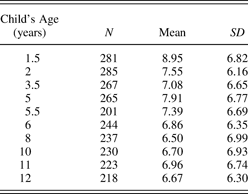
Mothers completed the BDI (Beck, Ward, Mendelson, Mock, & Erbaugh, Reference Beck, Ward, Mendelson, Mock and Erbaugh1961), a widely used measure of depressive states, at all assessments (e.g., children's ages 1.5, 2, 3.5, 5, 5.5, 6, 8, 10, 11, and 12 years). This measure is appropriate for both measuring intensity of depressive symptoms in psychiatric populations and detecting depressive symptoms in normal populations. Respondents rate the intensity of 21 depressive symptoms on a 0 (no symptomatology) to 3 (severe symptomatology) scale, and a score is derived by summing these ratings. Reliability and external validity of the BDI are high (Beck, Steer, & Garbin, Reference Beck, Steer and Garbin1988). In this sample, the reliability of the BDI ranged from .82 to .89, with an average Cronbach α of .86 across all 10 time points. Descriptive statistics for the total BDI scores at all assessments are presented in Table 1.
Descriptive statistics for BDI total score at all assessments
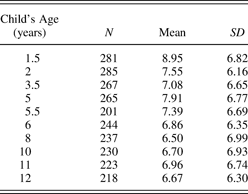
Note: BDI, Beck depression Inventory (Beck et al., Reference Beck, Steer and Garbin1988).
Self-Reported Delinquency (SRD)
Youth completed the SRD measure at ages 11 and 12 (Elliot, Huizinga, & Ageton, Reference Elliot, Huizinga and Ageton1985). This is a questionnaire that assesses the context and frequency of offending and examines overt, covert, destructive, and nondestructive offenses. Self-reported measures of delinquency have been shown to have strong psychometric properties, with test–retest reliabilities ranging from .75 to .98 and internal consistency αs from .65 to .92 (Krueger et al., Reference Krueger, Schmutte, Caspi, Moffitt, Campbell and Silva1994). The SRD is considered to be a highly respected self-report assessment of delinquency with good psychometric properties. In our sample, a composite score was used by summing the number of delinquent acts committed, with internal consistencies of .88 at age 11 and .84 at age 12. To minimize missing data, when data were available only at age 11 or at age 12, the total score from that age was used. If data were obtained at both time points, a composite score was derived by averaging the two scores.
Teacher Report Form (TRF)
Classroom teachers completed the TRF (Achenbach, Reference Achenbach1991) when the children were ages 11 through 13. The TRF is a widely used measure of child problem behavior consisting of 115 items that has adequate internal consistency and reliability (Achenbach, Reference Achenbach1991). For purposes of the present study, we used two broadband factors: the 36-item internalizing and 34-item externalizing factors. In this sample, internal consistencies were uniformly high from ages 11 to 13 (internalizing factor range = .86–.89, externalizing factor range = .92–.97). When data were available for only one age (n = 106), it was used as the final score. For participants with TRF scores available on two (n = 94) or three (n = 5) assessments, scores were averaged across available time points.
Analysis plan
Group-based trajectory modeling
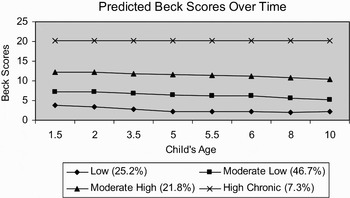
In the first step of the current study, we used a semiparametric, group-based approach (Nagin, Reference Nagin2005) to model the trajectory of depressive symptoms among mothers from when their sons were ages 1.5 to 10 years of age (Figure 1). The method is designed to identify clusters of individuals who share common pathways. This method may be particularly relevant for examining maternal depressive symptoms because it addresses such issues as course, timing, and severity of symptoms, which have been helpful in explaining discrepant findings in relation to child outcomes (Campbell et al., Reference Campbell, Brownell, Hungerford, Spieker, Mohan and Blessing2004). In addition, this method is designed to handle data that are missing completely at random; when data are missing, the equations in the base model are adapted to accommodate missing observations and the sample size count is adjusted so as not to include missing observations (Nagin, Reference Nagin2005). As a result, this method is useful for longitudinal data analysis, allowing the researcher to retain individuals with incomplete assessment histories.
Trajectories of maternal depressive symptoms from ages 1.5 to 10.

Technically, the group-based trajectory model is an example of a finite mixture or latent class model. A polynomial function is used to model the relationship between an attribute (e.g., maternal depressive symptoms) and age or time (Nagin, Reference Nagin1999, Reference Nagin2005; Nagin & Tremblay, Reference Nagin and Tremblay1999). The models were estimated with a specialized SAS-based procedure called “Proc Traj” which is described in Jones, Nagin, and Roeder (Reference Jones, Nagin and Roeder2001) and Jones and Nagin (Reference Jones and Nagin2007). A censored normal model was fitted to the data. Censored normal models are used not only in group-based models, but in conventional single-group models that use psychometric scale data where a significant number of participants cluster at the scale maximum or minimum. In this analysis, there were a significant number of mothers who exhibited no or few depressive symptoms, resulting in a cluster of data at the scale minimum. By formally accounting for this censoring in the specification of the likelihood function, the censored normal model provides consistent estimates of the parameters of the polynomial relationship that describe the trajectory equations for each group. A more comprehensive discussion of the technical details of this approach can be found elsewhere (Nagin, Reference Nagin1999, Reference Nagin2005; Nagin & Tremblay, Reference Nagin and Tremblay1999).
In selecting the optimal trajectory group model, the Bayesian information criteria (BIC) is typically used to identify the best fit in both number and shape of groups (D'Unger, Land, McCall, & Nagin, Reference D'Unger, Land, McCall and Nagin1998). Following the recommendation of Kass and Rafferty (Reference Kass and Raftery1995), model selection is guided by the objective of maximizing the BIC score. The model generates posterior probabilities of group membership, which estimates each individual's probability of belonging to each of the trajectory groups. Individuals are assigned to the group with the largest posterior probability estimate.
Risk factor and outcome analysis
Once the trajectories were established, we sought to address two core questions. First, what are the child effects on mothers’ depression trajectories? Second, how do mothers’ depression trajectories predict chidren's outcomes? To examine these questions, we first conducted exploratory analyses of variance (ANOVAs) to determine if there were early child behaviors that showed differences among mothers who had been assigned to different depression trajectory groups based on their posterior probabilities of group membership. Having identified candidate risk factors for trajectory group membership, we then estimated a generalized group-based model in which probability of trajectory group membership varied as a function of these risk and protective factors. As described in Nagin (Reference Nagin2005), a multinomial logit function is used to specify this probability function. By estimating a generalized model in which probability of trajectory group membership is conditional on individual characteristics and the trajectories themselves are jointly estimated, we avoid biases in statistical tests due to classification error in trajectory group membership. Finally, an analysis of covariance (ANCOVA) was conducted to examine if trajectory group status was associated with child adjustment outcomes at ages 11, 12, and 13 after accounting for the effects of child noncompliance assessed at 18 months.
Results
Identification of trajectories
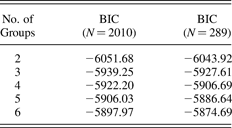
The first step was to model trajectories of maternal depressive symptoms from the time the children were 1.5 to 10 years of age. Various models were examined with regard to the characteristics and number of trajectory groups (see Table 2). As BIC scores generally improve as more groups are added, and this occurred in the current study, BIC scores were not the only criterion used for model selection (Nagin, Reference Nagin2005). Despite improved BIC scores, both the five and six group models resulted in subdividing already modest-size groups with higher levels of maternal depressive symptoms into smaller groups that were not substantively different from one another; thus, the four group model emerged as the best fitting and most parsimonious model.
Model fit indices
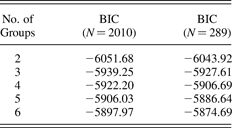
Note: BIC, Bayesian information criterion.
Groups 1 and 2, comprising the majority of the sample, demonstrated BDI scores suggestive of minimal depressive symptomatology (Beck et al., Reference Beck, Steer and Garbin1988). Group 1, which we term “low,” consisted of 25.2% (n = 73) of the sample who endorsed very few depressive symptoms across all time points (M = 2.0 across the eight time points). Group 2, which we term “moderate low,” included 45.7% (n = 132) of the sample and was characterized by a consistent pattern of moderately low depressive symptoms (M = 6.25 across eight time points). Group 3 included 21.8% (n = 63) mothers, which we term “moderate high.” This group consistently had BDI scores in the moderate depression range (M = 11.75 across all time points), with a slight decrease over time (M = 13.05 at age 1.5 versus M = 10.82 at age 10). Group 4, which included 7.3% (n = 21) of the sample, is termed the “high chronic group,” with scores suggestive of moderate to severe levels of depression at all time points (M = 20.55 across assessments).
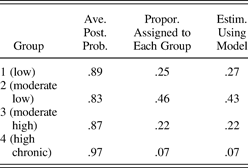
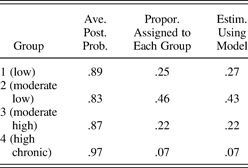
The average posterior probability for each group was calculated to confirm the adequacy of the final four-group model. Posterior probabilities measure a specific individual's likelihood of belonging to each of the model's trajectory groups (Nagin, Reference Nagin2005). As shown in Table 3, for all four groups the average posterior probabilities fell well above the lower recommended threshold for assignment of .7 (Nagin, Reference Nagin2005). The range in the current sample was .83 (moderate low group) to .97 (high chronic group). In addition, we found that the model met three other indicators of model adequacy recommended in Nagin (Reference Nagin2005): a close correspondence between each group's estimated probability and the proportion of individuals actually classified to the group on the basis of the maximum posterior probability assignment rule, reasonably tight confidence intervals on group membership probabilities, and high odds of correct group classification relative to chance.
Diagnostic statistics for judging model selection
Risk factors for depression trajectory membership
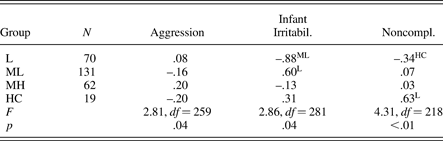
The next step was to examine child characteristics that may be associated with the trajectory group membership of mother's depressive symptoms. A series of exploratory ANOVAs was computed to examine the associations between trajectory group membership and individual child risk factors (see Table 4). Each child risk factor examined, including observed noncompliance, aggression, and infant irritability, showed significant associations with maternal depression group status; however, findings were not uniformly in the expected direction, particularly for infant irritability where the moderate low group showed the highest levels and aggression where the high chronic group had the lowest levels. Post hoc tests indicated that for noncompliance, children of mothers in the high chronic group were found to have significantly higher BDI scores than children of mothers in the low group, F (1, 215) = 11.14, p = .001, with p < .008 cutoff for significance using Bonferroni adjustment. For infant irritability, the moderate low group had significantly higher BDI scores than the low group, F (1, 278) = 8.29, p = .004. There were no significant, post hoc contrasts among groups for aggression.
ANOVA of 18-month child risk factors by trajectory group
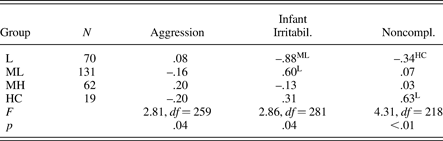
Note: ANOVA, analysis of variance; L, low; ML, moderate low; HC, high chronic; MH, moderate high. Superscript letters reflect significant differences between other groups in that column. Maximum N values are reported for each group, but actual N values vary by data available for each child risk factor.
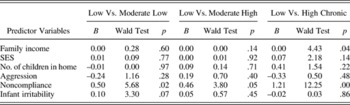
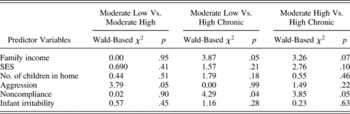
Next, we sought to examine the unique contribution of all three child variables in distinguishing trajectory group membership. We retained all three child variables in this multivariate logit analysis because the results of the ANOVAs found that each child factor showed differences in means by maternal depression trajectory groups. In this analysis, all groups were first compared to the low group using a multivariate logit analysis (Table 5), and then all other pairs of trajectory groups were contrasted using Wald tests of equality (Table 6). As low SES and income may increase the risk of the onset and persistence of depression (Lorant et al., Reference Lorant, Deliège, Eaton, Robert, Philippot and Ansseau2003), both variables were also entered into each logit equation and then subjected to Wald tests. Number of children in the household was also entered as a covariate, to control for the effects of family size on depression in this sample of economically depressed women. When all risk factors were entered in the model, only noncompliance consistently distinguished depression group membership, with greater child noncompliant behavior associated with higher levels of maternal depression. Noncompliance distinguished between the low group and both the moderate low and high chronic groups (B = 0.50 and 1.21, p = .02 and p < .001, respectively) and gave some indication of distinguishing between the low and moderate high groups (B = 0.46, p = .05). Noncompliance also distinguished between the moderate low and high chronic groups and the moderate high and high chronic groups in the expected direction (χ2 = 4.29 for moderate low and high chronic groups, p <.05, χ2 = 3.85 for comparison between moderate high and high chronic groups, p = .05). Family income significantly distinguished between the low and high chronic groups (B = 0.00, p < .05) and showed some indication of distinguishing the high chronic from the moderate low (χ2 = 3.87, p < .05) and from the moderate high groups (χ2 = 3.26, p < .10). In all cases, family income was significantly lower in the high chronic group. Child aggression showed some indication of discriminating trajectory group membership in only one comparison; aggression was higher for children in the moderate high group than the moderate low group (χ2 = 3.79, p = .05). Within a multivariate framework, infant irritability, family SES, and number of children in household were not found to distinguish between any pairs of trajectory groups.
Multivariate logit analysis for predicting trajectory group membership with each group compared to low
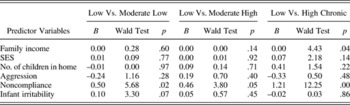
Note: SES, socioeconomic status.
Wald tests of equality and comparisons of regression coefficients in all pairs of trajectory groups

Note: SES, socioeconomic status.
Outcome analysis: Youth externalizing and internalizing problems during early adolescence
Our final goal was to evaluate whether maternal depression trajectory group membership predicted boys’ later externalizing symptoms, as measured by both TRF and self-reported SRD, and internalizing symptoms, as measured by the TRF. We conducted an ANCOVA to examine differences in boys’ reports of antisocial activities (i.e., SRD) and teacher reports of externalizing and internalizing symptoms by maternal depression trajectory group after controlling for 18-month child noncompliance. We then examined Bonferroni post hoc tests to look at the differences in outcomes among the maternal depression trajectory groups.
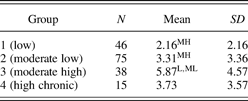
There was a significant effect of trajectory group status on boys’ self-reported delinquent behavior when controlling for 18-month noncompliance, F (4, 169) = 5.79, p < .001 (see Table 7). Post hoc tests indicated that self-reported delinquency in the moderate high group was significantly higher than in the low and moderate low groups (moderate high, M = 5.87; low, M = 2.48; moderate low, M = 3.31; ps < .01 for both comparisons).
Descriptive statistics for self-reported delinquency at ages 11 and 12
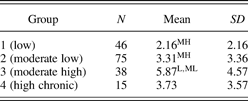
Note: L, low; MH, moderate high; ML, moderate low; HC, high chronic. Superscript letters reflect significant differences between the groups in the same column.
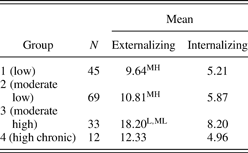
For teacher reports using the TRF, the ANCOVA found significant effects for externalizing, F (4, 158) = 3.81, p < .01, but not internalizing, F (4, 158) = 1.80, p = .131, outcomes after controlling for 18-month noncompliance (see Table 8). Post hoc tests indicated that teachers rated boys of mothers in the moderate high group to have significantly higher externalizing symptoms than boys of mothers in the low and moderate low groups (moderate high, M = 18.20; low, M = 9.55; moderate low, M = 10.85; ps < .01 for both comparisons). The externalizing scores among boys in the moderate high group were similar to the mean of a sample of clinic-referred boys, indicating that the level of externalizing behaviors for this group was elevated compared to a normal population (M = 15.7, SD = 12.4 for clinic-referred boys age 6–11, M = 18.1, SD = 13.6 for clinic-referred boys aged 12–18; Achenbach & Rescorla, Reference Achenbach and Rescorla2001). In all three outcome analyses, 18-month noncompliance was not significantly related to youth outcomes (ps = .39–.71).
Descriptive statistics for Teacher Report Form outcomes at ages 11–13
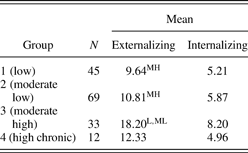
Note: L, low; MH, moderate high; ML, moderate low; HC, high chronic. Superscript letters reflect significant differences between the groups in the same column.
Discussion
This study sought to examine early child predictors of trajectories of maternal depressive symptoms followed over an 8.5-year period and youth outcomes in early adolescence associated with these trajectory groups. The trajectory analysis showed four relatively stable groups of maternal depressive symptoms, including low, moderate low, moderate high, and high chronic groups. Although the majority of the sample (71%) fell in either the low or moderate low groups, 63 mothers (21.8%) showed a consistent pattern of moderately high levels of depressive symptoms, and an additional 21 mothers (7.3%) demonstrated severe levels of depressive symptoms across all time points. The findings for the two persistently high groups are consistent with previous studies suggesting that for a subset of adult women, high levels of depressive symptoms tend to be recurrent and chronic (Belsher & Costello, Reference Belsher and Costello1988; Keller, Reference Keller2003; Kennedy, Abbott, & Paykel, Reference Kennedy, Abbott and Paykel2003; Monroe & Harkness, Reference Monroe and Harkness2005). When different types of observed aversive child behaviors were examined at 18 months within a multivariate framework, child noncompliance was the most robust predictor of maternal depression trajectory group; higher levels of child noncompliance were consistently associated with more persistent and higher levels of maternal depressive symptoms. Finally, examining the role of maternal depression in predicting youth outcomes in adolescence, we found that both youth and teacher reports of antisocial behavior were more prevalent for boys whose mothers were in the moderate high trajectory group, with no such difference found for internalizing problems.
These results are consistent with transactional perspectives of developmental psychopathology that have emphasized the dynamic interplay between child and parenting characteristics, and subsequent increased risk for child maladjustment (Bell, Reference Bell1968; Patterson, Reference Patterson1982; Sameroff & Chandler, Reference Sameroff, Chandler, Horowitz, Hetherington, Scarr-Salapatek and Siegel1975). Accordingly, disruptive child behavior in the toddler period was associated with increased risk for persistence of moderate to high levels of maternal depressive symptoms, which in turn, was associated with increased risk of boys’ and teacher reports of adolescent antisocial behavior. Regarding child effects on maternal depressive symptoms, although we do not wish to advocate that early forms of disruptive child behavior are a primary cause of maternal depression, the findings do suggest that aversive child behaviors might merit consideration as one of a constellation of intrapersonal (e.g., rumination) and interpersonal (e.g., social support) factors previously found to affect the course of depression (e.g., Bebbington, Reference Bebbington1996; Nolen-Hoeksema, Reference Nolen-Hoeksema1991). Of course, without reports of maternal depression during their child's infancy or the prenatal period, it also remains unclear how early maternal depressive symptoms might have been associated with irritability, noncompliance, or aggression at 18 months. As there is no correct “starting point” in capturing the genesis of reciprocal effects between mothers and their children, this study should be considered only a representative “slice” of a transactional process. Nonetheless, as previous literature has placed little emphasis on how child factors might have an impact on the course of maternal depression after the first 12 months of life (Forbes et al., Reference Forbes, Shaw, Fox, Cohn, Silk and Kovacs2006; Gelfand, Teti, & Fox, Reference Gelfand, Teti and Fox1992; Murray, Stanley, et al., 1996), the findings suggest child disruptive behavior might be an informative risk factor to assess among mothers showing high levels of depressive symptoms. It is somewhat surprising that child effects are not considered more heavily in assessing risk of maternal depression for families with toddler-age children based on the high levels of oppositional and defiant behaviors exhibited during the “terrible twos” (Shaw & Bell, Reference Shaw and Bell1993).
Noncompliance as a child risk factor
We found noncompliance to be the most consistent predictor of maternal trajectory group status, with child aggression and infant irritability showing few or no significant effects when examined within a multivariate framework. In studies of preschool and school-aged hyperactive children, many of whom exhibit high rates of noncompliance, noncompliant and oppositional behaviors in children have been found to create substantial distress for parents (Barkley, Karlsson, & Pollard, Reference Barkley, Karlsson and Pollard1985; Fischer, Reference Fischer1990; McKee, Harvey, Danforth, Ulaszek, & Friedman, Reference McKee, Harvey, Danforth, Ulaszek and Friedman2004). In addition, in interactions with hyperactive and noncompliant children, parents display more disapproval, are more negative and reprimanding, use more physical punishment, and are less responsive (Danforth, Barkley, & Stokes, Reference Danforth, Barkley and Stokes1991; Fischer, Reference Fischer1990; Johnston, Reference Johnston1996; Johnston & Mash, Reference Johnston and Mash2001; Woodward, Taylor, & Dowdney, 1998).
It is somewhat surprising that aggression and infant irritability were not as strongly associated with maternal depression trajectory group status as noncompliance. However, noncompliance occurs with greater frequency than aggression and severe bouts of irritability during the toddler period, as reflected by the greater frequencies of these behaviors within our structured laboratory assessments. Thus, we suspect that oppositional and defiant child behaviors are likely to have a greater cumulative effect on parental mood than less frequent incidences of physical aggression or less intense bouts of irritability during the second year. The timing of our assessment might have also affected the magnitude of effect for irritability, as previous research has shown irritability to be a correlate of elevated maternal depressive symptoms during the first year of life before children begin displaying increased levels of aggressive and noncompliant behavior (Gelfand et al., Reference Gelfand, Teti and Fox1992; Murray, Stanley, et al., 1996).
Outcome analysis
Consistent with the extant literature, we found that higher levels of maternal depressive symptoms were significantly associated with externalizing and antisocial youth outcomes at ages 11–13 (Munson et al., Reference Munson, McMahon and Spieker2001; Owens & Shaw, Reference Owens and Shaw2003; Zahn-Waxler et al., Reference Zahn-Waxler, Iannotti, Cummings and Denham1990). Variance attributed to maternal depression trajectory group in relation to later externalizing behaviors remained significant after accounting for early child noncompliance. In contrast to previous research, we did not find a relationship between maternal depressive symptoms and youth internalizing behaviors. This may, in part, be due to the use of teacher report for internalizing symptoms. Other studies have found that teacher reports of child internalizing (but not externalizing) behaviors tend to have lower levels of cross-informant agreement when compared to self- and parent report, especially in early adolescence (Glaser, Kronsnoble, & Forkner, Reference Glaser, Kronsnoble and Forkner1997; Stanger & Lewis, Reference Stanger and Lewis1993). This discrepancy also may reflect true variation in children's behaviors across settings and/or limited opportunities for teachers to observe internalizing symptoms compared to externalizing symptoms, which are more observable (Stanger & Lewis, Reference Stanger and Lewis1993).
Although sons of mothers with high chronic trajectories of depressive symptoms showed somewhat higher levels of youth- and teacher-reported antisocial behavior in early adolescence, it was only the sons of mothers in the moderate high group who consistently demonstrated significantly higher levels of antisocial outcomes when compared to boys whose mothers had low and moderate rates of depressive symptoms. Although somewhat paradoxical, this finding is consistent with a model posited by Rutter (Reference Rutter1990), who has suggested that children with chronically depressed parents may be less impaired than those with chronic but more moderate symptomatology. Accordingly, Rutter has suggested that offspring of mothers who are chronically depressed are better able to understand their parents as “ill” and as a result, may learn to rely more heavily on others and themselves to develop adaptive coping skills and better social functioning (Rutter, Reference Rutter1981, Reference Rutter1990). Furthermore, other people in the child's life (friends, extended family, teachers, relatives) may be more likely to offer support to children whose mothers are chronically depressed, thus serving a protective role. In contrast, when parents show a less severe, albeit a persistent and moderate course of symptoms, children and others in their lives may continue to expect mothers to be the primary source of support and model for developing emotion regulation skills. Rutter's theory provides a possible explanation for our findings; however, to our knowledge, the current findings and the Hammen and Brennan (Reference Hammen and Brennan2003) study are the first empirical demonstrations of this phenomenon. An alternate explanation is that the mothers in the high chronic depression group were less involved in parenting their sons, resulting in lower levels of conflict and other negative parent–child interactions that have been found to contribute to externalizing outcomes.
Limitations
There are a few significant methodological limitations to the study. First, participants were primarily low-income European and African American boys living in an urban setting. There is research to support there may be gender differences in how children are affected by maternal depression. For example, Leve et al. (Reference Leve, Kim and Pears2005) found that the association between maternal depressive symptoms and later outcomes vary by gender, with elevated maternal depressive symptoms uniquely predicting increases in internalizing symptoms for girls and increases in boy's externalizing symptoms only when impulsivity was low. This may help explain our findings as to why maternal depression was significantly associated with externalizing but not internalizing symptoms for this all-male sample. Similarly, it is not clear if these results would have been replicated for children living in rural or suburban contexts. Thus, we recommend that future work in this area be conducted on boys and girls from diverse socioeconomic strata and ethnic backgrounds to replicate or disconfirm our results.
In the current study, we cannot rule out the role of possible “third variables” at 18 months or during the age period from ages 1.5 to 10 when maternal depressive symptoms were measured. Incorporating measurement of other child (e.g., inhibitory control), parent (e.g., caregiving quality), or contextual (e.g., neighborhood quality) factors might provide additional insight into the underlying mechanisms by which reciprocal and transactional associations emerge. Although the primary goal of this paper was to examine early child factors on patterns of maternal depression and subsequent associations with adolescent outcomes, a more intensive examination of transactional processes underlying ongoing associations between child behavior and maternal depressive symptoms during the preschool and school-age periods is clearly warranted.
Clinical implications
The results of this study are consistent with the robust finding in existing literature that higher levels of maternal depressive symptoms are associated with poor outcomes in children. This finding coupled with our finding that maternal depressive symptoms were relatively stable over time and related to serious antisocial behavior in early adolescence suggest that identification and early preventive interventions are indicated (Olds, Reference Olds2002; Shaw, Dishion, Supplee, Gardner, & Arnds, Reference Shaw, Dishion, Supplee, Gardner and Arnds2006). In addition, the finding that child noncompliance was associated with higher and more persistent trajectories of maternal depressive symptoms suggests that the behavior of children and parents and the quality of their interaction should be a focus of interventions for children and mothers with young children. Finally, if future studies continue to find that children of mothers with chronic depression are less impaired than children whose mothers are moderately depressed (but may not reach clinical criteria), we should try to identify factors in these children's lives (e.g., external support systems, internal coping skills) that have allowed them to achieve normative levels of externalizing and internalizing problems. This information could be a powerful tool for clinicians working with children of depressed mothers.
In sum, these findings provide novel information about child factors associated with trajectories of maternal depression, and suggest that such trajectories in turn, are quite predictive of boys’ later adolescent antisocial behavior. This study has several methodological strengths. The trajectory modeling analysis used in this research allowed us to make a distinction between the two groups of mothers showing the highest levels of depressive symptoms. If these mothers had been grouped together, we would have overlooked the differences found in the outcomes between sons of mothers with moderate high and high chronic depressive symptoms. Another methodological strength of this study is that neither the associations between early child behavior and maternal depression nor between maternal depression and later child behavior can be accounted for by shared informant bias. The child's initial behavior was assessed using observational data, maternal reports were used to evaluate depressive symptoms, and youth and teacher reports were used to evaluate externalizing and internalizing problems. Finally, this study used data collected over an 11.5-year span from an at-risk sample with a relatively high retention rate. This provided a unique opportunity to examine a transactional process in a sample of mothers who generally showed above average rates of depressive symptoms and boys who exhibited elevated rates of disruptive behaviors as toddlers and adolescents.