


Re-interpreting the Sarno Lararium
One of the key recent developments in the study of ancient religion has been the inauguration of an approach centered on individual as opposed to civic practice. This new approach, which has come to be known as “lived ancient religion,” focuses on how individuals appropriated civic religion for their own domestic religious practices.Footnote 1 In the same way as scholars have long concentrated on civic religion, they have also directed their attention to official state art and eschewed smaller-scale private monuments. One genre of these private monuments is “the workshop scene.” Executed primarily in relief sculpture, mosaic, and wall-painting, workshop scenes displayed the activities and workplaces of craftspeople, shopkeepers, and agricultural laborers, and could be found decorating private homes, tombs, and commercial spaces.Footnote 2 This contribution examines one such monument, the Sarno Lararium, that lies at the intersection of private religion and the art of workshops. Through a novel reading of the lararium’s perplexing main scene, it advances our understanding of the way that Pompeiian workshop owners construed the role of divinities in their business enterprises. For we see at this shrine how household worship was entangled with daily labor, as well as how daily labor took place against the backdrop of a ritual landscape, highlighting the porosity between the categories of economy and religion.
The House of the Sarno Lararium at Pompeii (I.14.7) is renowned for the enigmatic scene painted on the bottom half of the lararium in its rear courtyard (Fig. 1). One half of this scene has been interpreted as portraying the river god Sarnus pouring water from a vessel into the stream that bears his name. The other half shows workers transporting, weighing, and packaging goods along the banks of the river, which flowed to the south of the city. The second part of this scene has long been interpreted as documenting the arrival of onions, or another type of agricultural commodity, following a common practice in classical archaeology of identifying an artistic scene based on a reference in an ancient text. In this case, the excavator linked the painting with a passage in Columella’s De Re Rustica describing the harvest and storage of the Pompeiian onion.Footnote 3 This article proposes a novel interpretation of the scene. I argue that it represents the activities of a group of fishermen bringing their catch back to port, weighing it, and preparing it for distribution in the city. Methodologically, I support this interpretation in several ways. I make use of imagery on the lararium that has previously been overlooked to show that the scene represents a group of fishermen, even though no figure on the lararium is represented in the act of fishing. I make use of iconographic comparanda and material evidence, especially from Pompeii, to bolster this interpretation. And I show how fishing activities would more closely connect the scene on the lararium to the deity pictured in its other half, the river god Sarnus. I argue that this scene shows a “workshop”Footnote 4 of fishermen rendering thanks to the patron deity who has provided them with a livelihood. After proposing the new interpretation, I connect the scene to several other paintings that combine divine and human actors and link economic activities with religion at Pompeii. The lararium, then, is one of a small group of paintings offering a rare opportunity to study how economic and religious activities were interconnected in the lives of non-elite inhabitants of the Roman world.
River god and commercial scene at the bottom of the Sarno Lararium. (By permission of the Ministero della Cultura – Parco Archeologico di Pompei.)

The house and its excavation
Excavations along the Via di Castricio under the supervision of Amedeo Maiuri discovered the House of the Sarno Lararium in 1954. The initial excavations exposed only the doorways along the street, but Maiuri later returned to uncover the majority of the house.Footnote 5 The excavations revealed nine rooms on the ground floor, covering a surface area of approximately 130 m2 (Fig. 2). The upper story, which does not survive, could have measured no more than an additional 60 m2.Footnote 6 By any standards applied to Pompeiian houses, this was a small dwelling.Footnote 7 In the judgment of the initial excavator, this was “one of the poorest houses in the whole neighborhood, of clearly commercial character.”Footnote 8 More recently, the house has been termed “middle class” and “nonelite.”Footnote 9
Plan of the House of the Sarno Lararium (I.14.7). (Drawing by the author.)

The sole feature of the house that has attracted attention is a large lararium positioned on the back wall of Room 9. Its placement along the main axis from the front door through the atrium indicates that it was meant to be seen by visitors and passersby when the door was open (Fig. 3).Footnote 10 Constructed of mortared rubble covered with a painted stucco decoration, it measures 1.83 m high, 1.17 m wide, and 0.77 m deep (Fig. 4). The lararium has a rectangular base but its upper half is built in the shape of an ogival arch containing a niche. It does not fit easily into any typology of lararia at Pompeii, whose standard shapes include wall niches, aediculae, and paintings, but it is closest to the aedicula type.Footnote 11 At the time of discovery, the niche in the lararium contained four artifacts: a ceramic bowl, a bronze lamp, and two bronze statuettes of lares. On the back wall within the arch there is a painting of a genius wearing a white toga and with a veiled head. The genius carries a patera in one hand and a cornucopia in the other and is in the act of sacrificing at an altar on which offerings have been placed. Reeds grow abundantly around and below the genius and the altar. Painted flowers decorate the intrados of the arch. At least three fish are preserved on the flat front left- and right-hand sides of the arch (Fig. 5); more may have existed at the top of the arch, which is not well preserved. Reeds and flowers decorate the lower outer sides of the shrine, with three birds perched among the vegetation on the right-hand side. At ground level the lararium is surrounded on three sides by a channel, which may have been filled with water. On account of this feature, the structure is sometimes compared to a nymphaeum,Footnote 12 although there is some debate as to whether this channel was an original feature of the lararium.Footnote 13 The excavators recorded “vegetal material” next to the lararium. It is possible that this material could have resulted from offerings or sacrifices, but it does not appear to have been retained, and the discovery does not appear to have been examined further.Footnote 14 No remains of sacrifices were recorded with the four artifacts discovered inside the arch. The painting of the lararium has been assigned to the workshop known as the Bottega dei pittori di via di Castricio, whose paintings have been identified in many other houses in Regio I during the last decades of Pompeii’s history.Footnote 15 It is dated to 62–79 CE, in the last phase of construction prior to the eruption of Vesuvius.
View of the Sarno Lararium from the entryway of I.14.7. (Photo by the author, by permission of the Ministero della Cultura – Parco Archeologico di Pompei.)

Right side of the Sarno Lararium during excavation, showing fish on the front of the ogival arch and reeds on sides. (By permission of the Ministero della Cultura – Parco Archeologico di Pompei.)

One of the fish painted on the front of the arch of the Sarno Lararium. (Photo by the author, by permission of the Ministero della Cultura – Parco Archeologico di Pompei.)

A second painted lararium exists on the west wall of Room 9. This lararium takes the form of a much more common type at Pompeii, a square niche inserted into the wall. It was sheltered by sloping tiles and had a ledge at the base. It contains a painting of a female figure reclining on a couch. A table with a two-handled cup is positioned in front of her and flowers are strewn at its base. A candelabrum is at its side. The reclining figure is surrounded by painted garlands, and in the corners of the niche are two nails, perhaps for hanging real garlands. The figure has been interpreted as Venus, Bona Dea, or other female divinities associated with the worship of household gods.Footnote 16 In the same room as the two lararia, several amphorae, some including tituli picti, a bronze coin, and a basalt cover for a cistern were found.Footnote 17 According to Maiuri, there was no stucco decoration in the house other than the lararium, but this appears to be contradicted by a drawing made in Room 2 at the time of the excavation.Footnote 18 Traces of stucco decoration have been found in Rooms 4, 5, and 8 as well. Nevertheless, the remains do not challenge Maiuri’s initial impression that this was a small non-elite residence.Footnote 19
The divine and commercial scene
Below the arch on the rectangular front of the lararium lies the scene with the depiction of a river god on the left and the commercial activity on the right. This scene is the focus of this contribution (Fig. 1). Let us begin with the representation on the left-hand side. The painter has depicted a bearded male figure reclining on his left elbow. Water pours out of a vessel by his left hand and flows downwards in a stream then to the right, feeding the river where the commercial activities are taking place. A shrine or small temple, shaded by reeds, occupies the far left, by the feet of the reclining male. A small boat occupies the bottom center of the scene. Two individuals wearing tunics stand in the bow and stern of the boat, and each is rowing with a single oar in his hand.Footnote 20 The middle of the boat has been piled high with some sort of cargo, but it is impossible to determine what the item is: the black and white brushstrokes render the cargo only in an impressionistic fashion. In front of the boat is a structure that must represent a pier at which the boat is intended to dock. Next to the pier stand two animals, probably donkeys, stationed there for the transport of the goods in the boat. Behind the donkeys is a large scale, at which two individuals wearing tunics are standing. One places a basket of goods on one side of the scale, the other stands beside the weight to adjust the balance as necessary. To the left of the scale are three individuals. One, wearing a red, blue, and yellow toga, stretches both hands toward the donkeys and the scale. This individual is commonly identified as the paterfamilias of the House of the Sarno Lararium on account of his gestures and the more sophisticated cloak that he wears. The other two tunic-wearing individuals are occupied with baskets full of the commercial items. One balances a basket at shoulder level, while the other stands in front of a large three-handled basket with both arms spread wide. The items in the baskets are again not depicted in an identifiable fashion.
Previous interpretations
The upturned urn or amphora next to the reclining male figure on the lower left-hand side of the lararium makes clear that he should be identified as a river god. In this case, the divinity has been universally accepted as a representation of Sarnus, the personification of the Sarno River, which flowed immediately to the south of Pompeii. Representations of Sarnus with similar iconography exist at five other lararia at Pompeii.Footnote 21
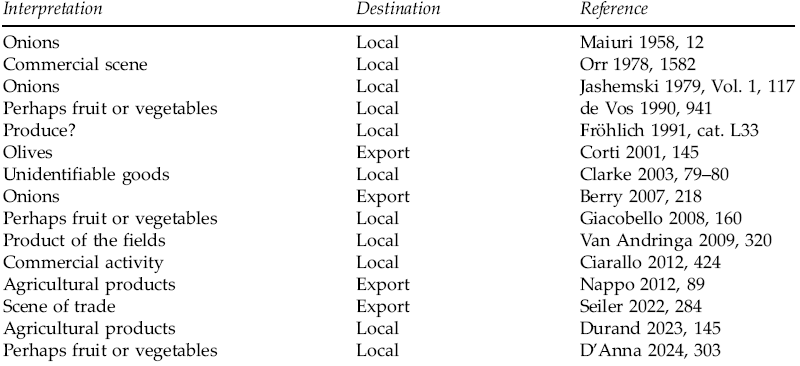
The identification of the commercial scene on the lararium has elicited greater disagreement. Several arguments have been made regarding the identification of the cargo in the boat and baskets. Table 1 presents a list of these previous interpretations, with references.Footnote 22 Maiuri, the excavator of I.14.7, initially suggested that they were onions, as noted above. Several scholars have followed Maiuri’s identification, including Nappo, Berry, and Jashemski, the last of whom excavated a house in the same insula (I.14.2). Instead of onions, Corti suggested a load of olives, because the painting indicates an irregular pile of cargo in the boat. Other Pompeiian experts have chosen to be more cautious about the identification, arguing that the scene represents some sort of fruit or vegetable produce destined to be sold in the market (A. de Vos, Fröhlich, Giacobello, van Andringa, D’Anna) but not precisely naming the cargo. Finally, the most circumspect interpretation regards the scene as simply showing unidentifiable commercial goods (Clarke, Orr, Ciarallo, Seiler, Durand). The lack of agreement among experts about the cargo is mirrored by their views on the intended destination of the goods. While most scholars see the arrival of the boat as the subject of the scene, some regard this as a scene of departure. Beyond the identification of the commercial scene, the lararium has also been employed in discussions of the whereabouts of Pompeii’s port.Footnote 23 Since I regard the lararium scene as showing the activities of a single workshop of fishermen rather than those of a larger port, I do not feel that the Sarno Lararium can contribute significantly to this debate. It does, however, attest to the important role of the river in the society and economy of the city.
Previous interpretations of the painted scene on the bottom of the lararium in the House of the Sarno Lararium.

Table 1. Long description
A table with three columns and fourteen rows. The columns are labeled Interpretation, Destination, and Reference. The table lists various interpretations of a painted scene on a lararium, the destinations of the goods depicted, and the references for these interpretations. Row 1: Onions, Local, Maiuri 1958, 12. Row 2: Commercial scene, Local, Orr 1978, 1582. Row 3: Onions, Local, Jashemski 1979, Vol. 1, 117. Row 4: Perhaps fruit or vegetables, Local, de Vos 1990, 941. Row 5: Produce?, Local, Fröhlich 1991, cat. L33. Row 6: Olives, Export, Corti 2001, 145. Row 7: Unidentifiable goods, Local, Clarke 2003, 79–80. Row 8: Onions, Export, Berry 2007, 218. Row 9: Perhaps fruit or vegetables, Local, Giacobello 2008, 160. Row 10: Product of the fields, Local, Van Andringa 2009, 320. Row 11: Commercial activity, Local, Ciarallo 2012, 424. Row 12: Agricultural products, Export, Nappo 2012, 89. Row 13: Scene of trade, Export, Seiler 2022, 284. Row 14: Agricultural products, Local, Durand 2023, 145. Row 15: Perhaps fruit or vegetables, Local, D’Anna 2024, 303.
A fishy business
This contribution argues that the scene painted on the bottom of the lararium in I.14.7 shows fishermen and the divinity they venerated in the hope of obtaining a greater catch. It is true that the scene does not depict the act of fishing itself. The absence of figures holding rods, casting nets, or spearing fish with tridents – the most characteristic feature of ancient fishing scenesFootnote 24 – does not mean that the painter has left us without clues. In this section I first point to the extensive evidence for fishing at Pompeii. Then, I explain several features painted on the lararium that have unambiguous associations with fishing: fish, boats, fishing rods, a possible fishing net, a port structure, and the river. The conclusion is also derived from painted features that may be associated with both fishing and other activities: baskets, reeds, and scales.
Pompeii’s extensive connections with fishing and fish consumption are documented by literary evidence, archaeological remains, tituli picti, and fish bones themselves. Only a brief summary of this evidence can be provided here.Footnote 25 Among ancient authors, the entire Bay of Naples was highly esteemed as a source of fish and shellfish from both the sea and artificial fishponds, and Pompeii produced some of the best-regarded garum in the Roman empire.Footnote 26 We have a detailed record of one garum manufacturer, Aulus Umbricius Scaurus, who was heavily involved in the production of garum and in municipal politics in Pompeii.Footnote 27 More than 50 painted labels naming Scaurus, along with several of his family members, have been found on jars containing garum and other fish products, and the multilevel home (VII.16.12–15) of Scaurus overlooking the Bay on the eastern side of Pompeii featured an atrium with the family’s garum jars represented in mosaics. The published record of fish bones from Pompeii is not extensive,Footnote 28 but it does suggest that the city was situated near a highly productive fishing environment. Isotopic analyses show that fish from a range of aquatic environments contributed to the diet at Pompeii, though there were significant sex-based dietary differences, with males obtaining more protein from fish and females more from terrestrial meat, dairy, and eggs.Footnote 29 The most detailed study has been made at the Bottega del Garum (“garum shop”) of Pompeii – located at I.12.8, only 30 m from the House of the Sarno Lararium. Analysis of the contents of 24 amphorae and 5 dolia by a Spanish-Italian team found that the Bottega del Garum was producing (or selling) several different fish sauces.Footnote 30 These containers were mainly filled with smaller species such as Engraulis (anchovy) and Sparidae (picarel), but there were also larger species such as Scombridae (mackerel, tuna, and bonito). The remains suggest that Pompeii’s fishermen developed strategies to make large catches of individual species in nets at peak times of the year. Beyond the Bottega del Garum, there were other salted fish producers in the neighborhood. Fish-salting tanks have been identified at I.9.11, I.12.3, and II.1.1, all of which lay about 100 m from the House of the Sarno Lararium, and at about 10 more locations elsewhere in the city.Footnote 31 Many of these intra-urban tanks were out of use by the end of the 1st c. BCE, and according to Steven Ellis, fish-salting activities were relocated to as-yet-unidentified suburban coastal zones around this time.Footnote 32 Several references attest to the location of salinae (salt flats) near Pompeii. The availability of salt, the key ingredient in antiquity for the preservation of fish, would have made Pompeii a more attractive location for fishing as well. A workshop of fishermen in the House of the Sarno Lararium would have been ideally placed to take advantage of good fishing grounds at Pompeii and to connect with other nearby businesses specializing in fish products. Let us now turn to the lararium itself, and to the evidence attesting that many items shown on it can be directly connected to fishing.
Fish, fishing equipment, and the river
At the top of the lararium there are three fish painted on both the left- and the right-hand sides of the front of the ogival arch (Figs. 4–5).Footnote 33 Very few scholars have mentioned the presence of these fish in their discussions of the lararium.Footnote 34 On occasions when the fish have been mentioned, scholars have identified them as “dolphins” or “marine creatures,” but have not regarded them as directly relevant to the subject of the commercial scene on the lower half of the lararium.Footnote 35 I propose instead that the painter of the lararium included them to represent, in a literal fashion, the main commodity produced by the workshop and, more metaphorically, the generosity of the divine patron Sarnus toward the owner of the lararium.
The boat on the Sarno Lararium is easily recognizable as a common element in fishing scenes in ancient paintings and mosaics at Pompeii and elsewhere in the Roman world. Fishing boats in painted scenes are frequently small rowboats with one, two, or three fishermen, as is shown on the Sarno Lararium. Third and fourth style paintings from Pompeii, for example, show such scenes.Footnote 36 The unnamed villa from Gragnano near Stabiae has three such boats engaged in fishing.Footnote 37 A painting from the south wall of the tablinum of the House of Marcus Lucretius Fronto at Pompeii (V.4.a) shows a rowboat approaching a dock or jetty. Small rowboats like these were designed for shallow waters in environments like the Sarno River or the Bay of Naples. The main discoveries of remains of Roman-period boats in the Bay of Naples to date have been larger ships, however.Footnote 38
The painter depicted two long poles emerging from the back of the boat on the Sarno Lararium. Most scholars who have studied the lararium have not mentioned these poles, despite their prominence in the scene.Footnote 39 Others, such as Salvatore Nappo, have noted “long poles,” but have not explained their relevance to the scene.Footnote 40 I identify these as fishing poles, one of the items most commonly depicted in paintings, mosaics, and other representations of fishing in antiquity.Footnote 41 Greek and Roman authors who discuss fishing techniques also regularly mention fishing poles.Footnote 42 The poles offer clear evidence that the scene concerns fishing and link the activity shown on the boat to the environment of the Sarno more closely than other explanations.
The contents of the rowboat have long posed a conundrum for modern scholars. I propose here three possible interpretations for the large pile in the center of the boat. The first two are consistent with previous arguments; the third is speculative but has many parallels in ancient evidence. The most logical explanation for the items piled high in the boat is that they represent a load of fish that the fishermen have caught and are in the process of bringing to the shore. A second, and related, hypothesis is that the items are oysters or another form of shellfish that has been gathered from the brackish water near the mouth of the river.Footnote 43 These two interpretations are consistent with the position of many who have seen the pile in the boat as representing commercial goods. Indeed, the depiction of the goods in the boat matches the depiction of the goods in the baskets. But a third – and not necessarily exclusive – possibility is that the pile in the boat consists of a fishing net (or nets), either alongside or separate from the catch. The technique of net fishing was regularly practiced by casting a net into the water from boats. A carbonized fishing net was found at Herculaneum.Footnote 44 Nets and poles are often present together in mosaics and other representations of ancient fishing activities, such as in the well-known Catacomb of Hermes at Hadrumetum, constructed around 200 CE.Footnote 45 Ancient authors described net fishing from small boats, most famously in the New Testament.Footnote 46 Thus, the amorphous pile in the center of the boat may represent not only the cargo but perhaps also a large fishing net that has been stowed in the boat after use. Figure 6 offers a modern parallel; one man hauls a net into a small fishing boat, gathering the catch in the process, and the other maneuvers the boat with an oar.
Small fishing boat in Lamta (Tunisia) with net piled in center as the fisherman gathers it in. The other fisherman uses a long oar. (Photo by the author.)

The Sarno Lararium scene depicts an artificial port structure along the bank of the river. The artist has not rendered the structure clearly, but it resembles a wooden dock that projects a short distance into the waterway.Footnote 47 In the center of the structure the artist appears to have painted an hourglass-shaped post to which the boat may be tied for mooring. It is significant that a dock is depicted here, because the purpose of such a structure is to facilitate the loading and unloading of boats, and therefore it is most often constructed where there is a significant volume of cargo to carry on and off ships.Footnote 48 The dock is not an essential or omnipresent feature of a harbor or a fishing workshop. Many small craft in the Mediterranean world and on its rivers did not utilize artificial port structures; instead, they would have been anchored in shallow water or dragged onto the shore itself.Footnote 49 The use of the dock for a fishing boat belonging to the workshop is a logical explanation for its presence here. But there is also another layer to this explanation. If it is correct, as argued above, to conclude that the lararium scene depicts only the location where this group of fishermen operated and not a wider port, then the presence of the dock may also have enhanced the status of the workshop, as not every group of fishermen will have had their own dock.
The setting along the banks of the Sarno River is a key element of the lararium scene. In antiquity, this river originated in the Sarno mountains to the east of Pompeii, passed to the south of the city and emptied into the Bay of Naples. Although the precise course of the river was obscured during the eruption of 79 CE, it must have been situated ca. 600 m from the Porta Stabia and the Porta Nocera on the southern wall of the city.Footnote 50 Fishermen might have chosen the Sarno as an appropriate location to build a dock and to set up equipment necessary to process the catch. Fishing boats docked near the southern city wall would have been better protected from storms on the riverbank than on the seashore. They still could have easily accessed the Bay of Naples, probably between 1 and 2 km downstream. A business located on the river would have been a short commute for city residents and would have made it easy to transport the catch to market.Footnote 51 Further, the Sarno would have been home to freshwater fish,Footnote 52 and there would have been both freshwater and saltwater species in the brackish estuary where the river met the Mediterranean.Footnote 53 Oysters may have been farmed in this location, as they were in artificial beds in brackish waters on the northern side of the Bay of Naples.Footnote 54 There is considerable evidence for fishing in rivers in the Roman world, and the Tiber River has recently been considered as a highly suitable location for catching species such as sea bass, eels, and sturgeon and selling them to the large urban population in Rome.Footnote 55
Baskets, reeds, and scales
The scene painted on the lararium contains several other iconographic elements that have associations with fishing equipment. Baskets, reeds, and scales may be found in depictions of a range of activities, but these elements nonetheless fit well with my interpretation that the Sarno Lararium depicts a fishing workshop.
Three baskets full of goods are shown on the Sarno Lararium. The baskets share a common design, with handles, though they are clearly not the same size. Such baskets were frequently used in Roman work settings, as is evidenced in a variety of workshop scenes,Footnote 56 but they also have clear associations with fishing. For instance, a panel from the Tablinum of the House of Marcus Lucretius Fronto at Pompeii (V.4.a) displays a variety of fish spilling out of a basket (Fig. 7), and similar scenes are known from across the empire.Footnote 57 Baskets made of organic materials normally decay in archaeological contexts, but the eruption of Mt. Vesuvius produced the sort of unusual conditions in which they have occasionally survived. Excavations at both Pompeii and Herculaneum have yielded baskets.Footnote 58 A current investigation at I.14.2 – in the same insula as the House of the Sarno Lararium – has revealed a pile of reeds, probably stored for later use. The excavators have suggested that these reeds may have been gathered for the production of mats, on the basis of a graffito mentioning a tegeticula (mat-maker). It is reasonable to suggest that the raw materials for reed mats could also have been used for making baskets. If this were the case, the owner of the House of the Sarno Lararium may have acquired baskets from a neighbor’s workshop to hold and transport the catch.Footnote 59
Fish spilling from basket in the Tablinum of the House of Marcus Lucretius Fronto (V.4.a), Pompeii. (By permission of the Ministero della Cultura – Parco Archeologico di Pompei.)

Reeds like those found in I.14.2 appear throughout the Sarno Lararium. They grow around the altar and the genius within the ogival arch; they appear in the hand of Sarnus and surrounding the shrine at his feet; they can be found beside the scales in the commercial scene; and they grow abundantly on both sides of the lararium (see Fig. 4). If we accept the trough at the base of the lararium as an original feature, then this feature may mimic the watery environment of the Sarno, with reeds emerging from it.Footnote 60 The growing reeds may symbolize the fertility of the riverine environment, but we can also think of them as essential to the fishermen’s workshop. Reeds comprise the raw material for the fishing poles in the boat,Footnote 61 and for the baskets used to transport the catch. They represent, too, the abundance that Sarnus provides to the fishermen.
Roman artists frequently included scales in a range of workshop settings.Footnote 62 They are especially common in relief sculptures depicting vendors who sell goods by weight, such as butchers, bread-makers, and grocers.Footnote 63 A scene of the weighing and packaging of fish on the riverbank fits this pattern. It is reasonable to conclude from the weighing that the catch may be intended for sale nearby. The image does not make clear who will obtain the fish – vendors who sell in the city’s market, individual buyers seeking a meal, or garum producers purchasing goods wholesale – but these potential customers constitute a starting point. It is also possible that the scale belonged to a wider port market area rather than the fishermen themselves. Roman authorities regularly endowed public markets with scales, weights, and measures in order to facilitate their smooth operation and to ensure the payment of state and municipal taxes.Footnote 64 One of the most famous examples of such a measuring device is the mensa ponderaria from the Forum at Pompeii, but additional measures were found at Herculaneum, and weighing implements of different sizes could have been available at multiple locations within a city.Footnote 65 As stated above, this scene appears to show workers from only one group, so we might conclude it is more likely that the scale belonged to this workshop.
“Taskscapes” at Pompeii
The emphasis of the argument above has been to interpret the main scene on the Sarno Lararium as a representation of a fishing workshop. Now it is time to examine some broader issues. The Sarno Lararium scene bears similarities to sculptural and painted representations of Roman shops and workshops – the “workshop scenes” mentioned in the introduction above. Tim Ingold has considered such scenes as “taskscapes,” a concept that refers to an array of temporally connected activities in a landscape.Footnote 66 This concept is helpful in thinking about how Roman artists depicted workshop scenes. Artists were not concerned with presenting every activity in the workshop,Footnote 67 but rather with evoking what Ingold might call the “temporality” of laborers performing their regular activities. That is to say, the scenes evoke a timeless quality of laborers performing their routine tasks in harmony with the natural setting and the other members of the workshop. Turning to the Sarno Lararium, we can see how the concept of “taskscape” can be applied to this painting. The initial activity in the sequence is the pouring of water from the amphora to fill the Sarno River. Importantly, it is the god Sarnus who literally initiates the action, and who figuratively deserves the credit for the bountiful harvest of the workshop. The subsequent steps include the arrival at the pier of the rowboat laden with fish, their transport by donkey, weighing on the scale, and departure in baskets. Some activities (including the act of fishing and the sale of the catch) are not depicted in the scene, and there is not a strict linear progression from one activity to the next. Nevertheless, the artist has rendered enough important elements for the overall narrative clearly to be read as a taskscape: a place regularly inhabited and transformed by this workgroup of fishermen.
Roman art has a wide range of “workshop” and “taskscape” scenes in mosaic, painting, and relief sculpture. Although these parallels with the Sarno Lararium have only rarely been noted in previous studies,Footnote 68 I will argue next that they offer important clues to assist with the interpretation of the scene. Closely comparable are depictions of the narrative sequence of activities performed by members of a shop or workshop. Rather than providing an exhaustive catalogue of comparanda,Footnote 69 I will confine my discussion to a selection of examples from Pompeii itself. Let us begin with a sequence of activities portrayed on a sculpted marble relief depicting a metalworking shop now in the National Archaeological Museum of Naples.Footnote 70 This relief shows workers weighing the raw material, hammering an object into shape, and polishing the inside of a bowl. In the background, finished items are displayed on a shelf. A second example comes from the “Caupona of Salvius” (VI.14.36), where a row of paintings depicts the serving of drinks, the playing of dice games, then the bar owner throwing out customers who have started a fight.Footnote 71 A third example derives from Room Q at the House of the Vettii (VI.15.1). One of several narrative vignettes shows cupids picking flowers, pressing olive oil, mixing the petals and oil into a perfume, and then marketing the product to a customer.Footnote 72 These examples demonstrate that both at Pompeii and in the wider Roman world, artists were accustomed to representing work activities in a temporal sequence within a geographic setting.
The Sarno Lararium scene fits within this repertoire of narrative workshop scenes, but it matches even more closely a group of narrative scenes that show a taskscape overseen by a god. These parallels offer the best comparanda for interpreting the scenes of work and worship on the Sarno Lararium. Our first example of this kind appears on a pillar in the peristyle courtyard of a fullery, now in the National Archaeological Museum in Naples.Footnote 73 On the front side of this pillar, an artist painted several scenes of workers in a fullery – presumably similar to scenes that took place in the surrounding space on a daily basis (Fig. 8). The workers are shown treading on garments in vats, carrying a wicker frame to hang the wet garments for drying, brushing the garments after drying has occurred, and presenting a finished garment for inspection. On the right-hand side, the artist painted a large wooden screw press for flattening clothes, a worker holding a tool used in the fullonica, and a worker and customer exchanging a garment, perhaps before rather than after cleaning. Additional garments hang to dry in the background. The left-hand side of the pillar contains an image of a nude goddess wearing a crown and standing within a wooden aedicula.Footnote 74 An adjacent fountain and a second pillar contained painted images of divinities, including Dionysos, Apollo, and a river god, and also a painting of snakes approaching an altar (as commonly seen on lararia).Footnote 75 The images of all these gods face visitors entering the peristyle of VI.8.20; given the position overseeing the activities of the household, they may reasonably be seen as tutelary deities.
Nude goddess, perhaps Venus, on a pillar next to scenes from a fullery at Pompeii (VI.8.20). (Photo by Giorgio Albano, by permission of the Ministero della Cultura – Parco Archeologico di Pompei.)

The façade of an unexcavated building on the Via dell’Abbondanza has two panels on either side of the doorway at IX.7.7 showing the activities of the business presumed to have existed inside: a felt-making or cloth-making workshop.Footnote 76 The painting on the exterior right of the doorway has a large and colorful image of Venus riding in a chariot pulled by elephants (Fig. 9). Fortuna and a genius appear at the sides of the elephants. This painting sits atop a smaller taskscape of cloth-makers. The foreground contains four workers stretching a large garment atop a central oven. This appears to be a felt-making scene, with the workers attempting to bind wool and a sticky paste into felt that could be used for waterproof materials. In the background, three individuals are seated at tables; they appear to be preparing cloth with an array of tools on the surfaces in front of them. At the right-hand edge of the scene, as in the house of the Sarno Lararium, the artist appears to have included an image of the paterfamilias or business owner. This individual, who is standing and holding a finished garment, is the sole named person in the scene; below his image is a graffito that reads “Verecundus”. To the left of the doorway, a less well-preserved painting contains similar scenes. In the upper register, parallel to the painting of Venus, there is an image of Mercury standing on the pronaos of a small temple. He holds a caduceus along with a bag of money, a symbol of the prosperity that the business aimed to achieve and of the god’s oversight of financial transactions. Below Mercury, there is an image of a woman behind a table laden with goods. A seated man occupies a bench at the side of the table. The woman, though unnamed, occupies a position parallel to Verecundus, and can plausibly be understood as the materfamilias, whose daily activities may have included selling goods made in the workshop to customers such as the seated man. To summarize, at IX.7.7, the divine patrons, Mercury, Venus, Fortuna, and the genius, offer their protection over the felt- and cloth-making business and its owners.
Venus in a chariot pulled by elephants above felt-makers and cloth-workers at IX.7.7, Pompeii. (By permission of the Ministero della Cultura – Parco Archeologico di Pompei.)

I could mention additional scenes, such as the procession of the carpenters with Mercury, Fortuna, and Minerva,Footnote 77 and one image of potters with MinervaFootnote 78 and a second of potters with Vulcan.Footnote 79 But further description seems unnecessary to demonstrate the connection between human labor and divine oversight in paintings at Pompeii. And, more importantly, the workers engaged in fulling, cloth-making, carpentry, and pottery manufacture were all roughly equivalent in social status to fishermen.Footnote 80 The similarities in these scenes clearly point to the parallel way that non-elite producers connected the success of their enterprises to divine oversight.
Conclusion: lived religion is a fishy business
Why has there been so much uncertainty in recognizing the activity represented on the Sarno Lararium? Perhaps the answer is that Maiuri’s initial suggestion that the cargo represented in the boat was onions has diverted attention from other possibilities. Perhaps the absence of the act of fishing has also made this conclusion difficult to reach. Another idea is that the view of fishing here is not comparable to representations of fishing on the walls of elite houses on the Bay of Naples. There, fishing is represented as one element in a wider landscape of busy activity, often seen at a distance, as if glimpsed from the window of a coastal villa.Footnote 81 These scenes include lone fishermen seated upon a rock with a pole in their hands, or occasionally rowboats with figures whom we can interpret as fishermen, even though it is difficult to make out details due to the small scale at which they are represented.Footnote 82 The Sarno Lararium, on the other hand, was not created for an elite audience, but instead intended for the less wealthy owner of the house and a small fishing business. It is primarily about the veneration of a divinity and the blessings he provided, not the decoration of spaces for entertainment. Indeed, the deviation from the standard elite fishing scenes, and the window that is opened to the economic and religious activities of a working class of Pompeiians, makes the lararium interesting. It presents a non-elite view of a “taskscape” and a local divinity. It fits with a small group of other scenes whose combination of work and worship offers new insights into the “lived religion” of ordinary inhabitants of Pompeii and the wider Roman world.
Although Sarnus was not a major god at Pompeii, the population of the city must have recognized the many important features of the river. It served as a source of fresh water for people as well as animals. It functioned as an important conduit for goods moving from the inland towns of Nola and Nuceria to the coast, and in the opposite direction, as Strabo noted.Footnote 83 Reeds utilized in manufacturing mats and baskets grew along the river’s banks. Its estuary would have provided tidal flats amenable to the harvesting of salt. While these benefits may all have served the average Pompeiian, the watercourse held a special importance for fishermen. It was a home to freshwater fish and furnished the spawning grounds for larger fish that inhabited the Bay of Naples. Some saltwater fish may have inhabited the brackish water at the mouth of the river, along with oysters and other shellfish. The river also provided safer anchorages than could be found on the Bay of Naples. Like agriculture or pastoralism, fishing involves risk from adverse weather or natural disasters, but it perhaps entails even more uncertainty because – unlike with crops – one cannot easily see fish and predict when or where they will appear. For the owner of the House of the Sarno Lararium, venerating a local divinity who had the power to exert control over the natural environment as a private household god must have seemed important.Footnote 84 Sarnus, who appears on the lararium pouring water from the amphora and initiating the current of the river, was the god from whom the house’s prosperity flowed.Footnote 85
Interpreting the scene as a representation of fishing brings together many more of the elements on the lararium than interpretations focusing on the transport of vegetables or on uncertain commercial activity. The painted fish on the upper half of the lararium now become an integral part of the decoration. The reeds that grow on the exterior of the sides, around the altar inside the niche, and by the feet of Sarnus, can be correlated with fishing baskets and fishing rods. Recognizing that the scene involves fishing does much to make the lararium a part of a neighborhood engaged in related activities, including the basket-makers at I.14.2, the garum producers at I.12.8, and others. The Sarno Lararium’s placement on the rear wall of I.14.7 fits logical expectations for the placement of a household shrine – although it might be objected that given its scale (Fig. 3), it is hard to know whether the fishing scene was fully discernible from outside the house. Many of the divine–human comparanda cited above were located on the exterior of buildings (e.g., I.8.10, II.3.9, IX.7.7, and VI.7.9).Footnote 86 It is probable, then, that the sale of the workshop’s catch did not take place in the House of the Sarno Lararium, but occurred along the riverbank or in the center of the city (e.g., in the Macellum at VII.9.7–8). The Sarno Lararium itself was where the offerings generated from the successful fishing activities were placed, the logical culmination of activities depicted in its taskscape. When the doors of the house were open, its intentional visibility to passersby from the street was important, but so was its function as a place of worship for the residents within the household.
Acknowledgments
I thank Gabriel Zuchtriegel and Giuseppe Scarpati for permission to visit the House of the Sarno Lararium and the Archives of the Parco Archeologico di Pompei in June 2024. I record my gratitude to Rosanna De Simone for making the Archives of the Parco Archeologico di Pompeii accessible to me, and for courteous assistance in finding excavation records, photographs, plans, and drawings. Federica Savarese and Julie Pezzali gave me permission to reproduce images on behalf of the Parco Archeologico di Pompeii and the Museo Archeologico Nazionale di Napoli. The Center for Research on Learning and Teaching at the University of Michigan provided me with a grant to visit Pompeii. Both Lisa Nevett and Elaine Gazda kindly accompanied me to the House of the Sarno Lararium and helped me to clarify my interpretation, for which I am very grateful. I have benefitted from discussing my interpretation with Touatia Amraoui, Stefan Ardeleanu, Hamden Ben Romdhane, Darío Bernal Casasola, Giulia Boetto, Moheddine Chaouali, Antonella Coralini, Allison Emmerson, Riadh Hamrouni, Matthew McCarty, Umberto Pappalardo, David Potter, Katie Rask, Abigail Staub, Lea Stirling, Molly Swetnam-Burland, and Steven Tuck. My greatest debt is to my good friends Mohamed and Fethi Bousrih, who took me fishing on their family boat and gave me the idea for this interpretation.




 Open access

