Introduction
The processing of emotional faces is important for social interaction and is strongly influenced by a person's current emotional state (Leber, Heidenreich, Stangier, & Hofmann, Reference Leber, Heidenreich, Stangier and Hofmann2009). Important components of the neural system extracting the meaning of facial expressions include the fusiform gyrus, the amygdale, and the prefrontal cortex (Haxby, Hoffman, & Gobbini, Reference Haxby, Hoffman and Gobbini2002).
The serotonin transporter (5-HTT) mediates the reuptake of released serotonin and modulates its concentration in extracellular fluids. The human serotonin transporter gene is most commonly composed of either 14 (“short” or s-allele) or 16 (“long or l-allele) repeated elements (Heils et al., Reference Heils, Teufe, Petri, Stober, Riederer, Bengel and Lesch1996). In humans, the s-allele has been associated with increased reactivity of the right amygdala during the processing of fearful and angry facial expressions (Hariri et al., Reference Hariri, Drabant, Munoz, Kolachana, Mattay, Egan and Weinberger2005). A recent study by Surguladze et al. (Reference Surguladze, Elkin, Ecker, Kalidindi, Corsico, Giampietro and Phillips2008) showed that differences in 5-HT neurotransmission can modulate the identification of emotional faces, particularly fearful faces. Functional connectivity analysis showed greater activity of the fusiform gyrus in s-allele homozygotes in comparison to l-allele homozygotes during the processing of fearful faces (Surguladze et al., Reference Surguladze, Elkin, Ecker, Kalidindi, Corsico, Giampietro and Phillips2008). Beevers, Wells, Ellis, and McGeary, (Reference Beevers, Wells, Ellis and McGeary2009) reported greater difficulty disengaging attention from emotional stimuli in s-allele carriers (Beevers et al., Reference Beevers, Wells, Ellis and McGeary2009). Fox et al. (Reference Fox, Ridgewell and Ashwin2009) showed selective processing of positive emotional stimuli and a tendency to avoid negative emotional material in healthy l-allele homozygotes but not in carriers of the s-allele (s/l, s/s) (Fox, Ridgewell, & Ashwin, Reference Fox, Ridgewell and Ashwin2009).
Catechol-O-methyltransferase (COMT) is one of several enzymes that degrade catecholamines such as dopamine, epinephrine, and norepinephrine (NE). In humans, catechol-O-methyltransferase is encoded by the COMT gene. The COMT gene contains a functional polymorphism (Val158Met) that determines high and low activity of this enzyme (Lachman et al., Reference Lachman, Papolos, Saito, Yu, Szumlanski and Weinshilboum1996). Homozygosity for the low-activity (Met) allele is associated with a three- to four-fold reduction of COMT enzyme activity compared with homozygosity for the high-activity (Val) variant. Low COMT activity results in reduced degradation of synaptic catecholamines (Graf et al., Reference Graf, Unis, Yates, Sulzbacher, Dinulos, Jack and Parson2001). In a recent study, including male and female students, we found that val158 homozygosity was associated with better and faster recognition of facial expressions of anger and sadness compared with met158 homozygosity (Weiss et al., Reference Weiss, Stadelmann, Kohler, Brensinger, Nolan, Oberacher and Marksteiner2007). As with carriers of the s-allele of the 5-HTT gene, COMT met158 homozygotes showed stronger activation of the amygdala and prefrontal cortex when processing unpleasant stimuli in emotion tasks (Drabant et al., Reference Drabant, Hariri, Meyer-Lindenberg, Munoz, Mattay, Kolachana and Weinberger2006; Smolka et al., Reference Smolka, Schumann, Wrase, Grusser, Flor, Mann and Heinz2005). Lonsdorf et al. (Reference Lonsdorf, Weike, Nikamo, Schalling, Hamm and Ohman2009) used startle blink potentiation and skin conductance response to investigate the influence of the s-allele and the l-allele of the 5-HTT gene and the COMT genotype on fear-learning and fear-extinction in 48 healthy participants (Lonsdorf et al., Reference Lonsdorf, Weike, Nikamo, Schalling, Hamm and Ohman2009). They reported that carriers of the s-allele of the 5-HTT gene, who were also homozygous for the met158-allele of the COMT gene, showed enhanced fear conditioning and worsened fear control.
In this study, we investigate the effects of and potential interaction between the 5-HTT s-allele and l-allele and the COMT Val158Met polymorphism on the recognition of emotional faces and on the magnitude of individual responses to happy and sad faces. We hypothesized that s-allele carriers and carriers of the low COMT activity gene (met158 homozygotes) would perform better in the recognition of negative emotions, as measured by the Penn emotion recognition test (ER40) (Kohler, Turner, Stolar, et al., Reference Kohler, Turner, Stolar, Bilker, Brensinger, Gur and Gur2004), in which faces conveying five different emotions are presented. The Penn Emotion Acuity Test (PEAT) (Erwin et al., Reference Erwin, Gur, Gur, Skolnick, Mawhinney-Hee and Smailis1992) measures the ability to discriminate between different intensities of facial sadness or happiness on a 7-point scale. We hypothesized that s-allele carriers and carriers of the low COMT activity gene (met158 homozygotes) would exhibit a tendency to more negative interpretation of emotional facial expressions (lower individual mean score on the PEAT) and greater reactivity to emotional facial expressions (higher individual standard deviation on the PEAT).
Methods
Subjects
Eighty-eight female undergraduate students were recruited at Innsbruck Medical University and Leopold-Franzens University Innsbruck. All participants were Caucasian and native German speakers. They completed a screening questionnaire concerning demographic data and general information. Each participant was asked about a history of major depression, generalized anxiety, and alcoholism in their mother and father. A family history of depression was considered as positive when at least one parent had a history of major depression. The use of oral contraceptives was investigated as a parameter that might influence mood. Furthermore, all subjects were screened for present or past Axis I diagnoses, using parts of the semi-structured clinical interview based on the DSM–IV. They also completed the Beck Depression Inventory (BDI). Participants were excluded if they had been diagnosed with any neuropsychiatric disease and if there was a history of drug misuse or addiction. A smear test was taken by means of swabs to genotype all participants for the s-allele and the l-allele of the 5-HTT gene and the COMT Met158Val polymorphism. All subjects were informed of the purpose and design of the study and gave written informed consent before participating. The study was approved by the Ethics Committee of Innsbruck Medical University.
Neuropsychological Testing
All subjects completed a battery of computerized tests to assess their ability to identify and differentiate facial emotions. The psychologist who performed the tests was blind to the subject's 5-HTT and COMT genotype.
The Penn Emotion Recognition Test (ER40) assesses categorical identification of emotional faces (Kohler, Turner, Gur, & Gur, Reference Kohler, Turner, Gur and Gur2004). The ER40 is a computer-based test in which subjects are asked to choose the most appropriate emotion label for color photographs of happy, sad, angry, fearful, and neutral facial expressions. The test consists of 40 pictures. Each emotion is represented eight times. Results represent the number of correctly identified emotions. Higher scores (maximum 8) correspond to a higher number of correctly recognized exemplars of a particular emotional expression.
The Penn Emotion Acuity Test (PEAT) assesses the ability to identify the degree of facial expressions of happiness and sadness (Erwin et al., Reference Erwin, Gur, Gur, Skolnick, Mawhinney-Hee and Smailis1992). Participants are asked to rate the emotional valence of the expression on each of 40 faces on a seven point scale ranging from 1 = very sad, 2 = moderately sad, 3 = slightly sad, 4 = neutral, 5 = slightly happy, 6 = moderately happy, to 7 = very happy. The test includes 10 happy pictures (2 very happy, 4 moderately happy, 4 slightly happy), 20 neutral pictures, and 10 sad pictures (2 very sad, 4 moderately sad, 4 slightly sad) of faces. Sum scores reflect subject bias toward either end of the scale and range from 40 to 280 points. Absence of bias corresponds to a score of 160. Scores between 40 and 159 points reflect a bias toward a negative interpretation of emotional faces, whereas scores between 161 and 280 reflect a bias toward a positive interpretation of emotional faces. To measure within-subject spread of response—the degree to which the subject tended to extreme ratings of emotional valence—a standard deviation was calculated for each individual.
Genotyping
Genotyping for the s-allele and the l-allele of the 5-HTT gene
DNA extraction from dried saliva swabs was performed according to (Walsh, Metzger, & Higuchi, Reference Walsh, Metzger and Higuchi1991) using 5% (w/v) Chelex 100 (Bio-Rad Laboratories, Hercules, CA) in water supplemented with 100 μg/mL proteinase K (Roche, Mannheim, Germany).
The polymerase chain reaction (PCR) was modified but was in accordance with the amplification published by Hu et al. (Reference Hu, Lipsky, Zhu, Akhtar, Taubman, Greenberg and Goldman2006). It was conducted in an ABI GeneAmp PCR system 9700 (Applied Biosystems, Foster City, CA) thermal cycler with a total reaction volume of 10 μL containing 5 μL of TaqMan Universal PCR Master Mix (Applied Biosystems), 2.5 μg of bovine serum albumin, 4% (v/v) DMSO, 100 nM primer HTTLPR_F: GCAACCTCCCAGCAACTCCCTGTA, 100 nM primer HTTLPR_R: GAGGTGCAGGGGGATGCTGGAA, and 2-μL of sample DNA. The thermal cycling protocol suggested an initial de-naturation step at 95°C for 10 min, 40 cycles of 96°C for 15 s, and 62.5°C for 90 s, and a final extension step at 62.5°C for 30 min. Laser-induced fluorescence capillary electrophoretic separation of the PCR products was performed on an ABI Prism 3100 Genetic Analyzer (Applied Biosystems) using POP6, 36-cm capillary arrays, and default instrument settings. Before electrophoresis, 2 μL of PCR product were heat-denatured in 20 μL of deionized formamide. Amplicon-length determination was based on the GeneScan-500 LIZ internal size standard (Applied Biosystems). Raw data were recorded and analyzed with the ABI Prism 3100 Genetic Analyzer data collection (v 1.1) and the Genotyper (v 3.6 NT) software's (both Applied Biosystems).
Genotyping of COMT Val158Met
DNA was extracted from individual saliva swabs using a modified Chelex method. A total of 1.25 mL of a solution containing 5% Chelex (Bio-Rad, Hercules, CA) and 200 μg/mL Proteinase K (Roche, Mannheim, Germany) were added to the saliva swab placed in a 1.5-mL micro-centrifuge tube. The solution was incubated at 55°C for 30 min. The mixture was vortexed and incubated again at 90°C for 8 min. After centrifugation at 13 000 × g for 5 min, the supernatant was transferred to a MultiScreen PCR96 cleanup plate (Milipore, Billerica, MA), which was used for DNA purification following the manufacturer's recommendations. PCR was conducted in a Gene Amp PCR System 9700 (Applied Biosystems) in a total volume of 10 μL containing 1 × Advantage 2 SA buffer (BD Biosciences Clontech, Uppsala, Sweden), 200 μM each dNTP, 250 nM each of the primers (5′-GTCAGGCATGCACACCTTGTCCTTCA-3′, 5-CCGACTGTGCCGCCATCAC-3′, Proligo, Boulder, CO), 1 × BD Advantage 2 Polymerase Mix (BD Biosciences Clontech) and 2 μL of purified DNA solution. Amplification comprised an initial de-naturation step at 95°C for 2 min, followed by 40 cycles of 15 s at 95°C, 30 s at 68°C, and 15 s at 68°C. The final extension step was carried out at 68°C for 10 min.
PCR products were analyzed by ion-pair reversed-phase high performance liquid chromatography electrospray ionization time-of-flight mass spectrometry (ICEMS). A detailed description of the instrumental setup has been reported (Oberacher, Niederstatter, Casetta, & Parson, Reference Oberacher, Niederstatter, Casetta and Parson2005; Oberacher, Niederstatter, & Parson, Reference Oberacher, Niederstatter and Parson2005). Allele-specific information was gathered from accurate molecular mass measurements of the denatured PCR products. Matching of the measured molecular masses to the theoretical molecular masses derived from the amplicon sequences of the two COMT variants enabled the calling of the present allelic state(s).
Statistical Methods
Analysis was performed using SPSS 11.0. Comparability of the different genotypes of each polymorphism (the s-allele and l-allele of the 5-HTT gene, COMT Val158Met) with respect to socio-demographic variables was determined by means of one-way analysis of variance (ANOVA). Test performances on the ER40 (happy, sad, angry, fearful, neutral) and the PEAT (sum score and individual standard deviation) were analyzed by two-way ANOVAs, the between-group factors being the 5-HTT and the COMT polymorphisms, each as a 3-level factor. Post hoc testing was limited to the main hypotheses, namely the effect of presence of the s-allele (s/s, s/l) for the 5-HTT polymorphism, and the presence of met158 homozygosity for the COMT polymorphism. A t test for independent samples was used.
Results
Sample Characteristics
Genetic analyses for the s-allele and the l-allele of the 5-HTT gene identified 64 female carriers of the s-allele (52 heterozygous and 12 homozygous) and 24 homozygous carriers of the l-allele; genetic analysis of the COMT Val158Met polymorphism identified 18 met158 homozygous, 43 heterozygous, and 27 val158 homozygous. The mean age (± standard deviation) was 23.2 ± 2.4 years. There was no significant deviation from Hardy-Weinberg equilibrium, either for the s-allele and the l-allele of the 5-HTT gene χ2 = 3.357; df = 1; p = .067), or for the COMT (Val158Met) polymorphism (χ2 = 0.006; df = 1; p = .937). There were no significant differences in the use of oral contraceptives and positive family history of depression between genotype groups.
Emotion Recognition by Penn Emotion Recognition Test (ER40)
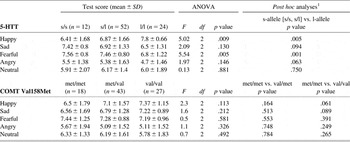
Two-way ANOVAs for the individual ER40 emotions showed significant differences between the three genotypes of the 5-HTT gene in the recognition of happy (p = .009; df = 2; F = 5.02) and fearful (p = .005; df = 2; F = 5.54) emotional faces but not for sad, angry or neutral faces. Post hoc analysis comparing s-allele carriers (s/s, s/l) with homozygous l-allele carriers (l/l) revealed a significantly worse performance by s-allele carriers in the recognition of happy faces (p = .005) and a better performance in the recognition of fearful faces (p = .001).
Results of the ANOVAs testing the effect of the COMT val158met polymorphism for individual ER40 emotions failed to demonstrate a significant effect. Post hoc analysis did not support our hypothesis regarding the influence of met-homozygosity on ER40 performance for any facial expression.
Penn Emotion Recognition Test (ER40) results

1Limited to main hypothesis testing.
Ability to Discriminate Between Different Intensities of Sad or Happy Faces
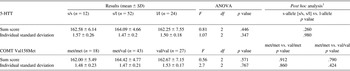
Analysis of the PEAT results demonstrated no statistically significant effects of either the 5-HTT polymorphism or the COMT Val158Met polymorphism on the PEAT sum score or individual standard deviations on the PEAT (Table 2). Post hoc analyses failed to support our a priori hypotheses regarding the impact of either the 5-HTT s-allele or 158met homozygosity.
Penn Emotion Acuity Test (PEAT) results

1Limited to main hypothesis testing.
There was no significant interaction between 5-HTT genotype and COMT Val158Met polymorphism in their effects on any of the ER40 or PEAT variables.
Discussion
In this study, we found a relationship between the s-allele and the l-allele of the 5-HTT gene and facial emotion recognition. Carriers of the s-allele were better at identifying fearful faces and worse at identifying happy faces relative to l-allele homozygotes. No effect of the 5-HT s- or l-alleles was found for emotional recognition involving neutral, angry, or sad facial expressions. Thus, there seems to be an association between genetic variants of the 5-HTT gene and recognition of specific emotional expressions. However, we could not confirm our hypothesis of a significant impact of the val158met COMT polymorphism on recognition of emotional faces.
We expected to find an interaction between 5-HTT genotype and the COMT val158met polymorphism in their effects on emotion recognition and differentiation because of known functional interactions within monoaminergic networks (El Mansari et al., Reference El Mansari, Guiard, Chernoloz, Ghanbari, Katz and Blier2010; Kapur & Remington, Reference Kapur and Remington1996). This expectation was not borne out.
Whereas we did find an impact of 5-HTT polymorphisms on the ER40, which assesses recognition of faces expressing five different emotions, we did not find such an effect for the PEAT, in which two emotions of varying intensity are presented. The ability to categorically identify facial emotions, as in the ER40, may differ from the ability to discriminate between different facial emotional intensities, as in the PEAT, since perception of emotion is a complex process and still not well understood. Some authors have suggested that emotional identification and perception of emotional intensity may share common neural substrates, but that they are not two aspects of the same function (Salem, Kring, & Kerr, Reference Salem, Kring and Kerr1996; Silver & Shlomo, Reference Silver and Shlomo2001). However, the extent to which the differences we observed reflect distinct neuro-cognitive mechanisms or test-related variables, such as task difficulty, remains to be determined.
The findings are in agreement with a recent study reporting that individuals homozygous for the l-allele of 5-HTT gene on average paid more attention to positive affective pictures, while selectively avoiding negative affective pictures (Fox et al., Reference Fox, Ridgewell and Ashwin2009). Several studies have identified the s-allele of the 5-HTT gene as a factor associated with increased negative emotionality traits and risk for emotional disorders (Hariri et al., Reference Hariri, Drabant, Munoz, Kolachana, Mattay, Egan and Weinberger2005; Neumeister et al., Reference Neumeister, Konstantinidis, Stastny, Schwarz, Vitouch, Willeit and Kasper2002).
Functional imaging studies have provided further evidence of an association between 5-HTT and COMT val158met genetic variants and emotional processing. In one study, variation in these alleles accounted for 40% of the inter-individual variance in the averaged BOLD response of amygdala, hippocampal, and limbic cortical regions elicited by unpleasant stimuli (Smolka et al., Reference Smolka, Buhler, Schumann, Klein, Hu, Moayer and Heinz2007). Changes in functional connectivity of the amygdala and parts of the cingulate cortex in s-allele carriers could underlie the influence of this allele on amygdala activity during processing of fearful (Fox et al., Reference Fox, Ridgewell and Ashwin2009) and happy stimuli (Lau et al., Reference Lau, Goldman, Buzas, Fromm, Guyer, Hodgkinson and Ernst2009). Furthermore, in functional magnetic resonance imaging studies, s-allele carriers of the 5-HTT gene showed significantly greater amygdala activations to fear-provoking stimuli compared with non-carriers (Hariri et al., Reference Hariri, Drabant, Munoz, Kolachana, Mattay, Egan and Weinberger2005). A greater attention bias, as well as a greater activation of attention related regions of association cortices, was reported in s-allele carriers in comparison to l-allele carrier during the presentation of faces displaying negative affect (Thomason et al., Reference Thomason, Henry, Paul, Joormann, Pine, Ernst and Gotlib2010). A recent study suggested that brain regions involved in the cognitive control of emotion are also involved in attention biases for emotion stimuli among s-allele carriers of the 5-HTT gene and that structural alterations of the lateral prefrontal cortex are associated with maintained attention for positive and negative stimuli (Beevers et al., Reference Beevers, Wells, Ellis and McGeary2009). Morphometric analyses have shown reduced gray matter volume in s-allele carriers in limbic regions critical for processing of negative emotion and functional imaging studies have demonstrated that s-allele carriers showed relative uncoupling of amygdala-cingulate functional interactivity (Pezawas et al., Reference Pezawas, Meyer-Lindenberg, Drabant, Verchinski, Munoz, Kolachana and Weinberger2005).
Increased COMT activity results in decreased availability of dopamine but also of norepinephrine. However, most studies have related the effects of COMT polymorphisms on emotion recognition exclusively to dopaminergic mechanisms, even though COMT effects on cognitive and behavioral function may more likely be mediated by norepinephine mechanisms. Norepinephrine release has a critical role in the emotional arousal that modulates the formation of memory (Tully & Bolshakov, Reference Tully and Bolshakov2010). Electrophysiological studies have demonstrated that norepinephrine could modulate both synaptic transmission and plasticity in specific neural circuits such as in the amygdala and hippocampus, which are important in acquisition and retention of memory for emotionally charged events (Maren & Quirk, Reference Maren and Quirk2004).
Study Limitations
Our findings suggest a significant association between emotion recognition and the s-allele and the l-allele of the 5-HTT gene but failed to support several other hypotheses. This could reflect the fact that our study is limited by small sample size, possibly by the nature of our study population, which consisted exclusively of highly educated young woman, and possibly by limited test sensitivity. Further studies are needed to more definitely establish the relationship of the genetic variants we studied to emotional perceptual processing, and to better define the differences in the neural substrate for recognition of emotion and perception of emotional intensity.
Conclusion
Our findings suggest an influence of the s-allele and the l-allele of the 5-HTT gene on the recognition of emotional facial expression by highly educated, healthy young women. The findings do not support the hypothesis of an interaction between s-allele and l-allele carriers of the 5-HTT gene and the COMT Val158Met polymorphism in the processing of emotional faces.
Acknowledgments
This study was supported by the Austrian Research Promotion Agency (FFG). SAP Number: D-151810012011. The authors declare no conflict of interest.