INTRODUCTION
The past half-century has witnessed a substantial shift in the racial alignment of the two major U.S. parties.Footnote 1 Millions of African Americans have entered the electorate, almost all as Democrats, while millions of southern whites have switched from voting overwhelmingly Democratic to voting majority-Republican. At the same time, there has been a substantial exodus of northern whites out of the Democratic Party. Many observers have characterized these erstwhile Democrats, not inaccurately, as “racially resentful” or “racially conservative.”Footnote 2 Today, virtually all African Americans and other racial liberals regularly vote Democratic, whereas most racial conservatives—largely whites—vote for Republican candidates or initiatives. Why did this voter alignment develop? Why has it persisted? Was it inevitable?
The dominant theory suggests that the current alignment of race and party was not inevitable and that it was actually set into motion by strategic choices of party elites during the mid-1960s. First promulgated by Edward Carmines and James Stimson in their landmark study Issue Evolution, this theory begins with the claim that the presidential election of 1964 was a critical juncture in American political history. Demands for racial equality were reaching a crescendo, and party elites had no choice but to respond. Under the leadership of President Lyndon Baines Johnson, Democratic elites chose to commit their party to the black freedom struggle, and the Democratic Party soon became identified with racial liberalism, or the belief that the government should play a robust and active role in addressing racial discrimination and its legacies. The shift attracted the votes of white liberals, as well as newly enfranchised African Americans. Even more crucial, according to this view, were the strategic choices of Republican elites, such as Arizona Senator Barry Goldwater, whose party was then in the minority. In keeping with their heritage as the party of Lincoln, Republican elites could have also chosen a path of racial liberalism, supporting a strengthened government role and continuing to compete with Democrats for the votes of white liberals and African Americans. Instead, GOP elites embraced racial conservatism, arguing that government should have a limited role in promoting racial equality, especially when it came to regulating the behavior of private individuals, firms, and organizations.Footnote 3
The consequences of these elite decisions were far-reaching for the racial alignment of the party system. In the short run, racially resentful white Democrats threw their loyalty to the GOP, and newly re-enfranchised southern blacks began casting Democratic ballots.Footnote 4 Over time, new voters started to sort themselves into the two parties partly according to their racial ideology. Racial liberals increasingly chose to side with Democrats and racial conservatives with Republicans. What eventually resulted from the strategic choices of party elites was thus the alignment of race and party we know today.
This theory rests on a crucial premise: namely, Republican voters were sufficiently racially liberal before 1964 that it would have been politically viable for Republican elites to have supported racially liberal policies. This assumption is central to the validity of the dominant theory. If it is supported by empirical evidence, then it makes sense to speak of Republican elites as having chosen to lead their party in a racially conservative direction. After all, they could have pursued a different strategy with some prospect of success. The dominant theory would enjoy a powerful source of validation. On the other hand, if Republican voters already tended toward racial conservatism before 1964, then it would make little sense to speak of Republican elites as having a real choice to make. Support for more liberal racial policies might have been met with punishment at the polls by their base. The decision to turn away from racial liberalism would thus appear less like a strategic choice and more like a clear-eyed concession to the ideology of their constituents. At the very least, such a finding would force us to consider that the range of strategic options available to Republican elites was not—as Carmines and Stimson argue—unconstrained by the racial ideology of Republican voters. And the theoretical relationship between masses, elites, and alignments of race and party would warrant closer examination by future scholars.
Despite the obvious importance of the assumption, however, it has yet to receive clear and sustained scrutiny, mainly because there are few known empirical settings that offer a credible opportunity to assess it. More specifically, there have been few, if any, known cases in which voters in a competitive, two-party system (i.e., cities and states outside the South) were asked before 1964 to decide a referendum or initiative about fair employment practices (FEP) or fair housing. This kind of contest would make it possible to evaluate the assumption, but no such contest has been identified thus far. It is simply unclear whether large numbers of white Republicans supported racially liberal policies before 1964.
This paper investigates the politics of Proposition 11, a little-known but important California ballot initiative in 1946, that would have outlawed job discrimination and created a state Fair Employment Practices Commission (FEPC) to enforce the law. The conflict over Proposition 11 offers the most credible opportunity thus far to assess the empirical validity of the claim that the racial politics of Republican voters would have permitted GOP elites to pursue racially liberal policies. Based on extensive archival research, as well as analysis of precinct-level election returns, we find evidence that Republican voters were much more likely than Democrats to oppose Proposition 11, despite popular Republican Governor Earl Warren being widely and publicly identified as a supporter of FEP legislation in early 1946. Although he never specifically endorsed Proposition 11, Republican voters cast their ballots in a way that contradicted the racial liberalism of their most prominent party leader. We interpret our findings as evidence that Republican Party elites may have been more constrained in their racial politics by their constituents than the theory of issue evolution implies, and we suggest that the contemporary alignment of race and party is less contingent and more structurally determined than political scientists and other scholars have thus far appreciated.
Our paper proceeds in four sections. The first section reviews the theoretical background and motivation for our study. It begins by characterizing the conventional wisdom on the relationship between racial politics and voter alignment. It then offers some reasons for rethinking the conventional wisdom and suggests how Proposition 11 can be used to explore some plausible counterfactual alignments of race and party. A second section provides a historical sketch of the battle for FEP in postwar California. The third section describes our unique dataset of precinct-level election returns for the initiative itself, as well as other statewide races in 1946. This dataset contains the universe of observations for over 14,000 California precincts. We also report our results in the third section. Our empirical analysis indicates that the core constituencies of the two parties were highly polarized on the initiative. A minimum of 61 percent of Democrats in heavily Democratic districts approved of Proposition 11, compared to a maximum of 16 percent of Republicans in heavily Republican districts. Moreover, ecological analysis suggests that this partisan polarization was nearly as strong when we examine the behavior of all Democratic and Republican voters statewide. A fourth and final section weighs the implications of our findings for theories of the relationship between elites and masses in party politics, as well as the importance of redistributive policies in shaping our contemporary alignment of race and party.
MOTIVATION
The Conventional Wisdom on Race and Party Alignment
Published in 1989 by political scientists Edward G. Carmines and James A. Stimson, Issue Evolution is a major landmark in the study of American politics. Perhaps its most influential and celebrated claim is that “the struggle over race … permanently rearranged the American party system” through a process they call “issue evolution.” The “critical moment” of the process was the mid-1960s, when Democratic and Republican elites started to stake out distinctive positions on racial issues. This critical moment led to a “sharply discontinuous” initial phase of political change characterized by “massive individual partisan conversions” and “partisan mobilization of new voters previously involved in politics.” Over time, party differences on race grew increasingly stark, and new voters began to sort themselves into the two parties according to their racial ideology. “Throughout the 1960s and 1970s,” they write, “new Republican and Democratic identifiers were substantially more distinctive in their racial attitudes than continuing identifiers.” Racial conservatives gravitated toward the GOP and racial liberals toward the Democratic Party. What eventually resulted was the mass alignment of race and party that remains recognizable even today.Footnote 5
The “decisive turning point,” according to Carmines and Stimson, was the presidential election of 1964, which pitted President Lyndon Baines Johnson (LBJ) against Senator Barry Goldwater (R-AZ). This contest marked the first time in decades that presidential candidates from the two major parties articulated highly divergent positions on whether and how the federal government should attempt to ameliorate America's racial inequalities. For his part, LBJ made it resoundingly clear upon assuming the presidency that he would press Congress to pass a civil rights bill. “We have talked long enough in this country about equal rights,” he said. “We have talked for one hundred years or more. It is time now to write the next chapter, and to write it in the books of law.” Over the next eight months, LBJ made good on his commitment, shepherding the bill through Congress and eventually signing it into law.Footnote 6 By way of contrast, Goldwater vocally opposed the Civil Rights Act. At a Madison Square Garden rally of 18,000 supporters, he insisted that racial inequality was a “problem of the heart and the mind” and could not be addressed through legislation. Eventually, he voted against the administration's bill, only one of eight “nays” cast by a nonsouthern senator. After the bill passed, he remained highly critical of it, worrying that it was “unconstitutional” and would eventually result in a “police state.”Footnote 7
To be sure, such differences between party elites did not materialize overnight. Since the 1958 midterm elections, when liberal Democrats in Senate races racked up a number of unexpected wins, racial liberals had been putting pressure on the national party to take a more aggressive stand on civil rights. In the meantime, Goldwater had been steadily rising to prominence in the GOP. The 1960 publication of his ideological manifesto, Conscience of a Conservative, announced his growing influence in the party. Internal pressures within each party had thus been building up for some time. But it was only during the presidential contest of 1964 that a stark partisan difference on civil rights finally crystallized and broke to the surface of national politics.Footnote 8
Carmines and Stimson view the shift as historic. Before 1964, the two sides of the racial debate were “progressivism” and “racism.” Partisan differences on civil rights were not especially stark. The Democratic Party was divided, often bitterly, between liberal northerners representing working-class white and black congressional districts and reactionary southerners devoted to protecting the prerogatives of the region's authoritarian enclaves.Footnote 9 As a result, party politicians often equivocated in their support of civil rights, and the national party never committed itself fully to a strong legislative and executive program. For their part, Republican politicians were often highly supportive of civil rights policies in Congress and on the campaign trail, and many of the party's leading lights had been vocal sponsors of anti-poll tax, anti-lynching, and pro-fair-employment legislation. In the eyes of Carmines and Stimson, “racism” was confined largely to the southern wing of the Democratic Party before 1964, whereas “progressives” could be found in both parties.Footnote 10
The decision of party elites to take divergent positions on racial issues proved enormously consequential for the composition of their mass support. By strongly backing the Civil Rights Act (and the Voting Rights Act), LBJ committed the Democratic Party to the black freedom struggle, dramatically reshaping the Democratic presidential coalition. Newly re-enfranchised southern blacks were quickly mobilized and began to cast Democratic ballots, but disaffected white southerners began to drift toward the GOP. The nascent conversion of the latter was a grievous blow to Democratic fortunes, yet it was compounded by the subsequent Democratic embrace of a radical “change in the civil rights agenda itself.” “That agenda,” according to Thomas and Mary Edsall, “shifted away from an initial, pre-1964 focus on government guarantees of fundamental citizenship rights (such as the right to vote and the right to equal opportunity), and shifted toward a post-1964 focus on broader goals emphasizing equal outcomes or results for blacks, often achieved through racial preferences.” If the party had remained committed to color-blind policies, it might have survived the mass exodus of white southerners. Instead, however, Democrats threw themselves behind color-conscious policies, such as affirmative action and busing, essentially forfeiting any remaining chance of recovering their footing. This decision, moreover, alienated white, working-class Democrats and fed their attraction to the GOP, a feeling that was only heightened by the wave of urban violence that crested in northern cities in 1967 and 1968.Footnote 11
The strategic choices of Republican elites were at least as important as those of their Democratic counterparts. By opposing the 1964 Civil Rights Act on ideological grounds, Goldwater essentially invented a new ideological species that Carmines and Stimson call “racial conservatism.” This aversion to regulating private acts of discrimination through the use of government authority began “as a minor adaptation from … general conservatism” but eventually became a core element of modern conservatism.Footnote 12 With the advent of this “southern strategy” on the part of Goldwater, Republican politicians beat a steady retreat from their erstwhile racial liberalism and began appealing successfully to white southerners and white, working-class northerners. The move did not pay off for Goldwater, who did not generate enough partisan converts to win in 1964, but Richard Nixon would achieve success with his own southern strategy only a few years later. The technique would be perfected by Ronald Reagan in 1980. In the span of a decade and a half, Republican elites had cleverly managed to fashion a new electoral majority around racial conservatism.
By the time that the Reagan-Bush years were in full swing, it was clear that electoral politics had been transformed. The roots of the new alignment were admittedly complex, but they all ran back to 1964. By taking radically different positions on the Civil Rights Act, Goldwater and Johnson permitted the two parties to begin differentiating themselves in their racial politics: “For the first time in the twentieth century, voters were presented with a clear choice between majority-party candidates holding sharply different positions on civil rights.” The choice “greatly clarified party images on race and citizens responded accordingly.” There was an initial wave of partisan mobilization (newly re-enfranchised southern blacks voting Democratic) along with some measure of partisan conversion (different groups of racially resentful whites shifting their loyalties to the GOP). Over time, racial attitudes became “a significant and stable element in the meaning of liberal/conservative political beliefs,” and new voters began to sort themselves into the two parties according to their racial liberalism or conservatism. This, in turn, set into motion a self-reinforcing polarization among party identifiers in their racial attitudes. A new alignment of voters had been born.Footnote 13
The account developed by Carmines and Stimson has grown to become the conventional wisdom, and it is decidedly rich and nuanced. Three particular features are worth highlighting for their analytical importance. The first is that voter alignment is viewed as an elite-led process. Here, party leaders occupy the driver's seat of partisan change. They initiate the framing of particular issues in partisan terms. Indeed, in the view of Carmines and Stimson, it is appropriate to think of the mass electorate as simply the “environment of elite politics.” This is not to say that the mass electorate has no political agency whatsoever. After all, it “chooses to respond (or more often not to respond) to new issues and new issue definitions,” but the initial “redefinition of the link between issue and party, however tentative and perhaps even unintended it may be, is a process that must begin with elite actors.” This was certainly the case with the post-1964 voter alignment, which depended on an ongoing evolution among political elites in their position-taking on racial issues—an evolution driven primarily via the mechanism of replacement.Footnote 14 Even after the fateful choices made by Goldwater and Johnson, elite agency continued to shape the sorting of voters into parties. As noted by Edsall and Edsall, support by Democratic elites for policies such as busing and affirmative action sealed their party's fate. Although multiple factors contributed to the emergence of the voter alignment that is manifest today, it was party elites who led the way.Footnote 15
The second feature is that voter alignment is viewed as historically contingent. By “contingent” we simply mean that Carmines and Stimson and other analysts consider the contemporary alignment of race and party to have resulted from a unique confluence of different factors. It was not inevitable or preordained. Had any of the various factors been absent, events would have unfolded quite differently.Footnote 16 A number of potential outcomes were thus possible at any given moment in time, though they were not all equally probable. Each outcome would have “reshape[d] the party system” in a different way, “replacing one dominant alignment with another and transforming the character of the parties themselves.” Carmines and Stimson offer empirical evidence to sustain this aspect of their argument, as well. The critical moment in their analysis—the 1964 presidential election—is itself contingent on a little-noticed change in the composition of the U.S. Senate following the 1958 midterms: the loss of Republican seats outside the South. This small and somewhat unnoticed change emboldened racial liberals in the Democratic caucus, as well as racial conservatives on the other side of the aisle, setting the stage for a major confrontation only a few years later. Carmines and Stimson do not sketch other plausible trajectories, but they insist that the outcome that did occur was highly contingent— something that “only appears inevitable in hindsight.”Footnote 17
A third crucial feature of the conventional Carmines and Stimson wisdom is the notion that voter alignment was driven by a post-1964 backlash against civil rights, primarily among “blue-collar ethnics” in the urban North.Footnote 18 The backlash narrative is familiar by now to most political observers.Footnote 19 A key component of the backlash narrative—and, indeed, the very concept of backlash itself—is the premise that before the mid-1960s, most whites outside the South were “on board” with local, state, and federal policies designed to secure “equality of opportunity” for racial minorities. Only after the advent of “color-conscious” public policies, which took place after 1964, did such voters decisively turn against the civil rights movement and racial liberalism. This narrative, which points to yet another apparent discontinuity in American racial politics, forms the final bulwark of the conventional wisdom. Republican voters may not have been quite as susceptible to racial conservatism—and Democratic voters may not have grown quite so racially resentful and disaffected—if Democratic elites had simply stayed the course after 1964 and remained committed to a racial liberalism anchored in a commitment to equal treatment and nondiscrimination. Instead, they acquiesced to new, militant demands for equal outcomes and affirmative action, redefining the meaning of racial liberalism and throwing fuel on the fire of issue evolution that had been initially sparked by Goldwater and Johnson.
All three features of the conventional wisdom, when taken together, form a powerful and coherent account. It is easy to see why legions of political commentators regard the contemporary alignment of race and party as the outcome of a highly contingent, elite-led process that was accelerated by a post-1964 backlash against civil rights. Carmines and Stimson have put together a valuable theoretical framework that powerfully illuminates the complex process by which the growing polarization of the national parties on race produced a new voter alignment. They substantiate their argument with a wide array of empirical data, including survey research, party platforms, and congressional roll-call analysis. Any discussion of the topic is indebted to their groundbreaking work, the impact of which is far-reaching; the concept of “issue evolution” has been applied to a diverse range of other issues, including abortion and women's rights. Few studies in American politics have been so influential.Footnote 20
A Critique of the Conventional Wisdom
There are, nevertheless, reasons to give the conventional wisdom a second look. Among the most compelling is the emergence of empirical research that challenges the idea that the political history of American racial conflict is sharply discontinuous around 1964. Two particular discontinuities seem increasingly questionable. One is that northern whites were largely supportive of the struggle for black equality until 1964, when the civil rights movement grew increasingly militant, took a color-conscious turn, and provoked a strong backlash from white voters all across the country. The other is that Republican elites supported civil rights until 1964 when Goldwater's candidacy decisively tilted his party (and Republican voters) in the direction of racial conservatism. A growing collection of monographs on postwar urban history provide compelling evidence that both discontinuities may be more apparent than real.Footnote 21
One of the most compelling examples is Thomas J. Sugrue's history of racial inequality in postwar Detroit. Sugrue finds that many white, working-class Detroiters aggressively resisted the racial integration of their neighborhoods and workplaces. This resistance found expression, not only in the persistent refusal of the segregated building trades to accept black apprentices or the organized violence that often greeted black families attempting to move into white, working-class neighborhoods, but also in politics. Throughout the 1950s and early 1960s, thousands of white, working-class homeowners—belonging to dozens of neighborhood associations—mobilized to elect Albert Cobo, Thomas Poindexter, and other local officials well-known for their skepticism toward open-housing initiatives. The culmination of Detroit's surprisingly vibrant “homeowners' movement” came in 1964 with the passage of the Homeowners' Rights Ordinance, which declared among other things the “right” of property owners “to freedom from interference … by public authorities attempting to give special privileges to any group.” The ordinance passed by a two-to-one margin in Detroit's two largest white wards; it was opposed by a four-to-one margin in predominately black wards. Although his main purpose is illuminating hidden fissures within the New Deal coalition, Sugrue also finds evidence that Republican officials were not nearly as friendly to civil rights as their party reputation suggested. For instance, Cobo was actually a Republican. In a city that was a long-time Democratic stronghold, he won three successive mayoral elections on the strength of his image as a friend of civic associations and neighborhood groups. Similarly, when civil rights groups sought to pass FEP legislation in Lansing during the early 1950s, their efforts were defeated not by a lack of genuine enthusiasm among Democrats but by Republicans in the Republican-dominated legislature.Footnote 22
In his research on the politics of federal and state FEP legislation, Anthony S. Chen closely traces the opposition to civil rights before 1964 and draws comparable conclusions about the fidelity of the GOP to their legacy as the party of Lincoln. Chen finds that southern Democrats were not the only force obstructing civil rights legislation in Congress; conservative Republicans played a crucial, but overlooked, role in blocking enforceable FEP legislation, particularly during the Truman years. Examining the passage of state FEP legislation before 1964, Chen finds archival and statistical evidence that nonsouthern states were far less likely to pass FEP laws if the GOP controlled a “veto point” in the legislative process. A handful of liberal Republicans did join with northern Democrats to support FEP legislation in both Congress and northern statehouses, but most Republicans were racially conservative in their orientation and could be found on the side of the opposition. Indeed, fights over federal and state FEP legislation in the 1940s and 1950s were crucibles in which the key themes of “backlash” rhetoric—including the charge of “quotas” and preferential treatment—were initially forged, and Republican officeholders were among the very earliest actors to deploy such arguments in the politics of civil rights. As far as FEP was concerned, Republican elites were not the most consistent friends of civil rights.Footnote 23
Such findings call key aspects of the conventional wisdom into question. The discontinuities on which it rests seem blurrier and less definite. The “white backlash” that erupted after 1964 seems less a sudden reaction to the radicalization of the civil rights agenda than a continuous extension of the political opposition that had long met the postwar campaign to integrate northern neighborhoods and workplaces. Goldwater's repudiation of civil rights appears not so much as the injection of a brand-new ideological sensibility into the GOP than the tip of a large iceberg of racial conservatism that had been lurking below the surface of national politics for years. Together, these findings make it increasingly difficult to sustain the argument that elite position taking in 1964 was the prime mover in voter alignment. Many of the developments attributed to elite strategy in the mid-1960s had been going on for some time.Footnote 24
“Issue evolution” can also be challenged, however, on theoretical grounds. It grants significantly more causal weight to elite choices than is normally given in accounts of cleavage formation and party competition. These accounts—whether advanced by political sociologists or political scientists—typically emphasize social structure and the timing of macro-historical processes such as industrialization.Footnote 25 In a related vein, it seems unsatisfying to imagine that there are a near-infinite number of ways to sort voters of various social groups into different political parties. Indeed, it would be lamentable if the leading accounts of electoral competition could not provide more definite guidance. While it is doubtless correct that ambitious politicians affect the timing and pace of partisan change, our theoretical priors suggest that the impact of social cleavages on electoral competition is not wholly dependent on strategic choices by political elites. Elites are limited by numerous other political forces.
The impressive continuity in partisan outcomes in the United States empirically bears out the argument that contingent elite decisions may be less important than the issue evolution view holds. John Gerring demonstrates such continuity in party ideology, and Larry Bartels's recent research suggests there is a good deal more continuity in the New Deal coalition over the past seventy years than has been appreciated.Footnote 26 New research on public opinion formation has also begun to raise questions about the extent of elite dominance. Taeku Lee finds that public opinion on civil rights was shaped much more by the collective mobilization of the civil rights movement and less by political elites than previously thought. More important, he finds that collective mobilization actually shaped the position taking of party elites.Footnote 27 Similarly, students of party politics such as David Karol have accumulated significant evidence that coalition-building imperatives and the power of organized interests narrow party elites' room for maneuver.Footnote 28 Lastly, in their exhaustive study of state party platforms, Brian Feinstein and Eric Schickler have uncovered strong evidence that nonsouthern Democratic activists—responding primarily to the demands of their coalitional partners—were pushing their state parties in a racially liberal direction as early as the mid-1940s.Footnote 29
This mounting body of research offers strong reasons to question the theoretical primacy of elites in shaping various partisan and political outcomes; but the conventional wisdom about the racial alignment of the two major parties has otherwise not been scrutinized.Footnote 30 What combinations of elite choices were plausible, and what electoral outcomes would have likely resulted from them? Is it plausible to imagine Republican elites taking their party in a racially liberal direction? What would their motivation have been? How realistic were their chances? Is the scenario historically grounded? How would have Republican voters responded? Only after considering these questions does it make sense to say that Goldwater's choice to oppose the Civil Rights Act was critical for the racial alignment of the parties. To be sure, Carmines and Stimson do entertain one alternate scenario. When discussing Republican elites before 1960, they briefly contemplate the possibility that the GOP might have taken the party in a racially conservative direction, but they observe that such elites were “severely constrained in moving rightward” by the GOP image as the party of Lincoln. However, they do not imagine how Republican elites might have been constrained from moving leftward on race.Footnote 31 This is precisely what is needed to evaluate the central claim of the conventional wisdom—that choices by Republican elites led to the alignment that exists today. If there is empirical evidence that Republican voters were already racially conservative before the mid-1960s, then it forces us to consider the possibility that Republican elites were constrained from moving to the left on race by Republican voters.
Counterfactual Alignments of Race and Party
If GOP elites made a decisive choice to oppose civil rights in the mid-1960s, then it should be possible to imagine that they might have made a different choice. Equally important, it should be possible to imagine that these other choices might have subsequently led to party alignments that are quite different than the alignment that continues to prevail today.Footnote 32
There were not a limitless number of plausible, alternate scenarios. Republican elites were somewhat constrained in their ability to tack leftward. Black demands for racial equality invariably implied a redistributive role for government that was fundamentally at odds with the ideological core of the GOP. To be sure, such demands were not of a single piece. Instead, they have historically reflected distinct concerns about civic, social, and material inequalities. The call for civic equality—that is, for permanent, first-class citizenship—was articulated most clearly in the campaign for the unrestricted franchise, but it also found expression in demands for fair treatment by law enforcement, equal participation on juries, and other matters of political and legal standing. African Americans have also called for social equality—that is, equal standing in the public sphere. This has meant in practice the cessation of formal and informal arrangements restricting black access to park benches, beaches, workspaces, schools, lunch counters, and swimming pools, and requiring black social deference to whites. Lastly, black demands for equality have partly been demands for material equality—or at the very least a significant reduction in the vast economic disparities that have long divided whites and blacks. From the days of the Freedman's Bureau to the New Deal to the Great Society to the contemporary campaign for reparations, many African Americans have continually called for a redistribution of America's wealth.Footnote 33 But the redress of all three forms of inequality has always implicated the state. Indeed, given the durability and depth of black–white disparities in so many areas of life, all black demands for racial equality will almost always mean state involvement in the redistribution of resources or privileges. The politics of race will thus almost always invoke the traditional, left–right dimension of modern politics.Footnote 34 Any organized interest or party that demands racial equality will effectively be calling for the intervention of the central state apparatus in the operation of the marketplace.Footnote 35 This suggests real political constraints on Republican Party leaders—past and present—in forcefully backing most calls for racial equality.Footnote 36
Even with this caveat in mind, it is nonetheless possible to imagine at least three distinct scenarios in which GOP elites might have led their party in a racially liberal direction during the postwar period. We choose to focus on the postwar period because it was clear by the end of the Second World War that racial politics had reached a major point of inflection.Footnote 37 The war had catalyzed a new phase of the black freedom struggle, and all national politicians were forced to reckon with a myriad of black demands on the polity. What, then, are these postwar scenarios, and how plausible are they?
In one scenario, Republican politicians would have chosen to stake out a liberal position on black civic equality, and Democratic politicians would have followed suit. As racial liberals, Republican voters would have stayed with the GOP, which would have split the remainder of the racially liberal vote with the Democrats. This scenario, which would have effectively taken the issue of civic equality off the table, is not unimaginable. After all, the Republican Party traditionally was the home of white politicians who supported black suffrage during and after Reconstruction. It is questionable, however, whether Republican politicians could have championed black suffrage after World War II without going on to call for black social and material equality. It seems unlikely that blacks and their white supporters within the GOP would have ceased making further demands. Moreover, if these constituencies refused to put social and material concerns aside, Republicans would most likely have found themselves losing the support of less racially liberal voters who may have been alienated by their support for civil rights. At the same time, they would have likely found themselves without the support of black voters who would eventually find the pull of Democratic economic policy stronger. Hence the first scenario is imaginable but implausible. It would not have been viable for Republican politicians to limit their support of black equality to civic equality alone.Footnote 38
In another scenario, Republican leaders would have endorsed both civic and social equality but not material equality, while key numbers of Democratic politicians would have continued to defend white supremacy in the South. This combination of elite choices would have put immense cross pressures on black voters, forcing them to choose between a racially liberal and economically conservative Republican Party and a racist but economically liberal Democratic Party. Here, it is imaginable that black voters would have grown increasingly disillusioned with the racial politics of the Democratic Party and begun to shift their loyalties back to the party of Lincoln. Yet it seems unlikely that the southern wing of the Democratic Party could have held the upper hand indefinitely. There is strong evidence that the Democrats' ideological commitment to racial inclusion generally was locked in after the 1930s.Footnote 39 Moreover, during the 1940s and 1950s, there were already strong elements within the Democratic coalition committed to racially and economically egalitarian policies, making it even more unlikely that the party could have remained racially conservative.Footnote 40 The southern wing was destined to lose influence. In short, it seems highly unlikely that the Democratic Party was capable of hewing permanently to a racially conservative position. This second scenario, while imaginable, is implausible, like the first.
In a third scenario, Republican leaders would have staked out a liberal position on all three types of racial equality—civic, social, and material. As racial liberals, Republican voters would have stayed with the GOP. The Democrats, however, would have been equally solicitous of black demands for equality, despite the protestations of their southern wing, and the loyalties and votes of African Americans (and the remaining racial liberals) would have been deeply split between the two parties.Footnote 41 Examples of policies that might have attracted some degree of bipartisan support include not only the passage of FEP and fair housing laws, but also the establishment of public works and job placement programs; the upgrading of unemployment insurance and an increase in the minimum wage; the expansion of federally financed public housing and federal aid to education; the provision of national health insurance; and the federalization of public assistance. This scenario seems the most plausible of the three, particularly because any party addressing demands for one type of equality would have eventually faced pressure to support all three types of equality. It is also plausible because it ascribes a politically comprehensible strategy to GOP elites. In this scenario, they would have been motivated by the aim to build a robust, interracial coalition around racial liberalism—a coalition that would have consisted of existing Republican voters and racially liberal Democrats who had become disaffected with southern intransigence. The only real question is whether any leaders of the Republican Party—the party of free enterprise—would have backed black demands for redistribution.
This might seem unlikely at first blush. After all, after the 1890s, Republican legislative proposals relating to black America were either highly cynical (because they knew southern members would defeat them) or did not involve redistribution (e.g., anti-poll tax or anti-lynching legislation). It is often forgotten, however, that the Republican Party for much of the postwar period was itself bitterly divided between a liberal and conservative faction. Republican liberals, such as Thomas E. Dewey, Irving M. Ives, and Jacob Javits, were among the most vocal supporters of FEP, anti-poll tax legislation, and other civil rights proposals, and their preferences regarding other social and economic policies were almost categorically more liberal than that of Robert A. Taft, leader of the conservative faction.Footnote 42 It is not historically implausible that Republican leaders could and would have voiced full-throated support for black equality, including policies with an explicitly redistributive dimension. In fact, this third scenario is the most plausible counterfactual set of elite choices and voter alignments. If the GOP had tried to stake out a liberal position on race and civil rights, it would have done so in this fashion.
Testing the Conventional Wisdom
If GOP elites had sought to take the party in a racially liberal direction before 1964, would Republican voters have exhibited a sufficient degree of racial liberalism for such a strategy to have been politically viable? This is the key question. If so, it would provide additional support for the conventional wisdom. On the other hand, if there is evidence that Republican voters tended toward racial conservativism before 1964, then a turn to racial liberalism by GOP elites may have been too risky. Here, the “choice” that they later made to endorse racial conservativism would not seem like much of a choice at all, and the conventional wisdom would be cast in some doubt.
This question has yet to be subject to critical scrutiny, mainly because few known episodes in U.S. political history meet the key requirements of a credible effort.Footnote 43 These requirements are numerous but straightforward. First, a useful episode should be a political contest in which prominent Republican leaders publicly take, or are at least strongly associated with, a racially liberal position. Second, it should take place before 1964 so that racial liberalism means only support for desegregation and nondiscrimination—and not also support for affirmative action or busing, as it would come to mean after 1964. Third, it should take place outside the South, where the vast white majority of Republicans lived before 1964.Footnote 44 Fourth, it should involve civil rights policies that implicate the actions of homegrown constituencies (e.g., FEP legislation or fair housing legislation) so that voting is not overwhelmingly driven by sectional biases against southern-identified practices, such as de jure segregation, poll taxes, or lynching.Footnote 45 Fifth, it should be a single-issue referendum or initiative so that the meaning of a ‘yea’ or ‘nay’ vote is clear and voter preferences can be correctly identified.
A little-known state ballot initiative in postwar California meets all five of these requirements. Proposition 11, as it was known, was an initiative on an enforceable FEP law. The state's most powerful Republican leader, wildly popular Governor Earl Warren, was a well-known supporter of FEP at the time. The initiative was on the ballot for the general election in 1946, and it targeted discrimination by California employers and unions. To be sure, Proposition 11 is not the strongest conceivable test of the conventional wisdom. Certain features of the case put important limits on the inferences it can support. Most problematically, Earl Warren never publicly endorsed the initiative. However, as a brief historical sketch shows, it still offers the best opportunity thus far to assess the validity of the conventional wisdom.
HISTORICAL BACKGROUND
Although it has been forgotten by almost everyone except historians, Proposition 11 was one of the most controversial and contentious issues in California politics in the early postwar years.Footnote 46 It galvanized the political mobilization of thousands of Californians and dozens of interest groups. Scores of stories were written about it in white and black newspapers. Days before the election, signs and posters for and against it were plastered all over the state. When the initiative fell to a two-to-one defeat in November, conservatives all across the Golden State rejoiced, whereas liberals felt a paralyzing mixture of outrage and despair. The aftereffects of its defeat reverberated in state and national politics for years. The pronounced absence of Proposition 11 from standard narratives is thus surprising, and its political history warrants close scrutiny, especially because it exhibits many desirable features that make it a credible setting in which to empirically assess “issue evolution” and elite-led models of voter alignment.
Wartime Origins
The impetus for Proposition 11 began to emerge at the end of the Second World War, when Roosevelt's FEPC started faltering under pressure from a cross-party, conservative coalition in Congress. The committee had been created in 1941 after A. Philip Randolph, head of the all-black Brotherhood of Sleeping Car Porters, threatened to stage a massive march on Washington to protest black exclusion from the national defense program.Footnote 47 In response, FDR established the FEPC and gave it the responsibility of monitoring job discrimination in war-related industries. The committee quickly garnered political support from liberals hoping to expand the role of the federal government in addressing racial and religious inequality, particularly in the labor market. But the FEPC also sparked substantial ire on the part of conservatives, despite the fact that it lacked any formal enforcement authority. Economic conservatives, such as Sen. Robert A. Taft (R-OH) considered the committee a dubious symbol of government interference in the private sector and a gross abridgement of management's prerogative to hire and fire whomever it pleased.Footnote 48 Others, such as southern Democrats, perceived it as a major threat to the racial and economic order of their region, which depended crucially on a racially segregated labor market. By 1945, conservatives had succeeded in defanging the committee; they had obstructed attempts to put the committee on statutory footing, slashed its appropriations, and ordered its liquidation by the next year.Footnote 49
In response to their dimming prospects on Capitol Hill, liberals turned their attention to the states. Justice Brandeis had famously likened states to the laboratories of democracy, and his metaphor furnished the basic insight of their strategy. If liberals could convince some states to pass FEP laws, then perhaps they could generate wider momentum for nationwide legislation.
The first breakthrough came in 1945 when an interracial and interfaith coalition of liberals won passage of New York's Ives-Quinn law, which prohibited racial and religious discrimination and established a powerful enforcement agency. Although the final tally of votes was lopsided in both chambers—only a few upstate Republicans cast their ballots against the bill—victory did not come easily. A major revolt among Republican legislators had thrown the outcome in doubt. Rank-and-file Republicans professed abhorrence of discrimination, but most claimed that any attempt to “legislate tolerance” would only lead to special treatment for racial and religious minorities and exacerbate racial divisions. The insurgency among Republican members was remarkably broad-based and energetic. It faded only after Republican Governor Thomas E. Dewey threw his weight behind the bill and liberals mobilized grassroots support of unprecedented proportions, culminating in a dramatic showdown at a legislative hearing in Albany.Footnote 50 Still, it was a distinctly hopeful moment for liberalism. Ives-Quinn was everything liberals had wanted. The battle over FEP would certainly be hard-fought, but passing a law was no longer manifestly impossible.
Fair Employment Practices Comes to California
Three thousand miles away, liberals in the California Assembly were immersed in their own campaign for a state FEP law. They took eager note of Ives-Quinn, whose passage had been widely reported across the state.Footnote 51 Perhaps it would help them extract their own FEP bill from the Republican-controlled Assembly Committee on Governmental Efficiency and Economy. That bill had been introduced in January by a bipartisan, interracial group of urban legislators, led by the perspicacious state Representative Augustus F. Hawkins of south-central Los Angeles.Footnote 52 It was not hard to understand the strategy of Hawkins and his allies. Demand for protection from job discrimination ran highest in their districts, which had experienced a wartime boom in industrial production and a massive influx of African Americans looking for work. Many such districts were also witnessing a surge of labor organizing by unions affiliated with the Congress of Industrial Organizations (CIO), and African Americans were among their most important constituencies.Footnote 53 For a brief time, it seemed that the passage of Ives-Quinn had expanded the horizons of political possibility in California politics. Hawkins and his allies successfully pried their bill loose from the Committee on Efficiency and Economy and set to work on bringing it to the floor. The bill, however, was quickly referred to the Republican-dominated Assembly Committee on Ways and Means, which failed to report it out. All further attempts to obtain a floor vote failed.Footnote 54 California's experiment with civil rights would have to wait.
The wait did not last long. California's legislature normally met in odd-numbered years, but Republican Governor Earl Warren called a special session in 1946, hoping to pass a program that would enable the state to meet the myriad challenges of demobilization. Along with full employment and health insurance, FEP legislation formed a centerpiece of his plan. This was not wholly surprising. Warren was a Republican cast from a liberal mold. In 1948, he would become the vice-presidential running mate of New York's Dewey—another prominent liberal Republican—in his ill-fated bid for the White House. Warren's avowed support for FEP nonetheless represented something of a departure for him. He had supported an educationally oriented research commission the previous year, but his proposal never made it out of committee.Footnote 55 Despite the failure, he was evidently prepared to go much further in 1946, publicly endorsing and strongly prioritizing an enforceable FEP bill that was nearly identical to Ives-Quinn.Footnote 56
Party calculations figured considerably in Warren's change of heart. As early as 1945, his main legislative aide, Beach Vasey, had warned him that the GOP was continuing to lose ground among black voters in California. Vasey was reporting back about a meeting he had held with a well-known trio of black Republicans who impressed upon him that “negro voters have been so thoroughly sold on the advantage of an FEPC that such a measure should be amended into your bill.” All three believed that Warren's educational commission would prove the “more important bill” for race relations in the long term, but they cautioned Vasey that “Assemblyman Hawkins is making so much capital of his FEPC bill that he is solidifying the present Democratic swing among the negro voters.”Footnote 57 A fellow Republican—and chairman of a Statewide FEPC Petition Committee—made the same point several months later, urging Warren to throw his full weight behind an FEPC law. A failure to take strong action would mean “goodbye to the Republican Party in California as far as the Negro goes.”Footnote 58
If their message made a definite impression on him, he nonetheless proceeded with characteristic caution. Warren began by asking his legislative aides to carry out a comprehensive review of California laws to determine whether a similar measure would be appropriate for the state.Footnote 59 Another trusted advisor, Walter A. Gordon, was dispatched to New York and New Jersey to interview their top officials and determine whether their anti-discrimination statutes were legally and operationally sound. The research led to mixed counsel. Gordon recommended the passage of a law along the lines of Ives-Quinn, which he considered more administratively sound than New Jersey's law.Footnote 60 Advisor Thomas Coakley, however, voiced a common concern that FEP legislation of any kind would “aggravate rather than solve problems,” suggesting that it would create racial discrimination and bad feeling rather than eliminate them.Footnote 61 It would be up to Warren to make a final decision.
Electoral considerations seem to have won out in the end, and Warren decided to back a strong bill for the 1946 session. However, he had tremendous difficulty finding someone who would introduce it into the Assembly on behalf of his administration. At least four Republicans privately rejected his overtures.Footnote 62 Their reluctance proved prescient. Raup Miller (R-Santa Clara) eventually agreed to sponsor Warren's bill, but it met a quick defeat in February. Although it managed to escape the Governmental Efficiency Committee, it lost by a ten-to-six vote in the Republican-controlled Ways and Means Committee, which refused to report the bill.Footnote 63 Warren's careful preparations had amounted to naught, and he would have to find another way to compete for black ballots.
The same fate had befallen other FEP proposals during the special session. Not to be outdone by Warren, liberals had introduced two FEP proposals. One was sponsored by Hawkins (D-Los Angeles), Edward J. Carey (R-Alameda), Kathryn T. Niehouse (R-San Diego), and William Rosenthal (D-Los Angeles); it was essentially the same bill that had been buried in the previous session. The other was sponsored by John W. Evans (D-Los Angeles). Neither of them made it further than Warren's bill. The bill pushed by Hawkins and his allies was tabled by the Republican-controlled Governmental Efficiency Committee by a ten-to-seven vote, whereas the Evans bill did not apparently even come up for a vote.Footnote 64 It was clear that committees dominated by Republicans would not report an FEP bill, no matter who was backing it.
The Turn to Proposition 11
Hawkins and his allies had anticipated as much, and a contingency plan was already in motion by the time it became clear that the special session would not yield any FEP legislation. At the end of 1945, Hawkins and other liberals had launched a grassroots campaign to place an FEP initiative on the 1946 ballot.Footnote 65 A coalition of interest groups was beginning to circulate a statewide petition, hoping to collect the thousands of signatures required to qualify an initiative for the ballot.Footnote 66 Among the most active groups in the campaign were the Los Angeles, San Francisco, and State CIO Councils; San Francisco Lawyers Guild; Los Angeles, San Francisco, and Regional Offices of the NAACP; San Francisco Council for Civic Unity; and the San Francisco Council of Churches. The ongoing failure of FEP legislation in Sacramento only intensified their efforts. This was the coalition that would take fair employment practices directly to the people of California.
The initiative, labeled Proposition 11, touched off a firestorm of controversy. Its provisions seemed straightforward enough. It began by declaring that “[t]he opportunity to obtain and hold employment without discrimination because of race, religion, color, national origin or ancestry” was a “civil and constitutional right.” It then went on to outlaw discrimination by private employers, labor unions, and employment agencies, and it established a state agency to enforce the law.Footnote 67 Hyperbole abounded on both sides of the issue. “To the minority groups,” wrote the enthusiastic editors of the California Eagle, a statewide black newspaper, “it will be salvation. It will be a gate opening into a Paradise of freedom from the hell of discrimination practices against Negroes, Catholics, Mexicans, and others [for] so many years.”Footnote 68 Critics were no less guilty of exaggeration. Employers warned that the state agency established by Proposition 11 would enable racial minorities to wrest jobs away from hardworking Americans: “anybody believing himself held back by his color, his race, his religion, his national origins, or his ancestry needs only to complain. The commission could force him into your job.”Footnote 69 Opinions about Proposition 11 were strongly held.
Warren's position on this measure was ambiguous. Although he remained a strong backer of FEP legislation, he never made public his views on Proposition 11. Credit-claiming motives suggest the simplest reason why. How could he credibly claim to have exercised leadership on civil rights by supporting a campaign led by a partisan competitor? His concerns, however, were also substantive. Privately, he had been advised by Vasey that the two measures—his legislative proposal and Proposition 11—posed a “real difference” in the way that “judicial review” was handled.Footnote 70 Proposition 11 limited judicial review to certiorari in the district court of appeals, prohibited judicial injunctions against the enforcement agency, and restricted the kinds of court orders that judges had the discretion to issue. Nevertheless, Warren avoided taking sides in public. As late as mid-October, observers wondered why Warren had not spoken up.Footnote 71 Only after the initiative went down to defeat did Warren express his agreement with Vasey's concerns. The court procedure, as he wrote to one Californian, was simply too deficient to warrant his endorsement.Footnote 72 He insisted, however, that a proposal along the lines of Ives-Quinn would have enjoyed a “much better showing” than Proposition 11.Footnote 73 If the initiative had envisioned a proper and robust role for the courts, it might have garnered more electoral support.
There is little evidence to suggest that Warren was correct. Complex questions about judicial review simply did not figure centrally among the criticisms of Proposition 11. It is easy to understand why a former district attorney for Alameda County—and the future chief justice of the U.S. Supreme Court—would ground his objections in the arcane details of regulatory design. However, even the most politically sophisticated elites had more basic concerns about FEP laws—whether they were established by statute or initiative. When the members of the Sixteenth Assembly District Republican Club passed a resolution opposing an FEP bill in 1945, they worried that any such legislation would “aggravate the problem and injure the people it is proposed to protect.” They were convinced that the “best cure” for the problem entailed “education and enlightenment of the general public.”Footnote 74 San Francisco Mayor Roger D. Lapham similarly argued that “man-made laws”—or what he labeled the “compulsory method”—was decidedly “not the right way to deal with a human relations problem of this kind.” Instead, “[e]ducation—the cultivation of tolerance, and the effort to understand the other man's viewpoint is a much more effective approach than legal compulsion.”Footnote 75 The most legalistic attack came when Kyle Palmer, columnist for the Los Angeles Times, claimed that Proposition 11 would become a “legal straightjacket” for California. Palmer was concerned that the statewide commission would unwisely fuse the functions of judge, jury, and executioner into one entity; he also argued that the passage of Proposition 11 would all but eviscerate the right to trial by jury.Footnote 76
The powerful California Chamber of Commerce (CCC) also did not specifically mention judicial review when it decided in September to declare its opposition to Proposition 11. Board directors offered numerous other reasons for their decision. The most important was the argument that it was “not possible to legislate prejudice and intolerance out of people.” Any attempt to do so would backfire and exacerbate, rather than reduce, discrimination. Board directors also expressed the concern that the initiative was targeted at the “wrong parties—that is, at the employer.” The target should not be employers but “those whose prejudices actually cause unfair employment practices,” by which they meant unions. The closest that the CCC came to a legalistic critique was the claim that the initiative would lead to the “destruction of certain constitutional rights of employers.”Footnote 77 As one official would later clarify to the press, Proposition 11 would “[a]uthorize imposition of critical penalties without trial by jury, one of our most valued constitutional rights.”Footnote 78
The mass public seemed unconcerned about judicial review, as well. The branch manager for a sign company based in Los Angeles wrote Warren to ascertain his “attitude toward the FEPC bill.” It was unclear whether he was referring to the three bills in the legislature (which had long since died in committee) or Proposition 11, but he was clearly a critic. “We cannot understand,” he wrote, “how any American could approve of setting up another Government snooping bureau to force employers to hire a certain percentage of Negroes, Japs, Hindus.”Footnote 79 A lengthy pamphlet authored by the Women of the Pacific, a statewide right-wing organization, offered eighteen well-elaborated reasons to oppose Proposition 11. Its inadequate provision for judicial review was only one of these, and it was listed seventh behind “Employer Would Be Helpless,” “Soviet Formula,” “Branding Employers as Criminals,” “You Would Be A Lawbreaker,” “The Dragnet,” and “Propaganda of Hate.”Footnote 80 After the defeat of Proposition 11, another resident of Los Angeles, J.M. Whitley, would not bother to remark on how the integrity of judicial review had been preserved. Instead, he would make a different point: “Th[e] overwhelming vote against proposition 11 means that the people of this state want no kind of action forcing negroes upon then. It means that the people of California realize that negroes simply constitute a blight upon an otherwise nearly perfect area.”Footnote 81
If the intricacies of judicial review were lost on many California voters, Warren's strong support of FEP must have been evident to them, despite his studied silence on Proposition 11 per se. Warren had supported the principle of FEP since 1945, but in 1946, he became a strong and visible sponsor of enforceable FEP legislation. There was no shortage of articles clearly and correctly reporting his position. “Governor Warren Set to Back FEPC,” proclaimed one ecstatic article in the Los Angeles Sentinel, southern California's biggest black newspaper.Footnote 82 When he addressed a joint session of the legislature to announce his reconversion program, California's most influential paper, the Los Angeles Times, carried a front-page story, and his support for FEP legislation was accorded prominent mention.Footnote 83 The governor himself dedicated a section of his speech explaining his commitment to equal treatment in employment. Just as important as achieving full employment, he said, was the “opportunity of everyone to obtain employment without regard to color, creed, or race.” Perhaps the most “fundamental” of all “human rights” is the “opportunity to earn a living,” and he urged lawmakers to take decisive action: “I recommend that you enact legislation which will guarantee economic opportunity through a Fair Employment Practice Act.”Footnote 84 Warren's FEP bill met with defeat, but even then it made bold headlines. The Times clearly identified Warren as the chief sponsor the bill. “The defeat,” it noted, “gave Gov. Warren victory in only one of the three social measures he proposed this session.”Footnote 85 Thus, while it is undoubtedly true that Hawkins was the elected official most closely identified with Proposition 11, Warren's support for FEP legislation in early 1946 was widely publicized, as was the defeat of the enforceable FEP bill he had sponsored. There can be little question that many voters understood where the most popular politician in California stood on FEPC.
Despite this, Proposition 11 went down to what the Oakland Tribune called a “smashing” defeat in November, collecting only 675,697 out of the 2,358,343 votes, or just 29% of the ballots cast.Footnote 86 Its failure greatly strengthened the hand of the conservative Republicans who dominated relevant Assembly and Senate committees.Footnote 87 They succeeded in obstructing FEP legislation for years afterward, despite repeated campaigns by the liberal coalition. Only in 1959 did the Golden State manage to enact an FEP law. The newly elected Democratic governor, Edmund G. Brown, had made it a major pledge in his gubernatorial bid, and his party controlled both chambers of the legislature—marking the first time in the twentieth century that Democrats controlled both the legislature and governor's office. It had taken more than a dozen years after the contest over Proposition 11, but California had finally become an FEP state—only six years before Congress would outlaw job discrimination across the entire country.
Exploiting Proposition 11
The political history of Proposition 11 suggests that it can offer a valuable opportunity to assess conventional wisdom. It is admittedly not the ideal test, as Warren remained silent about the initiative. It would have been a stronger test if he had publicly endorsed it, but it certainly provides the most credible and informative setting thus far discovered. On the most important criterion there can be little doubt: Warren was a Republican politician who was strongly and publicly associated with a racially liberal position on FEP. Not only did he support the principle of equal treatment, but he also supported strong legislation—almost identical to legislation that Dewey successfully pushed through the Albany statehouse in the previous year. It is also worth reiterating that Warren enjoyed enormous popularity. He was not just any elected official, but the most popular politician in California, having served first as attorney general for a term before convincingly winning the gubernatorial race against Culbert L. Olson in 1942. In fact, Warren's popularity extended across the country; he was the favored contender for the vice-presidential nomination in 1944 and might have easily landed it, but he took himself out of the running.Footnote 88 Thus, many California voters were likely paying attention to him in 1946 and would have learned of his racial liberalism on FEP.
This naturally leads to our central empirical question. What was the partisan breakdown of the vote? More precisely, what fraction of Republican voters supported Proposition 11? How did their support compare with Democratic voters? Were they more likely, less likely, or equally likely to support it than the average Democrat?
The theoretical stakes of such questions are clear. If it is true that Republicans voted for the Proposition 11 in greater proportions than Democrats—or even in equal or slightly lower proportions—then the account propounded by Carmines and Stimson would receive further support. It would seem plausible that Republican Party leaders could have built a viable electoral coalition around racial liberalism. This, in turn, would necessarily imply that the strategic choices of party elites about race and civil rights were decisive in shaping the course of electoral realignment. On the other hand, if Republican support for Proposition 11 were extremely low—in absolute and relative terms—then it would seem less likely that Republican elites could have built a racially liberal coalition. Their mass public would not have permitted them. Indeed, as Republican support for Proposition 11 falls, so does empirical support for the conventional wisdom.
ANALYSIS OF VOTING ON PROPOSITION 11
Data
To estimate a partisan breakdown of the vote on Proposition 11, we collected all of the available precinct-level data on the 1946 general election.Footnote 89 This consisted of observations from 14,909 precincts across 56 California counties, aggregating the results from 2,336,068 individual ballots. To gauge the partisan balance of each precinct, we used the results of a U.S. Senate race between William F. Knowland (R) and Will Rogers, Jr. (D) and the lieutenant governor’s race between Goodwin J. Knight (R) and Jack Shelley (D). The Republican candidates won these races by similar margins, receiving around 55 percent of the two-party vote in the precincts in our sample. In our subsequent analysis we use the Democratic share of the two-party vote in the lieutenant governor's race to measure the partisanship of a precinct, and often simply refer to precincts as more “Democratic” or “Republican” based on this measure.Footnote 90
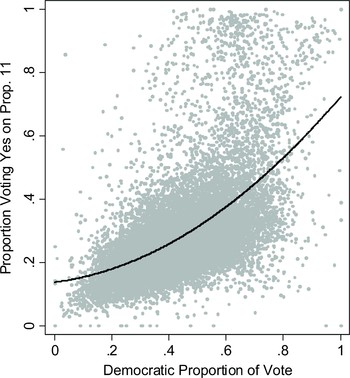
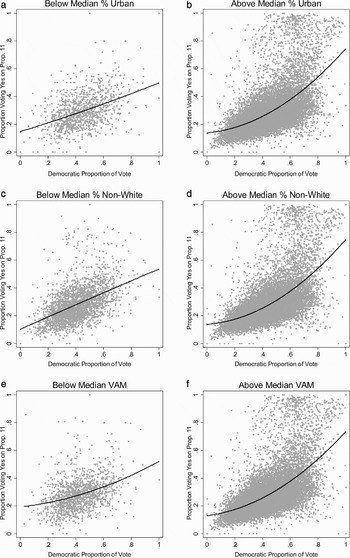
Figure 1 presents a scatter plot with quadratic-fitted values of these data showing support for Proposition 11. Two broad patterns are evident. First, there is a strong positive relationship between the Democratic proportion of precincts and their level of support for the ballot measure. Second, it is evident that Democratic precincts have substantially more heterogeneous views concerning the FEPC proposal than Republican precincts. This may be due to a variety of factors, including the greater variation in the racial or union member composition of Democratic-leaning precincts. We address the issue in our subsequent analysis. First, however, we consider whether the data allow us to solidify, quantify, and extend these basic inferences about the differences between Democratic and Republican voters on this ballot measure.
Support for Proposition 11 among Democratic Voters, California (1946).

Deterministic Bounds
One method for drawing more concrete inferences about the behavior of individuals with this sort of aggregate data is examining the deterministic bounds—the minimum and maximum possible rates at which Democratic and Republican voters in the state could have supported Proposition 11. These bounds can be identified by relatively simple calculations. For example, the maximum bound on the rate at which Democratic voters in California voted for Proposition 11 is MIN(Y/T d, 1), where Y is the proportion of voters that approved of the measure and T d is the proportion of voters that voted for the Democratic candidate in the lieutenant governor's race. The minimum bound is MAX(0, (Y−(1− T d ))/T d), where (1−T d) is the proportion of voters that voted for the Republican candidate in that race. Table 1 reports the bounds for the full dataset and for subsets of homogenously partisan precincts.Footnote 91
Deterministic Bound Voting Rates for Prop. 11, California (1946)

As is typically the case, the bounds for the full dataset provide only a limited amount of information. They indicate that, at most, 47 percent of those who voted for the Republican candidate supported the FEPC proposition. They also reveal that the highest possible level of Democratic support for the proposition was 59 percent. However, the true rates for each partisan group could be anywhere below these limits, and the bounds certainly do not preclude the possibility that the rates of support in the two partisan groups are identical.
One approach to gaining more information from the bounds is to calculate them for more homogenous subsets of the data. To do this, we examine precincts that voted more than 80 percent for the Democratic or Republican candidate for lieutenant governor. The bounds for these homogenous precincts provide the grounds for substantially stronger inferences. They indicate that in strongly Democratic precincts a minimum of 61 percent and a maximum of 77 percent of those who voted for the Democratic lieutenant governor candidate also supported the FEPC proposition. They also reveal that, at most, 16 percent of Republican voters in Republican precincts voted for the proposition. Thus, we can conclude with certainty that members of each party in that party's core precincts were strongly polarized on the ballot measure. This suggests, more generally, that at the very least, central elements in the electoral coalitions of each party had distinctive views on this particular racial issue in 1940s California.
The bounds in the homogenous precincts also provide suggestive evidence that Democratic voters across the state may have supported Proposition 11 at substantially higher rates than Republican voters. One limit of examining the bounds in homogenous precincts, however, is that they do not allow one to compare the behavior of Democratic and Republican voters in the same precincts. Thus, this analysis does not circumvent the inferential problem that arises from the fact that partisans in one type of precinct may have behaved differently than those in another type of precinct. For example, Democrats in overwhelmingly Republican precincts may have opposed Proposition 11, and Republicans in very Democratic precincts may have been overwhelmingly supportive. The bounds in such precincts cannot rule out this possibility. In fact, the bounds in this case do provide some evidence that Democratic voters in heavily Democratic precincts were more supportive of the proposition than their co-partisans in other districts. This is implied by the fact that the maximum possible level of support for the proposition among all Democratic voters in the state is 59 percent, whereas the minimum possible level in the homogenous Democratic precincts is 61 perecent. Despite such evidence of aggregation bias, the bounds reveal at the very least that the central elements in each party's electoral coalition had distinctive views on Proposition 11 and that there also may have been substantial heterogeneity among Democrats. The following section reports population-level estimates of support for Proposition 11 using ecological inference methods that are designed to be robust to aggregation bias.
Ecological Regression Analysis
The bounds can only tell us the absolute limits of support or opposition among particular groups. In the next three sub-sections, we explore different methods for ecological inference that estimate where, within the bounds, the levels of support fall for Proposition 11 among Democrats and Republicans across the state. We employ three different methods – quadratic regression, King's method of ecological inference, and Goodman's regression with demographic controls, because each is premised on different assumptions and they allow us to examine the robustness of our results. However, we first report the results from a standard method that is not robust to aggregation bias.Footnote 92
This method, known as Goodman's regression, is derived from the fact that the fraction of ballots recording approval for the measure in any particular precinct is given by the accounting identity Y = β dT d + β r (1−T d), where Y is the votes for Proposition 11 as a proportion of votes, β d is the rate at which Democratic voters support the proposition, β r is the rate at which Republicans do so, T d is the Democratic share of total turnout, and (1−T d) is the Republican share. Rearranging these terms gives Y = β r + (β d − β r)T d. If the parameters β d and β r are constant across precincts, we can estimate them via a Goodman's regression of Y on T d and a constant term.Footnote 93 This produces the following estimates with standard errors in parentheses: Ŷ i = .047 (.003) + .551 (.007) T di.Footnote 94 These estimates imply that 59.8 percent of the citizens who voted for the Democratic candidate in the lieutenant governor's race supported Proposition 11, yet only 4.7 percent of those who voted for the Republican candidate did so.
There are at least two reasons to doubt these estimates. First, the bounds also indicate that the maximum possible level of Democratic support for the proposition statewide was 58.9 percent, which is lower than the estimated level of support produced by the standard Goodman's model. Moreover, we also have evidence from the bounds that suggests that β d changes with the partisan composition of precincts—Democrats in heavily Democratic precincts appear more likely to support the proposition than Democrats elsewhere. The standard Goodman's regression does not allow this variation and thus is vulnerable to aggregation bias in the data, which can be present when the parameters of interest (in this case the support for Proposition11 among different partisan groups) are correlated with the regressors.
Quadratic Regression
One statistical approach to addressing potential aggregation bias in the data is offered by Achen and Shively, who derive an extended version of Goodman's regression and prove that it helps mitigate the effects of aggregation bias.Footnote 95 Adopting their strategy, we relax the assumption that the parameters are mean-independent of the regressors and instead model support for the proposition in each district i as linear functions of T di. Let β di = b 1 + b 2T di + e di and β ri = b 3 + b 4T di + e ri. By substitution into Goodman's regression, we obtain Y i = β 0 + β 1T di + β 2T di2 + ɛ i, where β 0 = b 3, β 1 = b 1 − b 3 + b 4, and β 2 = b 2 − b 4. The coefficients of this quadratic equation can be estimated by regressing Y i on T di, T di2, and a constant term.Footnote 96
To convert the estimates of β 0, β 1, and β 2 into measures of b 1, b 2, b 3, and b 4, we need to make an assumption. Only b 3, the intercept for Republicans, is identified by the quadratic regression, but we calculate values for the other b’s by assuming that either b 2 or b 4 is zero. This assumption makes the model less restrictive than the basic Goodman regression, which constrains both b 2 and b 4 to be zero and thus does not allow the support rate of either group to vary with the composition of the precinct. In cases like ours, the added flexibility from letting even one support rate change with T d reduces aggregation error relative to the basic specification.Footnote 97
The criteria for identification are straightforward. Note that β 2 represents the difference between b 2 and b 4. Suppose that the proportion of votes for the proposition increases—or at least does not decrease—for both partisan groups as precincts become more Democratic. If the estimate of β 2 is positive, we conclude that b 2 > b 4, which means the support for the measure among Democrats increases more quickly than among Republicans as T di rises. Consequently, we set the smaller of these values (b 4) to zero, allowing us to solve for b 1 and b 2. In this example, Republican support for Proposition 11 is held constant across precincts, whereas Democratic support is allowed to vary with the partisan composition of precincts.Footnote 98
Our data are consistent with this example, as a regression of Y i on T di, T di2 produces the following estimates with standard errors in parentheses: Ŷ i = .137 (.007) + .112 (.031) T di + .472 (.032) T di2.Footnote 99 Because the estimated coefficient on T di2 is positive and statistically distinguishable from zero, we identify the model by assuming that Republican support for the proposition across districts is constant and Democratic support varies. This identifying assumption is also consistent with our analysis of the bounds, which provided evidence that Democratic support is higher in more Democratic precincts.
We employ a simulation-based procedure described in Tomz and Van Houweling to translate these coefficient estimates into estimates of partisan rates of support for Proposition 11 and calculate associated confidence intervals (c.i.).Footnote 100Table 2 presents our findings using this method, as well as those from three other alternative methods we explore. The quadratic method leads us to estimate that 48.6 (95 percent c.i. 46.6 to 50.3) percent of those who voted for the Democratic candidate in the lieutenant governor's race supported Proposition 11, whereas 13.8 (12.4 to 15.1) percent of those who voted for the Republican candidate approved of the ballot issue. These estimates imply that Democratic voters were much more supportive of the ballot issue than Republican voters, but the difference between the two groups (35 percent, 32 to 38) is significantly smaller than the difference we estimated with a standard Goodman's regression (55 percent, 54 to 56). Therefore, the quadratic method confirms the overall distinctiveness of the two partisan groups but also suggests the standard Goodman's regression overstates this distinctiveness due to aggregation bias in the data.
Estimated Partisan Rates of Support and Confidence Intervals for Prop. 11, California (1946)

King's Ecological Inference
King introduces a method for ecological inference that incorporates information about precinct-level bounds to estimate precinct-level and aggregate quantities of interest.Footnote 101 Because it systematically employs this information, it is more robust to aggregation bias in the data than standard procedures, such as Goodman's regression. The method is implemented in a software package EzI, which we used to estimate support for Proposition 11 among Democratic and Republican voters.Footnote 102Table 2 displays the estimates and confidence intervals produced by this procedure, which peg Democratic support for the ballot issue at 50.0 percent and Republican support at 12.0 percent. The estimates are very similar to those produced by the quadratic model, though they imply a slightly larger gap between the two partisan groups.Footnote 103 Thus, using this distinct approach to addressing potential aggregation bias, we reach substantively similar conclusions, suggesting that our findings are relatively robust.
Goodman's Regression with Demographic Controls
A third approach to confronting aggregation bias is to estimate a model that allows support rates to vary with contextual demographic factors, rather than the percentage of Democratic voters in the precinct. In this analysis, we let support rates of Democratic and Republican voters depend on average levels of urbanism, the share of nonwhites in the population, and value-added manufacturing (VAM) per capita in their counties. This might mitigate aggregation bias that could arise if Democratic and Republican inhabitants of the same precinct are similarly influenced by their context. We do not use controls to equalize (in a statistical sense) the demographic characteristics of areas that people inhabit. Instead, we model the implications of those demographic characteristics on approval of the FEPC ballot issue and impound them into estimates of the rates at which each partisan group supports the initiative.
To do this, we define β d = b 1 + b 2Urbani +b 3Nonwhitei + b 3VAMi + e di and construct an analogous equation for β r. This leads us to regress Y i on a constant, T di, percent urban, percent nonwhite, per capita VAM, and interactions among these demographic measures and T di. We choose these demographic variables because each would plausibly affect the overall political support for the measure, or partisan polarization on the measure, in a political jurisdiction. In particular, the urbanism of an area and the level of per capita VAM have potential implications for the type of employment in which its inhabitants are engaged. The measure of per-capita VAM also taps into the extent of likely union penetration in an area, which is relevant because unions were strong advocates for the initiative. The percent nonwhite has similarly obvious consequences for how the adoption of an FEPC would affect the day-to-day lives of the residents of particular areas. Our measures of these demographic variables unfortunately contain error—they refer to the overall population rather than those who actually voted, they are recorded at the county rather than the precinct level, and they are not measured in 1946—but they are the best available data.Footnote 104
We use the method employed by Tomz and Van Houweling to translate the regression estimates of our quantities of interest.Footnote 105 In short, we use the actual values of T di and the demographic variables to obtain simulated values of β di and β ri for each precinct i. Then we compute a weighted average of the precinct-level estimates for each partisan group. This method estimates that 60.0 percent of Democratic voters and 4.3 percent of Republican voters approved of the initiative. It appears that this is not an effective way to address aggregation bias in this dataset, as it generates population-level estimates similar to a standard Goodman's regression and outside of the deterministic bounds. In the analyses reported below, however, we further explore the impact of these contextual demographic factors using a different approach.
Subsets of the Data
Our final approach to addressing the robustness of our results is to examine subsets of counties that are demographically distinct. Specifically, we divide the counties into halves depending on whether they were above or below the median county on each of the potentially influential demographic factors described above. Then we use the quadratic approach to make inferences about the behavior of voters in these subsets of the data.Footnote 106
Figure 2 presents scatter plots of these data with regression lines of quadratic-fitted values. Two common features run though all of the demographic comparisons presented here. First, in the group of counties that are relatively rural, white, and have low levels of VAM, the relationship between the Democratic proportion of the vote and approval of Proposition 11 appears more linear than in the other subset of counties. Second, the Democratic precincts in this subset of counties are much less heterogeneous in their support for the ballot issue than is the case in the more urban, nonwhite, and manufacturing-intensive groups of counties. One could speculate that this is because the members of the Democratic coalition who were most supportive of the proposition were those who themselves were nonwhite, and/or lived in urban areas, and/or were engaged in (unionized) manufacturing. However, the data provide no more than circumstantial evidence suggesting this possibility.
Support for Proposition 11 among Democratic Voters in California County Subsets (1946). (a) Below Median Percent Urban, (b) Above Median Percent Urban, (c) Below Median Percent Nonwhite, (d) Above Median Percent Nonwhite, (e) Below Median VAM, (f) Above Median VAM.

Somewhat surprisingly, given the evident differences in the scatter plots, the estimates produced by quadratic regressions, presented in Table 3, are remarkably similar across the subsets of counties.Footnote 107 This pattern increases our confidence in our overall estimates. However, one notable exception to the pattern bears attention. When the counties are divided by their level of VAM, we do detect statistically significant differences. In the low-VAM counties, we estimate that 19.4 percent of Republican voters supported the ballot issue, yet we estimate that only 13.1 percent of their co-partisans behaved likewise in high-VAM counties. For Democratic voters the estimated relationship was opposite, with more in high-VAM counties supporting the measure than in low-VAM counties (49.5 percent vs. 40.2 percent). Moreover, for both partisan groups these differences across counties are statistically significant, judging from the related 95 percent confidence intervals presented in the table.
Estimated Partisan Rates of Support and Confidence Intervals for Prop. 11 among County Subsets, California (1946)

In short, the only difference we detect across subsets of counties is that partisans were more polarized about the ballot measure in areas with relatively high levels of VAM than were those in areas with relatively low levels. At least two accounts of the politics of the initiative are consistent with this finding. First, it is possible that voters in low-VAM areas, where the existence of an FEPC was likely to have minimal effects, were not driven by their own instrumental ends to take opposing positions on the measure. On the other hand, voters in high-VAM areas were much more likely to be personally affected by the passage of the proposition and thus were polarized by these personal stakes.
Second, one might also suspect that the increased level of support in areas with high VAM activity was due to the strong support of unions, and particularly CIO-affiliated unions, which were likely to have large memberships and be well-organized in these areas. This seems to be a plausible explanation for the relatively high Democratic levels of support in these areas, but somewhat less likely to explain the low levels of Republican support.
Summary of the Statistical Evidence
Our statistical analysis has yielded a variety of evidence that Republicans were far less favorable toward Proposition 11 than Democrats. The deterministic bounds in precincts that supported either party by more than 80 percent indicate that core elements of the Republican electoral coalition overwhelmingly opposed Proposition 11, whereas core elements of the Democratic coalition strongly supported it. There is evidence that aggregation bias in the data affect a standard Goodman's regression on these election returns. However, two distinct methods of ecological inference aimed at confronting such aggregation bias add weight to the conclusion that, statewide, there was substantial Democratic support and Republican opposition to the FEPC ballot measure. Finally, even in low-VAM counties, where the estimated gap between the two partisan groups of voters is lowest, we nevertheless infer that the share of Democratic voters approving the measure was more than twice as large as the share of Republican voters doing so. The statistical evidence as a whole consistently points to a single finding: Republican voters in districts all across the state were much less likely than Democratic voters to support Proposition 11.
DISCUSSION AND CONCLUSION
The origins of the current alignment of party and race remain a topic of considerable debate. The most influential explanation, embodied in Carmines and Stimson's Issue Evolution, highlights the critical role of party elites. This view, which has acquired the status of conventional wisdom, holds that the current alignment is a product of a critical juncture during the mid-1960s when party elites chose very different responses to rising demands for racial equality. Inspired—and pressured—by the black freedom struggle, Democratic elites chose to embrace racial liberalism, winning the loyalties of white and black liberals but exacerbating the sense of partisan alienation among southern whites and stoking racial resentment among northern, working-class ethnics. Republican elites chose to reorient their party around racial conservatism and welcomed these erstwhile Democrats into the Republican fold. On this view, the current alignment of race and party was thus a contingent, elite-led phenomenon, and the choices of elites were critical.
This article exploits data on a little-known ballot initiative in postwar California to explore a key assumption of the conventional wisdom; namely, that Republican voters were racially liberal enough to make racial liberalism viable for the GOP. Proposition 11, featured in the general election of 1946, would have outlawed job discrimination and created a state FEPC to enforce the law. Drawing on a close reading of archival documents, as well as an ecological analysis of an original, precinct-level data set, we find that Republican voters were far more likely to have voted against the passage of Proposition 11 than Democratic voters. This was true despite the fact that popular Republican Governor Earl Warren was widely identified as a strong supporter of enforceable FEP legislation. Well before the “chain reaction” of race, rights, and taxes that is presumed to have been set off in the mid-1960s, Republicans voters exhibited a strong degree of racial conservatism, even when Republican elites were staking out a racially liberal position.
We conclude from our finding that Republican elites probably could not have pursued a racially liberal strategy. It would have risked alienating too large a component of their base. In this sense, Republican elites were constrained by the racial ideology of Republican voters. Racial liberalism was off limits. To the extent that GOP elites had any strategic choice at all, it was not a choice about whether but how and when to pursue a racially conservative strategy. This conclusion obviously challenges the conventional wisdom. Perhaps the origins of today's alignment of race and party are rooted less in the strategic choices of political elites than in the reassertion of deep, structural cleavages in the mass electorate. Maybe Goldwater did not so much lead his voters as much as he recognized—earlier than any other Republican politician—where his voters were trying to lead him.
The validity of our conclusions may seem to depend on our particular formulation of realignment dynamics. We have treated voter preferences as fixed. In this formulation, which may be called the “party conversion” thesis, party elites take new positions, and what follows is simply a reshuffling of voters who reassess their partisan commitment based on the proximity of each party's new position to the voter's fixed preferences. This is how the process is generally characterized in the work of Carmines and Stimson. However, as John Zaller has pointed out, there is another way to model the mass polarization of race and party. Here, voters' preferences may be shaped by elite cues. In this formulation, which he calls the “opinion leadership” thesis, party elites take new positions and mass opinion changes in response. This change occurs largely along partisan lines. Thus, when GOP elites staked out a racially conservative position for the party in the mid-1960s, Republican voters grew more racially conservative. In similar fashion, when Democratic elites staked out a racially liberal position, Democrats grew more racially liberal. Of course, the “party conversion” thesis and “opinion leadership” thesis are not mutually exclusive. “Although Carmines and Stimson make no attempt to sort out these competing possibilities,” Zaller has written, “it appears that both processes were at work.”Footnote 108 It bears asking, however, whether the theoretical significance of our finding is diminished if a significant component of the alignment process were driven by “opinion leadership” rather than “party conversion.” What if GOP elites had pursued a racially liberal strategy not just because they wanted to attract Republican voters who were already racially liberal, but because they hoped to encourage Republican voters to become so?
A related concern is whether Warren actually tried to lead opinion in light of the fact that he stayed silent on Proposition 11. Proposition 11 would surely represent a stronger test of the “opinion leadership” thesis if Warren had publicly endorsed the initiative. Our opinion is that it is defensible to treat Warren's overall stance on FEPC as a weak signal of racial liberalism.Footnote 109 Although he remained silent on Proposition 11, we have offered substantial evidence that Warren's support for enforceable FEP legislation was well-publicized and widely announced. Indeed, such legislation was one of three high-profile “social” measures in the reconversion agenda for which he called a special legislative session in 1946—just months before Proposition 11 became the focal point of racial politics in the state. When his immense popularity is also taken into consideration, it does not seem unreasonable to think that all but the least-informed voters understood that he had positioned himself as racially liberal on the issue. Still, it is understandable that some analysts would wish to treat Proposition 11 as a neutral “poll” of voter sentiment—a poll without elite signals in any direction from any party.
We believe our findings raise serious questions about the conventional wisdom, whether or not “opinion leadership” was a component of the alignment process and regardless of how Warren's racial politics was construed by the California electorate. Key here is the astonishingly low level of support for Proposition 11 among Republican voters, along with the substantial magnitude of the disparity between Republican and Democratic voters. Our best estimates of Republican support hover between 10 and 20 percent, with most estimates in the low teens. By contrast, our best estimates of support among Democrats range between 40 and 54 percent, with most estimates coming in just below 50 percent. Racial liberals were a tiny fraction of Republican voters, and there were simply not enough of them to anchor a racially liberal electoral coalition for the GOP, even if fully half of the Democratic coalition committed partisan apostasy. On the other hand, if Republican elites had tried to exercise opinion leadership, they would have had their work cut out for them. The sheer extent of the racial conservatism among GOP voters is so great that racial liberalism seems implausible even if the votes on Proposition 11 are treated as a poll of underlying voter sentiment. Moreover, it would have been challenging for Republican voters to have been led by their elites, whether or not their elites actually tried to lead them. The extremely low levels of racial liberalism among Republican voters thus point to one conclusion, regardless of the assumptions made: the path of least political resistance was racial conservatism.Footnote 110
Perhaps the most telling fact about who was leading whom emerged after the election. Although he had prominently endorsed enforceable FEP legislation in early 1946, Warren became hesitant to publicly endorse it in his remaining years as governor.Footnote 111 In light of the overwhelming hostility of Republican voters to Proposition 11, it is easy to surmise the reasons for his continued silence. Why lead the party in a racially liberal direction and risk the loss of votes when it was so much easier to say nothing? Warren may have freely declined to lead his voters before the election, but his voters were almost certainly constraining his political options after the election.
Our conclusions may also seem to depend on the claim that GOP opposition to Proposition 11 is a valid measure of racial conservatism. We believe it is a valid measure. If racial conservatism refers to the belief that government should play a limited role in addressing racial equality, then voting against FEPC is by definition a racially conservative vote, because it would prevent government from regulating discrimination in employment. To be sure, racial conservatism can stem from different motivations. The racial conservatism of some Republicans may have been motivated by pure racial animus, whereas the racial conservatism of other Republicans may have been motivated by a generic commitment to laissez faire. Still others may have held both motivations. However, casting a ballot against Proposition 11, no matter the underlying motivation, indicates racial conservatism because it reflects the belief that government should not become involved in addressing the problem of racial discrimination. Similarly, casting a ballot for Proposition 11, whether it is motivated by a commitment to racial equality or a generic commitment to state action, is properly construed as racially liberal because it reflects the belief that government should have a greater role in addressing racial inequality.
A more significant concern is that the battle over Proposition 11 and Goldwater's opposition to the Civil Rights Act are separated by nearly two decades. In the intervening period, it is possible that the racial attitudes of Republican voters grew significantly more liberal, perhaps as a result of exposure to the civil rights movement. Thus, it is possible that the thoroughgoing racial conservatism that seems to have prevailed among Republican voters in the mid-1940s simply has no bearing on whether it made sense for Republican elites to pursue racially liberal policies in the mid-1960s.
Unfortunately, our data do not permit us to trace the evolution of racial attitudes among Republicans voters. It is certainly plausible there was a gradual liberalization. However, if the politics of fair housing is a reasonable indication, it would seem that Republicans remained more racially conservative than the nonsouthern Democrats with whom they competed.Footnote 112 The battle over fair housing reached its zenith in the mid-1960s, just as the nation's attention to the struggle for racial equality in the South was at its highest point. In 1963, on almost a straight, party vote, California's Democratic state legislators passed a fair housing law—a key part of Democratic Governor Edmund G. Brown's legislative agenda. One year later, however, voters approved an initiative repealing the new law. Polling data suggest that, at every education level, white Democrats were more likely to oppose repeal than white Republicans.Footnote 113 A similar partisan difference characterized a Detroit “Homeowners' Rights” ordinance in the same year.Footnote 114 These ordinances warrant closer examination into their implications for the conventional wisdom. They suggest that Republican voters were staking out racially conservative positions—in both relative and absolute terms—before the pivotal 1964 general election in which national party politicians began to “lead” on race. These observations about partisan differences in the California public housing initiative are consistent with our findings about the racial conservatism of Republican voters in postwar California and raise further doubt that Republican elites were unconstrained by their masses in deciding their policy positions and electoral strategy.
A final concern is whether California is typical in the racial conservatism exhibited by Republican voters in the vote on Proposition 11. If it is typical in some fashion, then our case against elite-led theories of party alignment would be stronger. If it is exceptional, then we would need to explain how it nevertheless sheds valuable light on the process of voter alignment. Again, our data unfortunately do not permit us to address the question in a satisfying manner. The ideological character of Republicanism obviously varies outside the South, but it is also clear that the states belong to distinct clusters.Footnote 115 What is not clear is where precisely California belongs, although it is most likely situated on the more racially conservative side of the ideological spectrum. If it is not typical of all “northern” states, perhaps it is typical of racially conservative, “northern” states. This, too, is a topic well worth further research.
In sum, we believe that our empirical findings raise serious theoretical questions about the conventional wisdom. We also believe, however, that much more research is needed. There are two particular avenues of empirical inquiry that seem especially promising. The first depends on uncovering other ballot initiatives—state or municipal—that might provide opportunities for similar analyses in contexts beyond mid-century California. Are there other referenda that have gone overlooked? The other is early public opinion data. New strategies have been developed to overcome the methodological problems that plagued survey administration in the 1930s and 1940s.Footnote 116 The empirical analysis of data from both sources could help illuminate how the mass basis of racial politics developed between the early postwar period and the “critical juncture” of the mid-1960s, which the conventional wisdom identifies as pivotal in shaping our current party alignment.