INTRODUCTION
Fish belonging to the genus Conger are characteristically vigorous fish, with an elongate body, joint dorsal, caudal and anal fins, well-developed pectoral fins, and a big mouth with two rows of teeth arranged into a sharp edge, adapted to their fish-predator habits (Cau & Manconi, Reference Cau and Manconi1984; Morato et al., Reference Morato, Grós and Menezes1999). The body is brownish or dusky, lighter ventrally (Kanazawa, Reference Kanazawa1958). The genus Conger has approximately 14 species (Kanazawa, Reference Kanazawa1958; Cervigón, Reference Cervigón1980; Smith, Reference Smith and Böhlke1989). They inhabit both sides of the Atlantic Ocean and the west Indo-Pacific, in tropical to cool temperate waters. This genus presents primitive characters for the family Congridae (Asano, Reference Asano1962), such as the persistence of the parhypural bone in the caudal skeleton (Kubota, Reference Kubota1961; Castle, Reference Castle1964; Monod, Reference Monod1968; Figueroa, Reference Figueroa1999), compared to the extremely reduced and simplified hypural complex in the other species of the order Anguilliformes. The biology of this group of fish is rather unknown when compared to some species of anguillid eels, such as the American and European eels, famous for their migrations. Nonetheless, the European and American conger eels, Conger conger and Conger oceanicus, do undertake a spawning migration similar to that of anguillid eels (Cou & Manconi, 1984; McCleave & Miller, Reference McCleave and Miller1994). There are also references to the biology (Cou & Manconi, 1984; Hood et al., Reference Hood, Able and Grimes1988; Utoh et al., Reference Utoh, Horie, Okamura, Yamada, Tanaka, Mikawa, Akazawa and Poka2003) and early life history (Bell et al., Reference Bell, Witting and Able2003) of conger eels from various regions, and some information is reported on the gonadal structure of some congrid eels (Fishelson, Reference Fishelson1994), although the majority of the species of the genus have not been studied. Conger orbignianus is the world's southernmost species reaching the Patagonian littoral (Bovcon & Cochia, Reference Bovcon and Cochia2007), with a distribution restricted to the south-western Atlantic (Kanazawa, Reference Kanazawa1958; Cervigón, Reference Cervigón1980; Smith, Reference Smith and Böhlke1989; Mincarone & Smith, Reference Mincarone and Smith2005) and a maximum size of over one metre. Its distribution ranges from Rio de Janeiro (Brazil) down to Argentina, and it is usually caught by commercial coastal fleets. This study aims to find a relationship between the habitat, the morphological characteristics and the ovarian histological analysis of southern conger eel Conger orbignianus females from the western South Atlantic.
MATERIALS AND METHODS
Ovary samples of: 26 shallow water female specimens obtained through capture by net bottom trawl (July 1993; between 34°59′–36°27′S and 55°41′–56°41′W; 6 and 13 m depth); two females from the Argentine outer continental shelf captured by net bottom trawl (October 2000, 40°16′S 56°29W, 108 m depth and November 2000; 37°10′S 54°25′W; 228 m depth) and two giant females from the southern Brazil slope captured by longline commercial fisheries (no date available; 34°00′–34°20′S and 51°00′–52°00′W; 250 m depth).
Southern conger eel gonads from each fish were dissected and fixed in 10% formalin. Wet-mount preparations of ovarian tissue were examined to determine the maturation stage at 30 × total magnification. In order to observe microscopic details, thin sections of ovarian tissue (6 µm) stained with haematoxylin and eosin were prepared for 30 female conger eels of various sizes and maturity stages using routine histological procedures (Humason, Reference Humason1979).
Histological staging of ovaries was based on the stage of oocyte development, classified into five categories: (1) primary growth stage (pre-vitellogenic basophilic oocytes); (2) early yolk vesicle stage; (3) advanced yolk vesicle stage; (4) oocytes with yolk globules; and (5) atretic oocytes.
RESULTS
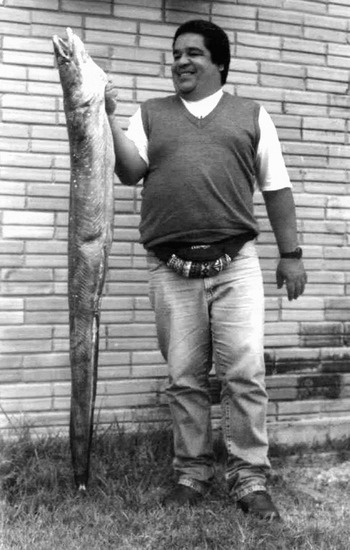
The morphology of the analysed specimens differed, according to the site of capture. Both of the samples, caught by means of net bottom trawls in deeper waters north of the Argentine Sea, had the ovaries in an advanced developmental stage, fully occupying the abdominal cavities. The stomachs and intestines were empty and obliterated by pressure caused by ovaries. The jaws were soft and flexible and they had lost nearly all their teeth (Figure 1); the bodies were swollen, very dark in colour, and the eyes were larger than those from coastal specimens. On the other hand, the two specimens from the southern Brazil slope, captured by means of longline fisheries, were in perfect condition, very similar to the shallow-water ones, but giant-sized (Figure 2).
Female Conger orbignianus head in Stage 4 showing loss of the majority of teeth, soft jaws and the big eye (head length: 145 mm).

Giant Conger orbignianus female in Stage 5 from south Brazil (total length: 1540 mm).

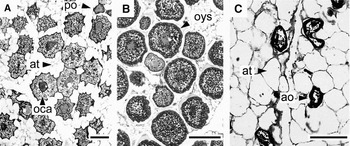
Histological sections were performed in ovaries of female conger eels from coastal and deep waters. Microscopic analysis of ovaries from coastal females showed two oocyte batches: pre-vitellogenic oocytes (primary growth stage) and yolk vesicle stage oocytes. These components were found surrounded by a broad net of adipose tissue (Figure 3a). The presence of only two oocitary generations suggests that this species could be a total spawner, which means that elements at vitellogenesis would mature in a synchronic way, and would be expelled in one or several pulses at the moment of spawning; nevertheless, the maturity of pre-vitellogenic oocytes would probably not occur. Ovaries of females collected in the intermediate shelf of the northern Argentine Sea also show traits of total spawning, but oocytes at the yolk stage are in a very ripe condition and the adipose tissue is scarce. (Figure 3b). These characteristics were associated with the process of tooth loss and the atrophy of bones (as they are incapable of feeding themselves, the ovaries increase very much in size and weight during the fasting period at the expense of the rest of the body) (Cunningham, Reference Cunningham1891–1892). The south Brazilian giant conger eel ovarian tissue showed atretic oocytes with abundant adipose tissue (Figure 3c).
Thin sections showing three maturation stages of female Conger orbignianus ovaries. (A) Oocytes with early cortical alveoli (Stage 2); (B) oocytes in yolk stage (Stage 4); (C) atretic oocytes (Stage 5). at. adipose tissue; ao, atretic oocyte; oca, oocyte with cortical alveoli; oys, oocyte in yolk stage; po, previtellogenetic oocyte. Bar 10 µm.

DISCUSSION
Conger orbignianus had always been considered a shallow-water species until isolated specimens were found in deeper waters of the northern Argentine Sea and in the southern Brazil slope, being somewhat different from their coastal congeners. Figure 4 shows how in coastal females maturity advances as their length increases. Thus, the last maturity stage observed in shallow-water females, with an ovary at Stage 4 (oocytes with yolk globules) is related to the largest size of 126 cm. Females found in the north of the Argentine Sea, in the intermediate shelf, also present a Stage 4 ovary, but the difference with their coastal congeners lies in changes observed in the already described body degradation. This same degradation is observed in southern conger eels captured by the artisan fleet and taken to the Museo del Mar aquarium, in the city of Mar del Plata, where they were held in captivity. After living for some years in the aquarium, feeding voraciously and growing hastily, these congers suddenly switch their behaviour and their look, and they cease feeding, their abdominal cavity becomes completely filled by hypertrophied ovaries, and finally, they move to shelters in the aquarium where they die (Matías Delpiani, personal communicationFootnote 1). Such behaviour, together with the body transformation and the ovarian development, was also observed in Conger conger (Cunningham, Reference Cunningham1891–1892) at the aquaria from Berlin, Plymouth and Naples. This event leads us to infer that it is at this stage of gonadal maturation when the South American conger eels would start their migration to the reproduction areas (an unknown place) and stop feeding. The fact that they cease feeding and subsist under their own reserves would explain the smaller size of the intermediate-shelf water females (Figure 4) with respect to those from shallow waters, both at Stage 4. These related stages would suggest to us the semelparity of Conger orbignianus. Based on the study of histological sections, Fihelson (1994) concluded that the ovaries of Conger orbignianus are monocyclic, that is, the female spawns either once a year or only once in its life. The problem is that the analysed samples come from the South Pacific, a region uninhabited by the southern conger eel. The giant deep water female with atretic oocytes in the ovary has never been captured in coastal areas. Its existence could be explained by the fact that should Conger orbignianus be a semelparous species, for some special reason, it would interrupt the process of sexual maturity, without reaching the final stage. Then, there would be no spawning and a stage of oocyte regression would begin; it would not suffer decalcification nor loose its teeth, and it would continue feeding and growing vigorously, until reaching the sterile giant conger eel female state.
Relationships between female Conger orbignianus total length and depth, according to the maturation ovarian stages.

Having analysed the non-larval life cycle of Conger orbignianus, we may ask ourselves if this same pattern is observed in other species of the genus. Only a small amount of literature about the reproduction of conger eels has been published, although evidence would suggest a common pattern. The American conger eel C. oceanicus, for example, stops feeding when approaching maturity (Bigelow & Schroeder, Reference Bigelow and Schroeder1953); the European conger eel C. conger—undoubtedly the most studied species—undergoes changes as the individual ripens (body degradation) (Cunningham, Reference Cunningham1891–1892) and it reproduces once in its life (Cunningham, Reference Cunningham1891–1892; Cau & Manconi, Reference Cau and Manconi1984; Correia et al., Reference Correia, Antunes and Coimbra2002). Hood et al. (Reference Hood, Able and Grimes1988) analysed samples of Conger oceanicus from the north-west Atlantic, coming from inshore samples caught by small-meshed trawls and from the tilefish longline fishery from 100 to 260 m. The histological sections showed characteristics equivalent to Stages 1, 2 and 3 of the present study, included the abundant storage of adipose cells; however, Stage 4 specimens with body degradation as here described or as those observed in Conger conger by Cau & Manconi (Reference Cau and Manconi1984), were not captured. This situation could be ascribed to the fact that at this stage of development the conger migrates, and since it has ceased feeding, it cannot be captured through longlines, but with trawler fishing nets only, as it happened with the samples of Conger orbignianus from the south-western Atlantic and the samples of Conger conger from the Mediterranean Sea. Photographs of histological sections of ovaries of the Japanese conger eel C. myriaster have been observed (Kubota, Reference Kubota1961), that show two oocyte batches and plenty of adipose tissue, similar to that observed in this research (Figure 3a). Utoh et al. (Reference Utoh, Horie, Okamura, Yamada, Tanaka, Mikawa, Akazawa and Poka2003) instigated an interesting work stimulating the ovarian maturation in Conger myriaster with chorionic gonadotropin; except for Stage 5, females reached all the stages observed in the present study. However, neither degenerative body stage in mature females, nor the abundance of Stage 2 adipose cells—seen in a photograph for this species (Kubota, Reference Kubota1961)—is mentioned. With reference to the giant conger eels, Conger oceanicus and Conger verreauxi, they have been mentioned to reach a size of 2 m (Bigelow & Schroeder, Reference Bigelow and Schroeder1953; Castle, Reference Castle1964), and Conger conger may grow up to 3 m long (Smith, Reference Smith and Böhlke1989); large conger eels have been observed sharing tilefish (Lopholatilus chamaeleonticeps) burrows in the north-western Atlantic (Hood et al., Reference Hood, Able and Grimes1988), but no histological sections were observed in order to confirm whether the specimens were sterile or not.
As far as the reproductive migration undertaken by the conger eel is concerned, the European conger eel Conger conger migrates to the central-east basin of the Mediterranean and, probably, to the north-east Atlantic between Gibraltar and the Azores (Correia et al., Reference Correia, Antunes and Coimbra2002); Conger oceanicus and Conger triporiceps migrate to the Sargasso Sea (like the behaviour displayed by the American eel Anguilla rostrata and the European eel Anguilla anguilla), and probably also to the Bahamas and Antilles (McCleave & Miller, Reference McCleave and Miller1994). Asano (Reference Asano1962) suggested that the Japanese conger eel Conger myriaster would migrate to spawn in the depths of the South Sea (north of 25°N), washed by the Kuroshio Current and its tributaries, a possibility recently endorsed by Ma et al. (Reference Ma, Miller, Aoyama and Tsukamoto2007). The possible spawning area of the southern conger eel Conger orbignianus is unknown, but it seems likely that all eels, including temperate species, require warm waters (around 18°C) and fairly high salinity (35°/oo) (Castle, Reference Castle1968). These conditions would occur in the South American eastern slope, north of the confluent front between the Brazil and Malvinas Currents. This is therefore regarded as the possible spawning area of the southern conger eel.
Much remains to be learned about the complex life cycle of the southern conger eel. In order to strengthen our proposal, it would be significant to considerably increase the number of individuals sampled, as well as to start working with the gonosomatic index and to carry out monthly samplings for at least two years. The leptocephalus larva of Conger orbignianus has been recently described (Figueroa & Ehrlich, Reference Figueroa and Ehrlich2006).
ACKNOWLEDGEMENTS
The authors would like to thank the Instituto Nacional de Investigación y Desarrollo Pesquero (INIDEP) and commercial fishermen for providing us the study material. Thanks to Matías Delpiani for donating conger specimens from the aquarium of the Museo del Mar, Mar del Plata, Argentina.