I. INTRODUCTION
Humidity sensors are widely applied in process control, environment monitoring, storage and electrical devices Reference Lee and Lee1–Reference Yamazoe and Shimizu3 ; hence, the research to develop some new materials for humidity sensor devices attracts more and more attention. The construction of a good humidity sensor is rather complex, because high-performance humidity sensors must meet many requirements, including linear response, high sensitivity, short response and recovery time, chemical and physical stability, wide operating range of humidity, and low cost. Materials that have been studied with these qualities include polymers, ceramics, and composites, which have their own advantages and specific conditions of application. Reference Kulwicki2,Reference Sakai, Sadaoka and Matsuguchi4,Reference Traversa5 Carbon nanotubes (CNTs) are a kind of carbon allotrope, which were found in 1991 by Iijima. Reference Iijima6 CNTs are one of the most attractive nanoscale fillers because of their high aspect ratio and combination of excellent thermal, electrical, and mechanical properties. Owing to these excellent properties, many CNT-based humidity sensors have been studied, including capacitive-type, Reference Chen, Zhao, Liu, Zhang and Suo7–Reference Yeow and She9 resistive-type, quartz crystal microbalance (QCM)-type sensors, Reference Su, Sun and Lin10–Reference Chen, Wu, Chan, Sun and Su12 etc. Capacitive-type sensors have the advantage of less power consumption, but the capacitance of a sensor relies on the frequency and is variable, which needs to be calibrated frequently. Reference Matsuguch, Kuroiwa, Miyagishi, Suzuki, Ogura and Sakai13,Reference Kim, Hong, Lee, Moon and Kim14 QCM-type humidity sensor devices are complex and not convenient. Resistive humidity sensors measure the change in the resistance of a sensor element according to the ambient humidity. It is easier and more straightforward to measure humidity using resistive-type sensors than using capacitive-type and QCM-type sensors.
Recently, various resistive-type humidity sensors Reference Liu, Ye, Wu, Han, Zhou and Cui15 and gas sensors Reference Slobodian, Riha, Lengálová, Svoboda and Sáha16,Reference Wong, Kang, Davidson, Wisitsora-At and Soh17 using CNTs have been studied. Cao et al. investigated the properties of the humidity sensors made of chemically treated and untreated MWCNT thin films, and it showed that both the chemically treated and untreated MWCNT thin films demonstrated humidity sensitive properties, but the former had stronger sensitivity than the latter. Reference Cao, Hu, Fang, Wang, Tian and Pan18 Su and Wang discussed a resistive humidity sensor based on the composite thin films of MWCNTs/PMMA/KOH, and it exhibited humidity sensitivity and good linearity. Reference Su and Wang19 Therefore, MWCNTs are a kind of ideal material for humidity sensing. In addition, hydroxyethyl cellulose (HEC) is a kind of hydrophilic polymer and it is very hygroscopic and sensitive to small amounts of moisture, therefore, it is useful for humidity sensing. Some researchers have studied optical fiber humidity sensors of HEC/PVDF film using the swell property of HEC in a humid atmosphere. Reference Muto, Suzuki, Amano and Morisawa20–Reference Xia, Li, Li, Kou and Liu22
In this study, treated multiwalled carbon nanotube (tr-MWCNT)/HEC composite films were prepared using HEC as matrix and tr-MWCNTs as conductive filler. The humidity sensing properties of tr-MWCNT/HEC composites were investigated, and the composites showed immense sensitivity to relative humidity (RH). Fabrication of this kind of humidity sensor is simple and low cost; hence, wide application of this tr-MWCNT/HEC composite film–based humidity sensor can be obtained for humidity detection in the future.
II. EXPERIMENTAL
A. Materials
MWCNTs produced by chemical vapor deposition (purity > 95 wt%, a diameter of about 20–30 nm, and a length of about 10 µm) were supplied by Chengdu Organic Chemicals Co. Ltd., Chinese Academy of Sciences. HEC was purchased from HeBei XinLe RunFeng Chemical Engineering Co., Ltd, China. The GD401 RTV SR was purchased from Chemical Institute of Sichuan, China.
B. Preparation of composites and instruments
To improve the dispersion degree of MWCNTs in composite, MWCNTs were treated at first: raw MWCNTs were added to the mixed solutions (3:1 H2SO4:HNO3), and then refluxed in the thermostatic oil bath for 60 min at 140 °C. The obtained tr-MWCNTs were then dried in a drying oven at 50 °C. The acid treatment can greatly enhance the hydrophilicity of MWCNTs by introducing oxygen-containing groups to the sidewalls and ends of MWCNTs, which could make MWCNTs disperse uniformly in distilled water (used as dispersant). Moreover, acid treatment can sever MWCNTs and make MWCNTs shorter, which is also beneficial for the dispersion of MWCNTs in distilled water. The oxygen-containing groups also make tr-MWCNT-based film more hydrophilic, which is also beneficial for water adsorption. The dispersion comparison in Fig. 1 between (a) raw MWCNTs and (b) tr-MWCNTs in distilled water has been highlighted, and the tr-MWCNTs have better dispersion in distilled water than the raw MWCNTs. Thus, the dispersion degree of MWCNTs in distilled water was improved by acid treatment.
Fabrication process of tr-MWCNT/HEC composite film.

Tr-MWCNT/HEC composites were fabricated through solution blending: 0.0625 g of tr-MWCNTs was put in a vessel and wetted with 2 mL distilled water, followed by magnetic stirring for 15 min to prevent the aggregation of tr-MWCNTs. After that, 0.25 g of HEC was added into the solution, and the mixtures were then diluted with 6 mL distilled water. After 15 min of magnetic stirring at room temperature, the obtained well-dispersed solution was then spin-coated on the interdigital electrodes and cured in a drying oven at 85 °C for 15 min to remove the distilled water. Hereto, the tr-MWCNT/HEC composites were successfully fabricated, and the weight content of tr-MWCNTs in the composite was 25%. The size of the humidity sensor fabricated is about 0.5 cm (length) × 0.5 cm (width). Figure 1 depicts the whole fabrication process of tr-MWCNT/HEC composite film. In addition, tr-MWCNT/silicone rubber (SR) composite films having the same size and weight content of tr-MWCNTs were fabricated as a comparison; the fabrication process is as follows: 0.0625 g of tr-MWCNTs was added to 3 mL Zippo premium lighter fluid (used as dispersant), followed by magnetic stirring for 15 min to achieve a uniform dispersion. Then 0.25 g of SR was added into the mixed solution and dispersed for 15 min. The obtained mixed solution was then spin-coated on the interdigital electrodes and cured at room temperature. In addition, tr-MWCNT/HEC and tr-MWCNT/SR composites having different thickness were prepared (about 10, 20, and 30 µm, respectively) by controlling the volume of suspension drop.
In this experiment, the resistance of composite was measured by an LCR meter (GW INSTEK LCR-819 from Taiwan). The humidity environment was provided by a humidity chamber (Temp & Humi Programmable Chamber BE-TH-80 purchased from Dongguan Bell Experiment Equipment Co., Ltd, China.) capable of adjusting the RH levels from 35 to 95% at 25 °C, which is the typical operating range for humidity sensors widely used in many measurement and control applications. The control accuracy of temperature and humidity is ±0.5 °C and ±2.0% RH, respectively. Humidity testing experiments were conducted by exposing the composites to different RH provided by the humidity chamber.
III. RESULTS AND DISCUSSION
A. Microstructure of the composites
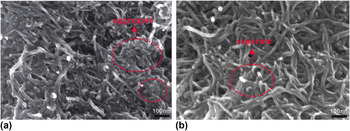
Figure 2 illustrates the SEM images of raw MWCNT/HEC and tr-MWCNT/HEC composite films. Raw MWCNTs tend to aggregate in polymer solutions and bunch up due to their nonreactive surfaces and extremely large surface areas, as highlighted in Fig. 2(a). The dispersion of MWCNTs in composite can be enhanced by making it shorter and adding some groups to the sidewalls and ends of MWCNTs that can react with dispersant and matrix molecules. It can be observed from Fig. 2(b) that tr-MWCNTs have a homogeneous dispersion in the composite, this is because of the hydrophilic groups in tr-MWCNTs and the shorter length of tr-MWCNTs by acid treatment.
SEM images of (a) raw MWCNT/HEC composite film and (b) tr-MWCNT/HEC composite film.

B. Fourier transform infrared spectroscopy (FTIR) analysis
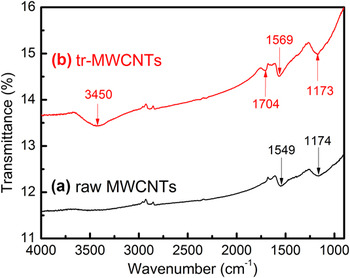
Figure 3 shows the FTIR spectra of tr-MWCNTs and raw MWCNTs in the range of 4000 to 1000 cm−1. The 1173 and 1174 cm−1 peaks are attributed to the C–C bond of MWCNTs, the peaks at 1569 and 1549 cm−1 are attributed to the vibration of carbon skeleton of the CNTs. Reference Xiong, Zheng, Qin, Li, Li and Wang23 In addition, the 1704 cm−1 peak of tr-MWCNTs can be assigned to characteristic of acid carbonyl (C=O) stretches, Reference Xiong, Zheng, Qin, Li, Li and Wang23 and the peak at 3450 cm−1 in Fig. 3(b) is due to the −OH functional groups, and these indicate the success of the treatment. Acid treatment can greatly enhance the hydrophilicity of MWCNTs by introducing −OH functional groups to the sidewalls and ends of MWCNTs. Owing to the presence of these hydrophilic groups, tr-MWCNTs can disperse uniformly in distilled water and homogeneous solution can be obtained. What is more, −OH functional groups make tr-MWCNT-based film more hydrophilic, which is also beneficial for water adsorption.
FTIR spectra of (a) raw MWCNTs and (b) tr-MWCNTs.

C. Current–voltage (I–V) characteristic
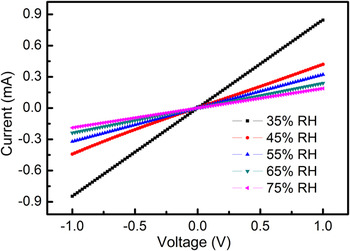
Figure 4 shows the I–V curves of 10 µm tr-MWCNT/HEC composite film at different RH levels from 35 to 75% at room temperature. It is observed that the I–V curves of this kind of composite exhibit a very good linearity in any RH atmosphere, suggesting an ohmic contact between the electrodes and tr-MWCNT/HEC composite. In the meantime, it is clearly seen that the resistance of the composite film increases promptly with the increase of RH level, which is in good agreement with the results shown in Fig. 5.
I–V curves of 10 μm tr-MWCNT/HEC composite film at different RH levels.

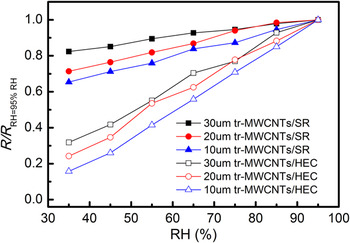
Normalized resistance–RH curves of tr-MWCNT/HEC and tr-MWCNT/SR composite film.

D. Humidity sensitivity and proposed mechanism
The humidity sensing properties of tr-MWCNT/HEC and tr-MWCNT/SR composite films were probed by measuring their film resistances in different RH environments at 25 °C. The normalized resistance–RH curves of both kinds of films are depicted in Fig. 5. The solid points in Fig. 5 are corresponding to tr-MWCNT/SR composite film, while the empty points indicate the resistance change of tr-MWCNT/HEC film. The resistances of both kinds of films increase almost linearly with increasing RH from 35 to 95%, as shown in Fig. 5. The sensitivity (S) to RH is determined by the following equation:
 $$S = {{\Delta R} \mathord{\left/ {\vphantom {{\Delta R} {{R_0}}}} \right. \kern-\nulldelimiterspace} {{R_0}}}\Delta \;\left( {\% {\rm{RH}}} \right)\quad {\rm{,}}$$
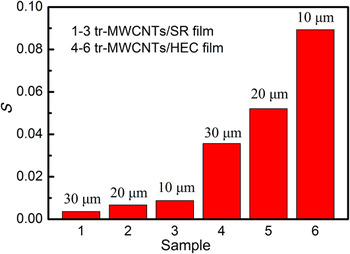
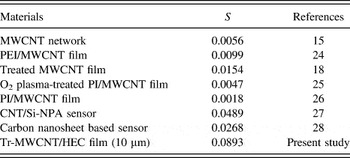
where ∆R = R RH − R 0, R 0 refers to the resistance when the RH is 35%, R RH represents the resistance at certain RH. To compare the sensitivities of both kinds of composite films clearly, a histogram is presented in Fig. 6. It is observed that the sensitivity of tr-MWCNT/HEC composite is much higher than that of tr-MWCNT/SR film with the same film thickness, and to both kinds of films, their sensitivity to RH increases with the decrease of the film thickness. Through calculation, the sensitivity of tr-MWCNT/HEC composite film (10 µm) is 10 times as high as that of tr-MWCNT/SR film (10 µm), indicating that the tr-MWCNT/HEC composite film is more sensitive to RH than tr-MWCNT/SR film. Table I also lists the comparison of sensitivity between tr-MWCNT/HEC composite and other materials: it can be seen that the tr-MWCNT/HEC composite shows higher humidity sensitivity in comparison with other films and it proves the superior humidity sensing property of tr-MWCNT/HEC composite.
Sensitivity comparison of tr-MWCNT/HEC and tr-MWCNT/SR composite films.

Comparison of sensitivity between tr-MWCNT/HEC composite and other materials.

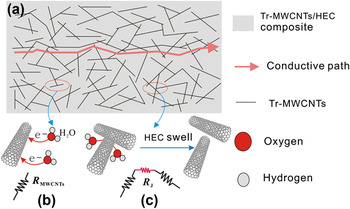
The humidity sensing mechanism of tr-MWCNT/HEC composite can be understood from the possible mechanisms given in the schematic of Fig. 7. The resistance change of tr-MWCNT/HEC composite depends on the interaction of water molecules with the MWCNT sites and MWCNT junction sites. The MWCNT network shows global p-type semiconducting behavior, where the electrical conduction is dominated by holes. Reference Varghese, Kichambre, Gong, Ong, Dickey and Grimes29,Reference Maiti, Andzelm, Tanpipat and von Allmen30 When a tr-MWCNT/HEC composite was placed in an atmosphere with some humidity level, some water molecules would be adsorbed by MWCNTs through physical adsorption; the water molecules adsorbing on the surfaces of MWCNTs transfer electrons to MWCNTs because of an electrical potential difference between the two materials, Reference Liu, Ye, Wu, Han, Zhou and Cui15 decreasing the number of holes and resulting in the increase of the electrical resistance of MWCNTs, i.e., R MWCNTs in Fig. 7(b). The amount of water molecules to be adsorbed by MWCNTs directly depends upon the RH level of the environment. The higher the RH level, the more water molecules will be adsorbed and more electrons will be transferred, causing a bigger increase of resistance. Moreover, the oxygen-containing groups on tr-MWCNTs can absorb more water molecules and more electrons are transferred between tr-MWCNTs and water molecules, leading to the bigger resistance increase of tr-MWCNT/HEC composite.
Schematic view of the possible mechanisms of tr-MWCNT/HEC composite film. (a) the formation of the conductive path (b) the interaction between water molecules and MWCNT (c) the swell effect in the composite.

Besides the electron donation model, other mechanism for the humidity effect of tr-MWCNT/HEC composite has been proposed as well: the reason is an increase of resistance between tr-MWCNTs (MWCNT junction sites). Since HEC has abundant hydroxyl groups, it can adsorb a large number of water molecules when exposed in an atmosphere with some humidity level, and it causes the swelling of HEC, Reference Muto, Suzuki, Amano and Morisawa20 thus, it can effectively increase the contact gap of the tr-MWCNTs intertube junctions in the composite film, causing the increase of the tr-MWCNT junction resistance, i.e., R J in Fig. 7(c). By contrast, the swelling property of tr-MWCNT/SR composite film is very weak for the nonhydrophilic property of SR, leading to the lower humidity sensitivity compared with tr-MWCNT/HEC composite film. Owing to these reasons, tr-MWCNT/HEC composite film has high humidity sensitivity and is a good candidate for humidity sensor.
E. Repeatability and response characteristics
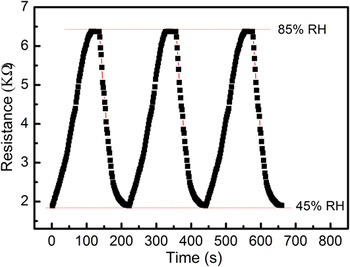
Here, tr-MWCNT/HEC composite film with a thickness of 10 μm was chosen to study the following characteristics due to its better humidity sensing performance than others. Response time, recovery time, and reproducibility are several important parameters for humidity sensor devices. To investigate these properties, the dynamic test of tr-MWCNT/HEC composite was performed at 25 °C. In the dynamic test, the composite was alternately exposed at 85% RH and 45% RH by putting it in the humidity chamber (85% RH at 25 °C) and removing it from the chamber (about 45% RH) at 25 °C. Figure 8 gives the response and recovery curves of tr-MWCNT/HEC composite at 25 °C, and it shows the good repeatability of the composite when exposed to the same RH levels. It is estimated that the response and recovery time (defined as the time required to go from 10 to 90% of the total resistance change and vice versa, i.e., the rising time) Reference Bruzzi, Miglio, Scaringella, Bongiorno, Piseri, Podesta and Milani31,Reference Hong, Jung, Kim, Kwon, Lee, Yun and Min32 of the composite are about 72 and 38 s respectively, which is much smaller than CNT/Si-NPA, PDEAAm-g-MWCNT/PEI nanocomposite, and MWCNT/PAA films. Reference Jiang, Xiao, Feng, Li and Li27,Reference Li, Zhang, Du, Li and Zou33,Reference Lee, Cho and Jeong34
Response and recovery characteristic curve of tr-MWCNT/HEC composite film.

It is worth mentioning that the actual response time and recovery time should be shorter because the measurement results were affected by the time delay of the humidity chamber. When the composite film is transferred into the chamber, this causes the RH level (85% RH) to decrease due to the mutual exchange with the environment (45% RH). It takes a period of time for the chamber to return to 85% RH and the same for the recovery process. Thus, the 72 and 38 s include the time delay of the humidity chamber, and this was also found by Chu et al. Reference Chu, Peng, Feng, Sheng and Zhang28 In addition, the experiment of response and recovery characteristic was between 45 and 85% RH, the RH range was larger than that of speaking and blowing tests in our study, so the response and recovery time tested was slightly larger than that of speaking and blowing, and this can be explained by the nature of the diffusion and adsorption process. (There are more water molecules diffused into the structure and absorbed by the surface of sensing material at higher RH levels. Reference Wang, Park, Yeow, Langner and Müller35 )
F. Temperature effect on tr-MWCNT/HEC composite
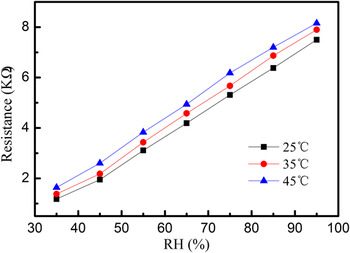
To determine the effect of temperature on resistances of tr-MWCNT/HEC composite film, the humidity experiments of tr-MWCNT/HEC composite film were measured at different temperatures (25, 35, and 45 °C, respectively), as shown in Fig. 9. It can be seen that the resistance–RH curves of the composite are all linear at different temperatures; in addition, as seen in Fig. 9, temperature has an effect on the humidity performance of tr-MWCNT/HEC composite, so temperature compensation is necessary when this film is used as a humidity sensor in practical use.
Humidity sensing characteristic of tr-MWCNT/HEC composite film at different temperatures.

G. Hysteresis of tr-MWCNT/HEC composite film
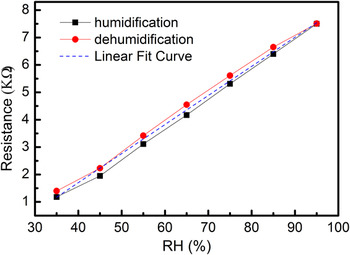
The noncoincidence between the loading and unloading curves is known as hysteresis. Hysteresis is one of the most important elements to measure the quality of humidity sensor. For a perfect sensor device, its loading and unloading curves normally follow the same or similar path. Figure 10 depicts the hysteresis curve of the tr-MWCNT/HEC composite film, it can be seen that the maximum humidity hysteresis of tr-MWCNT/HEC composite film occurs at 65% RH, and the hysteresis (H) can be calculated by this formula: H = ∆R max/L, ∆R max is the maximum resistance difference at certain RH; L is the resistance change per RH, which is obtained by linear fitting of resistance data of humidification and dehumidification. It was found that the maximum humidity hysteresis H of tr-MWCNT/HEC composite film is 3.58% RH, which indicates the small hysteresis.
Hysteresis curve of tr-MWCNT/HEC composite film.

H. Stability of tr-MWCNT/HEC composite film
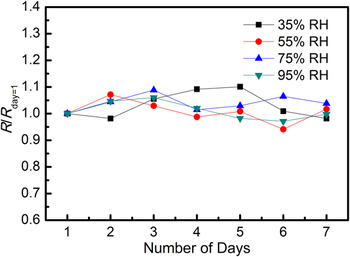
Stability is an important character for humidity sensors. Good stability is needed, so that the humidity experiments can be conducted meaningfully. The resistance of tr-MWCNT/HEC composite film was monitored at different RH levels (35, 55, 75, and 95% RH) for 7 days. The stability test was performed on the same film and the results are shown in Fig. 11. Through calculation, the standard deviations at different RH levels were 0.0512 kΩ (35% RH), 0.088 kΩ (55% RH), 0.093 kΩ (75% RH), and 0.135 kΩ (95% RH), respectively. It can be seen that slight variation in resistance at each RH level is observed over time, indicating the good stability of tr-MWCNT/HEC composite film.
Long-term stability of tr-MWCNT/HEC composite film.

I. Speaking and blowing sensing
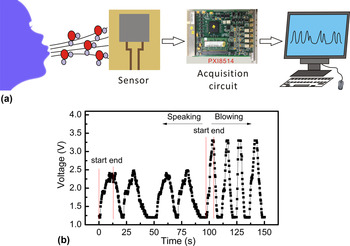
Highly sensitive humidity sensors may enable novel applications, such as in breath monitoring or in the development of new user interfaces. Owing to the higher humidity sensitivity of tr-MWCNT/HEC composite film in comparison with other materials, tr-MWCNT/HEC composite can feel the small humidity variation and react to it, making it available to apply in some special occasions where the humidity level changes a little. Figure 12(a) shows the schematic diagram of speaking and blowing tests. To detect the practical humidity sensibility of tr-MWCNT/HEC film expediently, an acquisition circuit was applied to the experiments (the circuit is not given in this study). The ability of the tr-MWCNT/HEC film in monitoring both speaking and blowing is shown in Fig. 12(b). The distance between our mouth and the sensor is 5 cm. As visible in Fig. 12(b), the tr-MWCNT/HEC film is sensitive to both speaking and blowing; furthermore, it can also distinguish the small humidity difference between speaking and blowing reflecting in the different voltage amplitudes (the humidity level of speaking is smaller than blowing, and the corresponding voltage amplitude of speaking is observed to be smaller than blowing in Fig. 12(b), which is in accordance with the general phenomenon). Moreover, it is seen that tr-MWCNT/HEC film is capable to capture the beginning time and ending time of our speaking and blowing, and the repeated experiments also prove the fine repeatability of this film.
(a) Schematic diagram of speaking and blowing tests. (b) Speaking and blowing experiments of tr-MWCNT/HEC composite film.

To verify that the sensor responses of speaking and blowing are mainly caused by humidity change rather than temperature and airflow pressure changes associated with speaking and blowing, temperature and airflow pressure experiments were tested. Figure 13 displays the resistance responses versus temperature, airflow pressure, and speaking. Here, the temperature changes from 22 to 23 °C, which is in accordance with the temperature change in speaking and blowing test. From Fig. 13, it can be seen that the resistance changes slightly when the temperature changes from 22 to 23 °C and the same to airflow pressure. The resistance changes caused by temperature and airflow pressure are much smaller than that by humidity; thus, it demonstrates that the sensor responses of speaking and blowing are mainly caused by humidity change rather than temperature and airflow pressure changes.
Resistance responses of tr-MWCNT/HEC composite film versus temperature, airflow pressure, and speaking. (Temperature changes from 22 to 23 °C.)

IV. CONCLUSION
In summary, tr-MWCNT/HEC composite films were deposited on interdigital electrodes for humidity sensing. The acid treatment promotes the dispersion of tr-MWCNTs in distilled water and makes it more hydrophilic. The tr-MWCNT/HEC composite film shows linear dependence of resistance on RH, and the resistance of tr-MWCNT/HEC film increases with increasing RH. Compared with tr-MWCNT/SR composite film, the humidity sensitivity of tr-MWCNT/HEC film is much higher with the same film thickness, showing its superior humidity sensing property. The response time and recovery time of tr-MWCNT/HEC film are 72 and 38 s, respectively, and it was pointed out that the actual response and recovery time should be shorter. Speaking and blowing sensing experiments demonstrate that tr-MWCNT/HEC film is sensitive to both speaking and blowing; furthermore, it can distinguish the small humidity difference between speaking and blowing. In addition, good stability and repeatability of tr-MWCNT/HEC composite film are also observed. Thereby, such tr-MWCNT/HEC composite film has potential applications as humidity sensor.
ACKNOWLEDGMENT
This research was supported by the National Science Foundation of China (Nos. 61471155 and 61401141).