Introduction
Citrus Linnaeus (Rutaceae) is one of the most important productive fruit crops in Iran; 4.2% of the area of citrus cultivation in Asia occurs in Iran; and among the citrus producers of the world, Iran ranks eighth (Food and Agriculture Organization of the United Nations 2014). Phyllocnistis citrella Stainton (Lepidoptera: Gracillariidae) is a major pest of citrus. The larvae mine the leaves and surface tissues of young shoots and stems, although the pest populations that are built up are greater on the new flush (Heppner Reference Heppner1995; Beattie and Hardy Reference Beattie and Hardy2004; Cardwell et al. Reference Cardwell, Godfrey, Headrick, Mank and Peña2008). In addition, these larvae have been linked to the occurrence of the citrus canker (Xanthomonas axonopodis (Hasse); Xanthomonadaceae), which is a serious disease of Citrus (Chagas et al. Reference Chagas, Parra, Namekata, Hartung and Yamamoto2001).
Phyllocnistis citrella was originally described in Calcutta, India (Stainton Reference Stainton1856). This pest was included in the list of important pests of agricultural crops and the products of Iran by Farahbakhsh in the first report (Farahbakhsh Reference Farahbakhsh1961). Under favourable summer and autumn conditions in Iran, this pest can have 7–8 generations within one year; and under laboratory conditions, a generation is completed in 19 and 16.5 days at 25 °C and 30 °C, respectively (Jafari et al. Reference Jafari, Mafi, Ebrahimi, Gerami, Ramezani, Peyravi and Kianoush2000). In laboratory studies, the developmental times of the egg and the larval, prepupal, and pupal stages of this pest on Citrus sinensis (Linnaeus) Osbeck cultivar Valencia were 3.6, 8.9, and 7.5 days, respectively, under 25 °C and 70% relative humidity conditions (Namvar and Safaralizade Reference Namvar and Safaralizade2008).
The host plant plays an important role in the damage and sensitivity of the plant, affecting the length of life cycle and the number of different biological stages as well as pest behaviour. Seraj (Reference Seraj1999) compared some citrus species as hosts of P. citrella under field conditions. He concluded that Citrus aurantifolia (Christmann) Swingle, Citrus sinensis cultivar Valencian, Citrus sinensis cultivar Siavarz, and Kinnow (a hybrid of Citrus nobilis Loureiro and Citrus deliciosa Tenore) are more susceptible to attack than Citrus paradisi Macfadyen, which had one-tenth the level of infested leaves compared to the other host species (Seraj Reference Seraj1999). Goane et al. (Reference Goane, Valladares and Willink2008) found no difference in oviposition preference and offspring performance (including parasitism and predation rates) of P. citrella on lemon (Citrus limon (Linnaeus) Osbeck), orange (Citrus sinensis), and grapefruit (Citrus paradisi) in laboratory and field conditions. Moreover, fewer P. citrella mines were observed in mandarin (C. reticulata Blanco cultivar Clementine) compared to lemon (C. limon cultivar Eureka) and orange (C. sinensis cultivar Navelina) trees (Kalaitzaki et al. Reference Kalaitzaki, Tsagkarakis and Lykouressis2011; Tsagkarakis et al. Reference Tsagkarakis, Kalaitzaki and Lykouressis2013). In addition to host preference studies, some studies have been carried out on the population fluctuation of this pest at different times. Biparva et al. (Reference Biparva, Haghani and Ostovan2013) studied these fluctuations in two (Poncirus trifoliata (Linnaeus) Rafinesque) (Rutaceae) orchards. The maximum population was recorded in November when the temperature was between 21 °C and 27 °C and the relative humidity was between 34.5% and 44.5%. In a study on the population dynamics and P. citrella infestation on some citrus hosts, it was shown that Navel orange (Citrus × sinensis) and lime (Citrus aurantifolia) were more susceptible than mandarin (Citrus reticulata Blanco). It was also found that abiotic factors such as temperature, humidity, and direction of trees could affect the population fluctuations of P. citrella (Abdel-Rhman Reference Abdel-Rhman2009). In another recent study, El-Afify et al. (Reference El-Afify, Shreef, Ghanim and Hendawy2018) investigated the seasonal activity of P. citrella on Navel orange trees and the effects of certain weather factors on its population. Their results showed that changes in this pest population were significantly correlated with temperature.
During recent years many insecticides have been continuously applied to control P. citrella at short-term intervals, which has resulted in the development of insecticide resistance, loss of natural enemies, and subsequent increases in outbreaks of this pest in Iran. Therefore, we undertook research to optimise the mass production of P. citrella for use in control programmes using sterile insect technique. In our previous studies, first, the life history of this pest on C. sinensis as a citrus host was investigated under different constant temperatures, and the results indicated an optimal temperature of 27 °C (Atapour and Osouli Reference Atapour and Osouli2017). In the next step, C. sinensis was used for the mass-rearing of P. citrella at 27 °C to investigate the effects of gamma radiation on the life history and mating competitiveness of this pest (Osouli and Atapour Reference Osouli and Atapour2018). A comparison of the results of our previous studies and that of others, such as Seraj (Reference Seraj1999, Reference Seraj2013), Goane et al. (Reference Goane, Valladares and Willink2008), and Kalaitzaki et al. (Reference Kalaitzaki, Tsagkarakis and Lykouressis2011) who have studied the life history of this pest on other citrus hosts, led to the question of whether different hosts would affect the biological aspects of the pest and the possibility to introduce a more suitable host for the mass production of this pest. Thus, the current study aimed to investigate the infestation rate as well as some biological parameters such as the duration and survival of the eggs, larval, and pupal stages; longevity of adults; and the sex ratio in certain commercial citrus hosts that are more readily available in our country, namely Valencia orange (Citrus sinensis cultivar Valencia), trifoliate orange (Poncirus trifoliata), grapefruit (C. paradisi), and sweet lemon (C. aurantifolia Swingle cultivar sweet lime). In addition, the oviposition site preference of moths in different parts of the leaf and various leaves of different sizes was investigated in these citrus hosts.
Materials and methods
Citrus plants
During the experiments, four different citrus seedlings were obtained from Dashte-Naz nurseries in Mazandaran province (36.6°N, 52.1°E; 16 m). These included C. sinensis cultivar Valencia, P. trifoliata, C. paradisi, and C. aurantifolia, which were about 50 cm tall, planted in a 1:1 mixture of potting soil and vermiculite in plastic pots (15 cm in diameter), and kept in a greenhouse (28 ± 3 °C, 80 ± 10% relative humidity). Plants were generally irrigated two times a week and fertilised two times a month with 10 mL/L solution of a citrus fertiliser (NPK fertiliser, 9-2-6 with micronutrients; Pokon, Veenendaal, The Netherlands).
Insects
Young shoots with newly emerged leaves infested with P. citrella were obtained from the Dashte-Naz nurseries to supplement the insect colony. After the formation of pupal cells at the leaf edge, the pupae were separated from the infested leaves with a soft brush and then put into cylindrical opaque plastic containers (5 cm length × 3 cm diameter), which contained moist cotton. After emergence, the moths were introduced to seedlings, and after two generations, the pests that reared on different hosts were used in the experiments. These seedlings were kept in a growth chamber at 28 ± 2 °C, 70 ± 10% relative humidity, and a photoperiod of 14 hours. Voucher specimens of P. citrella from this study were deposited in the insect collection of the Department of Entomology, Tarbiat Modares University, Tehran, Iran.
Infestation rate of plant hosts
Four large cages (95 × 70 × 105 cm) were used to evaluate the effect of the four citrus hosts on infestation rate. Each cage was divided into four sections by tulle walls, each containing six pots, which were considered as replicates. Therefore, there were 24 pots in four replications in each cage. Cotton wool moistened with honey solution (10%) was placed at the corners of these cages to provide food for moths. All the cages were kept at 27 ± 5 °C, 70 ± 10% relative humidity, and a photoperiod of 14 hours in a climatic room. A data logger (TES 1384; data logger 4 Input Thermometer, Taipei, Taiwan) was used to monitor the temperature. Then, 200 moths (with a male–female ratio of 1:1) were released inside each cage (50 moths in each section of a cage). The last abdominal segment, which was longer and bore two long setae in the female pupae, was used for sex determination as described by Jacas and Garrido (Reference Jacas and Garrido1996). The total number of pupae in each cage, number of infested leaves in each pot, number of pupae in each of the infected leaves, and the weight of the male and female pupae were investigated in each citrus host after about three weeks. To weigh the pupae, due to the small size of the specimens, a four-decimal-place balance (0.0001 g) was used (GR-200; A&D Company, Tokyo, Japan).
Oviposition site preference
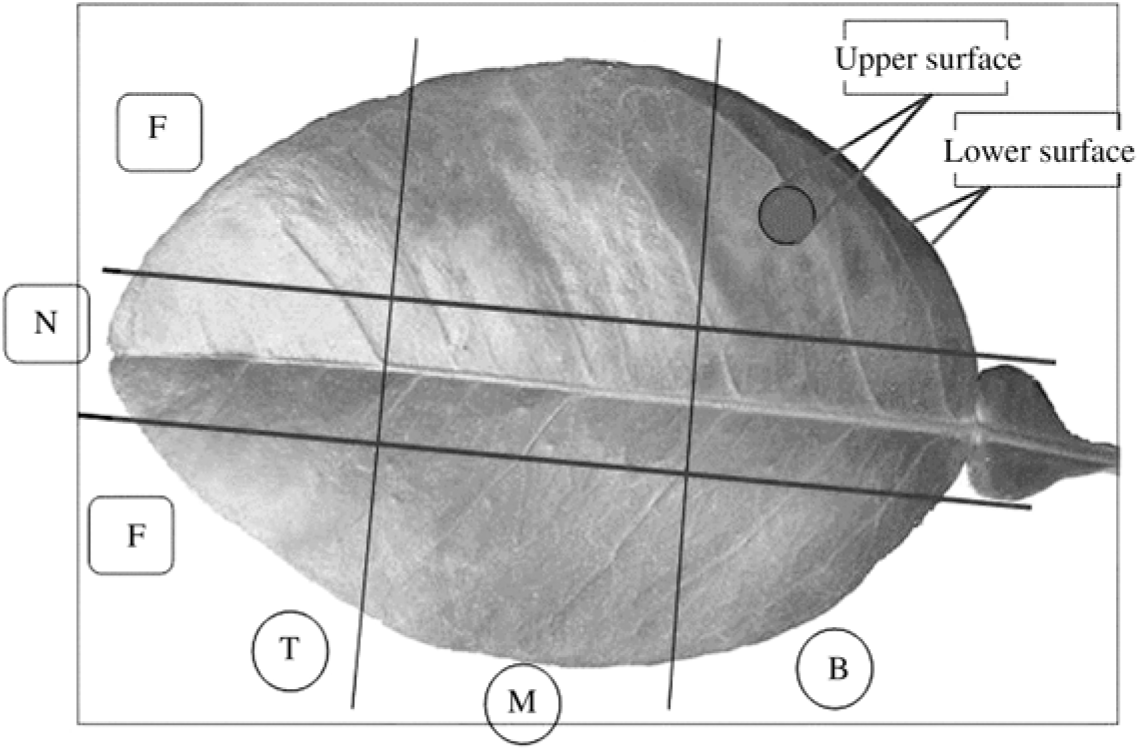
To investigate the oviposition site preference of females on the leaves, 100 infested leaves containing the eggs of the pest were studied for each citrus host. Different areas of each citrus leaf were chosen according to the method described by Chagas and Parra (Reference Chagas and Parra2000) (Fig. 1) as follows: upper or lower surface of the leaf; near (N) the midrib or far from it (F); and tip (T), middle (M), or base (B) of the leaf. In addition, to detect the relationship between “leaf size” and oviposition preference, the infested leaves of each host plant were grouped into four sizes: leaves with a blade width of < 1, 1–2, 2–3, or > 3 cm.
Different areas of a citrus leaf chosen to detect the oviposition site preference of Phyllocnistis citrella: upper or lower surface, near (N) or far from (F) the midrib, and tip (T), middle (M), or base (B) of a leaf.

Biological experiments
For each citrus host, 100 leaves containing one egg were transferred individually into Petri dishes kept in an incubator at 27 ± 1 °C, 70 ± 10% relative humidity, and a photoperiod of 14 hours. The duration and mortality of different developmental stages were recorded. The absence of a new mine, pupal chamber, or moth emergence was considered as indicators of egg, larval, or pupal mortality, respectively. The sex ratio of the pupae was determined before adult emergence, after which the mortality and longevity of female and male moths were recorded.
To determine the daily number of eggs laid, one pair of female and male moths was introduced to a seedling covered with a small tulle cage. Cotton wool moistened with honey solution (10%) was placed in each cage as a source of food. The laid eggs were counted daily for five days. Fifty couples were tested per plant host evaluated. Each pair of P. citrella couple was considered as a replicate.
Statistical analysis
The data obtained from daily observation was used to construct life tables according to Sokal and Rohlf (Reference Sokal and Rohlf1981). Statistical analyses were performed using the SPSS (version 16.0; IBM Company, Armonk, New York, United States of America) software. All the data were expressed as mean ± standard error. The differences among the treatments were determined using the one-way analysis of variance, followed by Tukey’s test for multiple comparisons at P < 0.05.
The distribution of eggs on leaves of different sizes was measured in a split-plot design based on randomised complete blocks, with five replications for every leaf size and four citrus hosts for every replicate. The citrus hosts were arranged in the main plots and different leaf sizes were arranged in subplots. In this test, all means were separated by the Fisher least significant difference test, and statistical analysis and mean comparisons were carried out using the MSTAT-C software (Michigan State University, East Lansing, Michigan, United States of America).
Results
Infestation rate of plant hosts
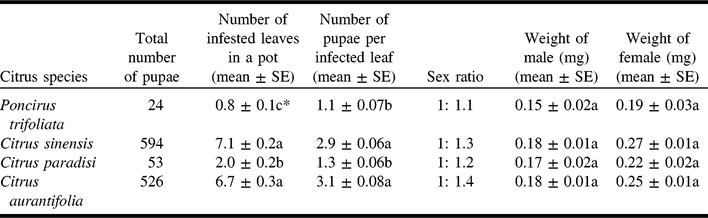
The total number of pupae in the pots was lower in P. trifoliata and C. paradisi (24 and 53 pupae, respectively) compared with C. sinensis and C. aurantifolia (594 and 526 pupae, respectively; Table 1). The number of infested leaves in each pot was significantly different (F 3,12 = 222.07; P < 0.001): from about seven infested leaves in C. sinensis and C. aurantifolia to 1–2 leaves in P. trifoliata and C. paradisi. The number of pupae in each infested leaf was significantly different as well (F 3,12 = 145.6; P < 0.001); there were about three pupae per leaf for C. sinensis and C. aurantifolia, whereas only one pupa was observed on the leaf of P. trifoliata or C. paradisi.
Effect of different citrus hosts on the total number of pupae, number of infested leaves in each pot, number of pupae in each infected leaf, sex ratio, and the weight of male and female pupae of Phyllocnistis citrella.

* Means followed by the same letter in each column are not significantly different using Tukey’s test at P < 0.05.
Although there was no significant difference between the weight of the male and female pupae on different hosts, the weight of the male pupae (0.15–0.18 mg) was lower than that of the female pupae (0.19–0.27 mg) (Table 1).
Oviposition site preference
The oviposition site preference of female P. citrella is shown in Table 2. Among the different citrus hosts, these moths preferred laying eggs on the lower surface of the leaves (73–84%), near the midrib (60–86%), and on the base of the leaves (41–48%). In P. trifoliata, the percentage of laid eggs was significantly higher on the lower surface (F 3,16 = 7.69; P < 0.05) and areas around the midrib (F 3,16 = 14.05; P < 0.01) compared with other hosts.
Oviposition site preference (%) of Phyllocnistis citrella on the upper or lower surface of a leaf, near the midrib or far from it, and the tip, middle, or base of a leaf of different citrus hosts.

*Means followed by the same letter in each column are not significantly different using Tukey’s test at P < 0.05.
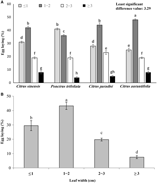
The analysis of data obtained from the eggs laid on four sizes of leaves on different hosts indicated a significant difference (P < 0.05) in the number of eggs among different hosts (Fig. 2A). Figure 2B illustrates how the eggs were significantly (P < 0.05) affected by the different sizes of the leaves completely. According to these figures, most of the eggs were laid on the leaves with a width of 1–2 cm in all of the hosts, except P. trifoliata, and the least number of eggs was observed on the leaves with a width > 3 cm.
A, Distribution of eggs laid by Phyllocnistis citrella female moths on the leaves of four host plant species, chosen in dimensional classes (leaf blade width ≤ 1, 1–2, 2–3, and ≥ 3 cm) in each host species and B, in total. Means designated by a common letter do not differ significantly (errordf = 48; least significant difference, P < 0.05).

Life history of Phyllocnistis citrella on different hosts
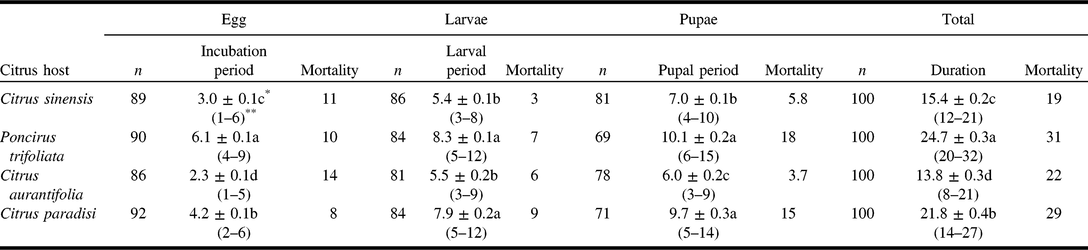
The developmental period and mortality of the immature stages of P. citrella in various hosts is shown in Table 3. In general, the total developmental period of the immature stages was shorter on C. aurantifolia (14 days) and C. sinensis (15 days) than on C. paradisi (22 days) and Poncirus trifoliata (25 days) (F 3,295 = 275.09; P < 0.001). The differences were found to be statistically significant in all the citrus hosts in the egg, larval, and pupal stages (Table 3). The lowest and highest mortality during the incubation period were recorded in C. paradisi (8%) and C. aurantifolia (14%), respectively. In the larval period, mortality rates increased from 3.4% in C. sinensis to 8.7% in C. paradisi. The greatest difference in mortality among the different hosts was observed in the pupal stage. Pupal mortality was relatively low in C. aurantifolia and C. sinensis (4–6%). It increased by about threefold to 15–18% in C. paradisi and P. trifoliata. The highest total rate of mortality during the immature stages was observed in C. paradisi and P. trifoliata as well (29–31%).
Developmental time (days) of immature stages (mean ± SE) and mortality (%) of Phyllocnistis citrella in different citrus hosts.

*Means followed by the same letter in each column are not significantly different using Tukey’s test at P < 0.05. **Values in parentheses are minimum and maximum values.
Both female and male moths showed the highest emergence in C. sinensis (86% and 90%, respectively). The lowest emergence rate (62%) was observed in C. paradisi and P. trifoliata for the female and male moths, respectively. However, the highest oviposition rate was observed in C. sinensis and C. aurantifolia, with an average about 51 and 48 eggs per female. Changes in the longevity of moths in different hosts were significantly altered. The longevity of females and males increased from about four days in the grapefruit to about 6.5 days in C. sinensis (Table 4).
Number of laid eggs per female (mean ± SE), percentage of emergence and longevity (mean of days ± SE) of Phyllocnistis citrella in different citrus hosts.

*Means followed by the same letter in each column are not significantly different using Tukey’s test at P < 0.05. **Values in parentheses are minimum and maximum values.
Discussion
Our results identified either C. sinensis or C. aurantifolia to be best suited for the mass production of Phyllocnistis citrella. The pest laid more eggs and attained faster development on these species versus C. paradisi and Poncirus trifoliata. Therefore, C. paradisi and P. trifoliata cannot be recommended as a host in the mass-rearing of the pest. Instead, these plant species may be better suited for breeding programmes to develop more resistant cultivars, or for fruit production in areas heavily infested by Phyllocnistis citrella.
There are few detailed studies on the effect of plant host on the infestation rate or life history of this pest. In a previous study on the resistance of certain commercial citrus cultivars to P. citrella in Pakistan, cultivars such as Kinnow showed a resistant response, whereas C. limetta Risso, C. meyeri Tanaka, C. paradisi, and “sweet lemon” (scientific name unknown) showed susceptible responses (Mustafa et al. Reference Mustafa, Imran, Khan, Azeem, Riaz and Afzal2013). In another study (Santos et al. Reference Santos, Vendramin, Lourencao, Pitta and Martins2011), six genotypes of different citrus plants were evaluated to determine the resistance level. Among the different genotypes, the pupae obtained in hybrid C × R4 (C. sunki horticultural usage ex Tanaka × P. trifoliata) were significantly smaller and the lowest value of corrected reproductive potential was recorded in hybrid C × R315 (C. sunki × P. trifoliata), suggesting that these genotypes are the least favourable for the development and reproduction of P. citrella, although there was no significant difference in the developmental periods of immature stages between the various citrus genotypes. Furthermore, the abundance of P. citrella larvae in the progeny of 87 seed parent genotypes of Citrus and Citrus relatives (in Rutaceae) was investigated by Richardson et al. (Reference Richardson, Westbrook, Hall, Stover and Duan2011), who observed that the progeny of 15 parent genotypes had a higher mean abundance (more than six larvae per newly flushed shoot). In a recent study, the number of different developmental stages and the duration of larval and pupal stages of P. citrella were evaluated on six citrus species: C. aurantifolia, C. limetta Risso, C. aurantium Linnaeus, C. sinensis, C. paradisi, and C. reticulata Blanco during two samplings of citrus orchards. The results showed that C. sinensis was the most sensitive host, while C. paradisi and C. limetta were less damaged (Karam Kiani et al. Reference Karam Kiani, Seraj, Habibpour and Ziaee2018).
Kharrat and Jerraya (Reference Kharrat and Jerraya2005) released 40, 80, and 160 pairs of moths on 25–30 saplings of P. trifoliata (20–40 cm tall) as citrus hosts in three cages (1.5 × 1 × 1.5 m) for the mass production of Phyllocnistis citrella. They determined a higher mortality rate for young larvae with an increase in moth density, although the number of eggs deposited by each female did not significantly change in different densities of moths (56–61 eggs per female). According to the observation of larval mortality even in lower moth populations, it seemed that the high mortality of larvae observed in this study could be a result of an inappropriate host.
In the present study, in addition to the detection of pest infestation, biological studies on P. citrella in four citrus hosts were performed. Some previous studies were carried out on the life history of this pest, especially on C. sinensis as a host. In the laboratory studies of Namvar and Safaralizade (Reference Namvar and Safaralizade2008) on the life history of P. citrella under 25 °C, with C. sinensis saplings, the average period of the egg, larval, and pupal stages were reported to be 3.65, 8.95, and 7.5 days, respectively. So, the total immature stages lasted for 20.1 days. Elekcioglu and Uygun (Reference Elekcioglu and Uygun2004) studied the life history of P. citrella in Turkey at 15 °C, 20 °C, 25 °C, 30 °C, and 35 °C on C. aurantium as a host. Incubation, larval, and pupal periods; longevity of moths; fecundity of females; and mortality at 25 °C and 30 °C in this study were similar to those of the present study. Therefore, it seems that C. aurantium, which was used as a host in this study, could be as susceptible as C. sinensis.
Previous studies have mass-reared P. citrella on C. paradisi or Poncirus trifoliata, which produced large flushes of leaves after pruning (Smith and Hoy Reference Smith and Hoy1995; Kharrat and Jerraya Reference Kharrat and Jerraya2005). In spite of the ability to produce high fresh flush, the results of the current study showed that these two hosts are not suitable for mass-rearing due to an increase in the total developmental period, high mortality, low fecundity, and low moth emergence. Using other susceptible hosts such as C. aurantifolia or C. sinensis will provide better results. Our results showed that the egg-to-adult development takes about three weeks on C. aurantifolia or C. sinensis, allowing to up to 16 generations per year with an average of about 50 eggs per female. Therefore, it can be expected to produce a large number of pests under these conditions in a year.
Although the distribution of eggs on P. trifoliata leaves was somewhat different in comparison with the other hosts, moths generally preferred to lay eggs on the leaves with a width of 1–2 cm. Herbivorous insects prefer young leaves due to their nutrients and thin cuticles (Eber Reference Eber2004). It seems that laying of eggs and use of such leaves allowed Phyllocnistis citrella to pass the defence mechanisms of older leaves with larger size (Ayabe et al. Reference Ayabe, Minoura and Hijii2015). It should be noted that the selection of an oviposition site by females is very important because the larvae are destined to feed on the selected plant species, so females usually lay eggs on the best available host plant. Semiochemicals and some apparent properties have a main role in host selection and acceptance (Scheirs et al. Reference Scheirs, De Bruyn and Verhagen2003; Ajayi et al. Reference Ajayi, Balusu, Morawo, Zebelo and Fadamiro2015). Dennis et al. (Reference Dennis, Doak and Wagner2015) showed that female moths of Phyllocnistis populiella Chambers preferred to oviposit on the leaves of Populus tremuloides Michaux (Salicaceae) without extrafloral nectaries. For some plant species, trichome density can reduce herbivory (refer to Dalin et al. Reference Dalin, Ågren, Björkman, Huttunen, Kärkkäinen and Schaller2008). For example, Agrawal (Reference Agrawal2004) showed that the damage of leaf chewers and leaf miners was reduced by an increased density of leaf trichomes on Asclepias syriaca Linnaeus (Apocynaceae). However, this is not always the case. Hall et al. (Reference Hall, Ammar, Bowman and Stover2018) investigated the relation between the density and structure of trichomes of young flush leaves and stems of six citrus hosts with different degrees of resistance to Diaphorina citri Kuwayama (Hemiptera: Liviidae). Based on the results, they concluded that trichomes might play little or no role in the infestation of this pest on different citrus hosts. In addition to trichomes, it has been shown that some epidermal features, such as stomata, mega stomata, and special sheath cells, are different among the leaves of various citrus species (Inyama et al. Reference Inyama, Osuoha, Mbagwu and Duru2015). Although, during the current study, young citrus seedlings with fresh leaves were used in all plant hosts, the ability to produce newly flushed shoot also seemed to be an important factor in host preference in this pest (Patil Reference Patil2015). So it seems that further studies are necessary in order to confirm the reasons for choosing and preferring some hosts such as C. sinensis by P. citrella.
In the current study, the infestation rate, oviposition site preference, and some biological aspects of P. citrella on four citrus hosts were investigated, and the results showed that the use of C. sinensis or C. aurantifolia seedlings containing leaves with a width of < 2 cm could be recommended for the mass-rearing of the pest.
Conclusion
The results obtained from this study provide new useful information on the infestation rate and some biological aspects of P. citrella in four different citrus hosts. Because P. citrella cannot be reared on artificial diet, its mass production for use in pest management programmes (e.g., sterile insect technique) is expensive and time-consuming. Due to the low cost of planting citrus seeds, the use of susceptible hosts such as P. citrella or C. aurantifolia, in which the pest developmental periods are shorter, will reduce rearing costs and time. However, further studies are required to determine the optimum condition for the mass production of this pest on a wider range of citrus hosts.
Acknowledgements
The authors are grateful to Mr. Yousefnia from Dashte-Naz Company for collecting and transferring P. citrella and infested citrus leaves. This study was supported by the Iran National Science Foundation with grant number 92039201.