In January 1922, a monument to a Victorian ‘hero’ of empire, Brigadier-General John Nicholson (1822–57) was unveiled in Lisburn’s main square.Footnote 1 The raising of Nicholson onto his plinth bookended a turbulent decade for the town, particularly for its minority Catholic population. This article explores the changing fortunes of Lisburn’s nationalists during this period. It begins by examining their contribution to the war effort, before turning to the impact of the 1916 Easter Rising. The rising ‘kick-started a trend of growing Irish nationalist militancy that spread through the island’ and precipitated a slow process of realignment of the majority unionist population’s perception of their nationalist neighbours.Footnote 2 From 1916 on, and especially after the ‘khaki election’ of 1918, the motivations of local Catholics were questioned, and they were increasingly suspected of disloyalty.Footnote 3 In August 1920, following the assassination of RIC District Inspector Swanzy (1881–1920) in the heart of Lisburn, days of rioting and burning forced the Catholic population to flee.
This case study offers three main insights. It provides an account of Easter week 1916 from the perspective of a northern unionist town.Footnote 4 Second, the Lisburn burnings of August 1920 have become emblematic of the plight of northern Catholics during the revolutionary period, with the rioting and expulsion of the town’s Catholics cast as ‘sectarianism at its most blatant’ and part of a wider pogrom — or one-sided targeting of an ethnic minority — in the north.Footnote 5 Drawing on compensation claims, newspaper reports and comparative examples from across Europe, the case for the Lisburn Riots as a sectarian pogrom is closely examined.Footnote 6 Exploring the riot and its aftermath in detail also offers a view into the motivations and mechanics of a neglected aspect of the Irish Revolution: loyalist or unionist communal violence.Footnote 7 Throughout this paper, I use ‘unionist’ to describe those who believe/d in the maintenance of the union, and ‘loyalist’ to refer to a more narrowly defined group of typically working-class, unionist, ethnonational Protestants.
The analysis draws on the toolkit of the historical geographer, foregrounding boundary-making and the indivisible nature of territory as an approach to understanding violence in the revolutionary period.Footnote 8 I argue that the changing relationship between the town’s nationalist and unionist communities in the war and post-war period can only be understood by viewing Lisburn as a bounded and tightly regulated communal space subject to specific norms and mores of behaviour, speech, loyalty and guarantees of territorial security. Moving beyond sectarianism, the case is made that communal security is key to understanding episodic violence in the town.
I
The market town of Lisburn, County Antrim lies in the heart of the Lagan Valley on the border with County Down.Footnote 9 The railway connected the town to Belfast, eight miles away, yet Lisburn was physically and socially separated. It was a microcosm, whose prosperity was built on the linen industry, which flourished here from the early eighteenth century.Footnote 10 By 1900, its skyline was dominated by three great linen thread-works — Barbours’ at Hilden, the Island Mill and Stewarts’ — which offered employment to the 12,000 inhabitants. At the centre of the town was Market Square, framed by the lofty clocktower of the Assembly Rooms and towering spire of Lisburn Cathedral. On the western side of the square was Bow Street, where the majority of the town’s commercial premises stood. It ran for half a mile west to Chapel Hill, up towards the town’s Catholic Church, St Patrick’s. Lisburn was a Protestant and unionist town. Of the 110 streets within the Lisburn Urban District Council (LUDC) area, only eighteen had more Catholics than Protestants.Footnote 11 Yet there were low levels of residential segregation, certainly in comparison to Belfast.Footnote 12 The 25 per cent minority Catholic community lived among their Protestant neighbours, and the only cluster of majority Catholic streets (50 per cent +) was in Barrack Street/Barrack Yard, south of Bow Street and the Low Road area of the town, half a mile east of Market Square. However, political tensions were easily roused: gatherings of nationalists to play hurling on Sundays at the isolated Blaris pitch, outside the town, were a frequent cause of rioting in the early twentieth century.Footnote 13 The home rule crisis had precipitated the raising of a regiment of the Ulster Volunteer Force (UVF) in 1913. And, one year later, this exclusively unionist and protestant paramilitary force, of around 900 men drilled nightly in the town with rifles, machine guns and armoured vehicles. These actions attracted little public comment from Lisburn’s nationalist and Catholic community until the eve of the First World War, in August 1914, when the minority made their political leanings clear by raising their own troop of Irish Volunteers (IVF). The nationalist paramilitary force had been formed in November 1913 as a reaction, in part, to the UVF.Footnote 14 As support for the IVF swelled, between May and September over 90,000 men joined up, expanding the ranks to 140,000.Footnote 15 This enthusiasm was matched in Lisburn, and on 26 August 1914, 600 men were reportedly in attendance at St Joseph’s parochial hall, attached to St Patrick’s Church, Chapel Hill, to inaugurate the first meeting of Lisburn’s Volunteer company.Footnote 16 The town had a Catholic Club and a branch of the Ancient Order of Hibernians (AOH) before the war, but this was the first overt mass gathering of local nationalists.Footnote 17 The meeting was chaired by the parish priest (Rev. Mark McCashin) and his two curates (Rev. P. Hayes and Rev J. Murray), while a third curate (Rev. John Walsh) chaired the organisation: Walsh and Hayes were long-standing members of the Irish Parliamentary Party (IPP).Footnote 18 On the platform, the priests were accompanied by the politician and author Sir Samuel Keightley.Footnote 19 A former liberal unionist, Keightley’s appearance coincides with the loss of his seat on the Senate of Queen’s University in 1914 for espousing pro-home rule sentiments.Footnote 20 He was joined by several prominent local businessmen, including the publican Daniel Mooney, Chapel Hill, and Edward Donaghy JP, of Donaghy’s Boot Factory, as well as a local magistrate, Dr J. J. Clarke JP. Michael Lavery, a solicitor with a practice in Bow Street, acted as secretary.
Opening the proceedings, Hayes claimed that Lisburn had not figured ‘conspicuously in the cause of Ireland as a nation’, but ‘the necessities of the time called for a grand spontaneous birth’, and the men of the town were ‘ready and willing’ to play their part. Keightley added that ‘Ireland has called for a national army; the country has answered her call’ and tonight Lisburn offered her ‘quota’. Murray evoked the ‘proud’ spirit of Henry Munro, the Presbyterian United Irishman who was hanged from the gallows in Market Square for his part in the 1798 Rebellion, and put forward the Lisburn Volunteers to fight for Ireland and ‘her birthright’.Footnote 21
While Keightley and the local clergy rallied the meeting, for the brief life of Lisburn’s volunteers, day-to-day leadership came from Mooney, Donaghy and the Lavery brothers. The men, for example, were photographed in April 1915 alongside officers and members of the Belfast battalion of the INV, to whom they were closely linked, at the National Review in the Phoenix Park.Footnote 22 During the Swanzy Riots of August 1920, nearly all these men would be targeted: Edward Donaghy’s Boot Factory was burned to the ground, as was the Empire Hotel on Chapel Hill, owned by the Mooney and Lavery family. The parochial house, home of the parish priests, was also burned out and daubed with sectarian graffiti.
St Joseph’s Brass Band closed the inaugural Volunteer meeting in Lisburn. They also played in late October 1914 during the IPP leader John Redmond’s visit to the Falls Road to inspect the Irish National Volunteers. Of the 600 men who enrolled at the Lisburn meeting, and listened to the band, there is little sense of their backgrounds. Many more volunteers signed up than were active. In April 1915, for example, only eighty mustered for parade.Footnote 23
The first Lisburn conference took place a few weeks before Redmond’s famous speech at Woodenbridge, County Wicklow, in which he pledged the Volunteers’ support to the war effort and which split the movement. Footnote 24 The much larger Irish National Volunteers (NV), backing Redmond, were on one side, with the more radical, separatist Irish Volunteers (IV) on the other. The meeting also took place in the weeks preceding the granting of royal assent to home rule on 18 September 1914. As Niamh Gallagher has shown, the prospect that self-government for Ireland was ‘inevitable was part of a mindset that framed nationalist attitudes and behaviour towards the war’. The looming passage of the act appears to have given the Catholic minority the warrant and confidence to organise. The sudden surge in support for Redmond and his Volunteers in Lisburn was repeated across Ireland.Footnote 25 There was a general ‘enthusiasm’ for the war and a British victory. In the months that followed, the Lisburn NV did little to allay the idea that they, like Volunteers in nearby Belfast, were firm Redmonites.Footnote 26 The Branch Chairman Rev. John Walsh and local solicitor Michael Lavery joined a long list of companies across Ireland publicly pledging Lisburn’s ‘wholehearted’ support for Redmond.Footnote 27 St Patrick’s parish priest Rev. McCashin was also a close friend of the Irish IPP MP for West Belfast, and John’s Redmond’s ally, Joe Devlin.Footnote 28 In March 1915, at a gathering in Lisburn marking McCashin’s recovery from a short illness, Devlin was unequivocal in acknowledging the priest’s strong home rule sympathies: it was an ‘encouraging thought’ that McCashin would soon ‘witness the triumph of an ideal’ — an ‘Irish Parliament in College Green’.Footnote 29
By November 1914, the Lisburn NV had imported over twenty-five rifles into the town, and in the new year the men took part in drills with comrades from Belfast at Hannahstown, in the Belfast Hills.Footnote 30 At Easter 1915, at least eighty of Lisburn’s NV paraded from St Joseph’s Hall, down Chapel Hill, through Market Square and Railway Street to the train station on their way to the National Review at the Phoenix Park, Dublin.Footnote 31 This was unheard of, and the local RIC recorded their surprise that the National Volunteers ‘were allowed to parade in the Unionist town of Lisburn and march unmolested’, adding that ‘before the War such a parade would probably have provoked a riot’ and would not have got ‘to the end of the first street’.Footnote 32 Before heading off to war, the local UVF drilled and marched through the town to nearby Sprucefield almost nightly, but parades by nationalists were rare.Footnote 33 After another march in May, the RIC district inspector (DI) painted a clear picture of relations in the town: there was no ‘opposition or disobedience’, the ‘hatchet had been buried here during the war’.Footnote 34 Relations appear so cordial that in late May, members of the Lisburn NV, along with a recruiting party for the Connaught Rangers, were invited to join the departing 11th battalion Royal Irish Rifles (RIR) — almost exclusively Protestant and largely composed of local UVF men — in Castle Gardens, 300 metres east of Market Square, for a farewell party. In this ‘unexpected but delightful’ episode the Connaughts, along with leading men from the Lisburn NV and the wider Catholic community marched into the gardens, opposite the town hall, to ‘thunderous’ applause from the townspeople and enjoyed a garden party.Footnote 35 The unionist Lisburn Standard said that war had brought the two sides together, and the men now ‘stood united in one common cause’.Footnote 36 Gallagher has shown how united displays of support for the war effort were common across Ireland at this time.Footnote 37 Still, in Lisburn such unanimity was unheard of.
The Lisburn NV continued to import weapons and drill after the garden party but lost momentum as many of its members enlisted. Between August 1914 and the summer of 1915, at least eighty-nine men from the local NV joined the army. Of the 600 who reportedly joined in August 1914, only 340 were officially listed in April 1915.Footnote 38 Others lost interest altogether, and enthusiasm for volunteering wore off, a trend reported across Ireland.Footnote 39 James Gallagher, for example, was a local Catholic worker at Barbour’s thread works, Hilden, and his membership card — perhaps the only piece of material culture remaining from the Lisburn NVs’ brief existence — was only active up until summer 1915; he did not join the army.Footnote 40 By November, the local RIC DI recorded that the Lisburn NV were ‘quite inactive’.Footnote 41 A similar pattern of inactivity amongst provincial INV companies is recorded in County Down and elsewhere.Footnote 42
The early enthusiasm for enlistment among Lisburn’s Catholic community perhaps reflects a much longer tradition of service in British Army regiments, stretching as far back as the Napoleonic wars. Footnote 43 For example, when the First World War broke out, many were already serving in the army, notably in the 2nd RIR, a traditionally Catholic battalion.Footnote 44 Others, reservists who had served in the Second Boer War (1899–1902), or in India, were called up, while huge numbers swelled the ranks of Kitchener’s volunteers, notably in the Royal Irish Fusiliers and Royal Inniskilling Fusiliers. The Lisburn Standard’s 1915, 1916 and 1917 rolls of honour — lists of men serving in the army along with casualties for local churches — help contextualise Catholic service in the town.Footnote 45 Catholics comprised approximately 24 per cent of the LUDC and Lisburn Rural District Council (LRDC) population and 23 per cent of army volunteers from the town. Footnote 46 By 1917, they were 27 per cent of aggregate casualties. Footnote 47 Niamh Gallagher argues that broad nationalist backing for the war and the IPP continued well into 1918, with only Redmond’s death and the threat of conscription acting as a brake on support.Footnote 48 The commitment of Lisburn’s Catholics to the war effort is important to remember when we consider events in the town in the early 1920s.
Like other volunteer companies across the island, by late 1915 the Lisburn NV had run out of men and momentum and stopped meeting corporately and publicly.Footnote 49 There was no split or schism, and local Catholics continued to volunteer for war service. Similarly, the mercantile class who founded the Lisburn INV maintained individual public displays of support for the war or fulfilled war-time contracts. Edward Donaghy’s manufactory, for example, produced boots for the War Office.Footnote 50 The Lisburn NV simply faded out of view and lapsed ‘into insignificance’.Footnote 51 In Belfast, the decline was slower, although by late 1917, one newspaper was asking ‘when last did anyone see a National Volunteer in this land?’ In Belfast, conspicuous support for the IPP remained strong throughout the war.Footnote 52 Even after June 1916, when the party had split Ulster between east and west through the concession of the principle of partition — or the exclusion of six northeastern counties from a proposed home rule settlement — Belfast would still turn out for the party and in particular Joe Devlin MP.Footnote 53 Despite Sinn Féin’s rapid growth across the island, his popularity was sustained, electorally long into the 1920s in Belfast. Footnote 54
The disappearance from public view of the Redmonites in Lisburn was accompanied by the conspicuous rise of the advanced nationalists, or those republicans and separatists who regarded home rule as insufficient.Footnote 55 The local RIC’s attention and resources were increasingly drawn to their movements. The president of the Irish Republican Brotherhood (IRB), Denis McCullough, regularly visited the town, as did IV organiser Bulmer Hobson. For example, between November 1914 and November 1916, over thirty-two entries were recorded by the Lisburn RIC District Inspector Vere Gregory, as he tracked IV organiser and local man Ernest Blythe.Footnote 56 Robert Lynch has described these men as the ‘new radical leadership’ of Irish republicanism in Ulster in the war-time period, and they were at odds with the accommodationist nationalism of Devlin and his supporters.Footnote 57
Even though Lisburn’s Catholics were Redmonites and backed the war effort, by the time of the armistice in November 1918, the wider Catholic minority lived under a growing cloud of suspicion. The genesis of the shift lies, in part, with the Easter Rising of April 1916. It was the rising, its aftermath and the subsequent rise of Sinn Féin that undermined loyalist territorial security, eroding the consensus in Lisburn which had been forged in the collective unionist-nationalist commitment to the war.
II
Lisburn, and most of Ulster, was quiet during Easter week, 24–29 April 1916, as news from Dublin filtered through. The town’s unionist newspaper, the Lisburn Standard, moved quickly to condemn this ‘well organised’ but ultimately ‘very silly’ rebellion.Footnote 58 Throughout the week, various men from Lisburn, largely state forces, saw action on the streets of Dublin. This included Lieutenant T. J. Kennedy, brother of the editor of the Lisburn Standard, and his proximity to the rebellion perhaps warranted the paper’s close coverage of events.Footnote 59 Attention was drawn to the service of Sergeant Arthur McMaster, a mill worker from Barbour’s thread works, who was dispatched to the capital with men from the Royal Irish Rifles to ‘down the Rising’. Although badly wounded, he earned a military medal for rescuing a fellow soldier from the rebel’s heavy fire.Footnote 60 The case of rifleman John Leatham was also highlighted. He was a local UVF man serving with the 11th RIR, and he had been recuperating at home when ordered to Dublin to ‘help quash the Irish Rebellion’. Placed under the command of Captain John Colthurst Bowen-Colthurst, he was in the party that arrested the pacifist Francis Sheehy-Skeffington at Portobello Bridge.Footnote 61 Skeffington was later murdered by firing squad.Footnote 62 Many more men from the town served during Easter week.Footnote 63 RIC DI Vere Gregory led local men to Galway to control potential disturbances at Moyode Castle, while others went to Dublin, and evidence points to a party of RIR men returning to Lisburn with a captured tricolour.Footnote 64 Nettie Mitchell, a civilian from Ballylesson outside Lisburn, was caught up in the fighting. Having lost her husband and young son on the Lusitania in May 1915, less than a year later her midwifery course at the Rotunda Hospital, Dublin was interrupted by the fighting on Sackville Street. She was not the first observer to describe burnt-out Dublin as like ‘Ypres on the Liffey’.Footnote 65 Amid Easter week, the UVF (South Antrim Volunteers) offered its support to maintain order on the streets of Lisburn, but this was rejected by the RIC. There was, the county inspector reported, ‘an active spirit of loyalty’ in the town, and the people ‘abstained from giving any support to the rebels’.Footnote 66 The call for UVF boots on the street would be repeated in August 1920.
The town’s unionist credentials were publicly proclaimed during Easter week with the posting of a resolution ‘of loyalty’ from LUDC, read by its chairman Dr George St George. Indignant that the rebels should strike during the war — ‘when all that the British Empire stands for is at stake’ — the council rejected any ‘attempt to force upon the majority of Irishmen the delusions of an insignificant minority’.Footnote 67 This is not to say that the council supported the majority view in Ireland; they were firmly unionist.Footnote 68 In August 1917, in the midst of the Irish Convention (1917–18), former LUDC chairman Thomas Sinclair and long-time Ulster Unionist drew the ire of his fellow councillors by advocating for an all-Ireland government within the empire, in a widely-published letter.Footnote 69 A hastily convened emergency council meeting was called in which his ‘traitorous’ and ‘treacherous’ views were repudiated. One serving soldier suggested that the courage Sinclair had demonstrated in expressing his views in unionist Lisburn would be of ‘inestimable value in front of the Hun’.Footnote 70 The sympathetic Irish News chided the ‘bigots without brains’ in the council, who condemned Sinclair without really understanding his argument.Footnote 71 At the core of Sinclair’s letter was a rejection of the principle of partition, underpinned by a belief that war had brought a great ‘clarifying influence’, levelling economic and religious differences, and uniting nationalists and unionists.Footnote 72 Yet even his careful argument for ‘Colonial Home Rule’ was too much in post-rising Lisburn.
The writer, poet, agitator and probable IRB man Herbert Moore Pim was vice-chairman of the Belfast battalion of the Irish Volunteers and mustered at Coalisland on Easter Sunday, 1916. A Quaker, he was educated at the Friends’ school in Lisburn, likely around the same time as Bulmer Hobson, and the local RIC carefully monitored his movements in Lisburn.Footnote 73 At Coalisland, hundreds of Irish volunteers from all over Ulster were tasked with gathering and travelling to Connaught to take part in a rebellion in the west. The IRB leadership felt that there was little to be gained by actions in Ulster, particularly under the nose of the UVF. Poor leadership and indecision saw the volunteers at Coalisland stood down and sent home by Easter Sunday. Lynch has described the IVs’ Ulster campaign as ‘little short of farcical’.Footnote 74 At Coalisland, Pim and Denis McCullough led, and were joined by, William Shaw and brothers William and Edward Gilmore who were part of a very small but active group of grassroots Lisburn IV. Sons of an old Belfast Fenian, William and Edward had grown up on the Crumlin Road, Belfast and were heavily involved in the GAA, William being a former county secretary for Antrim. Plumbers by trade, the men had moved to Lisburn in 1912 to help their mother run her shop in Market Square.Footnote 75 Shaw, a labourer from County Armagh, lived with his wife and daughter in Barrack Street in the centre of the town. He had unsuccessfully stood for election to LUDC as an independent candidate in 1913.Footnote 76 It is not clear if these three men joined the 600 nationalists at St Joseph’s Hall in August 1914. Liam Gaynor, an IRB man and prominent member of the Belfast Irish Volunteers, recalled that in 1916, Edward ‘was full of a bottle of stout and a little more’ at Coalisland, in sharp contrast to his ‘superior’ brother William.Footnote 77
Before 1916, there was little evidence of grassroots, radical nationalist sentiment in Lisburn, except the reaction to the death of the old Fenian leader Jeremiah O’Donovan Rossa. At his funeral at Glasnevin — a huge propaganda coup for the IRB — a wreath was delivered from ‘a few friends and admirers of Lisburn, Co. Antrim, who honour the man, and believe in his principles’.Footnote 78 Across Ulster, IV companies were patchy and confined to areas with large Catholic populations, such as west Belfast or Derry city.Footnote 79 Yet by 1917 the Gilmore brothers ran a dispatch line between Lurgan and Lisburn on behalf of the IV and were described as the ‘strongest and most active’ volunteers.Footnote 80
III
In the period between Easter 1916 and the armistice of November 1918, the Irish political landscape was transformed, and a re-organised Sinn Féin was in the ascendancy.Footnote 81 The threat of conscription, the scuppering of home rule by the exclusion of Ulster, and the alienation of nationalists from Westminster — through claims that they supported a ‘German plot’, for example — reconfigured the relationship between Irish nationalism and the British state.Footnote 82 The general election of December 1918 was the first in almost a decade. In Lisburn, Omagh-born Kevin O’Shiel was chosen as the Sinn Féin candidate for South Antrim.Footnote 83 A nationalist had never stood, let alone won, in the constituency, and O’Shiel was running against the incumbent, Captain Charles Curtis Craig MP, a local war hero and brother of leading Ulster Unionist James Craig MP. O’Shiel later claimed that he ‘feared for his skin’ in this ‘orange stronghold’.Footnote 84 The Lisburn Standard proclaimed that South Antrim would have ‘no truck’ with the ‘Sinn Féin menace’.Footnote 85 William Gilmore, the ‘ardent Sinn Féiner’, and the ‘strongest and most active’ volunteer in the constituency, acted as O’Shiel’s guide and agent throughout the campaign. Support was thin on the ground. Although the priests of Aghagallon, a small rural parish twelve miles from Lisburn, signed O’Shiel’s nomination papers, he was thrown out of the parochial house in Antrim town, and he claimed that, across the constituency, ‘the vast mass of the Catholic Clergy’ were ‘strong Irish Party [I.P.P.] supporters and backers of Joe Devlin’.Footnote 86 In the election, O’Shiel was ‘thoroughly trounced’ by Craig, who took 85 per cent of the votes. Much to his surprise, the defeat of the ‘rebelly shinners’ was celebrated in a good-humoured parade through the town. O’Shiels recalled watching his burning effigy and that of the German kaiser, paraded around Market Square, marched down Bridge Street and tossed into the River Lagan. He later retired to a local pub with some ‘orange and green’ friends to be ‘waked’.Footnote 87
While it is clear there was limited support for Sinn Féin in South Antrim, the lack of a constitutional nationalist candidate disguises the level of local support for the IPP: in nearby Belfast, for example, the IPP’s Joe Devlin convincingly defeated Sinn Féin’s Éamon de Valera.Footnote 88 The large AOH hall on Linenhall Street in the centre of the town was perhaps the most visible evidence of the quiet but enduring presence of the IPP and constitutional nationalist voice in the town.Footnote 89 It had been opened by Joe Devlin MP in 1916 and was operated by Lisburn NV founder Dan Mooney.Footnote 90
Ernest Blythe recalled that during his frequent visits to his home town in 1917 and 1918, there was ‘no personal hostility’ as a ‘Sinn Féiner living amongst them’, yet ‘the whole situation changed’ after the declaration of the Dáil, and increasing violence in 1919. Any unionist tolerance of Sinn Féin had disappeared in Lisburn by that summer.Footnote 91 In August, a mob — incited by renditions of ‘rebels airs’ — attacked a party of Sinn Féiners at Lisburn as they returned from demonstrations in Dundalk. The men were dragged from their motor coaches and beaten by ‘Loyal and muscular’ Orangemen.Footnote 92 Evidence, also, points towards Catholic marginalisation from Peace Day celebrations on 16 August 1919.Footnote 93 One month later, the Lisburn RIC raided the homes of local Sinn Féin men, including the Gilmores’ shop in Market Square and those of William Connolly (Market Square) and Patrick Strong (Railway Street), for arms. Edward Gilmore was arrested and subsequently court-martialled under the Defence of the Realm Act (DORA) for possession of a handgun and ammunition.Footnote 94 The RIC in Lisburn were closely watching Gilmore and his network, particularly when they met well-known republicans.Footnote 95 William Gilmore registered as a candidate for the Lisburn UDC election in January 1920, but later withdrew. In the same year, William Shaw, the Coalisland veteran, was elected for Sinn Féin, shocking the Lisburn voters.Footnote 96 He topped the polls in the Central Ward alongside Thomas Sinclair, who had registered as a ‘Dominion Home Ruler’. Edward Donaghy, the prominent organiser of the Lisburn NV, stood for Joe Devlin’s Nationalist Party.Footnote 97 His return proved that IPP values were still alive in Lisburn, as did the parading of the Lisburn division of the AOH and the Belfast National Club, established by Joe Devlin, at the funeral of Rev. McCashin in early August 1920.Footnote 98 Yet, the momentum was behind Sinn Féin. The party put forward four candidates in the May 1920 elections to the board of guardians — Patrick Connor, James Strong, William Shaw and William Gilmore — although only Gilmore was elected, the others having withdrawn under ‘strong influence’.Footnote 99 Gilmore’s election alongside eight unionists was viewed as a ‘remarkable’ victory in the ‘stronghold of Carsonism’. Footnote 100 No IPP, or affiliated, candidates stood.
Throughout 1920, as the increasingly sectarian and violent War of Independence played out, community relations were fraught.Footnote 101 During serious rioting in Lisburn in July 1920, a large mob chanted ‘down with Sinn Féiners’ before attacking the Gilmores’ shop, the AOH hall and Catholic homes more widely.Footnote 102 This was in response to the IRA murder of Lt Col. Gerald Rice Smyth of the well-known Banbridge linen family, in Cork city earlier that month.Footnote 103 He was alleged to have advocated a ‘shoot now, ask questions later’ approach to Sinn Féiners when addressing members of the RIC at Listowel, County Kerry.Footnote 104 His large funeral in Banbridge brought the reality and violence of the IRA’s southern campaign home to many unionists and loyalists in east Ulster, heightening anxieties about the perceived threat from Sinn Féin and the volunteers.Footnote 105 In Lisburn, this appears to have transferred to suspicion of local Catholics more generally, despite O’Sheil’s 1918 claim that ‘a substantial section of the Catholic nationalist population were irritated with them and against’ Sinn Féin.Footnote 106
IV
On 22 August 1920, RIC District Inspector (DI) Oswald Swanzy was assassinated by the IRA as he walked from the direction of Christ Church parish church on Hillsborough Road — and not Christ Church Cathedral, as often claimed — towards his home on Railway Street.Footnote 107 Swanzy had been district inspector in Cork city when the lord mayor, Tomás MacCurtain, had been assassinated in his home on Thomas Davis Street in March 1920 by men with blackened faces, believed to be members of the RIC. The murder was revenge for the increased targeting of policemen in Cork. Eyewitness testimony placed men from King’s Street RIC barracks, under Swanzy’s command, in the vicinity of the murder, and the discovery of spent police cartridges and RIC buttons at the scene points to a constabulary rifle having fired the fatal bullet. The same body of men was also seen talking to a man fitting Swanzy’s description — 5’ 8”–5’ 10” in height with a ‘pale complexion, dark moustache’ and wearing ‘a dark overcoat with a velvet collar and soft hat’ — close to his apartments on Patrick’s Hill, shortly before the murder.Footnote 108 At the inquest, Swanzy gave an unconvincing performance, and evidence from his men was vague and evasive.Footnote 109 The force was found to keep poor records. Barrack diaries, for example, failed to record parties of policemen who streamed out of local stations to attack several Sinn Féin clubs in Cork following the attempted murder of DI MacDonagh on 10 March 1920. Swanzy, it was publicly known, had led one of the raiding parties.Footnote 110 After weeks of sensational testimony, the jury laid blame for the ‘wilful murder’ on
David Lloyd George, Prime Minister of England; Lord French, Lord Lieutenant of Ireland; Ian McPherson, late Chief Secretary of Ireland; Acting Inspector General Smith, of the Royal Irish Constabulary; Divisional Inspector Clayton of the Royal Irish Constabulary; District Inspector Swanzy and some unknown members of the Royal Irish Constabulary.Footnote 111
Within months, a number of those suspected of the killing had been murdered by the IRA in Cork, and by June 1920, Swanzy was transferred north to Lisburn for his safety. His appointment in the north was public, advertised in the Irish Times and Lisburn Standard. At least one of his constables from Cork followed him.Footnote 112 His respite was short-lived and his assassination on a Sunday afternoon, allegedly carried out with MacCurtain’s revolver, led to three days of rioting in Lisburn.Footnote 113 Swathes of Market Square, Bow Street and surrounding streets — the commercial heart of the town — were looted and burned. The AOH hall on Linenhall Street was razed to the ground, and the military was brought in from Belfast to protect St Patrick’s Church on Chapel Hill and the convent on Seymour Street. After two nights of violence, the riots reached a crescendo on Tuesday 24 August with further attacks on local homes and then looting and burning of the parochial house off Longstone Street. Rioters allegedly danced in priests’ vestments, and there was ‘Hunnish desecration’ of nearby graves, as the house was destroyed. Footnote 114 Several local Catholic families were forced to flee the town.Footnote 115 In response, 140 special constables were sworn in by LUDC on 30 August and tasked with patrolling and securing approaches to the town at night alongside the RIC. Eventually this force comprised over 800, some being former UVF men, while many more were young students.Footnote 116 Charles Allen was enrolled at university in Belfast and temporarily joined up but he was bored on duty once everything quietened down after ten days or so, and he ‘retired’ by 10 October, returning to his studies.Footnote 117 The establishment of the Lisburn Special Constabulary pre-dates the establishment of the Ulster Constabulary (USC) in October 1920 but mirrors the setting-up of civic vigilante forces across Ulster during this period.Footnote 118
The riots in Lisburn — who was targeted and why — can only be understood in the context of the post-rising period and the subsequent growth of Sinn Féin in the town.Footnote 119 The family home of the Gilmore brothers, for example, was the first house attacked by the mob. The rioters were, as Gaynor recounts, ‘going with a rope to hang’ the pair.Footnote 120 The initial wave of anger was broadly directed at the handful of Sinn Féin activists in Lisburn, notably the Connollys (cousins of the Gilmores), William Shaw (Sinn Féin), Patrick Strong (Sinn Féin), ‘sympathisers of the Sinn Féin assassins’ and then the town’s constitutional nationalists, in the form of the AOH hall on Linenhall Street, followed by the wider Catholic population.Footnote 121 The low attendance at DI Swanzy’s funeral in Lisburn on 24 August suggests that rioters were moved to violence by factors other than personal feelings for him.Footnote 122 Lawlor, whose work has offered the most thorough chronology of the riots, views the event of late August 1920 as part of an ‘indisputable’ pogrom to rid the town of Catholics.Footnote 123 This view reflects a widely-held perception — still persisting today — that there was a link between the rioters and political or civic leaders in Lisburn.Footnote 124 Telling, for Lawlor, is the ringing of the bell on Lisburn Cathedral to summon the UVF onto the street.Footnote 125 Yet, this was also the call for local firemen to muster, and Magill’s examination of the riots in Lisburn, and the rampages in nearby Dromore, Banbridge and Newtownards during the summer of 1920, has shown that breakouts of violence were ‘spontaneous and plebeian’. There is little evidence of a coordinated or organised campaign against the Catholic minority, particularly as Catholics comprised fewer than half the victims.Footnote 126 This follows the pattern across east Ulster and Belfast in which rioting was vicious but ‘ad hoc and unplanned’.Footnote 127
Violence in nearby Belfast provides a useful parallel to Lisburn. In the last week of August 1920, Belfast had twenty-five deaths. Across the city from 1920–22, there was, as Parkinson notes, disproportionate targeting of a single-identity group, violence of a sectarian nature and the stockpiling of weapons in anticipation of violence: all hallmarks of a pogrom. Yet, both Catholics and non-Catholics were affected by violence in this period.Footnote 128 And, of the Catholics impacted by the ‘Troubles’ this was only 1 per cent of the population, with most fatalities (80 per cent) among Catholic men drawn from those involved in rioting.Footnote 129 Again, there was no evidence of political leadership directing rioters en masse. Although many Catholics fled or were displaced in Belfast from 1920–22, a large number returned to their homes and jobs, and the net Catholic population of the city grew during this period.Footnote 130
In Lisburn, there are no accurate figures for the number of families burned out and displaced during the riots.Footnote 131 However, the 306 compensation claims lodged in the days after the burnings, with 337 individuals identified, provide a useful snapshot. Several households or businesses submitted a single claim covering damages for multiple people, and some who fled may not have had the opportunity to submit claims or did not feel safe enough to do so. Yet, the applications include the Gilmores, William Shaw and Peter McKeever (who was shot), and the claims appear to provide the most objective measure of the impact of the riots. Over 42 per cent of claims were for commercial premises, reflecting the unplanned nature of the violence, and 49 per cent of the victims were Catholics, which is disproportionally high in comparison to their share of the aggregate LUDC population.Footnote 132 Yet, it is not exclusive, and of those identified as claimants, at least 35 per cent were Protestant. If the Lisburn riots were a ‘true’ pogrom, then it, like Belfast, was ‘curiously disjointed and badly organised’.Footnote 133 The lack of Catholic fatalities is perhaps the strongest evidence against characterising the violence in Lisburn as a pogrom. Consider the protracted and deadly riots elsewhere in Europe during the post-war period: by comparison, over 500 died in the Belfast ‘pogroms’ (1920–22), 10,000 in Hungary (1918) and 100,000 were massacred in the anti-Jewish pogroms in Ukraine (1918–19).Footnote 134 These are very different types of events.
In the aftermath, the unionist politician and former UVF gun runner Fred Crawford toured the town, capturing the confusion:
It has been stated that there are only four or five R.C. [Roman Catholic] families left in Lisburn; others say that this is wrong, that there are far more. Be that as it may, there certainly are practically no shops or places of business left to the R.C.s Sinn Fein has been organised by the R.C.s and got their Chief Bishop’s blessing.Footnote 136
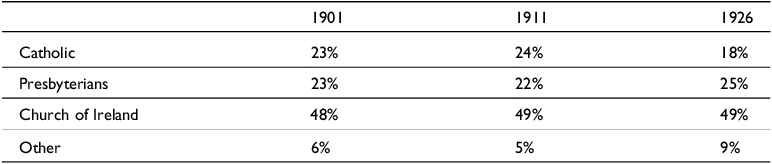
It is estimated that between 150–600 families, and over 1,000 individuals from a population of around 3,000 Catholics, were displaced from the town.Footnote 137 In the immediate aftermath of the riots, only nine Catholics turned up for Mass, and the RIC estimated that 400 individuals were still absent from the town in late October as ‘no attempt had been made to rebuild their destroyed homes’.Footnote 138 Although several individuals and families did not return to Lisburn — notably the Gilmores and wider family circle who were targeted as Sinn Féiners — ultimately many did.Footnote 139 For example, Edward Donaghy rebuilt his burned-out boot factory in Market Square and traded in the town until the 1930s. The badly beaten Lisburn councillor William Shaw also returned to town hall and made representation alongside other nationalist councillors in Antrim to Éamon de Valera at the Mansion House in 1921, protesting partition.Footnote 140 The Catholic convent on Castle Street emptied after the attack, and only a handful of nuns and students returned in the weeks after. They reported only half their intake, twenty girls, in 1921, although numbers recovered by the late 1930s.Footnote 141 In real terms, between 1911 and 1926 a quarter of the Catholic population had left the LUDC area (see table 1). This means that the majority, or 75% of the Catholic population, remained in Lisburn.
LUDC denominational demography, total population, 1901–26 Footnote 135

While the events of the period fall short of standard definitions of a pogrom, Kieran Glennon and Brian Feeney have argued that the term was widely used by those nationalists caught up in the violence in Belfast — likely influenced by reports of the 1919 anti-Jewish pogroms in Ukraine and Poland — and that out of respect for their ‘lived experience’, it warrants use.Footnote 142 This is compelling, and in the immediate aftermath of the riots reporters did refer to the ‘Lisburn Pogrom’.Footnote 143 Yet, speaking in the House of Commons in late 1920, Joe Devlin MP discussed the ‘Belfast pogroms’, but only the ‘looting’ in Lisburn, and Fr Hassan’s Facts and figures of the Belfast pogrom (1922) does not mention the riots that took place in its nearest neighbour.Footnote 144 Without adequate first-hand accounts from the Lisburn survivors, the label remains problematic.
The slow return of local Catholics to Lisburn and the lack of further outbreaks of violence is significant in understanding the motivation of the rioters.Footnote 145 I argue that the riots should be understood as an act of communal boundary-making and maintenance.Footnote 146 Swanzy’s assassination in broad daylight had shocked and undermined the unionist community, who perceived their safety and security as precarious, particularly as the targeted violence of the Irish War of Independence grew in intensity.Footnote 147 In targeting and driving out Catholics, the rioters were re-asserting dominance over their territory.Footnote 148 For Toft, territory — space, place, land — is central to understanding violence: ‘for ethnic groups, control of territory ensures survival by protecting group interests.’Footnote 149 Indeed, the ‘indivisible’ nature of territory in the north of Ireland — the fact that nationalists and unionists claimed the same homeland — was one of the underlying drivers of the conflict.Footnote 150
Securing ‘territory and unanimity to eliminate danger’ was, according to Hart, a prominent feature of the Irish Revolution.Footnote 151 This took place at multiple scales. On one level, unionist security was realised with the passing of the Government of Ireland Act, 1920 and the division of the island into two confessional states.Footnote 152 At another scale, intra-urban violence in 1920 saw the mass movement of Catholics and Protestants across Belfast and into safer single-identity areas as real or imagined threats re-drew the map of the city.Footnote 153 At a much sharper resolution, the expulsion of Catholics from Belfast shipyards was an act of spatial purification: as disloyalty was purged physically and ideologically from ‘The Big Yard’, security was gained.Footnote 154 Evident across these levels is the dialectic between security and territory.Footnote 155 The geographer Fred Boal identified a segregation ‘ratchet’, or the tendency for spatial segregation between Catholics and Protestants to increase over time in Belfast. This was a non-linear process with sharp increases, or ‘jolts’, during periods of communal instability or violence.Footnote 156 Times of territorial anxiety, including the home rule crisis or the War of Independence, acted as ratchet levers.Footnote 157 In periods of uncertainty, security was sought in spatial and ethnic homogeneity. Lisburn, in the aftermath of the murder of DI Swanzy, appears to mirror the dynamic in operation in Belfast, with the assassination acting as a ‘jolt’, prompting the tightening of the communal boundary.
Using territorial security as a framework to understand the Lisburn riots gives greater insight into the origins, character and duration of the violence.Footnote 158 In Hart’s view, a great deal of unionist or loyalist violence in this period reflected a desire for ‘territorial security and political mastery’, rather than a desire for wholescale ‘extermination or elimination’ of the ‘other’.Footnote 159 The assassination of another RIC district inspector, Percival Lea-Wilson, in June 1920, just two months before Swanzy’s murder, provides a comparison. Accused of mistreating Tom Clarke during the Easter Rising, Lea-Wilson was on an IRA hitlist. His daylight assassination in the heart of Gorey town, County Wexford, attracted little comment.Footnote 160 The DI’s death had no implication for the communal security of local nationalists. Ernest Clark, the assistant under-secretary for Ireland, responsible for setting up the infrastructure of the new Northern Ireland polity (1921), captured this battle over territory in notes written during a visit to Lisburn in October 1920.Footnote 161 The population, he wrote,
deeply stirred by a dreadful crime should decide on the spot to make it abundantly clear that practices which had been sympathised with or at any rate tolerated in other parts of Ireland would not be tolerated in Lisburn, and in consequence took stern measures with all whom suspected to be guilty of connivance of crime, or sympathy with the political party to whom, they attributed the crime.Footnote 162
Once unionist ownership had been restored, Catholics were able to return. This follows early patterns of inter-communal and anti-Catholic violence in Lisburn.Footnote 163 For example, in 1904, the playing of Gaelic games on Sundays at Blaris on the outskirts of the town led to widespread rioting, stone throwing, clashes with the police, threats of murder and attacks on the church and parochial house. In the Commons, Charles Craig MP appealed to the Chief Secretary of Ireland against the playing of hurling in this ‘strongly Protestant district’. Under pressure, the club, the Teelings, quickly abandoned Sunday games, and order was restored.Footnote 164 Similarly, in the summer of 1912, as the Third Home Rule Bill passed through parliament, communal tensions were heightened. An alleged attack by AOH men on school children in Castledawson, County Londonderry, led to the temporary exclusion of Catholic workers from the Belfast shipyards.Footnote 165 Violence spread to Lisburn, and there were a series of attacks on the priests, nuns and students of the Sacred Heart Convent as they departed and returned from a field trip to Ardglass, County Down, and windows in the parochial house and church on Chapel Hill were smashed.Footnote 166 In both 1904 and 1912, violence quickly dissipated once the communal boundary had been secured, or reinforced as unionist and loyal. Likewise, in August 1920, it seems telling that local photographer John Lannigan could capture a photograph of a nun, likely from the convent on Seymour Street, whose community needed military protection only days before, walking unchallenged past burned-out businesses on Bow Street in the aftermath.Footnote 167 It seems any immediate threat to her safety or need for military protection had diminished, and her presence further undermines suggestions that the Swanzy riots constituted a pogrom.
In early post-Swanzy Lisburn, in-group membership could be demonstrated and enforced in myriad ways. For example, photographs of locals posing with looted alcohol or children perched outside the remains of the parochial house daubed with graffiti proclaiming the new ‘Hertford Orange Hall’ are evidence of a degree of tacit communal approval for the rioting.Footnote 168 The rioters did not attempt to cover their faces and violence was not limited to a single act but re-instigated and repeated over several days. Union flags were also quickly erected on businesses throughout the town to demonstrate loyalty.Footnote 169 As was the case at the Belfast shipyards, in Lisburn, local Catholics were forced to sign declarations of loyalty on their return to work at Barbour’s thread works.Footnote 170 All three examples indicate the importance of demonstrating group loyalty and belonging in the town, and some of the ways that loyalism might be inscribed on its spaces, but again this fell short of a pogrom.
Magill has highlighted the extent to which acts of communal boundary maintenance was, itself, heavily regulated: riots had a code. The ‘jovial’ crowd quickly withdrew their support for the rioters when shots were fired during the initial wave of attacks on McKeever’s public house on Bridge Street. This was too much.Footnote 171 In the same sense, the rioting was vicious, but it was not lethal. In contrast to Belfast, there were no deaths in Lisburn apart from that of a rioter, whose charred remains were found in Donaghy’s Boot Factory.Footnote 172 There is no evidence of sexual violence, a hallmark of ethnic conflict where deep community boundaries are cleaved out of nominal ethnic differences.Footnote 173 Some incidents, like the burning of the homes and barns of Felix Toman or Hugh Clenaghan on the periphery of the town, seem to have had economic rather than political rationales; more calculated to undermine a major cattle export business than part of a wider plot to expunge Catholics from the countryside.Footnote 174 These burnings mirror the kinds of agrarian outrages occurring elsewhere in Ireland that were unconnected to (but could be given cover by) ethnic riots.Footnote 175 The clear demarcation of religion and politics between Catholics and non-Catholics, unionists and non-unionists in Lisburn, and across Ulster, also constrained the extent and form of violence.Footnote 176 We see this in Belfast. Wilson, for example, has shown that the vicious murders of the McMahon family in 1922 gave a ‘sharp jolt’ to the unionist community and erected clear boundary lines between acceptable and unacceptable levels of violence.Footnote 177 The murder of the publican and his sons was seen as ‘exceptional’ and ‘too much’.Footnote 178
Viewing the Swanzy riots as the re-assertion of dominance explains the hasty establishment of the Lisburn Special Constabulary to provide a bulwark against further episodic rioting through nightly patrols that prevented incursions from ‘the others’.Footnote 179 In November 1920, the local RIC DI noted that the constables considered themselves ‘ulster volunteers more than peace officers’, and their split loyalties were apparent when half the force threatened to resign when thirty-five of their colleagues were retrospectively charged with rioting during the August disturbances.Footnote 180 Many of these men were special constables, and ‘leading citizens’ invited Clark to Lisburn where he was given assurances that the riots were of a ‘spontaneous and sudden expression of feeling’ by men of previous good character who now regretted their actions, and that the town was ‘now quiet’. Footnote 181 Many in the town viewed the Specials as performing a heroic civic duty, one recalling that ‘a rota of householders who, each night, made available sustenance for those engaged in these protective activities. Happily, their vigilance was rewarded and as the months and years went by, despite “the troubles” elsewhere the town was unscathed.’Footnote 182 In other parts of Ulster, rioters joined the ranks of peace patrols or the USC, and aiding the security forces while engaging in extra-legal activities was entirely compatible in instances where a clearly defined ‘other’ community, Catholics, were the perceived ‘security problem’.Footnote 183
IV
In April 1921, as the LUDC wrestled with the compensation claims, the Lisburn Ratepayers’ Association was established. It sought to distance the town from responsibility for the riots — blaming the violence on ‘outsiders’ — and the costs of meeting claims. ‘Impress upon the government’, it was remarked at one public meeting, ‘the insecurity of the town of Lisburn during the riots’: Lisburn had been imperilled, but now it was secure.Footnote 184 There were further efforts to delimit the social and physical boundaries of the town in the months that followed. We can explore them in three distinct areas: public meetings, religious revivals and statues. In the spring of 1921, as preparations were being made for partition and the creation of Northern Ireland, a series of public meetings of the recently-formed Lisburn branch of the loyalist Ulster Ex-Servicemen’s Association (UESA) were held in Railway Street, close to where Swanzy had been shot.Footnote 185 The UESA was largely based in Belfast and argued for the revival of the UVF and the employment of loyal ex-servicemen over disloyal Catholics.Footnote 186 During the first elections to the Northern Ireland parliament, they held regular paramilitary parades and ran a campaign against Labour candidates.Footnote 187 The Lisburn meetings were chaired by the incumbent chairman of the LUDC, Dr George St George, who claimed that Catholics had gone ‘to the front to train to be Sinn Féiners’ and ‘become soldiers simply to be able to instruct the party of one side’.Footnote 188 Lawlor argues that this infamous gathering stoked the sectarian ‘embers’ in Lisburn in the wake of the Swanzy riots and exacerbated divisions.Footnote 189 The stark about-turn in St George’s language shows the extent to which the rhetorical space of Lisburn in the post-Swanzy period had shifted. When Rev. Mark McCashin, parish priest in Lisburn for almost thirty years, died in early August 1920, St George had given him a glowing tribute and attended his funeral.Footnote 190 In March 1921, a further, sharp sectarian line was drawn when the UESA resolved to petition the council to employ only ‘loyal’ men in upcoming council vacancies.Footnote 191 Locals subsequently complained ‘that not a single Catholic has since the burnings been employed under the Urban Council’ and that the slow progress of re-building in the town was having a disproportionate impact on Catholic businesses.Footnote 192 Wider allegations of Catholic marginalisation in Lisburn were also made in the wake of the first elections of the new Northern Ireland parliament in May 1921.Footnote 193 Catholic traders were excluded from Lisburn’s historic market, the temporary parochial house was attacked and daubed with graffiti, and the parish priest was threatened. Bonfires were also lit close to the church, voters were intimidated, and several Catholics, expelled in the wake of the Swanzy riots, were attacked on the train to Lisburn. William Gilmore campaigned for Sinn Féin in Belfast but avoided Lisburn.Footnote 194 The town was increasingly polarised, although there is no evidence of an ongoing pogrom: Catholics were still ‘tolerated’.Footnote 195
The ‘mayhem of the early 1920s’, it is argued, created a fertile environment for revivalism amongst Protestants, and close links between religious revival and patterns of rioting underline the ongoing process of boundary-making and maintenance.Footnote 196 An interesting case is the work of the evangelist William Patterson Nicholson, who preached to tens of thousands of people throughout Ulster in this period.Footnote 197 Nicholson’s preaching was most effective in the places where rioting broke out: Lisburn, Belfast (including the shipyards), Newtownards, Derry and Dromore.Footnote 198 Pages of the Lisburn Standard were given over to transcripts of Nicholson’s sermons.Footnote 199 As Bruce notes, ‘collective recommitment’ was a reaction to the uncertainty of the period and helped shore up communal Protestant identity.Footnote 200 Commitment to (Protestant) faith at a revival meeting helped demonstrate an individual’s group allegiance. A feature of the Nicholson meetings in Lisburn was the size and character of the audience. The meetings quickly outgrew the Orange hall and moved to Railway Street Presbyterian Church (next door to Swanzy’s former home), while a ‘striking feature’ of the services was the ‘large crowd of young men attending’, the group in the town who filled the ranks of the Lisburn Specials.Footnote 201
Finally, the unveiling of a statue of Brigadier-General John Nicholson in Market Square in January 1922, within view of many of the businesses that had been burned out, also fits the pattern of ongoing boundary maintenance. Nicholson, the son of a Lisburn doctor, was famous for successfully and violently putting down the Indian Mutiny/Rebellion of 1857. For some, he is a Victorian hero of empire and for others an ‘imperial psychopath’.Footnote 202 The monument was financed by the wealthy Lisburn-born unionist Henry Musgrave, although the council invested considerable funds and time into the statue despite the financial burden the Swanzy Riots placed on LUDC’s budget.Footnote 203 Its unveiling was a huge public event. From a dais erected in Market Square, the new Northern Ireland prime minister, Sir James Craig, drew comparisons between Nicholson and Sir Henry Wilson — former chief of the British Army, Unionist MP and security advisor to the Northern Ireland government — who was officially unveiling the monument.Footnote 204 Wilson was a ‘gallant Ulsterman’ and ‘prepared to back Ulster at all times and in all difficulties’, like Nicholson. Both Wilson and Brigadier-General Nicholson had been born in Leinster, and Craig was referencing an event from that province in 1914: the ‘Curragh mutiny’. Then, soldiers and officers based at the British Army camp in Kildare had threatened to resign if they were ordered to take up arms against the UVF, who were threatening to set up a provisional government in Ulster. Wilson had backed the unionists, and his politicking and role in the affair saw him accused of ‘a pre-emptive mutiny’.Footnote 205
Wilson’s speech drew close ties between unionists and the empire, with Nicholson’s escapades for the empire, and eventual sacrifice in Delhi, ‘elevated to near-religious devotion’. He encouraged the people of Lisburn to teach Nicholson’s story to their children as he had lived a life of unblemished imperial service.Footnote 206 But it is council chair Dr St George’s speech that warrants the closest examination. It was a long-held ‘aspiration’, he claimed, to see a statue erected to Nicholson, a man who built the British Empire and ‘carried British justice and peace to the ends of the world’. And its erection was particularly welcome at a time when politicians were trying to ‘tear down and dismember’ the very empire that Nicholson, and others, had built. A month earlier, the Anglo-Irish Treaty had been signed, and it was ratified in the days before the unveiling of the monument. This copper-fastened partition and fundamentally altered the position of Ireland within the empire.Footnote 207
As an expression of unionist and imperial sentiment, the statue soon became a focus for distinctly unionist acts of remembrance. Local unionists rallied around the monument in June 1922 after Sir Henry Wilson’s assassination and again in December 1922, on the centenary of Nicholson’s birth. A year later, 3,000 members of the USC mustered at his plinth for inspection by the secretary of state for war, Lord Derby. It was appropriated by the local Orange Order.Footnote 208 Its status as a unionist ‘totem’ is reflected in the occasional draping of an Orange sash over the statue during the parading season.Footnote 209
As Tim Cole has argued, certain statues are contested and act as lightning rods ‘where ideological battles are materialised’ and where power is inscribed in space.Footnote 210 In early-twentieth-century India, for example, the viceroy, Lord Curzon, attempted to cement British imperial history into the consciousness of an increasingly anti-colonial public through a programme of museum building, monuments and the erection of statues.Footnote 211 For Curzon, moments of imperial instability could be countered with statues that ‘solidified a history of the British Empire that was increasingly being challenged’. In the same way, Dr St George celebrated the erection of the Nicholson monument as it immortalised in bronze the empire he believed was being maimed.Footnote 212 Nicholson’s statue acted, or continues to act, as a lieu de mémoire, or ‘site of memory’, where communal identity and meaning coalesced and group identity was coded.Footnote 213 In encouraging the sharing of Nicholson’s story, placing the statue in the heart of the town and framing the brigadier as a hero of empire, the majority in Lisburn, led by the LUDC and civic elites, were asserting the town’s thoroughly unionist identity and marking the extent of the ‘in-group’ boundary. It is telling that the council did not erect a monument or plaque to commemorate the Swanzy Riots. The DI’s memory was marked, but only on a privately mounted memorial in Lisburn Cathedral.
With the creation of Northern Ireland in May 1921, the Protestant, unionist majority took ownership of a statelet with a smaller, nationalist Catholic minority. As Niall Cunningham notes, the state was never ‘envisaged as a homogenous’ entity: the minority always had to be ‘managed’.Footnote 214 As this case study of Lisburn demonstrates, this management worked at different times at different scales, both consciously and unconsciously. Rioters reclaiming the town; the deployment of the Specials; the language of the UESA; the communal, Protestant revival of William Nicholson; and the stamping of imperial authority on Market Square through Brigadier Nicholson’s statue, all acted to help regulate and manage the communal boundary in post-partition Lisburn.
V
Communal relations in Lisburn during the 1914–22 period should not be viewed as a continuum, moving broadly from harmony to violence in response to wider political developments. Rather, Lisburn was a carefully regulated communal space, constantly monitored by the norms and mores of the majority. This lends much greater nuance to our understanding of the period. Early episodic, low-level rioting from the 1880s, early 1900s or 1910s illustrates how the unionist-inflected communal boundary had long been monitored. Indeed, we can re-cast the garden party in Castle Gardens in May 1915 in which unionists and nationalists were ‘united in a common cause’. Consider that the local INV came to the fore after Redmond’s pledge of support for the war. It is argued here that rather than being ‘united in a common cause’, the NV were welcomed in the town as their actions (in support of the war effort and the interests of the empire) were in keeping with the communal mores of Lisburn’s majority. In the short space of five years, from 1915 to 1920, pronouncements of Catholic loyalty gave way to widespread suspicion of disloyalty. The rising, the growth of militant republicanism in its aftermath, and the local appearance of Sinn Féin, albeit small, in Lisburn were important factors in this transformation. Yet, the major precipitating event in 1920 was the assassination of DI Swanzy. The murder shattered the fragile détente and brought the War of Independence to the streets of Lisburn. The riots were not just an act of retaliation, but a process of securing territory and ‘fixing’ of the communal boundary. Counterintuitively, the destruction of the town was an act of re-making, as the communal boundary was re-forged without the disloyal elements.
Lisburn provides a counterpoint to Belfast, which suffered much greater levels of intimidation, violence and deaths during the same period.Footnote 215 Tim Wilson notes that ‘restraint in violence may in occasion derive from clearly maintained divisions between communities; more spectacular atrocity from their convergence’.Footnote 216 This explains Lisburn’s relatively muted level of violence compared to Belfast. The city’s more complex sectarian geography and its significantly larger population meant that ‘the other’ was not always known since ethnic differences were harder to spot, and thus a greater level of violence was needed to differentiate the two communities. But it also opens up further questions about whether the same level of violence might have been acted out if the Catholic population had been larger in Lisburn, and what population size provides a bulwark against reprisals and riots. Security, rather than sectarianism or a pogrom instigated by the authorities, appears to play a much more important role in understanding loyalist communal violence during the Irish Revolution. Outside Belfast, loyalist communal violence was limited to the summer of 1920, when rioting took place in the unionist towns of Lisburn, Banbridge, Dromore and Newtownards. From 1921 on, with the establishment of Northern Ireland as a unionist-dominated state with the USC as a Protestant force, the security threat of 1920 no longer loomed over the unionist majority: they were now safe.
In reaction to the riots, local Catholics appear to have settled into a period of ‘keeping their heads down’.Footnote 217 While there was further rioting in the town in August 1931, when the AOH hall, Donaghy’s factory and the parochial house were attacked, the violence never reached the heights of August 1920.Footnote 218 The riot has loomed large in Lisburn’s collective memory. It continues today: ‘Swanzy’, ‘pogroms’ or the ‘troubles of the 20s’ are still whispered under the breath in parts of the town.Footnote 219 It cuts both ways, however, as one example from 1935 demonstrates. After the removal of a flag in nearby Aghalee, the local RUC constable received a hand-written letter from the local IRA urging him to ‘Remember Easter Week. Remember the shooting of Swanzy in Lisburn. We got him and we will get you all.’Footnote 220