INTRODUCTION
Hemiramphids are surface dwelling fishes of marine, estuarine and freshwaters of the Atlantic, Indian and Pacific Oceans. They have an elongate and usually compressed body form, posterior dorsal and anal fins, and forked caudal fin with elongated lower lobe. The lower jaw is generally much longer than the upper (Watson, Reference Watson and Moser1996; Trnski et al., Reference Trnski, Leis, Carson-Ewart, Leis and Carson-Ewart2000). Hemiramphids are one of five families in the order Beloniformes. Worldwide, the family comprises 109 species from 12 genera (Nelson, Reference Nelson2006). Only one species (Hyporhamphus picarti) is native to the Mediterranean. Two halfbeak species have so far made their way into the Mediterranean as lessepsian migrants: Hyporhamphus affinis (Günther, 1866) and the spotted (or black-barred) halfbeak Hemiramphus far (Forsskål, 1775) (Golani et al., Reference Golani, Orsi-Relini, Massuti, Quignard and Briand2002).
The first Mediterranean specimen of H. affinis was collected from the coastal waters of Lebanon, but was originally misidentified as Hyporhamphus dussumieri by George et al. (Reference George, Athanassiou and Boulos1964). Bilecenoglu et al. (Reference Bilecenoglu, Taskavak, Mater and Kaya2002) reported on its presence in Turkish waters, and also identified it initially as Hyporhamphus dussumieri. Kinzelbach (Reference Kinzelbach2007) later found it around the harbour basin of Jerba Island, Tunisia.
Hemiramphus far, among the first lessepsian migrant fishes, is now found in many places in the eastern basin of the Mediterranean Sea. It is an Indo-Pacific species, and is distributed from South Africa northwards along the East African coast, including Madagascar, Mauritius, the Comoros Islands, Seychelles, and Zanzibar, through the Red Sea and along the coasts of Pakistan, India and Sri Lanka. It is also found in the eastern Indian Ocean and western central Pacific, extending westward to the Philippine Islands, New Caledonia and Okinawa.
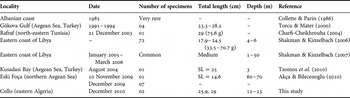
In the Mediterranean, H. far was recorded originally from Palestine as H. marginatus by Steinitz (Reference Steinitz1927). It was subsequently recorded from Syria (Gruvel, Reference Gruvel1931), the southern Turkish coast (Kosswig, Reference Kosswig, von Jordans and Peus1950), Cyprus (Demetropoulos & Neocleous, Reference Demetropoulos and Neocleous1969), Egypt (Ben Tuvia, Reference Ben Tuvia1978; El Sayed, Reference El Sayed1994), the Aegean Sea, including Rhodes Island (Tortonese, Reference Tortonese1946), Cyclades (Papaconstantinou, Reference Papaconstantinou1990), Gokova Gulf (Torcu & Mater, Reference Torcu and Mater2000), Kusadasi Bay (Tzomos et al., Reference Tzomos, Chartozia, Christodoulou and Kitsos2010) and Aslanburnu (Akça & Bilecenoglu, Reference Akça and Bilecenoglu2010), Adriatic Sea (Collette & Parin, Reference Collette, Parin, Whitehead, Bauchot, Hureau, Nielsen and Tortonese1986) and north-eastern Tunisia (Charfi-Cheikhrouha, Reference Charfi-Cheikhrouha2004). On the eastern part of the Libyan coast, this species has started to become commercially valuable in the fish market of Tubruk, where its local name is Abou-meshfa (Shakman & Kinzelbach, Reference Shakman and Kinzelbach2006), as already reported in other areas of its distribution (Carpentieri et al., Reference Carpentieri, Lelli, Colloca, Mohanna, Bartolina, Moubayed and Ardizzone2009). It is now considered to be an established species in Greek waters (Pancucci-Papadopoulou et al., Reference Pancucci-Papadopoulou, Zenetos, Corsini-Foka and Politou2005). Table 1 summarizes the chronology of documented records of this species in the Mediterranean.
Chronology of documented records of Hemiramphus far in the Mediterranean.

Hemiramphus far is a schooling, epipelagic species that is typically found in coastal waters, chiefly in areas of rich submerged vegetation. It feeds on zooplankton and floating matter. Adults feed mainly on seagrasses, and to a lesser extent green algae and diatoms (Fischer & Bianchi, Reference Fischer and Bianchi1984). Talwar (Reference Talwar1962) found that 70% of the gut contents of H. far from the Gulf of Mannar and Palk Bay (India) comprised seagrasses (Cymodocea), with 10% green algae (such as Cladophora and Chaetomorpha), 5% diatoms and 5% polychaetes (Nereis and Perinereis). The eggs are large and have adhesive filaments that attach to vegetation and other objects (Golani et al, Reference Golani, Orsi-Relini, Massuti, Quignard and Briand2002). In the eastern Mediterranean, it spawns in shallow waters during the summer (Torcu & Mater, Reference Torcu and Mater2000) and feeds mainly on seagrasses (Posidonia sp.), green algae and diatoms (Collette & Parin, Reference Collette, Parin, Whitehead, Bauchot, Hureau, Nielsen and Tortonese1986).
Despite its relatively early introduction into the Mediterranean, H. far has not penetrated the western basin until 2003. In this paper, we report the second observation of H. far, based on material collected from Algerian coasts.
MATERIALS AND METHODS
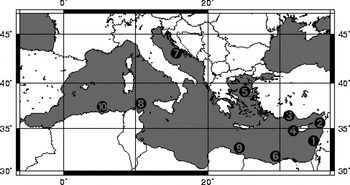
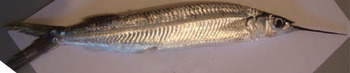
On 2 and 24 December 2010, two individuals of H. far were caught along the eastern coast of Algeria, at Collo (37°00′N 6°33′E), from the beaches of ‘les belles filles’ and ‘les trois pierres’ (Figure 1), at depths of 12 to 23 m. They were captured by gillnets, locally called bonitière, with a length of 160 m, a width of 20 m and a stretched mesh of 70 mm. They were collected from sandy and sandy–rocky bottoms. Both individuals were taken with a few individuals of other species (Seriola dumerili, Sarda sarda, Sphyraena sp., Mugil sp., Trachurus sp. and Boops boops). Since then, several records regarding its occurrence have been provided by fishermen, who consider this species to have only recently occurred in Collo Bay. One specimen (Figure 2) was fixed in alcohol and deposited at the ichthyological collection of the Marine Bioresources Laboratory (Annaba University) with the number code LCol-11-002.
Map pointing out the capture area of Hemiramphus far on Algerian coasts (10) and chronology of first records in the Mediterranean (1, Steinitz (Reference Steinitz1927); 2, Gruvel (Reference Gruvel1931); 3, Kosswig (Reference Kosswig, von Jordans and Peus1950); 4, Demetropoulos & Neocleous (Reference Demetropoulos and Neocleous1969); 5, Tortonese (Reference Tortonese1946); 6, Ben Tuvia (Reference Ben Tuvia1978); 7, Collette & Parin (Reference Collette, Parin, Whitehead, Bauchot, Hureau, Nielsen and Tortonese1986); 8, Charfi-Cheikhrouha (Reference Charfi-Cheikhrouha2004); 9, Shakman & Kinzelbach (Reference Shakman and Kinzelbach2006); 10, Kara et al. (this study)).

Hemiramphus far (total length = 29 cm) captured in Collo Bay in December 2010.

RESULTS
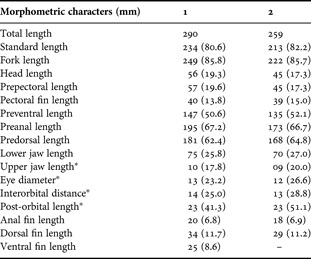
The two specimens were identified to species following Collette (Reference Collette1999): an elongate fish with a greatly prolonged, beak-like lower jaw; upper jaw short, triangular and scaleless; lower lobe of caudal fin much longer than upper; preorbital ridge absent; four vertical bars present on sides of body. However, in the Mediterranean population, the blackish spots that are commonly used to distinguish H. far from closely related species, are often faded or completely absent (Golani et al., Reference Golani, Orsi-Relini, Massuti, Quignard and Briand2002). In our case, these spots (3 in number) are faint and inconspicuous. Differentiation from H. affinis was based on the absence of scales on the upper jaw (scaled in H. affinis). Seventeen morphometric characters were recorded (Table 2), where all dimensions in relation to the length of the head were measured from the tip of the upper jaw, following Collette (Reference Collette1999). The body ratios given in this investigation are comparable to those given by other authors (Shakman & Kinzelbach, Reference Shakman and Kinzelbach2006; Akça & Bilecenoglu, Reference Akça and Bilecenoglu2010): total length/standard length (1.22 cm); total length/dorsal fin length (8.73 cm); total length/anal fin length (14.44 cm); total length/head length (5.46 cm), total length/eye diameter (21.94 cm); head length/standard length (0.22 cm); lower jaw length/standard length (0.32 cm); pectoral fin length/standard length (0.17 cm); eye diameter/head length (0.24 cm); interorbital distance/head length (0.26 cm); upper jaw/head length (0.18 cm); and postorbital length/head length (0.46 cm).
Main morphometric characteristics of the two captured specimens of Hemiramphus far. The values in parentheses are percentages of the total length or of the head length (*).

DISCUSSION
The observed increase of the mean annual temperature of the Mediterranean waters (Béthoux et al., Reference Béthoux, Gentili, Raunet and Tailliez1990; Francour et al., Reference Francour, Boudouresque, Harmelin, Harmelin-Vivien and Quignard1994; Laubier et al., Reference Laubier, Pérez, Lejeusne, Garrabou, Chevaldonné, Vacelet, Boury-Esnault and Harmelin2003; Vargas-Yanez et al., Reference Vargas-Yanez, Salat, Luz Fernandez de Puelles, Lopez-Jurado, Pascual, Ramirez, Cortés and Franco2005) could possibly explain both the increasing number of lessepsian migrants and the progressive geographical dispersal of previously known migrants in the Mediterranean (Tzomos, Reference Tzomos2007; Koukouras et al., Reference Koukouras, Kitsos, Tzomos and Tselepides2010). In Algeria, H. far is the second lessepsian migrant fish recorded, after the blue-spotted cornetfish Fistularia commersonii Rüppell, 1835 (Kara & Oudjane, Reference Kara and Oudjane2009). Compared to 81 lessepsian species that have been reported from the eastern Mediterranean over the past century (Edelist et al., Reference Edelist, Spanier and Golani2011), the lower number (3) of species in the western Mediterranean suggests some form of natural barrier (e.g. the Sicilian Channel) may prevent the invasion/establishment of alien species in the western Mediterranean (Pancucci-Papadopoulou et al., Reference Pancucci-Papadopoulou, Zenetos, Corsini-Foka and Politou2005). However, for F. commersonii as for H. far, it may be that their hydrodynamic body shape allows them to more easily cross the Sicilian Channel.