


Introduction
Guided self-help cognitive behaviour therapy for voices was developed to address the well-established problem with access to psychological therapies for people with psychosis (Kuipers, Reference Kuipers2011). The most recent figures from the UK suggest that only 26% of people with psychosis are offered CBT (CBTp) (The Royal College of Psychiatrists, 2018), despite this intervention being recommended for all people who require treatment for psychosis (NICE, 2014). One of the most commonly cited barriers to access is limited resources (Ince et al., Reference Ince, Haddock and Tai2015; Prytys et al., Reference Prytys, Garety, Jolley, Onwumere and Craig2011).
Guided self-help cognitive behaviour therapy for voices (‘GiVE’) draws on a growing body of evidence suggesting that CBT targeted at the specific symptoms associated with psychosis, such as voices and delusions, may generate benefits for patients experiencing psychosis (Lincoln and Peters, Reference Lincoln and Peters2018; Thomas, Reference Thomas2015). GiVE specifically targets the mechanisms known to maintain the distress that can be experienced when hearing voices, such as negative beliefs about the self (Fielding-Smith et al., Reference Fielding-Smith, Hayward, Strauss, Fowler, Paulik and Thomas2015), beliefs about the omnipotence and malevolence of voices (Chadwick and Birchwood, Reference Chadwick and Birchwood1994), and negative patterns of relating (Sorrell et al., Reference Sorrell, Hayward and Meddings2010). Consistent with evidence that CBT can generate benefits for psychosis patients when offered in brief formats (Hazell et al., Reference Hazell, Hayward, Cavanagh and Strauss2016b), GiVE aims to target each of these mechanisms within a brief therapy that requires less than the recommended minimum 16 clinician contact sessions (NICE, 2014).
We evaluated GiVE compared with a wait-list control condition within a pilot randomized controlled trial (RCT) with a transdiagnostic sample (Hazell et al., Reference Hazell, Hayward, Cavanagh, Jones and Strauss2016a). That is, in accordance with a symptom-specific approach (Thomas, Reference Thomas2015), the trial included participants who were using mental health services and were distressed by hearing voices, irrespective of their diagnosis. The RCT suggested that the GiVE intervention was acceptable (86% of participants completed therapy) and beneficial (between-group effect on the pre-determined primary outcome was very large: d = 1.86) (Hazell et al., Reference Hazell, Hayward, Cavanagh, Jones and Strauss2017a). However, the quantitative trial data does not tell us anything about the lived experience of GiVE, and whether participants noticed any changes that go beyond those captured within the GiVE trial assessment pack. In the present study, we adopted a mixed methods approach to address the following aims: (1) to explore participants’ subjective experience of accessing GiVE as part of a trial; (2) to identify what (if any) changes participants noticed over the course of the GiVE trial; and (3) to ascertain what participants attribute these changes to.
Method
Design
Our study used a mixed methods design using one-on-one interviews. Interviews were conducted after trial participants had completed therapy and the 12-week post-randomization assessments at either the participant’s home or their local mental health service.
Participants
All of the participants (n = 9) had participated within the pilot RCT and were randomized to receive the GiVE intervention within the treatment arm. The inclusion criteria for the trial meant that participants were: (1) aged 18 years or over, (2) currently hearing distressing voices, (3) heard distressing voices for the past year, (4) were not currently receiving or had plans to receive any psychological therapy, and (5) could read and write in English. Participants were excluded if they had a primary diagnosis of substance misuse or an organic illness that had been causally linked to their voices.
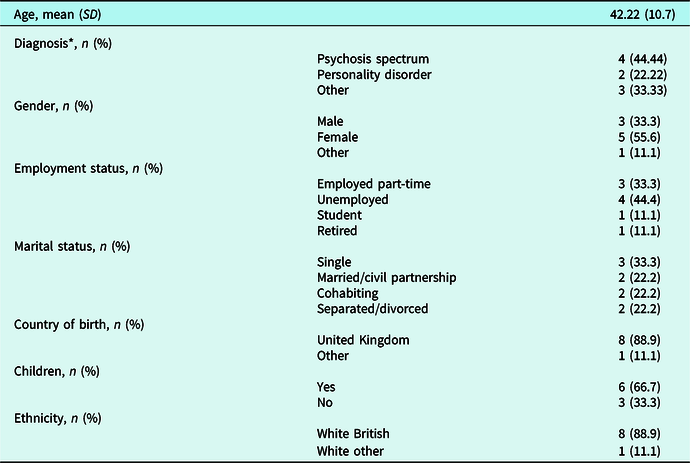
Of the 14 participants allocated to the treatment arm, five did not complete an exit interview: two were excluded because they did not attend any therapy sessions, and three could not be contacted and/or interviewed before the trial end date. For all participants, English was their first language. See Table 1 for participants’ demographic information.
Participant demographic information

* Diagnosis is taken from participants’ most recent clinic letter.
GiVE intervention
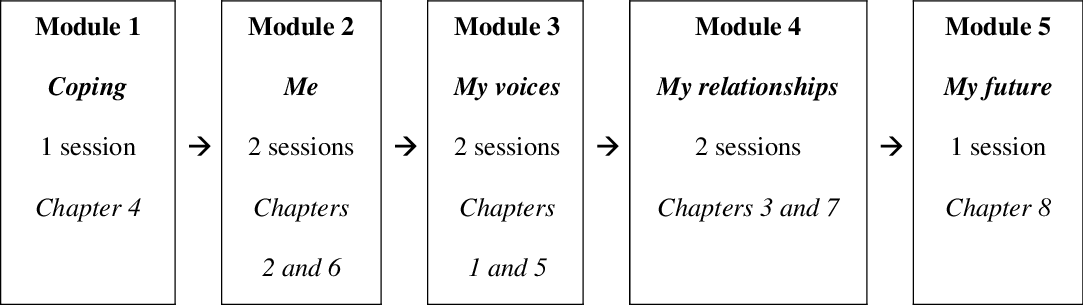
GiVE was delivered over eight hour-long sessions with a clinical psychologist. The intervention was based on the Overcoming Distressing Voices (Hayward et al., Reference Hayward, Strauss and Kingdon2012) self-help book, and supported with a workbook developed specifically for this RCT (Hazell et al., Reference Hazell, Hayward, Strauss and Kingdon2018). GiVE was divided into five therapy modules (see Fig. 1). Modules 2, 3 and 4 were the core therapy modules, each targeting different mechanisms known to maintain voice-related distress. These modules were bookended by an initial session exploring ways to cope with voices, and the final module where participants were encouraged to make plans for how they could continue to apply what they have learnt after therapy had finished.
Diagram of the GiVE therapy protocol, including the number of sessions per module and the book chapters from Overcoming Distressing Voices (Hayward et al., Reference Hayward, Strauss and Kingdon2012) linked to these modules.

Discussion guide
The discussion guide used for all nine interviews combined the trial experience interview schedule (Notley et al., Reference Notley, Christopher, Hodgekins, Byrne, French and Fowler2015) and the Change Interview guide (Elliott et al., Reference Elliott, Slatick and Urman2001). The trial experience questions (Notley et al., Reference Notley, Christopher, Hodgekins, Byrne, French and Fowler2015) ask participants about their experience of participating within an RCT. The Change Interview (Elliott et al., Reference Elliott, Slatick and Urman2001) asks participants what they found helpful, unhelpful and if there is anything missing from the therapy, as well as if they have experienced any changes over the course of the study, and if so, what they attribute these changes to.
The Change Interview (Elliott et al., Reference Elliott, Slatick and Urman2001) also has a quantitative element whereby participants are asked to list all the changes that they have experienced over the period of the trial. For each of these changes, participants are then asked: (a) was this a positive, negative or neutral change?; and to rate on a 5-point Likert scale: (b) how expected was the change? (1 = very much expected; 5 = very surprising); (c) how likely is it that this change would have happened without the therapy? (1 = very unlikely to have happened without therapy; 5 = very likely to have happened without the therapy); and (d) how important was the change to you? (1 = not at all important; 5 = extremely important). The interviews lasted no more than an hour and were all conducted by the first author. The interviews were audio-recorded and transcribed verbatim by S.O’B. and O.K.
Analysis
The transcripts were analysed in accordance with the a priori analysis plan included in the trial protocol (Hazell et al., Reference Hazell, Hayward, Cavanagh, Jones and Strauss2016a). The aim of this analysis was to identify patterns of meaning across participants’ interviews. We therefore chose to analyse all interviews using thematic analysis, as per the Braun and Clarke (Reference Braun and Clarke2006) protocol. Thematic analysis involves becoming familiar with your data, creating initial codes, and then clustering and reviewing these codes to create a thematic structure. The quantitative data collected via the Change Interview (Elliott et al., Reference Elliott, Slatick and Urman2001) is summarized using descriptive and frequency statistics.
Credibility checks
The interviews were transcribed by S.O’B., and then checked (comparing the transcripts with the recordings) by O.K. Only minimal discrepancies were found, and these were corrected prior to analysis. All members of the research team involved in the analysis received training from the first author. To facilitate adherence to the analysis plan, transcripts were double-coded and reviewed intermittently. The double coding was repeated until there were only minimal differences between coders. The clustering of the codes to form sub-themes and themes was discussed regularly within research team meetings. All members of the research team have agreed the final thematic structure reported here.
Results
Quantitative
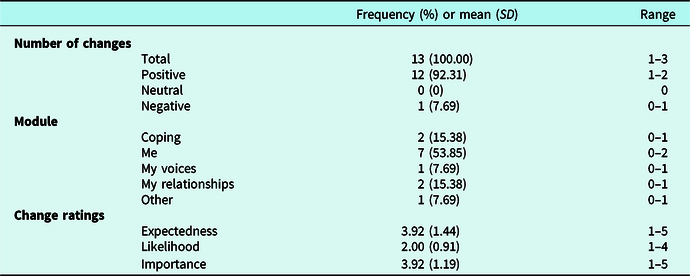
The quantitative results of the Change Interview are presented in Table 2. The nine participants reported 13 changes in total. With one exception, these changes were identified as positive. The one change rated as negative was from a participant who reported ‘feeling ill’. Most changes were related to the content of the ‘Me’ therapy module. When asked to rate the changes, participants tended to rate them as somewhat unexpected, somewhat unlikely to happen without the GiVE therapy, and very important (see Table 2).
Quantitative results from the Change Interview

Mean score across total number of changes reported (n = 13); frequencies are reported for the ‘number of changes’ and ‘modules’; mean scores are reported for the ‘change ratings’; range refers to the highest and lowest frequency/score reported by participants; expectedness (how expected was the change?): 1 = very much expected and 5 = very surprising; likelihood (how likely is it that this change would have happened without the therapy?): 1 = very unlikely to have happened without therapy and 5 = very likely to have happened without the therapy; importance (how important was the change to you?): 1 = not at all important and 5 = extremely important.
Qualitative
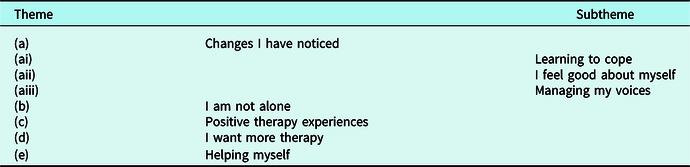
The full thematic structure and example quotes are reported in Table 3.
Thematic structure

(a) Changes I have noticed
In support of the quantitative findings above, participants discussed their experiences of change over the course of the therapy.
(ai) Learning to cope
The majority of participants mentioned the new coping strategies they had learnt to help manage their distressing voices. Participants reported a wide range of coping strategies, suggesting they had been developed for personal use. Coping strategies broadly fell into one of two categories: either distraction techniques:
‘I find that when I’m doing something artistic, whether it’s painting, or even where [sic], it seems to help. It seems to make the voices quiet, they don’t say anything, they leave me alone.’ (P3); or relaxation strategies: ‘Erm, smells, using soap and things. Erm, a smell that I like. Erm bathing.’ (P4)
For some, the coping strategies acquired during therapy were effective and became an important part of their daily routine:
‘Eh, it’s been huge because like literally every single night, even if we go on holiday we will take them [book used as part of coping strategy] with us. Or away for one night you know, it’s like that’s become a part of my erm, kind of going to bed routine.’ (P1)
For others, the effectiveness of the coping strategy was not maintained over time and stopped working after a while. Interestingly, one participant understood the dwindling effectiveness of their coping strategy as the voice finding a way around it:
‘When I tried that, the first time it worked, but then whenever I tried it the second and third time they cottoned onto it and, and eh…they [the voices], they got a bit nasty, yeah.’ (P3)
(aii) I feel good about myself
The ‘Me’ therapy module involves participants completing a measure of self-esteem (Rosenberg Self-Esteem Scale; Rosenberg, Reference Rosenberg1965) and evaluating the accuracy of beliefs about the self. Several participants were surprised at how negative their self-beliefs were: ‘Then it came to this, and my score was so low, I was surprised.’ (P6)
Although difficult, participants did not reject this part of the therapy. Instead, it was perhaps this moment of realization that gave participants a platform from which to re-evaluate these negative beliefs or seek to strengthen more positive ones.
‘Yeah I think I probably realized from that, that maybe I’m a bit negative sometimes and I get a bit depressed and, self-care can go up and down, and my opinion about myself can go up and down. It basically got me to focus more on positives I think, in the end, yeah.’ (P3)
The changing view of self was profound in some instances, as participants reported a positive view of self that transcended context:
‘So I’m feeling I have more worth now. So that wouldn’t have happened without this [therapy].’ (P6)
(aiii) Managing my voices
Participants were invited to be part of the GiVE trial on the basis that they heard distressing voices. The specific impact of the therapy on the voice hearing experiences was mixed. For some participants, they noted a marked improvement in their voices in terms of the frequency, loudness, associated distress and the amount of control they had over their experiences:
‘So in, in regards to before I started the therapy and where I am now, the difference is immense in regards to the, the volume of the voices and how much they affect me. I have to say.’ (P7)
Other participants described ways in which they had learned to have some control over their voices, either by developing a different attitude or behavioural response towards the comments of voices:
‘But yeah, just seems like the voice couldn’t deal with it, he had no power over me anymore. It’s like telling him that I actually don’t care about his stupid jibes, and eh telling me he’s gonna make me fatter and everything, it’s kind of made me enjoy eating a bit more really. Just changing my way of thinking about it.’ (P3) Or through deploying more assertive verbal responses:
‘It means I’ve got a voice to be honest with you. It means that I can be heard, and I can verbally fight back, which I never thought I could do.’ (P8), whereas, others brought about change in their voices by evaluating the accuracy of the beliefs they held about their voice (as in ‘My Voices’):
‘Erm, the voices, well the intensity of the voices has kind of has fluctuated I guess. Erm, but eh I think I’ve overall found it easier to not erm totally listen to them because, erm I had some evidence that they’re not entirely true. That the things they are saying are not entirely true.’ (P1)
A minority of participants reported that their voices made active efforts to sabotage the learning process:
‘I mean, the voices were very reacting to certain things I tried from the therapy. Like if I tried something that he [the therapist] suggested, they’d either, it would either work, or they’d get worse.’ (P3)
Unfortunately, for one participant the resistance from voices led to a rebound effect whereby voices got worse as the therapy progressed:
‘Erm, they [the voices] started interfering…with me everyday life.’ [Interviewer: ‘So the voices got worse towards the end [of therapy]?’] ‘Mmm, yeah.’ (P9)
(b) I am not alone
Although this was an individual therapy, participants referred to other people as being an important part of the therapy. There were two main groups of people that most participants talked about: other people who hear voices, and their own family and friends. Both groups were described largely as being supportive and a vital part of the change process.
The self-help book included as part of the therapy pack gave participants the opportunity to read about other people’s experiences of hearing distressing voices. Almost half of participants spoke of how they could relate to the case studies, and how this provided a sense of comfort and universality with another. Participants were able to make this connection just by reading brief excerpts from the self-help book.
‘But, I remember reading a bit it in about somebody saying they hear ducks quacking and animals barking or something, I can’t remember, [it] was along those lines. And I thought “I’ve had that, I’ve had that”. And it’s like that, that really helps when you, you know, you can identify with stuff.’ (P7)
Other participants, even though they were not directly asked about it, still spoke of the case studies. However, these participants were not able to find any similarity between their own and the case studies’ experiences: ‘I couldn’t relate to any of the people in the book. But quite frequently then, the people in the book, they don’t have quite the same problem.’ (P1)
Participants’ stories about their friends and family were comparatively more consistent. Friends and family were a positive resource throughout therapy. Having support within the therapy room was of clear importance, but the feedback from participants suggested that this alone was not sufficient to bring about change. Participants spoke of instances where the therapy became difficult, but they were encouraged to continue by loved ones: ‘She encouraged me to go on days that I didn’t feel too good or my boyfriend did.’ (P4)
‘Erm, just my mum probably encouraging me to keep going with it and eh, read stuff, and whatever. I didn’t need that much, but she did encourage me to keep going and I was wavering a little bit towards the end, I kept going so.’ (P3)
For some, their friends and family took an interest in what they were covering within the therapy and wanted to learn more about the CBT approach to reducing the distress associated with hearing voices: ‘Yeah I showed that [self-help book chapter] to my mum, and she liked that.’ (P5). For others, their friends and family got actively involved in helping them implement what they had learned within therapy:
‘I needed to have it [positive thoughts about the self] written down and then, just me writing it down also wasn’t enough so then came up with the idea of my partner doing it as well cause I could trust them so, erm I need so where on days I can’t really do anything that great to write my partner still writes something really nice.’ (P1)
(c) Positive therapy experiences
The therapy seemed to be well received. Even though the therapy may have been difficult at times, it appeared to have been worth it:
‘All I know is that the whole thing has helped me, and I can’t think of anything that you could’ve taken out which would’ve made things better for me or made things easier for me. I think, you know, there’s no gain without any pain at the end of the day, and you’ve gotta go through the sh*t to get to, excuse my language. You’ve gotta get through the worst to get better, to be honest with you.’ (P8)
When asked why they had found the therapy helpful, participants provided several reasons. Several participants compared the GiVE therapy with previous interventions they had received and reported a preference for this intervention with its clear, singular focus:
‘Oh I had had therapy before, but um, this time it was better because it concentrated specifically on the voices … So, the erm, the specific nature of the therapy made it really productive.’ (P5)
Even though this was a brief therapy, participants described building a positive relationship with their therapist:
‘[The therapist] was amazing. Yeah, we got on really well. And I still kind of miss, miss her in some ways because we, like it was interesting actually, maybe the first two meetings I was a bit suspect, and a bit like not really sure that you’ll quite get me and that this is gonna work. But, actually, by like week three, erm, I felt like um [the therapist] had really made a massive effort to remember what was going on for me and, erm, think about things and adapt things to my situation.’ (P1)
(d) I want more therapy
Although the brevity of the therapy did not seem to hamper change or detract from a generally positive experience, the duration of the therapy was commented on by many participants. Participants expressed a sense of frustration at the pace of the therapy, and that a lot of subject matter was crammed into so few sessions. It was not the duration of individual sessions that was problematic, but the number of sessions on offer:
‘Umm, yeah. I don’t think the sessions themselves should be any longer, because concentrating for any longer wouldn’t have been possible. But I think there, yeah it would have been helpful to have more sessions to cover the same amount of material.’ (P1)
This same participant went on to expand by explaining that it would have been preferable to have more time to cover certain topics. For this participant, they would have liked more time to let the new ideas ‘sink in’ so as to fully implement their new learning:
‘Like I kind of changed my thinking to a whole new kind of erm concept, and within that had to kind of learn about the concept, figure out how to apply it, and then come up with how I was going to do that for the following week, and it was just a lot to fit into that time.’ (P1)
Related to this, was the feedback from a couple of participants whom felt that they did not have the opportunity to gain closure over the end of therapy, saying that: ‘It was all a bit abrupt’ (P5). Both participants concluded with a suggestion that additional sessions could be added and tapered. At the heart of this feedback was the desire to have further contact with their therapist, review their progress, and make plans for how other parts of the therapy could be implemented into their daily activities:
‘I think what would’ve been nice, erm, would’ve been after the eight sessions with [the therapist], to of perhaps, after a month or so, had another session with [them], just to sort of, see where we’d got to and if I had achieved anything. Erm, just sort of a recap, another, just an extra one, just to get together with her to say “well actually [therapist] I have done this, or I haven’t been able to do that but I’m gonna so and so”.’ (P2)
(e) Helping myself
The GiVE intervention has self-help at its core. This aspect of the therapy did not go unnoticed by participants who all commented on the self-help materials given to them as part of the therapy pack. The feedback regarding the self-help book was somewhat mixed with some finding this a really helpful resource: ‘The book was the most useful. Can’t remember who it’s written by, but it’s fantastic. It was really helpful’ (P5), while others did not find much therapeutic value in the book: ‘Erm, I think the book made everything, was very simplified and very black and white. And that really annoyed me’ (P1).
The therapy workbook was more positively endorsed, and all participants said that they had used the workbook. For some, the workbook was a tool to help guide therapy within the sessions, and how this served as a permanent record for what they had learnt and achieved:
‘Yeah, yeah, yeah. Used the workbook every week, and I was set different chapters that I had to read every week for the next coming week. So yeah, used it all and found it all very helpful. Yeah.’ (P8)
Some participants talked about continuing to look back at the workbook after therapy had finished and continuing to complete the activities within it. One participant brought the workbook along to the interview and was able to pick out the parts they had completed by themselves after therapy had ended: ‘I can look back, when I don’t feel well, on what was said, and I’ve kept the little workbook as well so I can look back at that’ (P2).
Although participants’ feedback gives evidence of self-help, for some, the guidance offered alongside this as part of the GiVE therapy was vital for their understanding of the therapy model and their engagement:
‘It would have been, I wouldn’t have managed the book without somebody to help me through it, I wouldn’t have stuck to it. I know I wouldn’t of done, especially with all the boxes with a’s, b’s, and c’s [ABC model of CBT], I would have given up.’ (P6)
Related to the engagement with self-help, participants also talked about reaching a point of almost desperation with their mental health and being prepared to do whatever they could to improve their situation. This ‘desperation’ was reported as the strongest motivation for engaging in the therapy, which in turn aided change:
‘I know what I want sometimes. And I want to be free of this illness, so that worked in my favour.’ (P5)
‘Erm, I think I was kind of desperate to tell you the truth, cause the voices had got really bad and they were bothering me in all sorts of situations.’ (P3)
Discussion
Guided self-help cognitive behaviour therapy for voices (GiVE) is a brief and targeted intervention that seeks to increase access to evidence-based psychological therapy. Outcomes from a pilot RCT were encouraging and we were eager to learn from the participants about their experience of GiVE and the processes that may have facilitated any change. We interviewed nine of the 12 people who had completed the GiVE therapy as part of a pilot RCT. From these interviews, we found that participants reported 13 separate changes and that almost all of these were rated as positive. Our qualitative analysis yielded five themes. The first theme (changes I have noticed) describes the domains in which participants reported changes, specifically the ability to cope, feeling more positive about themselves, and reducing voice-related distress. Within the second theme, participants described how having a support network during therapy aided engagement; and thirdly, how the therapy was generally a positive experience for participants. The fourth theme reflects participants’ desire for a longer therapy; and finally, an acknowledgement that participants own actions and motivation were key to bringing about change.
The changes that participants reported most often were improved coping skills and self-esteem. Both adaptive coping strategies (Singh et al., Reference Singh, Sharan and Kulhara2003) and a positive self-experience (Fielding-Smith et al., Reference Fielding-Smith, Hayward, Strauss, Fowler, Paulik and Thomas2015) are individually associated with reduced voice-related distress. These findings may suggest that the ‘self’ module in particular, as well as the ‘coping’ module, are the most effective and/or the most valued by patients. This potential finding may suggest that the CBTv model, which postulates that voice-related distress is the product of believing voices are omnipotence, omniscient and malevolent, is somewhat incomplete (Birchwood and Chadwick, Reference Birchwood and Chadwick1997). It may be that the cognitive model of voices requires modifying to explicitly incorporate the concepts of ‘self’ and ‘coping’ so as to give a fuller understanding of factors associated with voice-related distress. Alternatively, it may be that there is an overlap in the influence that beliefs about voices, and the negative beliefs about the self and maladaptive coping strategies exert on maintaining the distress associated with voice hearing. These potential causes of voice-related distress are correlated with each (e.g. Sayer et al., Reference Sayer, Ritter and Gournay2000), which may indicate an interactive effect whereby beliefs about voices, self-esteem and coping strategies combine to predict voice-related distress. However, path analysis reveals that beliefs about the self and voices represent distinct relationships with voice-related distress (Cole et al., Reference Cole, Strauss, Fife-Schaw and McCarthy-Jones2017), and that improvements in coping are not predicted by changes in either of these constructs (Paulik et al., Reference Paulik, Hayward, Jones and Badcock2019). It therefore may be more likely that beliefs about voices, self-esteem and coping strategies uniquely cause voice-related distress. Also, there are other factors known to be associated with voice-related distress that are not currently explored within GiVE or part of the CBTv model [e.g. negative voice content (Larøi et al., Reference Larøi, Thomas, Aleman, Fernyhough, Wilkinson, Deamer and McCarthy-Jones2019)]. Further research is needed to re-evaluate the CBTv model and therein determine viable therapeutic targets.
Another factor the participants associated with treatment success was the involvement of their wider support network in the therapy process. Friends and family are a vital part of a patient’s support network. Family involvement (e.g. attending sessions, supporting homework completion, aiding implementation of changes, taking an interest in the content of sessions) is associated with greater treatment responses to CBTp (Garety et al., Reference Garety, Fowler, Freeman, Bebbington, Dunn and Kuipers2008), and both service and treatment engagement in Early Intervention in Psychosis (EIP) services (Dixon et al., Reference Dixon, Holoshitz and Nossel2016). Our findings add to this literature, with friends and family members reinforcing the learning generated in therapy and supporting their loved one to apply this learning into the real world. A self-help intervention may be particularly suited to facilitating carer involvement as the printed materials that guide the therapy content (e.g. book and workbook) mean that friends and family can find out what has been covered and consider ways that they can support the therapeutic process. However, involving friends and family members in the treatment of psychosis symptoms can present implementation challenges (Eassom et al., Reference Eassom, Giacco, Dirik and Priebe2014). Also, not all patients will have such support networks. For example, people with psychosis (Lim et al., Reference Lim, Gleeson, Alvarez-Jimenez and Penn2018) or a diagnosis of borderline personality disorder (Hengartner et al., Reference Hengartner, Müller, Rodgers, Rössler and Ajdacic-Gross2014; Hill et al., Reference Hill, Stepp, Wan, Hope, Morse, Steele and Pilkonis2011), can have difficulties in forging and maintaining relationships. Notwithstanding, the benefits are well-established, and therefore warrant further research attention and encouragement, wherever possible, within NHS mental health services.
Participants were generally positive when talking about the GiVE therapy. Where participants were critical of the therapy, this was usually due to its brevity. Participants wanted more therapy sessions. However, it is possible that this critique was not specific to the GiVE intervention, but instead is a common response to ending any psychological therapy, irrespective of their duration. For example, qualitative data from another trial of CBTv also found that participants wanted more therapy even though this therapy offered twice as many sessions (16 sessions) as GiVE (Hayward et al., Reference Hayward, Bogen-Johnston and Deamer2018). Nevertheless, as the rationale for this guided self-help intervention was to develop a resource-light therapy it is not possible to extend the duration of the therapy. Instead, more attention could be given to preparing participants for the end of therapy or conceptualizing GiVE as one part of a broader, longer term therapy programme. For example, GiVE could be a brief intervention offered as part of a stepped care model, akin to those used in Increasing Access to Psychological Therapies (IAPT) services (Clark et al., Reference Clark, Layard, Smithies, Richards, Suckling and Wright2009). Using a stepped care approach would mean that only those who are still distressed by voices after receiving GiVE are offered further therapy, therein using limited healthcare resources most efficiently. Moreover, in line with the IAPT approach (Clark et al., Reference Clark, Layard, Smithies, Richards, Suckling and Wright2009) and to further aid implementation, brief interventions like GiVE could be delivered by mental health professionals other than clinical psychologists (e.g. frontline practitioners, assistant psychologists). We are currently exploring the efficacy of GiVE delivered by assistant psychologists as part of a feasibility trial (Hayward et al., Reference Hayward, Berry, Cameron, Arnold, Berry, Bremner and Strauss2020).
Limitations
Our sample size was relatively small (Clarke and Braun, Reference Clarke and Braun2013), and like our quantitative results reported elsewhere (Hazell et al., Reference Hazell, Hayward, Cavanagh, Jones and Strauss2017a), the sample lacks homogeneity in relation to participants’ diagnosis. The ethnicity of our participants reflects the demographics of the local area but lacks diversity and therefore does not necessarily represent voice-hearers living in other parts of the UK. The effects and patient experience of GiVE requires testing with a more diverse sample to support the generalizability of our findings. Also, all participants were interviewed by the first author (C.M.H.) who was also the trial manager and first author of the GiVE therapy workbook. Although the interviewer explicitly encouraged negative and critical feedback, it may be that participants were reluctant to share this as a function of demand characteristics. A further limitation that may also have implications for the validity of our results is that we were unable to interview all of the participants who were allocated to receive the GiVE therapy. The five participants who were not interviewed could not be reached for various reasons (see Method section), but it may be that these participants would have reported different experiences and therefore different themes may have emerged. Finally, the interviews were conducted shortly after the end of therapy. We are therefore unable to determine the durability of any of the changes reported here.
Implications
During the development of GiVE we found that mental health clinicians were concerned that patients lacked sufficient motivation to engage in self-help (Hazell et al., Reference Hazell, Strauss, Cavanagh and Hayward2017b). However, the findings from this study offer a different perspective and suggest that people distressed by hearing voices can engage with self-help materials when guidance is offered. To maximize engagement, this guidance should be offered both during (from the therapist) and outside of therapy (from friends and family). A broader implication of our research is therefore encouraging clinicians to recognize that patients distressed by hearing voices have the potential to engage with guided self-help CBT.
Acknowledgements
The research team wish to thank all those involved in the set-up and delivery of this study: Taffy Bakasa, Yvette Earley (research governance), Dr Leanne Bogen-Johnston (research assistant), Dr Katherine Pugh, Dr Sam Fraser and Professor Kathy Greenwood (trial therapists).
Financial support
This work was supported by the Economic and Social Research Council (ESRC) and Sussex Partnership NHS Foundation Trust under studentship ES/J500173/1 (awarded to C.M.H.).
Conflict of interest
Authors C.M.H., M.H. and C.S. are authors of the self-help book(s) (Overcoming Distressing Voices (Hayward et al., Reference Hayward, Strauss and Kingdon2012) and Introduction to Self-Help for Distressing Voices (Hazell et al., Reference Hazell, Hayward, Strauss and Kingdon2018)) used in the present study, and therefore have a financial interest in a product(s) that may be affected by the research reported in the enclosed paper.
Ethical statement
This RCT, including the exit interviews, was approved by the North West – Lancaster NHS Research Ethics Committee (REC) (reference: 15/NW/0575). All participants provided informed written consent to conduct an interview, have this interview audio-recorded, and for their direct quotes to be anonymously reported. At the point of transcription, any identifiable data was either removed or replaced with pseudonyms. All authors have abided by the Ethical Principles of Psychologists and Code of Conduct set out by the British Association for Behavioural and Cognitive Psychotherapies (BABCP) and British Psychological Society (BPS).
Key practice points
(1) Patients find guided self-help CBT intervention for voices (GiVE) to be an acceptable intervention.
(2) GiVE is perceived to be most effective when patients are supported and have a desire for change.



Comments
No Comments have been published for this article.