Introduction
Otosclerosis is characterised by abnormal bone formation within the otic capsule resulting in stapedial fixation with a progressive low-frequency conductive hearing loss; it affects about 0.1–2.1 per cent of all Caucasians.Reference Crompton, Cadge, Ziff, Mowat, Nash and Lavy1 Whereas hearing aid rehabilitation can be discussed prior to surgery, most patients prefer stapedotomy for acoustic and aesthetic reasons.Reference McGee2
Between 1956 and 1958, Shea performed the first stapedectomies by removing the stapes from the oval window, covering the vestibule with a vein graft, and reconstructing the ossicular chain with a polyethylene strut placed between the incus and the oval window niche.Reference Shea3 In 1963, he changed this technique to the procedure of stapedotomy. In the beginning, the footplate was partially removed in the so-called ‘large fenestra stapedotomy’, but the technique was further modified into the formation of a centrally located opening into the footplate, called ‘small fenestra stapedotomy’ or just stapedotomy.Reference Shea4 Laser technologies have allowed a calibrated opening into the vestibule.Reference Wegner, Kamalski, Tange, Vincent, Stegeman and van der Heijden5 The most critical and delicate steps in stapes surgery continue to be fenestration of the footplate and removal of the suprastructure without subluxation of the footplate, and a tight attachment of the prosthesis to the long process of the incus.
The aim of stapedotomy is to obtain a post-operative air–bone gap of within 10 dB.Reference Huber, Ma, Felix and Linder6 Although this optimal hearing may be achieved in most patients, air–bone gap closure can be unsatisfactory in 20–40 per cent of all patients.Reference Ramsay, Karkainen and Palva7,Reference Fisch, Oezbilen and Huber8 One of the many reasons for insufficient closure of the air–bone gap, and thus unexpected failure of stapes surgery, may be inadequate crimping of the prosthesis loop onto the long process of the incus. This crimping is crucial for transmitting acoustic energy from the ossicles onto the prosthesis to the inner ear, and is essential for the lifelong success of stapedotomy. A loose attachment to the incus may explain erosion and subsequent long-process necrosis. However, the same outcome has been attributed to tight and traumatic crimping.Reference Kwok, Fisch, Strutz and May9
Several types of prostheses with different coupling mechanisms have been developed.Reference Kwok, Fisch, Strutz and May9,Reference Wegner, Swartz, Bance and Grolman10 Manual crimping remains the most frequently used technique, although self-retaining and self-crimping pistons have become attractive, not only to less experienced surgeons.Reference Rajan, Atlas, Subramaniam and Eikelboom11
In everyday practice, non-perfect coupling is not unusual, no matter how many additional attempts and efforts are performed. An ideal situation for perfect crimping would be a position of the long process of the incus that lies parallel to the plane of the oval window, and a prosthesis positioned perpendicularly to both the long process of the incus and the oval window. However, the shape, position and diameter of the long process of the incus are highly variable. These anatomical features could therefore be responsible for intra-operative coupling difficulties.Reference Toth, Moser, Rosch, Grabmair and Rasp12,Reference Skinner, Honrado, Prasad, Kent and Selesnick13
This study aimed to retrospectively address, based on peri-operative descriptions, whether ‘tight crimping’ is superior to ‘loose crimping’ (movable loop upon palpation) in terms of long-term follow up after primary stapedotomy.
Materials and methods
All patients at our institution undergoing any type of otological surgery have their clinical and surgical data entered into a prospective ENT database (ENTstatistics, Innoforce, Ruggell, Liechtenstein). A search was performed for all patients who underwent a stapedotomy between January 2002 and March 2022. This search identified 1155 stapedotomies; the results were further filtered to identify primary cases with a clear focus of antefenestral otosclerosis, without cochlear or round window involvement. Additionally, the patients had to have been operated on by the two senior authors, using the same surgical steps for the placement of a titanium stapes piston, namely a Karl Storz® Fisch, Heinz Kurz® MatriX or Heinz Kurz MatriX SlimLine titanium stapes piston. Furthermore, their operating report or peri-operative drawing must clearly describe the intra-operative crimping status.
Based on these criteria, we defined a group of 555 stapedotomy cases. Of these, 208 had to be excluded because of incomplete follow up by audiometry, concomitant middle-ear pathology or rare instances of partial stapedectomies. In total, 347 cases were included for analysis of the pre- and post-operative audiogram, the operating report, and the peri-operative drawing.
The Swiss Association of Research Ethics Committees has acknowledged this retrospective study as scientifically relevant, and as being in line with prevailing ethical standards as per the declaration of Helsinki (project identification number: 2022-01048). All patients gave their written informed consent to have their data included.
Surgical technique
Surgery was performed under general anaesthesia. An endaural approach was used to lift the tympanomeatal flap, leaving the chorda tympani attached to the tympanic membrane. After separation of the incudostapedial joint and exposure of the oval window, the prosthesis length was measured using a malleable measuring rod. Subsequently, a stapedotomy opening was created into the footplate, using an erbium-doped yttrium-aluminium-garnet (Er:YAG) laser (prior to 2014) or a carbon dioxide laser (since 2014), and manual perforators were used to smoothen the edges of the calibrated opening. In a few cases of obliterative otosclerosis, a drill was used as well.
The stapes piston was introduced into the middle ear, with the loop portion placed around the distal third of the long process of the incus, perpendicular to the opening and protruding for 0.5 mm into the vestibule. Smooth alligator forceps were used for crimping. Using a two-hand technique on the instrument, the larger smooth alligator forceps was applied for gross adaptation, and the smaller one and/or the McGee Wire Crimper forceps were used for the final attachment. Finally, the stapes superstructure was removed, and the stapedotomy opening was sealed with pieces of connective tissue and drops of patients’ own venous blood (taken at the beginning of the operation and kept in the refrigerator during the procedure). In cases of a limited view over the footplate, the stapes suprastructure was removed before footplate perforation.Reference Fisch14
The quality of crimping was assessed when palpating the incus in a vertical direction. When a rigid fixation at the incus was noted, this was labelled as ‘tight’ crimping. When the surgeon still observed some movement along the shaft of the incus, this was categorised as ‘loose’ crimping. In cases of too-loose crimping of an obviously bended loop of the piston, further crimping was performed, or the surgeon replaced this prosthesis with a new one. The final crimping state was used to categorise our cohort into tight and loose crimping groups.
Statistical analysis
Using the pre- and post-operative pure tone thresholds, the air–bone gaps for individual frequencies from 0.5 to 4 kHz were calculated, as well as pure tone averages (PTAs) for 0.5–2 kHz, 0.5–3 kHz and 0.5–4 kHz. The Mann–Whitney U test was used to assess differences between the tight and loose crimping groups. Comparisons were made for: pre- and post-operative bone and air conduction thresholds, and the calculated post-operative air–bone gaps of all individual frequencies between 0.5 and 4 kHz and the different PTAs. These calculations, as well as the Mann–Whitney U test statistical analysis, were performed using Innoforce ENTstatistics software. A p-value of less than 0.05 was considered statistically significant. All charts were created with Excel® spreadsheet software.
Results
Patients’ characteristics
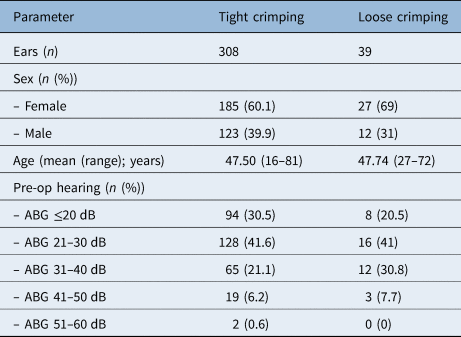
Overall, 347 cases were included, of which 308 were labelled as having tight crimping and 39 as having loose crimping of the loop portion of the piston around the long process of the incus. Demographic details of both groups are depicted in Table 1, as well as the mean pre-operative hearing results.
Demographic data for tight and loose crimping groups

Pre-op = pre-operative; ABG = air–bone gap
Prosthesis types
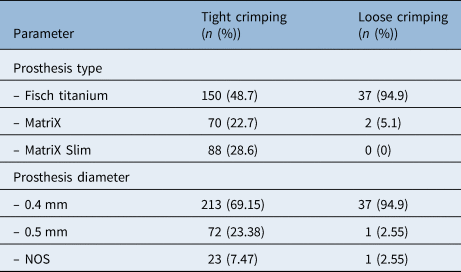
Only patients with one of the following stapes prostheses were included: Karl Storz Fisch, Heinz Kurz MatriX or Heinz Kurz MatriX SlimLine titanium stapes pistons. Product specifications are depicted in Fig. 1.
Product specifications of the Fisch, MatriX, and MatriX SlimLine titanium stapes protheses.

Table 2 shows the details regarding prosthesis type and prosthesis diameter, in both the tight and loose crimping groups. The use of a prosthesis with a diameter of 0.4 mm or 0.5 mm did not affect the post-operative air–bone gaps for the individual frequencies of 0.5 kHz (p = 0.85), 1 kHz (p = 0.08), 2 kHz (p = 0.10), 3 kHz (p = 0.17) and 4 kHz (p = 0.053), or the post-operative air–bone gaps for 0.5–2 kHz (p = 0.13), 0.5–3 kHz (p = 0.17) and 0.5–4 kHz (p = 0.06).
Prosthesis specifications

NOS = not otherwise specified
Hearing results
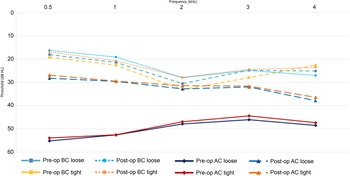
Figure 2 shows the pre- and post-operative mean air and bone conduction pure tone thresholds for the tight and loose crimping groups. For the tight crimping group, audiograms were obtained between 1 and 462 days pre-operatively, and between 1 and 119 months post-operatively. For the loose crimping group, audiograms were obtained between 1 and 319 days pre-operatively, and between 1 and 100 months post-operatively. The pre- and post-operative air and bone conduction thresholds for all individual frequencies did not differ significantly between the tight and loose crimping groups, according to the Mann–Whitney U test results.
Pre- and post-operative mean air conduction (AC) and bone conduction (BC) pure tone thresholds of the tight and loose stapes crimping groups.

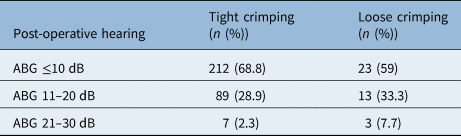
The mean pre-operative air–bone gap for 0.5–4 kHz was 25.75 dB in the tight crimping group and 27.47 dB in the loose crimping group. After stapedotomy, the mean (post-operative) air–bone gap for 0.5–4 kHz decreased to 8.80 dB in the tight crimping group and 9.55 dB in the loose crimping group. Air–bone gap closure of within 10 dB was successfully achieved in 68.8 per cent and 59 per cent of cases for the tight and loose crimping groups respectively. If we define the success rate broader, as air–bone gap closure of within 20 dB, the success rates increased to 97.7 per cent and 92.3 per cent for the tight and loose crimping groups respectively (Table 3).
ABG closure in tight and loose crimping groups

ABG = air–bone gap
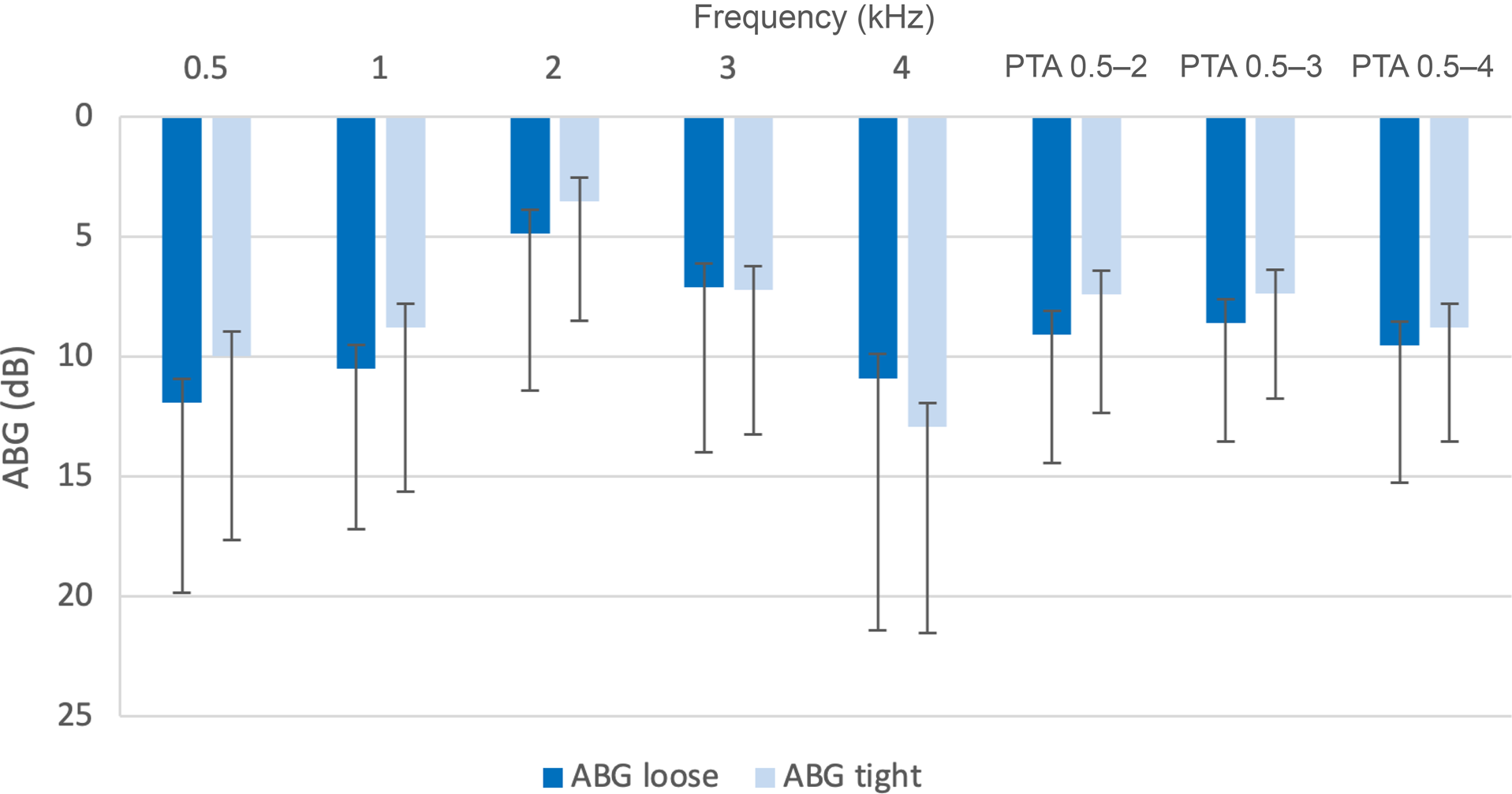
Figure 3 illustrates the post-operative air–bone gaps for both the tight and loose crimping groups. No statistical significance was reached for air–bone gaps at 0.5–2 kHz (p = 0.06), 0.5–3 kHz (p = 0.09) and 0.5–4 kHz (p = 0.4650). Likewise, the post-operative air–bone gap for the individual frequencies showed no statistical differences between the tight and loose crimping groups; the p-values for air–bone gaps for individual frequencies of 0.5, 1, 2, 3 and 4 kHz were respectively 0.10, 0.12, 0.35, 0.80 and 0.11.
Post-operative air–bone gaps (ABGs) for the tight and loose stapes crimping groups. PTA = pure tone average

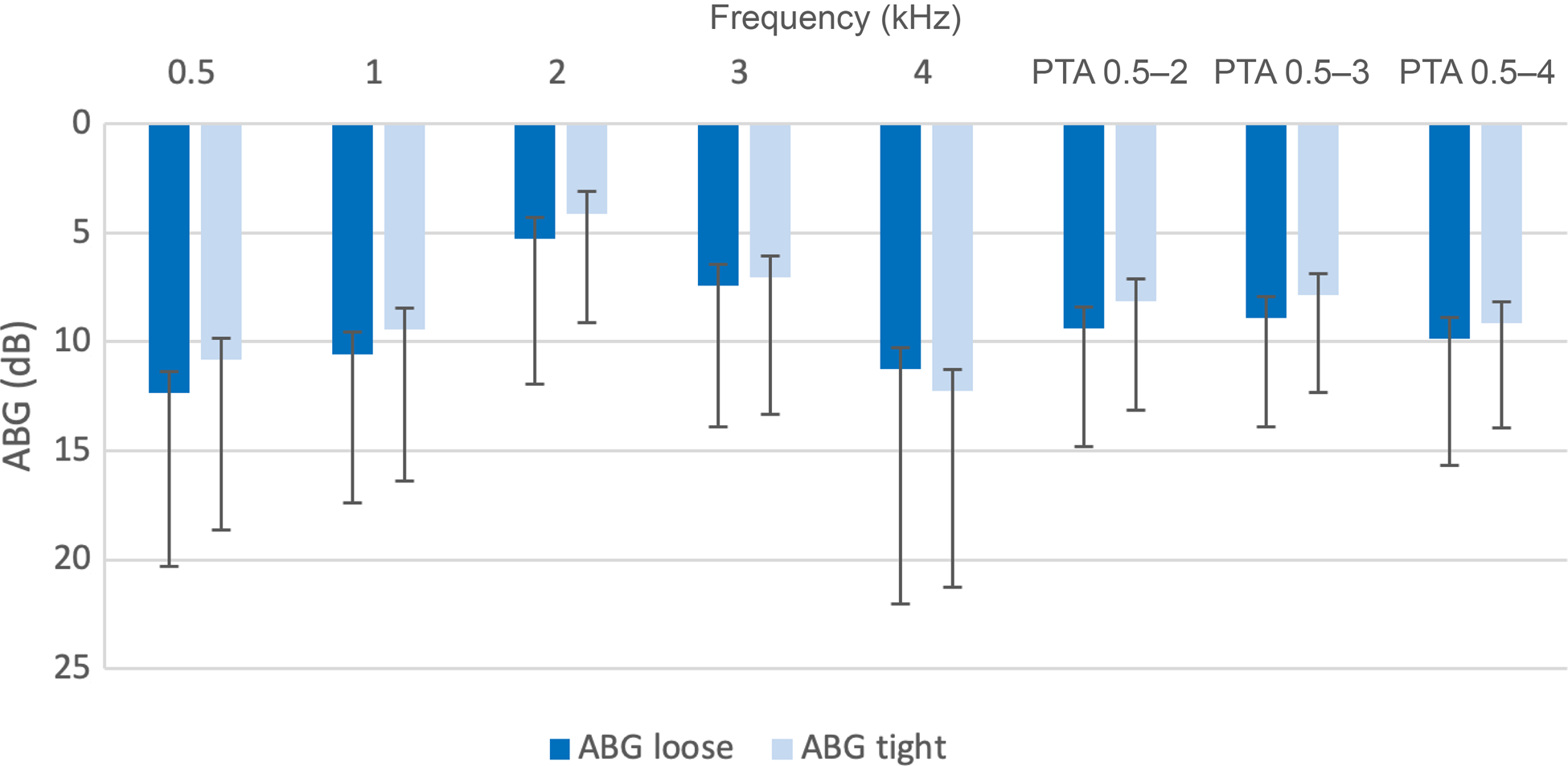
In order to elude bias associated with different prosthesis types, we investigated the hearing results of the 187 patients for whom a Fisch titanium stapes piston was used (Fig. 1). This also avoided bias associated with different piston diameters, as there was no statistical significance in post-operative hearing results for pistons with a 0.4 mm diameter compared with those with a 0.5 mm diameter. The pre- and post-operative air and bone conduction thresholds for all individual frequencies did not differ significantly between the tight (n = 150) and loose (n = 37) crimped Fisch titanium stapes pistons, according to the Mann–Whitney U test results. An air–bone gap of within 20 dB was reached in 98 per cent and 92 per cent for the tight and loose crimping groups, respectively, in cases where a Fisch titanium prosthesis was used exclusively. Figure 4 illustrates the post-operative air–bone gaps for both these groups. The mean post-operative air–bone gap for 0.5–4 kHz was 9.16 dB and 9.86 dB for the tight and loose crimping groups, respectively; the difference did not reach statistical significance (p = 0.56). Furthermore, there was no statistically significant difference noted for air–bone gaps for 0.5–2 kHz (p = 0.14) and 0.5–3 kHz (p = 0.25), or for air–bone gaps for the individual frequencies. The p-values for air–bone gaps at 0.5, 1, 2, 3 and 4 kHz were, respectively, 0.22, 0.30, 0.53, 0.73 and 0.36.
Post-operative air–bone gaps (ABGs) for patients with tight and loose stapes crimping of the Fisch titanium prosthesis. PTA = pure tone average

Revision cases
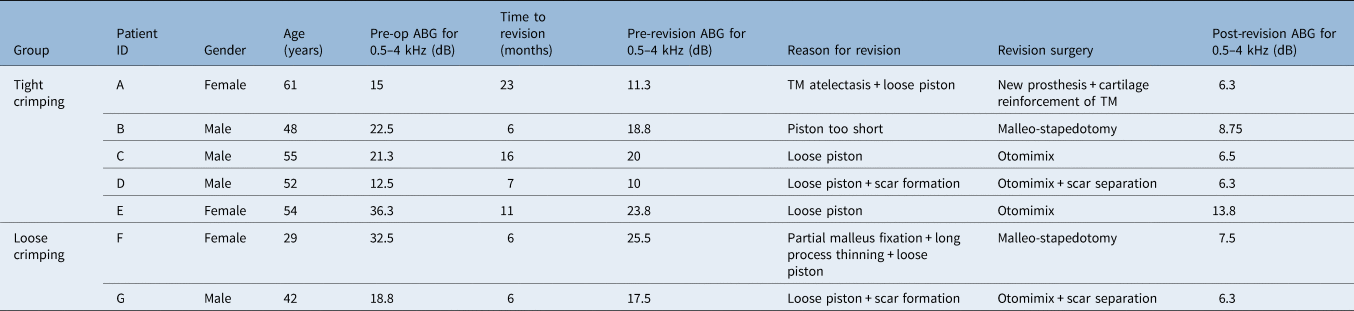
During the follow-up period, five patients from the tight crimping group and two patients from the loose crimping group required revision surgery. Reasons for the revision surgery, details of the revision procedures, and the evolution of the air–bone gaps at 0.5–4 kHz are depicted in Table 4.
Surgical revisions in tight and loose crimping groups

ID = identification; pre-op = pre-operative; ABG = air–bone gap; TM = tympanic membrane
Discussion
Stapedotomy is known to be a safe and effective procedure, and it has been the treatment of choice for otosclerosis for decades.Reference Bittermann15,Reference Vincent, Sperling, Oates and Jindal16 Most patients obtain satisfactory results, with a residual air–bone gap of within 10 dB, but results reported in the literature show large variations in post-operative air–bone gaps.Reference Shea4,Reference Rajan, Atlas, Subramaniam and Eikelboom11,Reference Fontana, Ferri, Lora and Babighian17 Revision surgical procedures hint at possible reasons for this, such as piston loosening, piston displacement, incus erosion, undetected malleus head fixation, fibro-osseous scarring and ongoing otosclerotic foci; however, as not all patients with a persisting conductive hearing loss undergo revision surgery, several factors postulated to be responsible for the failure of initial surgery remain unclear.Reference Ramsay, Karkainen and Palva7,Reference Rajan, Atlas, Subramaniam and Eikelboom11,Reference Farrior and Sutherland18
Insufficient crimping of the prosthesis loop onto the long process of the incus has also been put forward as a reason for insufficient closure of the air–bone gap. Crimping of the stapes piston onto the incus is a known critical step. Manual crimping may need several attempts and remains unpredictable.Reference Tange and Grolman19 Therefore, self-crimping or heat-activated loops have been developed to overcome this issue. While exposing the middle and inner ear to mechanical trauma, a firm attachment of the piston loop at the lenticular process remarkably affects sound transmission, as described by Hüttenbrink in 2003.Reference Fontana, Ferri, Lora and Babighian17,Reference Hüttenbrink20
Several studies have investigated the impact of crimping on sound transmission. It has been postulated that a loose crimped or an uncrimped piston still transmits sound energy, but at the cost of a large variation in residual air–bone gap and inconsistent sound transfer.Reference Rajan, Atlas, Subramaniam and Eikelboom11 Most of these studies compare tight with loose crimping by means of different prostheses, whereby the tight crimping is represented by a self-crimping piston, and loose crimping by a stapes piston that must be manually crimped.
Huber et al. compared the one-year post-operative results of stapedotomy in 150 patients, in a study where a nitinol prosthesis was used in half of the cohort and a conventional stapes prosthesis in the other half. The mean post-operative air–bone gap was 3.6 dB better for the nitinol group, but no statistical significance could be reached.Reference Huber, Veraguth, Schmid, Roth and Eiber21
Comparable results were found in a study by Rajan et al. They investigated the hearing outcomes of the nitinol stapes piston compared to a conventional titanium stapes piston in a preliminary case–control study of only 16 patients. The mean post-operative air–bone gaps (6.28 dB for the nitinol group vs 14.13 dB for the conventional group), and the inter-individual variations of the post-operative air–bone gap, were significantly smaller in the nitinol group.Reference Rajan, Atlas, Subramaniam and Eikelboom11
Tange and Grolman, on the other hand, compared the post-operative hearing results of 126 primary stapedotomies whereby a K-piston Titanium or a CliP-piston à Wengen was used. The mean post-operative hearing results were 11.6 dB for the CliP-piston à Wengen and 11.8 dB for the K-piston Titanium prostheses; no significant difference was demonstrated.Reference Tange and Grolman19
Thus far, tight and loose crimping, and the impact this has on post-operative hearing results, while using the same stapes prosthesis, has only been tested in temporal bone laboratory studies. In an experimental study on 17 fresh human temporal bones, Huber et al. found a mean transmission loss after loose crimping of 10 dB in the lower frequencies and of 5 dB in the higher frequencies, but with a range of losses up to 28 dB.Reference Huber, Veraguth, Schmid, Roth and Eiber21 In temporal bone studies, ideal crimping seemed to be mandatory for predictable perfect hearing reconstruction.
The hearing results in laboratory conditions seem to differ from clinical hearing results. This suggests that the final functional gain relies on many other factors, both intra- and post-operatively, which cannot be fully understood in laboratory environments. Scar formation, for instance, at the interface both of the piston loop onto the long process of the incus and of the piston shaft with the footplate fenestra, is one of these unpredictable factors that may further stabilise the attachment.
In our subgroup of 187 patients who received the Fisch titanium stapes piston prosthesis type, there was no statistical difference in the mean post-operative air–bone gap for 0.5–4 kHz between the tight crimping group (9.16 dB, range of 0–27.5 dB) and the loose crimping group (9.16 dB, range of 0–27.5 dB). The success rates were 98 per cent and 92 per cent for the tight and loose crimping groups respectively. These results suggest that, although theoretically a firm piston–incus interface is crucial for effective and consistent post-operative hearing results of an air–bone gap within 20 dB, slightly loose crimping also provides the desired post-operative air–bone gap with the same variability as seen in tight crimping conditions.
Additionally, given the irregular profile of the long process of the incus, the prosthesis loop can rarely obtain complete adhesion. We therefore do not advocate the routine use of bone cement (e.g. Otomimix®) in cases of a slightly loose attachment following proper crimping. Only in a few revision cases (both after tight and loose crimping) was the prosthesis substantially loose intra-operatively, and so bone cement was applied, with improved results. From this point of view, Fontana et al. found that crimping the prosthesis loop to the medial and lateral sides of the long process of the incus was more effective, given the physiological vibration pattern, than clinging to the anterior and posterior surface of the long process of the incus.Reference Fontana, Ferri, Lora and Babighian17
Three different stapes prostheses were considered in this study. They are all made from titanium, which has been considered the ‘gold standard’ material because its roughness assures a better connection with the surrounding tissue.Reference Fontana, Ferri, Lora and Babighian17 However, the prostheses differ in terms of the piston loop design. The senior authors first solely used the Fisch titanium stapes piston, but later switch to the MatriX stapes piston with a band loop instead of a wire loop. Band loops were thought to have a broader contact area with the incus than wire shaped loops and could therefore guarantee a firmer attachment onto the incus. In addition, a broader band allows easier manual crimping than a wire loop stapes piston. However, placement of this piston was more challenging given the groove-like openings in the band loop, into which the 2.5 mm hook got stuck. Furthermore, the advantage of a band loop over a wire loop in terms of a broader contact area disappears if the distal end of the incus shows a steeper aspect towards the promontory. Fontana et al. found, on scanning electromicroscopy of the crimping status, that if the distal end of the incus showed a steeper aspect towards the promontory, the band loop tends to act like a wire loop, as the long process of the incus is no longer parallel to the stapes footplate. In order to maintain the orthogonal axis between the piston and the footplate, the contact of the band loop is essentially limited to the upper edge of the band loop.Reference Fontana, Ferri, Lora and Babighian17
The above-mentioned concerns led to a preference for the MatriX SlimLine stapes piston by the senior authors. This prosthesis has a smaller band loop, favouring good contact in the orthogonal axis, and smaller groove-like openings that prevent the 2.5 mm hook from getting stuck during placement and additionally protect the long process from pressure-induced necrosis. Furthermore, we did not encounter any loose crimping when the MatriX SlimLine stapes prosthesis was used.
A loose attachment to the long process of the incus is one explanation for erosion and subsequent necrosis of the long process. However, the same has been attributed to tight and traumatic crimping.Reference Kwok, Fisch, Strutz and May9 Lesinkski claimed that incus erosion and necrosis occur because of vibrations of the incus against a fixed prosthesis.Reference Lesinski22 If the wire loop is loose, the vibrations between the incus and the stapes prosthesis lead to a notching of the long process of the incus with a further loosening of the wire loop.Reference Fontana, Ferri, Lora and Babighian17,Reference Wegner, Shahnaz, Grolman and Bance23 Marquet, on the other hand, compared the piston wire with a cutting tool.Reference Marquet and Filip24 This author believed that it was not only the small contact area of the wire that induced over-tightening, but – above all – the subjective crimping manoeuvre, which can be strong. This overtight crimping could eventually lead to a reduction in the blood supply towards the lenticular process, and a gradual development of erosion and necrosis.Reference Fontana, Ferri, Lora and Babighian17 Abrasions of the mucoperiosteum while crimping have been proven to cause focal bone erosions at the piston–incus interface.Reference Rajan, Atlas, Subramaniam and Eikelboom11 However, animal studies have demonstrated that the blood supply to the lenticular process mainly passes through the bone marrow of the incus and, to a much lesser extent, through the mucoperiosteal layer.Reference Anson and Winch25 Morphological analysis in revision cases attributes erosion to resorptive osteitis secondary to the abrasive friction of the piston on the bare incus, or to post-operative chemical inflammation induced by the piston material.Reference Rajan, Atlas, Subramaniam and Eikelboom11
It is well known that otosclerosis has a female predominance. Females, when reaching the post-menopausal state, have a marked decrease in oestrogen production, leading to post-menopausal osteoporosis. As McGee suggested, this type of demineralisation in bones, with additional motion erosion, in older adult women may be responsible for a ‘loose wire syndrome’. This author advised a firm attachment of the piston along the long process of the incus especially in women aged over 60 years.Reference McGee2 In our study population, none of the patients had incus necrosis as a reason for revision surgery. We did not find a female or seniority predominance in our revision groups. One patient from the loose crimping group had obvious long process thinning upon revision surgery, but concomitant partial malleus fixation was noted, which was considered a major reason for insufficient air–bone gap closure. We could therefore not determine whether incus atrophy occurs more often in cases of tight stapes piston crimping compared to cases of loose crimping. The mean follow-up duration was 15 months (range, 1–119 months) for the tight crimping group and 17 months (range, 1–100 months) for the loose crimping group. However, incus erosion and necrosis are typically seen after 3 months to 12 years.Reference Schimanski26 Further long-term and large scale studies are thus necessary to answer this question.
Limitations of this study include the retrospective study design. Patients were not randomly assigned to tight and loose crimping groups. As tight crimping is the goal in any stapedotomy, this led to a rather small loose crimping group. Furthermore, the crimping status was assessed manually and thus relied on the surgeon's experience. We did not use any method to objectively quantify the firmness of crimping, such as laser Doppler interferometry or a fibre-optic force-sensing instrument, as described before by the senior author.Reference Linder, Volkan and Troxler27
• The impact of stapes crimping on post-operative hearing results is a matter of debate
• The mean post-operative air–bone gap did not differ significantly between the tight and loose crimping groups
• Although firm crimping is always recommended, slightly loose crimping does not necessarily lead to unsuccessful hearing results or ‘loose wire syndrome’
Conclusion
Although firm crimping is strongly advised, a slightly movable loop upon palpation does not necessarily lead to unsatisfactory hearing results, and does not require piston replacement or the use of additional bone cement.
Competing interests
None declared.