The cartel party thesis
At the end of the 1990s, the debate on party and party system change was revitalised by R. Katz and P. Mair (Reference Katz and Mair1995). In their (well known and disputed) original article the authors introduced the concept of the cartel party to observe ‘patterns of inter-party collusion or co-operation as well as competition, and as a way of emphasising the influence of the state on party development’ (Katz and Mair Reference Katz and Mair2009, 755). Among the main characteristics of the cartel party were increased reliance on the state and a parallel withdrawal from society; organisational convergence, as a consequence of adaptation to party laws and state subventions, and the need to hold public office; the shift of intra-party power into the hands of the party in public office; and inter-party collusion and cartel-like behaviour. The cartel party thesis, then, derives from two intertwined strands: the systemic, where a party’s cartel-like behaviour develops, and the organisational,where a political party is expected to show similar trends in the relationship between its three organisational faces (Katz and Mair Reference Katz and Mair1993).
Despite the scarcity of broad theoretical reflections about party organisation and party behaviour, a general consensus has emerged about the actual ‘statisation’ of parties as a strategic response to the prolonged and inexorable weakening of their traditional ties with civil society.Footnote 1 No longer the representatives of specific societal groups, parties (are supposed to) have progressively become semi-state agencies (van Biezen Reference Biezen2004) in charge of producing public goods in their institutional role as decision makers, or even ‘full-grown institutions of the state’ (Katz and Mair Reference Katz and Mair2009).
An interesting aspect of party statisation consists in the peculiar role political parties play in the introduction of laws and funding schemes affecting their own organisations. In contrast to all other kinds of private (or semi-private) organisations, political parties are, at the same time, the policy makers and the policy takers of rules and regulations influencing their very existence and activities. Researchers have been paying increasing attention to cross-country differences and similarities at national level (Casas-Zamora Reference Casas-Zamora2005; Nassmacher Reference Nassmacher2009), by focusing on the ways different public funding schemes and laws affect party organisation and party system change (Pierre, Svåsund and Widfeldt Reference Pierre, Svåsand and Widfeldt2000; Koss Reference Koss2011). But while a bulk of literature has since then focused on the former aspects,Footnote 2 less attention has been paid to the analysis of the system-level hypothesised patterns of inter-party dynamics (Detterbeck Reference Detterbeck2005; van Biezen and Kopecky Reference Biezen and Kopecky2014).
The cartel party argument hypothesises that contemporary parties – at least the governing/established ones – tend to co-operate, as co-operation represents the most effective strategy to introduce and enforce a shared normative regime of party (self-) regulation and funding (Katz and Mair Reference Katz and Mair1995). Katz and Mair maintain that, in Europe, party co-operation has been facilitated by long-term social, economic and institutional factors, as well as by the impact of major international events and dynamics since the beginning of the 1990s, such as the end of the Cold War, the coming into force of the Maastricht Treaty and the sudden process of economic globalisation (Katz and Mair Reference Katz and Mair2009). As de-ideologisation and de-politicisation spread throughout European democracies, the tone of political competition lowered, policy positions came closer and party programmatic/organisational profiles tended to resemble one another. Containing the costs of losing became the main concern of established political parties, as a significant electoral defeat would compromise their access to the benefits granted by the state (Katz and Mair Reference Katz and Mair2009).
From this perspective, co-operation soon turns into collusive (informal, unwritten) agreements between the cartelised parties, whose main interest is to maintain and reproduce their privileged position within the political system, preventing the ascendancy of new competitors.Footnote 3 To this end, in their institutional role as regulators, established parties shape the rules of political competition (ballot access; media access; public funds access) to prevent the success of their potential challengers outside the cartel – although the co-optation of new co-operative parties is an option to improve the effectiveness of the cartel (Detterbeck Reference Detterbeck2005). At the same time, laws and regulations are tailor-made to avoid being in or out of government becoming a bar to accessing public funds, at least for those parties who are part of the cartel.
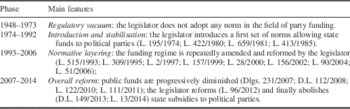
In what follows, I will verify these assumptions by analysing changes in party relationship with the state and party competition patterns in Italy. In fact, while the organisational dimension of the cartel party thesis has been investigated thoroughly (Bardi, Ignazi and Massari Reference Bardi, Ignazi and Massari2007; Ignazi, Bardi and Massari Reference Ignazi, Bardi and Massari2010; Pizzimenti and Ignazi Reference Pizzimenti and Ignazi2011), the broader systemic dimensions have received little attention (Pacini Reference Pacini2009; Pacini and Piccio Reference Pacini and Piccio2012; Piccio Reference Piccio2014). In particular this contribution addresses the following questions: does the Italian case fit with the cartel party thesis, is it possible to argue that the funding schemes adopted have conditioned party competition. To this end, I proceed to an in-depth reconstruction of the law-making process in the field of party funding from 1948 to 2014. To get a rapid snapshot of the evolution of the Italian party funding regime it is possible to identify four different phases (Table 1). In the next sections I will analyse each of them, focusing in particular on the third and the fourth, which cover the years of the so-called Second Italian Republic (1994–2014).
The evolution of the public funding regime in Italy (1948–2014)

Source: re-elaborated from Pizzimenti and Ignazi 2011, p. 202.
I concentrate on the main reforms adopted, by observing the relevant changes in the criteria set to access public funding. In addition I analyse data on the total amount of direct public funds allocated to the Italian parties and their impact on total party income; I also consider the funds allocated to party parliamentary groups as an additional source of state support to party organisations. To assess the impact of public subsidies on party competition I will observe the ‘deterrent power’ of the funding regime, i.e. its capacity to discourage (small) party challengers from participating in the electoral process. By following Scarrow’s (Reference Scarrow2006b) suggestion I will focus first on the share of vote going to parties that gain less than 5 per cent of the vote; second, the number of parties winning legislative seats; and lastly, the number of parties that gain at least 0.5 per cent of the vote. The research is based on both primary sources (laws and regulations; party balance sheets; parliamentary accounts; parliamentary budgets) and secondary sources (the specialised literature).
The regulatory vacuum (1948–1973)
The Italian Republican Constitution (art. 49) mentions political parties as fundamental actors in determining national politics through ‘democratic methods’. However, the article neither regulates specific aspects of intra-party dynamics (functional/organisational arrangements), nor defines the binding requirements that political parties must conform to (Pacini and Piccio Reference Pacini and Piccio2012). The legacies of the authoritarian regime – in particular, the interpenetration between the Fascist party and the state and the contemporary ban on political oppositions – were still too vivid to formally recognise political parties as state organs (Bianco Reference Bianco2001; Biondi Reference Biondi2012). Moreover, the transition between the authoritarian regime and democracy was led by the anti-fascist parties, whose primary interest was to preserve their recovered autonomy and reinforce their organisations through the occupation and exploitation of the democratic institutions (Scoppola Reference Scoppola1996; Pasquino Reference Pasquino2002).
In time, as parties strengthened their control over society, economy and institutions, the debate on their public role gained new relevance. The progressive establishment of the particracy regime could not but raise questions on the relationships between parties and the state (Calise Reference Calise1994; Pasquino Reference Pasquino1995). The deeply-rooted and cross-ideological prejudice against state control – which extended from the Liberals (PLI) to the Communists (PCI) – held back the parliamentary debateFootnote 4 on the opportunity to regulate party organisations and to introduce a public funding scheme.Footnote 5 However, the increasing costs associated with the maintenance of a widespread system of patronage, clientelism and vote-buying (Di Mascio Reference Di Mascio2012), and the financial needs of flourishing mass-bureaucratic party organisations would soon turn into the conducive factors behind the spread of a co-operative attitude among all major parties.
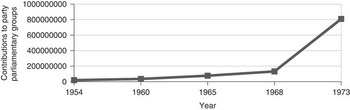
In the second half of the 1960s all the established parties agreed to double the contributions allocated by the two Chambers to party parliamentary groups to cover the costs of their offices and operational activities. As Fig. 1 clearly shows, the total amount of funds assigned to the groups by the Chamber of Deputies dramatically increased from 1968 (although the 1973 data must be analysed considering the devaluation of the lira following the end of the Bretton Woods system). This significant change was explained in the Chamber’s financial statement published in 1970 in these terms (p. 3): ‘the doubling of the contributions to party parliamentary groups is due to their growing needs: the parliamentary groups fulfil relevant constitutional functions that need to be adequately considered’ (author’s translation). However, it was only after a political corruption and bribery scandal – which involved personnel of the government parties (Democrazia Cristiana, Partito Socialista Italiano, Partito Socialista Democratico Italiano) and representatives of the national Union Oil Company – and in the wake of a widespread public mistrust toward party politics, that the parliament rapidly approved the first law introducing direct public subsidies to extra-parliamentary party organisations (Pacifici Reference Pacifici1983).
Contributions to party parliamentary groups, Chamber of Deputies (1954–1973). Source: personal elaboration of data published by the Chamber of Deputies (http://storia.camera.it/documenti/doc#nav). The amount is expressed in Italian lira.

The main justification advanced by the promoters of Law 195/1974 was the need to control party income to prevent illicit party financing (Bianco Reference Bianco2001). Among the then relevant parties (Sartori Reference Sartori1976), only the PLI voted against the law, claiming that it would hinder new parties’ parliamentary access and that it favoured the strengthening of national party oligarchies (Musumeci Reference Musumeci1999). The till then hostile PCI, on the other hand, supported the funding scheme, which has been interpreted as the by-product of a reactive and collusive response to citizens’ discontent with hidden party funding (Pizzimenti and Ignazi Reference Pizzimenti and Ignazi2011).
The introduction and stabilisation of the funding scheme (1974–1992)
The funding scheme set by L. 195/1974 assigned to political parties two kinds of direct subsidies: annual contributions to support the functional activities of party parliamentary groups and reimbursements for electoral campaigning. While the former were only formally allocated to the party in public office, as the ultimate recipient of 90 per cent of the funds was the party’s extra-parliamentary organisation (Bianco Reference Bianco2001),Footnote 6 the latter did not consist in proper ‘reimbursements’, as the money earmarked for parties winning at least 2 per cent at the national elections far exceeded their stated electoral expenditures.Footnote 7 The management of public funds was left in the hands of the party’s national head office, while the main competencies to control parties’ annual financial statements and campaign reports, as well as applying administrative sanctions, were assigned to a board of auditors nominated by the presidencies of the Chamber of Deputies and the Senate, thus to political organs controlled by the parties themselves. In addition, the controls over party accounts were almost formal, as the designated organs had no substantial investigative powers.Footnote 8
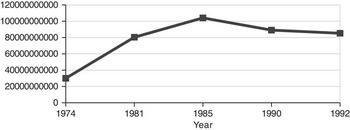
In 1978 a first referendum for the abrogation of the funding scheme was promoted by the Partito Radicale, the PLI and the leftist Proletarian Democracy (DP). However, the votes in favour of the abrogation (43.6 per cent) failed to achieve the majority, as all the major governing parties – including the PCI, at the time promoter of the ‘national solidarity’ formula – pushed their electorate to vote against the abrogation. This result paved the way for the adoption of two other laws, L. 422/1980 and L. 659/1981: while the former extended the electoral reimbursements to European and regional elections, the latter increased the total amount of funds to be allocated, as shown in Fig. 2. The Partito Radicale was the only opponent of these modifications. By analysing the 1981 parliamentary debates, we see that the main argument in favour of the reform was that party democracy had been wounded by terrorism and by ‘negative, irresponsible campaigning against the established parties’: consequently democratic parties needed to be supported in order to preserve representative democracy.Footnote 9 This normative framework did not undergo any further reform until 1992.
The total amount of public funds allocated to the Italian parties (1974–1992). Source: personal elaboration of data from Pizzimenti and Ignazi 2011. The amount is expressed in Italian lira.

The low payout threshold to access the electoral reimbursements (2 per cent of the total vote) apparently contradicts one of the main pillars of the cartel party thesis, the strategy of established parties to prevent the success of potential challengers outside the cartel.
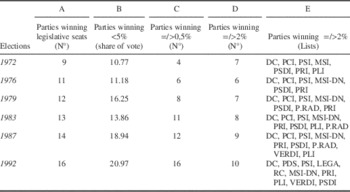
More generally, when analysing the patterns of political competition, data reveals that the funding scheme adopted did not preclude party fragmentation nor the access to funds of new political formations (Table 2). On the contrary, the share of votes obtained by parties winning less than 5 per cent doubled in 20 years (Table 2, column B), almost the same as the number of parties winning parliamentary seats (column A): moreover, the number of parties winning more than 0.5 per cent quadrupled in the period (column C). However, when focusing on the number of parties which passed the 2 per cent payout threshold, results are more stable (column D). By considering the results of the national elections preceding the introduction of direct funds (policy-off situation) it is possible to observe whether the limit set in 1974 was tailor-made to favour all the (then) relevant parties – DC, PCI, PSI, MSI-DN (Movimento Sociale Italiano Destra Nazionale), PSDI, PRI, PLI. From 1979 onwards the number of parties that succeeded in passing the threshold increased, as a consequence of the progressive de-freezing of traditional political loyalties and the de-ideologisation of party politics (Ignazi Reference Ignazi2002) – a widespread phenomenon throughout Western democracies, which is considered one of the main causes of party and party system change (Mair Reference Mair1997). In line with Scarrow’s observations (2006b) on the effects of public funding on party competition, not every funding scheme resulted in the outcome hypothesised by Katz and Mair: this was the case with the scheme adopted in 1974.
Party competition (1972–1992)

Normative layering (1993–2006)
In 1993 a new referendum promoted in the wake of the judicial inquiry ‘mani pulite’ (‘clean hands’) registered an overwhelming majority in favour of the abolition of the annual contributions to political parties (90.3 per cent). Following the result of the referendum, the parliament was forced to adopt a new law (L. 515/1993), which opened a decade of continuous reforms of the funding scheme: the outcome of this process was normative layering. However, continuity prevailed in several aspects of the law-making process, specifically in the reactive and collusive character of the norms; in the ineffectiveness of the external system of controls/sanctions; and in the lack of transparency of parties’ financial activities (GRECO 2012).
Similarly to what had happened in 1974, Law 515/1993 also represented a reactive attempt to combat the widespread system of corruption and bribery called ‘tangentopoli’, which, it was supposed, the introduction of public funds in 1974 would help to deter. Nevertheless, the extent of the reform was limited. The parliament was still dominated by representatives of the parties elected in 1992, when the judicial inquiry had just begun. Unsurprisingly, then, the window of opportunity (Kingdon Reference Kingdon1984) to combine the new discipline of party funding with party regulation was not capitalised on. On the contrary, the new law was inspired by a liberal approach (Biondi Reference Biondi2012) aimed at increasing the distance between the parties and the state: political finance was regulated within the general framework of the electoral legislation.
Law 515/1993 established new conditions to access direct funding, which consisted only in the reimbursement of campaign expenditure. However the term ‘reimbursement’ was still misleading, as public funds continued to far exceed the amount effectively spent by the parties during electoral campaigning. This led to a considerable increase in public funds destined for those political parties and political movements (a new type of collective actor recognised by the law) which were able to pass the new 3 per cent payout threshold or to elect at least one candidate in a single-member constituency.Footnote 10 State support continued to be extended also to party parliamentary groups, for their activities and staff (more than €262 million, on average, per year during the period).Footnote 11 The architecture of the external controls and sanctions was almost the same as the previous legal framework: however, the new law complicated things in that the controls on party balances were separated from those on party electoral expenditure.Footnote 12 None of the controlling organs wielded investigative powers: they only had the prerogative to control the conformity of campaign reports. The major competencies were still retained by the parliament, so that parliamentary parties were the main controllers of party activities.
In 1997 all the major parties (except the Partito Radicale) converged to approve a new law to integrate the existing legislation. Law n. 2/1997 introduced the possibility, for Italian citizens, of donating to political parties with parliamentary representation .004 per cent of their income tax. In the following two years the Ministry of State Treasury did not publish the official data on the total amount devolved to political parties by citizens. This lack of transparency casts doubts about the efficacy of the scheme, as well as the una tantum (one-off) tax appropriation of €135 million – to be assigned to parliamentary parties in 1997 and 1998 – contextually approved in 1997 by the parliament.
Most of the Italian parties born after the systemic collapse of 1992–1993 were not able to stabilise their organisational profile and suffered a structural lack of financial resources (Pizzimenti and Ignazi Reference Pizzimenti and Ignazi2011). In 1999 a new law (L. 157/1999) – voted through by a heterogeneous although less cross-coalition parliamentary majority – increased the total amount of public monies for electoral reimbursements, modified the fiscal rebate regime on private donations and, above all, lowered the payout threshold, from 3 per cent to 1 per cent.
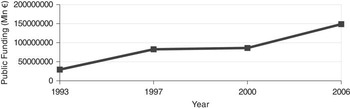
A referendum for the abolition of direct public funding failed in 2000.Footnote 13 After the introduction of the euro, Law n. 156/2002 significantly reduced the proportion of public funding: however, the electoral reimbursements were multiplied each year of the legislature! As a consequence, the funds due to political parties dramatically increased. Up to this point, funding ceased when a legislature ended prematurely: in 2006 this article was abolished, so that political parties would benefit from electoral reimbursement even after the dissolution of parliament before its natural due date. As Fig. 3 shows, the total amount of direct public funding to political parties, in 2006, had more than quintupled compared to that in 1994.
The total amount of public funds allocated to the Italian parties (1993–2006). Source: personal elaboration on party balance sheets. The amount is expressed in euros.

By looking at the 1993–2006 period it is almost impossible to delineate the profile of the Italian funding scheme: the high number of modifications, often inconsistent with each other, makes it difficult to place the Italian case within the recurrent normative frameworks adopted in Europe. Consequently it is hard to identify the eventual impact of state funds on party competition. Furthermore during the same period the Italian parliament reformed the electoral system twice,Footnote 14 , so that the overall analysis of party competition cannot but be heavily conditioned by these relevant changes. However it is possible to single out some specific aspects that may help an inductive interpretation of inter-party competition, on the one hand, and of the relationship between political parties and the state, on the other.
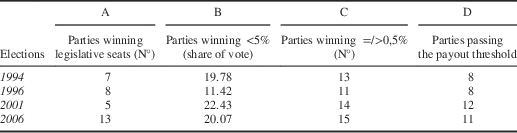
First, the significant lowering of the payout threshold to access electoral reimbursements (from 3 to 1 per cent) can be interpreted as the by-product of the new bipolar dynamic inserted in a highly fragmented party system. The new electoral laws forced political parties to join alternative pre-electoral coalitions, whereas until 1992 governmental coalitions were formed after elections (Bardi, Ignazi and Massari Reference Bardi, Ignazi and Massari2007). As a consequence, both the centre-right and centre-left major coalitional partners needed the electoral support of small (or even micro) political parties and movements, which were mainly rewarded through public offices and public resources. This could have led to the lowering of the proportion of the vote payout threshold – which was easier to pass than the one set to win parliamentary seats (4 per cent). Unsurprisingly, then, while the number of parliamentary parties decreased up to 2001 (Table 3, column A), the number of parties that received the electoral reimbursement for national elections increased from eight in 1994 to 12 in 2001 (Table 3, column D). One of the main objectives of the 1993 electoral reform – to reduce party fragmentation – failed to achieve this result (Table 3, columns B and C).
Party competition (1994–2006)

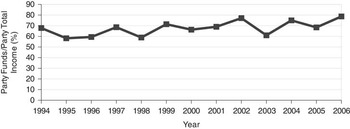
The inclusiveness of the cartel, then, was the by-product of a bipolar electoral competition inserted into a fragmented party system, which led to the formation of over-sized pre-electoral coalitions. The adoption of a PR-oriented electoral law, in 2005, contributed to the fragmentation. As for the relationship between political parties and the state, it is worth noting that, although parties had been subsidised for more than 30 years, at the beginning of the new century they were still regulated like private associations (Biondi Reference Biondi2012). This long-standing shared consensus on the need to preserve themselves from state control is indicative of the collusive attitude of all the established parties – an indication that is reinforced when considering the bland transparency requirements and the poor external controls set over party financial reports (GRECO 2012). All the laws were adopted as a consequence of external pressures (as in 1993) or as a means to maintain scarcely institutionalised party organisations. The dependence of Italian parties on state funds is clear when analysing party accounts: public funding constituted, on average, 67.7 per cent of parties’ total incomes (Fig. 4).
The incidence of state funds on party total income (1993–2006). Source: personal elaboration on party balance sheets.

The reform of the political finance regime (2007–2014)
In 2012, Mario Monti’s technocrat government promoted a reform of the funding regime: Law 96/2012 represented a significant step toward an overall rationalisation of the legislation in the field and a first attempt to connect party funding to party regulation. On 20 February 2014, the Chamber of Deputies approved Law 13, which suppressed direct public funding and other kinds of direct contributions to political parties. The law was passed during the brief transition between the government headed by Enrico Letta and the new executive led by Matteo Renzi, both supported by a cross-coalition (albeit different) parliamentary majority.
The main factors that brought these significant changes, however, were not rooted in a broader reflection on the shortcomings of the existing layered, fragmented and opaque funding regime. Yet the causes of this apparent paradigmatic shift were to be found in political and economic contingencies: the worsening, since 2008, of the country’s public deficit; governmental instability (neither the centre-left nor the centre-right executives elected, respectively, in 2006 and 2008 were able to complete their legislative term); the launch and the sudden electoral success of the Movimento 5 Stelle (M5S), a new political actor openly hostile to established party politics and in favour of the immediate abolition of state funding to political parties; and the re-emergence of widespread phenomena of political corruption and bribery, which involved politicians from almost all parties.
Within this general framework, the public debate on political finance was increasingly dominated by pressing requests to abolish party funding and the issue was rapidly included in the institutional agenda. In 2008 the state audit court intervened publicly to denounce the numerous problems associated with the existing regimeFootnote 15 and, five years later, raised a question of constitutional legitimacy of all the norms adopted after 1993, which were considered ‘elusive’ and ‘manipulative’ of the 1993 referendum result.
Unsurprisingly, the rules adopted in this last phase also adopted a reactive approach: inter-party collusion still emerges, although the issue of political finance was further politicised, especially in connection with the new scandals of political corruption. The theme of the privileges held by the political ‘caste’, in contrast to the increasing difficulties faced by ‘ordinary citizens’, was harshly debated by public opinion and the mass media (Bobba and Seddone Reference Bobba and Seddone2014). The rising discontent forced the established parties – even those traditionally in support of public funding – to change their official position. Analysis of the parliamentary debate clearly reveals the state of emergency in which parties adopted Law 96/2012 (author’s translation): Footnote 16
Colleagues, we cannot hide: we are approving the law under the pressure of a section of public opinion, while we should have done it before the present economic and political storm (Aurelio Salvatore Misiti, Misto-Grande Sud-Partito per l’Autonomia).
This attitude was even clearer two years later, when public attention towards public funding reached its peak. In the preamble of the decree law then converted into L. 13/2014 it is explicitly stated that
Considering the difficult economic situation of the country, the adoption of drastic measures of public deficit containment is needed, in line with citizens’ expectations of abandoning the party funding regime.
The established parties feared the challenges brought by the M5S, whose permanent campaigning against the privileges of politics was rapidly turning into electoral success. It is interesting to notice that almost all the parliamentary parties were in favour of maintaining some form of public funding, although significantly reduced. This attitude is well exemplified in some interventions by MPs who voted in favour of the suppression:Footnote 17
The MPs of Sudtiroler Volksparei and Movimento per l’Autonomia will vote in favour of the abolition of direct public funding. However all of us, and of course our party, are convinced that political funding must be public. But because of what has happened, and in the eyes of public opinion, we are forced to decide this way (Albrecht Plangger, Gruppo Misto-Minoranze Linguistiche).
For sure this reform is not conclusive (Antonio Leone, Nuovo Centro Destra).
It is our firm belief that the issue of public funding will be discussed again – and very soon – by this Chamber (Roberto Capelli, Gruppo Misto-Centro Democratico).
Both in 2012 and 2014 parliamentary debates focused also on the need to rethink the functions and role of political parties in contemporary democracies. Although L. 13/2014 introduced a set of more defined rules on party organisation requirements, neither in 2012 nor in 2014 did the Italian parliament approve a general reform of the relationships between political parties and the state, so that the overall debate acquired a mere symbolic value.
In general, the main goals of the laws passed in this last phase were the following: the review of the objectives of party funding; the reform of indirect and private funding; the introduction of basic party regulation;Footnote 18 and the introduction of a new set of external controls on the transparency and regularity of party financial activities and reporting.
Law 96/2012 was not intended to eliminate direct funding, but to modify and rationalise the existing regime, by reducing the maximum amount of state subsidies to €91 million (50 per cent less than in 2011). The cut of public funds to political parties had already begun in 2007 (minus 10 per cent) and between 2010 and 2011 (minus 20per cent): but it was the overall ratio of the law that made it the first effective attempt to reform the funding regime since 1993. The reform distinguished between, on the one hand, direct contributions for electoral reimbursement and political activities (70 per cent of the total amount of the funds), and on the other, a co-funding scheme in proportion to the funds parties were able to collect autonomously through grass-roots revenues and private donations (30 per cent). Although the introduction of a co-funding scheme was intended to promote political participation, parties could benefit from state subsidies only if they passed the 2 per cent election threshold and/or if they could elect at least one candidate to the European Parliament or in a Regional Council.
Law 13/2014 abolished all direct funding through a progressive reduction of the funds due for the following three years. The new regime maintained at 26 per cent the fiscal rebate regime on private donations between €30 and €30,000, introduced in 2012. Public disclosure of private donors was mandatory: the amount of money paid by a single individual and/or private company could not exceed 5 per cent of a party’s total income. In addition, the possibility was (re)introduced for citizens to allocate on a voluntary basis .002 per cent of their income tax to political parties regularly enrolled in the official register, the other relevant innovation of the law. Political parties and movements had to conform to a specific set of rules to be enrolled in the official public register. Enrolment was not the only condition: only parties with parliamentary representation (at least one elected candidate) or whose lists contested in at least three constituencies or regions could access the benefits set by the law for private funding.
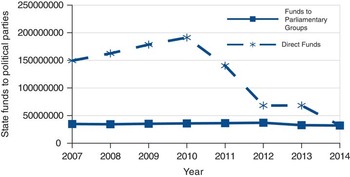
Compared to the past, two new tendencies seem to distinguish the most recent evolution of the Italian political finance regime: first, a long-standing trend of increasing direct funding for parties gave way to a process of contraction, culminating in its abolition (Fig. 5); second, a kind of state regulation was finally introduced to regulate party organisations. While the sum allocated to party parliamentary groups remained almost the same, the gradual reduction of electoral reimbursements began at the height of the financial crisis, before the reforms approved in 2012 and 2014 by all major established parties (Fig. 5). It is interesting to note that, in both cases, the extreme right-wing (Lega Nord) and left-wing parties (Italia dei Valori, Sinistra Ecologia Libertà) – plus the M5S, in 2014 – voted against these measures. However it is not possible to analyse the eventual impact of such reforms on party competition, as L. 96/2012 was approved in July 2012 and replaced in February 2014, while the national elections were held in April 2013.
State support to political parties (2007–2014). Source: personal elaboration on party balance sheets and data published by the Chamber of Deputies (http://storia.camera.it/documenti/doc#nav). The amount is expressed in euros.

Concerning the relationship between parties and the state, although party organisations were regulated for the first time they continued to be disciplined like private associations, in line with the cultural and institutional legacies of the past. External controls on party accounts were exerted by a new Commission on Transparency, composed of five public magistrates: the Commission was empowered only to verify the conformity and regularity of party statutes and accounts, in particular the proportionality between party expenditure and party income. The power to apply sanctions was still retained by the presidencies of the Chamber of Deputies and the Senate: in case of grave infractions, a political party/movement could be removed from the public register.Footnote 19
Conclusion
The aim of this study was to verify whether the introduction and the further evolution of the public funding regime, in Italy, have had consequences on the relationships between parties and the state and on party competition, in line with the assumptions of the cartel party theory. Empirical evidence has shown that inter-party collusion and party dependence on state funds are the only features that confirm the cartel-party argument, although Italy can be depicted as a case of the inclusive cartel-party model.
As far as the relationship between parties and the state is concerned, the research has shown that the peculiarity of the Italian case consists in the de-alignment of state subsidies and party regulation. Italian parties have always been regulated like private associations, in line with the legacy of the post-authoritarian period. Almost all parties, even if belonging to different ideological and organisational traditions, converged to maintain this legal status. Furthermore, in spite of the increasing and conspicuous amount of public funds received, the Italian parties – when acting as legislators – have always prevented the adoption of a set of effective external controls over their financial activities.
Although cartel-like patterns of collusive behaviour emerged in the law-making process, the funding schemes adopted did not prevent the access of new political formations to public subsidies; nor did they alter party competition. The format and mechanics of the political system changed as a consequence of a combination of external shocks and domestic causes (Cotta and Isernia Reference Cotta and Isernia1996), while it seems hazardous to hypothesise a direct influence played by the funding regime. Rather, the (layered and fragmented) legislation in the field of public subsidies responded mainly to political and economic contingencies. The payout threshold to access state funds has always been very low, as a consequence of a highly fragmented party system: in particular after 1993, when the inclusion of small (or even micro) political parties in pre-electoral coalitions became fundamental to winning elections. In addition the law-making style has always been of a reactive kind: all the laws were adopted following public discontent about widespread scandals of political corruption and bribery (in 1974, 1993, 2012 and 2014) or to simply enable parties to survive (the reforms adopted in 1997, 1999, 2002 and 2006).
Acknowledgements
The author would like to thank the anonymous reviewers for their helpful and constructive comments that greatly contributed to improving the final version of the article.
Notes on contributor
Eugenio Pizzimenti is Assistant Professor of Political Science and Comparative Politics at the Department of Political Sciences, University of Pisa. His research interests focus on representative democracy, particularly party politics. He is author or co-author of many publications in the field of political finance regime and party organisational change in Italy and at EU level. His latest article is ‘Party Organisational Change. Formal distribution of power between national and regional levels in Italian political parties 1991–2012’,in Participation and Conflict, vol. 8, 2015/n. 1, with E. Calossi.