Introduction
The maternal behaviour of the sow, the farrowing environment and type of management at the time of farrowing will all have a great impact on piglet survival. In Norwegian, loose-housed sow herds, piglet mortality ranges between 5% and 24%, and these huge differences between herds are most likely due to differences in management (Andersen et al., Reference Andersen, Melbø, Haukvik and Kongsrud2007). Crushing and starvation may explain 50% to 80% of the postnatal piglet mortality (e.g. Svendsen et al., Reference Svendsen, Bengtsson and Svendsen1986; Dyck and Swierstra, Reference Dyck and Swierstra1987; Andersen et al., Reference Andersen, Berg and Bøe2005), and as much as 60% to 80% of these deaths occur within the first 2 or 3 days after farrowing (e.g. Dyck and Swierstra, Reference Dyck and Swierstra1987; Marchant et al., Reference Marchant, Rudd, Mendl, Broom, Meredith, Corning and Simms2000). An increased management effort within this period is therefore expected to increase the survival rate and give the farmer more pay-off in terms of more piglets weaned.
When sows are kept loose in a farrowing pen, the sow interacts more with the piglets and maternal motivation and protectiveness are likely to have a great impact on piglet survival (e.g. Wechsler and Hegglin, Reference Wechsler and Hegglin1997; Pitts et al., Reference Pitts, Weary, Fraser, Pajor and Kramer2002; Andersen et al., Reference Andersen, Berg and Bøe2005). Postnatal mortality is often reported to be lower when sows are confined than when they are kept loose during farrowing and lactation (Svendsen et al., Reference Svendsen, Bengtsson and Svendsen1986; Cronin and Smith, Reference Cronin and Smith1992; Marchant et al., Reference Marchant, Rudd, Mendl, Broom, Meredith, Corning and Simms2000). However, other results show that piglet survival may be similar when comparing crated and loose-housed sows (Schmid, Reference Schmid1992; Weber and Schick, Reference Weber and Schick1996; Cronin et al., Reference Cronin, Lefébure and McClintock2000). Piglets from sows kept in farrowing crates appear to spend more time lying in the creep area than piglets from sows kept loose in a pen, and the sows are generally more active when they are not confined (Blackshaw et al., Reference Blackshaw, Blackshaw, Thomas and Newman1994).
Recent studies show that piglets may spend more than 3 h from birth to the first successful suckling (Thingnes et al., Reference Thingnes, Andersen, Torsethaugen and Pedersen2008). During this time these piglets will suffer from a huge heat loss, and this loss of energy can be fatal when competing with piglets that occupy a teat in less than 1 min after birth. Recent work in Denmark also shows that piglets with poor ability to maintain their body temperature in the first 2 h after birth are the ones that are most likely to starve or being crushed (Pedersen et al., unpublished). The lower critical temperature of a newborn piglet is 34°C (e.g. English and Morrison, Reference English and Morrison1984), and environmental temperatures below this level will initiate cold stress. While undergoing cold stress, the piglet suffers from reduced locomotive vigour, and because of this handicap, the risk of being overlain by the sow or loosing access to a teat will be higher (English and Wilkinson, Reference English and Wilkinson1982; English, Reference English1993). Furthermore, piglets that receive too little milk and have a lower weight gain spend more time near the sow begging for food and nuzzling the udder outside the time of nursing (Weary et al., Reference Weary, Pajor, Thompson and Fraser1996). This in itself will increase the risk of being trampled on or overlain by the sow.
In crated sows there is some indication that drying and placing the piglets under the heat lamp directly after birth will reduce piglet mortality to a large extent (Christison et al., Reference Christison, Wenger and Follensbee1997). Routines, including among others removal of placental envelopes around the piglets, drying the piglet with a towel, placing them under the heat lamp, tying the umbilical cord, providing extra oxygen with a facial mask, administering fluids to dehydrated piglets, and injecting colostrum or milk-replacer orally immediately after birth, may reduce piglet mortality with around 8% compared to unsupervised litters (Holyake et al., Reference Holyake, Dial, Trigg and King1995; White et al., Reference White, Anderson and Bate1996). A farmer on a commercial pig unit may not be willing to conduct some of these more time-consuming and complex routines, but a relatively unskilled person can administer simple and more practical routines such as drying and placing the piglets under the heat lamp after a short period of training. This requires that most farrowings are attended, but especially when large batches of sows are farrowing at the same time, the benefit of enhanced piglet survival may justify the use of extra labour at the time of farrowing.
The aim of the present experiment was to investigate the effects of one type of management around the time of farrowing that included placing newborn piglets under the heat lamp or both drying and placing them under the heat lamp on piglet mortality.
Material and methods
Experimental set-up and animals
The experiment was conducted on a commercial, Norwegian farm with loose-housed sows. A total of 67 litters from five batches (16 sows farrowed every 7th week) were used, and all the experimental groups were represented in every batch. Twelve to 14 litters from each batch were used in the experiment. Only healthy sows with no movement disorders were used. One batch of sows farrowed within 1 week.
In this experiment, 67 (Landrace × Yorkshire) healthy sows with different parities (two to four) were distributed into three different experimental groups: a control group where the farrowings occurred without supervision from the farmer (C; 23 litters), another group where the piglets were placed into the creep area under the heat lamp directly after birth (HL; 22 litters) and a third group where the piglets were dried with straw and paper towels followed by placing them into the creep area under the heat lamp directly after birth (DHL; 22 litters). Concerning the control litters, the farmer was allowed to assist birth for sows having birth problems, but he was not allowed to interfere in near-crushing situations when he could hear piglets scream. This was achieved by motivating the farmer to stay away from the control litters as much as possible. The piglets were not closed inside the creep area, but were free to move around in the pen. In the treatment where the piglets were placed in the creep area under the heat lamp, the piglets were lifted gently and carried to the creep area immediately after birth. The other treatment included first drying and massaging with straw and paper towels, followed by gently placing the piglet in the creep area under the heat lamp. The routines in the experimental groups required the farmer to attend the farrowings from the onset of birth of the first piglet until the last piglet was born. Sows receiving some kind of illness or disease around farrowing (for instance mastitis, metritis and agalacti) were removed from the experiment. Irrespective of treatment, all litters were given iron orally on day 3. Furthermore, tooth grinding was conducted on all litters, and castration was done 7 to 10 days after farrowing.
Housing and feeding
During pregnancy, the sows were kept in groups of around 15 in pens with straw bedding and individual feeding stalls. Ten to 14 days before expected farrowing, the sows were moved to the farrowing unit and placed into individual, farrowing pens (3.2 m × 2.0 m) with solid, concrete floor in the front 2/3 of the pen and slatted floor in the last 1/3 of the pen. The sows were kept loose both during farrowing and lactation. A creep area with a triangular, wooden roof, an infra-red heat lamp (150 W) placed through the roof, and concrete floor covered with sawdust, was located in the front right of the farrowing pen. The height from the roof to the floor was 60 cm, and a 20 cm-long plastic skirt was hanging from the roof to prevent draft in the creep area. The feeder of the sow was located in the front of the pen on the left side. No additional local heat sources were used around the time of farrowing. Room temperature in the farrowing unit was kept constant on 18 to 20°C. The room was mechanically ventilated. In addition to light from windows, artificial light was kept on between 0730 and 1600 h.
The sows were fed with a standard concentrated diet of wet feed twice a day. Around farrowing, a ration of 1.5 kg was given, and this was increased to 2.0 kg on day 1 after farrowing and 5.0 kg 1 week after farrowing. The pens were cleaned and new litter (sawdust) was provided both in the sow area and in the piglet creep area twice a day (in the morning and afternoon). The sows had free access to water from nipple drinkers.
Post mortem examination
All dead piglets were weighed and subjected to a post mortem examination at the farm to ascertain the cause of death. This was done by a highly experienced veterinarian from the Norwegian Pig Health Service. The following categories were used: crushed with or without milk in the stomach, no milk in the stomach (indicator of starvation), stillborn (inflated lungs), other causes (for instance Escherichia coli infection, naval bleeding, born weak or other unidentified causes). The dead piglets were collected in plastic bags, and sow number, date and time of the day when the piglet was found were noted. The post mortem was done once a day during the entire farrowing period.
Farrowing duration (the time from birth of the first until birth of the last piglet) was registered in the control group where the sows were not disrupted in any way.
Statistics
For the analysis of proportion of live-born piglets that died and from different causes, a generalized model, Poisson regression, was conducted by using the GENMOD procedure in SAS. The following treatments were included as class variables: control (C), placed under the heat lamp (HL) and dried and placed under the heat lamp (DHL). Litter size (no. of live born at birth) was included as a regression variable. For the analysis of how many litters were affected by crushing (crushing or not within each litter, 0/1-variable), we used a GENMOD procedure in SAS including the same class variables and litter size, but with a binomial distribution function. Mean ± s.e. are given. Pearson correlation was used to analyse the relationship between farrowing duration and causes of death in the control litters.
Results
There was no significant difference in the number of live-born piglets between treatments (control, C: 13.2 ± 0.6, placed under the heat lamp, HL: 12.9 ± 0.6, dried and placed under the heat lamp, DHL: 12.7 ± 0.4). Percent of stillborn piglets (of total born) was significantly lower in both treatment groups than in the control group (Table 1), but there was no significant difference between the HL and the DHL treatment. There was no significant effect of litter size on the percent of stillborn piglets.
Causes of piglet mortality in the different treatments (except for stillborn piglets, which is given in mean ± s.e. % of the total number of piglets born, all the other causes of death are given in mean ± s.e. % of live-born piglets per litter)

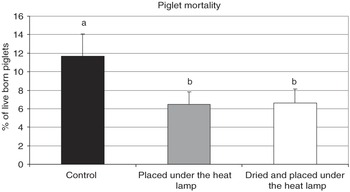
Mortality of live-born piglets (% of live born) was significantly lower in the HL and DHL groups than in the control litters (Figure 1). Postnatal mortality also increased significantly with increasing litter size (χ 21,63 = 5.6, P < 0.05).
Postnatal mortality of live-born piglets in the different treatments. Bars with different superscripts differ significantly (χ 22,63 = 43.2, P < 0.0001).

Percent of piglets that had no milk in their stomach (i.e. starved piglets) was significantly lower in the HL treatment than in the DHL and control group (Table 1). An increased litter size was associated with an increased percentage of piglets with no milk in their stomach (χ 21,63 = 7.2, P < 0.01). Drying and placing the piglets under the heat lamp resulted in the smallest percentage of crushed piglets (Table 1), but simply placing the piglets under the heat lamp also reduced the incidence of crushing significantly compared to the control group. A majority of the crushed piglets in the control group had received milk before the time of crushing (Table 1), and the proportion of crushed piglets that had received milk was more significantly affected by the treatments than the proportion of crushed piglets that had not received any milk before the time of death. Other causes of death (such as E. coli infection, naval bleeding, etc.) were also significantly affected by the treatments (Table 1). All death causes of live-born piglets increased significantly with increasing litter size (no milk: χ 21,63 = 26.2, P < 0.0001; crushed with no milk: χ 21,63 = 7.2, P < 0.01; crushed with milk: χ 21,63 = 14.7, P < 0.0001; crushed in total: χ 21,63 = 21.9, P < 0.0001; other causes: χ 21,63 = 15.6, P < 0.0001).
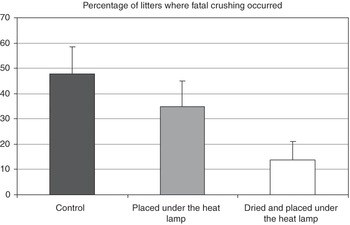
Compared to the control group, crushing occurred in significantly fewer litters in the treatment where piglets were both dried and placed under the heat lamp (χ 22,63 = 6.0, P < 0.05), but there was no significant effect of litter size. In the treatment including both drying and placing litters under the heat lamp, fatal crushing of one or more piglets by the sow occurred in only 13.6% of the litters, whereas this was increased to 34.8% and 47.9% when litters were only placed under the heat lamp or not subjected to any supervision at all (Figure 2). The maximum number of piglets being crushed in one litter was three.
Percentage of litters where one or more piglets were crushed by the sow.

Almost 60% of the crushed piglets with milk in their stomach were found the day after farrowing (total number dead: 22), whereas the majority (70%) of the crushed piglets with no milk in their stomach were found on day 2 (total number dead: 12). None of the crushed piglets with milk in their stomach were found on day 4 or 5. More than 70% of the starved (no milk in their stomach) piglets were found on days 2 and 3 (total number dead: 28). In general, most of the piglet mortality occurred within the first 3 days after farrowing.
Mean farrowing duration for the control group was 4.2 ± 0.3 h. Farrowing duration ranged between 2 and 12 h (only one sow), but only 8% of the farrowings lasted more than 6 h. A longer farrowing duration was associated with a higher % of stillborn piglets (R = 0.6, P < 0.05), but none of the other causes of death were significantly correlated to farrowing duration.
Mean weight of crushed piglets with milk in their stomach was 1.2 ± 0.1, whereas the starved piglets (that had not received any milk) and the crushed piglets with no milk in their stomach both weighed on average 0.8 ± 0.1.
The exact amount of extra working hours for the farmer was not recorded. Several sows farrowed at the same time or with overlapped time, and the farmer also spent time on other activities in between piglet births. We have still estimated the extra work to be around 2–3 h for each of the 44 attended farrowings.
Discussion
Routines used in the present study, such as placing the piglets under the heat lamp and drying/massaging them, will potentially reduce heat loss and stimulate blood circulation. As a consequence, the piglets will have more energy left to find and maintain a certain position at the udder, thereby increasing the chances of survival. Acquisition of passive immunity through colostral milk shortly after birth is considered to be the most important ‘ticket’ to survival (Tuchscherer et al., Reference Tuchscherer, Puppe, Tuchscherer and Tiemann2000; Rooke and Bland, Reference Rooke and Bland2002). Extended supervision around the time of farrowing where a combination of several routines, among others, including the routines in the present study, is reported to have major effects on piglet survival in crated sows (Holyake et al., Reference Holyake, Dial, Trigg and King1995; White et al., Reference White, Anderson and Bate1996; Christison et al., Reference Christison, Wenger and Follensbee1997). However, to our knowledge, there are no data concerning the effects of these types of routines when sows are kept loose. Treatments such as providing extra oxygen with a facial mask, administering fluids to dehydrated piglets, and injecting colostrum or milk-replacer orally immediately after birth would demand high skills of the farmer and are much more time consuming than simply drying and placing the piglets under the heat lamp. It is important to study the effects of each of these routines separately and in a systematic way to find out which routines are likely to produce the best results.
The present work showed that all causes of mortality were significantly lower when the piglets were placed under the heat lamp or both dried and placed under the heat lamp immediately after birth compared to the control group. Furthermore, most causes of piglet mortality declined even more when drying/massaging the piglets was done before placing them into the creep area compared to only placing them into the creep area immediately after birth. These are simple routines that can easily be done by relatively unskilled workers and without spending too many extra hours in the barn. Potentially, an increased presence of the farmer at the time of farrowing may also increase piglet survival in an indirect way, since it is easier to discover sows with birth problems and near-crushing events. Especially on the first 2 days after farrowing when the majority of crushing incidents occur, the farmer can prevent many piglets from being fatally crushed by just listening to piglet screams and assist wherever needed. The extra work and also the economical benefit of this work will depend strongly on how many sows farrow within one batch and on birth synchrony (i.e. the more the synchronous, the more the farrowings that can be attended at the same time, and thus take fewer hours of work). Considering our specific experimental farm with 16 sows per batch and on average 13 live-born piglets per sow, a 5% reduction in piglet mortality would amount to 0.65 piglets per litter. Per batch this would save around 10.4 piglets and the economical benefit of that will entirely depend on the price per piglet in each country. Comparatively, as much as 19.5 extra piglets are expected to survive in a batch of 30 sows. However, as we see from the present and several other studies (e.g. Pedersen et al., Reference Pedersen, Jørgensen, Heiskanen and Damm2006), an increased litter size will increase piglet mortality and also impair the maternal behaviour and investment in the litter (Andersen et al., submitted for publication), and thus potentially reduce the benefits of improved management.
The percent of litters where one or more piglets were crushed was much less when newborn piglets were both dried and placed under the heat lamp compared to only placing them under the heat lamp or no treatment at all. In fact, only around 13% of the litters lost some piglets due to crushing when the piglets were both dried and placed under the heat lamp, compared to more than 30% when the piglets were only placed under the heat lamp, and almost 50% in the unsupervised litters. A combination of quickly drying and warming may increase the vitality of the newborn piglet in a way that potentially reduces the risk of being crushed by the sow. However, to minimize the time to first suckling, it is important not to close them inside the creep area. An increased piglet vitality may both increase the speed with which the piglets escape from near-crushing events and also the likelihood of surviving when overlain or trampled on by the sow. This is of particular importance in individually loose-housed sows where the majority of piglet mortality is due to maternal crushing or a combination of crushing and starvation (e.g. Dyck and Swierstra, Reference Dyck and Swierstra1987; Marchant et al., Reference Marchant, Rudd, Mendl, Broom, Meredith, Corning and Simms2000; Andersen et al., Reference Andersen, Berg and Bøe2005).
For most pig producers it is a goal to let the sow do most of the job in weaning a large number of piglets herself without too much human interference. In other words, the willingness of the farmer to increase the working effort at the time of farrowing would probably be limited to the routines that are most likely to increase piglet survival and thus increase the direct pay-off to the farmer. At present, there is still a great need to document which type of routines are most efficient in producing certain ‘rules of thumbs’ for improving piglet survival in commercial farms. In a recent field survey, herds that consistently helped the piglets to get colostrum immediately after birth had around 3% lower piglet mortality than herds that did not practise this routine (Andersen et al., Reference Andersen, Melbø, Haukvik and Kongsrud2007). It is important to note that this did not imply holding the piglets at a certain teat during milk let-down, which may appear difficult and extremely time consuming, but simply to place some of the piglets at the udder and to make sure that they sucked one of the teats shortly after birth. In the future experiments we will compare the effects of this routine with the ones used in the present study.
Future research should include comparing to what extent different routines at the time of farrowing can improve piglet survival in crated and loose-house sows under both experimental and commercial conditions. For instance, if two or more routines are combined, does this have additive effects on piglet survival? Or which of the routines are most efficient in saving piglets? These are all questions of major importance to improve piglet survival in modern pig production.
In conclusion, mortality of live-born piglets was strongly reduced when piglets were either placed under the heat lamp or both dried and placed under the heat lamp in the creep area immediately after birth compared to the control group with no extra supervision. Furthermore, both drying and placing the piglets under the heat lamp resulted in fewer litters with fatal, maternal crushing. Because of the relatively large potential that some of these rather simple routines may have to improve piglet survival, different types of management or human interference around the time of farrowing should be compared on a larger scale both experimentally and on commercial farms.
Acknowledgements
This project was financed by the Norwegian Research Council. We would like to thank the farmer for letting us use the sows.