Introduction
‘The ability of government administrators to establish the routine by which revenues were collected, money raised and supply requisitioned could make the difference between victory and humiliation’.Footnote 1
Thus wrote John Brewer about the English state in the late seventeenth and eighteenth centuries; for him, the modern British state arose from the strengthening of revenue-gathering institutions necessitated by Britain's continuous involvement in the international conflicts of this period. Brewer's analysis suggested that, given certain conditions, states might emerge strengthened, not weakened, from an armed conflict. The Republic of China's experience during the Second Sino-Japanese War was very different from that ideal. The Nationalist Government of Chiang Kai-shek's Guomindang Party (hereafter GMD) emerged from the war with its finances and its reputation badly damaged. In this paper, I argue that this dual process was due to the way in which the Nationalist wartime government addressed the exigencies of wartime fiscal policy. The reason for the fiscal collapse of the wartime Nationalist state was its loss of tariff revenue. Since the Maritime Customs Service (hereafter Customs) was the most efficient and effective revenue-gathering institution of the pre-war Nationalist state, the wartime loss of tariff revenue, and the use of alternative fiscal instruments accelerated the administrative disintegration of the wartime Nationalist state. This disintegration caused a progressive loss of legitimacy of the Nationalist state, which is reflected in the way in which the wartime Nationalist government has been portrayed as fiscally incompetent and corrupt until the present day.
Since The Abortive Revolution, Lloyd Eastman's seminal work on Nationalist China during the Nanjing decade (1928–1937), an important theme in English-language studies of the Chinese Nationalist Party has been to focus on its fiscal and budgetary incompetence as well as the ultimate failure of its military efforts against the Chinese Communist Party.Footnote 2 This perception is heavily influenced by what Hans van de Ven termed the Stilwell-White paradigm, which posited that the Nationalist regime failed because it was corrupt, authoritarian and militarily incompetent.Footnote 3 General Joseph W. Stilwell, the chief United States military advisor to the Nationalist Government during World War II, recorded in an undated note found among his papers that the Chinese people could only expect ‘greed, corruption, favouritism, more taxes, a ruined currency, [and] terrible waste’ from the Nationalists under Chiang Kai-shek.Footnote 4 Theodore H. White, drawing on six years’ experience as TIME magazine's correspondent in the Nationalist wartime capital, Chongqing, wrote in 1946 of both the ‘extravagance and debauchery of the Kuomintang's machine’ and its ‘brutality and extortion’.Footnote 5 The Stilwell-White paradigm found its most lucid expression in Barbara Tuchman's Stilwell and the American Experience in China which, in order to demonstrate that ‘China was a problem for which there was no American solution’, went to great lengths to demonstrate that the Nationalist movement had been ‘overtaken by the compromises and corruption of climbing to power’.Footnote 6
In the following, I explore how the Customs as a revenue-collecting institution adapted to the outbreak of war, and investigate the functioning of the two chief wartime fiscal instruments employed by the Customs, the revised Interport Duty, and the Wartime Consumption Tax. From 1937 until 1940, GMD fiscal policy managed to preserve a degree of relative stability. The loss of the remaining central Chinese provinces in 1940, and the consequent loss of Customs revenue propelled GMD fiscal policy into a secular collapse, leading to deficit financing and hyperinflation. The Customs’ demise as a foreign-led institution with wide-ranging independence from the Nationalist Ministry of Finance was linked to its diminishing importance in terms of revenue extraction, and intensifying hostility towards the Customs from elements within the Nationalist Government. This demise heralded the end of stable Nationalist fiscal policy as implemented during the Nanjing decade, and the collapse of the pre-war Nationalist state.
Context
The Second Sino-Japanese War forced the Nationalist Government to accelerate its existing project of widening its tax base. The war also regularized many of the particularities of China's tariff system arising out of the Unequal Treaties concluded in the nineteenth century. Ultimately, GMD fiscal policy did not survive the Nationalist Government's loss of control over the Chinese seaports. By early 1938, the Nationalists had lost control over ports which hitherto had yielded 80 per cent of Customs revenue. While the Customs countered the loss of tariff revenue from the ports through developing other revenue-collecting strategies, these alternative sources of revenue never compensated for the revenue lost from the seaports, particularly in terms of the sustainability of revenue extraction. The state of the Chinese economy was such that it could not sustain the expense and industrial output required for a modern war for more than a short period of time.Footnote 7
Until 1937, GMD fiscal policy was successful. Reporting on Customs net revenue, E. D. G. Hooper, the Acting Financial Secretary, wrote to the Nationalist Government's Finance Minister, Kong Xiangxi, in early 1937 that ‘now, finally. . .it has reached the very considerable figure of 16 million dollars,. . .a sum which constitutes the largest revenue surplus on record for any one month since the Inspector-General took control of the Customs revenue and of the foreign loans and Indemnity and Internal Loans Service [in 1911]’.Footnote 8 Hooper attributed this increase to ‘a growing revival of world trade and general economic recovery. . ., together with signs of returning prosperity in China fostered by successful currency reform, settlement of outstanding political differences in the South and bumper harvests and the amelioration of smuggling conditions throughout the country’.Footnote 9 Similarly, the British Embassy's country report for 1937 records an upward trend in trade:
Had it not been for the hostilities, the trade figures for 1937 might well have approached those of the previous record year of 1931, before the world depression had begun to affect this country. By the end of July [1937], imports had gained 36.7 per cent and exports 45.5 per cent [on the previous year's figures]. In fact, in the summer of 1937, China's foreign trade was for the first time showing that it had almost completely recovered from the financial crisis of 1934–1935, which was caused largely by the exodus of silver owing to the high price of metal abroad.Footnote 10
The Customs and foreign interests, 1937–1941
From the Japanese invasion of China proper in July 1937 until December 1941, the Customs’ position in Japanese-occupied territories was anomalous insofar as it was protected by the Treaty Powers’ interest in the security of Customs revenue as a source of revenue for the service of foreign obligations. British interest in the Customs’ status quo, and the lengths to which Britain was prepared to go diplomatically to ensure this status, were demonstrated most clearly in the case of the British-Japanese Customs Agreement of 3 May, 1938. This agreement specified that revenue collected in the occupied areas was to be deposited with the Yokohama Specie Bank, and revenue already deposited in the Hong Kong and Shanghai Bank was to be transferred to this Bank. The Yokohama Specie Bank was then to remit full quotas for the service of foreign obligations to the Inspector-General of Customs. The Chinese Nationalist Government was to accept the financial burden of converting these quotas into foreign currency, and was also to release the Japanese portion of the Boxer Indemnity payments, payment of which it had suspended since autumn 1937.Footnote 11
Britain and Japan concluded this agreement without consulting the Nationalist Government. Additionally, it did not provide for the release of revenue quotas from the occupied areas for the service of the domestic financial obligations of the Nationalist Government. In consequence, the Nationalist Government refused to acknowledge the legality of this agreement, claiming that the agreement violated the principle of non-interference of foreign powers in China's internal affairs as guaranteed in the Washington Agreements of 1922.Footnote 12 The Nationalist Ministry of Finance allowed the Customs to place revenue collected in the occupied areas in Yokohama Specie Bank accounts, but refused all the other arrangements suggested in the British-Japanese Customs Agreement.
At its most instrumental level, the demise of the Customs as the principal revenue-collecting institution of the Nationalist Government was linked to the sharp decline of its contribution to central government revenue during the Second Sino-Japanese War (cf. next section). This demise would not have occurred, had the Customs not been weakened as an institution through the decline of the revenue it delivered. However, a growing Nationalist hostility towards the Customs as ‘an agency in the British orbit’ was also an important contributing factor.Footnote 13 Brewer points to the importance of the societal legitimacy of a state's revenue-gathering institutions in determining their fiscal efficacy: the Chinese Maritime Customs provided a fascinating variation on this theme, since their continued functioning in the occupied territories caused a perceived loss of legitimacy particularly on the part of the Nationalist state itself.Footnote 14 This loss of legitimacy, which had its origins in the nationalist discourse on the Unequal Treaties of the nineteenth century, intensified because of what the Nationalists perceived to be the weakness of British foreign policy in the late 1930s.
Losing control
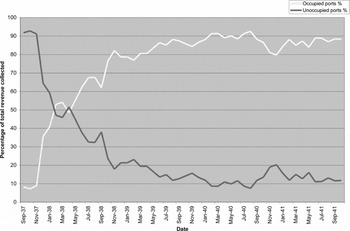
Under the terms of the British-Japanese Customs Agreement, concluded in defiance of China's reclaimed tariff autonomy, revenue collected in Japanese-occupied territory had to be paid into reserve accounts at the local branch of the Yokohama Specie Bank, and was not remitted to the Nationalist Government any more. Figure 1 shows the relative shares of Customs revenue collected in unoccupied and Japanese-occupied territories respectively (to speak of unoccupied territory as Nationalist-controlled territory would be to overstate the extent of the GMD's political and military control).
Share of Customs Revenue in Unoccupied China, September 1937 to September 1941.
Source: Based on SHAC 679/32750 F. W. Maze to P. T. Chen, Private and Confidential (21 October, 1939), (September 1937 to September 1939); SHAC 679/1/28980 ‘Financial Secretary's Correspondence with Ministry of Finance’, passim (September 1939 to September 1941).

The fall of Shanghai on 9 November, 1937, and the Japanese conquest of the entire Lower Yangzi Delta by March, 1938, accounted for a 45 per cent decrease in the amount of revenue over which the Nationalists had control. Guangzhou and Hankou fell on 18 October and 25 October, 1938 respectively. The fall of Hankou signified the Japanese conquest of the geographic and economic macro-region of the middle reaches of the Yangzi River. This conquest, together with the fall of Guangzhou, reduced the portion of Customs revenue controlled by the Nationalist Government to less than 20 per cent. By the time the Nationalist Government suspended the service of foreign loans on 15 January, 1939, it only controlled just over 20 per cent of Customs revenue. Calculated on a quarterly basis, the Nationalist Government controlled 20.91 per cent of Customs revenue in the last quarter of 1938 compared with 82.77 per cent in the last quarter of 1937.Footnote 15
Until the end of 1942, the revenue collected by the Chinese Maritime Customs in ports controlled by the Japanese military was recorded as Nationalist Government revenue. However, this revenue was paid into revenue accounts opened by the Yokohama Specie Bank in each port under the pretence of being held in trust by the Japanese Government until the end of the war. Chen Jingkun (陈 景 琨), who defected from the collaborationist Wang Jingwei regime's Maritime Customs Service to the Nationalist Government's Maritime Customs Service in Chongqing in 1944, described this arrangement in detail:
Revenue collection at these ports, after payment of local office expenditure and statutory grants to certain local government organisations, were retained in toto and accumulated locally in the revenue accounts of the ports concerned either with the Yokohama Specie Bank, or, in its absence, the Bank of Taiwan. Nominally, the balances so retained have always been regarded as still being held by the custodian banks, but, as a matter of fact, according to information gathered through informal sources, they are non-existent, having either been loaned to the bogus governments to meet administrative expenses or appropriated by the Japanese authorities for other purposes.Footnote 16
More specifically, the ‘quotas for. . .foreign loans and indemnities as due by each of the occupied ports before 1943, calculated in accordance with its revenue collection, [were] regarded as having been set aside locally in the ports’ revenue accounts but included in their frozen balances’. In other words, the loan and indemnity service quotas, like the remainder of Customs revenue in occupied areas, had in fact already been used up by the time of Japan's surrender in August 1945.Footnote 17
Following the Japanese attack on Pearl Harbour on 7 December, 1941, and the subsequent declaration of war against Japan by the United States and Britain, Japanese forces invaded the International Settlement at Shanghai, where the Inspectorate General was still located. On 11 December, 1941, Sir Frederick Maze was dismissed as Inspector General of Customs (hereafter IG) by Wang Jingwei's Nationalist Government, and replaced by Kishimoto Hirokichi, previously Chief Secretary (effectively second-in-command) within the Inspectorate General, and a Japanese national. In response, the Ministry of Finance of Chiang Kai-shek's Nationalist Government, by then based in Chongqing, ordered the local Commissioner of Customs to establish a new Inspectorate General of Customs in Chongqing. From then until September 1945, two Customs services existed in China, both claiming legitimacy as an institution.Footnote 18 David Barrett has claimed that Wang Jingwei's Nationalist Government was characterized to a great degree by continuity, rather than disjuncture with Chiang Kai-shek's Nationalist Government.Footnote 19 The case of the Customs controlled by Kishimoto's Inspectorate General in Shanghai support Barrett's argument, since it retained the majority of Customs staff, including the remaining neutral or Italian axis nationals and controlled the greater number of Customs stations.Footnote 20 Until the introduction of the Wartime Consumption Tax by Chiang Kai-shek's Nationalist Government in 1942 (discussed in the next section), it also collected the same kinds of duties, albeit at lower rates.
Like the Customs in Nationalist-held China, the Customs of Wang Jingwei's Nationalist Government experienced a decrease in importance of import and export tariffs receipts within total Customs receipts. Import tariff receipts were replaced as the most important source of Customs revenue by Interport Duty receipts. A report on ‘Revenue Collection in Occupied China’ compiled by the Chongqing Inspectorate General of Customs in 1944 noted that ‘the fact that most of the import and export trade [was] being carried on by military transports without passing through the Customs [had] reduced to insignificance the collection of import and export duties and therefore also the revenue and flood relief surtaxes’.Footnote 21 Import duties on goods from Japan and Manchukuo, and on goods withdrawn from bonded warehouses accounted for approximately 10 per cent of revenue collection, and export duties for another 5 per cent to 10 per cent. As a result of this decline, the Kishimoto Inspectorate General was forced to close some of its existing Customs stations.Footnote 22 The majority of Customs revenue in Japanese-held areas derived from Interport Duty; the collection of this tax having increased through the establishment of additional collecting stations.Footnote 23
Wartime fiscal instruments, 1937–1945
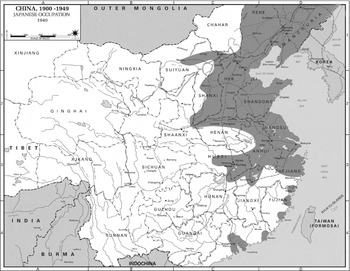
Besides the Nationalist Government's progressive loss of fiscal control over the territories producing the majority of Customs revenue, the success of the Japanese campaign also affected the functioning of Nationalist fiscal policy in other ways. In particular, it fostered the development of wartime fiscal instruments designed to deliver revenue under changed revenue-collecting conditions. By April, 1938, Customs revenue held in unoccupied areas accounted for merely 52 per cent of total Customs revenue (cf. Figure 1). Meanwhile, between August, 1937 and April, 1938 (the first nine months of hostilities), the value of import trade fell by 34 per cent, while import tariff revenue fell by 58 per cent compared with the same period in the previous year because of the increase in duty-free imports (particularly arms and army supplies).Footnote 24 In reaction to low tariffs introduced in Japanese-occupied and collaborationist-government-controlled areas (Figure 2), the Nationalist Government also implemented tariff cuts in unoccupied areas.Footnote 25 The collaborationist East Hebei Autonomous Government, for example, charged tariff rates equivalent to only one-fourth of Nationalist Government tariff rates.Footnote 26 The combined effect of the loss of control over revenue-yielding territories, tariff cuts and a decrease of tariff revenue, even when calculated at the notional nation-wide level, made the development of fiscal instruments suited to changed wartime conditions all the more imperative.
Japanese Occupation, 1940.
Source: ‘China Civil War, 1900–1949: Japanese Occupation, 1940’, Department of History, United States Military Academy, http://www.dean.usma.edu/history/web03/atlases/chinese%20civil%20war/ChineseCWGIF/ChineseCivilWar04.gif [Accessed 20 December, 2010].

The Interport Duty
Once the Nationalist Government had lost control over most of the Chinese seaports to the Japanese, and the Customs had lost the capacity to pay the revenue collected in these ports into the Bank of China, the two most important alternative sources of Customs revenue, successively, became the revised Interport Duty and the Wartime Consumption Tax. Both were old taxes, presented in a slightly different form and billed as emergency fiscal measures. The Interport Duty (转 口 税), levied on native goods moved between two Chinese ports, had been introduced in January, 1931 as part of the rationalization of the Chinese tariff system. It replaced the export duty on native goods, i.e. the duty charged on native goods when shipped between two treaty ports within China.Footnote 27 While the IG of Customs, Sir Frederick Maze, held that this tax was ‘from the point of view of a consistent tax scheme, anomalous’ since native goods transported between treaty ports would be ‘under a fiscal disability as compared with native goods when moved from a treaty port to an inland place or vice versa’; he also stated that the ‘abolition [of this tax], no doubt, [would] come in time’.Footnote 28
Instead, in September, 1937, the Nationalist Government changed the nature and scope of the Interport Duty from ‘goods [being] transported by steamer or aeroplane between treaty ports, but not on junk-borne or rail-borne goods, nor on goods transported by other routes on land’ or ‘even in the case of steamer-borne goods shipped between a treaty port and an inland place’. Because ‘in the circumstances the burden of taxation [was] not fairly borne by all merchants alike’ and ‘the collection of interport duty [had] also [suffered] considerably’, the method and scope of the collection of Interport Duty was changed so that it was ‘invariably [to] be levied on all native goods conveyed between a treaty port and an inland place or solely between inland places, regardless of whether they [were] transported by junks, railways, highways, or steamers’. The Interport Duty rates were fixed at 7.5 per cent for native goods paying ad valorem duties, and at 5 per cent for native goods paying specific duties (up from an effective 2 per cent based on the 1858 tariff rates, and now based on the 1931 Export Tariff). According to the Nationalist Ministry of Finance's Office of Customs Affairs, this change was introduced to ‘increase the revenue’.Footnote 29 The regulations defining the interaction of this newly defined tax with other aspects of the Nationalist fiscal regime remained the same —Interport Duty was only to be paid once: it was not to be levied on goods already having paid other national taxes, and it was to be refunded, or credited against Export Tax in the case of native goods being exported abroad after paying Interport Duty. The Customs were given extra power to collect the new Interport Duty:
When goods liable to interport duty are loaded or discharged at, or pass through, places where there is a Customs establishment, interport duty should invariably be levied by the Customs or Maritime Customs stations as the case may be. The Customs are also authorised to establish additional stations in order to facilitate the collection of interport duty.Footnote 30
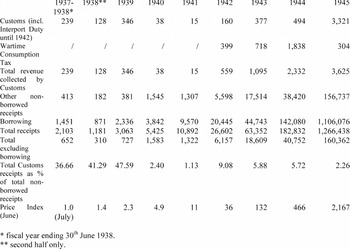
These powers, however, had to be used advisedly, and also within the budgetary constraints of the wartime Customs Service. In the circular accompanying these instructions, Sir Frederick Maze wrote that ‘duty on goods borne by rail should be levied only at places of loading or discharge’ unless there were ‘exceptional circumstances which [permitted] the Customs to take special action’. Similarly, despite the new powers to establish additional collecting stations, ‘discretion [would] have to be exercised to ensure that the expenditure [would] be justified’ because of the ‘present imperative need for drastic economy’.Footnote 31Figure 3 shows that, while the revised Interport Duty proved an effective fiscal instrument until the end of 1939, its revenue yield fell drastically in 1940 and 1941.
National Government Receipts 1937–1945 (in millions of Chinese $).
Source: Young, China's Wartime Finance and Inflation, pp. 332, 358; Bickers, R. (2007). ‘The American IG: L. K. Little and the End of the Foreign Inspectorate, 1943–1950’, unpublished manuscript, p. 25.

The Wartime Consumption Tax
The Interport Duty was abolished with effect from 15 April, 1942, and replaced by the Wartime Consumption Tax.Footnote 32 The Wartime Consumption Tax was the reincarnation, albeit under a different name, of an even older form of taxation, the lijin (厘 金) or transit tax (transliterated in older texts as likin). Lijin had been abolished by the Nationalist Government on 1 January, 1931, as part of the commitments undertaken by Duan Qirui's government in the ‘Treaty between the Nine Powers relating to the Chinese Customs Tariff’ concluded at the Washington Conference on 6 February, 1922, that led to the restoration of tariff autonomy to China by the Treaty Powers between 1927 and 1929.Footnote 33 The problems arising from lijin abolition were due to the nature and form of collection of this tax. A transit tax that was formally introduced to finance provincial military expenditure during the Taiping Wars, lijin was collected at roadside barriers, and by members of diverse central and local government agencies.Footnote 34 To collect lijin, no expertise or skill was necessary, as it was for Customs revenue collection: all that was required was military power to enforce payment if necessary. For this reason, lijin was a favourite financing tool of local power-holders and remained so even after the Nationalist Government officially declared its collection illegal after 1 January, 1931.
Recognizing its own inability to enforce lijin abolishment, in 1930 the Nationalist Government offered central government subsidies to the provincial governments in an attempt to compensate them for revenue to be lost through lijin abolishment.Footnote 35 Despite this attempt to purchase compliance with central government instructions, lijin continued to be collected by local power-holders. The Chinese Government, the Chinese merchant community and the foreign community in China all associated lijin with everything that was wrong with China's fiscal system.
For the Nationalist Government to revert to charging transit tax in 1942, albeit under a different name, was to admit that it was impossible, under the circumstances then prevailing, to sustain the programme of fiscal reform and rationalization advanced during the Nanjing Decade. While the revision of the Interport Tax had empowered the Customs to collect tariffs on goods transported by all means of transport within Nationalist-held China, the system of the Wartime Consumption Tax gave the Customs yet greater revenue-collecting powers. The Officiating IG, C. H. B. Joly, noted that:
As will be seen from the regulations the introduction of the Wartime Consumption Tax is, to all intents and purposes, a tax on the consumer. It follows therefore that the tax is not only to be levied on goods on [sic] movement but is also to be levied at places where the goods are produced or consumed. Pending the enforcement of regulations governing the registration of factories and payment of tax on existing stocks and goods produced, you may, as a temporary measure, concentrate at first on collecting the tax on all goods moved and consumed locally and gradually extend your activities, with the assistance of the Chambers of Commerce and Trade Guilds to every city and district if its collection justifies the establishment of a Customs Station.Footnote 36
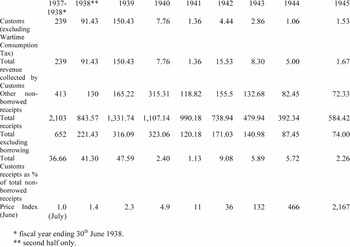
As the figures in Figure 3 show, the Wartime Consumption Tax delivered significant amounts of revenue from 1942 until 1944. In 1942, the first year in which the Customs collected the Wartime Consumption Tax, the Customs’ share of unborrowed government revenue increased to 9.08 per cent, from 1.13 per cent in 1941, the last full year in which the Customs collected the revised Interport Duty. This share fell to just under 6 per cent in 1943 and 1944, and the increase in the Wartime Consumption Tax revenue collected fell behind the increase of the price index, as is shown in Figure 4. However, the Wartime Consumption Tax was collected until 25 January, 1945.Footnote 37 It was abolished for the same reason that had led foreign merchants to complain so vociferously about lijin, namely its negative impact on trade within China.
National Government Receipts 1937–1945 (in millions of Chinese $) Adjusted for inflation using July, 1937 prices.
Source: All figures based on Figure 3 above.

Commenting on the introduction of the Wartime Consumption Tax, Arthur N. Young, the Nationalist Government's chief financial advisor, recollected in 1965 that ‘clearly the method was far from good, and in a memorandum of January 15, 1942, I [had] warned of the danger that such taxes would degenerate into a system of endless barriers to trade and movement, as the old likin had’. The result of the introduction of the Wartime Consumption Tax was ‘to restore an obstructive system similar to the old likin or transit tax, the abolition of which in the early 1930s, though not wholly effective, had been one of the fine accomplishments of the Nationalist Government’. For Young, lobbying for the Customs to be awarded the job of collecting the Wartime Consumption Tax was a way of limiting its potentially damaging effect by giving this responsibility to an institution which had no vested interest in perpetuating it.Footnote 38
Because of its highly intrusive nature, the Wartime Consumption Tax was frequently resented, not only by local power-holders who stood to lose revenue by the imposition of a new central government tax, but also by consumers.Footnote 39 Complaints against this new tax were varied and ranged from procedural complaints to physical mistreatment. In one case reported from Wuzhou (梧 州) in September, 1942, a range of complaints was combined in order to achieve greater effect with the IG of Customs and the Office of Customs Affairs. The complaints are arranged, in ascending order of importance, from a procedural mistake to the emotive charge of physical violence against a woman by low-ranking Customs officials. The Office of Customs Affairs ordered an internal Customs investigation into the latter charge, which resulted in the fact that the woman had been stopped while attempting to walk past a Customs barrier without having her baggage inspected. The local Commissioner of Customs denied that the woman had been assaulted by a member of his staff, and reported that, when questioned by local police, the woman had withdrawn her accusation. The attempt to evade taxation by linking a procedural complaint with a highly emotive one had therefore failed.Footnote 40
Besides its intrusive nature, general unpopularity and negative impact on trade within Nationalist-controlled China, there was another reason why the Wartime Consumption Tax was abolished. Implementing the Nationalist Government's instructions on revenue collection brought the Customs into conflict with other revenue-collecting and anti-smuggling institutions of the Nationalist Government, of which a plethora had sprung up in wartime, particularly since the Nationalist Government's move to Chongqing. In his circular transmitting the Ministry of Finance's original instructions regarding the introduction of the Wartime Consumption Tax, Joly noted that:
As the various Tax Bureaux in the provinces have now been ordered by the Government to abolish all local taxes on the movement of cargo from the date of introduction of the Wartime Consumption Tax by the Customs, the action taken by the local authorities in this regard should be reported by despatch in due course.Footnote 41
Anomalies of wartime trade
The anomalies of wartime trade affected both Customs revenue and the Customs’ primacy as a revenue-gathering and anti-smuggling institution. The decline in Customs revenue and the Customs’ loss of its privileged position were both causes and effects of the collapse of Nationalist fiscal policy. After 1939, legal trade was carried on across enemy lines.Footnote 42 For this reason, one faces conceptual difficulties when defining the meaning of ‘smuggling’ in wartime China. When analysing China's foreign trade before the beginning of the Second Sino-Japanese War, the distinction between licensed and unlicensed trade is more meaningful than that between trade and smuggling. During the war, however, the Nationalist Government's policy added another layer of complexity to the understanding of licensed and unlicensed trade. From October, 1937 until July, 1939 the Nationalist Government banned all trade with the Japanese-occupied areas of China. Anecdotal evidence as well as Customs statistics suggest that this trade went on regardless.
As stated above, by November, 1940 the Nationalist Government had lost control over seaports producing about 80 per cent of Customs revenue. The loss of control over the coastal areas, the North China Plain, the Lower Yangzi Delta and the middle reaches of the Yangzi (see Figure 2 above) meant that besides the areas generating the majority of Customs revenue, the Nationalist Government also lost control over the areas in which the emerging modern sector of China's national economy was located, and over key agricultural production areas. Faced with accelerating material depredation in the areas remaining under its control, the Nationalist Government in July, 1939 allowed the import of all but a list of specifically prescribed commodities ‘irrespective of their places of origin’, a euphemism for the Japanese-occupied areas.Footnote 43 In 1942, the number of prescribed commodities was lowered from 168 to 103—an indication of yet further material depredation:
. . .In reply to a query as to whether products of factories and firms in Hongkong and Shanghai—these two places being now occupied by the Japanese—should be treated as enemy goods and prohibited importation into Free China, the Ching-Chi Pu [Ministry of Economic Affairs] have notified the Ts'ai-cheng Pu [Ministry of Finance] of their ruling that goods produced by factories and firms in Hongkong, Shanghai, etc., other than those specified by them as enemy goods, should still be allowed importation into Free China in order to help stabilize prices and. . .meet the needs of the military and the general public.Footnote 44
This circular reveals the official motivation on the Nationalist side for permitting legal trade across enemy lines. The ambivalence of the Nationalist Government's position on trade with Japanese-held areas is well expressed in the following comment by the Officiating IG on a tariff increase on goods banned from importation into Nationalist-held areas:
. . .It is to be noted that the Government's revision of the duty rates for certain foreign goods on the embargo list does not mean their removal from the embargo list. The new rates are intended to be applicable to the articles concerned only when they are required to pay duty, e.g. seized goods and goods allowed importation under Special Import Permit.Footnote 45
At the same time, the decision to license trade with Japanese-held areas also created opportunities for Nationalist Government officials and military officers to seek their own financial advantage:
The Executive Yuan have received information that Government employees and employees of Government Enterprises have been found engaging privately in trade, in speculation, or in the hoarding of commodities. As such action is bound to affect the price of commodities and to disturb public confidence, the Yuan have ruled that the matter should be investigated and the offenders severely punished.Footnote 46
According to the United States’ embassy in Chongqing, the Japanese motivation in allowing this trade to carry on was the presumed inflationary effect on the economy of Nationalist-held China. By deliberately overpaying for goods imported from Nationalist-held areas, the Japanese military authorities in occupied China caused ‘inflation [to be] doubly aggravated by [the] drain of goods from and [the] increased supply of currency in Free China’.Footnote 47
Differing estimates exist as to the volume of trade between Nationalist- and Japanese-held areas. In 1940, the Nationalist Government estimated this trade to be worth Ch$400 millions (about US$21 millions), while the United States’ Office of Strategic Services (hereafter OSS) estimated a value of approximately Ch$2,280 millions (about US$120 millions).Footnote 48 Also according to OSS estimates, the volume of trade between Nationalist- and Japanese-held areas was even greater in 1941 than it had been in 1940. According to this estimate, 20,000 tons of goods were brought into Nationalist-held China monthly from Hong Kong, Macao and Guangzhouwan; a volume twice that of goods brought into Nationalist-held China by the Burma Road from British India.Footnote 49
Assessments of Nationalist trade with Japanese-held areas differ according to whether this trade is assessed in economic or in moral terms. With regard to the economic effect of trade across enemy lines, Eastman states:
In economic terms, it is probable that the Nationalists generally benefited from the inflow of goods. Without the cloth and other consumer goods brought in from the occupied area, life in the interior would have been harsher and perhaps even intolerable. Moreover, to the extent that these goods partially satisfied consumer demands, the trade had a moderating effect on the spiralling inflation.Footnote 50
It is interesting to note that Eastman's conclusion regarding the effect of trade across enemy lines on inflation is the exact opposite to that drawn by the United States Embassy in Chongqing, as quoted above. Regardless of its economic effects, trade with the enemy, whether licensed or unlicensed, was seen as anathema by many observers, such as the journalist Israel Epstein, who observed that this trade was ‘not only morally obtuse but strategically nonsense’.Footnote 51 Eastman also concludes that:
Even if the Nationalists derived economic benefits from the trade, however, these benefits must be weighed against the detrimental effects of the trade on the Chinese war effort. Supplying the enemy with food and with raw materials for their industries was surely a pernicious practice. And the massive involvement of the military appears to have thoroughly corrupted the officers stationed where they could participate in the traffic, which provided them with a personal interest in avoiding conflict with the Japanese. And the corruption and self-serving that were engendered by their commercial involvements weakened the already frail moral fibre of the Chinese army.Footnote 52
In our own assessment of this trade, we must beware of unreflectively integrating ourselves into an orientalist discourse of warfare, or indeed into the Stilwell-White paradigm itself. That the Chinese Nationalist wartime leadership did things differently from the way they were being done in Washington, DC or in London does not necessarily mean that they did them wrongly. Moreover, recent studies attest to the existence of trade across enemy lines during, for instance, the British-American War of 1812–1815. In the words of a United States militia officer: ‘They do say it is wrong to supply an innimy [sic] and I think so too,. . .but I don't call that man my innimy [sic] who buys what I have to sell and gives such a genteel price for it’.Footnote 53 There is indeed something to be said for Hubert Freyn's view:
Which side gains and which side loses if Japanese army gasoline finds its way, for a consideration, into Chinese hands? Or if Japanese cloth is bought to make uniforms for guerrillas or shivering Chinese farmers? Or if Shanghai and Hong Kong manufactures are ‘smuggled’ through the lines in order to fill, in the rear, a gap which local production is unable to close?Footnote 54
From the Customs’ point of view, trade with Japanese-held areas, both licensed and unlicensed, had an appreciable part in its downfall as the pre-eminent revenue-gathering institution of the Nationalist Government. While the taxation of licensed trade and seizures of unlicensed trade goods formed a source of Customs revenue, the complex and continually changing nature of trade across enemy lines made it increasingly difficult for the Customs to function effectively, since its virtual monopoly on collecting revenue on foreign trade and policing trade was being challenged by a proliferation of competing agencies under the direct control of the Nationalist Government or the Military.
During the Second Sino-Japanese War, the Customs also lost its primacy among revenue-policing and anti-smuggling organizations. The administrative upheavals of the war facilitated the rise of no fewer than three central government organizations nominally charged with smuggling suppression, but which in fact frequently engaged in trade with the occupied areas themselves. These organizations included the Tax Police (税 警 总 团; Shuijing Zongtuan), the Smuggling Prevention Bureau (缉 私 署; Jisi Shu) and the Wartime Goods Transport Management Bureau (战 时 货 运 管 理 局; Zhanshi huoyun guanli ju). All these organizations were controlled, more or less directly, by the Nationalist Military Secret Service (军 统; Juntong), under General Dai Li (戴 笠).Footnote 55 The Customs’ conflicts with the Juntong arose not least because Nationalist Government instructions to the Customs, such as the following, failed accurately to reflect the Juntong's power in the realm of trade and revenue collection.
. . .According to the regulations, the Customs are the only organ authorised to carry out inspections to prevent native goods from being sent for the use of the enemy, and. . .it is only at places at which there is no Customs establishment that the [Smuggling Prevention] Bureau may enforce the embargo. Seizures made by the Bureau should be handed over to the Customs for disposal according to the latter part of Article 10 of the regulations. If the Bureau [fails] to hand over seizures made by them, you are to report the matter by despatch, with a Chinese version in duplicate.Footnote 56
The conflicts with trade-policing institutions subordinate to the Juntong may well have contributed to an attempt by Dai Li in late 1944 to incorporate the Customs into his network of security agencies, and charge them with all cargo supervision, transport and security duties. L. K. Little, by then the IG, ‘strenuously’ resisted this proposal. To his relief, he learnt in January, 1945 that the Nationalist Government had formally decided not to proceed with this proposal.Footnote 57
The demise of the Customs
The demise of the Customs as a revenue-collecting institution of the Nationalist Government, but under foreign leadership and with a certain measure of administrative independence from the Nationalist hierarchy was over-determined in many ways. Early during the Second Sino-Japanese War, the Nationalist Government lost control over the areas that had yielded the greatest share of Customs revenue. Wartime duties collected by the Customs could not make up for this loss. The Customs also ended up on the losing side of the institutional turf-wars of the wartime Nationalist state. But besides fiscal realities, the main reason for the demise of the Customs was an increasing hostility within the GMD towards the Customs’ position during the War.
For the Customs, institutional survival mattered to such an extent that it obscured other responsibilities. Throughout the war, senior foreign Customs staff members argued with the Ministry of Finance and the Office of Customs Affairs about the degree to which Japanese aggression should be accommodated. In this conflict, old patterns came to the fore once more: a Chinese government concerned with its sovereignty over the Customs found itself confronting foreigners in leading positions within the Customs who were more concerned with the institutional survival of the Customs than with complying with the instructions the Customs received from the Chinese government.
During the war, the Customs also lost its perceived and actual primacy among the revenue-gathering institutions of the Nationalist Government. Between the Nationalists’ recovery of tariff autonomy in 1929 and the outbreak of war in 1937, the Customs rested assured in the knowledge that it provided the Nationalist Government with the single greatest share of government revenue, only once, in 1936, accounting for less than 40 per cent of central government revenue.Footnote 58 Within the provinces where the Nationalist Government exercised actual political and military control, the Customs could also rely on the Government's cooperation in reaching accommodations with revenue-gathering institutions seeking to extract revenue within the same territory. This changed after the Inspectorate General relocated to Chongqing. As the share of revenue delivered by the Customs fell, so did its clout compared with other revenue-gathering institutions. The roots of this decline are to be found in the period between the outbreak of the war and the removal of the IG to Chongqing. The decline was aggravated by a growing ‘hostility from elements in the Nationalist Government’ towards the Customs, partly ‘inspired by a genuine nationalist agenda which aimed to restore China's sovereign rights’, but also the result of ‘simple bureaucratic competition’ and ‘turf warfare’.Footnote 59
Conclusion
As a result of the Japanese occupation, Customs revenue collapsed, as did Nationalist Government revenue, and with it the Nationalist Government's fiscal modernization project. The difficult process of abolishing lijin illustrates the limits of GMD fiscal policy, and makes it quite clear that it cannot be judged against the criteria of a modern, centralized fiscal state. Likewise, bringing lijin back under a different name as the Wartime Consumption Tax only a few years after its official abolition as part of a programme of tax rationalization was an acknowledgement of defeat. The National Government's decision to license trade with Japanese-held areas had damaging consequences for China's fiscal system by creating conflicts of interest, and allowing the mushrooming of competing revenue-collecting and trade-policing agencies, while not establishing clear lines of responsibility.
Nationalist fiscal policy might have recovered some stability, and the Customs (which had established the revenue-collecting routines so crucial to Brewer's model) gained a reprieve as a foreign-led institution, albeit with diminished administrative independence of the Nationalist hierarchy, had China's external trade recovered quickly in the immediate post-war years. In the absence of such a recovery, the Nationalist Government had to rely on requisitions, taxation in kind and ever-increasing taxes on China's small urban sector. Thus the demise of the Customs as an institution, due to the Nationalists’ loss of control over large parts of its revenue base, heralded the collapse of Nationalist fiscal policy and the disintegration of the Nationalist polity. During this process of disintegration, the Nationalist state also became discredited, and it is still remembered thus today, aided by a historiography that singles out the fiscal decay of the Nationalist state as a manifestation of its corrupt nature and the incompetence of its leaders.