Introduction
Rumen degradation of dietary feed crude protein (CP) influences rumen fermentation and amino acid supply to ruminants. In particular, rumen-undegraded feed CP (RUP) together with rumen-synthesized microbial CP and endogenous CP contributes to the passage of metabolizable protein (MP) to the small intestine (Hristov et al. Reference Hristov, Etter, Ropp and Grandeen2004). Evaluation of the amount of dietary RUP is required by different feed evaluation systems (Broderick et al. Reference Broderick, Udén, Murphy and Lapins2004; Edmunds et al. Reference Edmunds, Spiekers, Südekum, Nussbaum, Schwarz and Bennett2014; Paz et al. Reference Paz, Klopfenstein, Hostetler, Fernando, Castillo-Lopez and Kononoff2014) to properly characterize feeds entering dairy cow diets.
The RUP could be estimated by adopting different in situ or rumen-based in vitro procedures, after correction for microbial nitrogen (N) colonization (Broderick Reference Broderick1987; Calsamiglia et al. Reference Calsamiglia, Stern, Bach, Givens, Owen, Axford and Omed2000; Gargallo et al. Reference Gargallo, Calsamiglia and Ferret2006). More recently, Ross et al. (Reference Ross, Gutierrez-Botero and Van Amburgh2013) proposed a two-step in vitro assay with rumen fluid to determine RUP as well as RUP intestinal digestibility in ruminant feeds (Spanghero et al. Reference Spanghero, Zanfi, Signor, Davanzo, Volpe and Venerus2015; Fessenden et al. Reference Fessenden, Hackmann, Ross, Foskolos and Van Amburgh2017; Giallongo et al. Reference Giallongo, Harper, Oh, Parys, Shinzato and Hristov2017). As discussed at length by Ross et al. (Reference Ross, Gutierrez-Botero and Van Amburgh2013), the assay was proposed to reduce sample loss and variation among samples due to use of bags. Furthermore, a novel approach to estimate microbial contamination of samples was tested, and it consisted of incubating a substrate low in N content, i.e. the neutral detergent (ND) residue of maize silage, during the in vitro rumen assay. However, these methods are difficult to standardize and require the use of rumen-cannulated animals, which are expensive to maintain and rarely available for commercial laboratories (Madsen et al. Reference Madsen, Hvelplund and Weisbjerg1997; Coblentz et al. Reference Coblentz, Abdelgadir, Cochran, Fritz, Fick, Olson and Turner1999; Hippenstiel et al. Reference Hippenstiel, Kivitz, Benninghoff and Südekum2015).
Alternatively, RUP values can be evaluated by adopting enzymatic methods based on the use of different commercially available bacterial, fungal, pancreatic or plant proteases: the literature (Luchini et al. Reference Luchini, Broderick and Combs1996; Stern et al. Reference Stern, Bach and Calsamiglia1997) provides a full description of these enzymes and their ability in predicting rate and extent of protein degradation. Among these, one of the most commonly used is the Streptomyces griseus protease (Krishnamoorthy et al. Reference Krishnamoorthy, Sniffen, Stern and Van Soest1983; Nocek Reference Nocek1988; Michalet-Doreau & Ould-Bah Reference Michalet-Doreau and Ould-Bah1992; Coblentz et al. Reference Coblentz, Abdelgadir, Cochran, Fritz, Fick, Olson and Turner1999; Calsamiglia et al. Reference Calsamiglia, Stern, Bach, Givens, Owen, Axford and Omed2000) and indications were that it was appropriate for differentiation of potential protein degradation of different feeds (Cone et al. Reference Cone, Van Gelder, Mathijssen-Kamman and Hindle2004; Chaudhry Reference Chaudhry2005). Therefore, the enzymatic approach has been largely adopted by both research and commercial laboratories to evaluate the RUP content of feeds entering dairy cow diets (Nocek Reference Nocek1988; Jones & Theodorou Reference Jones, Theodorou, Givens, Owen, Axford and Omed2000), despite poor relationships having been reported between rumen-based v. enzymatic-based RUP values (Luchini et al. Reference Luchini, Broderick and Combs1996; Gosselink et al. Reference Gosselink, Dulphy, Poncet, Jailler, Tamminga and Cone2004). The enzymatic approach was first proposed by Pichard & Van Soest (Reference Pichard and Van Soest1977) to evaluate the rate of hydrolysis of the insoluble protein fraction in forages (i.e. alfalfa hay or alfalfa, grass and maize silages) and soybean meal. Different authors have modified the enzymatic conditions since the 1970s, aiming to find optimal S. griseus protease working conditions for predicting RUP. In particular, several methodological aspects, such as S. griseus protease concentration or enzyme to substrate ratio (Krishnamoorthy et al. Reference Krishnamoorthy, Sniffen, Stern and Van Soest1983; Aufrère & Cartailler Reference Aufrère and Cartailler1988; Coblentz et al. Reference Coblentz, Abdelgadir, Cochran, Fritz, Fick, Olson and Turner1999), length of incubation (Mahadevan et al. Reference Mahadevan, Erfle and Sauer1980; Aufrère et al. Reference Aufrère, Graviou, Demarquilly, Vérité, Michalet-Doreau and Chapoutot1991; Cone et al. Reference Cone, Kamman, Van Gelder and Hindle2002, Reference Cone, Van Gelder, Mathijssen-Kamman and Hindle2004), buffer pH value (Cone et al. Reference Cone, Van Gelder, Steg and Van Vuuren1996; De Boever et al. Reference De Boever, Cottyn, De Brabander, Vanacker and Boucqué1996; Licitra et al. Reference Licitra, Lauria, Carpino, Schadt, Sniffen and Van Soest1998), type of substrate (Calsamiglia et al. Reference Calsamiglia, Stern and Firkins1995; Mathis et al. Reference Mathis, Cochran, Vanzant, Abdelgadir, Heldt, Olson, Johnson, Caton, Faulkner, Horn, Paisley, Mass, Moore and Halgerson2001) and pre- or post-incubations with carbohydrase or amylase (Assoumani et al. Reference Assoumani, Vedeau, Jacquot and Sniffen1992; Kohn & Allen Reference Kohn and Allen1995; Abdelgadir et al. Reference Abdelgadir, Cochran, Titgemeyer and Vanzant1997) have been evaluated. However, all these variations contributed to make the interpretation of results from different trials difficult (Klopfenstein et al. Reference Klopfenstein, Mass, Creighton and Patterson2001; Edmunds et al. Reference Edmunds, Spiekers, Südekum, Nussbaum, Schwarz and Bennett2014).
These methodological aspects were usually studied by adopting a ‘one-factor-at-a-time’ approach. This experimental approach consists of varying one factor at a time while keeping other factors fixed (Czitrom Reference Czitrom1999), thus supposing that: (i) different factors influence enzymatic RUP determination linearity and (ii) no interactions exist among different factors. However, the effects of different factors may not be linear, thus meaning that they could influence response variables in a curvilinear manner or concomitantly with other tested factors if interactions exist (St-Pierre & Weiss Reference St-Pierre and Weiss2009). Therefore, there is a need to design experiments in which tested conditions are changed simultaneously to quantify possible intra- (i.e. curvilinear) or inter- (i.e. interaction) non-linear relationships among different factors. As declared by Czitrom (Reference Czitrom1999), when testing the effects of two or more factors on a dependent variable, response surface methodology rather than a one-factor-at-a-time approach should be adopted, because: (i) it usually requires fewer resources (e.g. experiments, time, materials, etc.) to obtain the same or more information; (ii) estimates of the effect of each factor are more accurate, because a greater number of observations are tested; (iii) the interactions existing among factors can be systematically studied, whereas they are not estimable using the one-factor-at-a-time approach; and (iv) there is an opportunity to obtain information in a larger region of the factorial space. Despite the existence of several response surface methodologies, they can be assigned to two main categories: full or fractional factorial designs (Carley et al. Reference Carley, Kamneva and Reminga2004; Khuri & Mukhopadhyay Reference Khuri and Mukhopadhyay2010). As discussed by St-Pierre & Weiss (Reference St-Pierre and Weiss2009), among fractional factorial designs, the central composite design (CCD) appears able to reduce the number of treatments required to estimate all terms of a second-order polynomial equation considerably, without any loss of efficiency as compared with the full factorial design.
The aim of the current work was to identify, by adopting a CCD experimental design, the optimized combinations of three enzymatic methodological conditions, i.e. S. griseus protease concentration in the enzymatic working solution (CONC), length of enzymatic incubation (TIME), or total amount of sample CP incubated in the buffered enzymatic solution (CPW), to predict in vitro rumen evaluated RUP of different feed categories.
Materials and methods
Feeds and chemical analysis
A total of 26 samples consisting of solvent-extracted soybean meal (sSBM, n = 4), expeller-extruded soybean meal (eSBM, n = 4), solvent-extracted rapeseed meal (RM, n = 3), solvent-extracted sunflower meal (SFM, n = 3), soft white wheat bran (WB, n = 2), distillers dried grains with solubles (DDGS, n = 2), dried maize gluten feed (CGF, n = 1), dried maize gluten meal (CGM, n = 1) and alfalfa hay (AH, n = 6) were used in CCD. Both CGF and CGM were considered in the maize co-products (CCP) feed category. Among these, 18 samples (sSBM = 2, eSBM = 2, RM = 3, SFM = 3, WB = 2, DDGS = 2, CCP = 2, AH = 2) were re-used in the confirmatory test along with an additional set of 15 samples (SBM = 5, AH = 10) selected from samples sent to the laboratory of the Feed and Food Science and Nutrition Institute (Faculty of Agricultural, Food and Environmental Sciences, Università Cattolica del Sacro Cuore, Piacenza, Italy) for routine analysis. Samples with a mean particle size >1 mm (Gallo et al. Reference Gallo, Giuberti and Masoero2016a) were ground through a cutter mill (Pulverisette 19; Fritsch, Idar-Oberstein, Germany) equipped with a 1-mm screen. An aliquot (100 g) of AH samples was ground using a 2-mm screen to assay the in vitro RUP determination. All samples were analysed in duplicate as previously described by Gallo et al. (Reference Gallo, Bertuzzi, Giuberti, Moschini, Bruschi, Cerioli and Masoero2016b), except for dry matter (DM) assay, which was analysed once. In particular, DM was determined by gravimetric loss of free water from heating at 105 °C for 3 h (AOAC 1995, method 945.15), ash was determined as gravimetric residue after incineration at 600 °C for 2 h (AOAC 1995; method 942.05), CP (N × 6.25) was determined using the Kjeldahl method (AOAC 1995; method 984.13), and ether extract (EE) by the method 920.29 (AOAC 1995). The soluble fraction of CP (solCP, expressed on a CP basis) was determined according to Licitra et al. (Reference Licitra, Hernandez and Van Soest1996). The ND and the acid detergent (AD) fibre fractions were determined using the AnkomII Fibre Analyser (Ankom Technology Corporation, Macedon, NY, USA) according to the method described by Van Soest et al. (Reference Van Soest, Robertson and Lewis1991). The ND solution contained sodium sulphite and a heat-stable amylase (activity of 17.400 Liquefon units/ml, Ankom Technology). All fibre fractions were corrected for residual ash (i.e. aNDFom and ADFom).
In vitro rumen-undegraded feed crude protein determination
The in vitro RUP (expressed on a CP basis) was carried out in accordance with the rumen step of the method proposed by Ross et al. (Reference Ross, Gutierrez-Botero and Van Amburgh2013). In particular, fresh rumen fluid was obtained from two cannulated dry Holstein dairy cows (625 ± 10 kg of body weight, 38 ± 0.3 months old) fed at maintenance (NRC 2001) with a total mixed ration (120 g/kg CP and 550 g/kg aNDFom on a DM basis) composed of alfalfa hay, grass hay, maize silage, beet pulp and a protein vitamin-mineral supplement (250, 450, 150, 50 and 100 g/kg DM, respectively). The diet was administered to the cows twice a day, at 8.00 and 18.00 h. Collected rumen fluids were maintained in a warm, insulated carbon dioxide (CO2) flask at 39 °C, filtered through two layers of cheesecloth and used within 20 min from the collection. For each sample tested, about 500 mg were weighed into 125 ml Pyrex glass Erlenmeyer flasks, then 10 ml of filtered rumen fluid plus 40 ml of Van Soest buffer were added (Spanghero et al. Reference Spanghero, Zanfi, Signor, Davanzo, Volpe and Venerus2015). Blanks (buffered rumen fluid only) and maize silage previously treated with ND solution were incubated simultaneously to correct sample RUP for enzyme-derived and microbial N colonization (Ross et al. Reference Ross, Gutierrez-Botero and Van Amburgh2013). All samples were incubated in a water bath set at 39 °C. As indicated by Ross et al. (Reference Ross, Gutierrez-Botero and Van Amburgh2013), the contents of the flasks were filtered carefully (Whatman 54 filter paper) and residues analysed for CP content after 16 h of rumen incubation. Each sample was tested in duplicate on two different days. Samples within-day were considered analytical repetitions, whereas samples between days were experimental replicates.
Enzymatic rumen-undegraded feed crude protein determination
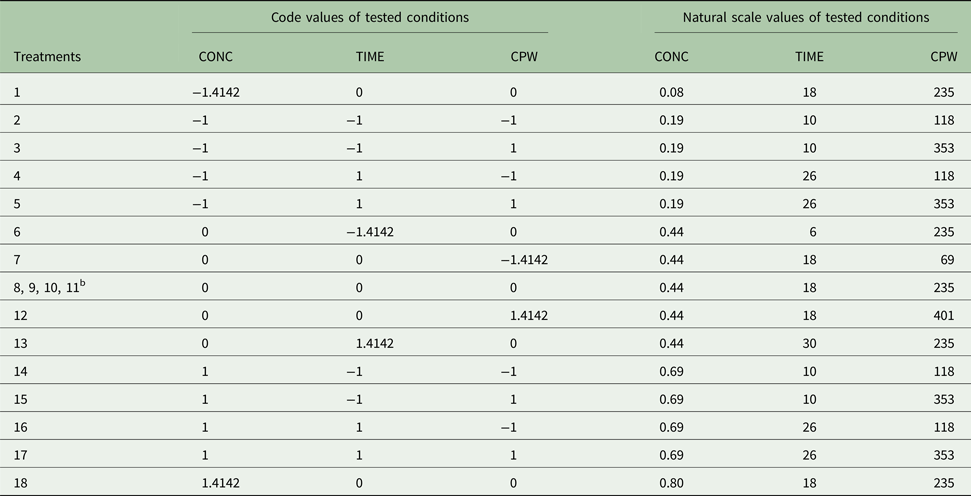
Three methodological factors, CONC, TIME and CPW, were tested simultaneously in the CCD experiment. Details of the statistical approach are reported elsewhere (St-Pierre & Weiss Reference St-Pierre and Weiss2009). In particular, 18 treatments were formulated, of which four were replications of the central point, combining the main tested effects at five different levels as planned a priori and detailed in Table 1. Codes used to test different levels for each factor were −1.4142 (−α), −1, 0, 1 and 1.4142 (α) (St-Pierre & Weiss Reference St-Pierre and Weiss2009), corresponding to 0.08, 0.19, 0.44, 0.69 and 0.80 U of S. griseus protease (P5147, Sigma-Aldrich, Milan, Italy)/ml of enzymatic working solution for CONC; 6, 10, 18, 26 and 30 h of incubation for TIME; and 69, 118, 235, 353 and 401 mg CP incubated for CPW. All other conditions were constant among treatments. In particular, samples were weighed into Pyrex glass Erlenmeyer flasks and 40 ml of a 0.1 M borate/phosphate solution at pH 8.0 was added (Aufrère & Cartailler Reference Aufrère and Cartailler1988; Cone et al. Reference Cone, Van Gelder, Steg and Van Vuuren1996). Then, samples were pre-incubated in the buffer solution for 1 h at 39 °C. At the end of the pre-incubation, 10 ml of enzymatic working solution was added. Blanks were also included to correct enzymatic sample RUP values for enzyme-derived N. At the end of the incubation, flasks were emptied, rinsed with distilled water (2 × 25 ml) and residues were collected carefully by filtration (Whatman 54 filter paper). Then, water-washed residues were analysed for CP content as detailed previously. Each sample was tested in duplicate on two different days. As reported above, samples within-day were considered analytical repetitions, whereas samples between days were experimental replicates.
Treatment layout of the three enzymatic methodological conditions a tested in the orthogonal central composite design (CCD) with four replications of central point
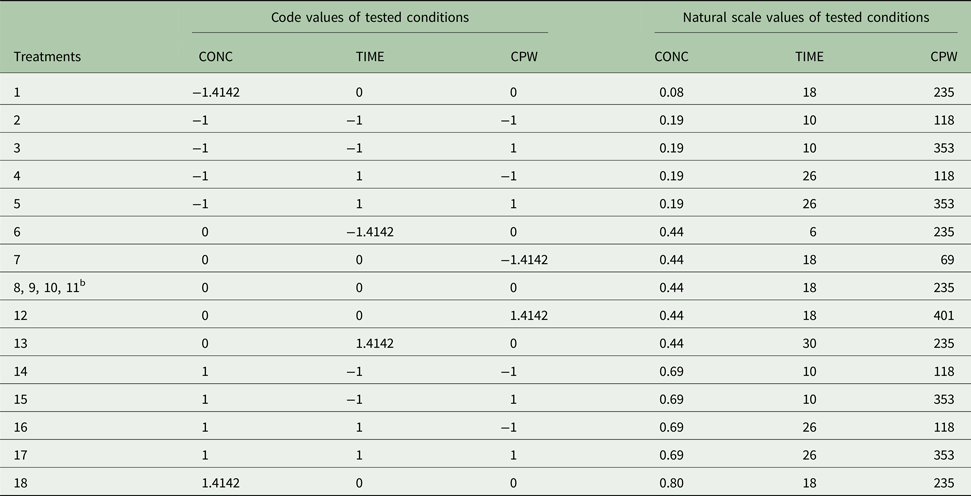
a Enzymatic methodological conditions: Streptomyces griseus protease concentrations in the enzymatic working solution (CONC, U of protease/ml of enzymatic working solution), length of enzymatic incubation (TIME, h) or total amount of sample CP incubated in the buffered enzymatic solution (CPW, mg CP/sample incubated in enzymatic test).
b Central points of CCD characterized by having 0, 0, 0 codifications for the three tested factors.
Statistical analysis and optimization process
Results from chemical assays and in vitro RUP determinations are presented descriptively (mean ± s.d.). Differences between in vitro rumen and enzymatic RUP (ΔRUP) or differences between experimental replicates of enzymatic method were analysed according to a CCD with four replications of central point (St-Pierre & Weiss Reference St-Pierre and Weiss2009) by the Mixed procedure of SAS (2003). The fixed effects of the model were CONC, TIME and CPW, their squared terms (CONC × CONC, TIME × TIME and CPW × CPW) and their single interactions (CONC × TIME, CONC × CPW and TIME × CPW). In the first step of the analysis, the complete model was fitted using the code values (–α, –1, 0, 1, α) for each of the three tested factors (Gallo et al. Reference Gallo, Giuberti, Bertuzzi, Moschini and Masoero2015). The absolute α value was estimated as reported by St-Pierre & Weiss (Reference St-Pierre and Weiss2009). Then, non-significant effects were removed from the model, whereas significant effects were expressed in their natural scale to obtain regression terms of second-order polynomial equations using the Mixed procedure of SAS (2003).
Differences between experimental replicates of the enzymatic method were not significant. Significance was declared at P < 0.05.
Then, the second-order polynomial equations were optimized by using the non-linear generalized reduced gradient method of the Solver option of Excel (Microsoft Office Professional Plus 2010®, Microsoft Corporation, Seattle, WA, USA). The objective of optimization was set either between or within sample categories at ΔRUP equal to 0. The optimization was carried out by changing CONC, TIME and CPW values and opportune constraints were used on these terms to obtain suitable solutions. Solver options were: interactions equal to 1000, precision equal to 0.00001, convergence equal to 0.001, tangent estimates, forward derivatives and the Newton research method. In confirmatory tests, the REG procedure of SAS (2003) was used to verify relationships between in vitro rumen RUP (dependent variable) and enzymatic RUP values optimized for the tested working conditions (independent variables).
Results
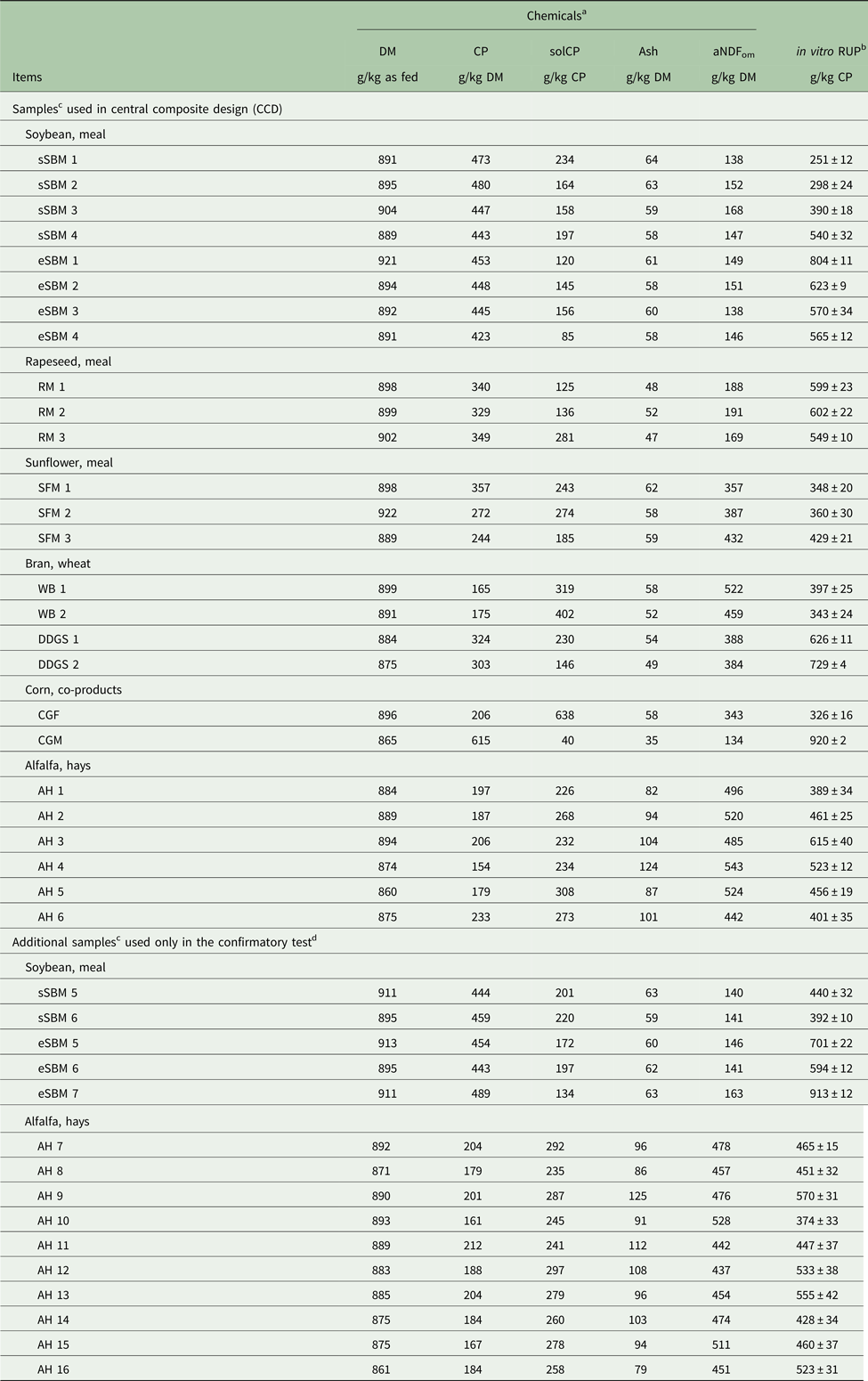
The chemical composition of samples employed in both CCD and confirmatory tests is presented in Table 2, and appeared to be typical for the different feed categories. A wide range of in vitro RUP was measured among samples. In particular, values ranging from 251 to 913 g/kg CP were measured for sSBM 1 and eSBM 7, whereas values from 374 to 615 g/kg CP were obtained for AH 10 and AH 3. On average, in vitro RUP values of 583, 379, 370 and 678 g/kg CP were achieved for RM, SFM, WB and DDGS. Lastly, the RUP of CGF and CGM were 326 and 920 g/kg CP, respectively.
Chemical composition and in vitro rumen undegraded feed crude protein (RUP) of samples
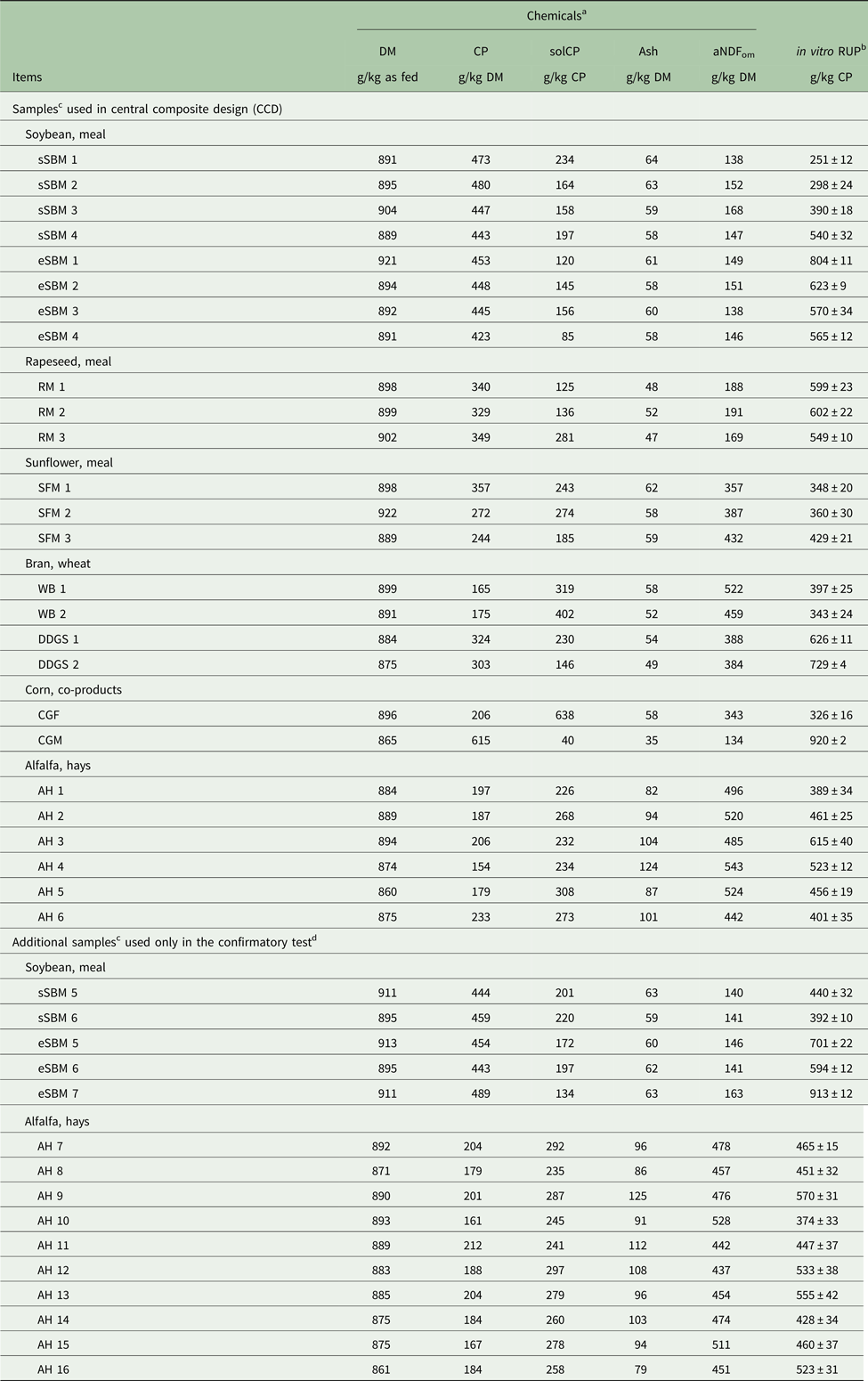
a Dry matter (DM), crude protein (CP), soluble crude protein (solCP), neutral detergent fibre fraction corrected for residual ash (aNDFom), acid detergent fibre fraction corrected for residual ash (ADFom).
b The in vitro RUP determinations were carried out in agreement to the rumen step of the method proposed by Ross et al. (Reference Ross, Gutierrez-Botero and Van Amburgh2013).
c Solvent-extracted soybean meal (sSBM), expeller-extruded soybean meal (eSBM), solvent-extracted rapeseed meal (RM), solvent-extracted sunflower meal (SFM), soft white wheat bran (WB), distillers dried grain with solubles (DDGS), dried maize gluten feed (CGF), dried maize gluten meal (CGM), alfalfa hay (AH).
d All samples used in the CCD were successively employed in the confirmatory test, with the exception of sSBM 3, sSBM 4, eSBM 1, eSBM 2, AH 3, AH 4, AH 5 and AH 6 due to the limited amount of available substrate.
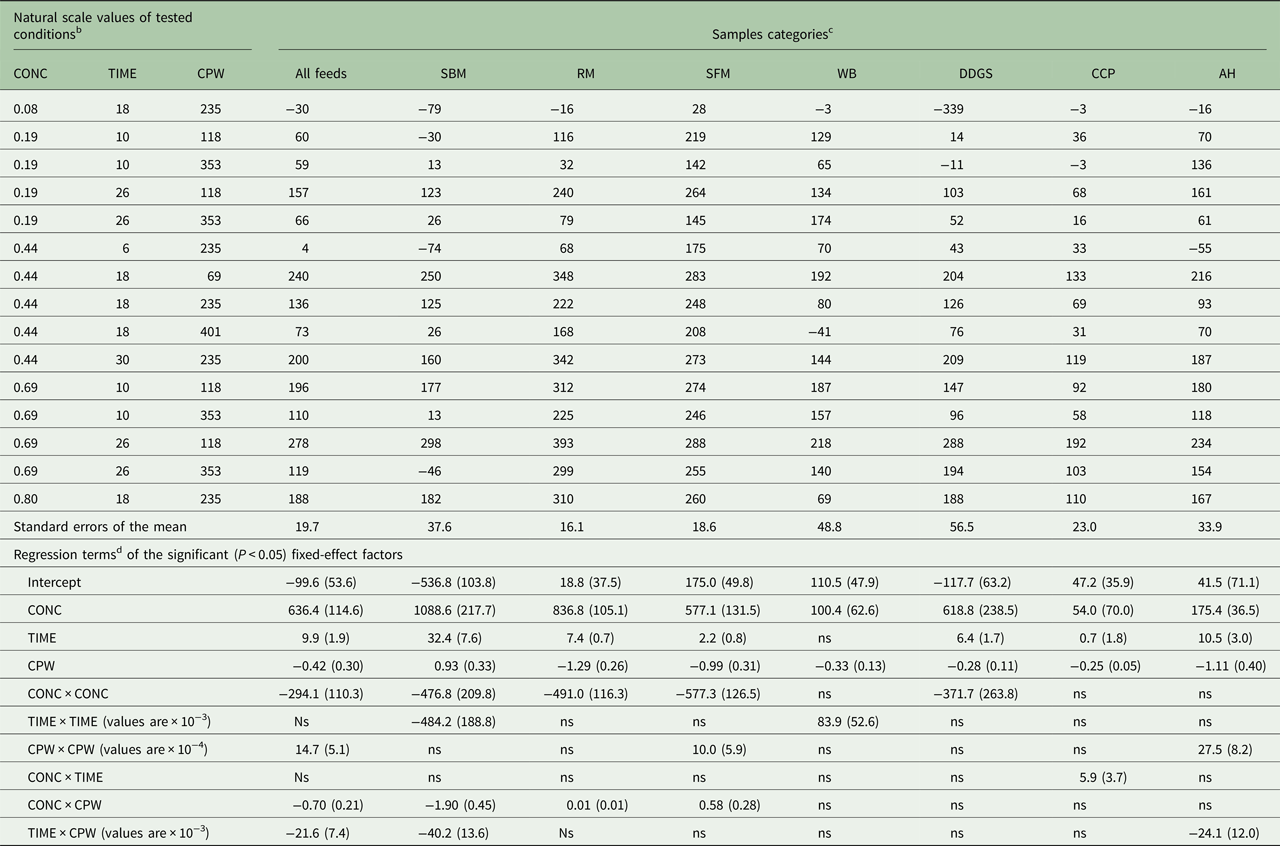
Table 3 shows the ΔRUP values obtained by incubating samples adopting different combinations of enzymatic methodological conditions. Differences between experimental replicates of the enzymatic method were not reported, as none of the tested effects were significant. When all samples were considered, the lowest and the highest ΔRUP values were observed for Treatment 1 (i.e. CONC of 0.08 U/ml working solution, TIME of 18 h and CPW of 235 mg CP incubated in enzymatic test) and Treatment 16 (i.e. CONC of 0.69 U/ml working solution, TIME of 26 h and CPW of 118 mg CP incubated in enzymatic test), respectively. Similarly, the highest ΔRUP values were measured for the different sample categories in Treatment 16, being 298, 393, 288, 218, 288, 192 and 234 g/kg CP for SBM, RM, SFM, WB, DDGS, CCP and AH, respectively. The lowest ΔRUP values were measured in Treatment 1 for SBM, RM, SFM, DDGS and AH (i.e. −79, −16, 28, −34 and −16 g/kg CP, respectively). In WB, the lowest ΔRUP value was obtained in Treatment 12 (i.e. CONC of 0.69 U/ml working solution, TIME of 26 h and CPW of 118 mg CP incubated in the enzymatic test), being −41 g/kg CP. For CCP, the lowest ΔRUP values (i.e. −3 g/kg CP) were observed in both Treatment 1 and 3, the latter being characterized by CONC of 0.19 U/ml working solution, TIME of 10 h and CPW of 353 mg CP incubated in the enzymatic test.
Effects of three enzymatic methodological conditions a on the differences between in vitro rumen and enzymatic evaluated undegraded CP (ΔRUP, g/kg CP) values both among and within sample categories
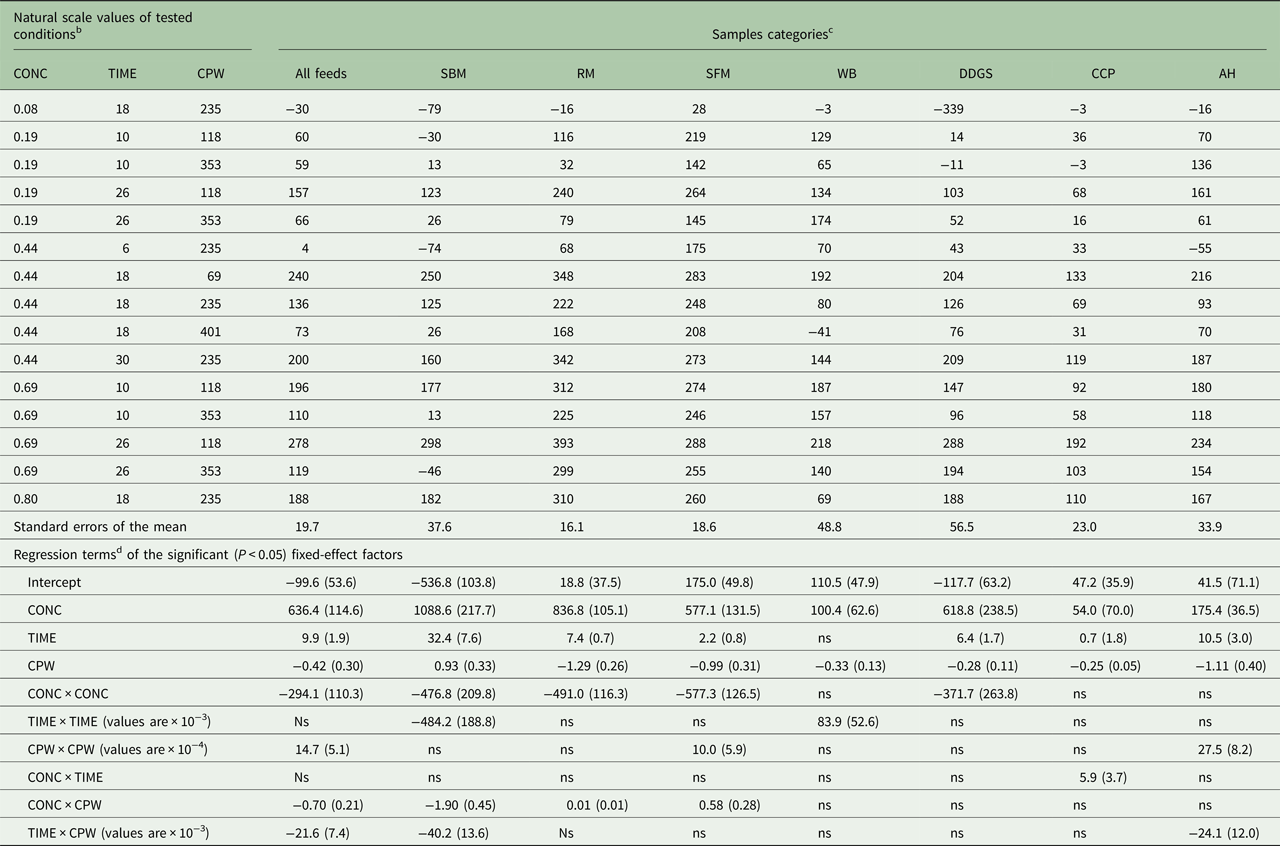
ns, not significant.
a Enzymatic methodological conditions: Streptomyces griseus protease concentrations in the enzymatic working solution (CONC, U of protease/ml of enzymatic working solution), length of enzymatic incubation (TIME, h) or total amount of sample CP incubated in the buffered enzymatic solution (CPW, mg CP/sample incubated in enzymatic test).
b The three enzymatic methodological conditions (CONC, TIME and CPW) were presented in their natural scale values as tested in the orthogonal central composite design (CCD). The code values of three tested conditions associated to specific treatment are described in Table 1.
c Soybean meals (SBM) consisting of four solvent-extracted soybean meals and four expeller-extruded soybean meals, three solvent-extracted rapeseed meals (RM), three solvent-extracted sunflower meals (SFM), two soft white wheat brans (WB), two distillers dried grains with soluble (DDGS), corn co-products (CCP) consisting of a dried maize gluten feed and a dried maize gluten meal, six alfalfa hays (AH).
d Values in brackets are the standard error (s.e.) of significant regression coefficients.
The regression terms of significant linear (i.e. CONC, TIME and CPW) and quadratic effects (i.e. CONC × CONC, TIME × TIME and CPW × CPW), as well as the interactions among main tested factors (i.e. CONC × TIME, CONC × CPW and TIME × CPW), are reported both as the average of all tested samples and within sample categories. In all developed models, the intercepts were maintained with values ranging from −536.8 to 175.0 for SBM and SFM. The three linear components influenced final ΔRUP values, with the sole exception of WB, in which the developed model did not include linear TIME component. Overall, greater ΔRUP values were obtained by increasing CONC and TIME or by decreasing CPW. The quadratic term CONC × CONC decreased ΔRUP values when all samples were considered, or in SBM, RM, SFM and DDGS, with regression coefficients ranging from −577.3 to −294.1 (U2/ml2 working solution) for SFM or all samples. The quadratic term TIME × TIME decreased in SBM and increased in WB the ΔRUP values, regression coefficients being equal to −484.2 × 10⁻³ or 83.9 × 10⁻³ (h2), respectively. The quadratic term CPW × CPW increased the ΔRUP values in all samples, SFM and AH, regression coefficients being 14.7 × 10⁻⁴, 1.0 × 10⁻⁴ and 27.5 × 10⁻⁴ (mg2 CP). The interaction CONC × TIME increased ΔRUP values only in CCP, whereas interaction TIME × CPW decreased ΔRUP values in all samples, SBM and AH. The interaction term CONC × CPW decreased ΔRUP values in all samples and SBM, whereas it increased ΔRUP in RM and SFM.
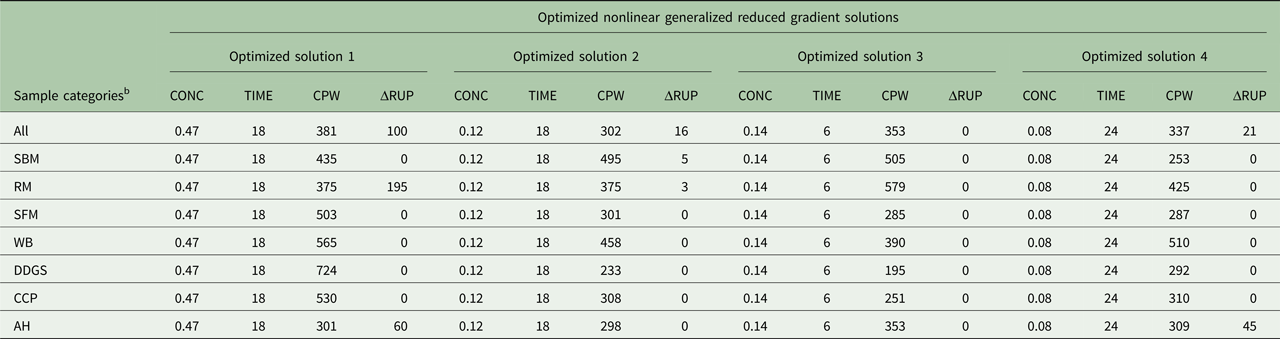
Four non-linear generalized reduced gradient solutions are presented in Table 4, both as the average of all tested samples and within sample categories. Within each enzymatic solution, both CONC and TIME were unchanged to avoid an excessive number of possible solutions. Therefore, the main factor changed during the optimization processes was CPW. Solution 1 was characterized by CONC of 0.47 U of S. griseus protease/ml working solution and TIME of 18 h, whereas CPW ranged from 301 mg CP in AH to 724 mg CP in DDGS. The attempted solution ΔRUP equal to 0 was obtained in all sample categories, except for RM and AH. For solution 2, CONC was set at 0.12 U/ml working solution, TIME at 18 h, and CPW ranged from 233 mg CP in DDGS to 495 mg CP in SBM. The condition ΔRUP equal to 0 was calculated for all sample categories, except for a slight difference from 0 estimated in SBM and RM (i.e. 6 or 3 g/kg CP, respectively). The TIME was reduced to 6 h in solution 3 and CONC was equal to 0.14 U/ml working solution. The CPW ranged from 195 mg CP in DDGS to 579 mg CP in RM, and a ΔRUP equal to 0 was obtained for all feed categories. For solution 4, CONC was set at 0.08 U/ml working solution, TIME at 24 h, and CPW ranged from 253 mg CP in SBM to 510 mg CP in WB. A ΔRUP value different from 0 was estimated exclusively in AH.
Nonlinear generalized reduced gradient solutions both among and within samples obtained by optimizing the second-order polynomial equations resulted by testing the three tested enzymatic methodological conditions a in the central composite design
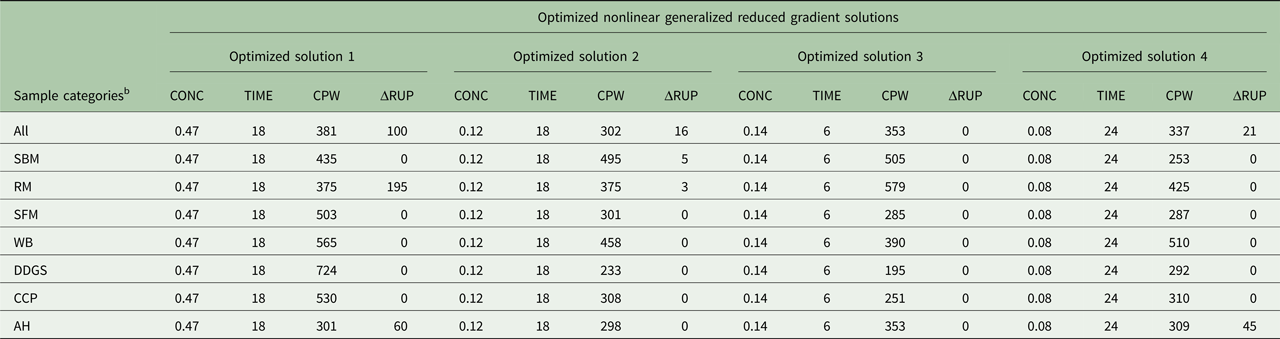
a Enzymatic methodological conditions: Streptomyces griseus protease concentrations in the enzymatic working solution (CONC, U of protease/ml of enzymatic working solution), length of enzymatic incubation (TIME, h) or total amount of sample CP incubated in the buffered enzymatic solution (CPW, mg CP/sample incubated in enzymatic test).
b Soybean meals (SBM) consisting of four solvent-extracted soybean meals and four expeller-extruded soybean meals, three solvent-extracted rapeseed meals (RM), three solvent-extracted sunflower meals (SFM), two soft white wheat brans (WB), two distillers dried grains with soluble (DDGS), corn co-products (CCP) consisting of a dried maize gluten feed and a dried maize gluten meal, six alfalfa hays (AH). The objective of optimizations was set at the difference between in vitro rumen and enzymatic undegraded feed CP (ΔRUP, g/kg CP) equal to 0.
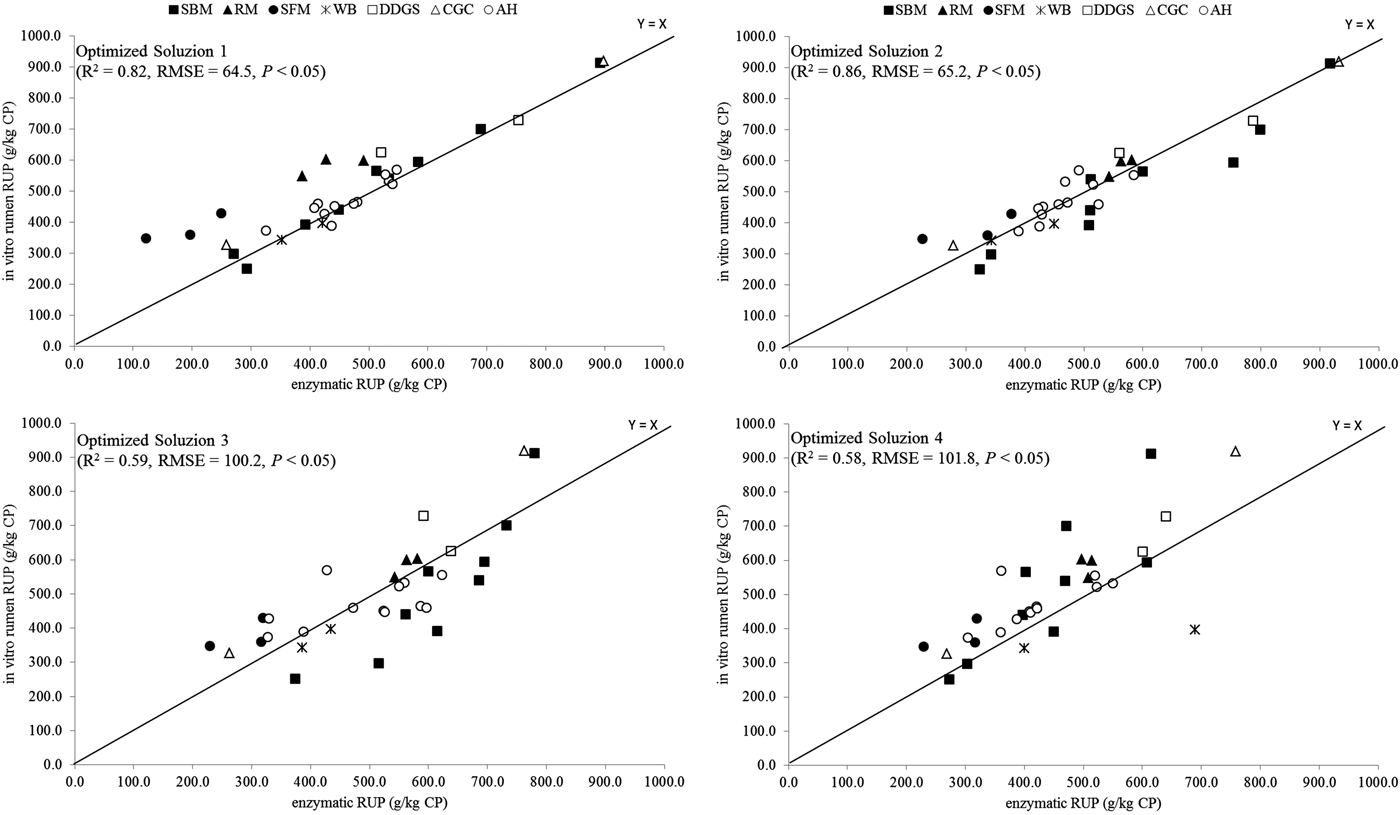
In Fig. 1, results of the confirmatory test carried out by employing the four optimized methodological conditions are reported. Very high coefficients of determination as well as low prediction errors were obtained when samples were analysed by both solution 1 [in vitro rumen RUP (g/kg CP) = 121.6 (s.e. 32.5) + 8.2 (s.e. 0.7) × enzymatic RUP (g/kg CP), RMSE = 64.5, R 2 = 0.82, P < 0.001] and solution 2 [in vitro rumen RUP (g/kg CP) = −25.6 (s.e. 36.9) + 9.5 (s.e. 0.7) × enzymatic RUP (g/kg CP), RMSE = 65.2, R 2 = 0.86, P < 0.001]. However, underestimated in vitro rumen RUP values were observed by carrying out solution 1 in RM and SFM. On the contrary, a slight overestimation of in vitro rumen RUP was observed for most SBM employed when applying solution 2. Both solutions 3 and 4 showed lower coefficients of determination (R 2 = 0.59 or R 2 = 0.58, respectively) as well as greater errors of prediction (RMSE = 100.2 or RMSE = 101.8, respectively) than those previously presented.
Results of four confirmatory tests carried out by employing the four optimized enzymatic methodological solutions reported in Table 4 on 33 samples. Symbols in figure referred to soybean meal (SBM), solvent-extracted rapeseed meal (RM), solvent-extracted sunflower meal (SFM), soft white wheat bran (WB), distillers dried grain with solubles (DDGS), maize co-products (CCP) and alfalfa hay (AH).

Discussion
When researchers move to develop a method, or optimize related working conditions, two different approaches can be employed. In particular, a one-factor-at-a-time experiment, which consists of varying only one factor at a time and keeping all others fixed, can be adopted. Accordingly, Aufrère & Cartailler (Reference Aufrère and Cartailler1988) verified how several enzymatic working conditions separately influenced the prediction of rumen CP degradability of 12 feeds. As a result, Aufrère et al. (Reference Aufrère, Graviou, Demarquilly, Vérité, Michalet-Doreau and Chapoutot1991) proposed a method successively validated on a larger dataset of about 100 samples, which has been used as reference method in the French intestinal digestible protein system. In the current study, the adoption of CCD permitted examination of both linear and quadratic effects of the three combined methodological factors concomitantly, as well as their first order interactions. As expected, the estimates of ΔRUP within all sample categories were increased linearly with CONC or TIME and decreased linearly with CPW. However, quadratic terms of the main effects tested also influenced the enzymatic RUP determination within different feed categories. Concerning CONC, it was decided to test increasing concentrations of S. griseus protease and to express them as U for ml in 10 ml working solution, in line with previous approaches (Krishnamoorthy et al. Reference Krishnamoorthy, Sniffen, Stern and Van Soest1983; Licitra et al. Reference Licitra, Lauria, Carpino, Schadt, Sniffen and Van Soest1998, Reference Licitra, Van Soest, Schadt, Carpino and Sniffen1999; Coblentz et al. Reference Coblentz, Abdelgadir, Cochran, Fritz, Fick, Olson and Turner1999). Thus, final enzyme concentrations in 50 ml buffer solution ranged from 0.016 to 0.160 U/ml. To develop enzymatic tests, different enzyme concentrations were tested with values ranging from approximately 0.020 (Krishnamoorthy et al. Reference Krishnamoorthy, Sniffen, Stern and Van Soest1983) up to 6.6 U/ml of buffer solution (Coblentz et al. Reference Coblentz, Abdelgadir, Cochran, Fritz, Fick, Olson and Turner1999). In addition, variable optimal enzyme concentrations as a function of experimental conditions have been suggested, with values ranging from 0.050 U/ml (Aufrère & Cartailler Reference Aufrère and Cartailler1988) to 0.8–1.0 (Licitra et al. Reference Licitra, Van Soest, Schadt, Carpino and Sniffen1999) or 2.7 U/ml (Cone et al. Reference Cone, Van Gelder, Steg and Van Vuuren1996). Consequently, the aforementioned approaches did not converge on a unique enzyme concentration, suggesting that there is no constant enzyme to substrate specificity or that it is difficult to mimic the activity of rumen fluid using commercial enzymes (Aufrère & Cartailler Reference Aufrère and Cartailler1988; Luchini et al. Reference Luchini, Broderick and Combs1996; Velasquez & Pichard Reference Velasquez and Pichard2010). In particular, as Licitra et al. (Reference Licitra, Van Soest, Schadt, Carpino and Sniffen1999) discussed, the problem of the ‘true’ enzymatic concentration could be overcome by using a proteolytic activity similar to that measurable in the rumen microbiota. However, several difficulties usually arise in rumen proteolysis simulations, including fluctuations in the rumen fluid proteolytic activity during the day, that could follow zero-, first- or second-order kinetics as a function of the amount of rumen-available protein substrate at a given time (Krishnamoorthy et al. Reference Krishnamoorthy, Sniffen, Stern and Van Soest1983). In addition, De Boever et al. (Reference De Boever, Cottyn, De Brabander, Vanacker and Boucqué1996) suggested that rumen fluid proteolytic activity could differ among feed categories, being greater when degrading CP of forages than that of concentrates, thus introducing a substrate-dependent effect. Lastly, Licitra et al. (Reference Licitra, Van Soest, Schadt, Carpino and Sniffen1999) hypothesized that the different mean retention time of feeds in the rumen compartment could also be an aspect influencing rumen fluid proteolytic activity. Probably due to these aspects, very different rumen fluid proteolytic activities, equal to 0.066 U/ml as suggested by Krishnamoorthy et al. (Reference Krishnamoorthy, Sniffen, Stern and Van Soest1983) or 1.5 U/ml as proposed by Licitra et al. (Reference Licitra, Van Soest, Schadt, Carpino and Sniffen1999), have been reported. In the current experimental conditions, the optimized enzymatic concentrations ranged from 0.016 to 0.094 U/ml, thus being comparable with values reported by Krishnamoorthy et al. (Reference Krishnamoorthy, Sniffen, Stern and Van Soest1983). Other authors have reported good agreement between in situ RUP measurements and enzymatic values, adopting similar enzymatic concentrations (Aufrère & Cartailler Reference Aufrère and Cartailler1988; Mathis et al. Reference Mathis, Cochran, Vanzant, Abdelgadir, Heldt, Olson, Johnson, Caton, Faulkner, Horn, Paisley, Mass, Moore and Halgerson2001; Cone et al. Reference Cone, Van Gelder, Mathijssen-Kamman and Hindle2004; Irshaid Reference Irshaid2007). In the current study, enzymatic results were compared with an in vitro rumen-based method (Ross et al. Reference Ross, Gutierrez-Botero and Van Amburgh2013) used in the Cornell Net Carbohydrate and Protein System and recently proposed as a reference method for the evolution version of the NRC (2001) protein system (Schwab Reference Schwab2015). This method was developed to overcome some issues related to the use of in vitro (Gargallo et al. Reference Gargallo, Calsamiglia and Ferret2006) or in situ (Cone et al. Reference Cone, Kamman, Van Gelder and Hindle2002) rumen-based assays, such as loss of small particles in the bags (Fessenden et al. Reference Fessenden, Hackmann, Ross, Foskolos and Van Amburgh2017). Furthermore, it proposed an easy-to-employ approach for estimating microbial contamination of samples, as discussed exhaustively by Ross et al. (Reference Ross, Gutierrez-Botero and Van Amburgh2013).
Other than CONC, discrepancies among different approaches exist concerning the duration of the enzymatic incubation and the amount of substrate or CP weighed. In particular, Krishnamoorthy et al. (Reference Krishnamoorthy, Sniffen, Stern and Van Soest1983) suggested incubating grain mixtures and forages for 18 and 48 h, respectively, thus mimicking appropriate rumen mean retention time. Accordingly, a 48-h incubation time was adopted by several authors when determining enzymatic RUP of different forages (Madsen & Hvelplund Reference Madsen and Hvelplund1994; Coblentz et al. Reference Coblentz, Abdelgadir, Cochran, Fritz, Fick, Olson and Turner1999; Mathis et al. Reference Mathis, Cochran, Vanzant, Abdelgadir, Heldt, Olson, Johnson, Caton, Faulkner, Horn, Paisley, Mass, Moore and Halgerson2001), whereas other authors adopted a shorter incubation time of 24 h (Aufrère & Cartailler Reference Aufrère and Cartailler1988; Cone et al. Reference Cone, Van Gelder, Steg and Van Vuuren1996; Reference Cone, Van Gelder, Mathijssen-Kamman and Hindle2004; Licitra et al. Reference Licitra, Lauria, Carpino, Schadt, Sniffen and Van Soest1998; Reference Licitra, Van Soest, Schadt, Carpino and Sniffen1999; Edmunds et al. Reference Edmunds, Spiekers, Südekum, Nussbaum, Schwarz and Bennett2014). In addition, very short incubation times have been suggested (Assoumani et al. Reference Assoumani, Vedeau, Jacquot and Sniffen1992; Susmel et al. Reference Susmel, Mills, Colitti and Stefanon1993; Coblentz et al. Reference Coblentz, Abdelgadir, Cochran, Fritz, Fick, Olson and Turner1999; Cone et al. Reference Cone, Kamman, Van Gelder and Hindle2002), aiming to make the enzymatic method less time-consuming. During the optimization processes, ΔRUP equal to zero was fitted by limiting possible solutions to short (i.e. 4–8 h) or medium (i.e. 18 and 24 h) enzymatic incubation time, thus excluding incubation times useless (i.e. from 8 to 16 h) or too long (i.e. >30 h) for practical laboratory purposes. Some authors weighed samples independently of the amount of enzyme (Krishnamoorthy et al. Reference Krishnamoorthy, Sniffen, Stern and Van Soest1983; Aufrère & Cartailler Reference Aufrère and Cartailler1988; Cone et al. Reference Cone, Van Gelder, Steg and Van Vuuren1996; Reference Cone, Kamman, Van Gelder and Hindle2002), whereas others adopted a fixed enzyme to sample CP ratio (Licitra et al. Reference Licitra, Lauria, Carpino, Schadt, Sniffen and Van Soest1998; Reference Licitra, Van Soest, Schadt, Carpino and Sniffen1999; Coblentz et al. Reference Coblentz, Abdelgadir, Cochran, Fritz, Fick, Olson and Turner1999; Mathis et al. Reference Mathis, Cochran, Vanzant, Abdelgadir, Heldt, Olson, Johnson, Caton, Faulkner, Horn, Paisley, Mass, Moore and Halgerson2001). De Boever et al. (Reference De Boever, Cottyn, De Brabander, Vanacker and Boucqué1996), testing this effect in a pH 8 buffer enzymatic solution, suggested maintaining the enzyme to CP ratio constant for different feeds. This finding was in line with the current results, even if, as noted, a fixed ratio could be adopted within, but not between, different feed categories.
To the best of our knowledge, this is the first time a study was planned to investigate possible interactions among different methodological factors on the determination of enzymatic RUP, with the only exception being the experiment carried out by Coblentz et al. (Reference Coblentz, Abdelgadir, Cochran, Fritz, Fick, Olson and Turner1999). In particular, these authors studied the interaction between enzyme concentrations (i.e. 0.066, 0.66 and 6.6 U/ml) and incubation times (i.e. 2, 4 and 48 h), indicating that interactions were found for only one of two tested forages (i.e. alfalfa and prairie hays): they suggested that a different resistance to enzymatic attack could exist among tested forages. From the foregoing results, interactions among the main tested factors influenced the evaluations of enzymatic RUP, without consistency among different sample categories. As a matter of fact, solution 2 (CONC of 0.12 U of protease/ml of enzymatic working solution, 18 h time incubation and CPW ranging from 233 to 495 mg CP, respectively, for DDGS and SBM) guaranteed the best prediction of in vitro rumen RUP in all tested feed categories, except in SBM samples, where an overestimation of RUP values was observed. For these feeds, solution 1 (CONC of 0.47 U of protease/ml of enzymatic working solution, 18 h time incubation and CPW of 435 mg CP) seemed to be more precise than solution 2. These discrepancies could be attributed to the differing capacity of S. griseus protease to hydrolyse CP of different substrates (Aufrère & Cartailler Reference Aufrère and Cartailler1988; De Boever et al. Reference De Boever, Cottyn, De Brabander, Vanacker and Boucqué1996; Velasquez & Pichard Reference Velasquez and Pichard2010). Consequently, the current results seemed to support the idea that the same methodological conditions should not be applied within different feed categories.
Conclusions
The application of a CCD experimental design permitted the study of both linear and quadratic effects of CONC, TIME and CPW, as well as their interactions and to develop second-order polynomial equations for each tested feed category. Using these equations in the optimization processes, the CONC, TIME and CPW conditions guaranteeing that mathematical solution ΔRUP is equal to 0 could reasonably be obtained. When optimized methodological conditions were employed on a cohort of samples, a good agreement between in vitro rumen and enzymatic RUP values was reported. The results presented in the current manuscript compared results from an in vitro rumen-based assay to those obtained by using different enzymatic approaches. Since the in vivo conditions can never be exactly reproduced by in vitro methods, further investigations, comparing RUP evaluations obtained by the enzymatic method to RUP of feedstuffs obtained through in vivo trials, are warranted.
Acknowledgements
This work was financed by the Ministero delle politiche agricole alimentari e forestali (MiPAAF) in the ‘AGROSCENARI: Scenari di adattamento dell'agricoltura italiana ai cambiamenti climatici’ project and by Servizio Sviluppo Sistema Agroalimentare of Regione Emilia-Romagna (legge regionale 11 agosto 1998 n. 28 ‘Promozione dei Servizi di Sviluppo del Sistema Agro-Alimentare’).