





Academic papers are retracted for many reasons, ranging from error to outright fraud. The Committee on Publication Ethics (COPE) was set up in 1997 to provide guidance to editors and authors on publication misconduct. 1 COPE states that ‘Authors who disagree with a retraction… sometimes threaten journals and their editors with legal action’. There is precedent, described in the public domain, suggesting that an author taking legal action against a journal over the issue of retraction is unlikely to succeed. Reference Baker2 In fact, several attempts in the USA to stop retractions or expressions of concern on the basis of free speech promotion have not been successful, although the outcomes of subsequent defamation suits are not clear. In 2020, a medical device company unsuccessfully sued Chelsea Polis, a USA academic, for defamation after she raised concerns about claims regarding a fertility tracker based on a paper that was ultimately retracted. Reference Haslett3
It is impossible to know how many papers are not retracted because of undisclosed threats of legal action, as such experiences are not routinely reported or recorded. Indeed, legal settlements may preclude such transparency. Persaud et al discuss this in relation to publication decisions (for example, rejection of a paper) and suggest that journals and authors should publicly post threats of litigation in the public interest. Reference Persaud, Ringer and Lemmens4 The concern remains that legal challenges to editorial independence may deter transparency and debate, Reference Bhui, O’Brien, Upthegrove, Tsai, Soomro and Newton–Howes5 and journal owners and editors need to be prepared to face this eventuality.
The rise in the number of academic retractions over the past decade is well documented, and a record 10 000 papers were retracted in 2023. 6 Between 2000 and 2021, biomedical retraction rate increased fourfold from 11 per 100 000 in 2000 to 45 per 1 000 000 in 2020; 67% were described as misconduct, 16% were because of errors and reasons for the remainder are unclear. Reference Fang, Steen and Casadevall7 Between 2000 and 2010 for overall (not just biomedical) retracted papers, 26.6% were because of fraud and the most common reason given was ‘scientific mistake’ (31.5%). Reference Grieneisen and Zhang8 In Europe, in the past 20 years, research misconduct accounted for 67% of retractions. Reference Freijedo–Fariñas, Ruano–Raviña, Pérez–Ríos, Ross and Candal–Pedreira9
COPE states that:
‘The main purpose of retraction is to correct the literature and ensure its integrity rather than to punish the authors. Retractions may be used to alert readers to cases of redundant publication, plagiarism, peer review manipulation, reuse of material or data without authorisation, copyright infringement or some other legal issue (e.g., libel, privacy, illegality), unethical research, and/or a failure to disclose a major competing interest that would have unduly influenced interpretations or recommendations’. 1
However, retraction is associated with stigma, and potentially embarrassment for authors and for journals: ‘the most punishing instrument in the editor’s toolbox’. Reference Srholec10 Some argue therefore that it should be reserved for the most serious misconduct – such as cases of outright fraud. The often-cited premise is that science is self-correcting, and for most cases, even the most inaccurate papers make up part of the scientific body and can be corrected by new science. Yet, some high-profile papers may be the basis of clinical and legal decisions, and self-correction would require more funded research and a willingness to challenge legal threats in the process.
In this context, we sought to describe psychiatry retractions (and expressions of concern) between the years 2003 and 2023, to consider recent trends in editorial and publishing processes.
Method
Data source
For this study, we reviewed the Retraction Watch database, which is a collection of retractions, corrections and/or expressions of concern that was acquired by CrossRef (a not-for-profit organisation) in 2023. 11 Officially launched in 2018, the Retraction Watch database is the most comprehensive index of retractions of published articles and includes notices of retraction for articles published from 1753 to 2024. The database includes citations, research funding, related research data, preprints and a taxonomy of reasons for retractions, and is updated daily. It actively cross-verifies publisher notices and status updates, allowing for accurate identification of retractions at the time of analysis. Importantly, it also provides authors and editors with guidance and updates standards on a regular basis. Its non-commercial and charitable status also protects its decision-making from commercially sensitive and potentially biased reasoning. We examined the database for papers retracted between the start of 2003 and the end of 2023, searching for the subject term psychiatry. A.O. and D.B. separately rated the papers for inclusion.
Data extraction
The following factors were established from the database:
-
(a) type of retraction, i.e. full retraction, expression of concern, correction or reinstatement;
-
(b) type of paper (determined according to classifications made in Retraction Watch): research paper (biomedical, clinical research); editorial, commentary, review or meta-analysis (including systematic review); case report, conference abstract, book chapter, letter or other. ‘Primary research’ article was defined as published item describing a hypothesis, means of exploring the hypothesis, results of exploration and conclusions drawn from the results; ‘clinical study’ was defined as the research study of humans where the outcome of a group undergoing a specific treatment is compared with a non-treatment group;
-
(c) country of origin (lead author);
-
(d) month and year published;
-
(e) month and year retracted;
-
(f) predominant reason given for retraction;
-
(g) population under study/subject matter (pharmacology/non-pharmacology was added as a subcategory, in addition to other subjects).
The approximate number of overall psychiatry publications was established with the database of the Web of Science Core Collection, 12 a paid-access platform aggregating scientific and medical journal databases commonly used in bibliometric analyses, including in the field of psychiatry. Reference Havlik, Uranga, Lee, Magallanes, Wahid and Rhee13,Reference Larivière, Diepeveen, Ní Chonaill, Macaluso, Pollitt and Grant14 The databases encompass the majority of researchers’ scientific contributions visible to the global scientific community (and most likely to be cited), although is not necessarily exhaustive as the inclusion of relevant articles in psychiatry published in journals nonspecific to psychiatry may be limited, and some papers disseminated via highly specialised journals or national journals are not indexed by the Web of Science. Nevertheless, it is a comprehensive and reliable resource with over 85 million records from 1900 to present. In this study, we extracted the number of overall publications per year published in the category ‘psychiatry’ from the Web of Science Core Collection.
The 2-year impact factors of the publication, both at the time of retraction and the time of publication, were established from the Journal Citation Reports database and the Web of Science. Journal impact factors were only considered post-1997 for year of publication. Cases where the publication was a book chapter, a conference paper or a journal without impact factor measurement were excluded for correlation analyses. The duration of time between publication and retractions was calculated in days.
Analysis
Summary data were presented with frequencies (percentages) and medians (interquartile range (IQR)) for categorical and continuous variables, respectively. Retractions as a proportion of overall psychiatry publications were calculated each year by considering retraction frequency per 10 000 published articles. The number of days between publication and retraction were compared according to reason for retraction by using a Kruskal–Wallis test (the distribution of days between publication and retraction were positively skewed and failed to approximate a Gaussian distribution). Associations between impact factor of the publishing journal and the number of days between publication and retraction were measured with Spearman’s ρ. The Benjamini–Hochberg procedure with a prescribed α-level of 0.05 (false discovery rate) Reference Benjamini and Hochberg15 was utilised in each set of correlational analyses, to account for multiple tests of association. All analyses were completed with SPSS IBM, version 28.0.
Results
There were 51 554 papers of all disciplines in the Retraction Watch database between 2003 and 2023; 426 entries had psychiatry as a subject term. After assessment by A.O. and D.B., it was established that some focused on other subjects such as pain management, neurological conditions such as Parkinson’s disease, or were related to topics such as educational psychology rather than to psychiatry. Of the 426, 321 were assessed by D.B. and A.O. as appropriate for inclusion. Regarding duplicate entries, 6 papers were in the database twice because they had been Expression of Concern (EOCs) before retraction, so were then recorded as retraction; 315 psychiatry papers remained.
The overall rise in number of psychiatry retractions over time is shown in Fig. 1(a), with a peak in 2020. Figure 1(b) indicates that there has been a steady increase in numbers of retractions in psychiatry publications as a proportion of overall psychiatry publications, rising, on average, by 1 retraction per 10 000 articles every 2 years. Figure 2 suggests that few psychiatry papers published in the 20th century have been retracted post 2003; rather, there has been a reliable increase since the turn of the century, with the number of retractions markedly increasing for papers published after 2012.
(a) Frequency of retractions according to year in which retraction occurred and (b) per 10 000 articles published in that year according to the ‘psychiatry’ Web of Science Core Collection category. Data labels represent frequency values. Please note, for years not included, there were zero retractions.

Fig. 1 Long description
Panel A: A vertical bar graph shows the frequency of retractions according to the year in which they occurred. The x-axis represents the number of retractions, while the y-axis lists the years from 2003 to 2023. Notable years include 2020 with 59 retractions, 2023 with 56 retractions, and 2022 with 17 retractions. Panel B: Another vertical bar graph displays retractions per 10,000 articles published in the psychiatry category according to the year. The x-axis represents retractions per 10,000 articles, and the y-axis lists the years from 2003 to 2023. Key years include 2020 with 13.1 retractions per 10,000 articles, 2023 with 12.7, and 2022 with 3.6.
Frequency of retractions according to year in which article was published. Data labels represent frequency values. Please note, for years not included (indicated by spaces), there were zero retractions.

Country
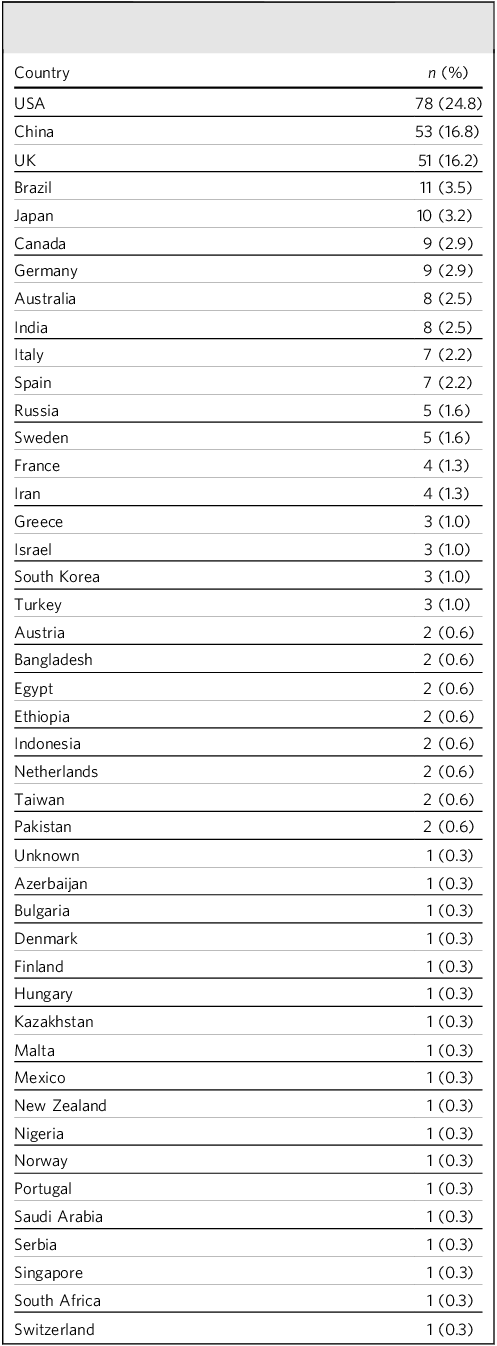
Most countries had a small number of retractions (according to lead author), but the USA (24.8%), China (16.8%) and UK (16.2%) were the three leaders, comprising almost 60% of all psychiatry retractions, followed by Brazil and Japan (Table 1). A total of 1 in 5 (n = 63, 20.0%) of the retracted papers described multinational authored studies; these were much less frequent for papers where the lead author was from USA (1 out of 77, 1.3%), the UK (2 out of 51, 3.9%) and Japan (0 out of 10, 0.0%), compared with China (12 out of 41, 22.6%), Brazil (7 out of 11, 63.3%) and Canada (9 out of 9, 100.0%).
Retracted publication according to country of lead author or study group (N = 315)

Table 1 Long description
A table titled ‘Retracted publication according to country of lead author or study group’ with 315 entries. The table has two columns: Country and n (%). The table lists countries and the number and percentage of retractions attributed to each. The countries are listed in descending order of retractions. The USA has the highest number of retractions with 78 (24.8%), followed by China with 53 (16.8%), and the UK with 51 (16.2%). Other countries with notable retractions include Brazil (11, 3.5%), Japan (10, 3.2%), Canada (9, 2.9%), Germany (9, 2.9%), Australia (8, 2.5%), India (8, 2.5%), Italy (7, 2.2%), and Spain (7, 2.2%). Several countries have fewer than 5 retractions, including Russia, Sweden, France, Iran, Greece, Israel, South Korea, Turkey, Austria, Bangladesh, Egypt, Ethiopia, Indonesia, Netherlands, Taiwan, Pakistan, Unknown, Azerbaijan, Bulgaria, Denmark, Finland, Hungary, Kazakhstan, Malta, Mexico, New Zealand, Nigeria, Norway, Portugal, Saudi Arabia, Serbia, Singapore, South Africa, and Switzerland.
A total of 63 out of 321 (19.6%) retracted publications were authored by individuals from more than one country.
Types of retraction
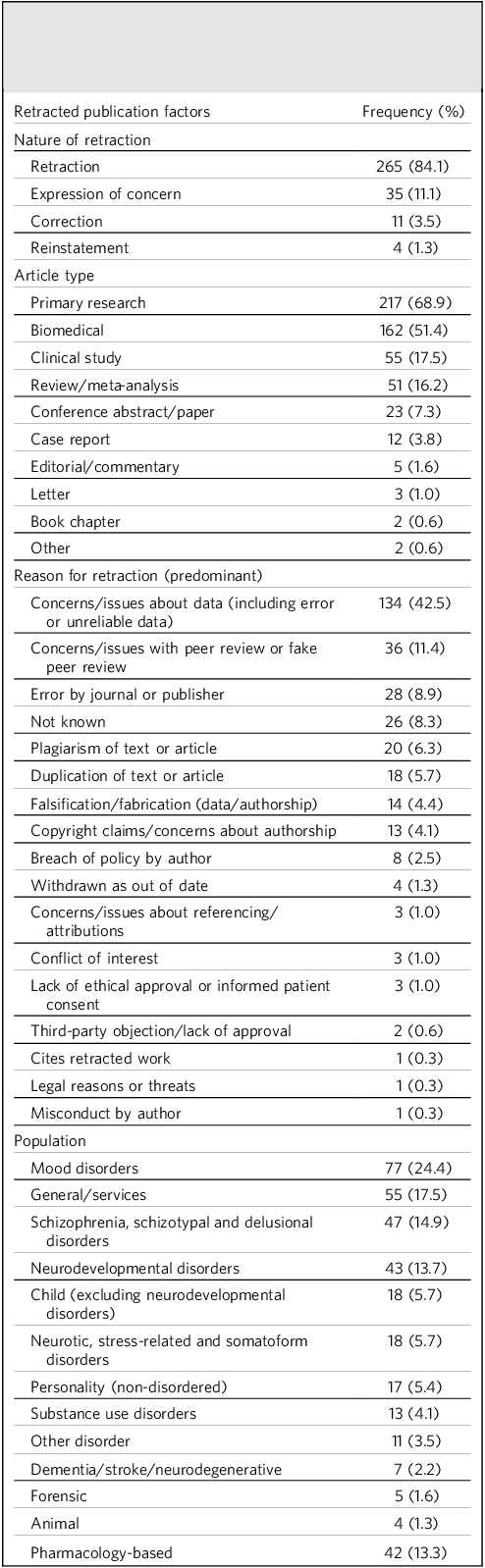
Types and reasons for retraction are summarised in Table 2. Most papers had been retracted (84.1%). Most retractions were primary papers reporting research findings (68.9%); 18.1% of these were clinical (based on research on patients) and 51.4% described biomedical research. Reviews, including systematic reviews and metanalyses, comprised 16.2% of retracted papers. Predominant reasons for retraction were most commonly data error (42.5%) and problems with peer review (11.4%). Falsification or fabrication (of data or authorship) and plagiarism constituted a small proportion of psychiatry retractions (4.4 and 6.3%, respectively), whereas in 26 instances (8.3%), reason for retraction was not established.
Retracted publication according to article type, reason for retraction study, population under study and whether they study was pharmacology-based (n = 315)

Table 2 Long description
The table presents data on retracted publications, categorized by nature of retraction, article type, reason for retraction, and population. It has 4 main sections with 21 rows and 2 columns. The first section lists the nature of retraction with frequencies: Retraction (265, 84.1 percent), Expression of concern (35, 11.1 percent), Correction (11, 3.5 percent), Reinstatement (4, 1.3 percent). The second section details article types: Primary research (217, 68.9 percent), Biomedical (162, 51.4 percent), Clinical study (55, 17.5 percent), Review/meta-analysis (51, 16.2 percent), Conference abstract/paper (23, 7.3 percent), Case report (12, 3.8 percent), Editorial/commentary (5, 1.6 percent), Letter (3, 1.0 percent), Book chapter (2, 0.6 percent), Other (2, 0.6 percent). The third section outlines reasons for retraction: Concerns/issues about data (134, 42.5 percent), Concerns/issues with peer review (36, 11.4 percent), Error by journal or publisher (28, 8.9 percent), Not known (26, 8.3 percent), Plagiarism of text or article (20, 6.3 percent), Duplication of text or article (18, 5.7 percent), Falsification/fabrication (14, 4.4 percent), Copyright claims/concerns about authorship (13, 4.1 percent), Breach of policy by author (8, 2.5 percent), Withdrawn as out of date (4, 1.3 percent), Concerns/issues about referencing/attributions (3, 1.0 percent), Conflict of interest (3, 1.0 percent), Lack of ethical approval or informed patient consent (3, 1.0 percent), Third-party objection/lack of approval (2, 0.6 percent), Cites retracted work (1, 0.3 percent), Legal reasons or threats (1, 0.3 percent), Misconduct by author (1, 0.3 percent). The fourth section categorizes the population under study: Mood disorders (77, 24.4 percent), General/services (55, 17.5 percent), Schizophrenia, schizotypal and delusional disorders (47, 14.9 percent), Neurodevelopmental disorders (43, 13.7 percent), Child (excluding neurodevelopmental disorders) (18, 5.7 percent), Neurotic, stress-related and somatoform disorders (18, 5.7 percent), Personality (non-disordered) (17, 5.4 percent), Substance use disorders (13, 4.1 percent), Other disorder (11, 3.5 percent), Dementia/stroke/neurodegenerative (7, 2.2 percent), Forensic (5, 1.6 percent), Animal (4, 1.3 percent), Pharmacology-based (42, 13.3 percent).
Nature of retraction: ‘Reinstatement’ refers to cases where the DOI of the original and replacement paper are the same. Reasons for retraction: ‘Error by journal or publisher’ includes duplicate publication via journal error; ‘Withdrawn as out of date’ is indicated where the article was retracted as part of a journal’s process of keeping guidelines or reviews current for professional use. General/Services’ includes publications describing studies with psychiatric patient populations with various disorders, healthy populations and/or healthcare staff. ‘Other disorder’ includes suicide/self-harm, anorexia nervosa, trichotillomania and neutropenia.
Subject matter
The subject matter of retracted papers is shown in Table 2. A quarter of retracted papers concerned mood disorder (24.4%). A notable proportion of papers included non-specific populations or focused on service delivery (17.5%), or described studies of people with psychosis (14.9%) or neurodevelopmental disorders (13.7%). Interestingly, data errors were predominant in papers describing studies of mood disorders (68.8%) and psychosis (45.0%), whereas most studies of neurodevelopmental disorders (59.0%) were retracted because of peer review concerns.
Journal
The journal Psychological Reports had the highest number at 25 (7.9%), followed by the Cochrane Database of Systematic Reviews at 22 (7.0%) and Research in Autism Spectrum Disorders at 16 (5.1%; Supplementary Table 1).
Time to retraction
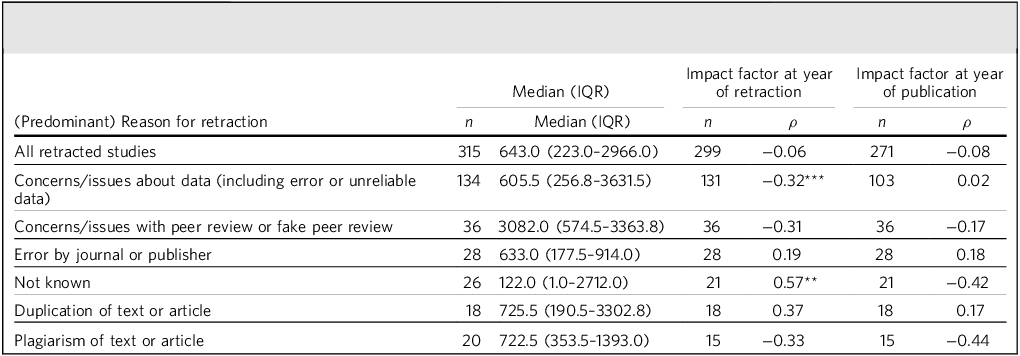
The median number of days between publication and retraction was 643 (IQR 223.0–2966.0) and ranged from 1 to 23 722 days. There was a significant difference in time between publication and retraction according to reason for retraction (for classifications with n ≥ 15; Kruskal–Wallis H = 17.55, p = 0.004), reflecting a longer period for those studies with fake peer review or concerns with peer review, and a shorter period for studies where the reason for retraction was unknown (Table 3). There was no association between the number of days from publication to retraction and journal impact factor considering all retracted psychiatry papers; there were modest (negative) associations with impact factor at retraction where the retraction reason concerned data validity/reliability or peer review (the correlation was significant for the former), suggesting that journals with higher impact factors tended to have shorter periods from publication to retraction (Table 3).
Number of days between publication and retraction and association with journal impact factor (in year of retraction and in year of article publication) according to predominant reason for retraction

Table 3 Long description
A table comparing the number of days between publication and retraction with journal impact factors at the year of retraction and publication, categorized by the predominant reason for retraction. The table has 10 rows and 6 columns. Column headers are Median (IQR), Impact factor at year of retraction, and Impact factor at year of publication, each with sub-columns for n and Median (IQR) or n and ρ. Row labels include All retracted studies, Concerns/issues about data, Concerns/issues with peer review, Error by journal or publisher, Not known, Duplication of text or article, and Plagiarism of text or article. Each row lists the median number of days and interquartile range (IQR), along with the correlation coefficient (ρ) for impact factors. Notable trends include longer periods for studies with fake peer review or concerns with peer review, and shorter periods for studies where the reason for retraction was unknown.
Rho, Spearman’s rho; IQR, interquartile range. Journal impact factors were only considered post 1997 for year of retraction and for year of publication. Correlational and summary data analyses pertaining to specific reasons for retraction were administered only in cases where n ≥ 15. *p < 0.05, **p < 0.01, ***p < 0.001.
Discussion
Over the past 20 years, psychiatry has had a relatively low number of papers retracted compared with many other fields (in medicine, the specialties of oncology, cardiology and pharmacology were the highest) Reference Okyay, Koçyiğit, Qumar, Yessirkepov and Sumbul16 and does not seem to have been affected to any major extent by ‘paper mills’, the profit-making journals producing low-quality or even fraudulent research (although there were some examples). The numbers of retractions, however, as in every other specialty, are generally on the increase. Most retracted papers in the Retraction Watch database were original articles, followed by reviews, as has been found in other specialties. The stated reasons for retraction were often vague – some had multiple reasons recorded, others had none. Most common was the nebulous reason ‘data error’. Some were identified as being errors by the journal. There were some cases of clearly stated research misconduct such as falsifying data or plagiarism.
We found that the UK, USA and China had the most psychiatry retractions, in contrast to Fanelli et al, Reference Fanelli, Costas and Larivière17 who argue that generally nations with smaller scientific communities appear to have a bigger problem with retractions. Fanelli et al suggest that scientific misconduct is more likely in countries that lack research integrity policies, where individual publication performance is rewarded with cash, in cultures and situations where mutual criticism is hampered.
The psychiatry topics most commonly the subjects of retraction were mood disorders, service delivery and psychosis. Unlike Fang et al, we did not find Alzheimer’s disease or old-age psychiatry to be a common subject, Reference Fang, Steen and Casadevall7 but it seemed that patterns of retraction were related more to individual journals and authors, or a particular conference, or even one investigator, leading to clusters by subject, rather than a subject itself being especially contentious.
Most authors only had one retraction, but there were some that were responsible for many, reported by Retraction Watch to have been subject to disciplinary procedures at their institutions because of problems such as plagiarism or data falsification. The one individual author with the most psychiatry entries in the database was Eysenck. Psychiatry may have relatively small numbers of retractions compared with some specialties, but it does have the problem of Eysenck’s work – there were seven in the database, although most are still expressions of concern rather than full retractions, prompted by the findings of a 2019 investigation by King’s College London, where Eysenck worked until 1983. That inquiry concluded that:
‘We consider the published results of studies that included the results of the analyses of data collected as part of the intervention or observational studies to be unsafe and that the editors of the journals should be informed of our decision.’ 18
Some papers have crossed over to be covered in the non-psychiatric media. For example, there was a deal of controversy regarding the topic of ‘terminal anorexia’, leading to the retraction of a letter in the Journal of Eating Disorders in 2023. Reference Yager, Gaudiani and Treem19 Papers related to sexuality have been retracted after criticism on social media or, for example, when the message of one was taken up by an alleged Neo-Nazi group.
Calls for retraction can appear on social media, the mainstream non-medical press or in academic journals. One of the most well-known controversies surrounds ‘paper 329’ on the antidepressant paroxetine, initially described as safe and effective for teenagers in 2001, Reference Keller, Ryan, Strober, Klein, Kutcher and Birmaher20 but re-analysed in 2015 in The BMJ after years of pressure. Reference Le Noury, Nardo, Healy, Jureidini, Raven and Tufanaru21 It has still never been formally retracted or even been subject to an expression of concern. The journal’s editors say the negative findings are included in a table, and that therefore there are no grounds to withdraw the article. This is not the only example of a paper that has, despite academic concerns being repeatedly raised, not attracted an expression of concern.
Rosenhan’s ‘On being sane in insane places’, published in 1973, launched a revolution in American psychiatry, leading professionals and the public to question psychiatric diagnoses, and is cited hundreds of times a year. Reference Rosenhan22 Nearly five decades later, an investigative reporter attempted to track down the pseudo-patients used in Rosenhan’s study, but she was only able to find three of them (one of whom was Rosenhan himself and the other of whom was excluded from the publication). Reference Cahalan23 Rosenhan’s study has been described as ‘one of the greatest scientific frauds of the past 75 years’, Reference Scull24 but to this day it remains unretracted.
Our findings should be interpreted in light of several limitations. First, the data need to be viewed with caution because of the nature of the topic; how retractions and expressions of concern are recorded is not a uniform process. We explored one source because of its neutral and charitable status and its comprehensive exploration of practices against standards. Papers with the subject matter ‘psychiatry’ in Retraction Watch were extracted from the database, but on inspection, some were clearly not correctly categorised; it is possible that in the same way, relevant papers were missed if they had been misclassified. The judgement as to whether some papers could be considered to be psychiatry was subjective, but was decided by two psychiatrists separately, as is described as good practice. Reference Kohl and Faggion25 Retraction Watch was chosen because it aggregates retractions across publishers, journals and databases, including cases where retraction metadata are missing, delayed or inconsistently applied. No other databases were examined, but Sebo and Sebo show that Retraction Watch Database (RWD) identified 90% of the retracted publications, which compared favourably with PubMed (84%) and Web of Science (86%). Reference Sebo and Sebo26 They note that, although supplementing a RWD search with PubMed and Web of Science may be valuable:
‘the necessity of using multiple databases depends on the scope of the research. RWD alone may be sufficient for identifying research articles and reviews, while additional databases are recommended for retrieving other types of articles, such as guidelines, letters, or commentaries.’
The overwhelming majority of publications in our analysis pertained to original research, clinical studies and/or reviews and meta-analyses.
A major limitation is that this study focuses exclusively on formally retracted publications and EOCs. Although we identify that the presence of problematic and unretracted papers is an issue, systematically identifying such papers is beyond the scope of this analysis and arguably is not possible within the current publication governance structures. Better standards are required around recording and reporting at journal owner and editorial levels, perhaps on a public data base, to encourage public trust, interest and scrutiny.
In conclusion, it is difficult to know whether the increase in the number of retractions over the years is to be viewed as a sign of positive, improved editorial and publishing governance or of reduced standards because of the rise of unethical publications. It is likely to be a combination of both. Bhui et al have stated that ‘we need better guidance to deter legal threats designed to intimidate and influence editorial decisions; for example, legal threats could be posted on the journal website to ensure such threats are in the public domain.’ Reference Bhui, O’Brien, Upthegrove, Tsai, Soomro and Newton–Howes5 Psychiatry might be regarded as one of the most political of medical specialties, given the multifactorial nature of mental illness and the influence of social, commercial and political determinants; debates about evidence are often imbued with allegations of human rights violations or of coercive practices, where evidence may be lacking or insufficiently developed in terms of mechanisms. Science, and arguable especially psychiatric science, is especially vulnerable to political interference in these troubled times. Reference Aggarwal, Bhui, Jarvis, Raikhel, Rousseau and Kirmayer27
Therefore, psychiatry inevitably includes research matters that are politically sensitive. Ideology and evidence frequently collide. So, for psychiatry and for all subjects, there needs to be a clear, accessible and accountable system if we are to maintain public trust and ethically advance science.
About the authors
Aileen O’Brien is a reader at School of Health and Medical Sciences, City St George’s University of London, UK. Alexander C. Tsai is a professor at the Center for Global Health and Mongan Institute, Massachusetts General Hospital, Massachusetts, USA; and a professor with the Department of Epidemiology, Harvard T.H. Chan School of Public Health, Massachusetts, USA. Jared G. Smith is a senior research fellow with the Department of Global, Public and Population Policy, City St George’s University of London, UK. Darren Bell is a consultant psychiatrist with the South West London and St George’s Mental Health NHS Trust, London, UK. Kamaldeep Bhui is a professor of psychiatry and senior research fellow with the Department of Psychiatry, University of Oxford, UK.
Supplementary material
The supplementary material is available online at https://doi.org/10.1192/bjb.2026.10311
Data availability
This study did not involve the novel creation, generation or analysis of primary research materials. All relevant literature is cited in the References.
Acknowledgement
No artificial intelligence tools have been used in the research or writing of this manuscript.
Author contributions
All authors contributed to the design of the study. D.B. and A.O. carried out the study. A.O. and J.G.S. analysed the data. A.O., J.G.S., A.C.T. and K.B. wrote the article.
Funding
A.C.T. acknowledges funding from the U.S. National Institutes of Health (grant number K24DA061696-01).
Declaration of interest
A.C.T. reports receiving a financial honorarium from Elsevier for his work as Co-Editor in Chief of the Elsevier-owned journal SSM – Mental Health; and a financial honorarium from BMJ Publishing Group for his work as Clinical Editorial Advisor for the BMJ Publishing-owned journal The BMJ. The other authors declare no competing interests. K.B. is Deputy Editor at BJPsych Open and played no part in the editorial process or decision-making.




 Open access


eLetters
No eLetters have been published for this article.