Conyza species have caused serious crop losses worldwide. Increased economic importance of these species comes mainly from the selection of herbicide-resistant biotypes, including some resistant to multiple modes of action. So far, resistance to four herbicide modes of action have been reported: 5-enolypyruvyl-shikimate-3-phosphate synthase (EPSPS) inhibitors (group 9), acetolactate synthase (ALS) inhibitors (group 2), photosystem I diverters (group 22), and photosystem II inhibitors (group 5) (Heap Reference Heap2016). Among the three main species of the Conyza genus, hairy fleabane [Conyza bonariensis (L.) Cronq], horseweed [Conyza canadensis (L.) Cronq.], and Sumatran fleabane, biotypes resistant to at least one herbicide mode of action have been reported in 35 countries, distributed on every continent except Antarctica (Heap Reference Heap2016).
Conyza species are able to produce a prolific amount of seeds, grouped into achenes. Hairy fleabane has the capacity to produce 110,000 seeds per plant, while horseweed produces about 200,000 seeds per plant (Bhowmik and Bekech Reference Bhowmik and Bekech1993; Wu and Walker Reference Wu and Walker2004). Seeds of these species have a pappus that facilitate dispersion by wind (Andersen Reference Andersen1993). Such biological characteristics and the selection for herbicide-resistant biotypes contribute to the wide and expanding dispersal of Conyza (Dauer et al. Reference Dauer, Mortensen, Luschei, Isard, Shields and VanGessel2009).
In the main soybean production areas of South America, glyphosate-resistant biotypes of all three Conyza species are widespread. Sumatran fleabane is especially concerning as selection pressure has resulted in the evolution of biotypes with resistance to both EPSPS- and ALS-inhibiting herbicides (Santos et al. Reference Santos, Oliveira, Constantin, Francischini and Osipe2014b). In South America, the winter fallow period (July to September) corresponds with peak emergence of Sumatran fleabane; this period allows the plant to grow undisturbed and reach sizes where herbicidal control becomes difficult (Oliveira Neto et al. Reference Oliveira Neto, Constantin, Oliveira, Guerra, Dan, Alonso, Blainski and Santos2010). These conditions for germination and emergence for Conyza species are similar with those found in certain regions of the United States (Dauer et al. Reference Dauer, Mortensen and VanGessel2007; Owen et al. Reference Owen, Steckel, Koger, Main and Mueller2009).
A preplant herbicide, often referred to as a burndown application, is usually used before planting soybean to control Conyza and other weed species. However, failure to control glyphosate-resistant Sumatran fleabane with a preplant application will lead to its regrowth and the need for additional herbicide applications to achieve control. Due to the widespread distribution of glyphosate-resistant biotypes, and the extensive area cultivated with glyphosate-resistant soybean varieties, many farmers fail to control this weed with in-crop glyphosate applications.
A typical grain-producing farm in southern Brazil has a rotation of soybean followed by corn (Zea mays L.) within a 12-month period. If corn is cultivated immediately following soybean harvest, remaining Sumatran fleabane plants are difficult to control since there are a very limited number of effective herbicides available. Therefore, it is essential to develop management options that provide effective Sumatran fleabane control during the fallow period following corn harvest and prior to soybean planting. Non-selective herbicide application during the fallow period is one of the options that has been shown to be effective and profitable in such areas (Constantin et al. Reference Constantin, Oliveira, Zobiole, Dalbosco, Arantes and Alonso2009; Davis et al. Reference Davis, Kruger, Young and Johnson2010).
In Brazil, the herbicide combination of glyphosate, 2,4-D, and diclosulam, applied before soybean planting, is considered to be the most consistently effective for Conyza species (Oliveira Neto et al. Reference Oliveira Neto, Constantin, Oliveira, Guerra, Dan, Alonso, Blainski and Santos2010; Paula et al. Reference Paula, Vargas, Agostinetto and Nohatto2011). Despite the efficacy of this combination, herbicide rotation and integrated weed management practices are critical to reduce the selection pressure for resistant biotypes (Norsworthy et al. Reference Norsworthy, Ward, Shaw, Llewellyn, Nichols, Webster, Bradley, Frisvold, Powles, Burgos, Witt and Barrett2012).
Halauxifen is the first of new family of herbicide chemistry (arylpicolinates) that has an auxin-mimicking (Group 4) mode of action. Halauxifen is absorbed by foliage, translocated through the phloem and xylem, and accumulates in meristematic tissue (Epp et al. Reference Epp, Alexander, Balko, Buysse, Brewster, Bryan, Daeuble, Fields, Gast, Green, Irvine, Lo, Lowe, Renga, Richburg, Ruiz, Satchivi, Schmitzer, Siddall, Webster, Weimer, Whiteker and Yerkes2016). This compound possesses a favorable toxicological and ecological profile, has a low use rate (6 to 10 g ha−1), degrades rapidly in soil and straw, provides broad-spectrum control, and performs consistently under various climatic conditions (EFSA 2014).
When halauxifen is used as a POST application, the symptoms exhibited in susceptible plants are similar to those caused by other Group 4 herbicides, including epinasty, leaf malformation, necrosis, and death. Halauxifen and 2,4-D have similar binding structures; however, halauxifen has more electrostatic interaction with the protein AFB5 (auxin F-box) (Bell et al. Reference Bell, Schmitzer and Robinson2014), while 2,4-D has more interaction with TIR1 (transport inhibitor response 1) (Grossmann Reference Grossmann2009). However, similar to the other auxin mimicking herbicides (picloram, fluroxypyr, and quinclorac), halauxifen has an affinity to coupling in both proteins (Lee et al. Reference Lee, Sundaram, Armitage, Evans, Hawkes, Kepinski, Ferro and Napier2014). Initially, this active ingredient will be available as a formulated premix combination with diclosulam in a 1:5 ratio. The formulated mixture of diclosulam plus halauxifen will provide POST weed control as a preplant application as well as provide residual control of key broadleaf and sedge weeds within the initial soybean establishment period.
The objectives of this research were to evaluate the efficacy of the formulated combination of diclosulam plus halauxifen in Sumatran fleabane control and to assess soybean tolerance to diclosulam plus halauxifen used as a burndown application.
Material and Methods
Experiments to test the efficacy of diclosulam plus halauxifen treatments applied in the fallow period prior to soybean planting for Sumatran fleabane control were carried out at two locations. One location was near Toledo, Parana state (PR), Brazil (24°42′S, 53°54′W) and the second was near Alto Piquiri, PR, Brazil (23°58′S, 53°24′W).
The soybean tolerance study evaluated various rates of commercially formulated diclosulam plus halauxifen. The locations were Toledo, PR, Brazil (24°42′S, 53°54′W) and Mandaguaçu, PR, Brazil (23°14′S, 52°00′W). The two trials near Toledo were located on different farms. All experiments were conducted from October 2013 to February 2014.
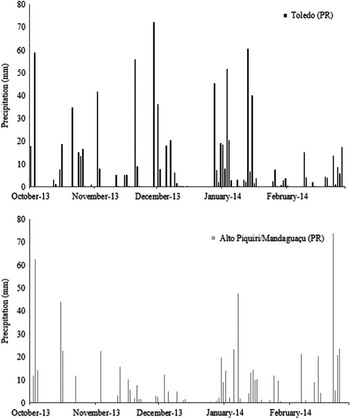
The climate in the locations where the experiments were conducted, according to Köppen’s Climate classification, is CFA mesothermal humid subtropical with hot summers and infrequent frosts, with a tendency to have more concentrated rainfall during summer months but no dry season. Average temperatures in the warmer months are higher than 22 C, and average temperatures in the cooler months are not lower than 13 C. Average annual rainfall is between 1,600 and 1,800 mm (IAPAR 2014). Precipitation data are presented in Figure 1.
Weekly precipitation data (mm) for the time the experiments took place. Season: 2013/2014. Source: SOMAR Meteorologye [SOMAR Meteorology].

Crop inspections for the incidence of pest insects and diseases in soybean were conducted weekly, assuring that no reduction in soybean yield occurred by these agents. For all trials, pesticide applications to control insects and diseases were performed following the recommendations proposed by Embrapa Soja (Reference Embrapa2010).
Efficacy Trial
The study was conducted in no-till soybean at both sites. The Toledo site had clay soil with a pH of 5.6 and 3.1% organic matter, while the Alto Piquiri site had a sandy-clay loam soil with a pH of 4.6 and organic matter of 1.4%. The main weed species at both sites was Sumatran fleabane. Based on both fields’ glyphosate herbicide use history and consistently poor control with glyphosate (Santos et al. Reference Santos, Oliveira, Constantin, Francischini, Machado, Mangolin and Nakajima2014a), the Sumatran fleabane population was assumed to be glyphosate resistant.
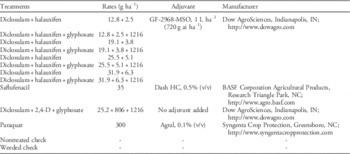
Treatments were applied as a burndown application 7 d before soybean planting (Table 1). Adjuvants were added according to the manufacturer’s recommendation. All treatments with diclosulam plus halauxifen (regardless of glyphosate usage) were applied with methylated soybean oil at 1 L ha−1 (GF-2968-MSO, Dow AgroSciences, Indianapolis, IN). Saflufenacil was applied with proprietary blend of surfactant and oil at 0.5% (v/v) (Dash® HC, BASF, Research Triangle Park, NC), and paraquat was applied with non-ionic surfactant at 0.1% (v/v) (Agral®, Syngenta Crop Protection, Greensboro, NC).
Herbicides and respective rates used in the efficacy trials at Toledo (PR) and Alto Piquiri (PR), 2013/2014.

Herbicide applications were made using a CO2-pressurized backpack sprayer equipped with four XR 110015 flat-fan nozzles (TeeJet Technologies, Wheaton, IL) at a pressure of 240 kPa and a speed of 3.6 km hr−1, delivering an application volume of 100 L ha−1.
The plots were 4 by 6 m, and the effective area consisted of eight 6-m-long soybean rows with 50-cm row spacing. Soybean was planted 6 cm deep on October 22, 2013 and October 21, 2013, at Toledo and Alto Piquiri, respectively. Soybean “SYN3358 RR” was planted at 340,000 seeds ha−1 at Toledo, and “VTOP1059 RR” was planted at Alto Piquiri at 320,000 seeds ha−1.
There were 160 and 75 Sumatran fleabane plants m−1 at Toledo and Alto Piquiri, respectively. Approximately half of the plants at each site were less than 10 cm tall, while the remainder were 10 to 50 cm in height. As a result, plants were classified as short (5- to 10-cm height) or tall (10- to 50-cm height). After preplant applications, no weed control method was used.
Sumatran fleabane control for each plant height was determined at 7, 21, and 45 d after application (DAA). For these evaluations, visual estimates of percent Sumatran fleabane control relative to the nontreated check were recorded using a scale of 0 (no control) to 100 (complete control).
At 28 DAA, a soybean stand evaluation was performed by counting soybean plants present in four meters of row. In order to determine the crop yield, all plants in the center six rows were manually harvested and threshed, and seeds from each plot were collected and weighed. Grain moisture was corrected to 13% for all plots. Toledo was harvested on February 18, 2014 and Alto Piquiri was harvested on February 26, 2014.
Soybean Tolerance Trial
The study was conducted in no-till soybean at both sites. The Toledo site had a clay soil with a pH of 6.0 and 3.1% organic matter, while the Mandaguaçu site had a clay soil with a pH of 5.9 and organic matter of 2.1%. At both sites, a preplant application of glyphosate (1440 gaeha−1) was made 20 d prior to soybean planting.
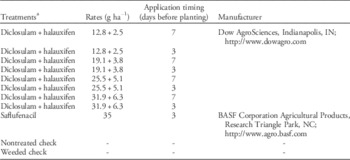
Herbicides were applied on two different dates, at 7 or 3 d prior to soybean planting (Table 2). The treatments consisted of four rates of diclosulam plus halauxifen, saflufenacil, and two checks (nontreated and weeded). No adjuvants were added to the spray mixture of the herbicide treatments. All herbicide applications were made with a CO2-pressurized backpack sprayer using the same settings as were used in the efficacy trial.
Herbicides and respective rates used in the soybean tolerance trials at Toledo and Mandaguaçu (PR), 2013/2014.

a No adjuvant added.
The plots were 4 by 5 m and the effective area consisted of eight 5-m-long internal rows, with 50 cm between rows. Prior to planting, seeds were treated with thiamethoxam (Cruiser®, Syngenta Crop Protection, Greensboro, NC) and fipronil plus pyraclostrobin plus thiophanate-methyl (Standak® Top, BASF, Research Triangle Park, NC). Soybean was planted 6 cm deep on October 22, 2013 and October 16, 2013 at Toledo and Mandaguaçu, respectively. Soybean “SYN3358 RR” was planted at Toledo, and “V-Max RR” was planted at Mandaguaçu, at a seeding rate of 320,000 seeds ha−1. After treatments were applied, the plots were kept free of weeds by manual weeding, except for the nontreated check.
At 14, 21, 28, 35, and 42 DAP, 20 plants per plot were individually evaluated for the presence or absence of visual symptoms caused by the herbicides, and the results were expressed as a percentage. Stand evaluations (four meters of row) and plant height (10 plants per plot) were also recorded at 42 DAP.
To determine crop yield, all plants in the center six rows were manually harvested and threshed, and seeds from each plot were collected and weighed. Grain moisture was corrected to 13% for all plots. The Toledo location was harvested on February 28, 2014 and the Mandaguaçu location was harvested on February 13, 2014.
The statistical design for both trials was a randomized complete block with four replications. The statistical analysis was performed using the software Sisvar (UFLA, Lavras, MG, Brazil) (Ferreira Reference Ferreira2011). Data passed either homogeneity of variance (Levene) or normality (Shapiro-Wilk) tests, and no transformation was required. Data were combined over sites when no site by treatment interaction was detected. Treatments were considered significantly different when the probability was less than 5% (P≤0.05). When the F tests were significant, the Tukey’s test at 5% (P≤0.05) was used for mean comparisons. The orthogonal contrast was used for comparisons of the glyphosate effect on the diclosulam plus halauxifen tank mixture (control evaluation).
Results and Discussion
Efficacy Trial
The results of the combined analysis for the Toledo and Alto Piquiri sites failed to detect a difference between locations, except for the control evaluation performed at 45 DAA (short plant). Thus, the other control evaluations and stand and yield data are discussed as averages of both sites.
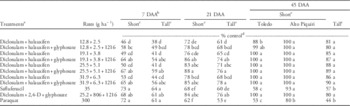
Initial (7 DAA) control ratings for short plants (5 to 10 cm) ranged from 46% to 73% (Table 3). The highest control levels were observed with treatments including contact herbicides (saflufenacil and paraquat), the three highest rates of diclosulam plus halauxifen with glyphosate, and diclosulam plus 2,4-D plus glyphosate. Sumatran fleabane responded to applications of saflufenacil and paraquat, but the plants quickly regrew after the initial injury.
Control of short and tall Sumatran fleabane plants after herbicide application. Sites included Toledo (PR) and Alto Piquiri (PR), 2013/2014. Data were combined when no herbicide by site interaction was detected. Herbicide applications were made 7 days prior to planting soybean.

a Herbicides included appropriate adjuvants, see Table 1 for adjuvants and rates.
b Abbreviation: DAA, days after application.
c Short plants were 5 to 10 cm in height and tall plants were >10 cm in height at time of application.
d Means within a column followed by the same letter are not significantly different according to Tukey’s test (P≤0.05).
At 7 DAA, the highest control levels for tall Sumatran fleabane plants (>10 cm) were observed with the application of saflufenacil, paraquat, diclosulam plus 2,4-D plus glyphosate, and diclosulam plus halauxifen plus glyphosate at the three highest rates (Table 3).
In most of the cases where diclosulam plus halauxifen and glyphosate were combined, there was an increase in Sumatran fleabane control compared diclosulam plus halauxifen alone. Based on orthogonal contrasts, there was an increase of 13% in Sumatran fleabane control at 7 DAA, and a 7% increase at 21 DAA, regardless the plant height at the time of application (data not shown). The benefit of adding glyphosate to the diclosulam plus halauxifen was only observed until 21 DAA. At 45 DAA, the levels of Sumatran fleabane control were similar in all treatments with diclosulam plus halauxifen, regardless of whether glyphosate was included or not.
The observed increase of Sumatran fleabane control with glyphosate at 7 and 21 DAA can be explained by the mixed population of susceptible and glyphosate-resistant biotypes at the experimental site. Moreover, even for resistant biotypes, glyphosate can cause stunting and injury symptoms after its application (Santos et al. Reference Santos, Oliveira, Constantin, Francischini, Machado, Mangolin and Nakajima2014a). Tank mixtures of glyphosate and other auxin-type herbicides have been shown to be synergistic for many broadleaf weeds, including Conyza spp. (Takano et al. Reference Takano, Oliveira, Constantin, Biffe, Franchini, Braz, Rios, Gheno and Gemelli2013). Besides the additive or synergistic combination of these mixtures, an additional advantage of the inclusion of glyphosate in such preplant applications is the broader spectrum of weed species controlled.
An important observation is the declining control with paraquat and saflufenacil treatments from the 7 to 21 DAA evaluations, indicating that Sumatran fleabane quickly recovered from the initial injury caused by the contact herbicides. At 21 DAA, control of short Sumatran fleabane plants was observed with diclosulam plus halauxifen at 19.1+3.8 g ha−1 and higher rates, in tank mixture with glyphosate and diclosulam plus 2,4-D plus glyphosate (Table 3). For diclosulam plus halauxifen applied alone, best results of Sumatran fleabane control were achieved at 25.5+5.1 g ha−1.
The best treatments for control of tall Sumatran fleabane plants were the same as those for short Sumatran fleabane plants (Table 3). However, overall control of short plants was an average of 10% better than it was for tall plants (>10 cm).
At the Toledo site at 45 DAA, most treatments provided >99% control of short Sumatran fleabane plants. However, saflufenacil, paraquat, and the lowest rate of diclosulam plus halauxifen without glyphosate ranged from 53% to 88% control (Table 3). At Alto Piquiri, short plants had similar level of control (≥93%), except paraquat. Control of taller plants at 45 DAA was >80% for most treatments except saflufenacil and paraquat; however, no treatment provided 100% control.
The limited effectiveness of saflufenacil and paraquat does not imply that these herbicides are not valuable in controlling Sumatran fleabane, but rather these herbicides should be used in sequential herbicide application management systems or in applications for smaller plants. Previous research showed that contact herbicides applied sequentially are effective options to manage Sumatran fleabane as preplant applications (Oliveira et al. Reference Oliveira, Guerra, Osipe, Franchini, Adegas and Osipe2013). Herbicides that exhibit efficacy for glyphosate-resistant Sumatran fleabane control are extremely important tools for developing consistent control programs that can be used for no-till soybean (Santos et al. Reference Santos, Oliveira, Constantin, Francischini, Machado, Mangolin and Nakajima2014a).
There was a small increase in control of taller plants treated with higher rates of diclosulam plus halauxifen; however, these treatments provided a similar level of control as the standard diclosulam plus 2,4-D plus glyphosate (Table 3).
The present research confirmed that Sumatran fleabane plant height at the time of application is critical because the efficiency of the treatment decreased as the plant height increased (VanGessel et al. Reference VanGessel, Scott, Johnson and White-Hansen2009; Mellendorf et al. Reference Mellendorf, Young, Matthews and Young2013). Among the factors that can explain the increased herbicide tolerance of plants in more advanced stages of development are lower absorption due to the thicker deposition of cuticle on the leaf blade, limited translocation, and increased capacity for herbicide metabolism (Koger and Reddy Reference Koger and Reddy2005). In addition, larger plants will require a higher rate of herbicide per plant to reach effective control.
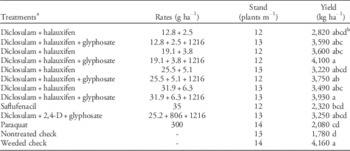
No differences in soybean stand due to the preplant treatments were observed. Since no weed control was performed after emergence of soybean in the field, the lowest grain yields were found for the nontreated check and in the limited residual or non-residual herbicides saflufenacil and paraquat. Residual weed control provided by treatments containing diclosulam prevented soybean yield losses (Table 4).
Soybean stand (14 days after planting) and grain yield when treated with preplant herbicides. Sites included Toledo (PR) and Alto Piquiri (PR), 2013/2014. Data were combined when no herbicide by site interaction was detected. Herbicide applications were made 7 days prior to planting soybean.

a Herbicides included appropriate adjuvants, see Table 1 for adjuvants and rates.
b Means within a column followed by the same letter are not significantly different according to Tukey’s test (P≤0.05).
Soybean Tolerance Trial
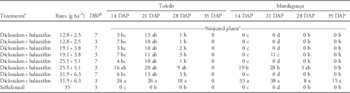
Despite a range of diclosulam plus halauxifen rates, no soybean injury was observed when applications were made 7 d before planting for the experiment conducted in Mandaguaçu. However, low levels of crop injury were observed in Toledo for similar applications (Table 5). For applications 3 d before planting, treatments with diclosulam plus halauxifen at the rates 25.5+5.1 g and 31.9+6.3 g caused early (14 DAP) soybean injury. Injury at 14 DAP ranged from 18% to 32% (Mandaguaçu) and 16% to 23% (Toledo; injury characterized by leaf crinkling and deformation in the unifoliate leaf).
Percent plant injury resulting from herbicide treatments applied 3 or 7 days before planting at Toledo (PR) and Mandaguaçu (PR), 2013/2014.

a No adjuvant were added to the treatments.
b Abbreviations: DBP, days before planting; DAP, days after planting.
c Means within a column followed by the same letter are not significantly different according to Tukey’s test (P≤0.05).
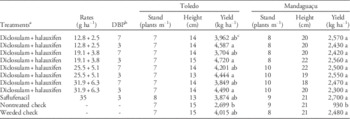
At 21 DAP at Mandaguaçu, injury was observed for diclosulam plus halauxifen at rates of 19.1+3.8 g ha−1 or higher (Table 5). At Toledo, injury was highest at 21 DAP. All symptoms were transient and no injury was observed at Mandaguaçu 42 DAP or Toledo 35 DAP and thereafter. Crop stand and plant height were not affected by the increasing rates of diclosulam plus halauxifen applied prior to soybean planting (Table 6). Although visual symptoms of herbicide injury could be found at initial stages of soybean growth, plants recovered during the season and grain yield were not affected at either site.
Stand, plant height, and grain yield of soybean subjected to increasing rates of diclosulam plus halauxifen applied prior to soybean planting at Toledo (PR) and Mandaguaçu (PR), 2013/2014.

a No adjuvant were added to the treatments.
b Abbreviation: DBP, days before planting.
c Means within a column followed by the same letter are not significantly different according to Tukey’s test (P≤0.05).
Other studies demonstrate that auxin mimic herbicides applied prior to soybean planting may affect crop yield (Thompson et al. Reference Thompson, Steckel, Ellis and Mueller2007). However, the safety of these application timings is usually improved by increasing the period between herbicide application and crop planting. In addition, soil characteristics, such as increased soil clay and organic matter contents, can reduce the availability of the herbicide in the soil solution (Procópio et al. Reference Procópio, Pires, Menezes, Barroso, Cargnelutti Filho, Pacheco, Vieira and Zanatta2009). In this study, despite the intervals between application and soybean planting (7 or 3 d), the cumulative rainfall was similar (67 and 61 mm in Mandaguaçu and Toledo, respectively). It is assumed the combined effects of rainfall and clay soil content helped to prevent crop injury.
This study indicates that diclosulam plus halauxifen can be safely used as a soybean preplant application, requiring a period of at least 7 d between herbicide application and crop planting. By using the minimum plant-back interval, no visual injuries or crop yield restrictions were found. Considering the rate of 2,4-D used in the efficacy trials, a greater period of time between application and soybean planting would be necessary to prevent crop injuries.
Considering both the effective Sumatran fleabane control and the selectivity to soybean, the combination of diclosulam plus halauxifen may be an important tool for preplant applications, since it allows a shorter interval of time between application and soybean planting as compared to traditional treatments with 2,4-D.
Combined results from the two trials reported here showed that the formulated mixture of diclosulam plus halauxifen, applied either alone or in a tank mixture with glyphosate, is effective in controlling Sumatran fleabane prior to planting soybean if Sumatran fleabane plants are small (5 to 10 cm). For taller plants, the best herbicide treatments consisted of diclosulam plus halauxifen at all rates tested when tank-mixed with glyphosate, or at rates above 12.8+2.5 g ha−1 without glyphosate, and the tank mixture of diclosulam plus 2,4-D plus glyphosate. Although there was an initial soybean rate-response when the applications were made 3 d before planting, visual effects were transient and crop yield was not affected. Therefore, the rates of diclosulam plus halauxifen tested in this study were considered to be effective on Sumatran fleabane control and selective to soybean.