1. Introduction
In recent years, theories drawing upon institutional economics (i.e. Williamson's transaction cost economics) and strategic management literature (i.e. Porter's strategic positioning framework and/or the capabilities view of the firm) have evolved to exploit the strengths of both disciplines. The key issue is to determine why different firms within the same industry choose to adopt varying strategies. Empirical work provides strong support for transaction cost economics, but ‘generally does not explore how the make or buy decision for a single transaction fits into a firm's overall strategy’ (Nickerson, Reference Nickerson1997). In addition, empirical testing for alternative theories of the firm is still rather scarce. Our contribution to the literature, therefore, is an empirical analysis of corporate strategies in the emerging global market for liquefied natural gas (LNG) based on a detailed dataset including 89 operating and future exporting and importing projects worldwide.
Converting natural gas to LNG for transportation by tanker has been utilized for more than 40 years, but only recently has LNG come to play a significant role in the global natural gas market. Even though technological advances enabled transport over greater distances, it was highly capital intensive in its formative years. Markets for the most part remained regional in nature prior to the 1990s. However, as investments in LNG infrastructure have grown throughout the past decade, driven by increasing natural gas demand worldwide, LNG has become a globally traded source of energy with rapidly diminishing costs. Today, it is essential to the energy supply of coastal nations such as the US, the UK, Spain, South Korea, India, and China.
The evolution of the institutional framework from monopolistic structures to competition requires fundamental changes in the organizational behavior of market participants. The rise of functioning spot markets, gains in contract flexibility, and increasing international trade have put LNG's ‘traditional’ players under intense pressure. Global mergers and acquisitions, integration, and strategic partnerships are common practices. We observe that many of today's oil and natural gas producers and distributors are heavily engaged in all stages of the LNG value chain; thus, the global industry is now defined by a small number of large players. Indeed, Jensen (Reference Jensen2004) argued that the developing global LNG market will be dominated by ‘super majors’.
Several case studies have examined corporate motivations to choose alternative institutions of governance and determinants of vertical integration in commodity industries (Monteverde and Teece, Reference Monteverde and Teece1982; Klein, Reference Klein1988; Acemoglu et al., Reference Acemoglu, Johnson and Mitton2005). Our contribution to the literature is an analysis of the determinants of vertical integration in the LNG industry from the view of both economics and strategic management. In the first stage, we identify three alternative target market positions, each supported by an underlying resource profile; in the second stage, we investigate the determinants that move companies in the direction of vertical integration. We test our hypotheses by applying ordinary least squares (OLS), Tobit, and binary Probit models, finding results consistent with current theory that provide strong support for the so-called positioning-economizing perspective of the firm. We show that national oil companies (NOCs) rely less on idiosyncratic assets than companies following a flexibility strategy and that companies following a flexibility strategy rely on less idiosyncratic assets than chain optimizers. In the second step we empirically confirm transaction cost economics presumptions, i.e. that investments in idiosyncratic assets under uncertainty have a positive impact on the likelihood of vertical integration.
The paper is organized as follows: Section 2 provides an overview of the existing theoretical and empirical literature analyzing the determinants of vertical integration and a rationale for applying new institutional economics to the global LNG industry. Section 3 introduces the industry-specific context and derives testable hypotheses. Section 4 summarizes the dataset and introduces the applied method. We present and interpret the results in Section 5 before concluding.
2. Literature survey
2.1. Approaches to vertical integration
Literature provides a number of theories to explain a firm's behavior. Most empirical work investigating motivations of internal organization are based on the transaction cost economics framework based on Coase (Reference Coase1937) and further developments thereof (Williamson, e.g., Reference Williamson1971, Reference Williamson1983; Klein et al., Reference Klein, Crawford and Alchian1978). This literature identifies asset specificity, uncertainty, and frequency of transactions as the most significant factors influencing transaction costs with the first being the strongest determinant of vertical integration. The hold-up problem arising from a high level of relationship-specific investments in uncertain environments with players characterized by bounded rationality results in costly ex-post bargaining, ex-ante under-investment, and decreasing efficiency. Organizing transactions within a corporation's own hierarchy by internalizing the subsequent quasi rents can avoid these problems. The transaction cost approach came into prominence during the 1980s when early stages of empirical analysis generally focused on manufacturing and the impact of investments in specific physical assets on corporate behavior (e.g. Monteverde and Teece, Reference Monteverde and Teece1982; Klein, Reference Klein1988). Subsequent research has emphasized the importance of human assets and applied the new findings to numerous industries (i.e. Acemoglu et al., Reference Acemoglu, Johnson and Mitton2005).
Following the more formal property rights approach (Grossman and Hart, Reference Grossman and Hart1986), incentives to integrate vertically are generated by the advantage of possessing residual rights of control over assets in cases where specific investments are required. Other theoretical approaches have concluded that market imperfections such as the existence of market power, barriers to entry, price discrimination, or asymmetric information favor vertical integration (Joskow, Reference Joskow2005).
Concurrently, the strategic management literature has also investigated corporate strategies and organizational forms, with ‘strategy’ understood as a firm's selection of a certain position in the market chosen to achieve a competitive advantage. However, no one ideal position along the value added chain exists for all companies because customers and markets differ. Porter's strategic positioning framework distinguishes between cost-based and differentiation-based positions.Footnote 1 He further argues that for companies to survive, they must be both flexible and able to respond to structural changes within their industry.
A related stream of literature, the so-called resource-based view of the firm, focuses on rents derived from imperfectly imitable or substitutable resources. It distinguishes tangible from intangible resources, with the latter being the main focus. Firms' experience in an industry, reputation, established networks, or internal routines determine production and transaction costs. Similar to Porter's strategic positioning framework, the capabilities view is a dynamic concept in which firms need to match resources and capabilities to changes in the environment if they wish to attain optimum performance. The capabilities view suggests that the choice of internalization of activities in the firm's own hierarchy is determined, at least in part, by the relative strengths of internal and external capabilities (Langlois, Reference Langlois1992). Other authors have examined the relationship between relative capabilities and the choice of a governance mode (e.g. Argyres, Reference Argyres1996).
2.2. Recent trends toward a synthesis of competing theories
Empirical work provides strong support for Williamson's transaction cost economics, but ‘generally does not explore how the make or buy decision for a single transaction fits into a firm's overall strategy’ (Nickerson, Reference Nickerson1997). In recent years, several authors have developed theoretical approaches combining economics and strategic management literature (e.g. Day and Klein, Reference Day, Klein and Houston1987; Nickerson, Reference Nickerson1997; Gosh and John, Reference Gosh and John1999). Whereas a market in which various firms are active is analyzed from an economic perspective, the strategic management literature examines the behavior and the performance of individual firms without any implications for the industry as a whole. This positioning-economizing perspective postulates that decisions regarding market position, resources, and governance mode are interdependent. A target market position is supported by a resource profile that in turn determines the organizational choice of a firm. Masten (Reference Masten and Groenewegen1995) also discusses the endogeneity of investment decisions.
Empirical literature testing for alternative theories is still very rare. Nickerson et al. (Reference Nickerson, Hamilton and Wada2001) link Porter's strategic positioning framework and Williamson's transaction cost economics with an application to the international courier and small package service in Japan. They point out that the assumptions underlying both theories are not contradictory and that both theories have a consistent unit of analysis – the value chain and transactions (unbundled value chain) respectively.Footnote 2 Nickerson et al. conclude that the heterogeneity in corporate strategies reflects the reality of firms being endowed with different feasible resource profile/organization pairings. Poppo and Zenger (Reference Poppo and Zenger1998) investigate make-or-buy decisions in information services testing transaction cost theory and the resource-based view of the firm. They conclude that in order to improve the theory of the firm, competing theories must be integrated.
We place ourselves in the continuation of this literature by analyzing corporate strategies in the global LNG industry. First, following Porter, we identify three strategic target market positions in this industry: chain optimization versus a flexibility strategy versus national oil companies. Each target market position is supported by an underlying resource profile characterized by a certain level of idiosyncrasy. Second, following transaction cost economics, we argue that specific investments under uncertainty provide incentives to integrate vertically. We test these economic relationships empirically based on a two-stage procedure.
3. Industry context
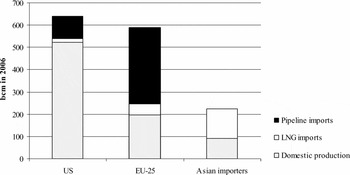
The transportation of natural gas is capital intensive and prices between geographic locations may differ substantially. During the 1980s and early 1990s, indigenous natural gas supplies and imports via pipelines were sufficient to meet demand in the Atlantic Basin, and LNG capacities grew relatively slowly. In contrast, Pacific Basin importers (e.g. Japan, South Korea, and Taiwan) lacking large domestic supplies and pipeline sources historically depended on LNG imports (see Figure 1).
Supply structure of natural gas importing regions

Converting natural gas to LNG for transportation by tanker has been utilized for more than 40 years, but the industry achieved a remarkable level of global trade only recently. As early as 1964, the technology of natural gas liquefaction enabled commercial natural gas transport in tankers, but transport remained expensive and markets stayed regional in nature until the 1990s. During this early stage, most of the world's LNG export infrastructure remained under state control, and private or foreign companies were rarely involved. Inflexible bilateral long-term contracts with take-or-pay and destination clauses secured infrastructure investments and reliable supplies for import-dependent buyers (Hirschhausen and Neumann, Reference Hirschhausen and Neumann2006).
Since the 1990s, investments in LNG infrastructure grew rapidly as worldwide natural gas demand increased significantly, leading to substantial economies of scale throughout the value chain. For example, the first liquefaction trains (Arzew in Algeria) had a capacity of 1.1 million tons per year (mtpa); today, trains with a capacity of 4 mtpa are common, and Qatar recently started the construction of 7.8 mtpa units.Footnote 3 Tanker financing and construction schedules have benefited from new manufacturing techniques and more shipyards that can build modern vessels. Large ships lower average transport costs. Break-even of offshore pipeline and LNG transport is now achieved at about 3,000 km (Jensen, Reference Jensen2004).
Today, LNG is responsible for supplying the US, the UK, Spain, South Korea, India, and China among others. The Middle East accounts for more than 40% of worldwide proven natural gas reserves and is expected to become the largest regional exporter of LNG. It is currently evolving to a swing producer; deliveries to European and Asian markets and even to North America are feasible without a significant difference in (transportation) cost. For a detailed survey of the globalizing LNG market, see Jensen (Reference Jensen2004).
Changes in the institutional framework (from monopolistic structures to competition) in turn demand fundamental changes in the organizational behavior of market participants. More competition, mirrored by functioning spot markets, a gain in contract flexibility, and increasing international trade, exposes ‘traditional’ players to greater pressure. Global mergers and acquisitions, integration, and strategic partnerships have become routine today and the LNG industry is dominated by a small number of large, powerful players. We can observe that global oil and natural gas producers and distributors are frequently engaged in all stages of the LNG value chain. In addition, export projects are increasingly financed and developed by private (and foreign) interests. Former downstream monopolists of natural gas are finding their traditional markets challenged by the intrusion of oil and gas majors integrating into import markets. Vertical integration in response to market deregulation features drivers, including upstream producers aiming to benefit from downstream margins, ownership of transportation capacities to exploit arbitraging possibilities, and distribution and power companies moving upstream to ensure margins and supply security in a period of increasing global demand.
Several authors have provided perspectives on the emerging corporate strategies employed in the LNG sector. Cornot-Gandolphe (Reference Cornot-Gandolphe2005) and Iniss (Reference Iniss2004) indicate that long-term contracts are increasingly accompanied by flexible short-term agreements as well as vertical integration and strategic partnerships. Nissen (Reference Nissen2004, Reference Nissen2006) identifies a new business model, the so-called ‘commercial LNG’, which is characterized by an unbundling of transportation assets enabling flexible trade. Jensen (Reference Jensen2004) even argues that the developing global LNG market will be dominated by super majors.
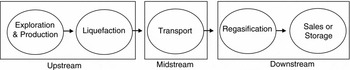
Figure 2 depicts the five stages of the LNG value chain: after exploration and production (stage 1), natural gas is transported via pipeline to liquefaction facilities where it is cooled to −160°C (113K) under atmospheric pressure (stage 2) and shrinks to about 1/600 of its volume. Next, the liquefied gas is loaded into tankers containing a complex isolation system essential to keep the gas liquid during shipment to the destination countries (stage 3).Footnote 4 Upon arrival, tankers are off-loaded to terminals that reconvert the LNG to its original state of aggregation (stage 4). Finally, the gas is fed into the destination country's pipeline grid, traded and sold to marketers, distributors, or power producers (stage 5), or stored for future demand.Footnote 5
LNG value chain

To investigate the LNG industry from an economic as well as from a strategic perspective, the five stages of the value chain should be considered together. The structure of export or import projects is largely predetermined by exogenous factors and therefore often beyond the control of the players. Exploration and production of natural gas is directly linked to the liquefaction projects whose ownership structures in many cases are determined by national oil and gas companies. On the downstream end, national infrastructure, marketing, and distribution systems are often in place before import terminal construction. Thus, our analysis concentrates on these three successive stages (upstream, midstream, and downstream) as shown in Figure 2.
Strategic positioning is understood as ‘performing different activities from rivals' or performing similar activities in different ways’ (Porter, Reference Porter1996). In the LNG industry, we distinguish upstream, midstream, and downstream activities. Companies may be specialized in one, two, or even all three of these segments. However, we also observe varying strategies of different companies which are active in similar stages of the value chain, and one and the same company choosing different positions along singular value chains. From Porter's strategic positioning framework, we identify three possible target market positions taken by LNG firms:
1. Flexibility strategy: players following a flexibility strategy (e.g. BG Group, Exxon Mobil) are investing in a portfolio of LNG export and import capacities on both sides of the Atlantic or even in the Atlantic and Pacific Basins, enabling benefits from arbitraging possibilities. The control of midstream transportation capacities is a key factor required for flexible trade.
2. Chain optimizers are typically active in one import country (e.g. Gaz de France, Korea Gas Corporation), contracting or integrating along the associated value chain in order to secure supplies.
3. National oil companies are upstream state-owned oil and natural gas companies (e.g. Sonatrach in Algeria) with the main objective of generating state revenues.
Each target market position is supported by an underlying resource profile.Footnote 6 The definition of asset specificity in the LNG industry is not straightforward. According to Nissen (Reference Nissen2007), asset specificity is ‘a property of the transportation links, created by the terms of physical and commercial access’ to shipping capacities. In particular, the midstream element of the value chain is of crucial importance in an industry with a relatively illiquid shipping market. Post-contractual opportunism by the counterparty may be hazardous for parties without shipping control, in other words, ex-ship/cif buyers and free-on-board sellers.Footnote 7 However, the transformation in the past decade to a sellers' market accompanied by restructuring and liberalization of downstream natural gas (and electricity) markets has resulted in downstream physical asset specificity. A player investing in regasification capacity without having secured supplies and access to midstream shipping is caught in a lock-in situation. LNG sellers profit from significant bargaining power since importers compete globally for natural gas supplies; furthermore, competitive downstream markets facilitate their access to numerous buyers.
Whereas NOCs typically invest in the upstream sector and may integrate downstream, chain optimizers hold downstream positions contracting or integrating upstream along the associated value chain in order to secure supplies. Employing a flexibility strategy allows players to invest in a portfolio of upstream and downstream capacities. From this we derive the following proposition:
Proposition 1: National oil companies should rely on less idiosyncratic assets than companies following a flexibility strategy; companies following a flexibility strategy should rely on less idiosyncratic assets than chain optimizers.
According to Williamson's transaction cost approach, idiosyncratic assets in uncertain environments lead to the hazard of opportunistic behavior by the counterparty. Asset specificity is the strongest determinant of vertical integration. Organizing transactions within a firm's own hierarchy will avoid these costs. Hence we derive:
Proposition 2: The higher the share of idiosyncratic (downstream) assets in the portfolio of an LNG firm, the higher should be the probability of vertical integration along the LNG value chain.
We define an econometric model analyzing this two-stage decision-making process. In the first stage we examine how players choose a resource profile supporting their target market position and in the second stage we study the determinants that drive players to vertical integration.
4. Data and methodology
4.1. Data
Our global industrial dataset was compiled from publicly available information complemented by interviews with industry experts. It includes capacities, ownership structures, investment costs, financing structures and expansion plans for liquefaction and regasification projects; data on LNG's worldwide tanker fleet, including vessels currently listed in shipyard order books; and analyses of contracting partners, supply facilities, contracted volumes, and contractual durations.
We first identify actual value chains based on the dataset's 67 import and 22 export projects and then analyze individual companies' activities throughout the chains.Footnote 8 Omitting observations with missing data, our sample consists of 253 corporate-specific value chains, of which 138 are situated in the Atlantic Basin and 115 correspond to Asia-Pacific trade. Precise definitions of the endogenous and exogenous variables employed follow.
Endogenous variables
Our first prediction relates the extent of idiosyncratic assets to the choice of a target market position. To test for this relationship, we define the extent of idiosyncratic assets of a player (SPECIFIC) by the ratio of regasification capacity (ri,year) over the sum of regasification and liquefaction capacity the player controls in the start-up year of the value chain (ri,year + li,year). The variable increases with the share of regasification capacities in a firm's LNG portfolio, mirroring the lock-in situation of a player investing downstream in a sellers' market. It is continuously distributed between 0 and 1 (including these threshold values)

Our second prediction is derived from transaction cost economics. For an empirical test we design an evolution criterion based on whether a company integrates vertically; the unit of analysis is whether or not a firm integrates from upstream or downstream, depending on its origin, into the midstream shipping stage. We classify both equity relationships and long-term charter contracts as vertical integration.Footnote 9 The dependent variable VI is a binary discrete measure taking the value of one if we observe vertical integration of the player, and zero otherwise

Exogenous variables
Proposition 1 describes the relationship between a target market position and the resource profile (i.e. the level of idiosyncrasy of a player's assets). We use dummies indicating chain optimizers (CHAIN) and national oil companies (NOC) as exogenous variables; the flexibility strategy (FLEX) is the omitted position.Footnote 10 Hence, Proposition 1 indicates a positive relation between SPECIFIC and CHAIN and a negative relation between SPECIFIC and NOC.
Proposition 2 refers to the impact of idiosyncratic assets and uncertainty on the likelihood of vertical integration. Transaction cost economics predicts that asset specificity is the strongest determinant of vertical integration. Theory shows that the most efficient solution is trade on a short-term market for exchange relationships not involving any investment in specific assets. Markets become inefficient as bilateral dependencies – resulting from investments in specialized assets – arise. Specific investments in environments without uncertainty can be secured through long-term contracts. In contrast, the existence of uncertainty results in vertical integration being more efficient.
Due to the high capital intensity of infrastructure investments, uncertainties regarding the scope of natural gas fields or price developments, investors generally face different risks. In addition, natural gas fields are often located in politically uncertain regions.Footnote 11 A number of risks can be hedged via diversification or other measures; therefore, we evaluate the political risk associated to upstream investments as the main driver of uncertainty. The variable for political uncertainty (UNCERT) is based on POLCON (Henisz, Reference Henzisz2000), an index that measures the degree of constraints on policy change in a country averaged for five-year periods since 1960.Footnote 12
Control variables
To account for changes in corporate strategies over time we include a dummy variable indicating value chains that came into operation after 1999 (D2000). We expect that players will encounter a changing environment given the industry's rapid expansion and that they must select or adapt strategies to maintain or gain competitive advantages as discussed, for example, in Porter (Reference Porter1996).
We use the dummy variable ATLANTIC to control for differences in corporate strategies resulting from regional factors that vary between the Atlantic Basin market (deliveries to Europe and North America) where LNG trading hubs already exist or are developing, and Asia-Pacific trade where buyers depend strongly on LNG imports.
We calculate the variable CAPOWN as the ratio of the accumulated liquefaction and regasification capacities controlled (owned or contracted) by a global player over the sum of worldwide liquefaction and regasification capacities in operation at the end of the respective year (ri,year + li,year)/(rtotal,year + ltotal,year). Companies controlling significant LNG capacities may be able to benefit from arbitrage possibilities, which in turn may increase the motivation to integrate into midstream shipping, especially when downstream regasification assets account for a significant share in the portfolio.
STATE, another dummy variable, identifies state-owned entities, thus allowing for differences in corporate strategies due to a different ownership structure.
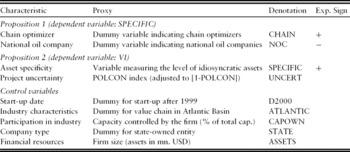
Finally, we use the firm's assets value (ASSETS) as a proxy variable for firm size and financial strength. We expect a positive relation between vertical integration and ASSETS since companies endued with a strong capital basis face lower barriers to entry in terms of funding capital-intensive LNG projects. For a survey of all exogenous variables see Table 1.
Exogenous variables and expected effect on the dependent variable

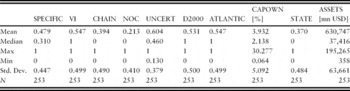
Table 2 gives summary statistics of the 253 observations in the dataset. More than 40% of the observations are chain optimizers, 21% are NOCs, and 33% players follow a flexibility strategy. There is a 55% average likelihood of vertical integration into midstream shipping. More than 50% of all observations came (or come) into operation in the period 2000 to 2010, mirroring the industry's rapid expansion. Slightly more than half of the observations are situated in the Atlantic Basin. Players control between 0.1% and 30.3% of worldwide liquefaction and regasification capacities during the observation period; 33% of the value chains are state-owned entities. Corporate size ranges from USD 358mn (Italian Enel) to USD 279bn (Japanese Nippon Oil Corporation).Footnote 13
Summary statistics

4.2. Methodology
We sequentially estimate two separate regression models: the relationship between a target market position and the level of idiosyncratic assets, and the impact of the firm's resource profile (with respect to the level of idiosyncrasy) on the likelihood of vertical integration. Following Proposition 1 that refers to Porter's strategic management literature, we hypothesize that each target market position is supported by an underlying resource profile

where the error term ɛi is expected to follow a normal distribution. For econometric reasons, all control variables used in equation (2) are included in equation (1) above. We estimate equation (1) using an OLS model. Since we observe a certain accumulation of observations at the threshold values of zero and one, we also employ a Tobit model to verify estimation results.
In the second step we examine, based on Williamson's transaction cost approach, the impact of specific investments on a firm's choice of governance form. Following Proposition 2 we expect that idiosyncratic assets in combination with the observed uncertainty relate positively to the likelihood of vertical integration, with asset specificity being the strongest determinant of the choice to organize transactions within the firm's own hierarchy. To account for endogeneity, we replace the observed values of SPECIFIC by their predicted values SPECIFIC_F calculated from equation (1) (Maddala Reference Maddala1983).Footnote 14 We also include an interaction term to account for transaction cost approach predictions that specific investments in combination with uncertainty enhance the probability of vertical integration. From this we obtain

where the error term ui is expected to follow a normal distribution. Having defined the dependent variable as binary variables, we apply a Probit estimation model.Footnote 15
5. Estimation results and interpretation
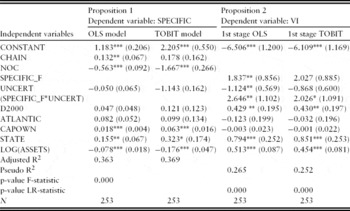
Table 3 provides the estimation results of the two models; both hypotheses are confirmed empirically. The p-values of F- and LR-statistics respectively (both < 1%) show that the null hypotheses of all slope coefficients equaling zero must be rejected for both estimations. Adjusted R2 and Pseudo R2 of 0.363 (0.369) and 0.265 (0.252) for OLS and Tobit-based equation systems support the explanatory power of the models.
Estimation results

Notes:***Statistically significant at a 1%-level; **statistically significant at a 5%-level; *statistically significant at a 10%-level; standard errors in parentheses. All levels of statistical significance are based on two-sided test statistics; however, since we are making directional predictions for the main dependent variables of Proposition 1 (CHAIN and NOC) which are different from zero, we employ in these cases one-sided test statistics.
Our empirical results provide support for Proposition 1; the estimation coefficient of chain optimizers has a positive sign (statistical significance at the 5% level for the OLS model) and the estimation coefficient of NOCs has a negative sign (statistical significance at a 1% level for both models). Hence, we can confirm that NOCs rely on less idiosyncratic assets than companies following a flexibility strategy, and companies following a flexibility strategy rely on less idiosyncratic assets than chain optimizers.
The results of the second-stage estimation provide broad support for transaction cost predictions. Asset specificity (or idiosyncrasy of investments), the strongest determinant of vertical integration, shows the expected positive sign (5% significance level). Uncertainty itself tends to have a negative impact on the probability of vertical integration. However, even though uncertainty itself does not lead to vertical integration (Williamson, Reference Williamson1971), its presence intensifies the impact of specific investments on a player's motivation to organize transactions within its own hierarchy. As shown by the interaction term (SPECIFIC_F . UNCERT), we can confirm that uncertainty enforces the impact of idiosyncratic investments; asset specificity in combination with uncertainty has a strong positive impact on a firm's incentive to integrate vertically.
Statistically significant control variables provide several interesting findings. The variable STATE is significant in both models and under both OLS and Tobit estimation procedures in the first stage. In contrast to private firms, state-owned entities tend to invest in assets with a higher level of idiosyncrasy; the share of regasification capacities in their LNG portfolios is larger on average. This can be explained by the fact that in the first decades of the LNG industry, mainly national natural gas companies and distributors invested in LNG import capacities, even though we observe the move to privatization (e.g. Gas de France, ENI). As suggested by theory, we find that the likelihood of vertical integration is on average also higher for state-owned entities.
Players controlling a larger share of world LNG (regasification and liquefaction) capacities (CAPOWN) show a higher extent of investments in specific assets; however, we could not find any significant influence on the likelihood of vertical integration.
The variable controlling for the start-up date of the value chain (D2000) indicates that vertical integration has become a more common organizational mode throughout the industry. This reflects global players' efforts to establish a portfolio of export and import positions in order to benefit from arbitrage potentials. We observe that access to flexible transport capacities (e.g. via integration into midstream shipping) is the key to successful employment of this strategy. Rapid industrial expansion accompanied by a restructuring process prompt firms to internalize risks inherent in the capital-intensive industry via strategic repositioning and reshaping.
For the variable measuring a firm's financial strength (ASSETS) we find that investments in specific assets decrease with a higher assets value. A possible explanation is that most capital-intensive investments are required upstream (exploration, production, and liquefaction). In contrast, the value of assets is positively related to the likelihood of vertical integration, an indication that larger firms have the financial capabilities necessary to invest in numerous capital-intensive LNG (export and/or import and shipping) facilities.
6. Conclusions
This paper provides empirical evidence for combining different theories of firms' strategies. Recent theoretical literature argues that economic and strategic management approaches should be linked to explain companies' behavior in dynamic markets. We analyze corporate strategies in the rapidly developing global LNG industry using Williamson's transaction cost approach and Porter's strategic management framework.
The ‘LNG rush’ forecasted during the early years of this decade has brought an increase in regasification capacity of about 45% since 2000. A large number of additional terminals and the expansion of existing facilities are approved, under construction, or already completed; countries not currently benefiting from LNG flexibility are considering investments in the near future (e.g. Wilhelmshaven in Germany, Gdansk in Poland, Krk in Croatia, Mariveles on the Philippines). Rapidly increasing worldwide demand and the ongoing process of deregulation in downstream markets have brought fundamental changes in corporate behavior such that the global LNG industry is now characterized by flexible long-term contracts accompanied by short-term agreements. Many companies are investing in regionally diversified LNG portfolios and integrating vertically to internalize risk factors resulting from investments in capital-intensive infrastructures. The control of transport capacities is a key factor in order to benefit from cross-trade opportunities.
Using a two-stage decision-making process, we test two propositions on corporate strategies in the LNG industry. First, based on Porter's strategic positioning framework, we identify three possible target market positions: chain optimization (investments in infrastructure along a single value chain) versus a flexibility strategy (investments in a portfolio of LNG export and import positions) versus national oil companies. Empirical results confirm our industry-specific predictions and support the positioning-economizing approach hypothesis of an interrelation between the three strategic choices of target market position, resource profile, and organizational structure. We show that NOCs rely on less idiosyncratic assets than companies following a flexibility strategy and that those companies following a flexibility strategy rely on less idiosyncratic assets than chain optimizers. Second, we use transaction cost economics to analyze the determinants of vertical integration. Our results confirm the theory's predictions and show that idiosyncratic investments in uncertain environments lead to a motivation to organize transactions within a firm's own hierarchy.
As Porter (Reference Porter1996) argues, ‘a company may have to change its strategy if there are major structural changes in its industry’. Although the LNG industry already has undergone significant changes, several dynamics in industry characteristics remain. Nissen (Reference Nissen2006) discusses the emergence of so-called ‘merchant structures’ upstream and downstream. The LNG industry has moved away from the project-utility model (bilaterally committed value chains with the LNG export project as seller and downstream energy companies as buyers with ship ownership embedded in these long-term contracts) to a commercial structure. Three ways of implementing merchant structures into an LNG value chain are feasible: (i) the expansion of a project to an integrated merchant (e.g. QatarPetroleum-ExxonMobil); (ii) the elimination of a project from the value chain (e.g. Idku/Egypt); and (iii) embedding trading optionality in long-term supply contracts (e.g. Sempra Energy in Tangguh/Indonesia). Further qualitative or quantitative analysis on the LNG industry should address these recent developments.