Introduction
In 1999, US President Bill Clinton launched Plan Colombia, an episode in the long history of US intervention in Latin America. In the post-World War II era, the Colombian government had been a constant and faithful ally of the US government's Latin American policy, first in its war against communism and then, from the 1970s onwards, against drugs, of which Plan Colombia was part. Between 1999 and 2010, the US government injected US$7.3 billion into this programme, which made Colombia one of the largest targets of US aid in the worldFootnote 1 and put it under the de facto tutelage of the US government.Footnote 2 Most of this investment was used for military action and the destruction of coca fields. Within Plan Colombia, the reform of Colombian prisons – the focus of this paper – formed only a small budgetary itemFootnote 3 and is generally an overlooked aspect of it. But it has profoundly reshaped the world of Colombian prisons. As part of this reform, and with the advice of the US Federal Bureau of Prisons (BOP), 16 new prisons were built, increasing the capacity of the Colombian prison system by almost 70 per cent between 1999 and 2010. Most of the 30,545 beds provided in the new facilities were located in housing blocks inspired by the high-security design of the United States Penitentiary at Coleman Federal Complex in Florida. Of those beds, 1,000 to 1,500 were punishment cells within the Unidades de Tratamiento Especial (Special Treatment Units, UTEs) directly inspired by ‘supermax’ or Secure Housing Unit (SHU) security blocks developed in the United States during the 1990s, characterised by the almost total isolation of prisoners, sensory deprivation and minimal interaction between prisoners and warders. This reform, which drastically toughened detention conditions and militarised the country's penitentiary culture, supplemented the ‘punitive turn’ in criminal justice policies initiated in Colombia in the mid-1990s.
As in many South American countries, the neoliberalisation of the Colombian economy over the 1990s coincided with an unprecedented hardening of penal policies, and therefore paved the way to a dramatic expansion of the prison system.Footnote 4 The Colombian government created multiple new offences in the penal code and stiffened penalties for minor infringements committed by the poorest sectors of the population.Footnote 5 As a result, in less than 20 years, the Colombian prison population increased fourfold (29,343 inmates in 1994 to 120,032 in 2013, according to official prison statistics).Footnote 6 After 2000, the direct intervention of the BOP during Plan Colombia not only fostered and reinforced this trend towards mass incarceration, but also led to a significant alteration in the nature of the prison system. Working closely with the Colombian government, the BOP intended to export to Colombia a set of penal architectural features based on the Federal Prison of Coleman, including punitive solitary confinement, as well as staff training techniques and day-to-day prison management policies.
The primary aim of this paper is to shed light on the process by which the ‘US prison model’Footnote 7 was introduced in Colombia and on the effects of this process on the penal system of this country. To develop this analysis, it draws on the complementarity of literatures that rarely talk to each other, dealing both with mobile policiesFootnote 8 and mobile built forms.Footnote 9 Policies and built forms sometimes travel independently: drug policies or legal ideas can moveFootnote 10 without being accompanied by a specific built form. Conversely, for example, the import of the shopping mall type of building in a new context does not necessarily go hand-in-hand with a policy change.Footnote 11 Furthermore, transnational circuits of policies and forms can differ in terms of actors, spaces of circulation, economic interests, etc. But in the case of the US prison model in Colombia, changes in the penal policy and changes in the architecture of prisons are congruent and complementary. The new model – and, in a particularly symbolic way, the introduction of the UTE supermax blocks – gives material form to an ultra-punitive penal regime where security and punishment predominate over any other function (such as re-education or dissuasion) associated with the imprisonment of the perpetrators of what a jurisdiction considers as a crime. This penal regime, which developed in the US in the 1980s and 1990s alongside the ascent of mass imprisonment, has been described by scholars in criminology as one of the main features of the ‘new punitiveness’.Footnote 12 One of the aims of Plan Colombia was to export this regime to Colombia. The US-led reform of Colombian prisons is therefore a strong example of a mobile policy and a travelling architectural type aiming at radically reshaping the application of the law, the behaviour of prisoners and warders and the architecture of prisons. Methodologically this convergence thus leads to the following question: how can concepts from studies of mobile policies and mobile built forms be fruitfully articulated? Empirically, it leads us to ask: how do mobile policies and forms complement each other? What is the nature of the frictions that both policy and architectural models are faced with when introduced in a new cultural and institutional context, taking into account asymmetrical North–South power relations?Footnote 13
In this paper, we argue that the transfer to Colombia of the US penal regime and its architectural icon – the supermax – has been of critical importance in the rise of a new punitive regime in the country. We also show that the introduction of US-inspired prisons in Colombia inaugurated an unprecedented pattern of prisoner isolation operating at different levels: on a regional scale, with the relocation of a large part of the prison population in deurbanised correctional facilities where contacts with the social and family environment are drastically weakened or destroyed; and, on a local scale, through architectural and regulatory arrangements aiming to break the collective dynamics and eliminate the significant margin of freedom that previously characterised the Colombian prison system. However, we argue, the reform did not succeed in wiping out the traditional prison culture (or what we call the ‘criollo’ prison), based on social bonds of inmates within and outside of the prison. Our analysis shows that the divergent interpretations of the prison reform's ‘programme of action’ by the US and Colombian governments – two states whose relations were marked by an asymmetry of power in the neocolonial context of Plan Colombia – and the heterogeneous nature of ‘institutional spaces’ between the US and Colombian carceral milieus are the main reasons for this incomplete transfer.
This paper draws on extensive fieldwork in both the United States and Colombia between 2009 and 2011, at a time when some of the US-inspired prisons were already functioning and others were still under construction in Colombia. Conducting fieldwork in high-security or supermax facilities remains quite unusual in prison studies and the question of access was particularly challenging for this piece of research. As scholars engaging with prisons have claimed, in many countries prisons have become highly bureaucratic and opaque institutions that are very difficult to penetrate in order for research to be conducted. Furthermore, funding agencies and universities today are often reluctant to support long-term and sometimes ‘risky’ field research in prisons.Footnote 14 However, these obstacles can be overcome, as is evidenced not only by the work of criminologists and anthropologists, but also by the new and fast-developing geographic scholarship focusing on spaces of incarceration and confinement in the era of new punitiveness in a variety of countries.Footnote 15 For the present research, difficulties in gaining broad access to prisons were circumvented thanks to collaboration with a Colombian NGO specialising in the monitoring of human rights in detention facilities and humanitarian assistance to prisoners.Footnote 16 Methodologically, the study is based on documentary analysis, statistical data, 50 visits to a broad range of Colombian prisons (including supermax UTE wings), as well as in-depth interviews with prisoners, former prisoners, family members, prison officers, prison directors, human rights activists and penal reform lobbyists. Additionally, a series of interviews was conducted with prison architects in the United States.Footnote 17
We develop our analysis in three stages. First, we situate our study within the recent literature on mobile policies and built forms, and we then argue that the worldwide export of the US ‘new punitiveness’ is itself a case of mobile policy, and the export of its prison model is a case of mobile built form. Second, we analyse how the reform of the Colombian penal and penitentiary system inspired by the US prison model took place during the first decade of the twenty-first century, describing the motivations of Washington and Bogotá in this process, how this reform transformed the Colombian prison system, and highlighting some of its consequences. In the final part of our paper, we argue for a broader relational view of space production beyond analyses of mobile policies and built forms.
Mobile Policies and Architectures
Since the early 2000s a series of publications studying the mobility of public policies in geographical space have developed new understandings of policymaking in an age of fast-paced globalisation.Footnote 18 In discussing policy mobility instead of transfer – a term generally used in political science – geographers have highlighted the selective, power-laden, spatially complex and often unpredictable processes through which policies travel.Footnote 19 Pursuing and deepening the debate, other authors have in turn recently questioned the concept of mobility, with its material connotations, as a limited concept for grasping the variegated ways in which a policy in one place can be influenced by a policy somewhere else.Footnote 20 It has been suggested that researchers need to use a repertoire of different conceptual descriptors and methodologies in order to capture the material, immaterial and sometimes elusive ways in which policies cross geographical spaces.Footnote 21 The debates on how to make sense of policies on the move also stretches beyond the boundaries of geography. Other fields of research – in particular urban history with studies of inter-municipal exchanges,Footnote 22 and planning theory with studies of cross-border planning practicesFootnote 23 – have dealt with similar processes for a long time. An emergent dialogue across these research fields is opening the possibility for greater thematic breadth and historical depth in policy mobility studies.Footnote 24 This conversation is also potentially fruitful as it brings together, as Ian Cook et al. remark, theoretically sophisticated work in geography with empirically rich work in other disciplines.Footnote 25
In geography, urban history and planning theory, the focus is on policies and how municipalities, planners and other experts are involved in the business of policymaking beyond the place in which they primarily intervene (a specific city, region or country). However, city relations are not restricted to policies, but include a wide range of exchanges from business to social movements or lifestyles.Footnote 26 In this paper, we argue that in order to grasp contemporary dynamics of space production, the scope should be widened further to include work focusing on the geographies of architecture. Built forms in different cities are indeed connected through the mobility of architectural types or models, as another strand of research in geography and urban studies has demonstrated.Footnote 27 This literature highlights processes that in many ways are similar to those described by policy mobility studies showing, for instance, that intermediaries such as professional journals or local experts play an important role in the mobility of built forms and that forms are adapted during their travel rather than simply copied off the shelf.
While policy mobility scholars have tended to develop rich analyses of how their research object moves,Footnote 28 scholars studying mobile built forms have tended to focus on how it is transformed by moving.Footnote 29 Looking at concrete material solutions rather than flexible policy discourses, the latter are more inclined to observe and try to account for modifications. We argue that a fruitful complementarity derives from this difference in focus. It is also particularly relevant for an understanding of the penal dimension of Plan Colombia, which combines the circulation of a punitive policy and of a prison model. Therefore, we draw on conceptual resources from both policy mobility studies and geographies of architecture. Concepts such as ‘globalised micro-spaces’ of negotiation – stemming from policy mobility studiesFootnote 30 – and ‘institutional embeddedness’Footnote 31 – stemming from the geography of architecture – are thus used to make sense of the empirical phenomenon on which this paper focuses.
According to Eugene McCann, the concept of globalised micro-spaces refers to ‘key relational sites that are central to the social process of teaching and learning about policy’.Footnote 32 These sites – such as meetings, conferences, on-site visits, workshops, award ceremonies and other networking events – are important nodes in the global circulation of policy knowledge ‘where trust is developed, where reputations are made or unmade … and where acquaintances, or “weak ties”, are made among copresent conferees’.Footnote 33 Among the main globalised micro-spaces are fieldtrips associated with ‘policy tourism’Footnote 34 – i.e. policy experts travelling to particular host places to share experiences or fact-finding visits to specific places – as well as meetings and conferences that include ‘micro-scale activities of policy packaging, communicating and persuading’.Footnote 35 As we will see below, such globalised micro-spaces played a central role in the mobility of the US prison system.
If attention to these spaces allows an understanding of mechanisms facilitating policy and architectural mobilities, the notion of institutional embeddedness draws our attention to how heterogeneous institutional contexts create frictions in these mobilities.Footnote 36 Recently, scholars have paid more attention to the role of institutions, highlighting the fact that policies and built forms do not smoothly travel across spaces regulated by different legal, administrative, political and cultural systems.Footnote 37 In this context, James Faulconbridge suggests it is essential to have a broad definition of ‘institutions’, embracing both their formal and informal dimensions:
Existing studies define institutions as both formal rules and regulations set by recognized authorities in a particular institutional field, and the informal norms, customs and traditions that support and result from formal rules […] Together these two dimensions of institutions are said to influence the priorities, behaviors and decision-making of actors.Footnote 38
Using such a wide analytical angle is particularly useful for addressing the case of the Colombian prison institution, at the heart of which sit informal or criollo norms and practices. As historian Frank Dikötter stresses, ‘Institutions like prisons […] are social artefacts which cannot be wholly explained in terms of mere instrumental purposes. They embody wider cultural meanings.’Footnote 39 We will show that the institutional and cultural divergences between Colombia and the United States in the penitentiary domain are crucial to an explanation of why the results of the prison reform were different from what was expected. Informal norms of the prison institution – or to put it in other terms, the cultural habits of the criollo prison – played a major role in preventing a full conversion to the US model. Criollo prison culture, expressed by the routine practices, discourses and representations of all the agents of the Colombian prison system (including prisoners, warders and prison authorities), could not be transformed by decree. It was only temporarily dampened during the years the BOP and local authorities attempted to transfer the US maximum-security blueprint to Colombia.
Exporting the US ‘New Punitiveness’ and Prison Model
Since the second half of the 1970s, the United States has been the birthplace of a drastic shift in the field of crime control, towards ultra-repressive ‘law and order’ policies. One of the key impacts of this ultra-repressive scheme has been to push the United States into an age of mass imprisonment.Footnote 40 Between 1975 and 2010, the US prison population increased by 600 per cent, a phenomenon without precedent in the history of contemporary democratic societies.Footnote 41 This ‘punitive turn’Footnote 42 represents not only a new trend in policies, but also a profound cultural change. What David Garland named the ‘culture of control’Footnote 43 elevates safety from crime – and related themes such as zero tolerance and war on drugs – to the highest levels of government priorities as well as of people's concerns and public debate.
US neoconservative thoughts, practices and policies regarding crime control, far from being a domestic issue, have become highly influential on a global scale. Scholars have described the international convergence and homogenisation of security and penal policies following the US example, highlighting the role of US think tanks, transnational networks of experts, professional associations and international conferences in this process of worldwide influence.Footnote 44
The US prison sector changed dramatically not only in scale, but also in nature. From the 1980s onwards, the objective of rehabilitation was progressively abandoned and replaced by other fundamental justifications for prisons: punishment, deterrence and incapacitation.Footnote 45 This was not only a rhetorical change, but also had material implications that led to a profound transformation in the correctional world of the United States. Prisons were increasingly built in remote rural areas and prisoners subjected to draconian rules, permanent supervision, harsh treatment and geographical, social and emotional isolation.Footnote 46 In the spirit of the law, as well as in the architectural design and internal rules of the facilities, security became the absolute priority above and beyond all other considerations. Security also became the ‘trademark’ that distinguished US experts and builders within the well-informed circles of the global prison industry.Footnote 47
Among the recent transformations in prison design, the super-maximum security prison (‘supermax’) is emblematic, as it materialises in built form the punitive turn in criminal justice policies. This prison model spread in the United States between the late 1980s and the late 1990s, at the height of the carceral boom.Footnote 48 Supermaxes (SHUs, in official parlance), operate like prisons within prisons. They are stand-alone facilities or special housing wings built inside larger state and federal prison complexes, and held, in 2013, about 20,000 prisoners who could not allegedly be controlled in the general prison population (mostly Hispanic gang members condemned to lengthy prison sentences).Footnote 49 People detained in supermax facilities are subjected to long-term solitary confinement under conditions of radical sensory deprivation.Footnote 50 Whilst it involves only a small minority of the prison population of the country, the supermax is of symbolic importance, as it has become the architectural icon of the new regime of ultra-punitiveness in the United States. In the light of the mass worldwide influence of US penal thinking and policy, it is hardly surprising that the supermax has played a role in the exportation of the US prison model, as we show below.
In the case of the exportation of the US prison model to Colombia, site visits in the two countries acted as key micro-spaces of persuasion. Short trips to US prisons by Colombian civil servants were organised by Washington in the early 2000s. A participant in the Colombian delegation invited to visit five prisons in the United States explained the impact of a trip in 2004 in the following terms:
The Americans showed us that everything must function according to a strict procedure and that any kind of space must be designed for that purpose. While analysing the architecture and the buildings’ typology, we could see that everything was functional. When we got back to Colombia, we took all this information, we consulted the national penitentiary law and we reconfigured our own model.Footnote 51
In turn, US experts of the BOP were invited for a long-term stay in Colombia to bring technical assistance. Their time at the heart of the Colombian prison administration was an important part of the transfer process, as the next section shows.
The US Prison in Colombia: One Script, Different Motivations
The transfer process of the US prison model was planned jointly by the US and Colombian governments in 2000–1 and was ratified in a bilateral agreement known as the ‘Improvement Program for the Colombian Prison System’, which was included in the broader framework of Plan Colombia.Footnote 52 In order to understand the workings of the policy mobility process, it is useful to borrow from the extended metaphor of the ‘script’ developed by Madeleine Akrich in Actor Network Theory.Footnote 53 A script is a scenario or programme of action inscribed in a technology or artefact. A ‘script analysis’ of an innovation ‘follows’ a programme of action from its conception to its inscription in technologies or artefacts and finally to its adoption or rejection by its users. This concept can be applied in an illuminating way to travelling policies and built types.Footnote 54
In Colombia, the script of the new prison system was contained in the essence of Plan Colombia: that is, in the implementation of ultra-punitive ‘tough-on-crime’ policies especially regarding counter-narcotic and counter-terrorism issues. This programme of action set out a series of measures that were inscribed in the bilateral Agreement settling different aspects of the technical input of the Federal Bureau of Prisons of the United States in the Colombian prison sector. According to the Agreement, the BOP was tasked with advising on: the design, construction, equipment and internal rules of new high-security facilities; upgrading of security levels in the facilities; redesigning the training programme in the National Penitentiary School; the creation and training of new special groups of commandos within the Instituto Nacional Penitenciario y Carcelario (National Penitentiary and Prison Institute of Colombia, INPEC); and the establishment and training of intelligence groups, auditors and instructors. Additionally, this programme of action prescribed the implementation of a new architectural model. Financially, the US government funded only technical aid by the BOP experts’ delegation, as well as some computing and security devices, while Bogotá was liable for the greater investments in the prison sector, such as Colombian staff expenses, building costs, equipment and maintenance.Footnote 55
From many possible examples provided by the US penitentiary building stock, the BOP chose the maximum-security ‘United States Penitentiary’ (USP), one of the prison facilities at the Coleman Federal Correctional ComplexFootnote 56 in Florida, for the model to be reproduced in Colombia, as BOP liaison agents in Colombia explained in a self-congratulatory report published in the trade press in 2002.Footnote 57 However, the transfer process that eventually resulted was much more problematic than the ideal of cooperation described by the BOP at this time would suggest. Although the content of the transfer was inscribed in the letter of Agreement and the choice of the architectural design of Coleman, a closer analysis of the process reveals that the interpretation of the script differed depending on the points of view of actors at the two ends of the process, because of their respective political context and interests.
For the US government, building more stable judicial institutions and secure detention facilities in Colombia was a pressing need in order to get Colombian drug traffickers (and to a lesser extent, guerrilla leaders) prosecuted and eventually extradited to the United States, where they were regarded as criminals in the eyes of US law. Indeed, according to the US Embassy in Colombia, between 1999 and 2011 at least 1,200 drug offenders were extradited to the USA, where most of them were tried and condemned to harsh sentences.Footnote 58 It was thus in Washington's interests to build high-security prisons, from which it was almost impossible to escape, so that prisoners would remain safely in custody during the months or years before their extradition to the United States.
From the Colombian perspective, the Agreement raised broader expectations. Beyond the will to please Washington, Bogotá perceived US aid as an opportunity to modernise its penitentiary system and put an end to the endemic crisis of prisons, plagued by nightmarish conditions of overcrowding, dilapidation and insecurity. At the end of the 1990s, the Colombian government was not only under pressure from the United States; it also had to face strikes by prison staff and mutinies by prisoners. Additionally, in 1998, the Constitutional Court declared the whole prison system unconstitutional, due to systematic violations of the inmates’ fundamental rights,Footnote 59 a situation exacerbated by the explosion of the prison population that started in the mid-1990s. According to government statements in Congress, the US intervention in penitentiary affairs was aimed at nothing less than wiping the slate clean and launching a new model of order and security, inspired by the US model. The Colombian government even harboured ambitions to position the country as running the most modern prison administration on the continent.Footnote 60 As reported by the Colombian press, the minister of justice launched the new prisons calling them ‘the safest and most modern of Latin America’ and proudly claimed that they had ‘nothing to envy the best in the world’.Footnote 61 The very name of the reform, ‘Nueva Cultura Penitenciaria’ (New Prison Culture), reflected this will to revolutionise prison policies: it was not merely the introduction of a few practices and architectural changes; rather the goal was to achieve fundamental transformation of the penitentiary culture. Despite the importance of this issue, prison reform and collaboration with the BOP were carried out in a discreet – almost secret – way by the Colombian government. The Agreement was never submitted to the national Congress and the government directly managed the prison reform with discretionary powers, without having to account to Congress at any point.
Soon after the signing of the first part of the Agreement in 2000, a delegation of BOP experts was sent to Bogotá. They rapidly gained considerable influence, such that they became a kind of hidden management board within the Colombian prison administration, a position they held until they left Colombia in 2005. This status is reflected in the comments made by several agents within INPEC, notably by a leader of a warders’ trade union:
We all knew that the key figure in INPEC was J. [the chief of the BOP delegation]. Everybody knew perfectly well that the prison system was managed from la oficina del Buró en la 26 [BOP's office in INPEC's headquarters located at 26th Street in Bogotá], at least for the main strategic issues. The employees used to go to his office to ask for personal favours, due to his influence.Footnote 62
In terms of policy mobility, this is therefore a case where, far from a symmetrical relation between municipalities or nation states, we have officials of a foreign government creating an enclave in another country to directly steer the implementation of a new policy within very asymmetrical international power relations.
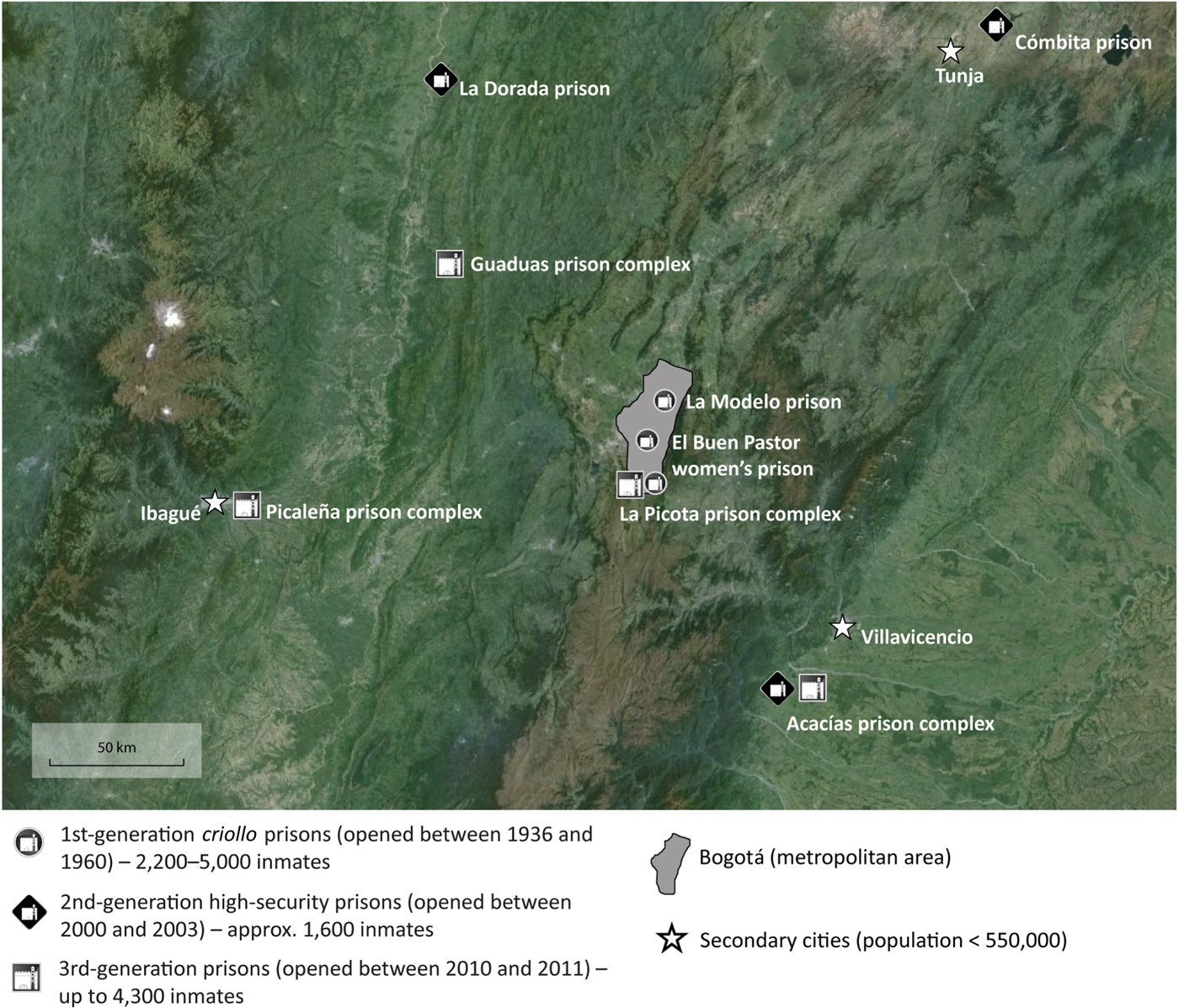
Between 2000 and 2003, the design of Coleman Prison inspired the construction of six large high-security ‘New Prison Culture’ facilities of 1,600 beds each in different regions of the country (Valledupar, Cómbita, Acacías, La Dorada, Girón and Popayán) that were officially classified as ‘2nd-generation’ prisons (see Figure 1). As generally happens in policy mobility processes, the original model was not literally copied. Rather, the the design of the new facilities was inspired by the high-security features of the Coleman penitentiary.
Prisons Built after 2000 in Colombia with the Advice of the US Federal Bureau of Prisons

In 2003, despite the opening of 10,000 new beds in the six new prisons, the Colombian government admitted that, contrary to what had been promised, the rate of overcrowding had not been reduced. The sustained growth in the number of prisoners resulting from increasingly severe penal laws had by far exceeded the pace of construction. In 2004, on the advice of the BOP, Colombia began to design ten ‘3rd-generation’ prisons – carceral mega-complexes designed to hold up to 4,300 inmates each, that included, on a single very large site, separate facilities with different security levels (low-, medium- and high-security). Ten of these mega-complexes were built after the BOP had left Colombia in 2005 (see Figure 1). Despite the unprecedented proliferation of prisons during the years of the New Prison Culture reform, new construction never could keep pace with the dramatic growth in the prison population resulting from the massive incarceration of minor offenders.Footnote 63
As with the ‘penalisation of poverty’ that occurred in the United States from the end of the 1970s,Footnote 64 the punitive turn that started in Colombia in the mid-1990s clearly targeted the poorest sections of the population. Statistics on education levels among prisoners in Colombia bear this out. Almost half of the inmates (45 per cent) received no education after primary school (five years of schooling),Footnote 65 a level of education far below the national average.Footnote 66 Furthermore, the dramatic increase in the prison population is mostly the consequence of the criminalisation of conducts or of harsher punishment – through successive ‘law and order’ penal reforms between 2004 and 2016 – for crimes committed mostly by the poorest sectors of society, primarily: low-level drug offences,Footnote 67 illegal possession of weapons and mobile phone robbery.Footnote 68 Meanwhile, crimes carried out by state agents and the elites – violation of human rights, corruption, white-collar crimes – have kept on enjoying broad impunity and remain largely outside the scope of prison sentencing.Footnote 69 Besides, it should be stressed that – mainly due to the evolution of the internal armed conflict – the rate of most violent crimes has actually dropped in Colombia since the early 2000s. This trend is notably evidenced by the steady reduction in the homicide rate between 2002 (68.9 per 100,000) to 2012 (30.8 per 100,000)Footnote 70 and the dramatic fall in kidnappings (from 3,572 cases in 2000 to 282 cases in 2010 nationwide).Footnote 71
From Criollo Culture to a Pattern of Isolation
A central aim of the New Prison Culture was to get rid of the old habits of the traditional or ‘criollo’ prison culture, which was based on flexibility, as well as geographical and social integration. Borrowing the emic notion of ‘criollo’, broadly used by Colombians in everyday speech to mean ‘typical of our own land’ or ‘distinctive of our culture’, we define the criollo prison culture as a set of culturally-embedded practices forged over the decades that considerably improve quality of life behind bars by limiting the depersonalisation and the desocialisation inherent in imprisonment, despite dreadful conditions of infrastructure deterioration, poor management, corruption and insecurity.
Acknowledging the integrative effects of the criollo prison culture must not, of course, overshadow the extremely violent and discriminatory nature of prison life in the country. Colombian scholars have commented on the exploitative and brutal power relationships between groups of inmates and between inmates and prison guards and authorities, as well as the severe human and material deprivation suffered by the prison population,Footnote 72 not to mention systematic violations of human rights that have been well documented by Colombian NGOs.Footnote 73
However, Latin American prisons also reflect a tradition of social inclusion and prisoners’ informal co-governance. This tradition is a heritage dating back to the creation and early development of the modern penitentiary in the continent during the second half of the nineteenth century.Footnote 74 These institutional and cultural features have collided with Western representations of the prison and even undermined early attempts to ‘import’ exogenous penitentiary models into Latin America.Footnote 75 In recent years, a growing body of ethnographic research has also sharpened our understanding of informal dynamics in contemporary Latin American prisons. This literature brings to light the multiple ways prisoners participate and collaborate to the extent that prisons are practically co-governed by state authorities and inmates in a variety of Latin American countries.Footnote 76 Although this situation is not recognised by governments, prisons would simply not operate without the participation of the inmates. Criollo prison culture in Colombia strongly echoes this pattern.
We identify four key characteristics of criollo carceral culture: firstly, prisoners’ communal and self-managed lifestyle; secondly, a significant amount of dialogue and negotiation between the prison population and the prison management; thirdly, the preservation of regular and intimate contact with family (notably through a sort of ‘open day’ at the weekend, with tens of thousands of visitors, including children, staying for long periods in the living spaces of prisoners); and, fourthly, the geographical location of the prisons in accessible sites within urban areas. Criollo prisons were certainly designed to punish penal offenders, but not to radically exclude them from society. The New Prison Culture's blueprint of isolation abruptly collided with this older institutional framework and represented a dramatic change, as it inaugurated an unprecedented phase of extremely severe control and deprivation, which precisely targeted the destruction of ‘permissive’ criollo habits, operating over several spatial scales: regional (location of the prisons in or outside of urban areas), local (transformation of the space of the prison itself) and micro-spatial (social interaction, practices and regulation of everyday life in prisons).
First, at the regional level, the new model targeted the previous pattern of social and geographical integration of the prison system within Colombian society. Thus, two apparently contradictory dynamics arose simultaneously during this period: there was, on one hand, an unprecedented growth in the number of correctional facilities and in the prison population; and, on the other hand, the carceral archipelago was rendered invisible, by being removed from cities and relocated in remote rural areas (Figure 1). This deurbanisation was particularly acute in the region of Bogotá. There, between 2003 and 2011, seven new prisons were built within a 200 km radius of the capital, providing 14,400 beds – an additional bed capacity 2.5 times higher than that of the three criollo prisons of Bogotá, where prisoners had been concentrated for decades (Figure 2). Consequently, prisoners’ contact with their families was weakened not only through a dramatic reduction in ‘visiting rights’, but also as a result of the physical distance separating them from their family, loved ones and friends.
The Deurbanisation of the Prison System: Prison Facilities Built since 2003 within a 200 km Radius of Bogotá

Second, locally, the new model transformed the prison itself, with the introduction of a series of architectural and regulatory standards emulating the Coleman prison in Florida: the construction of separate self-contained housing blocks (intended to easily suppress any kind of unrest by the prisoners and to prevent the propagation of protests to other housing blocks); the use of massive grey cement structures; the introduction of individual or dual-occupancy cells and of a series of security devices, such as generalised video surveillance and glass-separated visit halls. In addition, an SHU (UTE in Spanish) or supermax wing was constructed in each prison, designed to hold allegedly dangerous or recalcitrant prisoners for short- or long-term solitary confinement, as a means of disciplinary punishment.
According to the public servants within the Colombian prison administration who implemented the reform, the specific location and design prescribed by the BOP was intended to isolate the prisoners and create an austere atmosphere of punishment and subservience. However, from the perspective of the Colombian prison administration, the punitive philosophy promoted by the BOP was also, conveniently, an expedient and cost-efficient solution, as highlighted by two officials from INPEC:
[Colombian Official 1]: [the BOP officials] had the idea that prisons had to be painted in grey; they said the colour grey intimidates the soul and subdues it.
[Official 2]: Yes, but from our end we mostly used it to avoid maintenance, because it is cheaper. It was not so much because we wanted it grey, but rather because it was cheaper.Footnote 77
Third, at a micro-level, transferring the US prison model to Colombia was also about promoting new practices and rules within the new carceral spaces. Prescribing what kind of disciplinary regime had to be implemented and how to behave in the high-security prisons was considered by the BOP as important as the construction of the prisons themselves. Therefore, precise instructions on how to run US-inspired facilities were transmitted through training manuals and practical sessions for the warders and the administrative staff. If the supermax is the ultra-punitive script turned into stone, we have here, to use Akrich's words again, prescriptions about the correct use of this new type of carceral architecture in Colombia.Footnote 78 According to the US experts’ team, the cultural transformation of the prison system had to occur through the implementation of efficient administrative and operational procedures that were translated word for word from US training books to create new manuals at the Colombian National Penitentiary School.Footnote 79 The administrative staff and the warders were thus taught ‘New Prison Techniques’ borrowed from US correctional protocols. New Special Forces created by the US advisors – the Grupo de Reacción Inmediata (Immediate Response Group, GRI) and the Comando Operativo de Remisiones de Especial Seguridad (Special Escort Corps, CORES) – were trained in US security methods, including brutal use of force to subdue recalcitrant individuals or groups. The terror inspired by the new GRI, which carried out unannounced searches (requisas) in the main prisons of the country, was often mentioned by prisoners during the interviews as one of the most striking features of the new regime. According to the consistent testimonies of the inmates, the GRI raids usually mobilised 30 to 50 male and female agents who entered the housing blocks at night; prisoners were gathered in the courtyard, divided in small groups, stripped and body searched, while their cells were searched for prohibited items and often left ransacked. A prisoner relates:
Every three months or so, there is a GRI inspection […] They are very violent. We have to strip, lean forward so they can search us, open our mouth. Sometimes they fire tear gas at us and beat us. Last time they came, it was three months ago. They divided us into four groups, they had two Rottweiler dogs. There were about 50 of them. Being naked like this, in front of everyone, it is really embarrassing.Footnote 80
In the new facilities, warders in watchtowers were armed with high-calibre weapons. The practices and clothing of prison guards were modelled on the military, and camouflage uniforms replaced civilian clothes. Militarisation became, de facto, a key aspect of good understanding and smooth communication between US experts and local staff, the Colombian prison administration having long been trained according to military organisational and operational frameworks. For decades, the highest posts of the penitentiary administration had been exclusively assigned to high-ranking members of the army or the police, from the Director-General of INPEC to the wardens of the main prisons of the country. As the former head of the INPEC Civil Engineering Office stressed:
We have always had a military profile at the top [of INPEC]. And the military forces have worked for years under the lead of the Americans, so they master their language; they immediately know how to carry out the instructions and procedures.Footnote 81
Toughening of the procedures was also reflected in the daily treatment of prisoners. Warders were instructed to break with the ‘bad habits’ of the criollo prison culture, such as talking to the prisoners or greeting them with a handshake. Unprecedented interventions in the prisoners’ bodies were introduced, such as the use of US-inspired orange uniforms, the compulsory shaving of heads and facial hair and the shackling of hands and feet during transfer out of the housing block or from a prison to another, as described in this prisoner testimony:
On 10 May 2001, they transferred me on a military plane to the new prison of Valledupar. It was well known that it was the Yankee regime there. They took my shoes and clothes away and they gave me a uniform and a toiletry kit. The warders were very young; they treated us in a totally inhumane way, we had never known that before. They did not treat us like human beings. […] The inmates soon launched a protest about visiting rights. The response was brutal. A bloody repression, beating us with batons and tear gas […].Footnote 82
In sum, then, the planned elimination of the criollo system was to take place through the combined action of a new penal policy, geographical location, architectural standards and staff training programme.
Frictions in the Policy Transfer
However, things did not work out the way the BOP and the local transfer agents originally expected. Taking stock of the evolution of the Colombian prison system over the last 15 years, the gap between the initial script of the US model and the reality of the New Prison Culture is striking. The pattern of isolation has had an important and long-term impact on Colombian prisons and prisoners, even on the old ‘first-generation’ facilities, where inmates have been affected by the constant threat of being transferred to remote maximum-security prisons, restriction of visits and raids carried out by commando groups. Nevertheless, the hoped-for radical change to flawless order and absolute control within the prison system did not occur. In this last section, we suggest a set of explanations as to why this happened and what were nonetheless the effects of the prison reform.
The reform did not succeed in reaching its proclaimed objectives, for a series of institutional and political reasons. From the beginning of the transfer process, due to the differences in the formal rules between the US and Colombian penitentiary systems, the BOP experts had to adapt to local conditions that limited their capacity to manoeuvre. For example, a lack of finance in the Colombian penitentiary sector restricted the installation of technological security devices, and prevented increases in the number of warders; while the relatively restrictive Colombian legal framework limited the use of force inside prisons, in contrast to the United States.
Moreover, beyond this initial adaptation process, none of the announced goals of the reform, such as obtaining ISO 9000 certification (an international quality standard) for high-security facilities or ending overcrowding, have become a reality. Over the years, the new prisons – initially proudly presented as a successful symbol of modernisation – proved to be plagued with problems of poor construction, endemic malfunctions and human rights abuses. From the late 2000s onward, the negative image of the prison system was such that the Colombian government stopped mentioning the New Prison Culture policy or the collaboration with the BOP in any official document or public statement.
The predicted profound cultural transformation of the penitentiary world did not materialise either. In this regard, the informal dimension of institutional embeddednessFootnote 83 played a great role. The cultural habits of the criollo prison were a key factor that inhibited a full conversion to the US blueprint of radical isolation, draconian rules and strict control. This blueprint collided with deeply rooted practices such as the strong communal life style among the prisoners, the broad visiting rights for families and friends and the leeway for negotiation between the prisoners and the prison management.Footnote 84 Thus, although in the 16 prisons inspired by Coleman (all of which include UTE units) the severe regime instituted by the US advisers continues to apply, it has been infiltrated by the practices and unofficial norms of criollo culture. This was especially the case after repeated prisoners’ protests, acts of resistanceFootnote 85 and judicial activism, which received the support of Colombian human rights NGOs denouncing the New Prison Culture as a totalitarian nightmare. Furthermore, the New Prison Culture did not take hold in the vast majority of old prisons, where three-quarters of the Colombian prison population live today. In those jails, thousands of prisoners crowded into dilapidated and insalubrious facilities continue to live according to criollo carceral culture; they have never known the US model, except through hearsay. In sum then, the universe of the Colombian prison institution has become a dual system in which two contradictory penitentiary cultures coexist.
These institutional differences are augmented by political reasons for the failure, resulting not only from the divergent interpretation of the script according to the particular interests of each government, but also from a lack of political will to make sustainable improvements in the prison sector. From the outset, the objectives of the US government were clearly related to their agenda in the ‘war on drugs’. As soon as the programme stopped serving their interests (i.e. after the extradition of hundreds of drug traffickers), they abandoned the collaboration. After the BOP left the country in 2005, Washington removed the prison sector from its broad programme of intervention in Colombia, even excluding the creation of a follow-up mechanism to monitor the high-security prisons and their supermax UTE housing units. Furthermore, given that they were exclusively concerned with security issues, neither the US nor the Colombian government ever had the intention of including in the reform process essential elements to address the mismanagement of the prison system, such as corruption; lack of basic health provision and educational programmes; privileges for organised-crime bosses, white-collar criminals and high-ranking army officers; and practices of torture and human rights violations. Even more importantly, on the Colombian government side, there was an inherent contradiction between the proclaimed goal of solving the overcrowding of the prison population by building new prisons and the simultaneous active planning of a quantitative explosion in the prison population. The priorities of the Colombian authorities had thus increasingly diverged from their ambitions of order and modernity to focus on the improvised management of mass imprisonment.
If the reform failed to meet its objectives, significant transformations in the world of Colombian prisons did however take place. First, indicators of violence in prisons reduced during Plan Colombia: the number of violent deaths (essentially homicides by firearms), along with the mortality rate, declined steadily between 2000 and 2008.Footnote 86 Second, while for many years power had been in the hands of inmates involved in organised crime and drug trafficking, the state has been able to regain some control and authority inside the prison system. How much the US-inspired prison reform contributed to this change is highly uncertain, though. Credit cannot be attributed solely to the US ultra-punitive prison model, as it is likely that these indicators would have improved anyway due to other historical factors. Indeed, the high rates of violence in prisons at the end of the 1990s were a reflection, or an extension, of the generalised violence in Colombia caused by the intensification of the armed conflict, widespread paramilitary terror, the uncontested power of drug lords, and a weakening of state authority. As mentioned above, the homicide rate dropped more generally in the country during the 2000s. It is likely therefore that the registered drop in the prison homicide rate after 2000 mostly reflects the end of a particularly bloody episode in Colombian history rather than a change in prison policies.
Second, the introduction of the US prison model led to the partial imposition of a new blueprint of totalitarian control aiming to radically isolate prisoners geographically and socially. This bedrock of the US model was reflected not only in architectural design but also in the prison policies prescribed by the BOP experts. The location of correctional facilities in remote and inaccessible areas, the broad use of transfers which sent prisoners hundreds of kilometres away from their place of origin, and the strengthening of militarisation, all contributed to a situation of disconnection and social disaffiliation among prisoners. In this regard, the deurbanisation of the prison system that goes hand in hand with the move towards mass incarceration will have long-term consequences that we discuss in our conclusion.
Conclusions
This paper has explored the travel to Colombia of US prison policies and architectural design, including the supermax prison – the architectural icon of US new punitiveness. Our analysis provides an understanding of how, on the basis of US policy and architectural models, such transnational relations transformed Colombia's penal and carceral cultures. It also explains why the planned revolution of the Colombian prison system through the New Prison Culture did not take place.
Our analysis furthermore highlights the role of symbolic, economic and political power asymmetries. While these asymmetries are rarely addressed in policy and architectural mobility studies, our case study shows how central they often are in the way models circulate. The creation of the sort of enclave of foreign rule that took place within Plan Colombia is difficult to imagine in the North–North policy relations predominant in the literature, but it is far from exceptional when North–South relations are considered.
Besides providing a contribution to the issue as to how the new punitiveness in both criminal and prison policies has spread across the Americas and beyond, this story also addresses a methodological question relating to the phenomena of policy and built form mobility, which are usually analysed in two largely unconnected research fields. This paper has thus used concepts from these two bodies of research to analyse both the processes through which policies and forms were made mobile and the frictions they encountered. By articulating these concepts it has sought to reply to the question posed in our introduction: how do mobile policies and forms complement each other? Our analysis suggests two replies to this question.
Built forms make policies tangible and durable
Looking at the connections between penal policy reform and new prison architecture highlights how new strategies of the state are inscribed in tangible forms and how this allows us to better grasp the effects of policies on mentalities, bodies and daily lives. In the reverse direction, connecting forms with the policies – or scripts – from which they stem gives us a better idea of what built forms do: it unveils their pedagogical programme.Footnote 87 On the one hand, built forms – which can be visited, seen, touched – act as we have shown as powerful tools of persuasion in the adoption of new policies. On the other hand, like Bruno Latour's ‘technology’,Footnote 88 built forms are also ‘society made durable’: they disclose the stubbornness of policies even after their apparent death. Thus, supermax prisons have continued – through their location and spatial organisation – to shape Colombian carceral culture after the end of the penal collaboration with the US, even though criollo practices have crept back into these prisons. Because built forms perpetuate the effects of policies beyond their lifetime, so to speak, it is heuristically fruitful to make connections between analyses of policy mobility and architectural mobilities.
Policies and built forms follow distinct but intersecting circuits
Built forms have their specific circuits of circulation related to the reach and networks of architectural firms, as well as to the influence of journals and architectural schools.Footnote 89 They differ from inter-municipal policy networks organised around mayoral meetings, bilateral cooperation or large city networks such as United Cities and Local Governments (UCLG). Moreover, if journals and academics play an important role in architectural circuits, international conferences and fieldtrips play an important role as ‘global micro-spaces’ for urban policies. However, our analysis of the travel of the supermax shows that these circuits also intersect: actors involved in prison and criminal policy and prison architecture meet, for instance, at the conferences of the International Corrections and Prisons Association (ICPA). To advance our understanding of how space is produced in a global arena, systematic comparisons between these different circuits would thus be needed.
More generally, the convergences and divergences between these forms of mobility should encourage us to move towards fuller analyses of the relational production of urban space. In order to do this, we need to reduce the barriers between research fields such as studies of policy, architectural and planning mobility. Each of these fields identifies different logics of relational space production implying different circuits, actors and motivations. A systematic comparison of these logics would provide us with a better understanding of how places develop through different ‘politics of relatedness’.Footnote 90 Recent work on comparative urbanism has rightly insisted on the importance of comparing cities beyond the North–South divide in order to develop genuinely global and less Eurocentric urban studies.Footnote 91 As we hope our study of mobile penal policies and prison models demonstrates, there is also much to be gained – in order to understand the connective tissues that make places across the globe interdependent – from comparing differing forms of relations along the same routes.