More than half of Syria’s population of 23 million has been displaced by the civil war in Syria. Since late 2015, Canada has resettled more than 57,000 Syrian refugees (Government of Canada, 2017). A large number of these refugees are children and adolescents, and many experienced interrupted schooling before their arrival in Canada (Sirin & Rogers-Sirin, Reference Sirin and Rogers-Sirin2015). It is well known that refugee children are susceptible to academic, psychological, and social difficulties as a result of the challenges they experienced and continue to experience (Bronstein & Montgomery, Reference Bronstein and Montgomery2011; Kalt, Hossain, Kiss, & Zimmerman, Reference Kalt, Hossain, Kiss and Zimmerman2013; Tousignant et al., Reference Tousignant, Habimana, Biron, Malo, Sidoli-LeBlanc and Bendris1999). To support the full participation of refugee children and youth in their host country, it is essential to ensure that they acquire fluent language and literacy skills in the language of their host country, oftentimes their second language (L2), for academic achievement and social integration. Low proficiency in the language of the host country hinders access to services and compromises employability in refugees (e.g., Beiser & Hou, Reference Beiser and Hou2001). At the same time, it is important to maintain Arabic, their first (L1) and heritage language as it provides a sense of unity and belonging with family and community members (Tseng & Fuligni, Reference Tseng and Fuligni2000). The present study focused on the language and literacy skills of Syrian refugee children resettled in three metropolitan areas in Canada. These children were native speakers of Arabic who were learning English as their L2.
Limited empirical research has examined the levels of language and literacy achieved by the refugee population in a host country. Most of the available research is qualitative and focuses on role of L2 learning in acculturation (e.g., Schumann, Reference Schumann1978). In quantitative studies, self-report questionnaires are commonly used to obtain data concerning refugees’ proficiency in the language of the host country. For example, the Language, Identity and Behavioral Acculturation Scale (Birman & Trickett, Reference Birman and Trickett2001) evaluates refugees’ ability to adapt to the new culture, with their L2 proficiency as a component of this adaptation process (Bankston & Zhou, Reference Bankston and Zhou1997; Dodds et al., Reference Dodds, Lawrence, Karantzas, Brooker, Lin, Champness and Albert2010; Portes & Schauffler, Reference Portes and Schauffler1994; Trickett & Birman, Reference Trickett and Birman2005). Further, teacher reports or grade point average scores have been used as indicators of academic performance and school adaptation (Birman, Trickett, & Buchanan, Reference Birman, Trickett and Buchanan2005; Birman, Trickett, & Vinokuriov, Reference Birman, Trickett and Vinokurov2002; Trickett & Birman, Reference Trickett and Birman2005). Although these tools provide useful information about refugee children’s general academic achievement, little is known about their performance in specific linguistic and literacy domains such as vocabulary, oral language, word reading, and reading comprehension (Dunn & Tree, Reference Dunn and Tree2009; Jia, Gottardo, Koh, Chen, & Pasquarella, Reference Jia, Gottardo, Koh, Chen and Pasquarella2014; Li, Sepanski, & Zhao, Reference Li, Sepanski and Zhao2006; Sparks, Reference Sparks2016). More detailed information on children’s language and literacy skills is the first step toward helping them become proficient readers in both L1 and L2. Thus, the first goal of our study was to use carefully designed quantitative measures to evaluate Syrian refugee children’s language and literacy skills. We compared the performance of the Syrian refugee children in our sample on English standardized measures to that of the normative sample; we further examined whether younger (6–9 years of age) and older (10–13 years of age) Syrian refugee children exhibit different levels of proficiency in English (L2) and Arabic (L1).
According to the highly influential simple view of reading (SVR) model, the skills and processes that underlie reading comprehension fall into two broad categories, decoding and language comprehension (Gough & Tunmer Reference Gough and Tunmer1986; Hoover & Gough Reference Hoover and Gough1990). A child needs to master both sets of skills in order to achieve successful reading comprehension. Gough and colleagues propose that the relative influence of the two components changes over time. In the beginning stages of learning to read, decoding exerts a greater influence on reading comprehension. With time, word decoding becomes automatic, and language comprehension plays an increasingly more important role in reading comprehension. The validity of the SVR model has been established by an extensive body of research in English (Gough & Tunmer, Reference Gough and Tunmer1986; Kendeou, van den Brock, White, & Lynch, Reference Kendeou, van den Broek, White and Lynch2009; Oakhill & Caine, Reference Oakhill and Cain2012; Vellutino, Tunmer, Jaccard, & Chen, Reference Vellutino, Tunmer, Jaccard and Chen2007) and confirmed in many other languages (Ho, Fong, & Zheng, Reference Ho, Fong and Zheng2019; Proctor, Carlo, August, & Snow, Reference Proctor, Carlo, August and Snow2005; Tunmer & Chapman, Reference Tunmer and Chapman2012). There is preliminary evidence supporting the applicability of the SVR model among Israeli Arabic speakers (Asadi, Khateb, & Shany, Reference Asadi, Khateb and Shany2017), though it has not been tested in Arabic–English bilingual children residing in an English-speaking country. Due to the dearth of research, the second goal of the present study was to explore whether the SVR model is applicable for Syrian refugee children in both English and Arabic. In addition, we explored the relative importance of decoding and oral language skills in reading comprehension in younger and older refugee children in English. A similar comparison, unfortunately, was not carried out in Arabic because less than half of the children in our sample were able to read in Arabic.
Factors influencing language and reading outcomes of refugee children
A substantial body of research has examined how long it takes English language learners (ELLs) to obtain nativelike proficiency in English. With respect to oral language, it appears that children who have completed all of their schooling in English become generally proficient between Grades 3 and 5, and approach nativelike proficiency around Grade 5 (e.g., Saunders & O’Brien, Reference Saunders, O’Brien, Genesee, Lindholm-Leary, Saunders and Christian2006; but see Paradis, Reference Paradis2016). However, language development is multifaceted. Cummins (Reference Cummins, Street and Hornberger2008) argues that while L2 learners may establish conversational fluency quickly, it takes five or more years to develop academic language proficiency because it is context-reduced and cognitively demanding. Studies have also shown that ELLs develop word reading, oral language, and reading comprehension skills at different rates. Compared to English L1 speakers (EL1), ELLs achieve comparable performance on phonological awareness and word reading but experience a rather persistent delay in vocabulary. In a longitudinal study that evaluated 390 ELLs and 149 EL1s in Grade 2 and then again in Grade 5, Geva and Farnia (Reference Geva and Farnia2012) observed no group differences in word level skills (e.g., phonological awareness, word reading accuracy, and fluency) in either grade. In contrast, ELLs still lagged behind EL1s on oral language (e.g., vocabulary, syntax, and listening comprehension) and reading comprehension skills by Grade 5. Similar results were reported by Au-Yeung et al. (Reference Au-Yeung, Hipfner-Boucher, Chen, Pasquarella, D’Angelo and Deacon2015) for the English performance of ELLs and EL1s in French immersion programs.Footnote 1 The two groups of children performed similarly on English phonological awareness and word reading, but the ELLs were still behind on English receptive and expressive vocabulary by Grade 3. Since the Syrian refugee children in our study had only resided in Canada for less than 3 years by the time of testing, we expected that they would score lower on oral language and reading skills compared to the normative sample.
An important factor among that affects L2 learning is age of acquisition (e.g., Paradis, Reference Paradis, Hoff and Shatz2007, Reference Paradis2016). Age of arrival in an English-speaking country has been found to be a consistent and robust predictor of long-term L2 attainment (Dekeyser, Alfi-Shabtay, & Ravid, Reference DeKeyser, Alfi-Shabtay and Ravid2010; Granena & Long, Reference Granena and Long2013; Jia, Reference Jia2003; Jia & Aaronson, Reference Jia and Aaronson2003). For example, in a now classic study, Jia and Aaronson (Reference Jia and Aaronson2003) followed 10 native Chinese-speaking children and adolescents immigrated to the United States for 3 years. At the time of arrival, children of age 9 or younger spoke no English and the older ones (aged 10–16) had limited English proficiency. Within 3 years, however, all children in the younger group switched their language preference from the L1 to L2, whereas the older group maintained their preference for the L1 throughout this period. All of the participants in the present study arrived in Canada between the fall of 2015 and the summer of 2017, and had been in the country for less than 3 years at the time of the data collection. Based on the findings of Jia and Aaronson (Reference Jia and Aaronson2003), it is of interest to explore whether younger and older Syrian refugees exhibit different patterns of development in the L1 and L2.
In addition to age of acquisition, factors such as socioeconomic status (SES), emotional well-being, and interrupted schooling influence refugee children’s language and literacy development. SES is linked to the amount of resources at home, the quality of language input, and the amount of time that parents spend on literacy activities (Hoff, Reference Hoff2006). The home environment of low SES families tends to be less linguistically stimulating (e.g., Hart & Risley, Reference Hart and Risley1995), and low SES parents tend to be less responsive to their children due to competing demands (Hammer, & Miccio, Reference Hammer and Miccio2006). The well-known SES effect in English-speaking children was recently observed in Arabic-speaking children in Israel (Arafat, Korat, Aram, & Saiegh-Haddadj, Reference Arafat, Korat, Aram and Saiegh-Haddad2017). There is also increasing evidence that SES is related to English proficiency for ELLs (Cobo-Lewis, Pearson, Eilers, & Umbel, Reference Cobo-Lewis, Pearson, Eilers, Umbel, Oller and Eilers2002; Kieffer, Reference Kieffer2010; Mancilla-Martinez & Lesaux, Reference Mancilla-Martinez and Lesaux2011a; Paradis, Reference Paradis2016). Compared to other ELLs, refugee children face additional challenges such as interrupted schooling and traumatic experiences, which negatively impact their success at school (e.g., Gagne, Al-Hashimi, Little, Lowen, & Sidhu, Reference Gagne, Al-Hashimi, Little, Lowen and Sidhu2018). Since the majority of the Syrian refugee children in the present study came from low SES families and some experienced interrupted schooling, their language and literacy performance may be adversely affected.
The SVR model of reading comprehension
Reading comprehension is the ultimate goal of reading development. In addition to proficient oral language skills, successful reading comprehension is critical for full integration in society for refugee children. The SVR model defines reading comprehension as the product of two partially independent components: decoding and language comprehension (Gough & Tunmer, Reference Gough and Tunmer1986; Hoover & Gough, Reference Hoover and Gough1990; Hoover & Tunmer, Reference Hoover and Tunmer1993). Each of the two components can be further divided into a set of subskills (Roberts & Scott, Reference Roberts and Scott2006). Decoding requires “code-related skills,” which may include phonological awareness, lexical access, and knowledge of grapheme phoneme correspondences. Language comprehension, in contrast, may include vocabulary, morphology, syntax, and listening comprehension, all of which are related to reading comprehension (e.g., Carlisle, Beeman, Davis, & Spharim, Reference Carlisle, Beeman, Davis and Spharim1999; Hedrick & Cunningham, Reference Hedrick and Cunningham1995; Lindsey, Manis, & Bailey, Reference Lindsey, Manis and Bailey2003; Proctor et al., Reference Proctor, Carlo, August and Snow2005; Royer & Carlo, Reference Royer and Carlo1991). While oral narrations require children to generate or retell stories and are considered expressive language skills, these skills fall into the broader category of oral language proficiency and have been shown to contribute to reading comprehension (e.g., Hipfner-Boucher, Pasquarella, Chen, & Deacon, Reference Hipfner-Boucher, Pasquarella, Chen and Deacon2016). Since the SVR model was first proposed, its validity for explaining English comprehension has been confirmed by studies involving both EL1s (Gough & Tunmer, Reference Gough and Tunmer1986; Kendeou et al., Reference Kendeou, van den Broek, White and Lynch2009; Oakhill & Caine, Reference Oakhill and Cain2012; Vellutino et al., Reference Vellutino, Tunmer, Jaccard and Chen2007) and ELLs (Gottardo & Mueller, Reference Gottardo and Mueller2009; Hoover & Gough, Reference Hoover and Gough1990; Proctor et al., Reference Proctor, Carlo, August and Snow2005; Tunmer & Chapman, Reference Tunmer and Chapman2012), although the subskills were measured somewhat differently across studies.
Of note, the influence of decoding and language comprehension on reading comprehension changes over time in the SVR model (Florit & Cain, Reference Florit and Cain2011; Gough & Tunmer Reference Gough and Tunmer1986; Hoover & Gough Reference Hoover and Gough1990). In the early grades, the level of reading comprehension is restricted by children’s decoding abilities. This is because children have yet to acquire decoding skills, and the texts they read at this time are relatively simple. As decoding skills develop, reading comprehension becomes more strongly associated with language comprehension (Catts, Hogan, & Adlof, Reference Catts, Hogan, Adlof, Catts and Kamhi2005; Gough & Tunmer, Reference Gough and Tunmer1986; Hedrick & Cunningham, Reference Hedrick and Cunningham1995; Wingerden, Segers, van Balkom, & Verhoeven, Reference Wingerden, Segers, van Balkom and Verhoeven2018). The complex texts children read in higher grades require more advanced knowledge of vocabulary, morphology, syntax, and so on, to achieve full comprehension. This shift is particularly important for ELLs because they typically master code-related skills rather quickly, but take much longer to acquire oral language skills (Geva & Farnia, Reference Geva and Farnia2012; Verhoeven & van Leeuwe, Reference Verhoeven and van Leeuwe2012).
Although the SVR model has been verified in many different orthographies (e.g., Spanish, French, Dutch, Italian, etc., for a review, see Florit & Cain, Reference Florit and Cain2011), the evidence in Arabic is very limited. Vowelized Arabic is a shallow orthography in that there are regular correspondences between graphemes and phonemes (Elbeheri & Everatt, Reference Elbeheri and Everatt2007). However, because Arabic short vowels are presented as diacritical marks in vowelized texts only, nonvowelized Arabic is a deep orthography with a large number of homographic words (Elbeheri & Everatt, Reference Elbeheri and Everatt2007). For example, /madrasah/ ( ) school and /mudarisah/ (
 ) teacher have the same consonants but different short vowels. Arabic-speaking children initially learn to read vowelized texts and they transition to nonvowelized texts around Grades 3 and 4 (Mahfoudhi, Everatt, & Elbeheri, Reference Mahfoudhi, Everatt and Elbeheri2011). Another feature of the Arabic orthography is “ligaturing,” meaning connecting of letters (Tibi & Kirby, Reference Tibi and Kirby2018). The same letter changes shape depending on its position in a word. For example, the consonant (h) in Arabic(
 ) can be / hadiah/ (
 ) at the beginning of a word, / nahir/ (
 ) in the middle, and /itijah/ (
 ) in the final position. In addition, there are six non-connecting letters, which create space within the same word (Mahfoudhi et al., Reference Mahfoudhi, Everatt and Elbeheri2011). Due to these features, even vowelized Arabic is considered by some to be only semitransparent (e.g., Abdelhadi, Ibrahim, & Eviatar, Reference Abdelhadi, Ibrahim and Eviatar2011; Abu-Rabia, Share, & Mansour, Reference Abu-Rabia, Share and Mansour2003; Tibi & Kirby, Reference Tibi and Kirby2018).
Previous studies have shown that both code-related skills (e.g., Asaad & Eviatar, Reference Asaad and Eviatar2014; Layes, Lalonde, Mecheri, & Rebat, Reference Layes, Lalonde, Mecheri and Rebaï2015; Mannai & Everatt, Reference Mannai and Everatt2005; Taibah & Haynes, Reference Taibah and Haynes2011; Tibi & Kirby, Reference Tibi and Kirby2018) and oral language skills contribute to reading comprehension (Farran, Bingham, & Matthews, Reference Farran, Bingham and Matthews2012; Tibi & Kirby, Reference Tibi and Kirby2018) in Arabic-speaking children. With respect to code-related skills, Tibi and Kirby (Reference Tibi and Kirby2018) demonstrated that phonological awareness and rapid automatized naming were unique predictors of vowelized word reading and reading comprehension in third-grade Arabic speakers after controlling for age, nonverbal reasoning, and vocabulary. These findings are consistent with the notion that vowelized Arabic is largely a transparent orthography, although features such as allography, ligaturing, and diglossia add to its orthographic depth. Relatedly, studies also found that Arabic-speaking dyslexics were impaired in phonological processing and decoding skills (Abu-Rabia et al., Reference Abu-Rabia, Share and Mansour2003; Elbeheri & Everatt, Reference Elbeheri and Everatt2007). With respect to oral language skills, Tibi and Kirby (Reference Tibi and Kirby2018) reported that vocabulary was uniquely related to reading comprehension after controlling for age, nonverbal reasoning, phonological awareness, and rapid automatized naming. Farran et al. (Reference Farran, Bingham and Matthews2012) observed that vocabulary contributed to reading comprehension after controlling for phonological awareness and morphological awareness in both English and Arabic in a combined sample of Arabic–English bilinguals enrolled in Grades 3, 4, and 5. Neither study, however, included word reading in the model predicting reading comprehension. In a large concurrent study involving Israeli Arabic-speaking children from Grades 1 to 6, Asadi et al. (Reference Asadi, Khateb and Shany2017) found that both decoding and listening comprehension were associated with reading comprehension across the grades. While the contribution of decoding decreased from Grades 1 to 3, the contribution of listening comprehension increased across the same grades. This study supports the applicability of the SVR model in Arabic.
The present study
To recapitulate, the present study has two goals. The first goal was to assess Syrian refugees’ language and literacy performance in English and Arabic. The performance on English standardized measures was compared to that of the normative sample for the overall sample as well as the younger and older groups. Our sample had resided in Canada for less than 3 years by the time of the study. Due to the relatively short time in Canada, their low levels of SES and parental education, and the vulnerable nature of the refugee population, their performance was expected to be below average on word reading, vocabulary, and reading comprehension. They may also experience difficulties in acquiring Arabic due to interrupted schooling and low SES/parental education. Standardized measures, however, were not available in Arabic. Given that age of acquisition affects the relative proficiency levels in the L1 and L2 (e.g., Paradis, Reference Paradis, Hoff and Shatz2007, Reference Paradis2016), we explored whether younger (6–9 years of age) and older (10–13 years of age) refugee children exhibit different levels of proficiency in English and Arabic by comparing the performance of the two groups on all measures.
The second goal was to assess the applicability of the SVR model in English and Arabic in Syrian refugee children. We calculated regression models to examine whether decoding, vocabulary, and oral narration skills each explain unique variance in reading comprehension after controlling for age and nonverbal reasoning. Of note, we assessed not only language comprehension but also oral production in our study to gain a comprehensive understanding of refugee children’s language skills and the contribution of these skills to reading comprehension. We predicted that both decoding and language skills would contribute to reading comprehension in English, as observed with ELLs in previous studies. However, word reading may play a bigger role than language skills due to refugee children’s low levels of reading proficiency. The same patterns of results may be found for Arabic reading comprehension. In English only, we compared the relative contributions of decoding and language skills to reading comprehension in younger (6–9 years) versus older (10–13 years) children. Based on previous research, we expected that language skills would play a more important role in reading comprehension in the older group. We did not carry out a similar comparison in Arabic due to a reduced sample size; less than half of the sample were able to complete the reading measures in Arabic.
Method
Participants
Initially 133 Syrian refugee children aged 6–13 years old were recruited from 73 familiesFootnote 2 residing in three cities in Canada: Toronto, Waterloo, and Edmonton. All families arrived in the country between late 2015 and summer 2017. All children were enrolled immediately in public schools upon arrival. By the time of testing, the children had been exposed to English for 3–30 months. Because our participants had varied levels of proficiency in Arabic and English, some of them were not able to complete the testing batteries in either or both languages. As a result, 115 children (54 males, mean age = 9 years, 3 months) were included for the analysis of the English data, with 60 from Toronto, 32 from Edmonton, and 23 from Waterloo. Among the 115 children, only 57 participants (25 males, mean age = 10 years, 6 months) were able to read in Arabic and were included in the analysis of the Arabic data, with 35 from Toronto, 11 from Edmonton, and 11 from Waterloo.
Measures
All children were tested in the spring semester of their academic year. They received a battery of measures in English and Arabic. The ALEQ questionnaire was given in Arabic only, whereas nonverbal reasoning was assessed in English only. All the other measures were given in both languages.
ALEQ-4 questionnaire
Demographic information about family background, refugee camp experience before arriving to Canada, child’s language learning background and home literacy activities in both languages were collected through the ALEQ-4 questionnaire (Paradis, Soto-Corominas, Chen, & Gottardo, Reference Paradis, Soto-Corominas, Chen, Gottardo, Korntheuer, Maehler, Pritchard and Wilkinsonin press a). The questionnaire was given to mothers of the participating children in a face-to-face interview in Arabic. According to the questionnaire, about 68% of the children received formal instruction in Arabic either in Syria before the war, or in neighboring countries (e.g., Jordan, Lebanon, Turkey, and Egypt) after they left Syria and before they arrived in Canada. Approximately 32% (n = 43; 22 males) of the refugee children had interrupted education before arriving in Canada. With respect to maternal education, 21% of the mothers finished university education, 32% received secondary education, and 42% had primary education. The rest chose not to report their levels of education.
Nonverbal reasoning
Nonverbal reasoning was measured using the Matrix Analogies Test (Naglieri, Reference Naglieri1985). To save time, only two subtests, reasoning by analogy and spatial visualization were included. Each subtest consisted of 16 items of increasing difficulty. For each item, the child was asked to choose one of six patterns that best complete the given matrix. The test was stopped after four consecutive errors. The Cronbach’s α was .87 for this test.
Word reading
English word reading was assessed by the letter–word identification subtest of the Woodcock–Johnson III Tests of Achievement (Woodcock, McGrew, & Mather, Reference Woodcock, McGrew and Mather2001). The test consisted of 76 items with increasing difficulty. The child was asked to read each item aloud, and testing stopped when the student responded incorrectly to six consecutive items on the same page. The Cronbach’s α for this test was .96. Arabic word reading was evaluated with a similar task created by Tibi (Reference Tibi2016). The Arabic task consisted of 10 practice items and 90 vowelized words that gradually increased in difficulty. The task was stopped after the child failed 10 words in a row. The Cronbach’s α for this task was .99.
Vocabulary
English receptive vocabulary was measured with the fourth edition of the Peabody Picture Vocabulary Test (PPVT; Dunn & Dunn, Reference Dunn and Dunn2007). This test contained 228 test items of increasing difficulty. For each item, the examiner orally presented a word and the child was asked to point to one of four pictures that best represented the given word. The test was discontinued after the child failed 8 consecutive items. Arabic receptive vocabulary was assessed with the vocabulary subtest from the Arabic Language Assessment Battery (Asadi, Shany, Ibrahim, Khateb, & Ben Simone, Reference Asadi, Shany, Ibrahim, Khateb and Ben Simone2015). This test had a total of 73 items and followed the same procedure as the PPVT. The Cronbach’s α for this test was .90.
Oral narratives
English narrative skills were assessed with a shortened version of the Test of Narrative Language (TNL; Gillam & Pearson, Reference Gillam and Pearson2004). For narrative comprehension, one narrative story (The Treasure) was presented aurally to the child along with a picture. The child was asked to answer 12 literal and inferential questions after listening to the story. The child’s responses were recorded for later scoring. The Cronbach’s α for this task was .75.
For oral narrative production, the child was presented with another picture (Aliens). The child was asked to look at the picture carefully and to tell a story that was as long and as complete as possible. The child’s story was recorded for transcription and scoring. After transcription, the child’s story was scored on story content and story complexity. Story content reflected the setting/characters of the story, the beginning of the story, actions–reactions between the characters of the story, and the sequence/ending of the story. Story complexity was evaluated on conjunctions (temporal and causal relationships), sentences (grammaticality and inclusions of dialogue), and story (whether the story made sense, story completeness, and complexity). This task had a total of 24 items and the Cronbach’s α alpha was .98.
The English tasks were translated into Arabic to assess Arabic narrative skills. The same pictures were used and the same testing procedures were followed. The Cronbach’s α for Arabic narrative comprehension was .76, and the Cronbach’s α for Arabic narrative production was .82.
Reading comprehension
English reading comprehension was assessed using the passage comprehension measure in the Woodcock–Johnson III Tests of Achievement (Woodcock et al., Reference Woodcock, McGrew and Mather2001). This cloze test required the child to read a sentence or a short passage silently and fill in the blank with the most appropriate word by saying it aloud. The test consisted of 47 items that gradually increase in difficulty. The Cronbach’s α for this test was .91. Arabic reading comprehension was assessed with a task that consisted of two components. The first component was a sentence reading task adapted from Assadi et al. (Reference Asadi, Shany, Ibrahim, Khateb and Ben Simone2015). There were 2 practice items and 10 test items. Each item contained three sentences and one picture. The child was asked to read the sentences and choose the one that best represented the picture. The second component was a passage reading task taken from Mahfoudi (Reference Mahfoudhi2010). In this part, the child read short passages that gradually increased in difficulty and answered several multiple-choice questions related to each passage. Each question had four options. There were 2 practice and 6 test passages, with a total of 32 questions. The child was given 25 min to complete both components of the Arabic reading comprehension task. The Cronbach’s α for this task was .95.
Procedure
Testing occurred in two sessions in either the child’s school or the home. All measures were administered individually by trained research assistants highly fluent in English or Arabic. One session was given in each language, and each testing session lasted about 60 min. An additional session was added if a child was not able to complete all the tasks within the given time. Language of testing was counterbalanced for all children.
Results
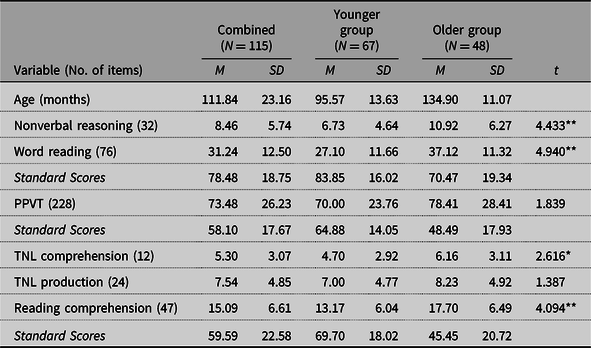
Table 1 displays the descriptive statistics of the English measures for the overall sample and for the younger (6–9 years old) and older (10–13 years old) groups. All variables were checked for skewness and kurtosis. For the overall sample and the older group, all variables were normally distributed. For the younger group, nonverbal reasoning was positively skewed. This variable was then transformed using the log function (+1), as the data contained some zero scores (Tabachnick & Fidell, Reference Tabachnick and Fidell2007). All further analyses for the younger group were performed with the transformed variable. All analyses (t tests, correlations, and regressions) for both the younger and older groups were carried out using raw scores. As shown in Table 1, a series of t tests were calculated to compare the two groups on all English measures. The older group performed significantly higher than the younger group on nonverbal reasoning, word reading, TNL comprehension, and reading comprehension. However, the groups did not differ on PPVT or TNL production.
Descriptive statistics for English measures

Notes: PPVT, Peabody Picture Vocabulary Test. TNL, Test of Narrative Language. *p < .01. **p < .001.
Standard scores are displayed in Table 1 for three standardized English measures, word reading, vocabulary, and reading comprehension. For the combined sample, refugee children scored between 1 and 2 SD below the mean on word reading (SS = 78.48), but more than 2 SD below the mean on receptive vocabulary (SS = 58.10) and reading comprehension (SS = 59.59). When standard scores were calculated separately for the younger and older groups, we found the same patterns for the younger group. They scored around 1 SD below the mean on word reading (SS = 83.85), more than 2 SD below the mean on receptive vocabulary (SS = 64.88), and 2 SD below the mean on reading comprehension (SS = 69.70). Standard scores for the older group reveal that they were close to 2 SD below the mean on word reading (SS = 70.47), and more than 3 SD below the mean on receptive vocabulary (SS = 48.49) and reading comprehension (SS = 45.45). Thus, while the patters were similar for the two groups, the gap was wider for the older group.
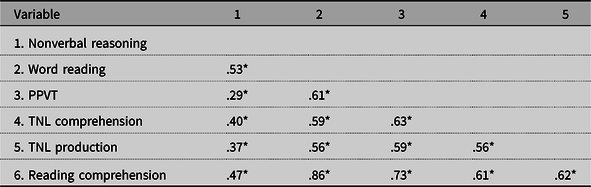
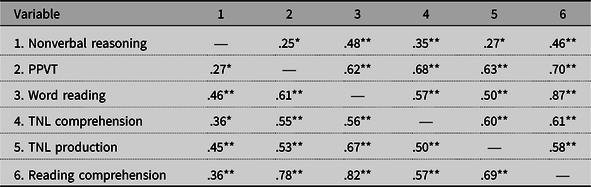
Correlations among all English variables for the overall sample are presented in Table 2. As displayed in Table 2, reading comprehension was significantly associated with all variables. Correlations among all English variables for the younger and older samples are displayed in Table 3. Again, reading comprehension was significantly correlated with all the variables for both younger and older children.
Correlations among English variables for the overall sample

Notes: PPVT, Peabody Picture Vocabulary Test. TNL, Test of Narrative Language. *p < .01.
Correlations among English variables for the younger (above the diagonal) and older (below the diagonal) groups

Notes: PPVT, Peabody Picture Vocabulary Test. TNL, Test of Narrative Language. *p < .05. **p < .01.
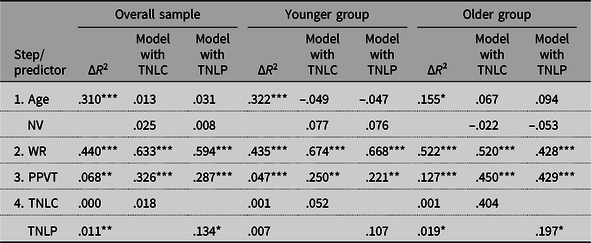
To examine the relative contributions of English word reading and English oral language skills (receptive vocabulary, TNL comprehension, and TNL production) in English reading comprehension, two hierarchical regressions were performed on the whole sample. As shown in the left panel of Table 4, the first three steps were the same in both regressions: children’s age and nonverbal reasoning ability were entered in Step 1, followed by word reading in Step 2, and receptive vocabulary in Step 3. In the first regression, TNL comprehension was entered in the fourth step, whereas in the second regression, TNL production was entered in the fourth step. Age and nonverbal reasoning accounted for 31% of the variance in English reading comprehension, word reading 44% of the variance, and receptive vocabulary 6.8% of the variance. TNL comprehension did not explain any additional variance above the variables entered in the first three steps. This model accounted for 81.8% of the variance in English reading comprehension. Both word reading and receptive vocabulary were unique predictors. In the second regression, TNL production, entered in the fourth step, explained about 1.1% of additional variance in English reading comprehension. Word reading, receptive vocabulary, and TNL production were all significant unique predictors in this model, which explained 82.9% of the variance in English reading comprehension.
Hierarchal linear regression predicting English reading comprehension
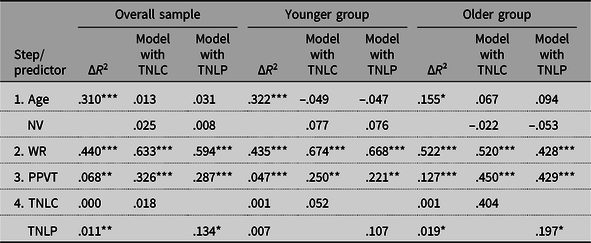
Note: NV, nonverbal reasoning. WR, word reading. PPVT, Peabody Picture Vocabulary Test. TNLC, Test of Narrative Language comprehension. TNLP, Test of Narrative Language production. *p < .05. **p < .01. ***p < .001.
The middle panel of Table 4 displays two hierarchical regressions for the children in the younger group. The two models contained the same variables as the regressions for the overall sample in the first three steps. TNL comprehension and TNL production were entered in the final step of the two models, respectively. Age and nonverbal reasoning, word reading, and receptive vocabulary accounted for 32.2%, 43.5%, and 4.7% of the variance in English reading comprehension respectively. Neither TNL comprehension nor TNL production explained any additional variance above the variables entered in the previous steps. Both models accounted for 80.4% of the variance in English reading comprehension. Only word reading and receptive vocabulary were unique predictors in the models.
Finally, the right panel of Table 4 shows the two hierarchical regressions for the children in the older group. These two models also contain the same control variables entered as the regressions for the overall sample in the first three steps. The last steps of the models were TNL comprehension and TNL production, respectively. Age and nonverbal reasoning, word reading, and receptive vocabulary accounted for 15.5%, 52.2%, and 12.7% of the variance in English reading comprehension, respectively. TNL comprehension did not explain additional variance above the variables entered in the previous steps. In this model, only word reading and receptive vocabulary were unique predictors of English reading comprehension. This model explained 80.4% of the variance in English reading comprehension. Of note, in a second model, TNL production was a significant unique predictor of English reading comprehension, explaining close to 2% of the variance. This model explained 82.3% of the variance in English reading comprehension, with word reading, receptive vocabulary, and TNL production as unique predictors.
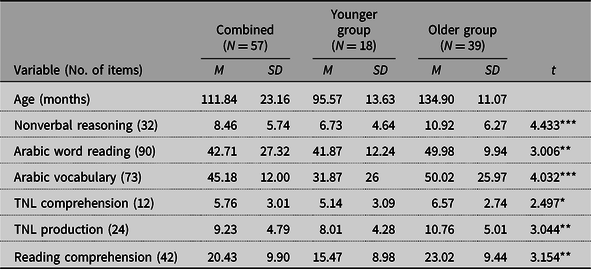
The means and standard deviations of the Arabic measures for the overall sample are shown in Table 5. Because many students were not able to complete the Arabic measures, only 57 children were included in this analysis. The data was checked for skewness and kurtosis. With the exception of the Arabic word reading task, all measures were distributed normally. We carried out a log transformation on the scores of the Arabic word reading task following Tabachnick and Fidell (Reference Tabachnick and Fidell2007). All further analyses were performed with the transformed variable. The descriptive statistics of the younger and older groups are also presented in Table 5. A series of t tests were carried out to compare the two groups on all of the measures. The older group outperformed the younger group on all of the Arabic measures.
Descriptive statistics for Arabic measures

Note: TNL, Test of Narrative Language. *p < .05. **p < .01. ***p < .001.
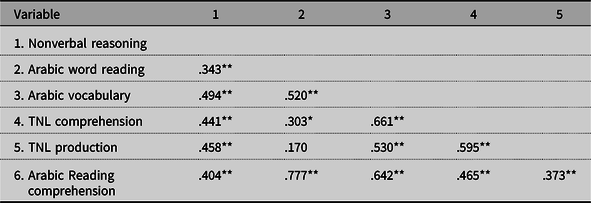
Correlations among all variables for the combined sample are presented in Table 6. Reading comprehension was strongly associated with all variables. Correlational and regression analyses were not performed for the younger versus older groups due to the small number of children in each group.
Correlations among Arabic variables

Notes: TNL, Test of Narrative Language. *p < .05. **p < .01.
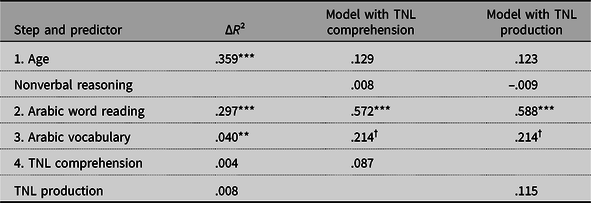
We then carried out two hierarchical regressions to examine the predictors of reading comprehension in Arabic (Table 7). The first three steps were the same in both regressions. Children’s age and nonverbal reasoning were entered in Step 1, followed by word reading in Step 2, and receptive vocabulary in Step 3. In the first regression model, TNL comprehension was entered in the last step. In the second model, TNL production was entered in the last step. As shown in Table 7, age and nonverbal reasoning accounted for 35.9% of the variance in Arabic reading comprehension. Arabic word reading and Arabic vocabulary explained 29.7% and 4% of the variance in Arabic reading comprehension, respectively. Neither Arabic TNL comprehension nor Arabic TNL production added any additional variance (<1%) to Arabic reading comprehension. Both models accounted for 69.6% of the variance in Arabic reading comprehension. Arabic word reading was a unique predictor and Arabic receptive vocabulary was a marginally significant unique predictor in both models.
Hierarchal linear regressions predicting Arabic reading comprehension

Notes: TNL, Test of Narrative Language comprehension. †p < .10. **p < .01. ***p < .001.
Discussion
The first goal of the present study was to use quantitative measures to evaluate Syrian refugee children’s language and literacy skills in both English and Arabic. We observed that the children, particularly those in the older group, performed poorly on the three English standardized measures (vocabulary, word reading, and reading comprehension) compared to the norming populations. These comparisons, however, must be interpreted with caution because the norming populations only included EL1 children, and our sample was within their first 3 years of learning English (Paradis, Reference Paradis2016). The children also struggled in Arabic, as more than half were not able to complete the reading measures. The second goal was to examine the applicability of the SVR model in English and Arabic. There was strong evidence supporting the model in English and Arabic as word reading and oral language skills were related to reading comprehension in both languages. Moreover, consistent with previous research, oral language skills became more important for reading comprehension in the older group than the younger group in English. This comparison was not carried out in Arabic.
Language and reading outcomes
To our knowledge, this was one of the first studies to assess refugee children’s language and literacy skills with standardized and specifically designed experimental measures. Previous research on refugee children often relied on self-report data, which led to over- or underestimation of proficiency levels (e.g., Wilkinson, Reference Wilkinson2002). Generally speaking, our English battery indicates that refugee children had very low levels of English proficiency. To begin with, only 86% (115 out of 133) of the children completed the English battery. About 14% of our sample were not able to read in English. Because three of the English measures (word reading, vocabulary, and reading comprehension) were standardized, we compared refugee children’s performance to that of the norming population. While ELLs examined by previous studies typically performed well on code-related skills (e.g., Geva & Farnia, Reference Geva and Farnia2012; Lesaux & Siegel, Reference Lesaux and Siegel2003; Muter & Diethelm, Reference Muter and Diethelm2001), our sample performed more than 1 SD below the mean on English word reading, suggesting that refugee children face more severe challenges than other ELLs in literacy development. In contrast, we must keep in mind that our refugee sample had only been in Canada for less than 3 years, and studies with other ELLs typically involved children who were born in the host country or have lived there for a longer period of time. Thus, lower performance does not necessarily imply a developmental deficit. With respect to English receptive vocabulary, refugee children’s performance was more than 2 SD below the mean, which placed them at the bottom 5% of the population. Since both word reading and vocabulary are critical for reading comprehension, it is not surprising that refugee children were also severely challenged in reading comprehension, scoring more than 2 SD below the mean of the normative sample.
Because our Arabic measures were not standardized, we cannot compare the performance of our sample to a norming population. However, the fact that only 43% (57 out of 133) of the children completed the Arabic battery suggests that more than half of the children did not have reading skills in their L1. This is consistent with the demographic information reported in the ALEQ-4 questionnaires. About one-third of our sample experienced interrupted schooling before they arrived in Canada. Paradis, Soto-Corominias, Chen, & Gottardo (Reference Paradis, Soto-Corominas, Chen and Gottardoin press b) reported that these refugee children had more schooling on average in English in Canada than schooling in Arabic, although they had been in Canada for less than 3 years. Apparently interrupted schooling had negatively impacted their language and literacy skills in Arabic. Of interest, Paradis et al. (Reference Paradis, Soto-Corominas, Chen and Gottardoin press b) also found that refugee children spent significantly more time reading and writing in English than in Arabic. This unexpected imbalance may reflect cultural practices that emphasize oral traditions (Rouchdy, Reference Rouchdy and Rouchdy2013).
The low levels of proficiency in English and Arabic are likely caused by a number of factors, including the amount of exposure to each language, SES and parental education, and richness of home environment (Paradis, Reference Paradis, Hoff and Shatz2007, Reference Paradis2016; Paradis et al., Reference Paradis, Soto-Corominas, Chen and Gottardoin press b). The refugee children in our study had only resided in Canada for less than 3 years, and therefore their exposure to English was limited. Research has shown that it takes at least 5 years for ELLs to establish English proficiency (Cummins, Reference Cummins1981; Saunder & O’Brien, Reference Saunders, O’Brien, Genesee, Lindholm-Leary, Saunders and Christian2006). Compared to other ELLs, the refugee children in our sample faced many additional challenges. They came from low SES families with low levels of parental education. Although Arabic was spoken exclusively at home, there were few literacy activities in Arabic (Paradis et al., Reference Paradis, Soto-Corominas, Chen and Gottardoin press b). Interrupted schooling also led to poor language and literacy skills in Arabic. Finally, many children in this sample showed signs of emotional trauma inflicted by the war and by adversity in the migration experience (Soto-Corominas et al., Reference Soto-Corominas, Paradis, Al Janaideh, Vitoroulis, Chen, Georgiades and Gottardo2019; Vitoroulis et al., Reference Vitoroulis, Georgiades, Jenkins, Soto-Corominas, Al Janaideh, Paradis and Gottardo2019). While it is beyond the scope of the present study, future research should examine the effects of SES and socioemotional well-being on language and literacy development in refugee children.
Comparing the younger and older groups reveals potential developmental trends about the refugee population. In English, the older group outperformed the younger group on nonverbal reasoning, word reading, TNL comprehension, and reading comprehension, while no group differences were found on receptive vocabulary and TNL production. Considering that ELLs typically master decoding skills fairly quickly (e.g., Geva & Farnia, Reference Geva and Farnia2012; Lesaux & Siegel, Reference Lesaux and Siegel2003; Muter & Diethelm, Reference Muter and Diethelm2001), it is not surprising that the older group was more advanced on English word reading than the younger group. Given the important role of word reading in reading comprehension for beginning readers, stronger word reading skills also led to better reading comprehension in the older group (see detailed discussion in the next section). In contrast, the older group experienced persistent difficulties in both receptive and productive language, again confirming previous findings that ELLs take much longer to develop oral language skills than word reading skills (e.g., Geva & Farnia, Reference Geva and Farnia2012; Mancilla-Martinez & Lesaux, Reference Mancilla-Martinez and Lesaux2011b). Of note, although the older group obtained higher raw scores than the younger group on some of the measures, they were further behind on standard scores on all standardized measures. The older group began to acquire English at a later age and the demand on language was greater in higher grades. As such, the older group experienced more challenges in language learning than the younger group.
When we compared the younger and older groups in Arabic, we found that older group outperformed the younger group on all of the measures. Since all children arrived in Canada roughly around the same time and primarily spoke Arabic at home, the older group had had more time and opportunities to acquire language and literacy skills in Arabic, leading to better performance. These findings point to resilience in refugee children. They are able to continue to acquire L1 skills despite adverse factors such as interrupted schooling and low richness of the L1 environment (Paradis et al., Reference Paradis, Soto-Corominas, Chen and Gottardoin press b). These patterns are consistent with those observed by previous studies comparing younger and older ELLs (e.g., Jia, Reference Jia2003; Jia & Aaronson, Reference Jia and Aaronson2003). Thus, compared to younger refugees, older refugees encounter greater difficulties in English acquisition but they excel in L1 maintenance.
The SVR model
The second goal of the present study was to examine the applicability of the SVR model in refugee children. We found strong evidence supporting the model in both English and Arabic. In English, our results on the overall sample showed that both word reading and receptive vocabulary were significant unique predictors of English reading comprehension, confirming findings of previous studies involving ELLs. Thus, despite the fact that refugee children may have lower reading skills than other ELLs reported in previous studies, predictors of English reading comprehension remain the same. Of note, word reading was a much stronger predictor of reading comprehension than oral language skills in refugee children, suggesting that these children were still in the beginning stages of reading development. Of interest, TNL production added a small but significant amount of variance to English reading comprehension in the overall sample. The majority of studies examining the SVR model use receptive vocabulary as an indicator of oral language skills (e.g., Braze et al., Reference Braze, Katz, Magnuson, Mencl, Tabor, Van Dyke and Shankweiler2016; Joshi, Reference Joshi2005). Our results suggest that adding expressive language skills, even in the early stages of reading development, improves reading comprehension models. However, our results also showed that the role of expressive language skills in reading comprehension was larger in the older group than in the younger group. This point will be discussed below when we compare the SVR models between the two groups.
Our findings also support the applicability of the SVR model in Arabic. We found that Arabic word reading was a strong predictor of Arabic reading comprehension. In contrast, Arabic vocabulary was only a marginally significant predictor and narrative skills did not contribute any additional variance to the model beyond word reading and vocabulary. The relative contributions of these variables confirm that the refugee children in our sample were beginning learners of Arabic who primarily relied on word-level skills for reading comprehension. As children become more proficient readers in Arabic, we expect that receptive and productive language skills will play increasingly larger roles in reading comprehension. Taken together, our study provides evidence supporting the SVR in Arabic, a language that has rarely been explored in previous studies, and highlights universal processes in reading development across different orthographies.
It is noteworthy that our reading comprehension models explained high percentages of variance in reading comprehension in English (more than 80%) and in Arabic (close to 70%). On the one hand, these findings indicate quantitative measures are useful for assessing refugee children’s literacy skills in both English and Arabic. As there are still relatively few language and literacy measures available in Arabic, more measures need to be developed, and with careful consideration of different developmental levels (e.g., immigrants vs. refugees) and unique linguistic features. Standardized measures in English produce standard scores, which allow us to gauge the performance of our sample in relation to that of the normative sample. However, standard scores must be interpreted with caution because they are derived from monolingual English-speaking children. On the other hand, the unusually high amounts of variance explained by these models indirectly support our observation of impoverished home literacy environment. Due to low SES and low parental education and perhaps also their unique migration experience, the refugee children had very limited literacy activities at home. As a result, the main sources of individual differences in reading comprehension came from linguistic and cognitive variables, rather than home environment factors. This is particularly the case in English, as the refugee children received school instruction only in English.Footnote 3 Our findings point to the need of increasing support to refugee children not only at school but also in the home.
We further divided the children who completed the English battery into a younger group and an older group to compare the relative contributions of English word reading and oral language skills to English reading comprehension between the two groups. As expected, receptive vocabulary explained more variance in the older group (12.7%) than the younger group (4.7%). In addition, expressive language skills as measured by TNL production were a significant predictor of reading comprehension only in the older group. Thus, the developmental patterns observed in refugee children converge with those of English L1 and ELL children reported in previous studies. The role of oral language skills increases as children become more experienced readers (e.g., Florit & Cain, Reference Florit and Cain2011). However, it should be noted that word reading was still the strongest predictor of reading comprehension in the older group, explaining more than 50% of the variance. These patterns suggest that refugee children follow a similar, albeit much delayed, developmental trajectory compared to less vulnerable populations, and highlight the need to provide additional support to accelerate their development.
The findings of the present study must be interpreted with its limitations in mind. First, with a concurrent design, the comparisons between the younger and older groups only yielded preliminary findings, which need to be confirmed by longitudinal studies. Relatedly, we were only able to examine the SVR model in younger versus older groups in English because many refugee children lacked literacy skills in Arabic. This points to the importance of L1 maintenance in addition to English acquisition. Second, while we compared the performance of the refugee children to that of other ELLs reported in previous studies, these children were not matched, other than the fact that both groups were immigrants and learning English as the L2. Future research should carry out direct comparisons between refugees and ELLs matched on cognitive and demographic variables and assessed with the same battery of measures. Third, although refugees represent a more vulnerable population than ELLs, we were not able to empirically examine risk factors such as low SES, interrupted schooling, and traumatic experience because these attributes were not evenly distributed in our sample. Future studies need to explore the effects of these factors on learning outcomes in refugee children. Fourth, government assisted and privately sponsored refugees demonstrate very different profiles in that the latter group tends to have higher SES and less traumatic experience (e.g., George, Reference George, Segal, Elliott and Mayadas2010). We were not able to make this distinction in the present study due to the small number of privately sponsored refugees in our sample. Future studies should examine the two groups separately. Fifth and finally, our sample only included Syrian refugee children who were resettled in Canada between 2015 and 2017. Therefore, our findings may not be generalized to refugees from diverse linguistic and ethnic backgrounds.
To conclude, the present study was one of the first studies to examine Syrian refugee children’s language and literacy development with quantitative measures in both English and Arabic. We found that the refugee children performed poorly in both languages (e.g., in some cases 2 or 3 SD below the normative mean), and many of them were unable to read in either language. However, this low performance of Syrian refugee children must be interpreted together with their unique experience. They have only been residing in Canada for less than 3 years, most came from low SES families and many had adversity in their premigration experiences. In this context, low performance does not necessarily point to neurological deficits in language and literacy development. Despite the low performance, word reading, and oral language skills were related to reading comprehension in both L1 and L2, supporting the applicability of the SVR model in both languages. In English, we also found that oral language skills played a more important role in the older group as compared to the younger children, although word reading was still the stronger predictor in the older group. It seems then that refugee children follow a developmental trajectory that is similar to that of other ELLs, but their trajectory is delayed due to their low levels of proficiency. Taken together, our findings underscore the urgent need to support refugee children’s language and literacy skills in the L1 and L2, and at school and in the home.
Acknowledgments
This research was funded by the Social Sciences and Humanities Research Council of Canada through a Partnership Grant (PI: Michael Ungar) and an Insight Developmental Grant awarded to the last author. We would like to first thank the families who participated in this research.