





No CrossRef data available.
Article contents
From washing hands to washing consciences and polishing reputations
Published online by Cambridge University Press: 18 February 2021
Abstract
While Lee and Schwarz propose grounded procedures of separation as an explanation for physical cleansing in various domains (e.g., washing one's hands), we suggest that separation can also account for behavioral cleansing aimed at washing consciences and polishing reputations. We discuss this extension in terms of degrees of behavioral cleansing, motivations, and intentions behind cleansing, and social settings.
Information
- Type
- Open Peer Commentary
- Information
- Copyright
- Copyright © The Author(s), 2021. Published by Cambridge University Press
References
Aquino, K., & Reed, A. II (2002). The self-importance of moral identity. Journal of Personality and Social Psychology, 83(6), 1423.CrossRefGoogle ScholarPubMed
Delmas, M. A., & Burbano, V. C. (2011). The drivers of greenwashing. California Management Review, 54(1), 64–87.CrossRefGoogle Scholar
Laufer, W. S. (2003). Social accountability and corporate greenwashing. Journal of Business Ethics, 43(3), 253–261.CrossRefGoogle Scholar
Légeret, M. (2020). Three essays in individual decision making. Unpublished doctoral dissertation, HEC Lausanne.Google Scholar
Lyon, T. P., & Montgomery, A. W. (2015). The means and end of Greenwash. Organization & Environment, 28(2), 223–249.CrossRefGoogle Scholar
Near, J. P., & Miceli, M. P. (1985). Organizational dissidence: The case of whistle-blowing. Journal of Business Ethics, 4(1), 1–16.CrossRefGoogle Scholar
Near, J. P., & Miceli, M. P. (1995). Effective-whistle blowing. Academy of Management Review, 20(3), 679–708.Google Scholar
Reynolds, S. J., & Ceranic, T. L. (2007). The effects of moral judgment and moral identity on moral behavior: An empirical examination of the moral individual. Journal of Applied Psychology, 92(6), 1610.CrossRefGoogle ScholarPubMed
Sachdeva, S., Iliev, R., & Medin, D. L. (2009). Sinning saints and saintly sinners: The paradox of moral self-regulation. Psychological Science, 20(4), 523–528.CrossRefGoogle ScholarPubMed
Suchman, M. C. (1995). Managing legitimacy: Strategic and institutional approaches. Academy of Management Review, 20(3), 571–610.CrossRefGoogle Scholar
Tost, L. P. (2011). An integrative model of legitimacy judgments. Academy of Management Review, 36(4), 686–710.Google Scholar
West, C., & Zhong, C.-B. (2015). Moral cleansing. Current Opinion in Psychology, 6, 221–225. https://doi.org/10.1016/j.copsyc.2015.09.022.CrossRefGoogle Scholar
Zhong, C. B., & Liljenquist, K. (2006). Washing away your sins: Threatened morality and physical cleansing. Science (New York, N.Y.), 313(5792), 1451–1452. https://doi.org/10.1126/science.1130726.CrossRefGoogle ScholarPubMed
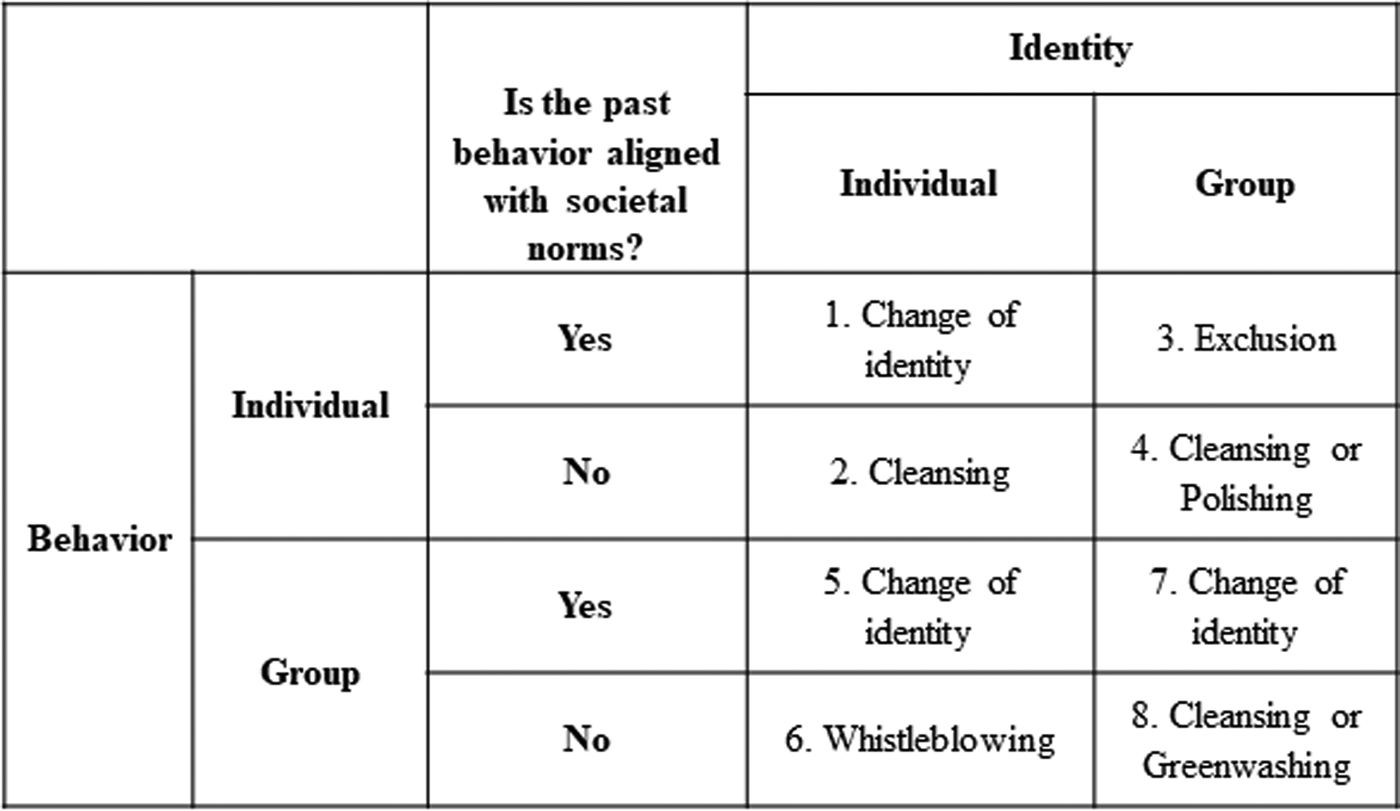
Figure 1. Potential solutions to conflicts occurring within an individual, within a group, or between an individual and a group, depending on whether the behavior is aligned with societal norms
Target article
Related commentaries (27)
Body ownership as a proxy for individual and social separation and connection
Developmental antecedents of cleansing effects: Evidence against domain-generality
It's a matter of (executive) load: Separation as a load-dependent resetting procedure
Proper understanding of grounded procedures of separation needs a dual inheritance approach
Psychology of cleansing through the prism of intersecting object histories
Separation/connection procedures: From cleansing behavior to numerical cognition
The role of meta-analysis and preregistration in assessing the evidence for cleansing effects
 You have
Access
Lee and Schwarz (L&S) posit that separation, as a grounded procedure, is a main driver of cleansing. In doing so, they relate physical cleansing to the moral domain; for instance, they review empirical evidence suggesting that moral violations tend to elicit cleansing behavior (e.g., Zhong & Liljenquist, Reference Zhong and Liljenquist2006). While L&S focus on the antecedents and consequences of physical cleansing (most of it symbolic), we propose to extend the scope of their theoretical contribution to include behavioral cleansing, specifically, the washing of consciences in the moral domain and the polishing of reputations in social settings.
Degrees of behavioral cleansing. Whereas symbolic cleansing (of the kind advocated by L&S) is only metaphorically related to a past misdeed, behavioral cleansing refers to behaviors that compensate in one domain for a misdeed performed in another (West & Zhong, Reference West and Zhong2015). It has been operationalized, for instance, through the amount individuals donate to a charity (e.g., Sachdeva, Iliev, & Medin, Reference Sachdeva, Iliev and Medin2009 or Légeret, Reference Légeret2020). Donations have the advantage of being continuous, thereby providing more information than dichotomized variables and allowing for sharper tests with more power to disentangle competing hypotheses. Note that variables capturing symbolic and physical cleansing can also be continuous, ranging, for instance, from simply rinsing fingers to washing hands thoroughly.
Motivation and intentions. Just as cleansing can be performed to different degrees, the motivations and intentions behind it can vary too. It is only a small step from removing physical or moral dirt to acts of polishing and shining. Polishing and shining can be observed in both the physical domain (cosmetics and make-up) and in the social domain (managing one's reputation). Such activities are ubiquitous, both for individuals and organizations. For example, many organizations engage in “greenwashing” – the act of superficially signaling interest in social and environmental issues (Delmas & Burbano, Reference Delmas and Burbano2011; Laufer, Reference Laufer2003; Lyon & Montgomery, Reference Lyon and Montgomery2015). While some individuals or organizations might engage in this activity to compensate for past misdeeds, others may do so for opportunistic reasons even when there is no need to reduce internal dissonances: they simply seek to bring their public image closer to the expectations of their audience.
Separations and reparations in social settings. It is hard to define morality universally, partly because it is grounded both in the self (i.e., an individual's values and identity; Aquino & Reed, Reference Aquino and Reed2002; Reynolds & Ceranic, Reference Reynolds and Ceranic2007) and societal norms (Suchman, Reference Suchman1995; Tost, Reference Tost2011). For some situations, these two pillars may suggest different behaviors, thereby fueling moral conflict. Consequently, an observable behavior may be misaligned with an identity, with societal norms, or both. A misalignment constitutes an unstable state, which may be overcome through distancing, or another kind of separation, from past misdeeds, from one's identity, and/or from one's social group. While L&S focus on entities, events, and experiences in their theorization of separation, we propose applying the notion of separation to social settings, thereby distinguishing between: (1) the individual and his or her social environment, be it society at large or more localized formations; (2) observable behavior and underlying identity; and (3) whether the observable behavior is aligned with societal norms or not. Figure 1 displays conflicts that can be characterized as combinations of these three distinctions. Such conflicts can be explained by mismatches and/or separations, and can eventually also be resolved by separations or reparations.
Potential solutions to conflicts occurring within an individual, within a group, or between an individual and a group, depending on whether the behavior is aligned with societal norms
These resolutions may be categorized as follows (see the eight cells of Fig. 1). Identity reparation: A mismatch between behavior and identity within a given individual (cognitive dissonance; Festinger, Reference Festinger1957), specifically if the behavior is aligned with societal norms, may be resolved by changing the individual's identity so as to make it consistent with the individual's behavior and with society (cell 1). Similarly, if the individual's behavior is misaligned with both the identity of a given group and societal norms, then the individual may engage in cleansing or polishing, for instance by signaling values that correspond to that group's identity (cell 4). Likewise, if there is a mismatch between a group's behavior and an individual's identity, and the group's behavior is aligned with societal norms, then the individual's identity may have to be adapted (cell 5). Finally, if a group's behavior conflicts with its own identity and if this behavior is aligned with societal norms, a new group identity may emerge (cell 7). Identity separation: In contrast, if a particular behavior is not aligned with societal norms, the individual may condemn his or her own past behavior and distance his or her self from it, that is, engage in cleansing, in order to protect his or her identity (cell 2). Social reparation: If the behavior of a group is misaligned both with its own identity and with societal norms, then that group is likely to engage in cleansing or polishing (cell 8). Such reparations at group level can also combine deep and superficial washing; that is, a combination of moral cleansing to solve the internal conflict and greenwashing to reestablish a positive moral identity in the eyes of society. Social separation: If an individual's behavior conflicts with his or her group's identity, group members will be alerted. If the individual fails to appease these members or even bluntly refuses to adapt to the group – which may be facilitated if the behavior is in line with society – he or she may be excluded from the group (cell 3). If the group's behavior is not aligned with societal norms, then cleansing on the side of the individual may not be sufficient. Rather, the individual's discomfort arising from such a mismatch may grow internally until it eventually erupts, resulting, for instance, in whistleblowing (Near & Miceli, Reference Near and Miceli1985, Reference Near and Miceli1995). Even though the whistleblower typically aims at changing (i.e., repairing) certain of the group's practices, it typically leads to the separation of the group and the whistleblower (cell 6).
Acknowledgements
The authors gratefully acknowledge comments and helpful suggestions from Konstantinos Armaos, Barneby Dicker, Moritz Gruban, Aurélien Feix, and Sebastian Hafenbrädl.
Financial support
This research received no specific grant from any funding agency, commercial, or not-for-profit sectors.
Conflict of interest
None.