Much lore about doing good accorded with the two key pillars in the edifice built by Confucius and his followers: the value of humaneness and the concern for the well-being of the common people. (speaking of the late Ming) (J. Smith Reference Smith2009, 252; emphasis added)
At present four big unstable strata exist in society, three-withouts peasants, demobilized soldiers, college graduates who cannot find full employment and religious believers. If we use the following measures to alleviate contradictions with these groups, government expenditures to maintain their stability [weiwen feiyong 维稳费用] can temporarily be stopped. (scholar, 2012) (Li Reference Weidong2012; emphasis added)
“Today the number of poor people in our nation can be said to have reached an extreme…. When foreignerssee this, how they must collapse in laughter!” … Workhouses, therefore, could partially salvage China's battered international reputation by alleviating “the nation's poverty.” (1902 editorial) (J. Chen Reference Chen2012, 22; emphasis added)
Much has been made of the recent revival of Confucianism in the People's Republic of China (PRC), with its renewed promotion by the country's political leadership since the turn of the century. Among the chief teachings of that doctrine is the principle that the government has an unshakeable mission to “nourish the people” (yang min 养民), as translated in Pierre-Etienne Will and R. Bin Wong's Reference Will, Wong and Lee1991 tome of that title (Will and Wong Reference Will, Wong and Lee1991; R. Wong Reference Wong1997), a term designating what was one of the most central precepts that the Master and his disciples set forth. Sun Yat-sen's Three Principles of the People again put “the people's livelihood” in an honored position. And perhaps Mao Zedong's prescription to “serve the people” was a successor of sorts to Confucius's command. Indeed, this enjoinder has an ancient pedigree. But as the quotations above suggest, Confucian precepts are several and can be drawn upon to legitimate variable actions.
In this context, one may ask: what can be said about the present, now that socialism-in-practice has slipped away, even as the Sage's injunctions to show compassion and induce harmony do hold sway in the rhetorical realm? Does a verbal official commitment to care for the needy truly carry force and if so, in what guise? In this paper, I explore the extent to which the foundational Confucian directive to “nourish the [poor] people” remains vital in the nation today, a task I achieve by way of briefly setting up comparisons with a few periods in the past and underscoring critical distinctions. I make special reference to the stances taken by several Chinese states toward their indigent subjects, with particular attention to the ideological rationales that various leaderships have used to bolster their stances.
I will structure this exercise by situating China's contemporary stance in relation to a set of three modal, and, I propose, universal, patterns of state-supplied sustenance; these are best viewed as “ideal types,” abstract constructions that emphasize central elements shared among a given class of like phenomena, in the Max Weber tradition. To capture this situation, I utilize data on the current “dibao” program. This scheme, whose full name is the Minimum Livelihood Guarantee (zuidi shenghuo baozhang 最低生活保障), was instituted on a nationwide basis in September 1999 after its inception in Shanghai in 1993, and, following trial implementation, in other cities as the 1990s wore on.
I begin with the set of three models that I devised while reading about welfare throughout Asia. For comparing the present in China with the past, I then go on to fit findings from studies of different periods in Chinese history into this triple mold. Finally, I address the central object of my inquiry, the dibao scheme and its novelty, noting its transformations over the short time of its enforcement. Accordingly, I point to the way in which its recent execution displays a fundamental shift in the authoritative treatment of the poor in China today, one suddenly attaching conditions to determine who are appropriate recipients (Solinger and Jiang, forthcoming). My data is primarily secondary historical literature, along with some statistics on that current program. The work is also informed by some 100 fieldwork interviews with urban poor people in eight cities over the years 2007 to 2013, and with several officials and scholars who either deal with these people or who manage and study the policy.
Three Models, Three Issues
Three Welfare Models
To devise a format that is widely applicable, and that also cuts across factors typically used to categorize welfare policies (such as regime type, economic developmental level, or geographical region), I take as my mode of differentiation the moral, conceptual, and motivational factors that I see as undergirding disparate types of state welfare effort. These factors are prevailing societal values and state goals that purport to inspire, underlie, and dictate the provision of assistance at given times. The framework, then, amounts to a heuristic typology consisting of three ideal-typical models—or, alternatively put, styles—of social relief, each of which is organized around separate mentalities or belief systems about the proper relationship between the indigent and the state.
My purpose is to illuminate ideational influences, rather than political or economic ones, that shape welfare, even though material factors may influence a regime's capabilities and thus constrain its choices. Each such model is organized around its own rationale, has a different group whose interests are served by its workings, employs disparate modalities or tactics, and aims at goals of its own. The tactics reflect what could be labeled latent goals and beneficiaries, using the term “latent”—as opposed to “manifest”—in the usage coined by Robert Merton (Reference Merton1968, 119, 122–23).Footnote 1 Thus, I allude to apparent values and reasons behind extending assistance, and to the types of actors who profit—or who are meant to profit—from the policies’ provision. In emphasizing latent (as opposed to explicit, publicly announced) goals, beneficiaries, tactics, and rationales, I am making assumptions based on the outcomes of policies and actions. I am chiefly concerned with relief for the very poor, not with all kinds of welfare.
A particular policy stance may draw on elements of more than one model at a given juncture. There can also be emphases from one model that dominate over, if coexist with, elements from another one at any point in time; different governments in the same state clearly have adopted differing models over time. Additionally, at any moment various societies around the globe subscribe to disparate ideologies about welfare and, accordingly, models. These dissimilarities of time and place seem to indicate that, while foundational precepts—such as the Confucian mandate to care for the people—may never have been totally discarded in China, more is at play than either a people's static culture or the impact of au courant globally popular notions.
Here I cast the proximate roots of variation in dissimilar beliefs about the poor, and about the government's sense of responsibility to the poor, as well as in distinctions in the state's sense of its mission toward its people across periods of Chinese governance. At times, broader state ideology is at play; at other times, foreign influences have their impact. Again, my objective is to place today's dibao program into a historical framework for comparative purposes.
The first of these three models I label the rights-based model; it is grounded upon an assumption that all people possess basic human rights to livelihood, social protection, and security (Perry Reference Perry2008). This approach, which might be paternalistic (Frazier Reference Frazier2002, 12, 60) (as in more authoritarian regimes) or rooted in notions of justice and egalitarianism (in democratic regimes), purports to work to realize these rights. Policies promulgated in line with this perspective generally claim to take the individual as their target, as they have as their final goal the sustenance of persons, taken as ends in themselves. Rulers, however, like traditional Chinese emperors—guided by a norm of providing for “the people's” welfare—might aim at collective subsistence, not just at the preservation of the single person. But still, the basis is a creed of bestowing livelihood as a state duty.
One more caveat: since the notion of “right” is almost unanimously taken by scholars of China to be outside the Confucian tradition,Footnote 2 I advance a correlative concept that could be viewed as having operated in a similar fashion, that of “rite.” The Random House Webster's College Dictionary (2001, 1140) notes that one of the senses in which that word can be used is to mean “any customary observance or practice.” Thus, a state norm of benevolence, in sustaining the people's livelihood, could be said to have been applied in the form of a customary observance by those officials who properly managed the populace under their charge. Both concepts—right, rite—are (or can be) grounded in principles that enforce good treatment of people; both also are presumed, in their purest embodiment, to operate outside politics. So for the Chinese story, I modify my first model's name from rights-based to rights/rites-based.
The second model, the responsive model, is represented by programs crafted in response to voice, that is, designed principally in reaction to expressions of popular discontent (or from fear thereof), demands that have been (or that conceivably could be) put forth by citizens who feel aggrieved, as, for instance, expressed by them through their ballots. This model is either reactive or preemptive, or both. But, I emphasize, voice can be communicated not just through votes in democracies: it can also be potent when—either in democracies or, occasionally, in authoritarian states—it is raised by rioters and demonstrators, especially, but not only, if they are organized (X. Chen Reference Chen2012).
It is enough that leaders are apprehensive about domestic disorder or about their own dethronement (as in authoritarian regimes) or, as in democracies, about the failure to win or to hold on to an official post they desire or hope to retain, for them to install welfare remedies directed at defusing the tensions, satisfying the demands, or demobilizing the masses in the immediate or short term, in the wake of expressed dissatisfaction with the status quo. In these cases, one can sensibly claim that the plans devised are prepared and presented (at least latently) chiefly for the good of politicians. In Confucian terms, this concern is linked to striving for social harmony.
The third model's motivating impulse—or logic of sustenance supply—is what amounts, perhaps just latently but in practice nonetheless, to an urge to remove the impoverished (or, alternatively, what is perceived to be their disagreeable traits) from the public realm, on the grounds that they display features that public leaders and, often, the public at large, see either as innately offensive or else as plainly ill-suited to the society in question and its contemporary goals. This one I call the remold/reject pattern.
Here is a pattern that potentially has both positive and negative perspectives, and, in turn, operates in both affirmative and derogatory modes. From a positive angle, the guiding aspiration is to remold or rehabilitate indigent persons, in the stated interest of integrating them into the mainstream, what is perceived as the proper populace, and for rendering them better able to position themselves within, and to contribute to, the nation. From this more optimistic, inclusive, vantage point, recipients can be tutored or nourished—in other words, upgraded—on a hope of gaining their more permanent cooperation, and they are not, as in the responsive model, simply to be temporarily placated and silenced. Confucius would approve of this impulse to better people by educating them, and would likely be satisfied that such an effort would serve the collective good.
But renovation can also spring from a negative view and, accordingly, adopt an antagonistic approach, as in regulating, disciplining, repressing, surveilling, and, in the extreme case, altogether excluding the poor from the rest of the residents-at-large (Wacquant Reference Wacquant2009). Here the treatment works not to elevate, but instead to downgrade the targets. In either of these cases connected with rejecting persons as they present themselves—whether inspired by positive or negative outlooks on these people—the discursive language behind the policies and programs is to improve the nation. And so it is to the collectivity as a whole that the advantage is to accrue. The stimulus behind this approach—whether benign in instinct or battering and abusive in impact–is often revealed in platforms that smack of a need for improvement. Thus, each of the three models rests upon a distinct rationale, whether explicit or latent.
With each of these logics of succor there go distinctive modalities or tactics. Where the individual and his or her rights are critical (or where officials—usually paternalistic ones—operate on the basis of shared visions of appropriate “rites”) in the rights/rites-based model, relevant treatment could be either private charity or governmental entitlements, despite the fact that these concepts are sometimes presented as contradictory (charity sometimes seen as belittling and unpredictable, while entitlements may lend some dignity, since they are universally bestowed on all qualified subjects and are institutionalized) (Hanlon, Barrientos, and Hulme Reference Hanlon, Barrientos and Hulme2010, 27; Piven and Cloward Reference Piven and Cloward1993, 410).
Recently, for example, some areas in India—along with Indonesia, parts of Latin America, and South Africa—have initiated programs that offer outlays of direct cash to the impoverished, a product of a new, post–Universal Declaration of Human Rights era. This thinking emerged in the “Global South” in the late 1990s, in the spirit of a 1948 United Nations document that introduced the notion that people have a right not to be poor (Hanlon, Barrientos, and Hulme Reference Hanlon, Barrientos and Hulme2010, 19–20).
Secondly, when the dominant motive is to provide gains and benefits to politicians, as in the responsive variety of aid, compensation or payoffs that are time-limited and conditional tend to be the mode of giving; alternatively, politicians may also pick off protesters’ leaders while palliating lesser participants, all in the service of deactivating demands and instating peace. And third, when elevating and enhancing—perhaps so-styled “modernizing”—the nation is the guiding aspiration, in affirmative, remolding assistance, the objects are apt to be treated beneficently, as by extending funds for education and health care to them in order to form human capital to heighten national productivity, if chiefly for the sake of the state as a whole.
In both Japan and Korea, for instance, in the postwar decades, high-growth goals for the nation meant that a “productivist” public policy informed social protection rather than did either a notion of rights or a hope to respond to voice (Kasza Reference Kasza2006, 115). As Leonard Schoppa (Reference Schoppa2006) has detailed, the Japanese government achieved this end for a number of decades through elaborate systems of regulations, import protections, tax benefits, and banking protections that incentivized state institutions and large firms to retain, train, and sustain their workforces.
Likewise, Stephan Haggard and Robert Kaufman (Reference Haggard and Kaufman2008, 1, 9–10) point out that, while postwar East Asian states extended low levels of social insurance, some of them (notably Korea and Japan) did put investment into education, thereby enhancing (or creating) the skills and knowledge of those who were poor for lack of adequate training. To the extent that these governments propped up the agencies that disbursed the welfare, one of their objects was to rehabilitate and uplift the unfortunate so they could join in a national project, in line with the constructive side of the remold/reject pattern.
Contrariwise, from a negative impulse, when the inclination for national advancement is paired with a widespread belief that poor people—whether from deficiencies in education, morality, or skills; for reasons of poor health or disability; or for unseemly appearance—are hopelessly incapable of donating to the larger community, refurbishing is less likely than simply removing the persons from the public purview. This can be accompanied by stiff regulation or else by untarnished coercion, all in the interest of keeping the larger collectivity pure or up to par.
Somewhat differently, but still fitting into the remolding pattern, an account of India tracing back to the first half of the twentieth century relates the exclusion of the poor there—much as in China during the same period—to a vision the British fashioned of them as unstable, volatile, and rootless as well as dangerous, all factors that, in their colonial overseers’ judgment, were quite likely to drive such vagrants to moral decay and social anomie; these traits were apt also to push these people on to foment political disorder, again in their governors’ estimation. This portrait seemed to justify treating them as targets for molding or else as objects to be rejected; which of these approaches was adopted hinged on issues of conditionality and worthiness in particular instances (Gooptu Reference Gooptu2001, 13–16, 420–23).
An extreme case of this model would be Barbara Harriss-White's (Reference Harriss-White, Stewart, Saith and Harriss-White2007, 198) depiction of what she terms “the very poorest of the poor.” Her subjects, the casualties of accidents, addictions, natural and health-related disasters, and deep indebtedness, are rejected by and estranged from their society; the general populace is actively hostile toward them. As Harriss-White explains, they are those who “have nothing (in terms of assets), ‘are’ nothing (in terms of political and social status) and contend with ferocious obstacles to the exercise of agency (i.e., can ‘do’ virtually nothing in terms of realizing their capabilities)” (198).
Harriss-White (Reference Harriss-White, Stewart, Saith and Harriss-White2007, 104–5) goes on to argue that “destitute people are a social category which exists within the territorial boundaries of a society but from which society evidently wishes to rid itself.” Speaking of the fate of such unfortunates in both India and Peru, she does note that there are movements aimed at the restitution and empowerment of these people. These efforts, however, coexist with a “stripping of rights” from people held to be expendable, she documents, describing lice-infested storage places into which already miserable indigents may be tossed (121–22). It is obvious that these people are simply to be removed.
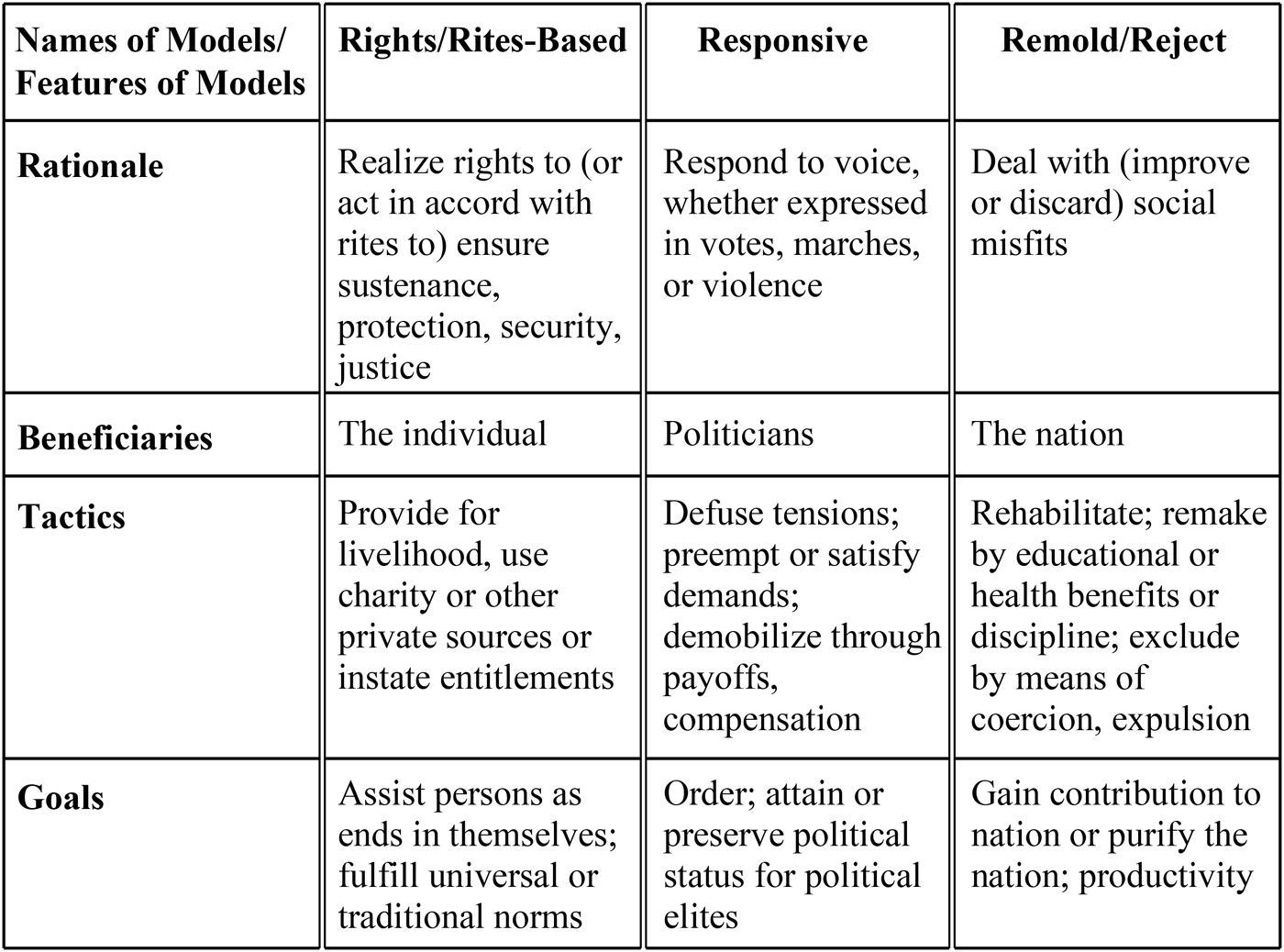
Three sets of state (and political leaders') ideal-typical, ideologically based goals characterize the three models, respectively, each of which may involve an aspiration to bolster the legitimacy of the regime and/or its leaders, whether domestically, externally, or both, in the light of some prized value. These are (1) in the rights/rites-based model, to achieve universally honored norms or to fulfill traditional ethical understandings about the claims and deserts of persons;Footnote 3 (2) according to the responsive model, to preserve or to bring about political support, societal harmony, domestic order, and especially social stability; and (3) as the remold/reject logic would have it, to attain national development and “progress,” economic growth, and, often, what is held to amount to “modernity,” either through educating or eliminating the inferior. The schematic presentation in figure 1 portrays these distinctions.
Three ideal-typical models of welfare provision, in terms of their latent rationales.

Three Key Issues Welfare Programs Confront
Aside from following ideal-informed models, states instituting welfare programs also confront three key questions: whether or not to set conditions for the allocation of benefits; of selectivity or of how to determine who truly deserves relief; and what the appropriate source of funding ought to be.
To begin with the first question, welfare efforts differ on whether or not conditions are set on the uses of the allocated funds (e.g., that funds can be expended only for furthering recipients' human development), or that the beneficiaries must work in order to collect a grant. I term this the issue of conditionality.
A second large issue is about selectivity, deserts, or so-called “worthiness.” Here the question is whether to differentiate able-bodied individuals (who, in theory, ought to be employable, but who often are viewed as “undeserving” or “unworthy”—e.g., drug addicts, alcoholics, tramps, vagabonds, and prostitutes) from those considered “deserving” or “worthy” (a concept that generally alludes to the chronically ill, the disabled, the mentally incompetent, orphans, widows, and the aged). This issue can also be thought of as the query over whether assistance should be provided universally, or instead given only to those who are ”targeted” according to certain criteria. For instance, some of the states of India sponsor cash allowance schemes only for those usually known as the “deserving poor,” such as children, pregnant women, disabled individuals, and the elderly. These outlays fall under the categories of national old-age pensions, family benefits, and maternity allowances. This is the issue of selectivity.
And third is the issue of whether the source of financial assistance should be private, that is, coming from employers and firms, family members, or voluntary organizations and charitable foundations, or public, that is, disbursed by the state. The governments of both Korea and Japan, as cases in point, developed social protection policies over the years that relied heavily upon private rather than public funding. In Korea, voluntary agencies and businesses were tasked with providing social protection. Indeed, in both countries the social safety net was more the responsibility of employers than it was of the state. As Taekyoon Kim et al. (Reference Kim, Kwon, Lee and Yi2011, 130) have argued, “For most of South Korea's history, family support and occupational welfare had [sic] compensated for the lack of government-provided welfare” (see also Yang Reference Yang2013, 457–58). This was because the state's goal of fostering economic development overrode all other considerations, and, consequently, activities that furthered that venture served as the premier target for state investment. Despite a discursively rights-based assistance program created in South Korea in 1999 and a doubling of public expenditure on welfare at the same time, coverage remained limited, and the proportion of the poor who received assistance probably equaled only a mere third of those who were eligible, in these authors' reckoning (Kim et al. Reference Kim, Kwon, Lee and Yi2011, 131–32). Here is the issue of funding source.
In Japan, as in South Korea, where the concept of the “deserving” poor still holds sway, conditionality obtains, with able-bodied people denied welfare. Instead, as Gregory Kasza (Reference Kasza2006, 100, 105) explains, for decades the official emphasis was placed on helping people to remain at work through a system of incentives to firms. Historically, family support relieved the government of the need to help the needy (108). In the formulation of Leonard Schoppa (Reference Schoppa2006, 2, 4), the Japanese government constructed a model of “convoy capitalism,” which helped the vulnerable to subsist as the firms that employed them were at once both charged with nurturing their employees and restricted in laying them off. The firms were, in turn, aided to sustain solvency by government subsidies and pro-productive policies.
In sum, an examination of several states' execution of social assistance suggested three separate modes—or models—of welfare, each founded on disparate doctrines. These models, however, cannot simply be superimposed upon three large issues or questions confronting donation that this research also uncovered. States' responses to these queries or choices are not necessarily obvious just from observing which of the three models they adopt. I now turn to look briefly at how several more or less Confucian states in China fashioned their styles of succor, and how they grappled with their choices, as backdrop and prelude to a much closer exploration of today's Minimum Livelihood scheme, designed in an era when Confucian memories and morals are often invoked.
Chinese Cases
At various times, the central states governing China from the late Ming up to the present have presented examples of disparate approaches to honoring the ancient Confucian and Mencian exhortation to provide for the people, whether explicitly or implicitly. That fundamental charge was never ignored (even if the Confucian heritage was expressly denigrated under the PRC's founder, Mao Zedong), though it was differentially interpreted, expressed, and executed over the centuries and years. There has existed a range that, to pick out highlights, stretched from the late Ming's dependence upon a paternalistic alliance of local officials and gentry (J. Smith Reference Smith2009, 9; Will and Wong Reference Will, Wong and Lee1991, 13) chiefly activated by episodes of famine; to the mid-Qing construction and operation of a nationwide, centrally coordinated system of granary storage (R. Wong Reference Wong1997, 117); on to the Republican period's public workhouses and private charities; and then to the early PRC's handouts for its “three-without” (sanwu 三 无) city dwellers (those with no ability to work, without a legal supporter, and without a source of income) cum work-unit-based benefits and communally allocated care; and finally reaching the current dibao or Minimum Livelihood program.
I proceed to compare some salient forms of welfare and their rhetorical justification over these several epochs: I underline how varied historical behaviors illustrate my typology of three ideal-typical welfare models, and also show how rulers at certain junctures responded to the three key queries that welfare programs address. My objective is not so much to characterize entire eras as it is to use Chinese historical cases to portray the three ideal types. And I reiterate that latent outlooks, values, and goals often inform the shape of the resultant programs.
For simplicity's sake I collapse the late Ming and the Qing dynasties into “late imperial China,” but I note distinctions within that long period; combine the decades 1911–49 into the time of the Republic as a second period; and refer to the years after 1949 as the era of the People's Republic, though I point to differences between earlier, later, and recent years within that block of time. This exercise is just to provide a point of reference for the larger statement I wish to make about the contemporary PRC, and in no way do I attempt to be exhaustive in my descriptions of prior periods.
Three Eras, Three Models, Three Issues
Models: From Late Imperial China
According to Joanna Smith (Reference Smith2009, 4), “ancient political texts had [sic] counseled rulers to employ, feed, and clothe the dumb, the deaf, the crippled, and the lame, and to aid those who were widowed, orphaned, and socially isolated.” Alluding to an ideological dimension, she argues that “[d]istributing food and restoring moral order went hand in hand” (202). Similarly, R. Bin Wong (Reference Wong1997, 93) maintains that “the ideology of rule was moral, and this necessarily carried commitments to shape the peasant's mental world and sustain his material well-being.”
Referring to both the late Ming and Qing dynasties, Pierre-Etienne Will and R. Bin Wong (Reference Will, Wong and Lee1991, 14) write that “[t]he paternalistic responsibility for the people was a Confucian obligation shared by all leaders, from the central bureaucracies to the local worthies”; they also attribute the ideology's origin to Mencius as well as to Confucius, in the former's linking livelihood to “a fixed heart” (2). While disadvantaged people were always the specific focus of the care dispensed—Wong (Reference Wong1997, 101) explains that “active promotion of material welfare, especially of the poor” was a “feature basic to the Chinese case”—there was often a preference for the moral and “genteel poor,” though certainly in times of trouble anyone in need would be eligible (Liang Reference Qizi and Yinggui1993, 151–54; J. Smith Reference Smith1987, 317, 329).
Thus, late imperial China's efforts to help the needy are probably best captured by the rights/rites-based model, steeped as its distributors of succor were in traditional norms (Buddhist and Daoist, as well as Confucian) of benevolence, a concept that Steve Bein characterizes as “compassion” for the person; Smith and Bein both refer to Buddhism and Daoism, as well as to Confucianism, as sources of this norm (Bein Reference Bein2013; J. Smith Reference Smith2009, 249). A prominent—if not the sole—rationale behind the charitable actions of the state and its supporters was, then, to realize a right to sustenance, or, put differently, to observe a rite of caring for the needy. As Smith has written, “rulers had [sic] supported charitable activities to fulfill the paternalistic obligations associated with political power” (J. Smith Reference Smith1987, 325).
At times this doctrinally driven sense of duty—or this enactment of a rite—was honored more rigorously by the central state than it was at others; it was especially honored in the Early and High Qing, when both the state's administrative capacity and its fiscal health permitted (Liang Reference Qizi and Yinggui1993; J. Smith Reference Smith1987, 310, 317). Beyond the central administration, an allegiance to Confucian values (and rites) penetrated down into the counties, where local gentry—whose preparation for the classically based official examinations schooled them in study of the creed—were to carry out its instructions (J. Smith Reference Smith2009, 8). Says Smith, “with examination success and high status came a responsibility for the people's well-being” (180).
Smith relates a tale of a retired Ming official, Qi Biaojia, who urged friends, merchants, and officials in office to deliver grain to the starving, as one outstanding case of this sensibility (171–201). In short, scholars and scholar-officials had been tutored in the notion that the state was meant to assist the impoverished and the hungry, which in so many words might be said to amount to a belief that the individual had a basic right to livelihood, or, at least, that the state and its servants (even in retirement) shouldered a charge to perform a sort of rite to help to ensure that those in situations of want might survive.
The beneficiary of the efforts would often be a collectivity, since natural disaster, frequently the clarion call to philanthropic action, struck localities, not households, in the main. But nonetheless what was if nothing else at least the rhetorical justification for state relief was always donation to the downtrodden, whether they be only temporarily victims of calamity of climate or instead long-term sufferers of poverty. In the Qing especially, the tactics used to help all such persons in need were the late imperial maintenance of granaries and the direct deliveries of food, clothing, or other necessities of daily existence when called for (Brown Reference Brown2012, 31). And, while Smith, Will, and Wong acknowledge the firm official belief then in the bond between subsistence provision and political and social order (J. Smith Reference Smith1987, 9–10, 204; Will and Wong Reference Will, Wong and Lee1991, 2–3; Wong Reference Wong1997, 98),Footnote 4 the immediate goal was, at a minimum, to enact traditional norms, even if doing so was also seen as a firm basis for guaranteeing state viability.Footnote 5
Answers to Issues: From Late Imperial China
In late imperial times, certainly the civilian poor were not required to use the alms they acquired toward any specific end, such as the education or health care of their young; nor was performing labor a condition of their right to a dispensation. Instead, provisioning was done in the main as a matter of morality, and also to bolster peace among the populace. According to Joanna Smith (Reference Smith2009, 4), emperors, informed by the paternalism inherent in Confucian teachings, aimed to minister to the “poor, sick, disabled, and lonely,” even if it was principally times of dearth that mobilized them to action, and though they did not attend to the quotidian concerns of the unfortunate.
Insofar as selectivity came into play (the issue of deserts and worthiness), in at least one typical instance that Smith (Reference Smith2009, 175, 184, 248) depicts in depth, discrimination did work in favor of those closest to starvation, not in terms of their personal characteristics or their occupations. But debates also arose as to the precise criteria or boundary lines to be observed among categories of beneficiaries. Apparently, at least in principle during the late Ming, “doing good,” a “just distribution of resources,” and an “urgency” attached to “saving lives”—matters of rights or perhaps rites—mandated looking to such issues as hunger and degree of impoverishment rather than to establishing qualifications on the basis of behavior.
Still, there was a conception of “deserving” as opposed to “non-deserving.” For instance, at this time there were sometimes disagreements among local elites as to whether the appropriate recipients should be the “genteel poor,” who might momentarily be too ashamed to accept alms publicly, or those who habitually “fell through the cracks” (J. Smith Reference Smith2009, 183–84). And in an essay by Liang Qizi (Reference Qizi and Yinggui1993, 152), a scholar from Zhejiang is quoted as having placed priority upon the filial, the chaste, and those poor who exhibited moral behavior, while giving was not to benefit gamblers, drunkards, loiterers, and parasites, or even the young and strong.
Funding sources in that era were both public and private. In the late Ming, local elite, scholars, former officials, and, over time, merchants became significant donors as well as the developers of charitable organizations (J. Smith Reference Smith1987). When the state had the requisite wealth and administrative capability, as in the High Qing, and when fiscal resources were not to be deployed for other purposes, such as for furnishing armies (Will and Wong Reference Will, Wong and Lee1991, 4–10), the central government took the lead in stocking what were termed the “ever-normal granaries” (changpingcang 常平仓).
But at the same time, local elite of means were expected to, and did, contribute to the upkeep of what were called “community granaries,” or shecang 社仓. Thus, not only did the state offer up its tax receipts and stores of reserves to the disposal of the needy, it also enjoined those able to afford to do so to divide their own inventories with their less-endowed neighbors (Will and Wong Reference Will, Wong and Lee1991, 7–10). In one place, Joanna Smith (Reference Smith2009, 8) judges that “the line between state welfare and nongovernmental charity … was blurred in late Ming times” (see also Will and Wong Reference Will, Wong and Lee1991, 504). Vivienne Shue's (Reference Shue2006, 416–22) study of a benevolent hall established in the waning years of the Qing shows that it likewise existed on collaborative input from high officials and the state paired with local elites. These instances imply that in general the practice of late imperial Chinese rule was to proffer provisions unconditionally, but with some reference to notions of “desert” and “non-desert,” and, though public and private wellsprings of giving had their separate sorts of institutions, the two forces also worked cooperatively at times.
Models: From the Republican Period
Despite Sun Yat-sen's lofty promise for the future pronounced in his party's philosophical program of Three Principles, in Janet Chen's (Reference Chen2012) telling of the final days of the Qing and through the era of Republican China—and also in Frederic Wakeman's (Reference Wakeman, Wakeman and Edmonds2000) characterization of the guiding mentality of the government then as being a “Confucian Fascist” one—the poor were perceived by many, including politicians and intellectuals, as a sort of plague on the people, lazy parasites and social deviants who should be made to become self-reliant. This was true even despite some local regimes in the Nationalist days perceiving “‘social relief’ as part of their responsibility and an essential component of national reconstruction” (J. Chen Reference Chen2012, 110). Shue's (Reference Shue2006) depiction of a Guanren Tang in its days during Republican-era Tianjin bears this out.
How did this switch—from seeking to sustain the poor as per the benevolence of the Qing to denigrating them in the Republican era—come about? During the early years of the twentieth century, as China became more connected globally, a widespread sense arose among both scholars and the general public that the nation was in danger of being left far behind internationally—even in some way of collapsing—and that the “Chinese race” itself could be facing extinction as a people. In Janet Chen's (Reference Chen2012) telling, for many Chinese scholars and also among some of the political elite, a feeling of national self-consciousness and a sense of ethnic inferiority before the eyes of the world seem to have spurred a new sense of urgency. For novel notions of “progress,” “modernity,” and “catching-up” with the advanced nations filtered into China, once contacts with the outside multiplied, and China's relative “backwardness” then became apparent and grew into an embarrassment to its citizens.
Thus, people thought, only if indigent individuals could somehow be transformed—a deed to be accomplished through their involuntary detention and labor—could the civic body, struggling to enter the sphere of cosmopolitan modernity, make a place for them. Otherwise, they were best put away, out of sight. Janet Chen (Reference Chen2012, 32) writes, “Relief was just one component of these new institutions [workhouses and poorhouses], which simultaneously sought to contain the dangerous mobility of urban transients, increase individual self-sufficiency, and expand the productive base of the nation.” And, she continues, “Whereas traditional work relief had been voluntary, twentieth-century workhouses and poorhouses subjected some transients, ambiguously identified as ‘vagrants’ and ‘evil beggars,’ to compulsory labor in incarceratory settings” (see also Lipkin Reference Lipkin2005, Reference Lipkin2006; Shue Reference Shue2006, 427).
In the same vein, Zwia Lipkin's (Reference Lipkin2006) study of Nanjing in the Nationalist decade (1927–37) emphasizes the city's efforts to create “modern” citizens, a process that entailed simultaneously discarding such undesirable, “useless,” or deviant people as rickshaw-pullers, beggars, and the poor, banning them from the wide avenues peopled by educated and financially stable citizens. Commenting upon the capital's obsession with its “looks,” Lipkin goes so far as to judge that “offensive people were allowed to exist as long as they remained invisible” (15).
In line with this reasoning, the poor were often pushed off the streets of cities back out to the countryside from which they might have come, or, more typically, thrown into workhouses. These people also sometimes received charity, offered out of sympathy among some private parties that even the impoverished should be granted the basic wherewithal of sustenance. But public welfare as a concept was not yet operative on any significant scale, and the “privilege” of living in a poorhouse critically depended upon working. For the leaders, the old Confucian notion of “rights” to subsistence for persons—or, alternatively put, even a notion of a duty to respect ancient rites—seems to have slipped away. Alms could be acquired only at the price of fulfilling physical assignments.
In this era, officials reasoned that “the nation” would be harmed by permitting the ignorance and even the presence of those seen as misfits to stain the public. In this case, the operative model was the negative side of the remold/reject paradigm, and its rationale was a perception that those subsisting in penury, understood to be undeserving nuisances, stood as an obstacle to the progress of society as a whole. Thus, the beneficiary of any program of relief was meant to be less the recipient as a person than it was to be the nation, and the tactics in use were, variously, either rehabilitation or discipline and coercion, but sometimes the two in tandem.
Moreover, the goal informing the effort was to purify the nation and enhance its productivity. Consequently, the poor were viewed as properly penalized or instructed, in the interest of elevating the general caliber of the populace. If Confucianism as an ideology was operative at all, it was just as a notion that people could be perfected only with state guidance; otherwise, they were outside the pale.
Issues: Answers from the Republican Era
This mentality produced a regimen focused on detention and labor for the lowly, such that a new, heretofore untried conditionality was placed upon receiving state charity, while distinctions between the deserving and those who were unworthy of assistance were officially and routinely grafted upon decision making about the dispensation of welfare. Accordingly, where historically work relief had been voluntary, now it was essential if one expected assistance, as selectivity or worthiness tempered the traditional concept that a right to subsistence for the indigent (or that there ought to be a rite of sustaining such souls) was naturally the property of all persons.
The idea was to overcome national weakness almost on a one-by-one basis, by using welfare-type donations expressly for the purpose of strengthening deficient individuals (J. Chen Reference Chen2012, 2, 4, 14, 30, 31, 43–44). Besides, clearer categories were conceived officially for bestowing benefits upon the hungry. In the late 1920s, for instance, the institutions of assistance were differentiated in terms of their target populations: relief homes for those incapable of working, workhouses for the able-bodied, and factories charged with employing those released from workhouses (98).
The third issue, about the appropriate fount of funds for the indigent, was, as in late imperial times, to be solved by contributions from the private and public realms. The Guomindang regime did fall into line with previous rulers who took assistance to the deprived to be the government's responsibility, and it did establish social affairs bureaus and relief homes at the urban level to take on this chore. Still, there were also non-state forces energetically at play, even if they sometimes needed to make common cause with officialdom, as in the relief work undertaken by philanthropic groups and benevolent societies (such as Shue's Guanren Tang), especially during the wartime decades of the 1930s and ‘40s, as Nara Dillon (Reference Dillon, Dillon and Oi2008) and Stephen MacKinnon and Robert Capa (Reference Mackinnon and Capa2008) have chronicled.
So, in short, the twentieth century saw new goals for the government, along with the emergence of new popular understandings about how to perceive and cope with the indigent. A new, more rigid conditionality checked charity, and only those prepared to go to work were deemed to “deserve” welfare. But the marriage of (largely) merchant-supplied private contributions to state-delivered money harked back to previous modes of giving, if in somewhat altered forms.
Models: From the People's Republic
In the cities during the early years of the People's Republic, soon after the 1949 takeover, as Janet Chen (Reference Chen2012, 223–28) records, the view of “the poor,” particularly those prepared to labor to build up the New China—changed once more. Now they were officially celebrated as one of the motivating emblems of the revolution, based on the understanding that places could be found for them in the industrializing economy. Even those who seemed useless, such as vagrants and beggars, were to be reshaped into producers. Aminda Smith (Reference Smith2013, 1, 5, 40–43, 68) elaborates on the government's provision of skills training and job placement, even for those known as “vagrants,” immediately upon the Communist victory in Beijing, where cadres enrolled such people into productive work. The critical difference here from the Republican injunction to work was that under the PRC work itself obtained such a high valorization that just by performing it one partook of a kind of ideological exaltation.
Smith refers to Municipal Committee regulations from 1949 Beijing in which relevant authorities were ordered to “ensure that vagrants ‘receive reform, education and skills training’” (68). And, crucially for the subject here, the “main content of the education” was to include “establishing the perspective that making one's own living is glorious” (68). Also notably for the purposes here, the People's Daily explicitly linked labor with welfare in its proclamation that “if you don't labor, you won't receive food…. [I]f you don't produce, you won't survive” (139). The Beijing local government even assigned beggars to labor brigades to guarantee that they went to work, and the newspaper announced that even some elderly and disabled people had been put into action in places such as print shops, while unemployed workers and other members of the urban poor were “mobilized” to do their part in agricultural activity. Finally, Smith casts the central government's “guiding principle” as being that “all social relief” must be “‘self-help through production’” (155).
So at that time, according to the perspective of municipal officials, the new regime was disposed to make use of all the available hands around, provided they were not interloping peasants who needed to be shipped back to the rural areas (Brown Reference Brown2012, 48, 66, 69). At the same time, as Linda Wong (Reference Wong1998, 113) explains, a residual program for the needy, the “three-withouts,” was reserved just for the extremely destitute. Overall, Janet Chen (Reference Chen2012, 228) notes, there was no operative notion of political, civil, or social rights behind these stances, nor, of course, of benevolence. But neither were there conditions, so long as one joined the laboring ranks. Such a mindset, harking back to Confucian concerns for the indigent in various ways (without naming his name), meant that for the most part a positive project for the poor obtained. This was a program based on a vision of building up the nation, and so best categorized as a remolding one, though this time grounded quite explicitly on the value of labor (A. Smith Reference Smith2013, 168).
The 93rd Article of the 1954 state constitution did announce a “right to material assistance from the state and the society, in old age, and in case of illness or disability,” but this was modified in a 1975 amendment to limit this right just to the “working people” (Zhou Reference Fenghua2014, 12). With the PRC's 1951 and 1953 regulations on labor insurance, bolstered when the nationalization of commerce and industry delivered all economic enterprises into state hands after 1956, guaranteed benefits were handed to urban workers, especially those in the larger state-owned firms.
Welfare became a responsibility of the firms themselves—which Mark Frazier (Reference Frazier2002, 60–61) terms a “dramatic shift from the limited managerial paternalism of the 1930s,” though he found that this switch took off first during the war years, not just after 1949—along with an unenforceable, but still well-intentioned, nationwide ideological aim of striving for equality of provision (L. Wong Reference Wong1998, 48, 67–68, 189). As Linda Wong relates, up into the 1980s, “[c]ity residents did not need direct state support since all enjoyed the right to work and hence could support themselves and their families” (113). In the countryside, villagers were cared for, if generally only minimally, through their communes (Parish and Whyte Reference Parish and Whyte1978).
But following Mao's death in 1976 and the coming of market reforms under Deng, in Wong's (Reference Wong1998, 80) words “a major value reversal” erupted, as the old socialist-style framework of urban rule ran out, and a huge transformation in the delivery of social welfare took place, once again, as in the early Republic, driven by dreams of meeting the foreign standard. In the mid-1990s, as laborers were discarded en masse if judged to be superfluous to a major surge to fully revamp and modernize the industrial sector, understandings of the worth of the “masses,” and of the treatment its members merited, shifted drastically.
At that point, on the verge of China's entry into the World Trade Organization, an unspoken but, in practice, potent precept emerged, according to which multitudes of once-workers were perceived as noncompetitive and unfit for the global marketplace, and therefore best let go from their positions. Thus one more transformation took place, spurred again by foreign contact. A massive and sudden unemployment of tens of millions came about, gathering force after the autumn of 1997, along with an attendant institution of an incipient, but harshly exclusivist, labor market. Ordinary labor (and its practitioners) had lost its luster; the lower classes seemed no longer of worth to the nation-building venture. Most starkly, where labor had once been glorious in the early 1950s, it was wealth that became so in the era of leaders Deng Xiaoping and Jiang Zemin (1978–2003).
In the major cities in particular, in the late 1990s only the young, skilled, and well-educated were considered suitable for the now suddenly upgraded slots in the job arena, while posts that called just for manual labor were in the main reserved for migrants entering the municipalities en masse from the countryside. Those who had been in manufacturing in the past, therefore, became unwelcome in their old workplaces—insofar as such sites were still standing and solvent—or elsewhere in the formal urban economy either, for that matter. They would have to be removed.
But in light of large and disturbing protests mounted by the newly redundant (and, by the way, able-bodied) workers in the late 1990s and early 2000s (Hurst Reference Hurst2009; Lee Reference Lee2007), the regime proclaimed on a nationwide basis a scheme named the Minimum Livelihood Guarantee for those who abruptly had been turned terribly impoverished. As it was expanded, numerous provincial officials praised it, one even labeling it a “tranquilizer,” thereby signaling its intended connection to enforced “stability” (Ding Reference Ding1999).
In 2002, as demonstrations played on, the state decreed a huge increase in the number of the newly poor to be included in the project, primarily in order to cater to, and quiet down, the restive redundant. Confucian “harmony” was to win the day. Thus, whereas only 2.8 million people were being served by the dibao in 1999, by year-end 2002 (at the order of then-premier Zhu Rongji) that figure had leapt to 20.6 million (Solinger Reference Solinger, Wu and Webster2010, table 2). Indeed, at that moment when the post-layoff “reemployment rate” was trickling down into the teens after the turn of the century,Footnote 6 the project's funds seem to have been available to anyone who had lost his or her job.
In part, Zhu called for the substantial expansion of the program in 2002 on the grounds that an earlier effort, a Reemployment Program for “laid-off workers,” (xiagang zhigong 下 岗 职 工), was not working effectively (Hammond Reference Hammond2010, chap. 5). In what may be evidence of this targeting of former workers, in 2002, the numbers of the unemployed plus the laid-off personnel (shiye 失业 and xiagang renyuan 下岗人员, respectively) accounted for as much as 44 percent of the total dibao recipients nationwide, while those counted as the members of what was once the “three-withouts” poor amounted to just 4.45 percent of the whole.Footnote 7
As the years went by, however, perhaps because the dismissed turned out with time to be progressively less troublesome, the leadership appears to have demoted the status of the ordinary, work-able jobless among the dibao targets, in effect setting up conditionality for eligibility, where none appears to have adhered in the dibao program before. For unlike the commotion in the streets that the newly cashiered had caused in the late 1990s and early 2000s, by mid-decade street actions by the poor (many of whom had once been laid-off workers) tended in the main to occur only on a small scale, usually in the form of occasional rowdy behavior by just handfuls of individuals.Footnote 8
Illustrating this changed official perspective toward the danger posed by the impoverished, a willingness to toil was no longer a requirement for state compensation, as it had been in China during the first half of the twentieth century and into the 1950s; nor was there any more state provision of employment, as there was from 1949 into the 1980s—those fired were for the most part just left to their own devices. By the middle of the first decade of the new century, only the state of being weak, very ill or disabled, bereft, or otherwise totally incapable rendered one worthy of officially financed alms. This becomes clear in that in 2006, xiagang and shiye persons dropped down to amounting to only 35 percent of all recipients, a decline of almost 10 percent from just four years before, while the sanwu stayed at around 4 percent of the total.
By 2009, xiagang, or “laid-off,” was no longer even listed as a category among the dibao recipients, and the registered plus unregistered unemployed together amounted to just 39 percent of the program's total beneficiaries (Minzheng nianjian 2010); this drop-off remained the case as of mid-2015. But meanwhile, in 2009, the sanwu and disabled together had risen to as much as 11.7 percent of all dibao takers as of 2009, and these two groups continued to account for 11 percent of all beneficiaries three years later (Ministry of Civil Affairs 2012). One could imagine that disabled people would have been one component of the sanwu back in the years 2002 to 2006 (when there was no separate category called “disabled” in the dibao statistics), at a time when the total numbers of these most desperate amounted to just 4 percent of all grantees.
One might conjecture that the decline in the percentage among total recipients occupied by the laid-off and unemployed was simply the result of an exogenous decline in the numbers of those who had lost their posts nationwide, and not a result of state policy. Thus, it could be that due to the laid-offs' reaching the age for receiving their pensions, or because of their finding some kind of paid labor, there were just not so many people in need of social assistance on the grounds of simply being out of work.
But interviews reveal that the years since 2006 have seen a distinct tightening of the qualifications for the dibao (one could say an introduction of conditionality), with those considered capable of doing labor—whether or not they are able to find a place that would hire them—progressively excluded from the program's benefits. In fact, localities labeled people who appeared to be able to labor as being actually “employed” even when they could not secure any work, and grassroots governors then attributed to these persons' households the income they should have earned if that seemingly able person were at a job. This mode of operation (called counting a person as “notionally employed”), along with excessive selectivity that came to mark the new formal labor market, relegated the great bulk of the undereducated and those above age thirty to ongoing penury and to nothing more than just occasional “flexible” work.
Another way of measuring the present regime's attention to the new urban poor is to calculate what turn out to be plummeting percentages that the program represents in respect to several metrics. The dibao's mode of operation is to subsidize households where the average per capita income falls below a locally set poverty line, so that, overall, ideally, each poor family's average income reaches that line. As of September 2005, for instance, the mean dibao norm (or poverty line) across urban China represented 22.2 percent—over one-fifth—of the average monthly per capita disposable income in large cities. Two years later, that percentage had gone down to only 17.9 percent. In November 2011, just another four years on, the proportion stood at a mere 13.2 percent, close to being just about half the percentage of the mean urban disposable income that it had represented only six years earlier.
Besides, in 2007, total national urban dibao expenditures accounted for .113 percent of gross domestic product; in 2008, they were a bit higher, at .128 percent. In 2009, the figure climbed up, but just to .1439 percent, and in 2011, back down to .14. By 2012, the percentage had fallen down to just .108 percent, even below the 2007 figure. A last illustration of this degradation of the urban dibao recipients is this: in 1998, the average dibao norm (or poverty line, a norm set by individual cities for their own residents) nationally was equal to 20.5 percent of the mean wage in the largest cities. But in less than a decade, by 2007, that proportion had sunk down to 10.3 percent. In 2011, the norm amounted to a mere 7.8 percent of the mean wage in state firms.Footnote 9
And again exhibiting intensifying niggardliness, this time in words, a harsh State Council directive appeared in September 2012, calling for tightening up the management of the dibao program. It specified that the rewards of hardship should go just to the totally abject. Notably, one of its injunctions was to take “the old, under-age, seriously ill and seriously disabled” as the scheme's “keypoint assistance targets,” creating a new category of “desert” and “worth,” even as the state failed to provide work opportunities.
The document did charge officials with “perfect[ing] the connection between the urban dibao and employment,” and it goes on to demand an “increase [in] the strength of support for the employment of those with labor ability.” Furthermore, it specified, “Before applying for the dibao, the unemployed in cities who are within working age and have labor ability should first go to the local public employment service organs to register as unemployed, and these organs should supply timely employment service” (Guowuyuan 2012). The extent to which these agencies truly help out, however, is not so clear; there have been no energetic programs publicized to realize the vision.
In short, as of the 2000s, the remolding project in welfare work, one that had lived, in multiple formats, through nearly a century—that always offered some sort of integration of the poor into the fold—has mutated into what amounts to a purely responsive scheme. If one is silent, one can receive a pittance; if one is able-bodied, one must labor without alms. This means that, given the current, and no doubt largely pessimistic, quietude of the destitute, today's social assistance has become an even more miserly enterprise than ever.
Issues: Answers from the People's Republic
The three issues of conditionality, selectivity, and the suitable source of funding for poverty alleviation have been dealt with differently over the course of Communist Party rule. Initially, in the days when workers were celebrated as the “master” class, labor was exalted, such that it was seen as the superior means of serving the state and sacrificing for the people. On this basis, those poor capable of doing so were urged and actively assisted to help themselves, as the government, through its labor departments, assigned compulsory work to the able-bodied (J. Chen Reference Chen2012, 222–23; A. Smith Reference Smith2013). Too, the Party provided in a paltry way for the “three-withouts,” who received a portion “not enough for subsistence” (L. Wong Reference Wong1998, 123).
In these ways, and especially when combined with the practice of “Reeducation through Labor” that aimed to convert the undeserving into bona fide workers (thereby rendering them worthy) (A. Smith Reference Smith2013), conditions and selectivity or worthiness went hand in hand, with neither being stringently applied. The glaring exception here was that under the Maoist regime, the operative condition became whether or not one was a member of “The People”; only such persons would be worthy. And given the state's incorporation of private charities in the early 1950s and its absorption of all non-state economic assets by the mid-1950s, there was—and only could be—just a public form of giving soon after Communist Party victory in 1949 (Dillon Reference Dillon, Brown and Pickowicz2007). This situation obtained in the main through the 1980s.
By the early 2000s, the dibao was to cater to all poor urban residents whose families met a poverty norm, most of whom had become impoverished as a result of industrial upgrading, and many of whom were demonstrating over this issue. Any impecunious individual could qualify, at least theoretically. But in the past few years, the statistics cited above—with their changing proportions of the aid monies given to two sets of targets, the able-bodied poor and the helpless—and the late 2012 State Council document, when considered in the context of the current and recent labor market's inhospitableness to those over thirty and to the underskilled, together appear to announce that the pre-1990 honor attached to work is now gone. As against what was the situation in the first half of the twentieth century and during the earlier decades of Communist Party rule, it would seem that labor, and performing labor, no longer serves as a condition for the receipt of state-furnished welfare; rather, now either one can and must work or, absent one's ability to do so, one will receive state aid.
The open market, whether it can or not, is to absorb the impoverished of fit body, keeping state charity cheap and the numbers of its objects strictly bounded. As to selectivity, the worthiness of a target, now, is to be determined by the degree of his or her downtroddenness and helplessness. And on funding sources, one can only hope that private charity, quite negligible at present, will arise to address the gaps. But Beatriz Carrillo's (Reference Carrillo2013) recent research and comments from the high-ranking civil affairs official and scholar Wang Zhenyao (Reference Zhenyao2014) do not give cause for hope in the near term: most charity today is given just in response to immediate natural disasters, Carrillo shows, and Wang has decried that “[o]ur charity is just for major disasters, not for daily life.”
Conclusion
This paper has argued that a vantage point perched on perspectives and moral arguments can be used to group approaches to welfare into one of three models, or ideal types. Chinese governments appear to have chosen from this set of three models (or from elements of them), each of which has its own particular tactics for extending or denying benefits, or, put otherwise, for compensating or punishing beneficiaries or targets. States also have their ways of coping with and selecting replies to the three generic questions that welfare programs must confront: conditionality; the issue of selectivity or “worthiness” or “deserts” of recipients, as against their deemed “unworthiness”; and whether funding should come from public sources (the state) or from private sources. Of course, any effort at assistance is in some way a response to an imperative to tend to the wretched.
In endeavoring to demonstrate the relative restrictiveness and miserliness of the present regime's poor programs as against those of Chinese rulers past, I developed an analytical framework. This framework enables comparison among different epochs in China's modern history, with implications for the degree to which each abided by (or currently abides by) Confucian values, and the variable manners in which they did (or do) so. Clearly some attempts were more sympathetic with the biddings of the Sage than others. Whereas a kind of notion of right to governmental protection and state-supplied sustenance (or, probably better put, a sense of observing a rite of benevolence) adhered under late imperial rule (if, again, variably), and Republican leaders understood the help they provided as geared toward educating the people to strengthen the nation, as did the early and pre-reform PRC, the current political elite has bestowed financial aid in the hope of preempting disturbances and preventing “instability.”
Thus, in recent years, as resignation and noiselessness appear to be the norm among the poor, dibao funding has plummeted as a proportion of government domestic production, and in relation to average city workers' wages, as well as to the average disposable urban income. Those considered fit to work, despite their being effectively unemployable in the current context, have more and more been treated as outside the pale of the deserving impoverished, even as their present plight was handed to them by their own once-benevolent government.
True, given the presence of the current dibao program, the Sage's mandate that the regime should serve an objective of succoring the distressed and the needy has not vanished altogether. But unlike what the Master seems to have intended, conditions have been imposed dictating who may receive aid, such that today the assistance is to go only to a very narrow slice of those once held to be worthy. And, even as the government offers little, private donors have not yet stepped in in force to take its place. It would seem that the state's proclaimed Confucian pretensions may in this policy sector be just paper-thin at present—save for the mission of manufacturing “harmony.”
Acknowledgments
I am grateful to Thomas Bernstein, Elizabeth Perry, Joanna Smith, and R. Bin Wong for very helpful comments, insights, and corrections.