Introduction
The main goal in radiotherapy is to deliver the prescribed dose to the target volume affecting the surrounding healthy tissues as less as possible.Reference Kitamura, Shirato and Shimizu 1 – Reference Balter, Lam and Sandler 5 In order to achieve the later, radiation is delivered to the patient from different angles, while the patient is lying on the treatment table. When posterior and posterior oblique treatment beams pass through the treatment tabletop attenuation of the photon beams occurs.Reference Meydanci and Kemikler 6 Radiotherapy treatment tabletops are usually made of carbon fibre. Carbon fibre is a polymer-like component,Reference Wen 7 widely used in radiotherapy treatments due to its high mechanical strength and rigidity, low specific density, extremely light and regularly considered radiotranslucent.Reference de Mooy 8 – Reference Hufton and Russell 11 Moreover, artefacts in the images acquired in clinical routine for setup verification and correction are avoided if carbon fibre components are used.Reference Rau 12 , Reference Seppälä and Kulmala 13
The attenuation of various carbon fibre tabletops have already been reported by other authors.Reference Gillis, Bral and De Wagter 10 , Reference Meara and Langmack 14 – Reference McCormack, Diffey and Morgan 16 Some treatment planning systems, like the Eclipse (version 11, Varian Medical Systems, Palo Alto, CA, USA) that we use in our department, have the ability to account for attenuation factors for the tabletop used for the treatment.
A system for tracking the tumour is available for radiotherapy treatment: Calypso 4D Localization System. It consists of a magnetic array positioned above the patient during treatment that continuously detects the position of the beacons that were previously placed inside the patient, in/by the tumour. Three infrared cameras in the room detect the position of the array relative to the isocenter.Reference Quigley, Mate and Sylvester 17
For the beacons detection to be accurate, it is necessary to guaranty some requirements. Beacons have to be in the array’s volume detection, there is a maximum distance between the treatment isocenter and the beacons, and also, no electric conductive materials are allowed in the array’s volume detection. This last item may prevent patients with certain metallic prosthesis to be treated with Calypso.
Besides metal, carbon fibre compatibility with Calypso system is also an issue. It is known that carbon fibre is an electrical conductive material, and it interferes with EM frequencies detection.Reference Wen 7 , Reference Rau 12 If the treatment tabletop has a carbon fibre tabletop, it has to be replaced by a Calypso system compatible tabletop. As compared with other light-weight materials such as carbon fibre, Kevlar is less conductive and thus tends to cause less distortion in the EM field.Reference Wen 7 , Reference Kwolek 18
In our institute a Calypso 4D Localization System was acquired complementing the existing Varian True Beam linear accelerator (Varian Medical Systems). Part of the Calypso system installation process done by Varian’s engineers consisted of exchanging the tabletop of the treatment table. The carbon fibre Varian Exact IGRT tabletop (no rails) was replaced by a tabletop system with rails support and two different tabletops—kVueTM Universal Tip Insert (carbon fibre) and kVueTM Calypso® Varian Insert (Kevlar).
In the current article, we report on the attenuation effect of the above mentioned three tabletops for conventional flattened 6 and 10 MV photon beams and also 6 and 10 Flattening Filter Free (FFF) MV photon beams produced by a Varian True Beam STx machine, for various gantry angles. It is our goal to (1) determine the attenuation of the new treatment tabletops and (2) to verify if it is adequate not to switch between kVueTM Calypso® Varian and kVueTM Universal Tip tabletops according to the use of Calypso system or not, respectively.
Materials and Methods
Measurements were performed on a True Beam STx linear accelerator equipped with conventional flattened 6 and 10 MV and also 6 and 10 FFF MV energies.
Three tabletops were studied: Varian Exact IGRT tabletop (carbon fibre), kVueTM Universal Tip Insert (carbon fibre) and kVueTM Calypso® Varian Insert (kevlar).
Transmission measurements were performed with a CC13 ionization chamber of 0·13 cm3 of sensitive volume (IBA Dosimetry, Germany, Schwarzenbruck) connected to a Dose 1 electrometer (IBA Dosimetry). Corrections for temperature and pressure were applied.
The ionisation chamber was positioned aligned to the isocenter inserted in a slab phantom at 5 cm depth. The source-detector distance was 100 cm.
Measurements were done for the four referred energies, for both 5×5 cm2 and 10×10 cm2 square field sizes. The readings were obtained in three different gantry angles 0°, 30° and 60°. These angles represent posterior and posterior oblique treatment fields. For every measurement 200 MU were delivered at a dose rate of 600 MU/minute for conventional flattened beam energies and 800 MU/minute for FFF energies.
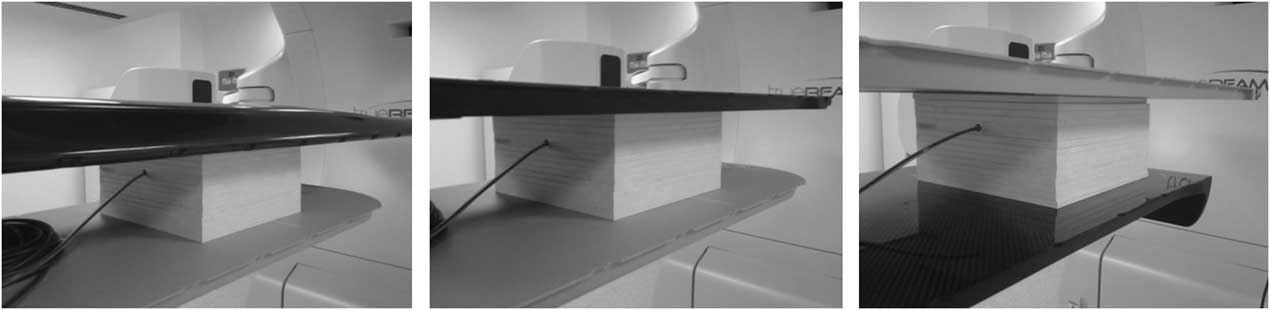
Each tabletop was positioned on top of the phantom and all measurements were repeated for each tabletop—couch rails not considered in this study (see Figure 1). Summarising, 72 measurements were done: 4 energies×2 field sizes×3 gantry angles×3 repetitions for every measurement.
The three tabletops studied, in measurement acquisition position: Varian Exact IGRT tabletop (left), kVueTM Universal Tip Insert (centre), kVueTM Calypso® Varian Insert (right).
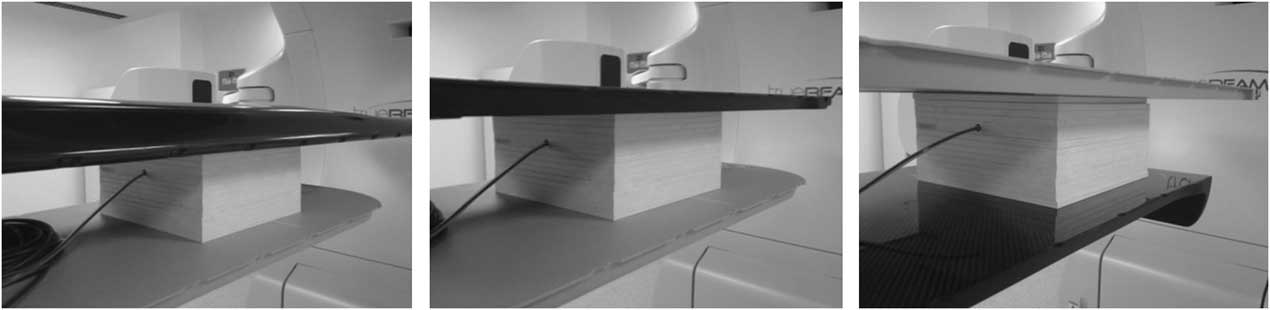
For the Varian Exact IGRT tabletop, the attenuation measurements were performed from the medium thickness part of the tabletop (longitudinal position equivalent to pelvic region treatment), as the thickness of the tabletop is not constant in the longitudinal direction. For both kVueTM inserts, their thickness is consistent all along, so the point of measurement has no impact on the results.
The transmission measurements were registered in a table. The attenuation was calculated according to the following formula:
 $${\rm attenuation}\,\left( \,\%\, \right){\rm {\equals}}\left( {1{\minus}{{\rm measurement\ with\ tabletop} \over {\rm measurement\ without\ tabletop}}} \right){\times}{\rm 100}$$
Each measurement point was repeated five times. Mean of the five repetitions was calculated and registered. Standard deviation was calculated to evaluate the precision of the measurements.
Math operations were performed using Microsoft Excel (Microsoft Corporation, Washington, DC, USA).
Results
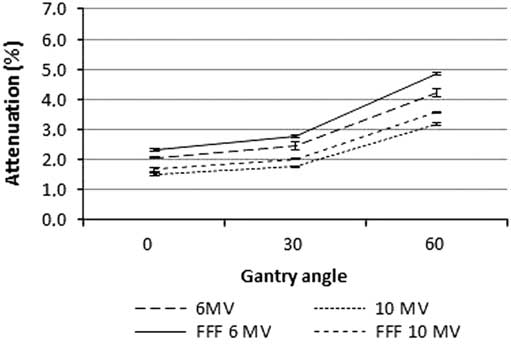
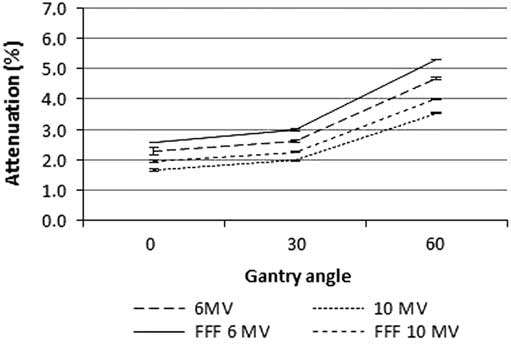
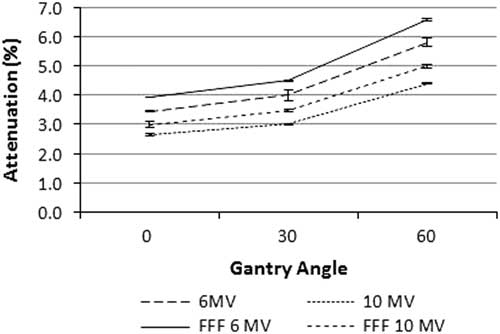
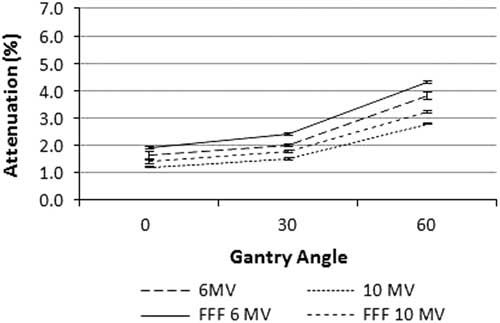
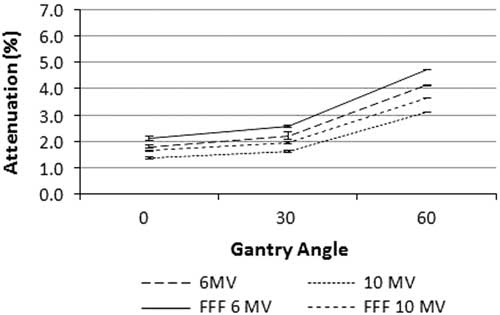
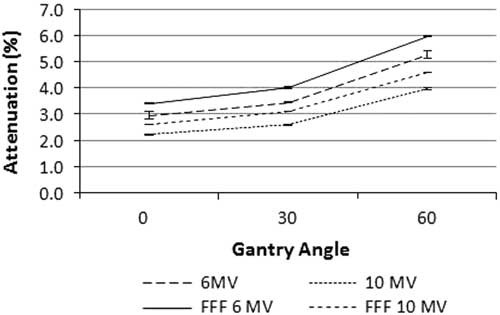
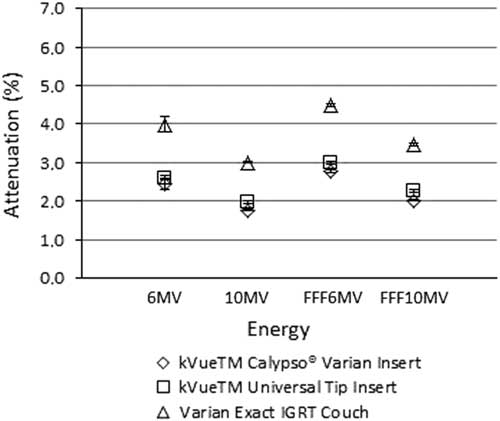
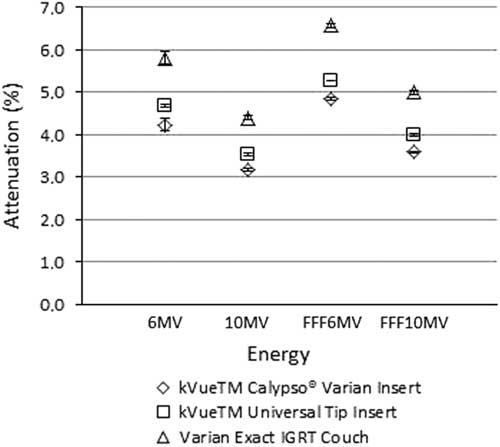
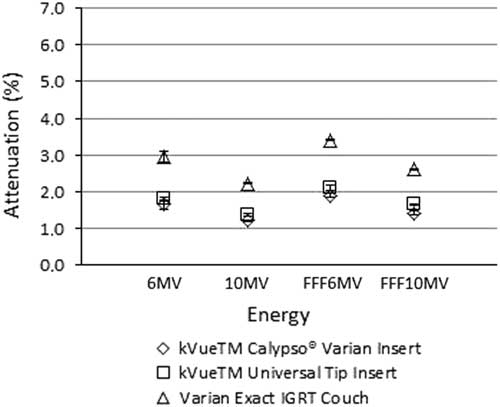
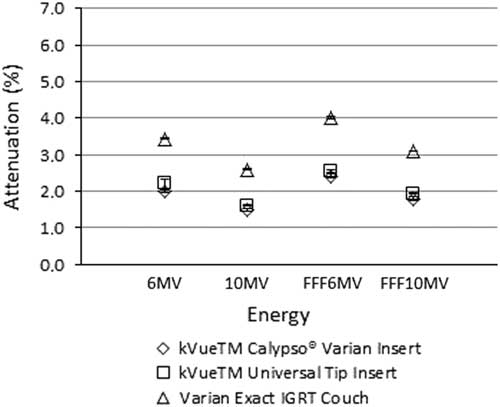
The attenuation measurements for each tabletop for the three gantry angles measured for the 5×5 cm2 field size are presented in Figures 2–4. The attenuation measurements for the each tabletop for the three gantry angles measured for the 10×10 cm2 field size are presented in Figures 5–7.
Mean attenuation by KvueTM Calypso® Varian Insert for the three gantry angles measured for a 5×5 cm2 field size.
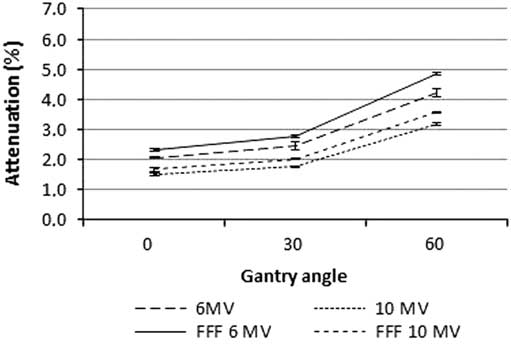
Mean attenuation by kVueTM Universal Tip Insert for the three gantry angles measured for a 5×5 cm2 field size.
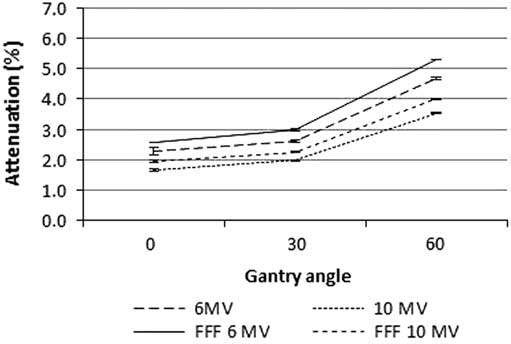
Mean attenuation by Varian Exact IGRT tabletop for the three gantry angles measured for a 5×5 cm2 field size.
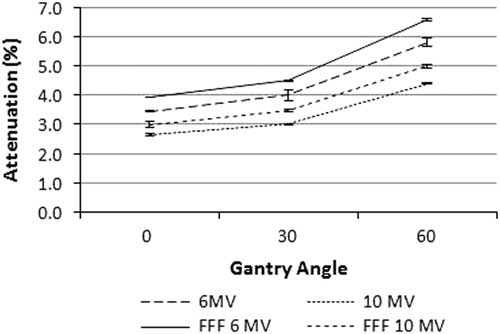
Mean attenuation by KvueTM Calypso® Varian Insert for the three gantry angles measured for a 10×10 cm2 field size.
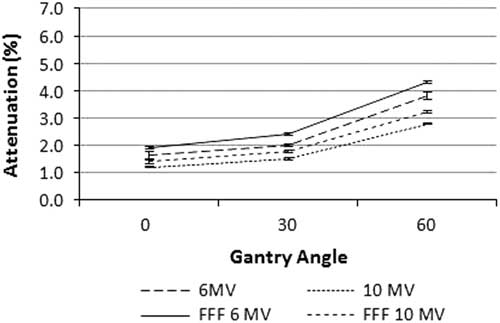
Mean attenuation by kVueTM Universal Tip Insert for the three gantry angles measured for a 10×10 cm2 field size.
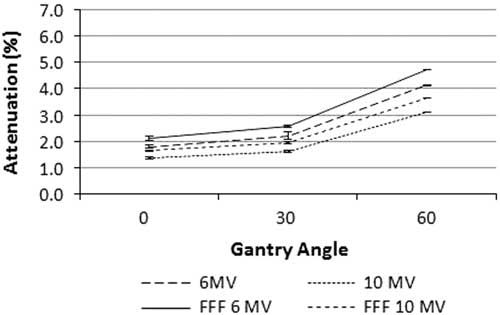
Mean attenuation by Varian Exact IGRT tabletop for the three gantry angles measured for a 10×10 cm2 field size.
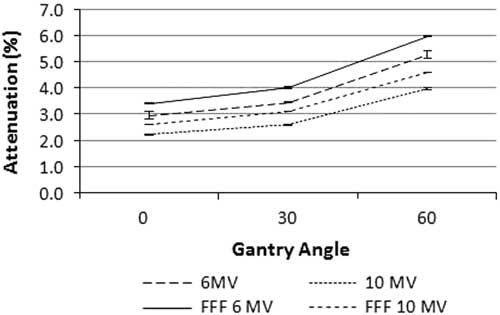
Regarding all the measurements, only two have a SD of 0·2%, both in attenuation measurements of 6 MV fields by Varian Exact IGRT tabletop: gantry angle 0° for 5×5 cm2 field size and gantry angle 30° for 10×10 cm2 field size. All the other measured points showed 0·0 or 0·1% SD. It can be said that measurements have good precision.
The output measurements show that the attenuation is field size dependent. The attenuation values measured were always higher for 5×5 cm2 fields than for 10×10 cm2 fields, in the same measurement conditions.
The collected data also indicates an angular dependence of the attenuation. As expected, all measurements (for both field sizes, for all energies, for all tabletops) indicate higher attenuation values as the gantry angle increases.
At 0° incidence on the Exact IGRT tabletop, the measured attenuation for 10×10 cm2 was 3·0 and 2·2% for 6 and 10 MV beams, respectively. For the same field size was measured 3·4 and 2·6% attenuation for 6 and 10 FFF MV beams, respectively. At the same incidence on the other tabletops, the measured attenuation is lower. For 10×10 cm2 field there is 1·8, 1·4, 2·1 and 1·6% attenuation for 6, 10 MV, 6 and 10 FFF MV energy beams on the kVueTM Universal tabletop. For the KvueTM Calypso® tabletop 10×10 cm2 irradiation field, the measurements were 1·6, 1·2, 1·9 and 1·4%, respectively.
This example shows the tendency observed for all gantry angles, and for all tabletops: 6 MV and 6 FFF MV energy beams are more attenuated in the tabletop than the 10 MV and 10 FFF MV energy beams. Also, FFF energy beams are more attenuated than the respective conventional flattened energy beam.
Figures 8–13 show the same data presented in Figures 2–7, but they were rearranged in order to show the mean attenuation values for the three different tabletops, when maintaining the field size and the gantry angle.
Mean attenuation for the three tabletops for 5×5 cm2 field—gantry angle 0°.
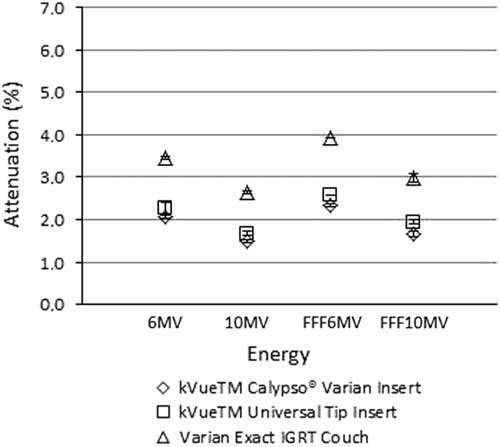
Radiation attenuation for the three tabletops for 5×5 cms field—gantry angle 30°.
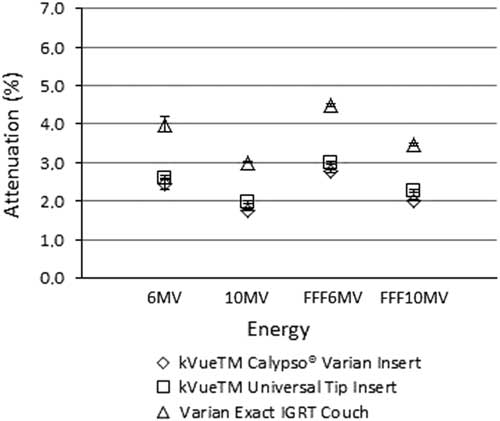
Mean attenuation for the three tabletops for 5×5 cm2 field—gantry angle 60°.
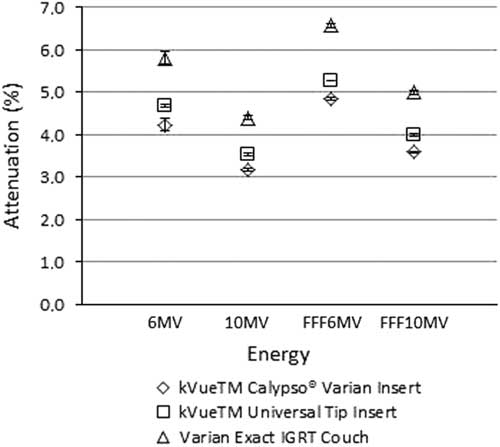
Mean attenuation for the three tabletops for 10×10 cm2 field—gantry angle 0°.
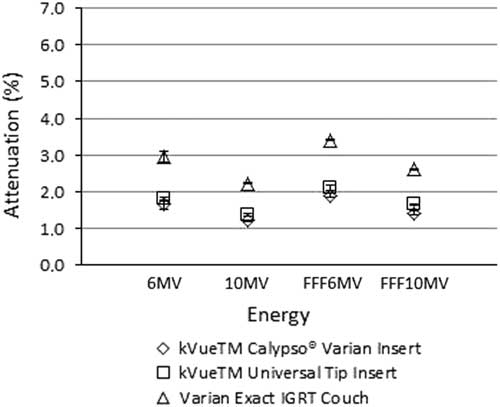
Mean attenuation for the three tabletops for 10×10 cm2 field—gantry angle 30°.

Mean attenuation for the three tabletops for 10×10 cm2 field—gantry angle 60°.
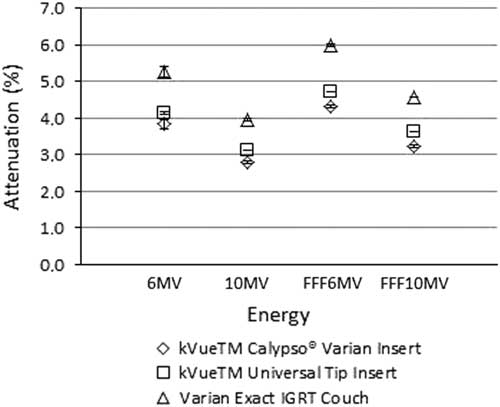
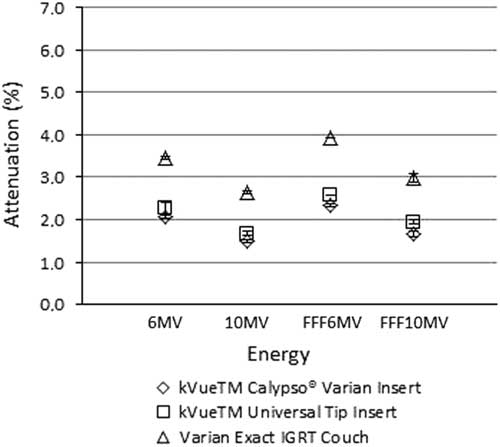
For all 72 measurements, it is clear that the Exact IGRT tabletop presents higher attenuation values than the other two tabletops.
Mean attenuation values by kVueTM Universal tabletop are higher than mean attenuation by KvueTM Calypso® tabletop for all the measured points. Nevertheless the tips of error bars of kVueTM Universal and KvueTM Calypso® tabletops are coincidental for gantry angles 0° and 30° for 6 MV energy beam and for gantry angle 30° for 10 FFF MV energy beam (Figures 11 and 12).
Discussion
Attenuation measurements
As previously reported,Reference Li, Lee, Johnson, Zhu and Kudchadker 19 – Reference Njeh, Raines and Saunders 21 the measurements showed field size dependence. Higher attenuation was measured for the 5×5 cm2 field size beams than for 10×10 cm2, for the same measurement conditions.
Measurements were also angular dependent. The higher the gantry angle, the higher is the attenuation due to the slightly increased path length due to oblique incidence at these angles. This dependence has also been reported already.Reference McCormack, Diffey and Morgan 16 , Reference Li, Lee, Johnson, Zhu and Kudchadker 19 , Reference Njeh, Raines and Saunders 21
Vanetti et al. measured the attenuation of the thinner part of the Varian Exact IGRT tabletop for a 10×10 cm2 field size with a 6 MV photon beam. The authors report attenuations of 2·3 and 3·1% with gantry angles of 0° and 45°, respectively.Reference Vanetti, Nicolini, Clivio, Fogliata and Cozzi 22 Seppälä et al.Reference Seppälä and Kulmala 13 found the corresponding measured attenuations to be 1·9 and 2·7%. Our study reports on the attenuation values for a thicker part of the tabletop which corresponds to the pelvic treatment region. Our results are between 3·0 and 5·3% for 0° and 60° gantry angles, respectively. All these data support angle dependence attenuation.
6 MV energy beams are more attenuated than 10 MV energy beam for all tabletops used in this study. Li et al.Reference Li, Lee, Johnson, Zhu and Kudchadker 19 studied the attenuation of two tabletops (Varian Clinac standard tabletop and Varian Exact IGRT tabletop) in 6 and 18 MV beams and stated that the 6 MV photon beam yielded a larger attenuation difference than the 18 MV photon beam. Considering 6 MV beams are less energetic than 10 MV beams, it is expected that more photons of this beam are attenuated in the tabletop than 10 MV photons are. Similarly, this happens with 6 and 10 FFF MV beams.
On the other hand, 6 FFF MV energy beams are more attenuated than 6 MV beams. Conventional flattened energy beams go through the flattening filter leading to a more homogeneous field. FFF beams contain the low-energy photons that were not attenuated by the flattening filter. Therefore, it is expected that more photons are attenuated in the tabletop.
Tabletops comparison
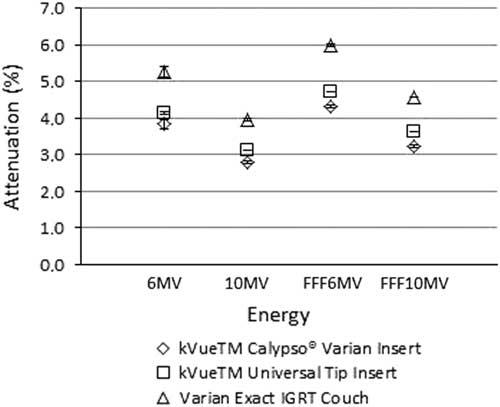
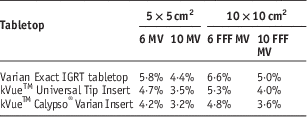
For both field sizes and for all energy beams, the attenuation outputs were definitely higher for the Varian Exact IGRT tabletop when compared with the kVue tabletops. Figure 10 shows the maximum attenuation measured values for each tabletop (Gantry=60° for 5×5 cm2). The Varian Exact IGRT tabletop mean attenuation is 5·8 and 4·4% for 6 and 10 MV, respectively. Measurements with the new tabletops are 4·7 and 3·5% for the carbon fibre tabletop, and 4·2 and 3·2% for the Kevlar Calypso tabletop, respectively. FFF energy beams are attenuated for these tabletops the same way. For the same field size, Varian Exact IGRT tabletop mean attenuation of 6 and 10 FFF MV are 6·6 and 5·0%, respectively. kVueTM Universal Tip tabletop corresponding measurements are 5·3 and 4·0% and kVueTM Calypso® Varian tabletop corresponding measurements are 4·8 and 3·6%, respectively (see Table 1). All the remaining measurements follow the same tendency, as it is shown in Figures 8–13.
Maximum attenuation values: gantry angle 60°

Therefore, treatment delivery was not compromised due to beam attenuation in the tabletop when tabletops were changed because of the Calypso System carbon fibre limitation. Nevertheless, in Eclipse the Varian Exact IGRT Tabletop can be modelled to account for beam attenuation, but none of the kVue tabletops are available for this tool, yet. That way the characteristics of the treatment table stopped being included in the treatment plan.
The attenuation measurements for the kVue tabletops were closer to each other. kVueTM Calypso® Varian tabletop showed smaller mean attenuation of the beams than kVueTM Universal Tip Insert for all energies. As it was previously referred, there was a coincidence in error bars limit in three measured points. Since there are 72 measurements, it was considered that kVueTM Calypso® Varian tabletop attenuated radiation less than kVueTM Universal Tip Insert. Therefore, it was decided that in the department there was no need to change between tabletops whenever there was a regular treatment or a Calypso System guided treatment.
Limitations of the study
This study reports on the attenuation of radiotherapy treatment beams by treatment tabletops. Four energy treatment beams are analysed: 6, 10 MV, 6 and 10 FFF MV. All measures were performed at the isocenter; 6 and 10 MV beams can be considered homogeneous, so measurements can be considered representative of the whole field.
Varian Exact IGRT tabletop insert is supported on the tabletop stand, but the two new tabletops (kVueTM Universal Tip and kVueTM Calypso® Varian) are supported on two rails that are also in the beam path. Every tabletop measurement was performed with the tabletop positioned on the phantom, which means that rail supports were not taken into consideration in this study.
Although several studies have reported on carbon fibre rails support beam attenuation,Reference Li, Lee, Johnson, Zhu and Kudchadker 19 , Reference Myint, Niedbala, Wilkins and Gerig 20 , Reference Vieira, Kaatee, Dirkx and Heijmen 23 none is applicable to the rails with the calypso system because the material is Kevlar instead of carbon fibre.
Conclusions
Attenuation output measurements are field size and angular dependent.
Low conventional flattened energy beams are more attenuated than higher conventional flattened energy beams. FFF energy beams are more attenuated than conventional flattened energy beams.
The Exact IGRT tabletop presents higher attenuation values, followed by kVueTM Universal tabletop and, finally, the KvueTM Calypso® tabletop. Therefore treatment delivery was not compromised by the exchange of tabletops. However, attenuation of treatment tabletops should be corrected in the treatment planning. Unfortunately, kVue tabletops are not included in the treatment plan system (TPS) yet. It is suggested that the TPS should have kVue tabletops characteristics available so they can be taken into consideration in the treatment plan.
Future work should include more detailed studies on FFF energy beams attenuation as they are not homogeneous: it would be interesting to see attenuation values in points of the beam away from the isocenter. Calypso tabletops rail support system attenuation should also be studied in the future.
Acknowledgements
The authors thank the staff of the Radiotherapy Department at Centro Clinico Champalimaud for their personal encouragement and Dr Andrew Macann for helping with English language revision. This article was proposed in the master course Radiations applied to Health Technologies—Radiation Therapy, at Escola Superior de Tecnologias da Saúde de Lisboa. Revision of the article was kindly made by Sandra Vieira and Dalila Mateus, who have worked with Calypso, and also by Prof. Margarida Eiras.
Financial support
No monetary costs were involved in this article. Any cost related to publication is supported by the primary author herself.
Conflicts of Interest
None.