Introduction
Forage cactus has been considered key to increase resilience and ensure sustainability of livestock activity in semiarid regions (Rocha Filho et al., Reference Rocha Filho, Santos, Véras, Siqueira, Novaes, Mora-Luna and Ferreira2021). In Brazil, it is estimated that approximately 600,000 ha are cultivated with forage cactus of different genotypes (Dubeux Jr. et al., Reference Dubeux Júnior, Araújo Filho, Santos, Lira, Santos and Pessoa2013; Dubeux Jr. et al., Reference Dubeux, Santos, Souza and Siebert2022), and cultivation continues to expand over the years. Forage cactus crops have also been identified as one of the main strategies to deal with climate change in semiarid conditions due to their high adaptation, favouring the resilience of livestock activity (Dubeux Jr et al., Reference Dubeux, dos Santos, da Cunha, dos Santos, de Almeida Souza, de Mello and de Souza2021). However, the occurrence of pests, mainly the carmine cochineal (Dactylopius opuntiae Cockerell), has been considered one of the main threats, increasing the risk of cultivation (Santos et al., Reference Santos, Farias, Lira, Santos, Arruda, Coelho, Dias and Melo2006). The primary tool to reduce its impact on forage cactus crops is growing more pest-resistant varieties, especially Miúda [Nopalea cochenillifera (L.) Salm Dyck.] and Orelha de Elefante Mexicana (Opuntia sp.) (Santos et al., Reference Santos, Farias, Lira, Santos, Arruda, Coelho, Dias and Melo2006; Vasconcelos et al., Reference Vasconcelos, Lira, Cavalcanti, Santos and Willadino2009; Garcia et al., Reference Garcia, Mello, Cunha, Silva, Santos, Santos, Dubeux and Homem2021).
Forage cactus is usually harvested, chopped and used to feed the animals (Dubeux Jr. et al., Reference Dubeux, dos Santos, da Cunha, dos Santos, de Almeida Souza, de Mello and de Souza2021). Although it is not necessary to collect cactus pears daily to feed the animals, considering that the material collected can be used for up to 16 days (Santos et al., Reference Santos, Lira, Farias, Burity and Filho1992), the need for frequent harvesting contributes to the lack of uniformity in forage cactus crops, potentially affecting its growth and production. Thus, evaluating strategies that contribute to improving the use of this forage resource in the semiarid region may favour the reduction of the vulnerability of animal production systems.
Ensiling forage cactus may be an alternative to maximize its use in semiarid regions since it allows the harvest of the entire crop and standardizes the harvest, favouring plant growth (Brito et al., Reference Brito, Santos, de Araújo, de Oliveira, Zanine, Perazzo and Cavalcanti2020). It may increase forage productivity, reduce the need for labour for harvesting throughout the dry season, and conserve the water in the feed (Galvão Jr. et al., Reference Galvão Júnior, da Silva, Morais and de Lima2014; Brito et al., Reference Brito, Santos, de Araújo, de Oliveira, Zanine, Perazzo and Cavalcanti2020).
Cactus pear has a low dry matter (DM) content (generally below 150 g/kg) (Gama et al., Reference Gama, de Paula, Véras, Guido, Borges, Antoniassi and Ferreira2021; Rocha Filho et al., Reference Rocha Filho, Santos, Véras, Siqueira, Novaes, Mora-Luna and Ferreira2021) with considerable variation among species and cultivars (Dubeux Jr. et al., Reference Dubeux, dos Santos, da Cunha, dos Santos, de Almeida Souza, de Mello and de Souza2021), which can be considered an unfavourable characteristic for the ensiling process (Kung Jr et al., Reference Kung, Robinson, Ranjit, Chen, Golt and Pesek2000), and low crude protein (CP) (Dubeux Jr et al., Reference Dubeux, dos Santos, da Cunha, dos Santos, de Almeida Souza, de Mello and de Souza2021). However, it presents a high concentration of pectic polysaccharides and mucilage, esterified sugars with a high concentration of galactose, arabinose, xylose and fructose, which may allow adequate fermentation of the silage (Brito et al., Reference Brito, Santos, de Araújo, de Oliveira, Zanine, Perazzo and Cavalcanti2020). However, excessive fermentation and high loss of nutrients may occur (Kung Jr. et al., Reference Kung, Schmidt, Ebling and Hu2007). The pectic polysaccharides and mucilage composition may vary along the year and be reduced during the rainy season (Ribeiro et al., Reference Ribeiro, Silva, Lima Filho, Brito and Silva2010; Luna-Zapién et al., Reference Luna-Zapién, Zegbe, Meza-Velázquez, Contreras-Esquivel and Morales-Martínez2023), when more water is absorbed and stored by the cactus plant, potentially affecting silage fermentation and losses. The increase in DM contents of the ensiled mass with the addition of absorbent additives can improve the silage’s fermentative characteristics and reduce losses throughout the process (Borreani et al., Reference Borreani, Tabacco, Schmidt, Holmes and Muck2018).
The inclusion of Leucaena hay [Leucaena leucocephala (Lam.) Wit] may contribute to improving the silage nutritive value due to its high CP content, improve the conditions for cactus pear fermentation with the increase in DM levels, and reduce losses (Borreani et al., Reference Borreani, Tabacco, Schmidt, Holmes and Muck2018). Gusha et al. (Reference Gusha, Katsande, Zvinorova and Ncube2013) evaluated fermentative characteristics and nutritive value of silages composed of 60% cactus pear (Opuntia ficus-indica Mill) and 40% forage legume hay [Acacia angustissima (Mill.), Leucaena leucocephala (Lam.), Calliandra callothrysus Meisn and Macroptilium atropurpureum Ubr.]. They reported that the hay inclusion improved silage nutritive value without negatively affecting fermentative characteristics, with pH ranging from 3.97 to 4.11.
Understanding variations in the fermentative profile and nutritive value of cactus pear silages with the inclusion of forage leguminous hay can contribute to optimizing the use of this important forage resource in semiarid conditions. The hypotheses of this study are: (i) the association between cactus pear and Leucaena hay may result in silages with adequate fermentative characteristics and nutritive value since Leucaena hay can contribute to increasing the levels of DM and CP, reduce the excessive fermentation and losses of ensiled mass; and (ii) differences in the initial DM content of cactus pear cultivars and the level of Leucaena hay may contribute to differences in the fermentative profile of silages. Thus, the objective was to evaluate the fermentative characteristics, DM losses, and the nutritive value of silages of three cactus pear cultivars associated with levels of Leucaena hay (0, 15 and 30%).
Material and methods
Experimental site, design and treatments
The experiment was conducted at the Animal Science Department of the Federal Rural University of Pernambuco (UFRPE), in Recife-PE (8º04’N, 34º55’E. 4 m a.s.l.), between September and November 2021. All analyses were conducted in the Forage Laboratory of UFRPE, except the analyses of organic acids that were performed in the Chemistry Laboratory of the Federal University of Pernambuco (UFPE). The forage cactus was collected at the IPA Experimental Station, located in Arcoverde (8°26’N, 37°03’E, 664 m a.s.l.), Pernambuco, Brazil, located in the semiarid region, and has an average annual rainfall of 680 mm and an average annual air temperature of 23.7°C, ranging from 16°C to 34°C (INMET, 2019).
Silages of three cactus pear cultivars resistant to carmine cochineal (Dactylopius opuntiae Cockerell) were evaluated: Orelha de Elefante Mexicana (OEM) (Opuntia stricta Haw.) and Nopalea cochenillifera cvs. IPA Sertânia and Miúda associated with three levels of inclusion of Leucaena hay (0, 15 and 30% on a fresh weight basis). The design used was completely randomized, following a 3 × 3 factorial arrangement, corresponding to three forage cactus cultivars and three levels of inclusion of Leucaena hay, with four replications, totalling 36 experimental units (minisilos).
Silage production
Leucaena hay was produced by cutting thin branches (up to 1 cm thick). After harvesting, the forage was passed through a forage chopper (EP-25 Gold Series, Pinheiro Máquinas Agrícolas, São Paulo, Brazil) adjusted to a 1.5 cm cut and exposed to the full sun for dehydration. The cactus pear cultivars were harvested from cactus pear crops with two years of regrowth. At the beginning of the regrowth, the cactus pear crops received an application of three tons per hectare of goat manure. Harvesting was performed manually, collecting all the forage located immediately above the primary cladodes.
Cactus pear cladodes were passed to a forage cactus chopper (Master 1400, Sertaneja, São Paulo, Brazil), resulting in particle sizes of approximately 2.5 × 2.5 cm, and then mixed with the Leucaena hay according to each treatment. The forage was stored in in cylindrical polyvinyl chloride (PVC) minisilos (76 cm in height and 15 cm in diameter), containing a Bunsen valve for gas escape in the top, and washed and dried sand (5 kg) placed in a tissue non-tissue (TNT) bag at the bottom of the silos for the capture of effluents. Each experimental unit (minisilo) was filled with approximately 7.5 kg of forage (fresh matter) according to treatment.
Sampling procedures and forage characterization
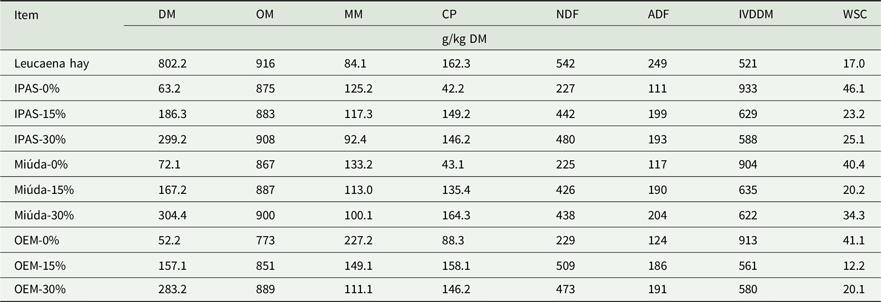
Immediately before filling the silos, forage mass samples were collected and taken to a forced ventilation oven set at 55°C until constant weight and, later, ground in a Willey type mill, using a 1 mm sieve to determine the levels of dry matter (DM) (method 967.03), organic matter (OM), mineral matter (MM) (method 942.05) and crude protein (CP) (method 988.05), lignin (method 973.18) according to AOAC (Horwitz, Reference Horwitz and Latimer2005), and neutral detergent fibre (NDF), acid detergent fibre (ADF) and in vitro digestibility of dry matter (IVDDM) using the DAISYII Incubator (ANKOM® Technology) according to the methodologies described by Detmann et al. (Reference Detmann, Silva, Rocha, Palma and Rodrigues2021), and water-soluble carbohydrates (WSC) using the anthrone method (Bezerra Neto, Reference Bezerra Neto and Barreto2011) (Table 1).
Chemical composition and in vitro digestible dry matter (IVDDM) of Leucaena hay [Leucaena leucocephala (Lam.) de Wit], forage cactus varieties and the mixture between them

DM, dry matter; OM = organic matter; MM, mineral matter; CP, crude protein; NDF, neutral detergent fibre; ADF, acid detergent fibre; IVDDM = in vitro digestible dry matter; WSC, water-soluble carbohydrates.
IPAS-0%, IPA Sertânia forage cactus; IPAS-15%, IPA Sertânia forage cactus + 15% of inclusion of Leucaena hay; IPAS-30% = IPA Sertânia forage cactus + 30% of inclusion of Leucaena hay; Miúda-0%, ‘Miúda’ forage cactus; Miúda-15%, ‘Miúda’ forage cactus + 15% of inclusion of Leucaena hay; Miúda-30%, = ‘Miúda’ forage cactus + 30% of inclusion of Leucaena hay; OEM-0%, Orelha de Elefante Mexicana forage cactus; OEM-15%, Orelha de Elefante Mexicana forage cactus + 15% of inclusion of Leucaena hay; OEM-30% = Orelha de Elefante Mexicana cactus + 30% inclusion of Leucaena hay.
The average density within the silos was 716 kg/m3 (determined by weighing before and after filling the silos). The silos were stored at room temperature during 70 days until opening for silage characterization.
Fermentation losses, sensory analysis and chemical composition of the silages
The dry matter losses in the silages in the form of gases (GL) and effluents (EL), as well as the dry matter recovery (DMR), were determined by weight difference, using the equations described by Zanine et al. (Reference Zanine, Santos, Dórea, Dantas, Silva and Pereira2010), in which:
 $$ {\rm GL} = ({\rm WFc} - {\rm WFo})/({\rm FMc} \times {\rm DMc}) \times 100$$
where GL is the gas losses (% of DM), WFc is the weight of the filled silo at closing (kg), WFo is the weight of the filled silo at opening (kg), FMc is the forage mass at silo closing (kg) and DMc is the forage DM concentration at silo closing (%).
 $$ {\rm EL}= [({\rm WEf} - {\rm Tb}) - ({\rm WEi} - {\rm Tb})]/{\rm FMi} \times 100$$
where EL is the effluent losses (kg/ton of fresh matter), WEi is the weight of the empty silo + sand at closing (kg), WEf is the weight of the empty silo + sand at opening (kg), Tb is the weight of the empty silo (kg) and FMi is the forage mass at silo closing (kg).
The DM recovery was estimated based on the difference in forage mass weight and DM concentration before and after ensiling using the equation described by Zanine et al. (Reference Zanine, Santos, Dórea, Dantas, Silva and Pereira2010):
 $$ {\rm DMR} = ({\rm FMo} \times {\rm DMo})/({\rm FMc} \times {\rm DMc}) \times 100$$
where FMo is the fresh mass at opening of the silos, DMo is the dry matter at opening, FMc is the fresh mass at closing of the silos and DMc is the dry matter at closing.
The sensory evaluation of the silages was performed at the opening time according to the criteria described by Guim and Clemente (Reference Guim and Clemente2019). The following parameters were evaluated: odour, coloration and texture aspects (DM content), for which the silages received scores from 1 to 4 for each item and, from the average of these, were then classified as good to very good, satisfactory, regular and unsatisfactory. For mould evaluation, silages were classified regarding the presence or absence of apparent mould. Three evaluators performed sensory assessments, and the results were averaged.
The pH of the silages was determined using approximately 9 g of sample of the ensiled material of each treatment. To each sample, 60 mL of distilled water was added, and after 30 minutes, the reading was performed using a potentiometer, according to the methodology described by Silva and Queiroz (Reference Silva and Queiroz2002).
Subsequently, two silage samples were taken from the median portion of each silo, discarding approximately 10 cm from the upper layer. A fresh sample was frozen at −20°C for further analysis of ammoniacal nitrogen (N–NH3) contents according to the methodology described by Bolsen et al. (Reference Bolsen, Lin, Brent, Feyerherm, Urban and Aimutis1992). Organic acids (acetic, propionic and butyric acids) and ethanol were analysed by gas chromatography and lactic acid by liquid chromatography, according to methods described by Kung et al. (Reference Kung and Ranjit2001). The second sample was dried in a forced ventilation oven (55°C for 72h) to constant weight. Subsequently, samples were ground in a Willey mill using a 1-mm sieve for the analysis of dry matter (DM) (method 967.03), organic matter (OM), mineral matter (MM) (method 942.05) and crude protein (CP) (method 954.01), lignin (method 973.18) according to AOAC (Horwitz, Reference Horwitz and Latimer2005), and neutral detergent fibre (NDF), acid detergent fibre (ADF) and in vitro digestibility of dry matter (IVDDM) using the DAISYII Incubator (ANKOM® Technology) according to the methodologies described by Detmann et al. (Reference Detmann, Silva, Rocha, Palma and Rodrigues2021), as previously described for fresh mass characterization. Rumen fluid was collected in the early morning from fistulated dairy cattle and used as inoculum in IVDDM analysis. The animals used to collect rumen fluid were fed Tifton 85 hay (Cynodon ssp.) and corn and soybean meal, and cared for in accordance with the guidelines and recommendations of the Committee of Ethics on Animal Studies at the Federal Rural University of Pernambuco (Licence No 002/2020).
Aerobic stability test
A subsample of approximately 3 kg of fresh silage was placed in buckets and exposed to air in a room with a controlled temperature to perform aerobic stability test by monitoring the surface and internal temperature three times a day using a digital thermometer (Kung Jr. et al., Reference Kung, Robinson, Ranjit, Chen, Golt and Pesek2000). Aerobic stability was defined as the number of hours silage remained stable before a rise in temperature of 2°C above room temperature.
Statistical analysis
The data was analysed using the PROC MIXED of the statistical package SAS® (Littel et al., Reference Littell, Stroup, Milliken, Wolfinger and Schabenberger2006). In the choice of the matrix of variance and covariance, the Akaike Information Criterion was used (Wolfinger, Reference Wolfinger1993). The treatments (forage cactus cultivars and Leucaena hay levels) and their interactions were considered fixed effects (Littel et al., Reference Littell, Stroup, Milliken, Wolfinger and Schabenberger2006). Orthopolynomial contrasts were used to characterize the type of response (linear and quadratic) to Leucaena hay’s inclusion level. Linear predictor and quantile-quantile plots of residuals were used to check for homogeneity of variance and normality of error (visual assessment), and when necessary, data transformations were performed. Lognormal transformation was used for gas losses, butyric and propionic acids and crude protein variables prior to statistical tests, but the descriptive data presented are based on non-transformed data for ease of interpretation. The means were estimated using the ‘LSMEANS’ and comparisons between them using the probability of the difference (‘PDIFF’) by Student’s t-test at a significance level of 5%. When necessary, the interaction between cultivars and levels of Leucaena hay was unfolded, and the polynomial contrasts were analysed for the inclusion levels of hay in the silages of the different cultivars. Data of sensory analysis were descriptively (qualitatively) analysed.
Results
Dry matter losses
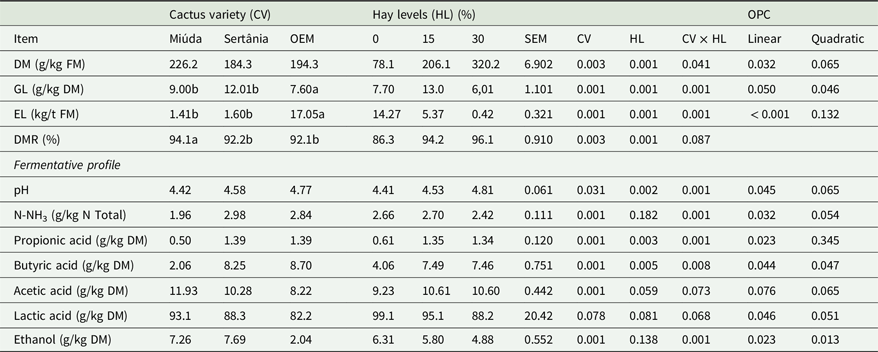
There was an effect of the interaction cultivar × Leucaena hay levels for most of the variables related to losses during the fermentation process, and fermentation profile of the silage (Table 2). Only the lactic acid concentration was not affected by the studied treatments.
Gas and effluent losses, dry matter recovery and fermentative profile of forage cactus silages from different varieties containing inclusion levels of Leucaena [Leucaena leucocephala (Lam.) de Wit] hay

Hay levels on a fresh weight basis. OPC, orthogonal polynomial contrast for the hay inclusion effect; DM, dry matter (g/kg fresh matter; GL, gas losses; EL, effluent losses (kg/t fresh matter); DMR, dry matter recovery; N-NH3, ammonia nitrogen, expressed in g per kg of total nitrogen; pH, hydrogen potential. SEM = Standard error of the mean. Means followed by different letters in the lines (for the same effect – variety or hay level) differ from each other by the Student’s t-test at 5% probability.
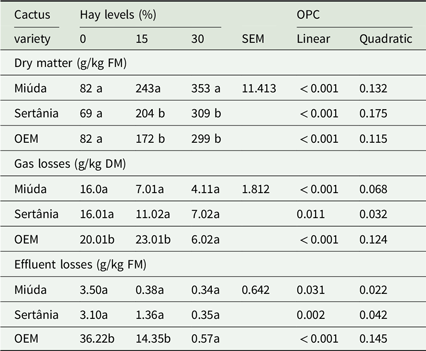
The DM contents in cactus pear silages without inclusion of Leucaena hay were similar (P > 0.05). Among silages with inclusion of 15% and 30% of Leucaena hay, the highest DM concentrations were observed for the cultivar Miúda. The inclusion of hay linearly increased the DM content of silages (Table 3).
Unfolding the interaction between the effects of forage cactus varieties and inclusion levels of Leucaena [Leucaena leucocephala (Lam.) de Wit] hay on dry matter content, gas and effluent losses from forage cactus silages containing levels of Leucaena hay

Hay levels on a fresh weight basis. OPC, orthogonal polynomial contrast for the hay inclusion effect; OEM, Orelha de Elefante Mexicana. SEM = Standard error of the mean. Means followed by different letters in the column (for the same hay level) differ from each other by the Student’s t-test at 5% probability.
The greatest losses by gases (GL) and effluents (EL) were observed in silages of the OEM cultivar without inclusion of hay and with the inclusion of 15% of Leucaena hay. There was no difference for silages of forage cactus cultivars with inclusion of 30% of Leucaena hay. The increase in the inclusion of Leucaena hay resulted in a linear reduction in GL of Miúda and OEM silages. In the IPA-Sertânia cultivar, the inclusion of Leucaena hay resulted in less variation between the 0 and 15% inclusion levels of hay, which contributed to a linear and quadratic response (Table 3).
A linear reduction was observed in EL with increasing levels of Leucaena hay for silages of the cultivar OEM (Table 3). In silages of the other cultivars, the inclusion of Leucaena hay also reduced EL, although for the levels of inclusion of 15% and 30% of hay in the silages, the variations were smaller, contributing to a linear and quadratic response (Table 3). Silage density and lactic acid concentration in silages were not affected by treatments (P > 0.05) (Table 2).
Sensory analysis
The colour of the silages varied from light green to dark green, being darker in the treatments with the inclusion of hay (Figure 1). Among the cactus forage cultivars, no difference in colour was observed (average 1,85 – good to satisfactory). The smell of the silages was considered and varied between sweet vinegar smell and acid vinegar (average 1,66 – good to satisfactory). The texture of the silages was finer in the exclusive OEM variety. The other treatments presented a medium texture and not coarse. The presence of mould beyond the surface was not observed (average 1,0 – good to very good).
Silage of different forage cactus varieties. (1). Orelha de Elefante Mexicana (Opuntia Stricta Haw). (2). Palma Miúda (Nopalea cochenillifera Salm Dyck.); (3). IPA Sertânia (N. cochenillifera).

Fermentative profile
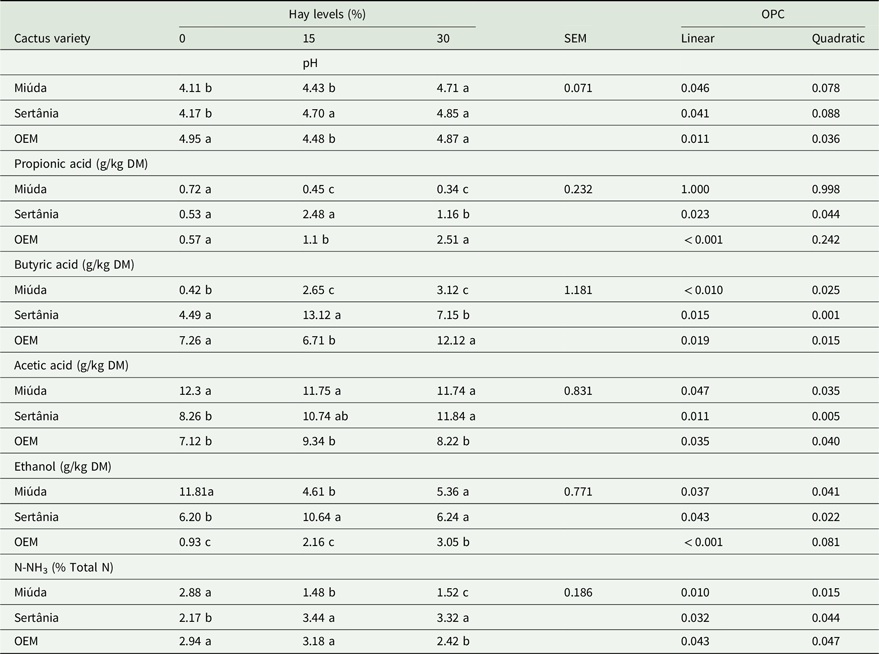
There was a difference for the pH of the silages of cactus pear cultivars (Table 4). In the silages with 0 and 15% of hay inclusion, the highest pH values were observed for the cultivar IPA Sertânia. With the increase of Leucaena hay, the cultivars Miúda and IPA Sertânia showed linear increases in pH, while in the silage of OEM, the pH reduced from the 0% level of Leucaena hay inclusion to the 15% level, and increased from 15 to 30% hay inclusion, which contributed to a linear and quadratic effect.
Unfolding the interaction between the effects of forage cactus varieties and inclusion levels of Leucaena hay Leucaena [Leucaena leucocephala (Lam.) de Wit] on the fermentative profile of forage cactus silages containing levels of Leucaena hay

Hay levels on a fresh weight basis. OPC, orthogonal polynomial contrast for the hay inclusion effect; OEM, Orelha de Elefante Mexicana; pH, potential hydrogen; N–NH3, ammonia nitrogen, expressed in g per kg of total nitrogen; SEM, standard error of the mean. Means followed by different letters in the column (for the same hay level) differ from each other by the Student’s t-test at 5% probability.
The highest propionic acid production was observed in the silages of the IPA Sertânia cultivar, with inclusion levels of 15 and 30% of Leucaena hay. There was no difference in the propionic acid concentration in cactus forage silages without the inclusion of Leucaena hay. The low variation of propionic acid concentration in mixed silages of Miúda and IPA Sertânia cultivars with 15% and 30% hay inclusion contributed to quadratic effects. In the silages of the variety OEM, the propionic acid concentration increased linearly by including Leucaena hay (Table 4).
The lowest butyric acid concentrations occurred in the Miúda silages at all inclusion levels of Leucaena hay. The butyric acid contents increased between the inclusion levels of 0 and 15% of hay and showed slight variation for silages with 30% of hay inclusion, contributing to linear and quadratic effects for all cultivars (Table 4).
OEM silages showed the lowest ethanol production levels with the inclusion of Leucaena hay, with a linear reduction in response to hay inclusion. Unlike OEM silage, the silages of IPA Sertânia and Miúda presented higher concentrations of ethanol, and the variations in concentration with the inclusion of hay contributed to linear and quadratic responses (Table 4).
The lowest concentrations of N-NH3 were observed in the silages of the IPA Sertânia cultivar without the inclusion of hay. The inclusion of hay resulted in a linear and quadratic response to the inclusion of Leucaena hay in the silage (Table 4).
Silage nutritive value
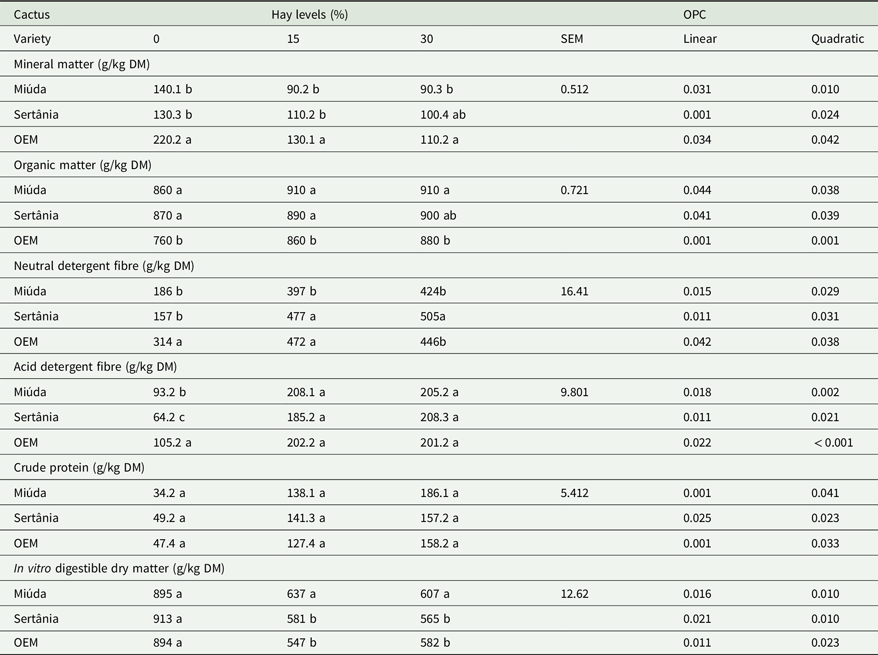
The effect of the cultivar × levels of Leucaena hay interaction was observed for the contents of dry matter (DM), organic matter (OM), crude protein (CP), neutral detergent fibre (NDF), acid detergent fibre (ADF) and in vitro digestible dry matter (IVDDM) (Table 5); thus, the interaction was unfolded (Table 6).
Nutritional value of silages of different forage cactus varieties of with inclusion levels of Leucaena [Leucaena leucocephala (Lam.) de Wit] hay

Hay levels on a fresh weight basis. OPC, orthogonal polynomial contrast for the hay inclusion effect; OEM, Orelha de Elefante Mexicana; OM, Organic matter; CP, crude protein; NDF, neutral detergent fibre; ADF, acid detergent fibre; LIG, lignin; IVDDM, in vitro digestible dry matter; SEM, standard error of the mean. Means followed by different letters in the column (for the same hay level) differ from each other by the Student’s t-test at 5% probability.
Unfolding the interaction between the effects of forage cactus variety and levels of Leucaena [Leucaena leucocephala (Lam.) de Wit] hay on the nutritive value of forage cactus silages from different varieties containing levels of Leucaena hay

Hay levels on a fresh weight basis. OPC, orthogonal polynomial contrast for the hay inclusion effect; SEM, SEM, standard error of the mean. Means followed by different letters in the column (for the same hay level) differ from each other by the Student’s t-test at 5% probability.
The highest concentrations of MM were observed in the silages of the OEM cactus forage regardless of the level of inclusion, and the inclusion of Leucaena hay resulted in a quadratic effect (Table 6). On the other hand, OM concentrations were generally higher in the silages of the Miúda and IPA Sertânia cultivars, and a quadratic effect was also observed for the inclusion of hay.
An increase in NDF and ADF concentrations was observed with the inclusion of Leucaena hay. The silages without the inclusion of Leucaena hay of the variety OEM presented the highest concentrations of NDF and ADF (Table 6). The inclusion of hay increased NDF and ADF from 0 to 15% and showed less variation between levels 15% and 30%, contributing to the linear and quadratic effect.
There was no difference in CP concentrations between silage cultivars without including Leucaena hay. The inclusion of hay increased the CP level of the silages without compromising the fermentation processes inside the silo. The Miúda variety presented the greatest IVDDM. The inclusion of Leucaena hay contributed to a reduction in IVDDM and an increase in the levels of ADF and CP without major differences between the levels of 15% and 30%, resulting in a linear and quadratic effect (Table 6).
Silage aerobic stability
The silages remained stable for more than 60 hours of air exposure, indicated by the reduced variation in temperature than that recorded for the environment (variation less than 2oC) (Figure 2).
Aerobic stability of cactus forage silages from different cultivars with inclusion levels of Leucaena hay. Varieties: IPA: Ipa-Sertânia; PM: ‘Miúda’; OEM: Orelha de Elefante Mexicana; TA: Ambient temperature.

Discussion
Dry matter losses and sensory analysis
The forage cactus presents low dry matter (DM) content in its natural composition (Table 1). For this reason, significant losses per effluent were expected, which was not observed in silages without including Leucaena hay. The higher DM losses in OEM silages compared with the silage of other cultivars may result from differences in mucilage viscosity (Luna-Zapién et al., Reference Luna-Zapién, Zegbe, Meza-Velázquez, Contreras-Esquivel and Morales-Martínez2023). The mucilage formation during the chopping of cladodes contributes to increasing water retention (Monrroy et al., Reference Monrroy, García, Ríos and García2017) in silage, thus reducing losses by effluents.
Although the amount and characteristics of mucilage can contribute to reducing effluent losses, it can favour increased gas production (Cunha et al., Reference Cunha, Rodrigues, Costa, Lima, Araújo, Oliveira, Campos, Magalhães, Araújo and Gois2022). It happens because of the production of complex polymeric substances composed mainly of carbohydrates with several branches, which include L-arabinose, D-galactose, L-rhamnose, D-xylose and galacturonic acid in different proportions (Sepúlveda et al., Reference Sepúlveda, Sáenz, Aliaga and Aceituno2007). These substances can modify the speed of fermentation during the ensiling process (Brito et al., Reference Brito, Santos, de Araújo, de Oliveira, Zanine, Perazzo and Cavalcanti2020). Leucaena hay contributed to increased DM in silages and favoured reduced silage gas losses. Considering the linear and quadratic effect observed for gas losses, it is suggested that the level of 15% inclusion of hay would already allow the reduction in losses that occurred throughout the OEM and ‘Miúda’ fermentation process. The lower production of gases may be related to the decrease in gas-producing microorganisms, such as enterobacteria and bacteria from the genus Clostridium, which develop in poorly maintained silages due to the low DM content (Andrade et al., Reference Andrade, Pires, Carvalho, Veloso and Bonomo2010).
The higher losses by gases and effluents of the OEM silages may be related to the physical characteristics of the mucilage, such as the possible greater liquidity of the mucilage (Luna-Zapién et al., Reference Luna-Zapién, Zegbe, Meza-Velázquez, Contreras-Esquivel and Morales-Martínez2023)., which possibly favoured the increase in gas production. It is essential to highlight that the excessive increase in gas losses may indicate heterofermentation (Van Soest, Reference Van Soest1994). According to Siqueira et al. (Reference Siqueira, Reis, Iturrino, Pires, Bernardes and Amaral2007), the increase in gas losses affects the recovery of DM from silages, as the greatest reducer of DM recovery is the production of CO2 by yeasts during the fermentation of carbohydrates to ethanol. It is worth mentioning that although the losses by gases and effluents were higher for the OEM cactus forage, the observed values can be considered low when compared with other forage resources used in the silage process (Borreani et al., Reference Borreani, Tabacco, Schmidt, Holmes and Muck2018). Caregnato et al. (Reference Caregnato, Menezes, Paula, Farias, Carneiro and Baraviera2019), evaluating sugarcane silages (Saccharum officinarum L.), reported GL of 9.59 % DM and EL of 237.7 kg/ton of silage, values higher than those reported in the present study.
At the opening time, all silages evaluated presented sensory patterns within the expected silages with good fermentation profiles. Including Leucaena hay gave the silages a darker colouration but without indications of undesirable fermentation, such as mould or strong smell, which can be classified as good (Tibebu et al., Reference Tibebu, Ashenafi, Adugna and Geert2018). According to Charley and Schmidt (Reference Charley and Schmidt2014), silages with ideal fermentation do not smell strong since the lactic acid that is usually the most produced in cactus forage silages is almost odourless. The acidic smell observed in the silages indicated that the pH would be within the recommended conservation, confirmed during the pH measurement.
Fermentative characteristics
The fermentative profile of the silages confirmed the good qualitative characteristics of the silages. The silages presented, in general, pH values lower than 5, being the highest values observed for the OEM cactus forage silages, which may indicate a lower fermentation pattern concerning the other varieties. According to Silva et al. (Reference Silva, de Araujo, Santos, de Oliveira, Campos, Godoi and Turco2021), the pH is one of the main indicators for good fermentation, with expected values close to 4.2 for forage conservation range and inhibition of unwanted microorganisms. Although, pH values below 5.0 can also allow a good level of fermentation of the material (Rodrigues et al., Reference Rodrigues, Lobo, Silva, Borges, Meyer and Demarchi2007).
The pH reduction is related to the soluble carbohydrate contents, which, for a good fermentation, must present values above 20 g/kg DM and the dry matter around 250g/kg of fresh matter (Guim and Clemente, Reference Guim and Clemente2019). Some compounds present in cactus forage, such as oxalic, malic, malonic, succinic and tartaric acid, resulting from the metabolism of crassulaceous acid, are buffering substances that contribute to proper fermentation, even having conditions for excessive fermentation due to a large amount of soluble carbohydrates (Pereira et al., Reference Pereira, Santos, Araújo, Oliveira, Pinho, Zanine and Nascimento2019).
Feed preservation in silage form results from the production of organic acids (acetic, lactic, propionic and butyric), and pH is the fastest and most practical method to indicate the production of these acids indiscriminately (Kung Jr et al., Reference Kung, Shaver, Grant and Schmidt2018). In cactus forage silages, lactic acid was predominant, and the addition of Leucaena hay did not result in significant differences in the accumulation of lactic acid in silages. Matias et al. (Reference Matias, Araújo, Campos, Moraes, Gois, Silva and Voltolini2020), evaluating the fermentative profile of cactus forage silages associated with maniçoba (Manihot sp.), also observed the predominance of lactic acid in silages.
The higher concentrations of propionic acid observed in the silages of the variety IPA Sertânia due to Leucaena hay inclusion (15 and 30%) might indicate the greater development of propionic and heterolactic bacteria. The presence of acetic acid can improve the aerobic stability of silage (Carvalho et al., Reference Carvalho, Ávila, Miguel, Pinto, Santos and Schwan2015). Propionic acid has a lower hydrogen dissociation constant, which increases pH and may favour the development of microorganisms undesirable to the conservation process (Okoye et al., Reference Okoye, Wang, Gao, Wu, Li, Sun and Jiang2023). However, the negative effect of propionic acid overlaps with the improvement of stability, making its presence in large concentrations a problem for the conservation of silages (Rutenberg et al., Reference Rutenberg, Granit, Chen, Poverenov and Weinberg2016).
Among the silages of cactus forage varieties with and without the inclusion of Leucaena hay, those of the Miúda variety presented the lowest concentrations of butyric acid, indicating that, among the varieties studied, Miúda is the one with the best fermentative characteristics. It is worth mentioning that the Miúda variety also presents higher DM contents in the pre-ensiled mass (Table 1), which may have favoured fermentation. Although the silages of all cactus forage varieties showed linear and quadratic responses to the inclusion of hay, the values observed for the varieties IPA Sertânia and OEM were always higher. The production of butyric acid is considered undesirable for the quality of silages. It may indicate the growth of microorganisms of the genus Clostridium that transform soluble carbohydrates and lactic acid into butyric acid and have the potential to deaminate proteins, raising the levels of N-NH3. Silages with high butyric acid concentrations can reduce animal consumption (Ogunade et al., Reference Ogunade, Kim, Jiang, Weinberg, Jeong and Adesogan2016).
The lowest concentrations of acetic acid were observed in the OEM cactus forage silages, with slight variations between the inclusion levels of hay and may be a result of the higher DM losses of these silages. Acetic acid results from the action of enterobacteria, a group of microorganisms that contribute to reducing silage quality due to the medium’s lower acidification (Macedo and Santos, Reference Macêdo and Santos2019).
Forage cactus varieties silages showed differences in ethanol production in response to hay inclusion. The Miúda variety presented higher ethanol contents in the silages without including Leucaena hay and reduction with hay. In contrast, in the OEM variety, adding hay linearly increased ethanol production. Increased ethanol production usually indicates the presence of yeast and heterofermentative bacteria (Okoye et al., Reference Okoye, Wang, Gao, Wu, Li, Sun and Jiang2023). Possible differences in the epiphytic population of the ensiled mass of forage varieties with Leucaena hay may have contributed to modifications in the fermentation process, affecting the use of soluble carbohydrates and conversion into ethanol and CO2 (Carvalho et al., Reference Carvalho, Ávila, Miguel, Pinto, Santos and Schwan2015).
Although there were differences in the fermentation profile of silages, the values observed for N-NH3 of all varieties and in all inclusion levels of hay remained below 100 g kg of total N, a value considered critical (Costa et al. (Reference Costa, Pires, Moura, Sales, Rodrigues and Rigueira2016), indicating that the silages were well fermented. The increase in the concentration of N-NH3 suggests the presence of Clostridium and enterobacteria, which are characteristic of silages with inadequate fermentation. Despite the low DM content and high soluble carbohydrate content, which could favour the occurrence of excessive fermentation in cactus forage silages (Brito et al., Reference Brito, Santos, de Araújo, de Oliveira, Zanine, Perazzo and Cavalcanti2020) without the inclusion of Leucaena hay, in the present study, no indications of undesirable fermentation were observed.
Forage cactus silages without including Leucaena hay presented DM values below 100 g kg FM, which could affect fermentation. According to Nogueira et al. (Reference Nogueira, Araújo, Santos, Gonzaga Neto, Oliveira, Perazzo and Pereira2015), cactus forage silages should have minimum DM values of around 120 g kg FM to reduce nutrient losses. The cactus forage presents lower DM content during the rainy season when there is a more significant accumulation of Leucaena forage. Thus, producing hay and using Leucaena hay to manufacture cactus forage silages could contribute to qualitative gains and the reduction of EL. In addition, varieties that generally have higher moisture contents, such as OEM cactus forage, could benefit during the ensiling process by adding a dehydrated material (hay).
Silage nutritive value
The concentrations of DM in the cactus forage in the rainy season can reach values close to 37 g/kg FM due to the greater appearance of young cladodes, while in the season with the scarcity of rain, the DM varies between 120 to 155 g/kg FM (Nogueira et al., Reference Nogueira, Araújo, Santos, Gonzaga Neto, Oliveira, Perazzo and Pereira2015; Brito et al., Reference Brito, Santos, de Araújo, de Oliveira, Zanine, Perazzo and Cavalcanti2020). It indicates the need to consider aspects related to climate to determine the timing of cactus forage harvest for use in the silage process. Adding dehydrated forages (hay) can increase the DM content, favour the fermentation process, and, in the case of Leucaena hay, improve the silage’s chemical composition.
The inclusion of Leucaena hay decreased the concentration of MM in the silage due to the lower concentration of minerals in the legume. Although the MM contents are close between varieties, the OEM cactus forage generally presents higher concentrations. The minerals in cactus forage, such as Mg, Ca and Na, tend to increase the buffering power of silages (Ávila et al., Reference Ávila, Pinto, Figueiredo, Morais, Pereira and Schwan2009). The association of cactus forage and Leucaena hay in the ensiling process may contribute to the balance of the MM contents.
Including Leucaena hay contributed to increases in NDF and ADF concentrations of silages. Low NDF values may favour protein deamination and the formation of nitrogenous compounds due to possible improvements in the adhesion of microorganisms in the substrate (Arriola et al., Reference Arriola, Oliveira, Zhengxin, Lean, Giurcanu and Adesogan2017). It is worth mentioning that cactus forage must be provided along with feeds rich in physically effective fibre (Rocha Filho et al., Reference Rocha Filho, Santos, Véras, Siqueira, Novaes, Mora-Luna and Ferreira2021), and the addition of Leucaena hay can meet this need and still optimize the supply process to animals.
The forage cactus presents low concentrations of CP; thus, the inclusion of hay considerably improved the concentration of CP in the ensiled material. An increase in the concentration of CP can hinder the reduction of pH by increasing the buffering power of the ensiled mass. However, in the case of cactus forage with a high concentration of soluble carbohydrates, adding Leucaena hay may reduce the risks of excessive fermentation due to its possible impact on the speed of pH reduction.
The inclusion of Leucaena hay led to reduced digestible contents of silages. However, it is essential to highlight that in situations where losses are reduced, the variation in nutritional value occurs as a function of the proportions of the mixture and characteristics of the feeds used. Among the cactus forage varieties, Miúda had the highest IVDDM. Considering that the hay used was similar for all silages, the variation in IVDDM between varieties may result from the mucilage’s chemical composition (Pereira et al., Reference Pereira, Santos, Oliveira, Santos, Lopes, Santos and Júnior2021). However, there were no significant variations between the IVDDM of the ensiled mass before and after ensiling, although it was possible to have an increase in IVDDM due to the activities of the microorganisms during the fermentation process (Rabelo et al., Reference Rabelo, Rezende, Rabelo, Nogueira, Senedese, Vieira and Carvalho2014).
Silage aerobic stability
Even with variations in the fermentation profile and nutritional value of the silages as a function of the variety and level of inclusion of Leucaena hay, the silages showed high stability after air exposure since there was no breakdown of aerobic stability during the 60-hour monitoring period in the present study. Santos et al. (Reference Santos, Santos, Oliveira, Medeiros, Zanine, Araújo and Oliveira2020), evaluating cactus forage silages, reported that the loss of aerobic stability could occur after 96 hours due to the production of acetic acid during the fermentation process that contributes to reducing the activity of aerobic microorganisms. Pereira et al. (Reference Pereira, Santos, Oliveira, Santos, Lopes, Santos and Júnior2021) evaluating cactus forage silages, indicated that the delay in breaking the stability of cactus forage silages might be related to the high concentration of lactic acid present in these silages. The silages showed high concentrations of lactic acid, even with the addition of Leucaena hay.
It is important to mention that forage cactus and forage cactus silage are not a complete feed for livestock. It presents low concentrations of DM, which results in the need of large volume of feed, as well as low effective fibre and CP contents (Rodrigues et al., Reference Rodrigues, Pitacas, Reis and Blasco2016; Rocha Filho et al., Reference Rocha Filho, Santos, Véras, Siqueira, Novaes, Mora-Luna and Ferreira2021, Dubeux Jr. et al., Reference Dubeux, dos Santos, da Cunha, dos Santos, de Almeida Souza, de Mello and de Souza2021). Adding during the ensiling process the hay of a forage legume such as Leucaena may contribute to improve its CP an effective fibre contents, despite the reduction in forage cactus contribution in dry matter basis due to its low DM contents.
Conclusions
Forage cactus silages present good fermentative characteristics, and including Leucaena hay improves the CP and NDF content without affecting the fermentative profile. The inclusion of Leucaena hay increased the DM concentration, improved the silage fermentation profile of the OEM variety and reduced DM losses, but reduced IVDDM. All forage cactus varieties silages showed satisfactory fermentation patterns; however, the silage of cultivar Miúda, with and without the inclusion of Leucaena hay, showed lower concentrations of butyric acid and better IVDDM compared to IPA Sertânia and OEM. The high level of inclusion of Leucaena hay (30%) contributed to the increase in pH, although the silages remained acidic enough for conservation. The inclusion of 15% can be considered a good option, as it showed similar or even better silage fermentative characteristics compared to 30%, while also reducing the need to produce hay for inclusion during the ensiling process.
Author contributions
Silva VJ, Mello ACL, Guim A, Santos MVF, Cunha MV, Félix, RS, JCB Dubeux conceived and designed the study. Félix, RS, Cavalcanti JVFL, Santos DC conducted data gathering. Félix RS, Silva VJ, Mello ACL, Guim A wrote the article. All the authors approved the final version.
Funding statement
This study was financed in part by the Coordination for the Improvement of Higher Education Personnel Brazil (CAPES – Finance code 001) and FACEPE (Fundação de Amparo a Ciência e Tecnologia do Estado de Pernambuco) (CAPES-FACEPE-Biomas Call) with a graduate scholarship to the first author, and dryGrow Foundation.
Competing interests
The authors declare there are no competing interest.
Ethical approval
Cattle used for rumen fluid collection were cared for in accordance with the guidelines and recommendations of the Committee of Ethics on Animal Studies at the Federal Rural University of Pernambuco (Licence No 002/2020).