This article aims to give an account of monuments as technologies of community-scale motivated social cognition. A cognitive approach can provide an explanation for how the ‘“technology of the monument” structures and restructures how people and cultures think and interact … accomplishing particular types of work in tandem with human partners’ (Jackson & Wright Reference Jackson and Wright2014, 119). I develop this theory from an extended and enactive view of cognition. The extended mind can shed light on how monuments externalize social cognition, while an enactivist approach helps to explain the generative power of monuments. This theory maintains that monuments are relational but also posits that monumentality may be quantifiable to some degree.
Introduction: monuments and the communal imagination
Previous theoretical accounts of monuments have approached them in terms of relational qualities, collective memory, imaginaries, affect, event, materialization and object agency, to name only a few. Some theorists have pushed for the development of approaches that will render monumentality quantifiable, while others deny that this is possible. This study proposes that these varied accounts can be condensed into a cognitive scientific approach drawing on blending theory. I propose that monuments are material anchors for conceptual integration networks that are run in parallel by communities of people. Among various potential new ideas and relationships, social structures emerge from the blends produced in these networks. Monumentality then is an artefact's potential to anchor conceptual integration networks from which social structures emerge. Utilizing this approach makes it possible simultaneously to affirm that monumentality is relational and quantifiable in terms of the scale of the anchored networks. Though monuments may remain in the eye of the beholder in this model, the cognitive processes generated in that beholder are possible to reconstruct and model. This allows for a more precise approach to monuments that can accommodate a diverse collection of previous theory and simultaneously push the discussion in important new directions.
Among art historians, anthropologists and archaeologists, the descriptor ‘monumental’ can no longer be uncritically applied to artefacts based simply on their size or material. The problem is that these features alone do not guarantee an artefact's reception as a monument. Theoretical work on monuments and monumentality has increasingly emphasized their relational and even imaginary qualities. Such approaches have helpfully problematized aspects of monuments’ reception in addition to their production and thus balanced an artefact's spatial and social contexts with its form and material. As disparate as many of these approaches may appear, work on monuments in various fields is converging towards a model for human–artefact relations that has already been articulated by cognitive scientists and cognitive archaeologists.
In this article, I join this interdisciplinary endeavour and propose a cognitive scientific definition of monument and monumentality. Drawing especially upon the work of Gilles Fauconnier and Mark Turner (Reference Fauconnier and Turner2002), Edwin Hutchins (Reference Hutchins2005) and Lambros Malafouris (Reference Malafouris2013) on conceptual blending, I argue that recent theoretical approaches to monuments can be expanded by treating them as material anchors. Monuments primarily function by enabling conceptual integration in the minds of their users. Through conceptual integration or blending, monuments afford meaning, become agents and enter into relationships with the communities engaging them. To demonstrate the utility of this approach, I will first summarize relational approaches to monumentality. I will then introduce the key definitions that lay the groundwork for my own approach. To develop my approach, I apply this theoretical framework in a case study of the ceremonial plaza of tenth/ninth-century bc Karkamiš in northern Syria. Approaching these monuments in terms of conceptual integration will provide the basis for new understandings of them as technologies of community-scale motivated social cognition.
Previous accounts of monumentality as relational
Previous approaches to monuments are admittedly diverse, but a thread emphasizing the relational qualities of monuments appears in the work of many theorists. Beginning already in 1903, Alois Riegl insisted that monuments should be analysed in terms of their social reception rather than their production, allowing him to expand the definition of monument to include artefacts and structures not intended as monuments and even natural phenomena and landscapes (Riegl Reference Riegl1903). Richard Bradley (Reference Bradley1993) similarly argued that the meanings of monuments were dependent upon contemporary viewers and thus subject to change—even dramatically—over time. Along the same lines, the oft-cited work of Elizabeth DeMarrais, Luis Jaime Castillo and Timothy Earle argues that monuments are fundamentally communicative; they materialize ideology for a particular community, thus ‘organizing and materializing social relationships and boundaries’ both as discrete constructions and as ‘facilities or settings for ritual events’ (DeMarrais et al. Reference DeMarrais, Castillo and Earle1996, 19). The same ideas have been repeatedly revisited by theoretical work on monuments in the twenty-first century.
The present work was initially inspired by that of Wu Hung, who has argued that
a monument, no matter what shape or material, serves to preserve memory, to structure history, to immortalize a figure, event, or institution, to consolidate a community or a public, to define a center for political gatherings or ritual communication, to relate the living to the dead, and to connect the present with the future. (Wu Reference Hung1995, 4)
Wu's definition is broad enough—and by his own admission, vague enough—to include any number of artefacts, structures, and landscapes—both human-made and natural. This is not necessarily a weakness, however. He immediately offers the caveat that monumentality is never transcultural or transhistorical, so the statements above amount to “empty words until they are historically defined” (Wu Reference Hung1995, 4). In other words, while monuments may outlast their associated communities, their meanings and the means of engaging them do not. Moreover, communities produce different types of monuments and receive them in different ways at different times in different contexts. Sarah Jackson and Joshua Wright (Reference Jackson and Wright2014, 117) echo this observation in their assertion that monuments ‘are dynamic (in form and interpretation)’ and ‘polysemic’. Their dynamic approach to monuments requires that more specific definitions of ‘monument’ and ‘monumentality’ be restricted to particular social contexts. Nevertheless, this has not prevented theorists following Wu from proposing more generic definitions.
In his introduction to Approaching Monumentality in Archaeology, James Osborne defines monumentality as ‘an ongoing, constantly renegotiated relationship between thing and person, between the monument(s) and the person(s) experiencing the monument’ (Osborne Reference Osborne and Osborne2014, 3). As a result, he argues that ‘we can only consider an object's monumentality in the context of its relationship to the community of which it forms a part’ (Osborne Reference Osborne and Osborne2014, 4). Jackson and Wright (following Brown Reference Brown2001) arrive at much the same conclusion, stating that monuments ‘influence movement, relationships and thoughts toward particular channels, and draw humans in the landscape into passing or ongoing relationships’ (Jackson & Wright Reference Jackson and Wright2014, 118). While these conclusions lend some weight to Frank Hole's (Reference Hole, Burger and Rosenswig2012, 457) assertion that ‘monuments … are in the eye of the beholder’, I argue here that it is precisely because monuments are relational that they fall within the realm of cognitive scientific inquiry.
In part as a reaction to Osborne's volume, Felix Levenson proposes in his own introduction to the subject in Size Matters that ‘it is of the utmost importance to create tools and techniques to … make monumentality quantifiable’ (Levenson Reference Levenson, Buccellati, Hageneuer, van der Heyden and Levenson2019, 36). He begins this process by proposing some properties common to monuments. He argues that ‘affection makes a monument’, ‘society makes monumentality’ and ‘events create monumental spaces’. It is not just any relationship between a community and an artefact that can make it monumental, but specifically one defined by ‘perceptual impact’ and ‘cultural investment’ (Levenson Reference Levenson, Buccellati, Hageneuer, van der Heyden and Levenson2019, 22). This echoes Timothy Pauketat's argument that monuments
inspire, motivate, and actively engage people by disproportionately articulating social relationships to other places, substances, moving celestial objects, and the great beyond … Monuments, to be monuments, must be more than big memorials. They must possess the qualities of monumentality, the foremost of which is the imaginary. We do not merely see them and remember. We feel them and imagine. (Pauketat Reference Pauketat and Osborne2014, 442)
This assertion is reminiscent of that of Henri Lefebvre (Reference Lefebvre and Nicholson-Smith1991, 143) that monuments express ‘collective thought’. In other words, there is nothing monumental but thinking makes it so. Quantifying qualities like ‘perceptual impact’ and ‘cultural investment’ will require an effective model of human imagination.
I aim to expand and improve upon the theoretical approaches above with a cognitive scientific model. A cognitive approach makes it possible to harmonize previous accounts of monuments and also to move beyond them into new realms of inquiry. Monumentality is indeed relational and therefore dynamic. It must be approached in terms of the sociocultural and historical context of the monument in question. Nevertheless, it is quantifiable. This is so because of—and not in spite of—the primary aspect of monumentality, the imaginary. Precisely because monuments are in the eye of the beholder—the imagination of the community—they are within the realm of cognitive scientific inquiry. I propose that the concept of the material anchor in cognitive science can be utilized for modelling and quantifying a relational understanding of monumentality.
Conceptual integration, material anchors and the cognitive mechanisms of imagination
How, then, do we model the relational and the imaginary the better to understand monumentality as it is construed across social, geographic, material and academic boundaries? I propose using conceptual integration or blending, which Fauconnier and Turner (Reference Fauconnier and Turner2002, 6) argue is the mechanism underlying imagination—perhaps even all human cognition. The strengths of this theory are that it not only offers a new account of what many previous theorists have observed about monuments, but it also provides a means of approaching monuments both in terms of classical cognitive science or alternatively in light of more radical 4E (embodied, embedded, enacted and extended cognition) theories.
Conceptual integration is a model for conceptual projection or mapping, which Lambros Malafouris (Reference Malafouris2013, 100) summarizes as ‘the pervasive and (in most cases) unconscious capacity of the cognitive agent to establish direct implicit ontological correspondences between domains of influence’. Those familiar with other models of conceptual projection will notice that this is similar to conceptual metaphor theory (cf. Lakoff & Johnson Reference Lakoff and Johnson1980; Lakoff & Núñez Reference Lakoff and Núñez2000), but conceptual integration is distinct from it in key ways. Rafael Núñez summarizes the differences as follows:
Unlike conceptual metaphor, the mappings are not unidirectional (from a source to a target domain), but they establish correspondences between entities in different input spaces and project (often partially and selectively) the properties to a third space, the blended space. (Núñez Reference Núñez, Stewart, Gapenne and Di Paolo2010, 320)
Fauconnier and Turner define these input spaces as ‘small conceptual packets constructed as we think and talk, for purposes of local understanding and action’ (Fauconnier & Turner Reference Fauconnier and Turner2002, 102; cf. Fauconnier Reference Fauconnier1985). These mental spaces include elements—or individual pieces of information—and frames—organizational principles that tie those elements together. In other words, mental spaces contain not only discrete concepts but also the relationships between them. Conceptual integration theory can thus be used to analyse metaphors, but its aim is to account for non-metaphorical mappings as well (Malafouris Reference Malafouris2013, 103). In this way, conceptual integration/blending can be said to be more fundamental to cognition than metaphor.
Fauconnier and Turner posit that imagination progresses as different mental spaces are networked and coactivated in order to blend them into new mental spaces with unique properties. The simplest possible conceptual integration network consists of at least three spaces: two input spaces and a blended space. The network is constructed as two or more input spaces are cross-mapped with one another. In this process, elements and frames from different inputs are selectively associated and projected into a new blended space. The input spaces are thus blended into a new space that contains some or all of the same elements as the inputs but with new relationships between them. As a result, the blended space ‘develops a new structure (“emergent” structure) not initially available from the separate inputs’ (Malafouris Reference Malafouris2013, 103; cf. Fauconnier & Turner Reference Fauconnier and Turner2002, 40–44). This process is schematically illustrated in Figure 1, in which circles denote mental spaces, letters denote concepts, dotted lines represent cross-mapping and solid lines represent conceptual projections.
Simplex conceptual integration network.

Once a conceptual integration network has been constructed, it can be run or elaborated. This process ‘consists in cognitive work performed within the blend, according to its own emergent logic’ (Fauconnier Reference Fauconnier1997, 151). In the blend, new relationships result from a combination of the input spaces that are more than the sum of those inputs. Fauconnier and Turner label these unique features of the blend emergent structure. Elaboration within this emergent structure leads to the emergence of new ‘entities and inferences that were not available in the original input spaces alone’ (Núñez Reference Núñez, Stewart, Gapenne and Di Paolo2010, 320). The phenomenon of emergence through conceptual integration provides a process behind Jackson and Wright's assertion (Reference Jackson and Wright2014, 119) that a monument ‘creates new things (places, relationships, ideas), and recreates old ones’.
As a basic illustration of conceptual integration, Fauconnier and Turner offer the example of a computer desktop. The desktop interface allows users to manipulate intuitively the files and folders stored in their computer. This is made possible through the blending of the input spaces of traditional office work and those concerning the manipulation of hardware and software to do work on a computer. These input spaces contain not only discrete concepts—like folders and data—but also frames for organizing them in relation to one another. For example, in order to delete a folder on my desktop, I can simply ‘grab’ it and ‘drag’ it into the recycle bin. In so doing, I am selectively projecting conceptual structure and entities from an input space concerning the physical manipulation of a real folder into the trash onto a digital representation of information in my computer. Of course, what is happening within the machine is nothing like this action, and were I to interact directly with machine language I could not accomplish this task. By selectively projecting what I know from the input space of a real desktop, however, I can delete a digital folder intuitively. The blend also has significant emergent structure of its own that did not exist in any of the input spaces. For example, ‘pointing and clicking buttons is not at all part of traditional office work’ and ‘having little two-dimensional squares disappear under other little squares’ has nothing in common with throwing a real folder into the trash (Fauconnier & Turner Reference Fauconnier and Turner2002, 23). Only by blending the spaces of office work with computer work is this effective manipulation of hardware and software made possible, and the projections from the various inputs and emergent structure of the blend are more complex and varied than those accomplished by metaphorical mappings alone.
For the purpose of the present topic, it is important to note that conceptual integration networks are not just structured in internal thought but also in external discourse. This is what makes this approach particularly pertinent to the diverse and dynamic nature of monumentality. This also makes it possible to utilize this approach in studying ancient cognition. While ancient artisans and audiences are unavailable for cognitive neuroscientific study, it is possible to reconstruct their mental spaces based on the discourse of their material culture, whether that discourse be verbal, visual, spatial, ritual or otherwise (Fauconnier & Turner Reference Fauconnier and Turner2002, 102–3). Even more significantly, conceptual integration networks can be anchored outside the brain. Fauconnier and Turner describe such extensions as material anchors (Fig. 2). They essentially function by provoking individuals to project material structure onto conceptual structures. Fauconnier (Reference Fauconnier1985, 12) terms this process triggering, and it is essentially the same as a monument's ‘habit of demanding engagement’ (Jackson & Wright Reference Jackson and Wright2014, 118; Brown Reference Brown2001). Fauconnier and Turner have documented several examples of material anchors, but the present discussion will be most benefitted by considering the case of the gravestone.
Conceptual integration network with a material anchor.

Fauconnier and Turner posit that when someone visits a gravestone, they cross-map the physical presence of the stone with an input space of the deceased's presence while they were still alive. Visiting a gravestone then enables a blend in which the stone is integrated with the space of the deceased while they were alive. In the blended space, the visitor is able to meet the deceased through the gravestone. Communication with the dead and the continued interactive presence of the deceased thus emerge from the blend (Fauconnier & Turner Reference Fauconnier and Turner2002, 204–6). Just as Jackson and Wright argue with regard to monuments, gravestones thus shift ‘from passive objects to co-subjects with humans’ (Jackson & Wright Reference Jackson and Wright2014, 118). Conceptual integration theory provides a means of explaining how such shifts occur.
Another strength of conceptual integration theory for approaching monumentality is that it accommodates diverse approaches within cognitive science. Conceptual integration theory originates within classical cognitive science (the computational or representational theory of mind). Nevertheless, this theory can accommodate extrabodily materials and discourse into its network model of cognition. In the original formulations of the theory, material culture can trigger and stabilize conceptual integration (Fauconnier & Turner Reference Fauconnier and Turner2002; Hutchins Reference Hutchins2005). Conceptual integration theory therefore presents us with a set of theoretical tools for studying invisible relationships that are materialized, akin to actor network theory (Latour Reference Latour2005), network analysis and, more recently, the archaeology of entanglement (Hodder Reference Hodder2012; Hodder & Mol Reference Hodder and Mol2016). These tools can thus be applied to monumentality within a computational theory of mind, but they can also be used to pivot towards a more radical view.
The concept of material anchors also accords well with theories of extended cognition. Edwin Hutchins argues that ‘there [is] no need to posit a separate mental representation of the material structure as an input space … Another alternative is to say that the physical objects themselves are input to the conceptual blending process.’ As a result, conceptual blending includes ‘perceptual processes and therefore … bodily interaction with the physical world’ (Hutchins Reference Hutchins2005, 1560). This comports well with Ezequiel Di Paolo's view of embodied and enacted cognition ‘as an embodied engagement in which the world is brought forth by the coherent activity of a cogniser in its environment’ (Di Paolo Reference Di Paolo2009, 12). Material anchors can thus be incorporated into the extended mind thesis ‘that not only mental content but also the mental process (or at least part of it) can be external to the subject’ (Malafouris Reference Malafouris2013, 74). According to Colin Renfrew (Reference Renfrew and Malafouris2013, xi), ‘the mind is to be understood as embodied, indeed as extended beyond the body, and beyond the individual, and as interacting with the things of the material world’. In this view, material anchors are no longer merely causally linked to cognitive processes but rather constitutive of them (Malafouris Reference Malafouris2013, 44, 97; cf. Newen et al. Reference Newen, de Bruin and Gallagher2018, 6). While it is possible to build many of the remaining conclusions of this study within a computational theory of mind, I adopt a 4E approach. I propose that monuments not only provoke community-scale imagination, but rather that they are constitutive of it. Monuments are thus ‘one half of a feedback loop’ of cognition; they are the material remains of externalized cognition (Jeffares Reference Jeffares2010, 505).
Viewing conceptual integration in light of 4E cognitive science also makes it possible to reframe the emergent characteristics of conceptual integration networks in terms of enaction. Malafouris has used conceptual blending to explain his view of enactive signification. In this account of material culture, artefacts are construed as enactive signs. They do not simply reflect, represent, or even support internal representations. Rather, they actually enact or bring forth concepts. That is, people do not simply think about things but also with and through them (Malafouris Reference Malafouris, Newen, de Bruin and Gallagher2018). This means that artefacts are not primarily communicative, though they may in some cases communicate messages. Rather ‘for material semiosis, meaning is not the product of representation but the product of a process of “conceptual integration” between material and conceptual domains’ (Malafouris Reference Malafouris2013, 90). Malafouris elaborates on this notion of material semiosis as follows:
The distinctive properties of the material world bring about meaning in ways that language cannot, and vice versa … That means that the material sign, in most cases, does not stand for a concept but rather substantiates a concept … Indeed, a material sign as an expressive sign does not refer to something existing separately from it, but is a constitutive part of what it expresses and which otherwise cannot be known. (Malafouris Reference Malafouris2013, 95–7)
Applying this logic to monuments means that they do not merely represent or communicate. Rather, they actually enact or bring forth new ideas. The mechanism for this is conceptual integration, which results in the emergence of new concepts and conceptual structures. If monuments are material anchors—material inputs in conceptual integration networks—then people engaging monuments are actually thinking through them and not simply about them.
The distinguishing features of monuments
Almost any artefact can act as a material anchor for conceptual integration networks or be analysed as an enactive sign. What, then, makes monuments unique in this approach? I propose that it is the scope of the cognition enacted through monuments and the results of that enaction that define them.
If ‘a “technology of the monument” structures and restructures how people and cultures think and interact’ (Jackson & Wright Reference Jackson and Wright2014, 119), then the means by which this is accomplished is the anchoring of conceptual integration networks. Significantly, these networks are run by ‘people and cultures’ and not simply by individuals. It is the ability of an artefact to anchor networks for a group of people that makes it monumental. Jeremy Smoak and Alice Mandell argue (Reference Smoak, Mandell, Buccellati, Hageneuer, van der Heyden and Levenson2019, 311) that in the case of monuments ‘scale—not size—matters’. Here I contend that it is the scale of the conceptual integration networks anchored in monuments that defines them. The imagination partially constituted by monuments is community-scale. Thus, one means of quantifying monumentality is in terms of the number of users engaging the monument.
I would also argue that monuments anchor multiple conceptual integration networks, rather than a single network. As emphasized above, monuments are dynamic and polysemic. They do not stably afford a single meaning over time nor even at a particular time. Rather, as Lefebvre contends, a monument
has a horizon of meaning: a specific or indefinite multiplicity of meanings, a shifting hierarchy in which now one, now another meaning comes momentarily to the fore, by means of—and for the sake of—a particular action. (Lefebvre Reference Lefebvre and Nicholson-Smith1991, 222)
Though Lefebvre was not intending an enactivist understanding of monuments, this is more or less what he has described. The meaning enacted by a monument depends on the nature of engagement with it and upon other particulars relative to the users engaging it. Though the simplest form of conceptual integration network has only two inputs, any number of inputs could be coactivated. Users undoubtedly bring various sociocultural, historical and environmental experiences and preconceptions into their engagement with monuments, allowing for dynamic sense-making within a single community. This explains why the meaning of monuments can change—sometimes radically—when they are embedded in new socio-historical contexts. Indeed, the network run by any one user could potentially be quite different from that of another. Catherine Bell has argued that social cohesion depends more upon the act of collectively engaging a monument than upon the particulars of that engagement. The users need not agree upon the meanings they make (Bell Reference Bell1992, 183). Nevertheless, because the same monument acts as a stabilizing input space in all of these networks, ‘people's encounter with it will be constrained in distinctive and definite ways’ (Pauketat Reference Pauketat and Osborne2014, 432). The material affordances of monuments are limited and so monuments afford a particular ‘horizon of meaning’ within a given socio-historical context, but not necessarily an unlimited set of meanings. Therefore, another more difficult means of quantifying monumentality is in terms of the number of conceptual integration networks monuments anchor.
But what sorts of meanings are enacted through monuments? What structures and entities emerge from the conceptual integration networks they anchor? Monuments have typically been associated with memory, most often of the variety variously described as collective, social, or cultural (Assmann Reference Assmann2011; Connerton Reference Connerton1989; Halbwachs Reference Halbwachs1941; Hutton Reference Hutton1993). It is essential to emphasize, however, that the memories emerging from monuments are imaginative constructions. Bradley (Reference Bradley1993, 129) describes such memories as the result of ‘a process of recreating a past that was really beyond recall and making it play an unrehearsed part in the present’. Similarly, Lynn Meskell (Reference Meskell, Van Dyke and Alcock2003, 48) contends that ‘remembering entails evoking a concrete image within the mind, fostered by the imagination: memory and imagination are to some degree interchangeable’. Patrick Hutton (Reference Hutton1993, 78) has described collective memory in general as ‘a process of imaginative reconstruction, in which we integrate specific images formulated in the present into particular contexts identified with the past’. This process of imaginative reconstruction is dependent upon present perceptions and conceptions of what matters and what does not. Collective memory is thus fundamentally ideological. This was recognized as early as the approach to the subject by Maurice Halbwachs, who stated that ‘collective memory reconstructed its recollections as such, so that they remained in conformity with contemporary ideas and preoccupations’ (Halbwachs Reference Halbwachs1941, 192). Therefore, it is ideology and not simply memory that is an essential emergent structure of engagement with monuments (Jackson & Wright Reference Jackson and Wright2014, 119; Wu Reference Hung1995, 4).
From a cognitive scientific perspective, social cognition is more significant to an understanding of monuments than are processes of memory. As Aaron Beim argues in his cognitive approach to collective memory, this memory is dependent upon ‘the social interaction of culturally related individuals with each other among cultural objects and other institutional forms’ (Beim Reference Beim2007, 18). In fact, social cognition is fundamental to ideology more broadly. John Jost and his various contributors have proposed that ideology should be defined more broadly as motivated social cognition (Jost & Amodio Reference Jost and Amodio2012; Jost et al. Reference Jost, Glaser, Kruglanski and Sulloway2003a,Reference Jost, Glaser, Kruglanski and Sullowayb; Reference Jost, Napier, Thorisdottir, Gosling, Palfai and Ostafin2007). Essentially, what this concept entails is that ideologies are enacted when people think about their relationships with other people, places, things and ideas, and, more importantly, about how and why those relationships matter. This recalls Pauketat's assertion that monuments ‘actively engage people by disproportionately articulating social relationships to other places, substances, moving celestial objects, and the great beyond’ (Pauketat Reference Pauketat and Osborne2014, 442). Monuments are specifically used to enact motivated social cognition. This is what emerges from the various networks anchored within them.
In light of the above considerations, I will now propose a cognitive scientific definition of monumentality. Monuments are material anchors for multiple conceptual integration networks that are run in tandem by many users. Monumentality is an artefact's potential to anchor conceptual integration networks in which its users enact motivated social cognition. Conceptual integration is key to monuments’ affordance of meaning and hence their monumentality. This model makes it possible to affirm that monuments are fundamentally relational, but also that monumentality can be quantified in terms of the networks anchored and the users running them. This raises the question of at what point the numbers of users and networks make an artefact into a monument. I would maintain that as long as an artefact is engaged by more than one user (Osborne Reference Osborne and Osborne2014), anchors more than one network (Lefebvre Reference Lefebvre and Nicholson-Smith1991), and motivated social cognition is enacted through those networks, then that artefact is a monument. Of course, it is also possible that artefacts will be understood at an emic level as monuments at different scales depending on their specific sociocultural contexts. From an etic perspective, specific numbers of users and networks will often be difficult to reconstruct with certainty, but relative quantities can still provide a means of measuring the degree of an artefact's monumentality.
Test case: Katuwas’ ceremonial theatre at Karkamiš
In order to develop my approach further, I turn now to a case study of the monuments of the ceremonial plaza at Karkamiš as they existed at the turn of the ninth century bc. Because I maintain the dynamic and polysemic nature of monuments, I will restrict this case study to the monuments erected by the ruler Katuwas as they were engaged during his reign. These monuments, of course, continued to be engaged for hundreds of years following Katuwas, but a full history of their monumentality goes beyond the scope of this study. Also, because these monuments represent only ‘one half of a feedback loop’, it is important to keep in mind that the conceptual integration networks they anchored can be only partially reconstructed. While our knowledge of all the possible input spaces is limited, analysing the discourse of these monuments can still tell us much about the social cognition they afforded.
The ruins of Karkamiš (modern Karkamış) lie on the Turkish–Syrian border along the west bank of the Euphrates river. During the Late Bronze Age, Karkamiš was the seat of one of the Hittite empire's most significant viceroyalties and ruled by a cadet branch of the imperial family. When the empire collapsed around 1200 bc, a newly independent Karkamiš maintained its position of influence as the clearest successor state to the Hittites (Gilibert Reference Gilibert2011, 10–14; Giusfredi Reference Giusfredi2010, 45–51, 78–9; Hawkins Reference Hawkins2000, vol. I, 73–5). Though its direct political dominance of the surrounding regions waned over the next two centuries, the city remained one of the most culturally—and especially artistically—influential sites in the greater Near East throughout the Iron Age (Aro Reference Aro, Luukko, Svärd and Mattila2009; Bunnens Reference Bunnens2005; Winter Reference Winter, Kühne, Nissen and Renger1982; Reference Winter1983).
During the tenth century bc, Karkamiš experienced regime change as the ‘great kings’ descended from the Hittite royal line were replaced by the ‘country-lords’ of the new House of Suhis. The early rulers of the new dynasty sought to legitimate themselves by restructuring the city around massive installations of monumental art and architecture (Denel Reference Denel, Cheng and Feldman2007; Gilibert Reference Gilibert2011, 12–13, 99–106; Reference Gilibert2013, 37–40). One of the key features of northern Levantine cities such as Karkamiš was that they were laid out concentrically to demonstrate a clear hierarchy of space. City centres were typically walled off and accessible by means of central processional roads. The city centre itself was further subdivided into ceremonial and residential regions, and the ceremonial area was dominated by the ceremonial plaza—a large-scale theatre designed for ritualized engagement with monumental art and architecture. The primary ceremonial plaza of Karkamiš was the Lower Palace Area.
The Lower Palace Area connected Karkamiš’ acropolis to the inner city that surrounded it. The plaza was accessed by means of a monumental gateway, the King's Gate, which marked the beginning of a processional way through the plaza to the so-called Great Staircase connecting to the acropolis and thus to the temple to Kubaba, the chief goddess of Karkamiš. The temple of the Storm-god—the patron deity of Katuwas—was also accessible by means of the Great Staircase and it formed a raised focal point within the Lower Palace Area. South of the Great Staircase lay the palace of Katuwas. A route continuing east past the palace towards another major gateway passed by yet another temple, perhaps that of the goddess Nikarawa (Marchetti Reference Marchetti2015; Reference Marchetti, Matthiae and D'Andrea2016). Surrounded as it was by the palace, multiple temples and sequences of monumental art including statuary, finely sculpted wall reliefs and Hieroglyphic Luwian inscriptions, the Lower Palace Area probably served as the ceremonial centre for the entire city.
Assuming a medium crowd density of 2.5 persons per square metre, at 3000 sq. m the lower palace area of Karkamiš could hold at least 7500 spectators at once. Karkamiš’ total population has been estimated at 18,200. Since it is also probable that 50 per cent of this population was either under the age of 12 or over 69, the lower palace area could easily accommodate the segment of the population that the rulers most needed to engage (Gilibert Reference Gilibert2011, 103). This plaza was thus an ideal theatre for the staging of monument-engaging spectacles intended to ‘constitute political subjects through the formal and codified enactments of relationships’ (Inomata & Coben Reference Inomata and Coben2006, 4–5). The mere production of the plaza projected the elite ability to mobilize capital and labour. In particular, it demonstrated the ability to mobilize the population of Karkamiš as a community (DeMarrais et al. Reference DeMarrais, Castillo and Earle1996; Glatz & Plourde Reference Glatz and Plourde2011). Within the space of the plaza, disparate individuals ‘actually witness the public as a collective body which gazes, moves, and interprets together’ (Hogue Reference Hogue, Smoak, Mandell and Cleathforthcoming). Alessandra Gilibert argues that the Lower Palace Area ‘should be analyzed as the material correlate of the “citizens” as a generic political subject’ (Gilibert Reference Gilibert2013, 39, n. 19). The plaza became such a material correlate as the crowds gathered there projected input spaces of elite power onto the physical gathering place and the many people present. These individuals thus became a subject populace by means of conceptual blends anchored in the plaza.
During the transition from the tenth to the ninth century bc, the ruler Katuwas completed the Lower Palace Area through the installation of monumental orthostats along the major boundaries of his palace and the portals of the plaza (see plan, Figure 3). Orthostats were designed to protect the structures they adorned from environmental weathering. In fact, they originated as undressed protective elements of Levantine walls. They were only later co-opted for the display of monumental art (Harmanşah Reference Harmanşah, Cheng and Feldman2007, 72–4). As such, orthostats were not easily distinguishable from the larger structures of which they were a part. While these orthostats are conventionally labelled as separate monuments, they are fundamentally indistinguishable from the plaza at large as well as Katuwas’ palace as monumental spaces. These orthostats made possible the enaction of a Katuwas-centred ideology within the Lower Palace Area.
Plan of the lower palace area with Katuwas’ monuments. (Plan: Amy Karoll.)

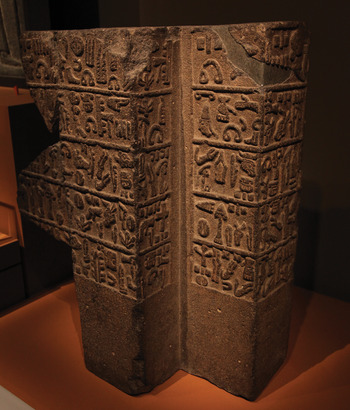
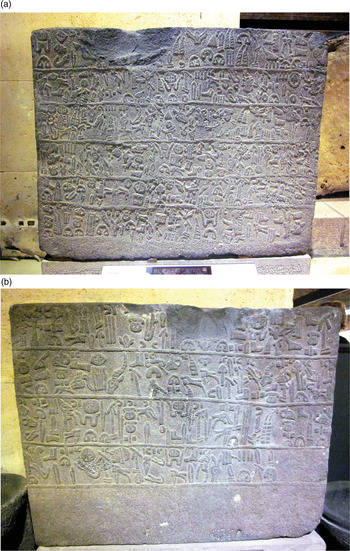
Six inscribed orthostats in the plaza explicitly identify Katuwas as their commissioner. Following their plate numbers in the excavation report (Woolley & Barnett Reference Woolley and Barnett1952), these six inscriptions are conventionally labelled KARKAMIŠ A2+3, A11a, A11b+c, A12, A13d, and A23. As described above, the potential users of these monuments would find themselves on a processional road clearly leading to the acropolis upon entering Karkamiš (Fig. 4). They would first encounter Katuwas upon reaching the King's Gate restricting entry to the Lower Palace Area. The southern entrance of this gateway was flanked by the portal orthostats KARKAMIŠ A11b+c and KARKAMIŠ A11a. Upon passing through the gateway, the users of the monuments would come face to face with the temple of the Storm-god to the north, but they would be unable to access it directly because it was raised on a temenos and the Great Staircase lay to its east. Instead, they would need to turn 90° to the right in order to continue their procession, at which point their gaze would instead be invited to the Palace of Katuwas. Adorning the walls of the palace were two more inscribed orthostats of Katuwas—KARKAMIŠ A13d and KARKAMIŠ A12. The palace appears to have been inaccessible from the plaza, however, and so the procession instead turned another 90° left to approach the Great Staircase, where they would encounter KARKAMIŠ A23 (Gilibert Reference Gilibert2011, 38–9). Upon completing their procession to the temple of the Storm-god, the users would meet Katuwas one final time in a portal orthostat pair flanking the doorway to the temple's cella (KARKAMIŠ A2+3) (Fig. 5; Gilibert Reference Gilibert2011, 50–51). Having thus distributed his monuments throughout the Lower Palace Area, Katuwas transformed it into a material anchor for enacting a relationship specifically to him. The users were no longer generic political subjects, but rather Katuwas’ subjects in particular.
Monumental orthostat erected by Katuwas: KARKAMIŠ A23. (Photograph: Wikimedia Commons user Rama. Licensed under the Creative Commons Attribution-Share Alike 2.0 France licence.)

Portal orthostats KARKAMIŠ A2+3. (Photograph: Tayfun Bilgin, www.hittitemonuments.com, v. 1.69.)

The six orthostats afforded differing social relationships to Katuwas through their spatial discourse. As the users encountered Katuwas at the plaza's liminal zones, they entered a space defined by his social power. The orthostat inscriptions in the King's Gate explicitly narrate the triumphal processions the gate was designed to facilitate, as well as Katuwas’ military successes, construction efforts and his religious devotion to the Storm-god and other deities of Karkamiš (Gilibert Reference Gilibert2011, 110; Pucci Reference Pucci, Bonatz, Czichon and Kreppner2008, 219–20). KARKAMIŠ A11a gestures to the temple of the Storm-god, which was the ultimate target of the procession (Pucci Reference Pucci, Bonatz, Czichon and Kreppner2008, 221). The ideal user's act of passing through the gateway could be cross-mapped with the acceptance of Katuwas’ proposed ideology. In the anchored network, an input space of crossing a threshold was projected to another space of ideological shift (see Figure 6). Emerging in the blend was an ideal user who followed Katuwas’ processional route and thus successfully integrated into the social and ceremonial life of his city. The users’ movements along a path through the gateway were projected onto inputs of social and ideological transition. In the blend, moving through the gateway moulded the users into Katuwas’ ideal subjects (Hodder Reference Hodder, Inomata and Coben2006, 82, 96).
Conceptual integration network anchored in the King's Gate.

The orthostats set up along the Herald's Wall that bounded Katuwas’ palace served a different role. In this context, the users would encounter Katuwas at an impenetrable barrier, beyond which lay his palace. This input of physical separation could be projected onto the social relationship between Katuwas and the users. In the resulting blended space, the users occupy a somewhat excluded position in the Karkamišean hierarchy. While they can pass into the Lower Palace Area and in so doing become Katuwas’ subjects, they are not permitted so much access as to be able to claim intimacy or parity with the ruler. A hierarchical relationship was thus enacted through engagement with KARKAMIŠ A13d and KARKAMIŠ A12.
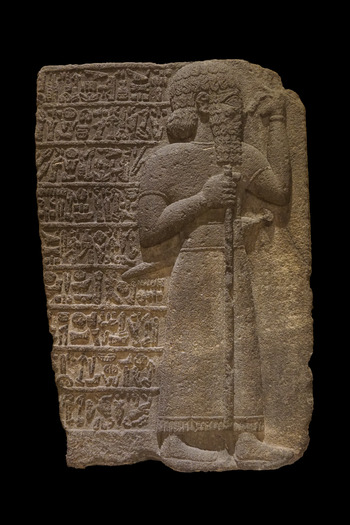
Setting aside the spatial discourse of Katuwas’ monuments, conceptual blending also serves as a powerful explanatory tool for the iconography of Katuwas’ orthostats. The most impressive example of this is a full portrait of Katuwas in profile that accompanied KARKAMIŠ A13d (see Figure 7). In the ancient Near East more broadly, such images occupied a unique ontological category. Rather than being understood as mere representations, these were seen as duplicating an individual's personhood and as possessing an agency all their own (Bahrani Reference Bahrani2003; Reference Bahrani2014, 24–9; Hare Reference Hare1999). This understanding underlay the many artistic reproductions of rulers at Karkamiš (Aro Reference Aro, Mouton, Rutherford and Yakubovich2013, 232). This conceptual categorization of image as person is easy to understand in light of blending. The portrait of Katuwas coactivated the conception of Katuwas the human being within the minds of the monument's viewers. In the anchored conceptual integration network, the input space of orthostat is cross-mapped with the input Katuwas. In the blended space, the presence of Katuwas emerged from his image (see Figure 8). As a result, the users could personally encounter Katuwas through his orthostats in the ceremonial plaza.
KARKAMIŠ A13d. (Photograph: A. Erdem Şentürk.)

Conceptual integration network anchored in Katuwas’ portrait.

It is important to note that the imagined encounters produced by these monuments are not merely the sum of the blended inputs of orthostat and Katuwas. The encounter is an emergent structure that can only arise from the blend of person and monument. By engaging the orthostats, users enacted a conception of the monuments as persons. Analysing these artefacts as material anchors explains how the personhood of images was enacted and culturally stabilized in this context. It also presents the possibility that as this emergent structure could be elaborated in unique ways within the Lower Palace Area. For example, as the blend was run, Katuwas might even become the plaza in some sense, because his orthostat images were not clearly differentiated from their architectural context.
The image blend was not only elaborated but also recruited as an input space in other conceptual integration networks anchored in Katuwas’ monuments. The posture of Katuwas in KARKAMIŠ A13d intentionally evoked the Luwian Hieroglyph EGO (amu ‘I’). In fact, the placement of the portrait alongside the inscription and the lack of the word amu in the initial line (which is grammatically impossible without it) reveals that the portrait itself was intended to be read as the initial hieroglyph in the inscription. This practice of extending the hieroglyph EGO into a full portrait (known as the amu-figure) is a fascinating development in Luwian monumental tradition attested at many sites during this period (Payne Reference Payne and Velhartická2016). It also represents a remarkably complex conceptual blend. The hieroglyph itself is a complex blend of sign, sound and linguistic meaning but it has now been further blended with the image of Katuwas, which was already blended with Katuwas himself. The portrait thus directly evokes the voice of Katuwas announcing ‘I am Katuwas’ to his monument's users and activating a blend of speech and inscription (Hogue Reference Hogue2019, 331). Emerging from this series of blends is a speaking portrait or imagetext (see Figure 9). In fact, the portrait is not just speaking in this blend. It has itself become speech and yet another means of relating to Katuwas.
Conceptual integration network anchored in the amu-figure.

A similar but less rich blend can be posited for all of Katuwas’ inscribed orthostats. Every inscription opens with the Luwian phrase amu-wa-mi Katuwas ‘I am Katuwas’. Opening the inscription with the pronoun ‘I’ triggered deictic projection in the minds of the audience. In order to make sense of the deictic referent, they had to imagine the physically absent Katuwas as though he were present and addressing them directly (Hogue Reference Hogue2019, 339; Stockwell Reference Stockwell2002, 46–9; cf. Houston Reference Houston, Inomata and Coben2006, 142; Houston & Stuart Reference Houston and Stuart1998, 88; Sanders Reference Sanders2009, 114; Zilmer Reference Zilmer2010a,Reference Zilmer, Rankovic, Melve and Mundalb). The audience then experienced the text as though it were the speech of Katuwas. The monument thus anchors a blend from which an imagined address in Katuwas’ own voice emerges (see Figure 10). Kristel Zilmer observes the same process in Scandinavian runic monuments, in which ‘there emerges something reminding of an immediate interaction that can be repeated over and over again … That is to say, there unfolds interaction similar to face-to-face communication’ (Zilmer Reference Zilmer, Rankovic, Melve and Mundal2010b, 147).
Conceptual integration network anchored in inscription.

The monuments in the Lower Palace Area at Karkamiš functioned by anchoring conceptual integration networks from which a variety of social relationships emerged. Through the texts and images on the monuments, users could personally encounter the ruler Katuwas. Their relationship to him emerged in this blend. The spatial discourse of the monuments at liminal zones allowed the users to project conceptual structure from their physical movement through thresholds onto an input space of ideological transition; in the blend, the users socially transitioned into Katuwas’ subjects. Within the monumental plaza, many users encountered Katuwas and his ideology together, thus blending inputs of groupness with inputs of social power and a Katuwas-centred ideology. The monuments on the palace wall afforded the blending of physical separation with otherness, anchoring another aspect of social hierarchy within Katuwas’ monuments. Of course, different users undoubtedly brought various other inputs into these blends, allowing for even more complex and further stratified social cognition. All the users alike, however, thought these social relationships into being through Katuwas’ monuments. These were the material anchors for community-scale social cognition at Karkamiš.
While I argue that social cognition was the most important emergent feature of monuments, the examples from Karkamiš also draw attention to another emergent property—the stabilization of the enacted social relationships. Edwin Hutchins describes this feature more broadly as follows:
one of the most important emergent properties of this blend is the stabilization of the representation of these conceptual relations. A mental space is blended with a material structure that is sufficiently immutable to hold the conceptual relationships fixed while other operations are performed … Blending with material anchors may increase the stability of conceptual structure, enabling more complex reasoning processes than would be possible otherwise. In some cases, the conceptual structures to be represented and manipulated are so complex that they cannot possibly be given stable representation using mental resources alone. (Hutchins Reference Hutchins2005, 1562)
The monuments at Karkamiš were essential to the emergence of new complex social structures. Their effective engagement was indispensable for Katuwas, who was attempting to solidify his newly minted dynastic hold on the city. By anchoring social cognition in monuments, social relationships were given tangible forms. As such, the social cognition emerging from the anchored networks could be reenacted again and again, as often as the monuments were engaged (Zilmer Reference Zilmer, Rankovic, Melve and Mundal2010b, 145). The externalization of these cognitive processes in monuments and the elaboration afforded by running the blends anchored within them also made it possible for the people of Karkamiš to enact complex social structures that may not have been possible otherwise. Monuments thus afford motivated social cognition to a degree not available by internal reasoning alone or indeed via other artefacts.
Conclusions: the cognitive work of monuments
I conclude by rearticulating cognitive definitions of monuments and monumentality. Monuments are material anchors for conceptual integration networks. As such, they extend the minds of the people engaging them. But monuments uniquely anchor multiple networks at once and extend the minds of many people at once. Different users may of course be thinking different thoughts through monuments, but the physical parameters of the monuments constrain the possibilities of social cognition through them such that the users are at least thinking similar thoughts. Also, because a significant portion of this cognitive activity is externalized, all the users are alike thinking through the monuments. More specifically, monuments are artefacts through which communities enact motivated social cognition. While the specifics of this social cognition must be determined on a case-by-case basis with attention to socio-historical context, in general monuments anchor blends from which groupness, otherness and various potential social organizations may emerge. Furthermore, the social cognition anchored in monuments is complex enough that it could not be accomplished to the same degree internally or individually.
Monuments are monuments because people think through them together. The connection of monuments to the extended mind presents a new possibility for understanding them; they may in some cases be technologies of group cognition. While computational theories of mind locate the mind primarily within the human brain, the extended mind theory posits that the mind may also be made up of material objects and even other people. By engaging monuments together in joint action, individuals extend their cognition to the users around them. Especially in contexts like Karkamiš where monuments were engaged in public spectacles, users were enacting social cognition not only by engaging the monuments, but also by engaging each other. Even by merely observing each other engage the monument, each user could potentially recruit the others as material anchors in their individual conceptual integration networks, a process that was undoubtedly supported by the firing of mirror neurons and other processes of embodied simulation (Gallese & Sinigaglia Reference Gallese, Sinigaglia, Newen, de Bruin and Gallagher2018). This ‘two-way interaction between individuals … provides for cognitive integration, an interdependence of cognitive functions and the basis for thinking of the group as a system in itself’ (Tollefsen & Dale Reference Tollefsen, Dale, Newen, de Bruin and Gallagher2018, 271). In the case of a monument, the cognitive system functions as users both think through the artefact and through each other. This does not mean that every user would be thinking the exact same thing, but rather that the cognition facilitated by the group and monument would be impossible outside that context (Ludwig Reference Ludwig2015).
Alternatively, the monument may simply serve to create ‘a collection of individual cognitive systems’ (Tollefsen & Dale Reference Tollefsen, Dale, Newen, de Bruin and Gallagher2018, 271). In this case, the monument may still constitute a collective mind (Tollefsen Reference Tollefsen2006). This is because the extended mind thesis accepts the monument as a constituent of the mind. Even though the brain and body of each individual engaging a monument may not constitute a collective mind, the monument—since it is a constituent of multiple extended minds—does constitute a collective mind. That is, a single monument constitutes many minds simultaneously.
What, then, is monumentality? It is the potential for an artefact to extend many minds at once. It is the potential to anchor multiple conceptual integration networks at once. And it is the potential to afford motivated social cognition on a communal scale. Monumentality may thus be quantified in terms of the number of users a monument engages, the number of networks it anchors, and the complexity of social cognition it affords. All of these qualities are also relational. No material anchor is so intrinsically. Conceptual integration can only be externalized through active engagement (Hutchins Reference Hutchins2005, 1562). Monumentality is thus an artefact's potential to pair with many people to externalize motivated social cognition on a community-scale.
Acknowledgements
I wish to express my thanks to Alice Mandell, Nadia Ben-Marzouk, Andrew Danielson, Jeremy Smoak and Mark Lester for reading and commenting on drafts of this article, as well as Craig Melchert, Virginia Herrmann, Mark Steinberger, William Schniedewind, Dennis Pardee and Seth Sanders for discussing aspects of this research with me. I am also grateful to Nathaniel Levtow, Laurie Laine, Dexter Callender and the other participants in the ‘Mind, Society, and Religion’ session at the Society of Biblical Literature Annual Meeting in November 2018 who commented on the initial presentation of this research in that context and sharpened my approach. The final form of this article also benefited immensely from the comments of the anonymous reviewers as well as the editor John Robb. Any remaining errors are solely my own.