Introduction
Child labor became extensively used in domestic services and manufacturing as a result of accelerating monetization and commercialization in the Ottoman world during the nineteenth century.Footnote 1 Although in the nineteenth-century Ottoman world children were increasingly employed in many factories and workshops such as tobacco factories, shipyards, textile production, cotton spinning and silk reeling mills,Footnote 2 this study, however, deals only with the changes in domestic child labor. The transformation of child labor in the nineteenth-century Ottoman world has barely received due attention until now. The current historiography of Ottoman studies is dominated by a static notion of child labor in legal and economic terms. Even in recent studies children employed in domestic services or those sent to other families for foster care are either depicted as weak figures who fell victim to exploitation or as children raised by benevolent families.Footnote 3 Rejecting such static notions of child labor, this study contextualizes the mechanism of nineteenth-century domestic child labor within the framework of socio-economic transformations and continuities.
This article focuses on children taken by Istanbulite families for employment and upbringing in the Ottoman capital during the 1800–1900 period. It contends that domestic child labor which was shaped by the concept of “charity” and economic interests during the first half of the nineteenth century progressively turned into wage labor to a remarkable extent during the second half of the century. The study claims that the nineteenth century witnessed a transformation of labor relations in the domestic service market, which, according to the taxonomy of the Global Collaboratory on the History of Labour Relations, 1500–2000, implies the transition from reciprocal to commodified labor.Footnote 4 Further, it highlights two important aspects of this transformation. First, the labor of children employed in domestic services underwent a monetization process throughout this period. In the first half of the nineteenth century, upon leaving their host families, children were given various articles and goods either in return for their labor or as a “charitable act.” This state of affairs gradually changed in the second half of the century, when children evolved into wage-laborers who were paid prearranged sums in cash in return for their labor. The second important aspect of the process has to do with the gradual metamorphosis of legal contracts regulating the relationship between host families and children into standard labor contracts involving less uncertainty for both parties. During the first half of the nineteenth century, the fees to be paid by host households were usually spent on food for children. When the time came for children to part ways with their host families, they would be given clothes and goods, the value of which was determined by the family in proportion to their generosity and the strength of the relationship between the two. To put it differently, the amount of the payment and the child's status—even though recorded in court—were based on the personal relationships between the family, the child and the child's guardian, rather than on fixed legal arrangements with clear-cut boundaries. During the second half of the century, however, as a result of a process that had partially existed before but gradually was becoming more and more common, the status of children under foster care or in domestic service was to be determined by more standard, legal considerations. Thus, issues such as the status of such children and the cost of their labor, previously confined to the private domain, came to be treated according to a legal framework. In fact, the development of standard legal formulas for labor contracts is linked to the Ottoman socio-legal modernization which involved standardization, centralization and rationalization in the legal sphere. Along with such transformations in domestic labor, this study also underlines the continuities that dominated the moral economy of labor relations in domestic services throughout the nineteenth century. In doing so, it conceptualizes the changes in the nineteenth-century socio-legal structure of domestic services from the perspective of long-term legal and economic transformations.
Recent studies on Ottoman legal modernization have convincingly shown that the nineteenth-century legal transformation was closely linked to the then-ongoing monetization of the Ottoman economy.Footnote 5 The rise of a monetized economy and standardization of market relations in the Ottoman lands were not simply the result of the Ottoman codification project and Ottoman integration into the world capitalist system as a periphery. The growth of a market economy with monetized exchanges and profit-oriented production had indeed become visible in the early seventeenth century across different parts of the Empire, gradually transforming the prebendal distribution mechanisms as well as informal economic relations based on the state-ascribed social status.Footnote 6 While monetary relations became more prominent in Ottoman society throughout the eighteenth and nineteenth centuries as a result of internal economic dynamics and growing encounters with foreign societies, the deepening of monetary relations came to set the patterns of capitalist transformation, labor relations and state-society interactions. From the eighteenth century onwards, an increasing number of workers, children, women and peasants turned into wage laborers paid in cash, while the regulations of guilds became more market-sensitive.Footnote 7 This trend toward market economy and monetization went hand in hand with the transformation of informal economic relations into more formal ones through standardized legal procedures and bureaucratic supervision. Reflecting on the nineteenth-century legal transformations, Avi Rubin noted that the emergence of commercial tribunals and regulations in the Ottoman Empire resulted from the rising market interactions and reflected the bureaucratic need to introduce a standard means to settle disputes between Ottoman and foreign merchants as well as controversies among Ottoman merchants themselves.Footnote 8 Moreover, the rising market economy urged factory owners and merchants to standardize employment conditions of workers.Footnote 9 However, it is important to note that this standardization did not fully eliminate the informal nature and moral aspects of the labor market. In his study on craftsmen and small traders in nineteenth-century Cairo, John Chalcraft shows that the rising market economy led not only to the development of formal and bureaucratized market structures but also kept informal labor organizations intact.Footnote 10 Similarly, child domestic workers in nineteenth-century Istanbul experienced a similar trend on their own part, witnessing the acceleration of formal economic structures and persistence of patron-client networks. The acceleration of formal economic structures indeed entailed a transformation of labor relations in the domestic service sector. In the 1800–45 period children who lived with the host families contributed to the maintenance of host household under reciprocal labor relations while in the second half of the nineteenth child labor became largely commodified in the Ottoman capital. No doubt, the changes in labor relations went hand in hand with the emergence of hybrid socio-cultural values attached to domestic labor.Footnote 11 From this perspective, analyzing the coexistence of informal and market relations in the commercialized domestic services of Istanbul would provide us with an opportunity to contextualize the capitalist transformation of child labor during the Ottoman passage to modernity.
Although domestic services make an effective case study of Ottoman modernity and capitalist development, Ottoman, Balkan and Middle Eastern historiography has paid very little attention to the legal and economic transformation of domestic child labor. The relevant historiography has been mainly shaped by three kinds of studies. The first mostly deals with the phenomenon of domestic service as reflected in nineteenth-century newspapers, journals and novels. For instance, a much-valued work by Ferhunde Özbay focuses on how domestic services were treated in literary texts and newspapers with no discussion on changing legal arrangements concerning domestic services and the economic transformation of service relationships.Footnote 12 The second group of studies is based on documents from the Prime Ministerial Ottoman Archives. In her examination of the conditions of orphans and destitute children in late Ottoman society, a significant contribution to the historiography, Nazan Maksudyan completely overlooked the changing legal status of the children working or living in other families’ homes. This was because Maksudyan mostly relied on documents produced by Ottoman bureaucrats and officials.Footnote 13
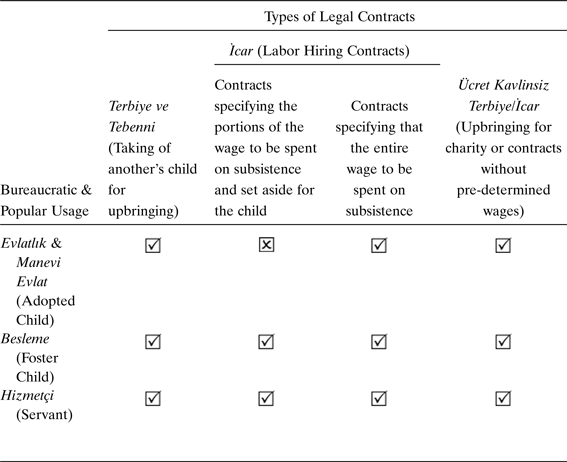
In fact, documents found in the Prime Ministerial Ottoman Archives were drawn up not by legal experts but by ordinary officials, most of whom did not distinguish between children placed with families for upbringing (tebenni edilen çocuk),Footnote 14 wage-earning children employed in domestic services, and children whose entire wage was spent on their subsistence. When referring to these children, state officials saw no harm in using the terms besleme, hizmetçi and evlatlık interchangeably. Table 1 presents the terms used for the diverse legal relations between children and Istanbulite families as reflected in archival documents and newspapers of the period. It shows that the same term was used to denote more than one type of legal contracts between host families and children. For instance, the terms besleme and hizmetçi were employed to define all four types of relations between host households and children. There were possibly various differences between these denominations, which the Istanbulites knew very well but are quite unfamiliar to present-day researchers. Throughout the nineteenth century, Ottoman authorities were presented with matters pertaining to domestic services usually when a major problem between the family and the child or the child's guardians emerged. Thus, studies relying upon Prime Ministerial Ottoman Archives, literary texts and journals have treated the subject rather through tensions involving sexuality and the abuse of girls. The third category of studies has largely focused on the informal relationships between host parents and children. For instance, in his study on Bursa, Abdurrahman Kurt has highlighted the phenomenon of charity-oriented protection of domestic child servants. Consequently, notwithstanding such phenomenon, he has failed to conceptualize the economic relations growing out of domestic services.Footnote 15 A similar problem also applies to the study by Evren Dayar who has discussed labor contracts of children in Antalya.Footnote 16
Bureaucratic-Popular Terms and Types of Legal Contracts between Host Families and Children

Sources: Court Registers of Galata, Davud Paşa, Mahmud Paşa, Üsküdar, Ahi Çelebi and Bab.
Relying mostly on documents of the central bureaucracy, memoirs and newspapers of the late Ottoman period, three types of studies have not discussed labor relations in domestic services within a larger context of Ottoman legal and economic transformations. This study examines the long-term legal and economic metamorphosis of domestic child labor on the basis of domestic service contracts in Islamic court records, focusing on the details of changing informal and formal relationships between children and employing households. In doing so, it is the first attempt to analyze a century-long data set on child labor and domestic services in the Ottoman and Middle-Eastern context.
1. Sources and an Overview of Domestic Services in Istanbul
In addition to the documents kept in the Prime Ministerial Ottoman Archives, the study draws upon the records compiled from the Galata, Davud Paşa, Mahmud Paşa, Üsküdar, Ahi Çelebi and Bab courts of the Ottoman capital. We have examined a total of 1,548 legal cases between host families and children. Of these cases, 152 transpired in the Üsküdar court, 204 in the Mahmud Paşa court, 19 in the Bab court, 155 in the Ahi Çelebi court, 7 in the Galata court and 1,011 in the Davud Paşa court. Not surprisingly, the Davud Paşa court distinguishes itself by both the abundance and continuity of its records, for since the last quarter of the eighteenth century, it established itself as the main court to which most Istanbulites resorted in order to resolve their domestic legal disputes.Footnote 17 Beside Istanbul court records, other registers used in study were retrieved from two Anatolian towns, i.e. Safranbolu and Kastamonu.Footnote 18 Since a considerable portion of the children who were sent to Istanbul for work in the nineteenth century came from Northwestern Anatolia (a region which also encompasses these two towns), registers of these courts contain the records of such children before they set out for the capital. Along with court registers, we also made use of journals and newspapers published in the late nineteenth and early twentieth centuries. Domestic service became a hot topic discussed in these periodicals, particularly in the early years of the twentieth century. Such discussions specifically provide us with crucial insight into the extent of the transformation that took place in domestic services.Footnote 19
Court records used in the study contain information such as the name, age and place of residence or origin of the children as well as the host household's name and location and the conditions of placement for the children. Such records could be broadly categorized into two. The first group involves the court records kept once the child started to live with or work for the host family, and describes the conditions under which the child was taken. The second type of record, on the other hand, includes those kept at the time when the children left the host parents. These documents provide information as to the duration of stay and what the children were given as they bid farewell to their host households. Needless to say, the records used in the study do not cover all the children and youngsters taken for employment and upbringing during the period in question. It is likely that a significant part of the host households or employees as well as their guardians never felt the need to take recourse to a court and commit to writing their relations with the family at any point in their lives. Still, a vast number of contracts that define the relationships between the host families and children found their way into court records.
Works by Boğaç Ergene and Hülya Canbakal show that litigation process and registration of contracts in the Ottoman legal system often, if not always, protected the interests of the wealthy and powerful against the interests of others. Canbakal, for instance, claims that Ottoman courts created an equitable system administrating justice according to everyone's status as prominent people had always more interest to take their affairs to court than ordinary people.Footnote 20 Therefore, although the registration of wage contracts was not compulsory under Ottoman law until the 1880s, the employing Istanbulite households seem to have quite frequently reported their agreement to court in order to prevent any future wage claims of children or their parents. But this does not mean that receiving written documents from courts was only a strategy of employing households to legitimize their actions and made children simply the victims of court registration. In case of disputes over wage payments, such documents also served to protect the children's rights. Therefore the most important aspect of court registration is the institutionalization of domination and subordination embedded in the relationship between child servants and employers. Contract registration indeed formalized and consecrated the asymmetrical relationship between Istanbulite households and children, i.e. child labor exploitation. In fact these contracts formulated according to the concepts of morality, charity and compassion functioned as tools of the symbolic violence. According to Bourdieu, symbolic goods and charitable gifts appeared as ideological machines which perpetuate the unequal balance of power.Footnote 21 By registering ethical and moral obligations of the wage contracts and charitable gifts given to children, employing households were thus able not only to retain their dominance, but also control the mobility of child labor.
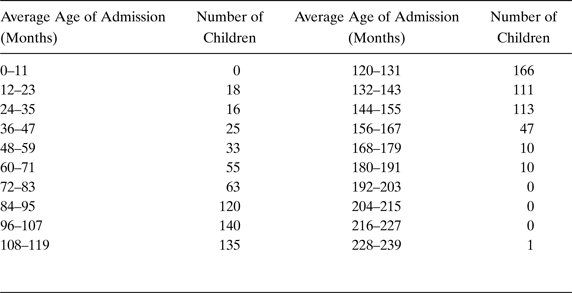
Scribes in Istanbul courts did not always register the ages of children. Of the 1,548 contracts used in this study, 1,063 refer to the ages when children were recruited by Istanbulite families. As Table 2 shows, these children overwhelmingly fell under the age group 7–13. Throughout the nineteenth century, children's average age of admission by Istanbulite households was 8.7, a figure which was 8.8 for girls and 8.2 for boys. Although the average recruitment age appears low, at least to modern eyes, it should not come as a surprise in view of the fact that children in the Ottoman world are known to have worked in various sectors, starting with age 4 to 5.Footnote 22
Children's Average Age of Admission by Istanbulite Households (1800–1900)

Sources: Court Registers of Galata, Davud Paşa, Mahmud Paşa, Üsküdar, Ahi Çelebi and Bab.
In the course of the nineteenth century, children's duration of stay with Istanbulite families was 76 months on average. Although there existed no significant difference between the recruitment ages of boys and girls, the duration of stay was much below the average for boys (50 months). Several factors contributed to the more extended duration of stay for girls, such as the complex relations between host families and girls, attitudes of children's families, and marriage of girls. Particularly the records kept for girls who left their jobs on grounds of marriage provide us with invaluable insight into the socio-demographic structure of nineteenth-century Istanbul. Authorities registered the age of 41 girls who terminated their contracts on account of matrimony, indicating that the average age of marriage throughout the century was around 17. Still, the age of marriage tended to rise for these girls in the course of the nineteenth century. While the average marriage age was 16 for girls employed in Istanbul households in the 1800–1845 period, the figure increased to 17.7 in the second half of the nineteenth century. The figure in question is somewhat lower than the average age of marriage referred to by Duben and Behar, which was 19 as of the year 1885.Footnote 23 However, in their remarks on the increased age of marriage and the declined fertility rate in the late nineteenth century, the authors claim that such demographic transformations might have commenced well in the earlier decades of the century. Such argument is corroborated by the findings of this study. The increased age of marriage for girls employed in domestic services went hand in hand with the changes that took place in the demographic structure of Istanbul throughout the nineteenth century.
Regions of Origin for Children Kept by Istanbul HouseholdsFootnote 24

Istanbul residents recruited children either from the capital itself, or from the regions in the Balkans, Anatolia, the Crimea and the Caucasus, placing them in their homes as live-in servants to perform all kinds of domestic work. Court records explicitly state that children placed with families for upbringing did render domestic services.Footnote 25 Furthermore, certain records specifically made it clear that the guardians granted permission for the employment of the children at the time when they took up residence with the host families.Footnote 26 Yet, the same records do not provide details as to the nature of the housework they did. These children were probably responsible for common domestic chores such as lighting the brazier, drawing water from the well, house cleaning as well as taking care of younger children and running errands in the kitchen.Footnote 27 The service relationship between host parents and children did not always entail working at home, however. Certain court records clearly stipulated that some boys would be employed in shops or specific crafts as long as they remained with the family. As some records reveal, unlike girls, the employment of boys by host families would also require them to work outside home, apart from helping the family with the housework.Footnote 28
Host families did not always get on well with the children and there was no certainty that they would not have a falling out at some point. Hence, arising disputes often found their repercussions in legal cases, resulting in an increase in the number of court records reflecting the relationship between two parties. This study analyzes the transformation of domestic services during the nineteenth century under two periods, i.e. 1800–1845 and 1846–1900. Exerting a deep impact upon the regions of Central Anatolia and the Western Black Sea, the famine of 1845 brought about an influx of scores of Anatolian children into the Ottoman capital.Footnote 29
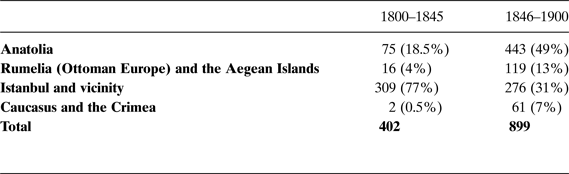
As seen in Table 3, of the 402 children or youngsters for whom we managed to identify the place of origin for the 1800–1845 period, 309 had been living in Istanbul and its vicinity prior to being placed with Istanbulite families. In contrast, following the famine of 1845, there was a considerable decline in the rate of children from Istanbul. For example, of the 55 children reported to the Davud Paşa court with their places of origin during the 1840–1845 period, 45 lived in and around Istanbul, while only 6 of them came from Central and Northwestern Anatolia. On the other hand, in the 1846–48 period, only 6 of the 38 identified children were actually from Istanbul, while 32 children came from Anatolia. In the following years, we also see the same decline in the number of Istanbulite children raised by or working for the families in the capital. An increase in the number of immigrants from the Caucasus and the Crimea is seen in the second half of the 1850s as well as in the 1860s, and following the Russo-Ottoman War of 1877–78 which brought about a flux of Balkan refugees to Istanbul.Footnote 30 As a result, the domestic service sector in the capital came to include more people from other regions in the second half of the century.
Regions of Origin for Children Kept by Istanbul Households in Domestic Services

Sources: Court Registers of Galata, Davud Paşa, Mahmud Paşa, Üsküdar, Ahi Çelebi and Bab.
Children's places of origin shifted from Istanbul and its vicinity towards Anatolia in particular, which had serious repercussions in the socio-legal transformation of domestic services. In the first half of the century, a significant number of the Istanbulite children taken by Istanbulite families were orphans and had no one to take care of them. Families keeping these children probably knew well the agents who introduced them. In such cases, host families would accept such children based on contracts without pre-determined wages (ücret kavlinsiz). Therefore, the family's close circle would be well aware of the reason for keeping children and the legal status of these children. In contrast, for the children coming from outside the capital in the period of 1800–1845, their legal status required further explanation as they were known to no one. For instance, of the 532 court records illustrating the service relationship between the contractors and children or their custodians in the 1800–1845 period, 188 (approx. 35%) defined relationships based on contracts without pre-determined wages. This meant that the family was supposed to feed and look after the child, but there was no certain amount of subsistence money specified at the time of contract. Moreover, no fee was determined in return for the child's services. However, of the 93 children or youngsters coming from outside the capital, only 11 (approx. 12%) had established contractual relationships without pre-determined wages. The increase in the number of children arriving in Istanbul in the aftermath of the Anatolian famine of 1845 undoubtedly created a greater need to identify the legal status of such children. Indeed, the Anatolian famine of 1845 constitutes a crucial occurrence, and provides the breaking point for our periodization.
According to this periodization, we have identified 532 children or youngsters living with Istanbulite families in the 1800–1845 period, whose terms of placement were recorded in courts of law. For the subsequent 1846–1900 period we used a total of 1,016 court records. Of the 532 children or youngsters included in the data set for the first period, only 92 (approx. 17%) are boys. On the other hand, of the 1,016 children or youngsters concluding contracts for domestic services in the 1846–1900 period, 149 (approx. 15%) are male. It should be here noted that girls were more likely to be engaged by way of a written contract than boys due to the sociocultural cultural concerns of the host families and guardians to protect the “girls’ honor.” Despite underrepresentation of boys in our data set, however, it seems that the female predominance in domestic services had already been the case in the early 1800s and continued to grow in the course of the century. As a matter of fact, journals and magazines circulating in the late nineteenth and early twentieth centuries manifestly demonstrate that domestic services were now a female-labor-intensive sector.Footnote 31 This constituted the sexual division of labor within the child labor market where Istanbulite families ascribed specific roles and labor activities to children on the grounds of their sex. Although the migration of girls from Anatolia to work in Istanbul houses challenged the idea of women's and girls’ domesticity, it ironically strengthened the sexual division of labor in employing households and reproduced, in new forms, the gendered hierarchies in the labor market.
2. Child Labor entangled with Charity and Economic Relations: 1800–1845
In April 1836, Fatma bint (daughter of) Elhac Mehmed applied to the Davud Paşa court to register her leave from her employer's house. Defined by the records as mürahika, i.e. an individual who has not yet reached puberty, Fatma had worked for a total of 16 months in the house of a certain Zeliha bint (daughter of) Halil. According to the contract between the two, Fatma was to be paid a sum of 12.5 guruş Footnote 32 per month in return for her services. Yet, this total wage was clearly divided into two parts. It had been predetermined at the start of employment that a monthly sum of 10 guruş was to be spent as subsistence money (nafaka) on the girl's food and upkeep expenses throughout her stay. So, Fatma was supposed to receive a monthly wage of 2.5 guruş excluding her subsistence money. Indeed, when the time came to part ways, she was paid in cash by Zeliha her wage for 16 months amounting to a total of 40 guruş.Footnote 33 The agreement between Fatma and Zeliha was a labor contract in all respects, and was designated in records with the term icar, meaning labor hiring. Such type of icar contracts would specify a monthly wage for children, which was followed by a clear explanation on how much would be spent on subsistence. The residual sum after the deduction of the subsistence money was saved, to be paid to the child later upon departure. In fact, the relationship between the above-mention Fatma and Zeliha was strictly defined in economic terms, which was an exceptional case for the 1800–1845 period. Our data set contains a total of 532 records kept by the Istanbul court during the period in question. In 86 of these records, i.e. only about 16% of the recorded service relationships, the total wage for the employed children was predetermined as was in the case of Fatma and Zeliha, with the wage consisting of two parts, i.e. subsistence money and a certain sum separately set aside.
During the first half of the nineteenth century, the contracts that clearly specified the proportions to be spent on subsistence and to be saved for future payment were, in practice, influenced by ‘personal relations’ and ‘charity’. For the period up to 1845, we have identified a total of 32 records kept at the time of leave for children with predetermined wages consisting of two parts. Only in 14 of these cases, the children were paid their wages in cash as was laid down in their written or verbal contracts. In 17 of these 32 cases, they received both cash and articles.Footnote 34 For example, a 13-year-old Ayşe bint (daughter of) Abdullah had lived for 25 months in the home of Şerife Kamile bint Seyyid Ali Rıza and her husband Yorgancı (quilt-maker) Mehmed Salih Ağa bin Yusuf. Ayşe's monthly wage amounted to 15 guruş in total. 10 guruş had been arranged to be spent on her daily food and upkeeping expenses, while the residual 5 guruş was set aside for being paid later on. They seemingly got on well, because Ayşe received ‘gifts’ from the family in addition to her wage payment amounting to a total of 125 guruş.Footnote 35 Cevriye bint (daughter of) Abdullah was another girl who managed to build ‘good relations’ with her host families. The 20-year-old girl had served Fatma bint Abdullah for 5 years according to her wage contract. A monthly wage of 5 guruş excluding board and lodging had been agreed for Cevriye, who probably left the job when she got married. At the time of her leave, she was not only paid her wage of 300 guruş, but was also given by Fatma some articles as dowry.Footnote 36 As is clear from these examples of the period, personal relations definitely mattered even in wage contracts entailing explicit economic terms. This is also evident from the wording of wage contracts. Beside the purpose of performing housework, many records justified children's placement with host families using terms such as ‘learning good manners’ (terbiye ve edeb almak) and ‘food and clothing provided by the family’.Footnote 37 Such terms were not random: In fact, it demonstrated that wage contracts, even those with predetermined wages, involved moral and ethical obligations.
Shaped by moral discourses and defining specific fees paid in cash or in kind, wage contracts with subsistence and reserve money involved some degree of certainty for both parties. Thus, both children and their guardians on one side, and host families on the other, had written documents as proof or could also produce witnesses if the contract was based on verbal agreement. In case of disputes, such documents and witnesses served to protect the children's rights. If things went well between both parties, the children received ‘gifts’ from the host families. However, failing this or even when the contract had to be terminated, the children's predetermined wages were thus secured. For instance, Ali Rıfat and İnekçi (cattle dealer) Mehmed bin (son of) Mustafa had to dissolve their wage contract in 1828. The contract between the two parties stipulated that he was to be paid a monthly wage of 10 guruş, of which 8 guruş would be spent on his subsistence, with the remaining 2 guruş to be paid to the child. As the contract involved a certain sum of subsistence out of the wage, Ali Rıfat had received from Mehmed his 11-month wage in its entirety, which amounted to 22 guruş.Footnote 38
Yet, not all wage contracts provided that a part of the wage would be reserved for subsistence purposes. For the 1800–1845 period, there exist a total of 258 court records containing wage contracts which required that the entire wage be spent on subsistence. This figure corresponds to about 48% of all service relations registered for the period in question. To illustrate, the employment relationship between Emine bint Abdullah and Ayşe bint Mehmed was based on such a wage contract. Having worked for 10 years in Ayşe's house, Emine quit the job in 1829, describing herself as an individual serving in return for wage (‘ücret ile hizmet eder makulesinden’). The arrangement between two parties called for reserving the entire wage for subsistence. Indeed, her whole wage of 6 guruş a month was spent on her subsistence and clothing expenses (nafaka ve kisve baha). According to her contract, the employer had no obligation to make any payment to Emine when she left the job. Yet, ‘taking pity’ of her poverty, Ayşe gave her valuable articles and jewelry. The diamond earrings and brooches she received on her leave alone cost almost 600 guruş. Not leaving it at this, Ayşe also donated to her other articles and clothing such as trousers (şalvar), towels, kerchiefs (yemeni), shawls and spoons worth 1000 guruş in total.Footnote 39 Ayşe's ‘generosity’ was indeed remarkable, but in the first half of the nineteenth century many other people like Ayşe also donated (teberru‘en vermek) various articles and clothing to their servants even though they had not agreed to do so under wage contracts.Footnote 40
Still, such examples do not remove the uncertainty in cases when the entire wage was to be spent on subsistence as required by wage contracts. Such contractual requirements left the child or youngster's payment open to negotiation and legal maneuvering by the parties in court at the expiration of the service period. As far as this type of wage contract is concerned, children and their custodians could always claim that the value of the service rendered exceeded that of subsistence. This is exemplified by the case of Müftüoğlu İbrahim, father of 12-year-old Ayşe, and Halide, who employed Ayşe. Applying to the Davud Paşa court in 1830, the father, as the guardian of his daughter, claimed Ayşe's rights arising from her services. In his statement, İbrahim explained that as he was poor he had to hire out to Halide his daughter's services before she reached puberty. İbrahim and Halide had agreed that Ayşe was to serve Halide, for which she would receive a wage of 6 guruş. According to the wage contract, Ayşe worked for a total of 24 months in Halide's house and then left the job. The father was asking for a sum of 144 guruş as payment for her two-year services. However, apart from subsistence, there was no extra sum involved in the wage at the time of her recruitment, a fact which he also acknowledged. At the very outset of the contract it had already been agreed to spend her entire wage on her subsistence. Upon his recognition of the fact, the court dismissed İbrahim's wage claim.Footnote 41 He was quite aware of the terms of his daughter's employment, but it seems he wanted to take his chance in the court.
In fact, there was no surprise in such attempt, for İbrahim possibly believed that his daughter's services were worth far more than the subsistence she was paid. He had many examples before him that made him think so. It was probably why he thought that asking for payment would mean obtaining some money from the family. The wage contract of Ayşe, daughter of İbrahim, was in many ways similar to that of the 16-year-old Hadice bint (daughter of) Halil. Hadice had worked for Şerife Emine for 30 months, and just like Ayşe she was to receive a monthly subsistence money of 6 guruş as per her wage contract. However, Hadice was given certain goods and articles as ecr-i misl when she left the job.Footnote 42 The term ecr-i misl in labor market means fair recompense for work or service based on the average earnings of an average employee of the same employment. Shaped by Islamic principles of economic justice, the term ecr-i misl was indeed used in land, labor, credit, and commodity markets to refer to the “average, reasonable and fair” rents, prices or wages across the Ottoman lands.Footnote 43 In spite of all the rhetoric about fairness in Islamic law, there was no clear consensus on how to calculate a fair value. In other words, the fair price of not only commodities but also wages, profits and rents could be either higher or lower than the prevailing market rates.Footnote 44 That is why the term ecr-i misl perfectly reflects both the presence of an active market for child laborFootnote 45 and the ambiguity in wage contracts where subsistence money was not specified as a certain portion of the wage.
In the 1800–1845 period, authorities kept a total of 90 service termination records mentioning that the children were paid their ecr-i misl either in kind or in cash or both. However, most of these records do not refer the exact amount of ecr-i misl. In 28 records of these contracts which clearly specified the amount of ecr-i misl paid, the average ecr-i misl was about 13 guruş a month. Yet, among the court files only 4 records spell out an approximate ecr-i misl of 13 guruş a month, while ecr-i misl is given as 1 to 5 guruş a month in 10 records, 5 to 8 guruş in 7 records, and in some cases it even went as high as 60 guruş a month. Under such circumstances with variable pricing, ecr-i misl was obviously based on negotiation between the family, the child and the custodian. It was probably for this very reason that the above-mentioned Müftüoğlu İbrahim tried to take advantage of the uncertainty around the exact amount of ecr-i misl, or the availability of negotiation. He most likely thought that he could at least procure some goods from Halide Hanım. He was not wrong in thinking so, because as they left the job, children usually received goods instead of cash according to wage contracts by which the entire wage was paid as subsistence. Our data set contains 37 records that specified the method of payment at the end of contracts and reserved the entire wage to subsistence. They received goods and cash in 6 records, and only goods in 26 cases at the time of job termination.
Despite or because of its ambiguity, ecr-i misl was used extensively in written or verbal agreements other than wage contracts regulating the family-child relationship in the early nineteenth century. As a matter of fact, the study data set includes a total of 188 non-hiring service contracts without predetermined wage during the 1800–1845 period, making up around 35% of all registered service relationships in the same period. Most characteristically, this type of agreement sets the conditions under which the child was raised and served, without mentioning any kind of fee whatsoever. Compared to wage contracts, such agreements without specified wages or subsistence money were rather formulated according to the concepts of morality, ‘charity and compassion’. Yet, just as wage contracts are inseparable from the concepts of moral economy, contracts without predetermined wages were not far from being mingled with economic interests either. This is clearly exemplified by the wording in the court records documenting the relationship between Hanife bint İbrahim and Fatma bint Mustafa. In this record of the Davud Paşa court of the year 1831, Hanife stated that Fatma had accepted her to her service, feeding and clothing her ‘out of compassion’ (merhameten). In the face of such magnanimity, Hanife served in Fatma's house without having established any wage. Although she avoided explaining their relationship with reference to economic terms, Hanife implied that her service had an ecr-i misl or monetary value. In the end, Hanife received garments such as a cloak (ferace) and baggy trousers (şalvar).Footnote 46 Again, when Seyyid Halil entrusted his 2-year-old son İbrahim to Molla Ömer and recorded this act in the court of Üsküdar, the combination of economic and moral concerns was explicitly noted. Halil stated that İbrahim's mother Ayşe had deceased, leaving no one behind to take care of him. As he was incapable of raising his son himself, Halil delivered him to Molla Ömer, a ‘charitable man’, to provide for his feeding, clothing and upbringing. It is hard to argue that Molla Ömer's relationship with the 2-year-old İbrahim had an economic motivation at this point. Still, like other children, İbrahim would help Molla Ömer and his family with chores once he was old enough to do so. However, when he grew up, he might possibly forget about this charitable act and ask for a service fee. Apparently, both Molla Ömer and Halil had this concern in mind, for Halil specifically asked the court officials to put the following statement in record: ‘Should my child grow up to ask Molla İbrahim for any money, then I hereby guarantee this wage contract without any predetermined wage’.Footnote 47 Such statement was obviously added to relieve Molla Ömer of any concern, preventing any future wage claims on the part of the child.
As in all other examples, it would be İbrahim's personal ties to Molla Ömer's family which would shape his status after he was old enough to help with the chores. In some cases, the child's service might require an ecr-i misl; however, in others, the child might as well say: ‘The family has raised and looked after me all this time in return for my wage’. Ümmügülsüm, for instance, chose the second path. She lived with and served Fatma Hanım for three years. Acknowledging the fact that she had been raised by Fatma, she renounced her entire ecr-i misl claim. This choice by Ümmügülsüm was surprising, because children taken by host families would rarely give up on their ecr-i misl. Probably she was unwilling to jeopardize her ‘good relations’ with the family. For in the court record this statement is immediately followed by a wage contract with much more definite terms between Ümmügülsüm and Fatma Hanım, where the amount of subsistence for the former was clearly indicated.Footnote 48 Throughout the 1800–1845 period, we see only 12 records in which the child appreciates the family's efforts and relinquishes his/her ecr-i misl in return. Yet, in 10 of these records the children's renouncement statements were immediately followed by wage contracts concluded with the same families but with clearly identified monthly wages. Such a high rate cannot be coincidental: The children probably gave up their ecr-i misl provided that a new contract be drawn up.
3. Moral Aspects of Service Relations and Evolution of Domestic Services into an Economic Sector: 1846–1900
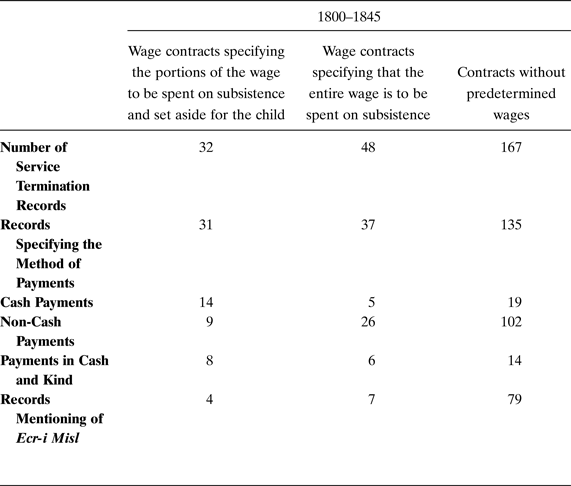
The economic and legal aspects of the relations between host parents and children would undergo a significant transformation in the post-1845 period. However, such metamorphosis did not imply that the moral elements of these relations ceased to exist. On the contrary, the strong emphasis on the ‘charity’ in these relations observed in the 1800–1845 period continued well into the 1900s. During the 1800–1845 period, children often received ‘gifts’ from the families who kept them on the basis of contracts without predetermined wages so as long as they remained on ‘good terms’. According to a record of Üsküdar court dated 1802, Emine binti İsmail had worked for Fatma for a total period of eight years. Fatma not only provided for her feeding and clothing, but also taught her the art of embroidery. In return, Emine relinquished her claim for ecr-i misl. But still, Fatma gifted her goods and articles such as a blanket, pillow, mattress (minder), towel, waistband (uçgur), coffee cups and a coffee tray.Footnote 49 All such service relations without predetermined wages, such as seen in Emine and Fatma's case above, involved ecr-i misl and the transfer of property such as ‘gifts’; yet, they were far from being monetized when compared to wage contracts. As shown in Table 4, in the 1800–1845 period, authorities kept a total of 167 records which specified the method of payments at the service termination for children employed on contracts without predetermined wages. Of the records in question, 135 report the type of payments made to the children as they left the host families; and in only 19 of them (approx. 14%) the children were simply paid in cash. In 14 cases (approx. 10%), on the other hand, the children received both cash and articles. As for the remaining 102 records (amounting to around 76% of all cases), the children were delivered only articles. One reason why children were paid in kind rather than in cash was girls leaving their host families to get married were in general paid in kind rather than in cash.
Method of Payments in Service Termination Records (1800–45)

Sources: Court Registers of Galata, Davud Paşa, Mahmud Paşa, Üsküdar, Ahi Çelebi and Bab.
In the Ottoman capital of the nineteenth and early twentieth centuries, host households were expected to marry off their maid servants at the end of their employment term. In the first half of the nineteenth century, particularly in the context of service relations based on contracts without predetermined wages, a substantial number of records explicitly stated that the girls left their host families when they got married. That is why many records specifically mention that the girls were paid their ecr-i misl in kind or their ecr-i misl was spent on their dowry. During the 1800–1845 period, girls leaving their host houses for marriage were mostly recorded with reference to service relations without predetermined wages. The extra-economic relations that girls established with host parents on the basis of contracts without predetermined wages survived extensively into the second half of the century. After 1845 a majority of the girls who left their host families on grounds of marriage similarly appear in the records pertaining to contracts without predetermined wages. Our data set contains 64 girls who quit their host families for marriage after 1845, 48 of whom had been kept without predetermined wages. All these girls received valuable trousseaus from their host parents, sometimes in return for their ecr-i misl, and sometimes out of compassion by the family. For instance, a certain Şerife Dilber of 17 years of age had worked in the house of an Istanbulite family for a total of 6 years. Similar to the earlier examples of the century, she was fed and raised by the family and performed various housework in return. When she left the family, she not only received an ecr-i misl of 720 guruş, but was also granted a dowry containing valuable items.Footnote 50
In the second half of the century, the practice of ‘receiving gifts’ from employing families was quite common, even among children working on wage contracts of a highly economic character, in which a certain sum was to be reserved for the children's subsistence. Out of 33 children who were donated articles by benevolent families during the 1846–1900 period, 17 had been employed on wage contracts stipulating an additional sum to be paid alongside their subsistence money. Despite the emergence of economic relations with standardized terms between children and employing households, interpersonal relations retained their importance throughout the century. In fact, compared to the 1800–1845 period, the subsequent period witnessed a slight increase in the number of children who received ‘gifts’ from their employers as they left. 21 children or youngsters received ‘gifts’ from their employers out of a total of 247 cases with records of job termination during the 1800–1845 period, while 33 children out of 240 were presented with gifts in the 1846–1900 period.
Even a brief glance at the Ottoman magazines and newspapers generally published for wealthy and middleclass Muslim women in the late nineteenth and early twentieth centuries would clearly reveal the emphasis on the economic relations between servants and employing families, intermingled with notions of ‘charity’ and ‘benevolence’. For example, a certain Mehmed Nureddin of Istanbul authored an article titled Hizmetçiler (Servants) in the early twentieth century, a time when periodicals provided abundant coverage on domestic servants. In this article he makes the following point: ‘If we were to establish a school for servants, the innocent and pure girls of Anatolia would make very good servants’.Footnote 51 Apparently, Mehmed Nureddin did not consider young Anatolian girls—commonly called beslemes—as servants in the full sense of the word. In his view, besleme girls had to be ‘trained’ to become proper servants. On one hand, newspapers advised Muslim women employing maid servants in their homes to cherish ‘good relations’ with those girls and win their hearts. On the other hand, the same newspapers cautioned against spoiling these servants, recommending that family-servant relations should be centered upon the employer-employee hierarchy. Reminding ladies of who the real boss was at home, other articles about maid servants advised them to exert their authority over the girls. The most striking of this kind of advice was that a servant is in fact ‘a tool for service’. In brief, such articles commenting on domestic employees of the period embedded the notion of ‘charity’ within the hierarchical economic relations.Footnote 52
In the second half of the nineteenth century, along with the continuity of moral elements in children-family relations, the domestic service sector also underwent important breaks and dramatic changes in the economic sense. The first remarkable change in the sector was the ever-increasing monetization of payments. Of the 247 service termination records belonging to the 1800–1845 period, only 38 (approx. 15%) refers to servants who received payment in cash. During the period in question, employees were, for the most part, paid in kind (i.e. goods or clothes) at the end of the service term. In the data set pertaining to the 1846–1900 period, there are a total of 240 records about job termination, 59 of which involve servants paid in kind, amounting to around 25% of all cases. In 152 records in total (approx. 63%), the host families paid their former servants in cash. It is a well-known phenomenon that the ongoing monetization and commercialization processes in economic relations in the Ottoman Empire gained a new momentum particularly after the 1840s.Footnote 53 It appears that the domestic service sector was not left out of this trend either, with very rapid monetization especially during the second half of the century. This extensive monetization went hand in hand with a major transformation in the legal ties of servant children and youth with their employer families.
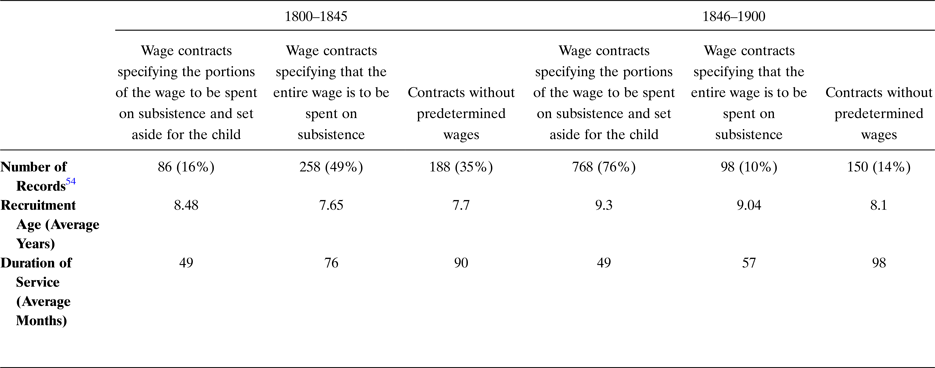
As is clear from Table 5, a very small portion of servant children working in Istanbul in the first half of the century were tied to the employing families through wage contracts with clear-cut terms whereby payments included both subsistence money and an additional sum for the child. These contracts made up only 16% of all contracts identified for the 1800–1845 period. As per about 49% of the wage contracts of the period, the wage determined prior to recruitment was to be entirely spent on subsistence.
Distribution of the Types of Child-Family Contracts in Nineteenth-Century Istanbul

Sources: Court Registers of Galata, Davud Paşa, Mahmud Paşa, Üsküdar, Ahi Çelebi and Bab.
Children or youngsters working on contracts without predetermined wages made up 35% of all service contracts in the 1800–1845 period, and legal terms of these contracts often implied a great deal of uncertainty. In the second half of the century, on the other hand, a massive standardization is observed in children's legal relations with host families.
The wage portions of domestic servants to be spent on subsistence were determined at the very outset of their service term, and can be viewed as the most important stage toward such standardization. While they were not very common in the domestic service sector in the early years of the century, these wage contracts came to make up 76% of all service contracts concluded after 1845. In the second half of the nineteenth century, there was also a parallel decline in the number of wage contracts containing a degree of legal vagueness which prescribed spending the entire wage on subsistence. These transformations may be related to a stronger social perception that domestic services performed by children had a current market price.
This is well illustrated by a wage record dated 1893 from the Safranbolu court regarding a 10-year-old named Asiye. With a monthly wage of 50 guruş, her father Mahmudoğlu Mustafa bin İbrahim sent her to work for Şefika bint Abdurrahman, mother of Osman Pasha, Commander of the Tripolitanian Army. The agreement prescribed that 30 guruş be spent on the child's subsistence, with the residual amount to be saved for her future payment. Yet, the wealthy Istanbulite family employing Asiye would later raise an objection against the contract. The family contended that a monthly wage of 50 guruş was far more than precedent examples, and thus certainly had to be brought down. The family's claim was eventually deemed justified, with the monthly fee being reduced to 30 guruş. 25 guruş of this sum was to be spent on the child's subsistence; this was the value assigned to her feeding and clothing expenses. After spending a large portion of the wage on her subsistence, the family would save for the child an extra monthly fee of 5 guruş.Footnote 55 In this case, the family expressed concerns about the high price by citing precedent examples within the city,Footnote 56 which attests to the fact that a standard wage had already been established for child labor in Istanbul by the end of the study period.
Table 5 also shows that as non-wage contracts were formulated along the charitable principles, children often ended up being kept at a relatively early age compared to those working on wage contracts involving predetermined subsistence and reserve money. Recent studies have remarked that child labor was extensively used in the Ottoman world particularly during the nineteenth and early twentieth centuries. However, these studies are not based on long-term child labor, but rather draw upon consular reports, newspaper coverage, traveler accounts and the findings of the American research team in the 1920s. Thus, there is still a lack of precise data concerning the age of employment for children in the Ottoman society. Still, certain remarks and observations in these papers provide researchers with valuable information about children. For instance, Ulrich Jasper Seetzen, a German physician of the early nineteenth century, notes that children worked in the textile industry starting from the age of four. Similarly, the Hungarian scholar and researcher Béla Horvath reports that there were children of seven to eight years of age working in the textile industry in early twentieth-century Anatolia, while Hogop Mintzuri makes mention of late Ottoman children beginning to work at the age of eight. According to some reports published in Tuna, i.e. the official newspaper of the vilâyet of Tuna (Danubian Province), the ıslahhane (reformatory) of Niš housed seven-year-old children who were employed in clothing and sewing tasks. Hence, these remarks and observations generally seem consistent with the age of employment for children in domestic services.Footnote 57
Natal household would often give out their children for fosterage or employment out of ‘necessity’, and the children's contribution to housework usually went hand in hand with their upbringing. As a result, most non-wage contracts registered in the 1800–45 period report an average recruitment age of 7.7 years, followed by long stays with host families. As for the children employed by families on wage contracts involving predetermined subsistence and reserve money, they served for almost half the duration of their counterparts working on non-wage contracts. With their labor rather than their upbringing brought to the foreground, these children usually stayed with the contractors for about a period of 4 years, at the end of which they left service. After 1845 there was no remarkable change in service durations for children tied to contractors through wage contracts involving subsistence and additional reserve money. Yet, in this category, the age of recruitment was extended for almost one year. On the other hand, during the second sub-period, children placed with host families without wage contracts became older than their counterparts at the beginning of the century. The duration of child's stay at host families did not decline in family-child relations shaped by non-wage contracts. More importantly, in the second half of the nineteenth century, children came to stay with host families for much shorter periods in case they were employed on contracts specifying that the wage was to be spent fully on subsistence.
As the share of wage contracts with subsistence and reserve money dramatically increased in the domestic market, the short service durations among children became a remarkable phenomenon in the late nineteenth century. In an article published in the Kadın (Woman) journal in 1911, the aforementioned Mehmed Nureddin Bey complained that girls recruited as maid servants now did not stay long with their employers.Footnote 58 Likewise, another article by F. Samiha published in the Kadınlar Dünyası (Women's World) journal emphasized the fact that servants didn't want to stay in their jobs long, and thus, employing families should treat them well to retain them.Footnote 59 Without doubt, the increased turnover rate and mobility among domestic child laborers had a lot to do with the new circumstances in which labor was now a sector assessed according to market conditions. Two general trends emerged in the second half of the nineteenth century: First, child labor was now legally recorded with specific mention of the value of labor vis-à-vis subsistence expenses. Second, there was now an accepted rate of child labor in Istanbul market. In case of wage contracts reserving a portion of the wage for subsistence, court records clarified children's rights and wages were determined according to market conditions. Children might receive certain ‘gifts’ if they had ‘good relations’ with contractors, but such favors depended on the ‘good will of employing families’ and were never mentioned in the original recruitment contract. Such character of family-child agreements during the latter half of the nineteenth century clearly indicated that child labor now had transformed into “wage labor” in the service sector. The last round in the evolution of children's domestic services into a salaried sector took place at the turn of the twentieth century. The first attempt to set up commercial agencies in the imperial capital came after the 1908 Revolution in order to provide employing families with servants and job-seeking girls with jobs.Footnote 60 Consequently, domestic child laborers would be regarded as salaried servants in the full sense of the term.
Conclusion
A long-term project being conducted at the IISH: The Global Collaboratory on the History of Labour Relations, 1500–2000 has recently developed a taxonomy of labor relations, based on four large categories: the non-working population, reciprocal, tributary, and commodified labor.Footnote 61 According to this categorization, most of the children who lived with or worked for the host Istanbulite families during the 1800–45 period could be classified as non-kin servants performing reciprocal labor. Domestic service sector in Istanbul after 1845, however, witnessed a rapid transformation of labor relations implying a shift from reciprocal to commodified labor. In addition to a relatively economic taxonomy of labor relations, the Global Collaboratory has offered a perspective which seeks to contextualize labor as a product of the total cultural fabric.Footnote 62 In this regard, analyzing labor relations in the domestic service sector also provides us with crucial insight into the impact of sociocultural values and legal norms on the workings of labor market.
In the first half of the nineteenth century, contracts drawn up for children living with Istanbulite families appeared to be motivated by the notions of ‘charity’ and ‘compassion’. Children were placed with employing families at early ages (earlier than it would be in the late nineteenth century), growing up there to serve within doors for a long period. In return for their service they were often granted articles as dowry or ‘gifts’. By contrast, a limited number of children worked in Istanbul houses on the basis of wage contracts (icar) requiring an extra payment beside the subsistence money. Such children were employed for much shorter periods. In between these two categories was the service contract designated as icar, i.e. based on hiring out the labor of the child but reserving the entire wage for subsistence, which regulated many children's relationships with host families. In the first half of the century, conditions for the relations between host families and servant children were not documented in legal terms. Thus, service relations were, for the most part, based on negotiation. In the second half of the century, however, service relations where subsistence money made up only a portion of the wage now became a norm for children and employing families in Istanbul. Towards the turn of the century, wage contracts without predetermined wages where fees only consisted of the subsistence money gradually dwindled away. All such transformation meant that the domestic services sector in the Ottoman capital was now being gradually governed by legal contracts that tied the hiring-out of labor to specific conditions. Ruling that the total wage would comprise of subsistence money and extra payment, both of which were to be determined right before recruitment, these contracts gradually led to the crystallization of the legal status of child labor in the course of the century. This process of the socio-legal transformation in family-child relations also went hand in hand with the monetization of domestic services. In the first half of the century, wages for domestic services were usually paid in kind. Towards the end of the century, in contrast, children for the most part received their payment in cash. By the second half of the century, wages earned from domestic services were now increasingly determined in the labor market. So it seems clear that as other sectors in Ottoman economy, domestic service sector was deeply shaped by the trends toward market economy and monetization throughout the nineteenth century. From this perspective, the changes in domestic services in the Ottoman capital paralleled those in other parts of Eurasia where the spread of domestic wage labor was accompanied by legal and economic changes.Footnote 63
Nonetheless, these economic-legal changes giving shape to the service sector throughout the nineteenth century did not inhibit the continuity of certain elements pertaining to the socio-legal aspect of domestic services. Moral elements and discourses representing family-child relations in the early 1800s survived to the end of the century. Putting it differently, as a result of the economization of family-child relations, discourses such as ‘compassion cultivated by host families towards children’ and ‘nurturing and upbringing responsibilities’ did not entirely cease to exist by the end of the nineteenth century. Domestic servant girls continued to receive ‘gifts’ from employing families when quitting the job, while these families in turn maintained the custom of preparing trousseaus. While domestic services evolved into an economic sector, ‘charity’ as a traditional phenomenon still survived in employer-employee relations. The continuity of moral elements in children-family relations provides glimpses into the nature of wage labor with the advent of capitalist development in Ottoman and Middle Eastern contexts. As revealed by recent studies, the attempt on the part of workers to sustain traditional artisanal relations and patronage policies in the nineteenth and early twentieth centuries was actually a defense strategy formulated to withstand mechanization and competition of European commodities.Footnote 64 By contrast, however, domestic services sector was exposed to neither the spread of factory-based production nor European competition. Still, the sector's transformation embodied in itself the market dynamics as well as the persistence of cultural values associated with the economy. Thus, it was for this very reason that the then-ongoing indigenous capitalist development since the eighteenth century followed a course which also involved “the silent or less visible segments” of the society.Footnote 65
In fact, changes and continuities in the character of domestic services provide very important clues for conceptualizing the nineteenth-century Ottoman legal transformations. Recent studies have also revealed that the Ottoman socio-legal modernization did not actually mean the complete elimination of Islamic law or Ottoman legal structures inherited from the early modern period.Footnote 66 On the contrary, along with the continuity of these early modern legal elements, such modernization also involved standardization, centralization and rationalization in the legal sphere as well as bringing social relations under control. Accordingly, family-child relations in domestic services in Ottoman Istanbul which had formerly been considered rather as a part of private domain now turned into recorded legal agreements. Parallel to this development, these agreements came increasingly under government control as a result of the expansion of the legal sphere. In fact, taking shape through such socio-legal continuity and discontinuity during the nineteenth century, this course of development whereby domestic services were transformed into a salaried sector was accompanied by the process of recording such regulative contracts at ‘traditional and religious’ sharia courts.